If your teeth look dull or have stains from coffee, tea, red wine, tobacco, or other dark-colored foods and drinks, a whitening toothpaste can help improve their appearance. But not every whitening toothpaste works in the same way, and most are better at removing surface stains than changing the natural color of the tooth.
The American Dental Association (ADA) explains that whitening toothpastes primarily use abrasives to mechanically remove extrinsic, or surface, stains. Some formulas also contain low levels of peroxide that may contribute to lightening tooth color. (American Dental Association)
That distinction matters when choosing a product. If your main concern is coffee staining, you may want a toothpaste focused on stain removal. If you have sensitive teeth, you may need to give greater weight to sensitivity control and comfortable daily use. And if your teeth have deeper internal discoloration, a whitening toothpaste may not provide the change you expect.
This guide explains how whitening toothpaste works, which ingredients matter, how to compare products, what to look for if you have sensitive teeth, and when a toothpaste is unlikely to be enough.
What Is the Best Whitening Toothpaste?
There is no single whitening toothpaste that is the right choice for everyone. The better question is: Which toothpaste matches the type of staining you have, your sensitivity level, and your everyday oral-care needs?
For most shoppers, the important factors are:
- Surface-stain removal: Whitening toothpaste should be useful for extrinsic stains that sit on or near the tooth surface.
- Fluoride: If cavity prevention is also a priority, look for a fluoride toothpaste. ADA-accepted toothpastes making a cavity-protection claim contain fluoride. (American Dental Association)
- Sensitivity considerations: Whitening can sometimes cause temporary tooth sensitivity or gum irritation, so sensitive teeth should influence your product choice. (American Dental Association)
- Ingredient transparency: You should be able to identify the active ingredients and understand what the formula is designed to do.
- Evidence or recognized standards: An ADA Seal can provide an additional signal that a product has submitted information supporting its safety and effectiveness for the relevant claim. (American Dental Association)
- Daily comfort: A toothpaste is only useful as part of your routine if its flavor, texture, and cleaning feel are comfortable enough for regular use.
Whitening toothpaste is not the same as professional bleaching
This is one of the most important distinctions when shopping.
Whitening toothpaste mainly works by removing external stains through brushing. Professional and many over-the-counter bleaching treatments use peroxide-based chemistry to change the appearance of stains within the tooth. The ADA identifies hydrogen peroxide and carbamide peroxide as common bleaching ingredients. (American Dental Association)
So if you want a toothpaste for everyday stain maintenance, a whitening formula may make sense. If you want a substantial change in the underlying shade of your teeth, toothpaste alone may not produce the result you are expecting.
How Does Whitening Toothpaste Work?
Most whitening toothpastes do not whiten teeth in exactly the same way as a bleaching treatment.
Surface stains vs. deeper discoloration
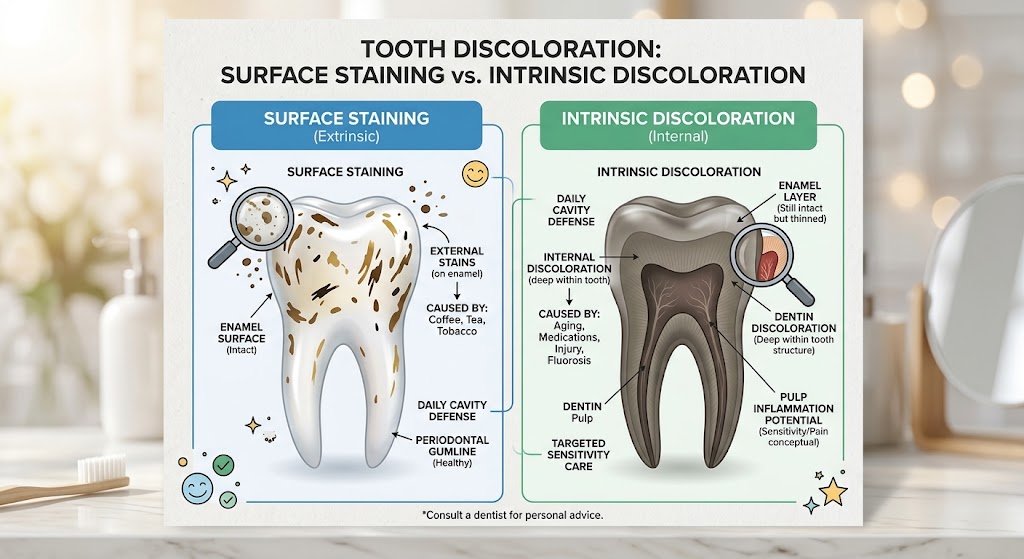
Tooth discoloration can be broadly divided into extrinsic and intrinsic staining.
Extrinsic stains develop on the outside of the tooth and are commonly associated with things such as coffee, tea, red wine, tobacco, and other pigmented foods or beverages. These stains can often be reduced through mechanical cleaning, including brushing with a whitening toothpaste. (American Dental Association)
Intrinsic discoloration occurs within the tooth structure. Aging, certain developmental conditions, some medications, fluorosis, trauma, and other factors can contribute to this type of discoloration. Whitening toothpaste generally has much less ability to change intrinsic tooth color. (American Dental Association)
This gives you a useful starting point:
| Your main concern | What a whitening toothpaste may do |
| Coffee or tea stains | Help remove surface staining |
| Surface discoloration from tobacco | Help reduce some external stains |
| Dull-looking enamel from accumulated stains | Improve the appearance of the tooth surface |
| Naturally darker tooth color | Usually limited effect |
| Deep internal discoloration | Usually not the right tool by itself |
| Existing crowns, veneers, or fillings | Does not whiten the restoration itself |
The ADA notes that whitening procedures can whiten natural teeth, but tooth-colored restorations do not respond in the same way. (American Dental Association)
The role of abrasives
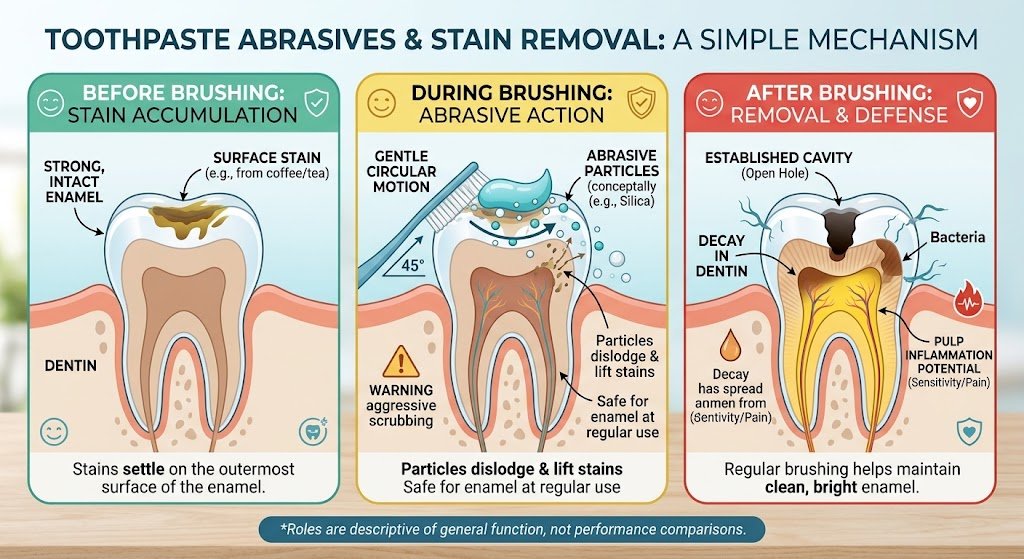
Abrasives are an important part of many whitening toothpastes. They help physically remove deposits and surface stains during brushing.
Common toothpaste abrasives include forms of silica and calcium carbonate. The ADA explains that abrasive ingredients can help clean teeth and remove surface stains. (American Dental Association)
More abrasive does not automatically mean better.
The goal is to remove stains while still using the toothpaste appropriately and brushing with reasonable pressure. The ADA describes Relative Dentin Abrasivity (RDA) as a standardized measure of dentifrice abrasivity, but specifically cautions that RDA values should not be used to rank toothpastes by safety. (American Dental Association)
What Ingredients Should You Look for in Whitening Toothpaste?
The ingredient list can tell you more about a toothpaste than the word “whitening” on the front of the package.
Abrasive ingredients
Abrasives help physically remove surface stains during brushing.
Examples can include:
- Hydrated silica
- Calcium carbonate
- Other silica-based abrasives
The exact formulation varies by product, so avoid assuming that two whitening toothpastes will have identical cleaning characteristics simply because both use the word “whitening.”
For someone primarily dealing with coffee or tea stains, stain-removal capability may be more relevant than a marketing claim about making teeth dramatically whiter.
Peroxide
Hydrogen peroxide and carbamide peroxide are commonly used in chemical tooth-whitening treatments. Some whitening toothpastes contain low levels of peroxide, although many primarily rely on mechanical stain removal. (American Dental Association)
This is an important buying distinction.
If you see peroxide listed, that does not automatically mean the toothpaste will produce the same whitening effect as a peroxide whitening strip, gel, or dentist-supervised treatment. The concentration, formulation, contact time, and delivery method all matter.
Fluoride
Whitening should not be your only consideration.
If you use toothpaste twice a day as part of your regular oral-care routine, cavity protection remains important. Fluoride helps protect teeth from decay, and ADA-accepted cavity-protection toothpastes contain fluoride. (American Dental Association)
For many shoppers, the practical goal is therefore not simply:
“I want the whitest teeth possible.”
It is closer to:
“I want a toothpaste that helps remove stains while still fitting my everyday oral-health needs.”
That distinction makes product comparison much easier.
Ingredients for sensitive teeth
If whitening products have caused discomfort before, sensitivity deserves special attention.
The ADA notes that temporary tooth sensitivity is one of the most common adverse effects associated with vital tooth whitening. (American Dental Association)
Some toothpaste formulas are specifically designed to help reduce sensitivity. If sensitivity is already an issue, it may make more sense to choose a toothpaste that balances stain removal with sensitivity control rather than choosing a formula solely because it emphasizes whitening.
What about SLS?
Sodium lauryl sulfate, commonly called SLS, is a detergent used in some toothpastes to create foaming action. The ADA notes that SLS can be among ingredients reported as oral irritants or contact allergens in some people. (American Dental Association)
That does not mean every person needs to avoid SLS.
If you know that certain toothpaste formulas irritate your mouth, or you have a personal preference for SLS-free products, you can use that as one of your comparison criteria. It should not automatically outweigh more relevant factors such as stain-removal purpose, fluoride, sensitivity needs, and overall formulation.
Best Whitening Toothpaste by Need
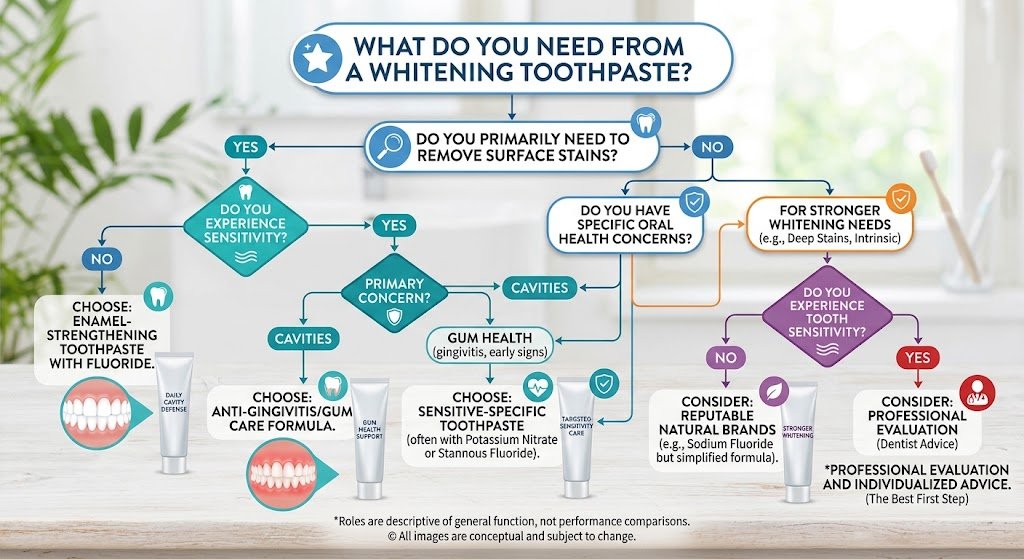
Instead of treating one product as universally “best,” it is more useful to compare whitening toothpaste by what the shopper actually needs.
Best for Coffee and Tea Stains
If coffee or tea is the main reason your teeth look darker, focus on a toothpaste designed to remove surface stains.
Look for:
- A clear stain-removal or whitening purpose
- An abrasive system intended for surface-stain removal
- Fluoride if you also want everyday cavity protection
- A formula comfortable enough for regular brushing
Remember that surface-stain removal is different from bleaching. A whitening toothpaste can help clean away external discoloration without dramatically changing the natural color of the tooth. (American Dental Association)
Best for Whitening With Cavity Protection
For everyday use, a fluoride whitening toothpaste can address two separate goals: helping remove surface stains while providing fluoride for cavity protection.
This is particularly relevant if you do not want a separate toothpaste for whitening and another for your normal brushing routine.
When comparing products, check the active ingredients rather than relying only on packaging language.
Best for Sensitive Teeth
If your teeth already react to cold drinks, sweets, or brushing, aggressive whitening may not be the most important priority.
Instead, look for a formula that addresses sensitivity while still offering reasonable stain removal.
An ADA-accepted sensitivity-control product, for example, has demonstrated safety and efficacy for reducing sensitivity in otherwise normal teeth when used as directed. (American Dental Association)
Best for a Broader Oral-Care Routine
Some toothpaste formulas are designed to provide several benefits rather than focusing exclusively on whitening.
For example, the ADA’s product database includes Colgate Total SF with accepted claims covering cavity prevention, plaque and gingivitis control, sensitivity reduction, surface-stain removal, and bad-breath reduction. (American Dental Association)
That does not make it universally the right choice for every person. It illustrates why looking at the full set of product claims and active ingredients can be more useful than choosing based on the word “whitening” alone.
When a Whitening Toothpaste May Not Be Enough
If your discoloration is primarily intrinsic, a whitening toothpaste may not deliver the level of change you want.
The ADA explains that whitening toothpastes are primarily effective for extrinsic surface stains and generally do not significantly change intrinsic tooth color. (American Dental Association)
If you have significant discoloration, restorations, unexplained changes in tooth color, or persistent sensitivity, discussing the situation with a dentist can help determine whether whitening is appropriate and which approach fits the cause of the discoloration.
Sources used for this section
The medical/dental claims above are based primarily on current ADA guidance covering whitening, toothpaste ingredients, abrasivity, sensitivity, and ADA Seal criteria. (American Dental Association)
Continue karne par main exactly “How to Compare Whitening Toothpaste” se start karunga—Part 1 repeat nahi hoga.
How to Compare Whitening Toothpaste
Not every toothpaste labeled “whitening” works in exactly the same way. Some mainly remove surface stains with mild abrasives, while others may also contain peroxide or ingredients designed to support sensitivity.
When comparing products, look beyond the word “whitening” on the front of the package.
| What to Compare | Why It Matters |
| Whitening mechanism | Helps you understand whether the toothpaste mainly removes surface stains or may provide some additional lightening |
| Abrasives | Help remove stains from the outside of the teeth |
| Peroxide | May help with certain types of discoloration, although whitening toothpaste generally has a more limited effect than bleaching products |
| Fluoride | Helps protect against cavities during everyday use |
| Sensitivity ingredients | Useful if whitening products tend to make your teeth uncomfortable |
| ADA Seal | Can provide evidence that a product has met the relevant ADA requirements for safety and effectiveness |
| Flavor and texture | Important because a toothpaste needs to be comfortable enough for consistent use |
| Current ingredient label | Formulas can change, so check the current package before buying |
A Simple Whitening Toothpaste Label Checklist
Before adding a product to your cart, check:
- Does it contain fluoride if you want everyday cavity protection?
- What ingredients provide the whitening effect?
- Is it primarily designed to remove surface stains?
- Does it contain an ingredient intended for sensitivity control?
- Does the product have an ADA Seal or other evidence supporting its stated claims?
- Are the current ingredients clearly listed?
- Does the toothpaste fit your normal oral-care needs?
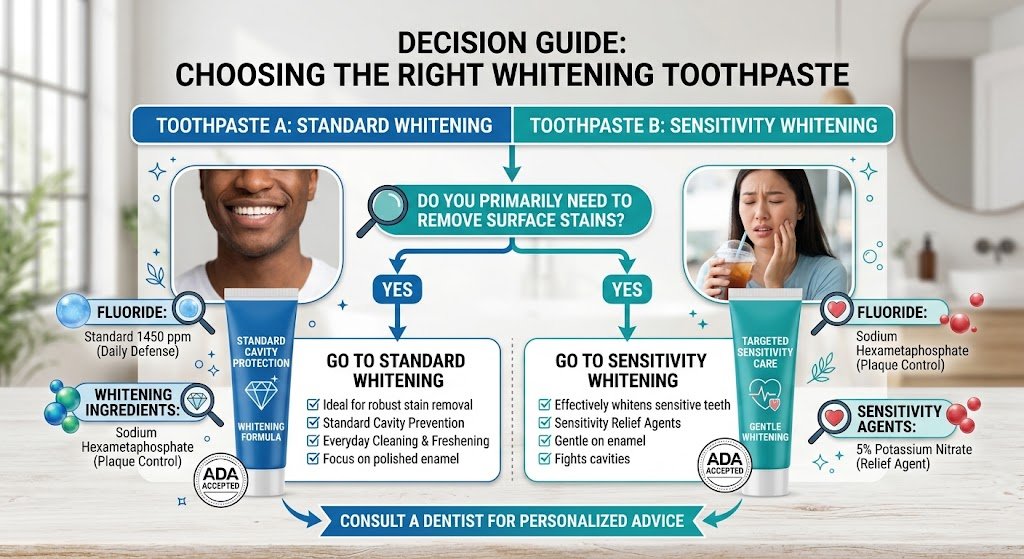
[IMAGE SUGGESTION — Side-by-side whitening toothpaste label comparison showing fluoride, whitening ingredients, sensitivity ingredients, and ADA Seal areas to check]
Best Whitening Toothpaste for Sensitive Teeth
Whitening and tooth sensitivity can sometimes go together. The American Dental Association notes that sensitivity is a common side effect associated with tooth-whitening treatments.
If your teeth are already sensitive, choosing a whitening toothpaste requires a little more care.
Look for a toothpaste that combines:
- Surface-stain removal
- Fluoride for cavity protection
- Sensitivity-supporting ingredients, when appropriate
- A formula comfortable enough for regular brushing
- Clear directions for use
You should also avoid assuming that a more aggressive-feeling toothpaste will produce better whitening. Whitening toothpaste works mainly by helping remove stains from the tooth surface, so increasing the intensity of brushing is not a good substitute for choosing an appropriate product.
The goal is not to find the toothpaste with the strongest-sounding whitening claim. The goal is to find one that matches your type of staining, sensitivity level, and everyday oral-health needs.
If sensitivity continues or becomes significant, it is worth discussing it with a dentist rather than simply switching to increasingly strong whitening products.
How to Use Whitening Toothpaste
Whitening toothpaste works best as part of a consistent oral-care routine rather than as a one-time whitening treatment.
The National Institute of Dental and Craniofacial Research recommends brushing twice a day with fluoride toothpaste. It also recommends positioning the toothbrush toward the gumline and brushing gently rather than using excessive force.
A simple routine is:
- Brush twice a day with fluoride toothpaste.
- Use gentle pressure.
- Clean all surfaces of your teeth.
- Pay attention to the gumline.
- Follow the product’s directions.
- Clean between your teeth regularly.
- Do not assume that harder brushing means better whitening.
Whitening toothpaste can help with surface stains, but it is not designed to remove hardened tartar. Plaque that becomes calculus may require professional cleaning.
If your teeth look darker because of heavy surface buildup, professional cleaning may sometimes be an important first step before considering additional whitening.
Can Whitening Toothpaste Actually Whiten Teeth?
Yes, but the type of whitening matters.
Whitening toothpaste can improve the appearance of teeth by removing extrinsic stains, which are stains on the outside surface of the teeth. Common sources include coffee, tea, red wine, tobacco, and other strongly pigmented foods or drinks.
However, whitening toothpaste generally has a much more limited effect on intrinsic discoloration, which occurs within the tooth.
This distinction is important:
Surface stain:
Coffee → stain builds on tooth surface → toothpaste helps remove stain → teeth can look cleaner and brighter.
Internal discoloration:
Tooth color is naturally darker or discoloration exists within the tooth → ordinary whitening toothpaste has limited ability to change that underlying color.
The ADA also distinguishes whitening toothpastes from bleaching products. Whitening toothpastes primarily use abrasives to remove surface stains, while bleaching products use peroxide-based chemistry to lighten tooth color.
Research reviewed by the ADA has also found stronger clinical evidence for some whitening strips than for whitening toothpaste, with much of the toothpaste evidence focused on laboratory or in-vitro findings.
So if your goal is simply to remove coffee or tea stains, whitening toothpaste can be useful. If your goal is a substantial change in the natural color of your teeth, toothpaste may not be enough.
Common Mistakes When Choosing Whitening Toothpaste
1. Choosing Only by the Word “Whitening”
A whitening label does not tell you exactly how the product works.
Read the ingredient list and product claims to understand whether it is focused on stain removal, bleaching, sensitivity, cavity protection, or a combination.
2. Assuming More Abrasive Means Better
Abrasives help physically remove surface stains, but stronger-feeling brushing is not automatically better.
The ADA uses the Relative Dentin Abrasivity, or RDA, system to describe the abrasiveness of toothpaste. ADA-accepted dentifrices have RDA values within the accepted safety range, but the ADA specifically cautions against using RDA numbers to rank toothpastes by safety.
3. Ignoring Sensitivity
If your teeth become uncomfortable with whitening products, sensitivity should be part of your buying decision.
A toothpaste that removes stains but is uncomfortable to use may not be a practical choice for your everyday routine.
4. Forgetting Fluoride
Whitening is only one part of oral care.
For everyday toothpaste, consider whether the formula also provides fluoride for cavity protection. The ADA identifies fluoride as an important anticaries ingredient in accepted toothpastes.
5. Expecting It to Whiten Crowns or Veneers
Whitening products affect natural teeth, not tooth-colored restorations in the same way.
Crowns, veneers, fillings, and other restorations do not simply become whiter when you use whitening toothpaste. This can create a color mismatch if the surrounding natural teeth become lighter.
6. Treating Amazon Reviews as Clinical Evidence
Customer reviews can tell you about personal experiences such as flavor, texture, packaging, or whether someone liked using the product.
They cannot establish that a toothpaste is clinically effective for whitening.
For evidence-based comparison, look at the ingredient list, manufacturer claims, independent evidence, and recognized dental organizations such as the ADA.
7. Assuming “Natural” or Charcoal Automatically Means Safer
A natural ingredient is not automatically better for whitening.
The ADA notes that evidence supporting DIY charcoal-based whitening approaches is insufficient, and some approaches may raise safety concerns.
When to Talk to a Dentist Before Whitening
Whitening toothpaste is intended for routine stain management, but some changes in tooth color can have causes that toothpaste cannot address.
Consider speaking with a dentist before focusing on whitening if you have:
- Unexplained tooth discoloration
- Persistent tooth sensitivity
- Tooth pain
- Visible cavities
- Cracked or damaged teeth
- Bleeding or irritated gums
- Extensive crowns, veneers, or fillings
- A single tooth that has changed color
- Significant discoloration that does not improve with normal cleaning
A dental examination can help determine whether the discoloration is simply surface staining or something that needs additional evaluation.
The ADA also recommends discussing whitening with a dental professional when appropriate, particularly when someone has sensitivity or wants realistic expectations about the result.
Frequently Asked Questions
What is the best whitening toothpaste?
There is no single whitening toothpaste that is best for everyone.
For surface stains, look for a formula designed to remove extrinsic staining while still meeting your everyday oral-care needs. Fluoride, sensitivity, ingredients, evidence, and personal comfort can all be part of the comparison.
Does whitening toothpaste really work?
Yes, whitening toothpaste can help remove surface stains and make teeth look cleaner and brighter.
Its effect is generally more limited when discoloration comes from inside the tooth rather than from surface staining.
What toothpaste is best for coffee stains?
Coffee commonly causes extrinsic staining. A toothpaste designed for stain removal can help reduce these surface stains when used as part of regular brushing.
For heavy or persistent staining, a professional dental cleaning may also be useful.
Is whitening toothpaste safe for sensitive teeth?
Some people experience sensitivity with whitening products.
If you have sensitive teeth, prioritize a comfortable formula and consider toothpaste that includes an ingredient intended to help with sensitivity. If sensitivity is persistent or painful, talk with a dentist before continuing whitening products.
Is fluoride whitening toothpaste better?
“Better” depends on what you need.
If you want a whitening toothpaste for everyday use and cavity protection is also important, fluoride can be an important feature. The ADA identifies fluoride as the key anticaries ingredient in accepted cavity-protection toothpastes.
Is peroxide in toothpaste safe?
Peroxide is used in whitening products, including some toothpastes, and peroxide-based bleaching is a recognized whitening method.
However, whitening products can cause temporary sensitivity or gum irritation in some people. Follow the product directions and stop or seek dental advice if you experience significant discomfort.
Does whitening toothpaste damage enamel?
Whitening toothpaste commonly uses abrasives to remove surface stains. The important point is not to assume that a higher abrasivity automatically produces better whitening.
Use gentle brushing and follow the manufacturer’s directions. The ADA notes that RDA is a standardized measure of abrasivity but should not be used by consumers as a simple ranking of toothpaste safety.
Can whitening toothpaste whiten crowns or veneers?
No. Whitening products are intended to whiten natural teeth and do not whiten tooth-colored restorations in the same way.
How long does whitening toothpaste take to work?
Results depend on the type and amount of surface staining, the formula, and your brushing routine.
Because whitening toothpaste primarily removes surface stains, it should not be expected to produce the same type of color change as a peroxide-based bleaching treatment.
Are charcoal whitening toothpastes effective?
Evidence for charcoal-based DIY whitening approaches is limited, and the ADA notes that there are safety concerns with some charcoal whitening methods. A product’s charcoal label alone is not evidence that it provides superior whitening.
Final Thoughts: Choosing the Best Whitening Toothpaste
The best whitening toothpaste is not necessarily the one with the strongest whitening claim.
Start by identifying what you actually want to change.
If your main concern is coffee, tea, tobacco, or other surface stains, a stain-removing toothpaste may be appropriate. If you want a major change in your natural tooth color, whitening toothpaste may have limitations and a different whitening approach may be more suitable.
For everyday use, consider these factors together:
- Surface-stain removal
- Fluoride for cavity protection
- Sensitivity support when needed
- Ingredient transparency
- Evidence behind the product’s claims
- Comfortable daily use
- Your existing dental restorations and oral-health needs
Before buying, check the current product label and claims, because formulas and product offerings can change.
Ready to Compare Whitening Toothpaste Options?
Once you know whether your main goal is coffee-stain removal, everyday whitening, sensitivity control, or general oral care, you can compare products based on the features that actually matter to you.
For current product options, check the latest ingredient list, fluoride status, whitening claims, and available customer information before purchasing through Amazon.
Affiliate Disclosure: This article may contain affiliate links. If you purchase through one of these links, we may earn a commission at no additional cost to you. Our recommendations are based on product characteristics and available evidence, not on the size of the commission.
