Dry mouth can make choosing toothpaste more complicated than simply picking a flavor you like. When saliva is reduced, your mouth loses some of its natural protection, and the risk of tooth decay, tooth sensitivity, and oral infections can increase. (NIDCR)
For most people with dry mouth, a good toothpaste should do more than feel comfortable. Fluoride, cavity protection, ingredient tolerance, and suitability for everyday use all matter.
This guide explains what to look for in toothpaste for dry mouth, which ingredients deserve attention, how to compare products, and when a toothpaste may not be enough to manage the underlying problem.
What Is the Best Toothpaste for Dry Mouth?
There is no single toothpaste that is automatically the best choice for every person with dry mouth.
The better question is:
Which toothpaste provides the oral-health protection you need while remaining comfortable enough to use consistently?
For many people with dry mouth, fluoride should be one of the first things to check. The American Dental Association recommends gently brushing at least twice a day with fluoridated toothpaste as part of dry-mouth care. (American Dental Association)
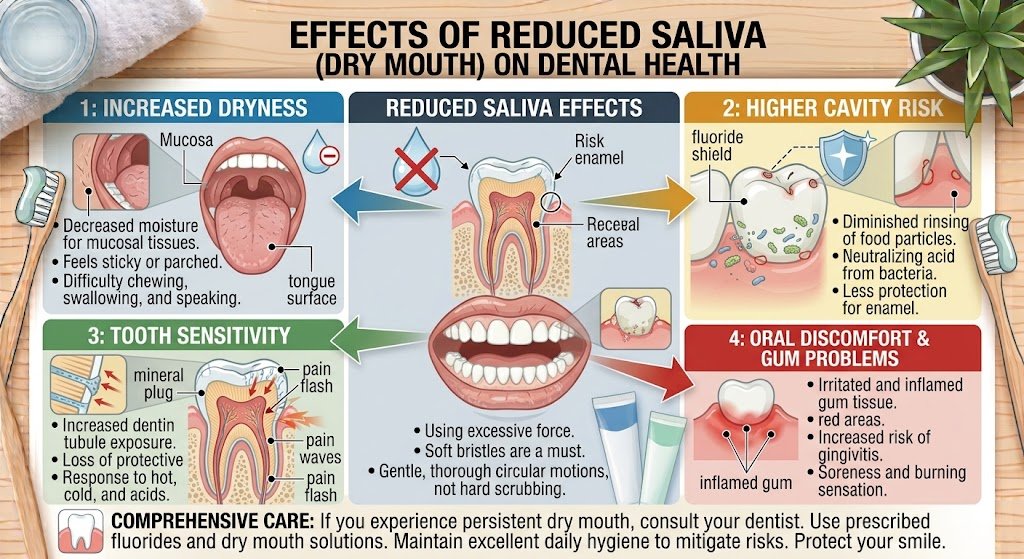
That matters because saliva normally helps protect teeth. It washes away food particles and contains minerals that help keep teeth strong. When saliva production is reduced, the mouth can become more vulnerable to decay. (NIDCR)
When comparing toothpaste, consider these features:
- Fluoride: Important for cavity prevention.
- Comfort: A toothpaste should be comfortable enough for regular brushing.
- Ingredient tolerance: Some people may experience irritation from particular ingredients or strong flavoring.
- Sensitivity support: Useful if dry mouth is accompanied by sensitive teeth.
- Dry-mouth suitability: Some products are specifically formulated for people experiencing oral dryness.
- Clear labeling: You should be able to identify the active ingredients and understand the product’s main purpose.
- Evidence or recognized acceptance: An ADA Seal can provide an additional signal that a product has undergone the organization’s evaluation process for the relevant category.
The important distinction is that toothpaste supports oral hygiene; it does not necessarily treat the underlying cause of dry mouth.
Persistent dry mouth can have many causes, including medications, dehydration, certain diseases, cancer treatments, and other medical factors. If dryness continues, finding the cause is important. (NIDCR)
Why Dry Mouth Changes Your Toothpaste Needs
Saliva does much more than keep your mouth wet.
It helps wash food particles away, supports swallowing and speaking, and provides minerals such as calcium and phosphate that help protect teeth. Saliva also helps maintain the oral environment and limit the effects of harmful microorganisms. (NIDCR)
When there is not enough saliva, several problems can become more important.
Higher Cavity Risk
Reduced saliva can increase the risk of tooth decay. This is one reason fluoride becomes particularly important when choosing everyday toothpaste for someone with dry mouth. (American Dental Association)
Fluoride helps strengthen enamel and can help reverse early stages of tooth decay by supporting remineralization. (NIDCR)
More Sensitivity or Oral Discomfort
The ADA notes that reduced salivary flow can be associated with tooth sensitivity and demineralization. Dry mouth may also cause a sticky feeling, burning sensation, mouth sores, difficulty swallowing, or bad breath. (NIDCR)
That means a toothpaste that feels perfectly comfortable for one person may be unpleasant for another.
Irritation Can Matter More
People with dry mouth may already have uncomfortable oral tissues. Strong flavors or particular toothpaste ingredients can be irritating for some individuals.
This does not mean every potentially irritating ingredient is harmful to everyone. It means that if a specific toothpaste repeatedly causes burning or discomfort, ingredient selection becomes more important.
Dry Mouth Is a Symptom, Not Just a Toothpaste Problem
This is an important point that product lists often miss.
Toothpaste can help with daily oral hygiene and cavity prevention, but persistent xerostomia can have an underlying cause that needs professional attention.
NIDCR recommends seeing a dentist or doctor if you think you have dry mouth so the reason for the dryness can be evaluated. (NIDCR)
What to Look for in Toothpaste for Dry Mouth
Once you understand why dry mouth changes oral-care needs, product selection becomes easier.
Instead of choosing a toothpaste simply because the package says “dry mouth,” check the actual features and ingredients.
Fluoride
For everyday cavity protection, fluoride should be a major consideration.
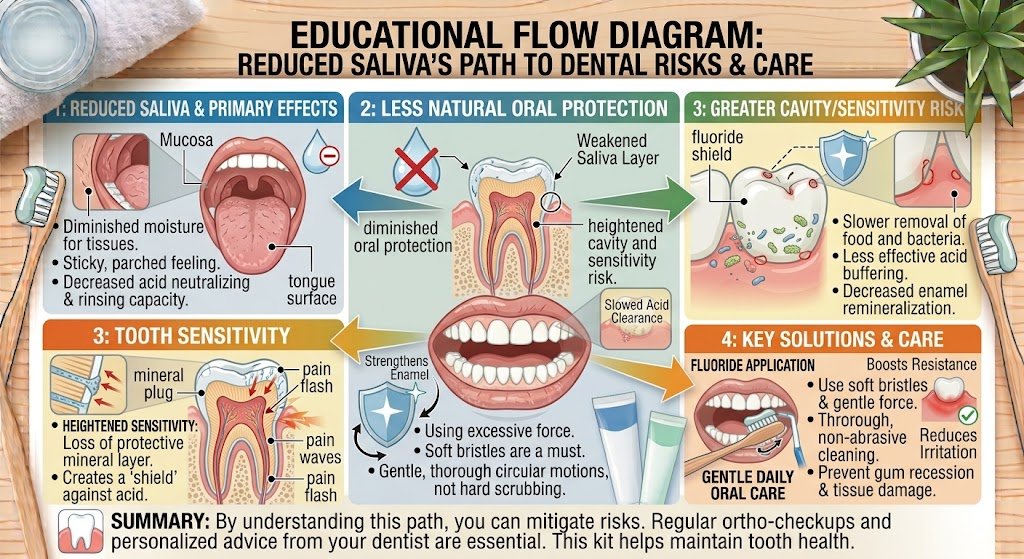
The ADA identifies sodium fluoride, sodium monofluorophosphate, and stannous fluoride as fluoride compounds used in toothpaste for anticaries purposes. Fluoride helps strengthen enamel and supports the prevention of tooth decay. (American Dental Association)
NIDCR also recommends brushing with fluoride toothpaste twice a day as part of cavity prevention. (NIDCR)
For someone with dry mouth, this is especially relevant because reduced saliva can increase the risk of tooth decay.
A Gentle Formula
A toothpaste does not need to feel extremely strong to clean your teeth effectively.
If your mouth feels dry, sore, or easily irritated, consider how the toothpaste feels during and after brushing. A comfortable formula may make it easier to maintain your daily brushing routine.
Pay attention to:
- Burning
- Excessively strong flavor
- Uncomfortable foaming
- Irritation after brushing
- Increased sensitivity
If a toothpaste consistently causes discomfort, discuss alternatives with your dentist or dental hygienist.
SLS-Free Options
Sodium lauryl sulfate, commonly called SLS, is used in some toothpastes as a foaming ingredient.
Some people prefer SLS-free toothpaste because they find certain formulas more comfortable. However, it is too simplistic to say that SLS is automatically harmful or that everyone with dry mouth must avoid it.
The ADA notes that toothpaste ingredients can cause irritation or allergic reactions in some people. (American Dental Association)
So if you notice that a particular toothpaste causes irritation, an SLS-free alternative may be worth considering.
The decision should be based on your tolerance and the overall formula, not on fear-based ingredient lists.
Flavor and Irritation
Mint may make toothpaste feel fresh, but a strong flavor is not necessary for effective brushing.
If your mouth already feels dry or irritated, pay attention to how the flavor feels. A milder formula may be more comfortable for some people.
This is especially useful when comparing products marketed specifically for dry mouth.
Sensitivity Support
Dry mouth and tooth sensitivity can occur together, so sensitivity may be another useful product-selection factor.
Certain toothpaste formulas contain ingredients intended to reduce dentin hypersensitivity. The ADA identifies ingredients such as stannous fluoride, potassium-based compounds, and arginine among desensitizing approaches used in toothpaste. (American Dental Association)
If sensitivity is one of your main concerns, don’t choose solely based on the words “dry mouth.” Look for a product that also addresses your sensitivity needs.
Clear Ingredient Label
A transparent ingredient list makes comparison easier.
Before buying, check:
- The active fluoride ingredient.
- Whether the product is specifically marketed for dry mouth.
- Whether it contains ingredients you personally know cause irritation.
- Whether it includes sensitivity-related ingredients if you need them.
- The manufacturer’s current directions and claims.
Product formulas can change, so check the current package or product listing rather than relying only on an old review.
ADA Seal of Acceptance
The ADA Seal can be another useful consideration when comparing oral-care products.
The ADA evaluates submitted evidence and information against requirements for safety and efficacy for relevant product categories. (American Dental Association)
Importantly, the Seal should be considered in relation to the specific claim or product category. It does not mean that one toothpaste is universally better than every other toothpaste.
For dry-mouth products specifically, the ADA has a category for products that have been found safe and shown efficacy for temporary relief of dry-mouth symptoms when used as directed. (American Dental Association)
Best Toothpaste for Dry Mouth by Need
Once you know what to look for, the most useful way to compare products is by use case.
Someone whose biggest concern is frequent cavities may need a different product focus from someone whose biggest concern is irritation or sensitivity.
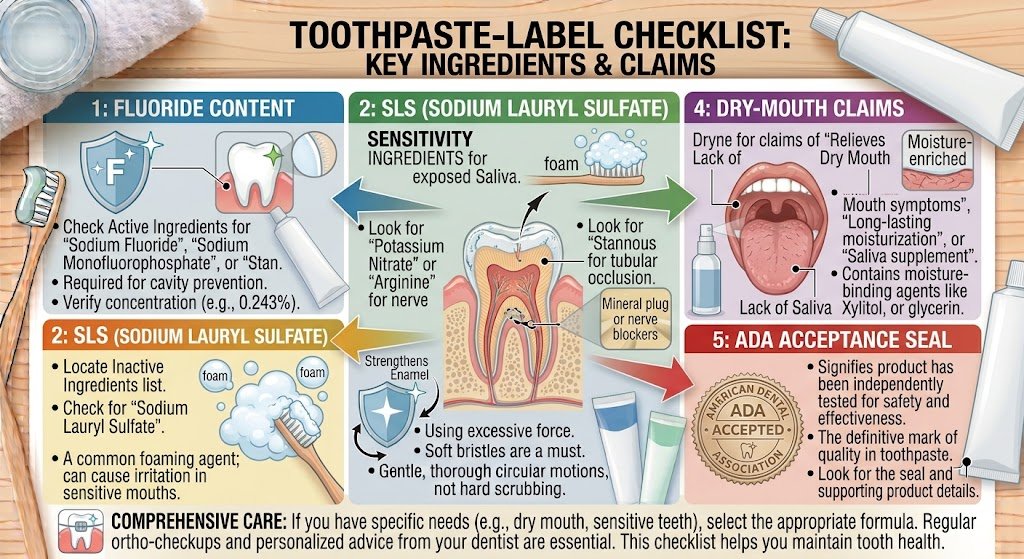
Best for Cavity Protection
If your main concern is preventing cavities, prioritize a fluoride toothpaste.
This is especially relevant for people with dry mouth because reduced saliva can increase the risk of tooth decay. Fluoride strengthens enamel and helps protect against cavities. (American Dental Association)
When evaluating products, check:
- Fluoride active ingredient
- Clear anticavity claim
- Comfortable daily use
- Current product directions
- Evidence or recognized acceptance where available
Best for Sensitive Teeth
If dry mouth is accompanied by tooth sensitivity, consider a toothpaste designed to provide both fluoride protection and sensitivity support.
The important thing is to avoid treating “sensitive” as a substitute for cavity protection. You can look for a formula that addresses both needs.
If sensitivity is severe, persistent, or associated with pain, a dentist should evaluate the cause rather than relying only on a toothpaste change.
Best SLS-Free Option
An SLS-free toothpaste may be worth considering if you find that conventional formulas cause irritation or discomfort.
But SLS-free should be treated as a comfort preference or individual suitability factor, not as proof that a toothpaste is automatically safer or more effective.
When comparing SLS-free products, still check for fluoride and the rest of the ingredient profile.
Best for Everyday Use
For everyday brushing, the simplest useful combination is often:
fluoride + comfortable formula + good brushing habits.
You do not necessarily need a product with the longest ingredient list or the most complicated dry-mouth marketing.
A toothpaste that you can comfortably use consistently while meeting your oral-care needs may be more practical than a product with features you do not actually need.
Best for a Dry-Mouth-Focused Formula
Some products are specifically formulated for people experiencing oral dryness.
These products may focus more heavily on comfort or moisture than conventional toothpaste. However, do not assume that a dry-mouth label alone proves that a product will relieve everyone’s symptoms.
The ADA notes that evidence for specific topical dry-mouth therapies is limited, and individual preference and potential adverse effects are important considerations. (American Dental Association)
For that reason, compare the actual product purpose and ingredients, rather than choosing solely because “dry mouth” appears on the package.
Ingredients to Look For and Ingredients to Consider Carefully
When you have dry mouth, the ingredient list deserves more attention than the marketing words on the front of the package.
The goal is not to find a toothpaste with the fewest ingredients. Instead, look for a formula that provides the oral-health protection you need without causing unnecessary discomfort.
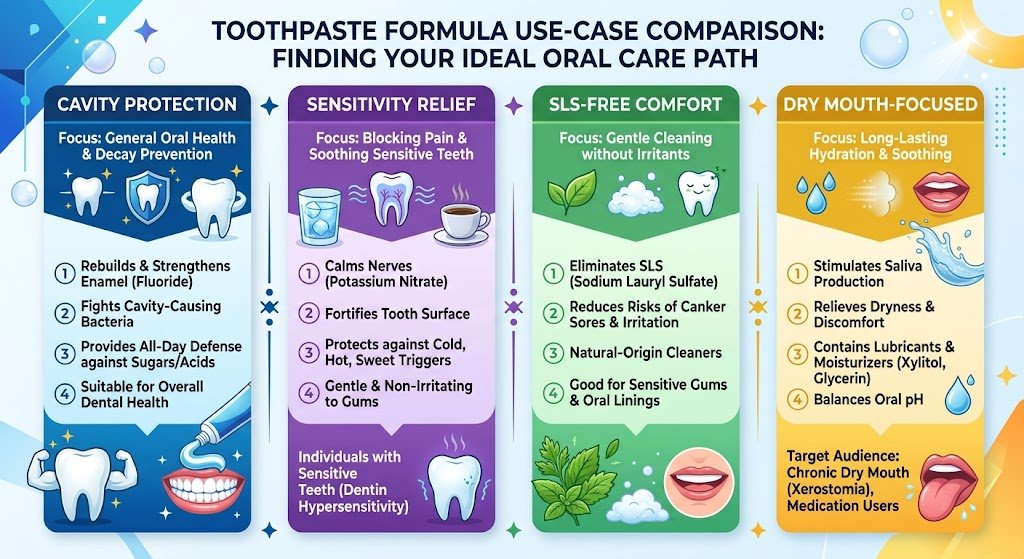
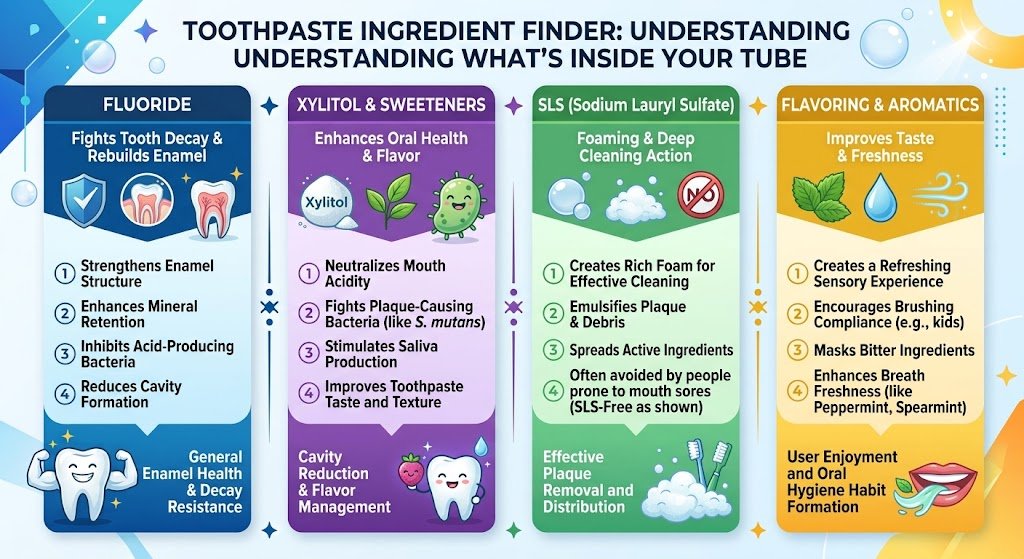
Fluoride
Fluoride is one of the most important ingredients to consider for everyday toothpaste.
Common fluoride compounds found in toothpaste include:
- Sodium fluoride
- Stannous fluoride
- Sodium monofluorophosphate
These ingredients help protect teeth against cavities. For people with dry mouth, that cavity-protection role is particularly important because reduced saliva can make teeth more vulnerable to decay. [ add a link ]
If you already have a high risk of cavities, your dentist may recommend a specific fluoride product or additional fluoride treatment based on your individual needs.
Xylitol
Xylitol is a sugar alcohol commonly used in sugar-free oral-care products.
It is important to distinguish xylitol-containing products from toothpaste that is specifically proven to treat dry mouth. Xylitol may be used in chewing gum and other products designed to stimulate saliva, while the evidence and purpose can vary depending on the product.
If you are looking for something to chew between meals, a sugar-free gum may be a different category of product from your everyday toothpaste.
The key point is simple: do not choose toothpaste solely because the label contains the word “xylitol.” Consider the complete formula and the product’s intended purpose.
SLS
Sodium lauryl sulfate, or SLS, is a detergent used in many toothpaste formulas to create foam.
Some people prefer SLS-free toothpaste because they experience irritation or simply prefer the feel of formulas without it.
However, SLS should not automatically be described as harmful for everyone. Toothpaste ingredients can cause irritation or allergic reactions in susceptible individuals, and personal tolerance matters. [ add a link ]
If you regularly experience burning, soreness, or irritation after brushing, trying a different formula may be reasonable. If symptoms continue, dental advice can help determine whether toothpaste is actually responsible.
Strong Flavoring
Flavoring can affect comfort when you have dry mouth.
A strong mint flavor may feel refreshing to one person but unpleasant or irritating to another. If your mouth already feels dry, sore, or sensitive, you may prefer a milder flavor.
Look at the complete ingredient list rather than assuming that “fresh” or “extra fresh” means better oral care.
Essential Oils
Some toothpaste formulas contain essential oils or other flavoring ingredients.
These ingredients are not automatically bad. However, some people can experience irritation or sensitivity to particular ingredients.
If you notice that one toothpaste causes discomfort while another does not, comparing the formulas can help you identify possible differences.
Sugars and Sweeteners
Toothpaste should not be selected based simply on whether it tastes sweet.
For people concerned about cavities, the overall oral-care formula matters much more than sweetness. Sugar-free products are generally preferable for products intended to remain in the mouth or be used frequently, but always check the actual ingredient list.
What About “Natural” Ingredients?
“Natural” does not automatically mean better for dry mouth.
A plant-derived ingredient can still cause irritation in some people, while a synthetic ingredient can be useful and well tolerated.
Instead of dividing toothpaste into “natural” and “chemical,” focus on:
What does the ingredient do? Is it appropriate for the product? Does it meet your needs? And do you tolerate it comfortably?
That approach gives you a much more useful way to compare toothpaste.
Fluoride vs. Fluoride-Free Toothpaste for Dry Mouth
If you have dry mouth, the fluoride-versus-fluoride-free decision deserves particular attention.
The reason is the relationship between reduced saliva and cavity risk.
When saliva production decreases, the mouth can lose some of its natural protective effects. That can make preventing tooth decay more important. The ADA specifically recommends brushing with fluoridated toothpaste as part of oral care for people with dry mouth. [ add a link ]
For this reason, choosing a fluoride-free toothpaste simply because it sounds more “natural” does not necessarily make sense for someone whose main concern is dry-mouth-related cavity risk.
When Fluoride May Be the Practical Choice
A fluoride toothpaste can be especially relevant if:
- You are at increased risk of cavities.
- You experience persistent dry mouth.
- You want everyday cavity protection.
- Your dentist has recommended fluoride toothpaste.
- You want a single toothpaste for regular oral hygiene and cavity prevention.
What About Fluoride-Free Toothpaste?
Some people intentionally avoid fluoride for personal reasons.
If you choose fluoride-free toothpaste, understand what you are giving up in terms of conventional fluoride-based cavity protection and discuss your choice with a dental professional if you have significant cavity risk.
The important point is not that every person must use exactly the same toothpaste. It is that dry mouth changes the risk calculation, so cavity protection should not be ignored.
For people with especially high decay risk, a dentist may recommend a prescription-strength fluoride toothpaste or another fluoride treatment. That decision should be individualized rather than made solely from an online product list.
How to Use Toothpaste When You Have Dry Mouth
Choosing an appropriate toothpaste is only one part of managing dry-mouth-related oral-health risks.
Your brushing routine matters too.
The National Institute of Dental and Craniofacial Research recommends brushing teeth twice a day with fluoride toothpaste. It also recommends regular cleaning between teeth and maintaining dental care. [ add a link ]
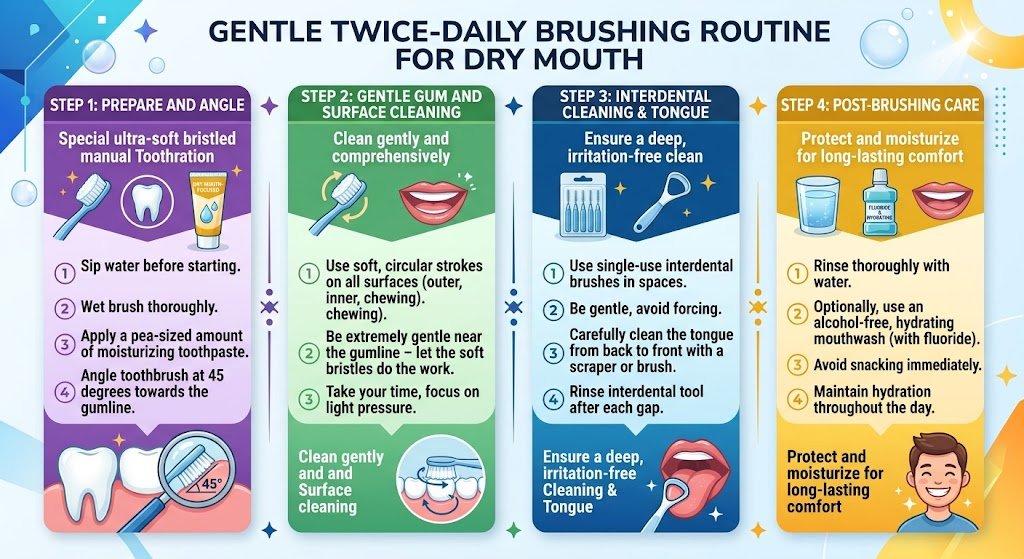
Brush Gently
Dry mouth does not mean you should scrub harder.
Use gentle pressure and clean all tooth surfaces. Pay particular attention to the gumline, where plaque can accumulate.
Aggressive brushing can irritate your gums and does not provide a shortcut to cleaner teeth.
Brush Twice Daily
Consistency is more important than using an unusually strong toothpaste.
A practical routine is:
- Brush twice a day with fluoride toothpaste.
- Use a soft-bristled toothbrush.
- Brush gently around the gumline.
- Clean all sides of your teeth.
- Clean between your teeth regularly.
- Follow the toothpaste’s instructions.
- Maintain regular dental appointments.
Keep Your Mouth Hydrated
Toothpaste itself cannot replace saliva.
Depending on the cause and severity of dry mouth, your dentist or doctor may recommend measures such as drinking water, using sugar-free gum or other products intended to stimulate saliva, or using saliva substitutes.
NIDCR notes that treatment for dry mouth depends on its cause and may include measures to relieve symptoms and prevent complications. [ add a link ]
Don’t Ignore Frequent Cavities
If you continue developing cavities despite regular brushing, do not simply keep switching toothpaste.
Dry mouth can have an important role in increased decay risk, and persistent symptoms may require professional evaluation.
Toothpaste vs. Dry-Mouth Gels, Sprays and Saliva Substitutes
One of the most common sources of confusion is treating all dry-mouth products as if they perform the same job.
They do not.
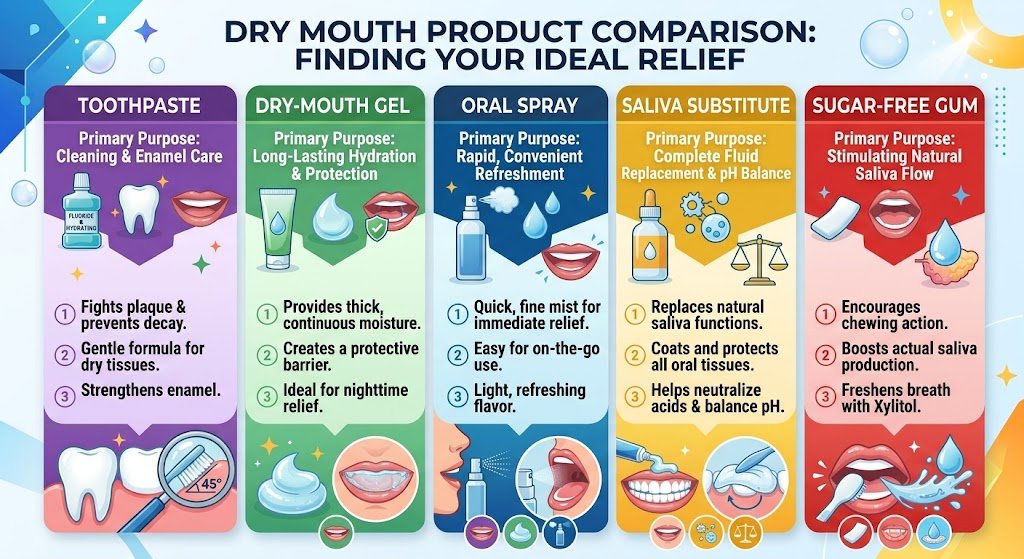
Toothpaste
The primary role of toothpaste is to support brushing and oral hygiene.
For people with dry mouth, fluoride toothpaste can help provide cavity protection while brushing.
Dry-Mouth Gels
Dry-mouth gels are generally designed around comfort and moisture, rather than replacing the role of toothpaste.
Some products are formulated to provide temporary relief from oral dryness.
Dry-Mouth Sprays
Sprays may be convenient when someone wants temporary moisture or comfort during the day.
Their role is different from brushing with toothpaste.
Saliva Substitutes
Saliva substitutes are products designed to mimic some of the lubricating or moisturizing functions of natural saliva.
They may be useful for symptom relief, but they do not mean that a person can skip normal brushing and cavity-prevention practices.
Sugar-Free Gum
Sugar-free gum can be useful for some people because chewing can stimulate saliva flow when the salivary glands are still capable of responding.
This makes it a complementary oral-care option rather than a replacement for toothpaste.
The ADA notes that topical dry-mouth products may provide temporary symptom relief, but individual response varies. [ add a link ]
The Simple Difference
Think about these products this way:
| Product | Main Role |
| Fluoride toothpaste | Brushing and cavity protection |
| Dry-mouth gel | Moisture/comfort |
| Dry-mouth spray | Convenient temporary moisture |
| Saliva substitute | Lubrication/moisture support |
| Sugar-free gum | Saliva stimulation |
| Mouthrinse | Additional oral-care support depending on formula |
This distinction makes product shopping much easier.
If your main problem is daily cavity protection, toothpaste is central.
If your main problem is daytime dryness and discomfort, a dry-mouth gel, spray, saliva substitute, or sugar-free gum may provide a different type of support.
You may need more than one type of product depending on your symptoms and dental needs.
Common Mistakes When Choosing Dry-Mouth Toothpaste
A product marketed specifically for dry mouth is not automatically the right choice for everyone.
Avoid these common mistakes.
Choosing Fluoride-Free Just Because It Sounds “Clean”
For people at risk of cavities, fluoride can be an important part of everyday oral care.
Do not sacrifice cavity protection simply because a product uses “natural,” “clean,” or “fluoride-free” language.
Assuming SLS Is Always Harmful
SLS may bother some individuals, but that does not mean everyone needs to avoid it.
If you experience irritation, an SLS-free alternative can be worth considering.
Expecting Toothpaste to Cure Dry Mouth
Toothpaste can support oral hygiene, but persistent xerostomia may have an underlying cause.
Treating the toothpaste as the cure can delay appropriate evaluation.
Focusing Only on Moisturizing Claims
A toothpaste may feel soothing without addressing the most important oral-health concern for someone with dry mouth: cavity prevention.
Look at the complete product purpose.
Ignoring Your Cavity Risk
If you have frequent cavities, fluoride and professional dental guidance deserve more attention than flavor, packaging, or marketing claims.
Choosing the Strongest Flavor
Extra-minty does not mean extra-effective.
If a strong flavor causes discomfort, a milder formula may be easier to use consistently.
Trusting Amazon Reviews as Medical Evidence
Customer reviews can help you understand practical details such as:
- Flavor
- Texture
- Packaging
- Personal comfort
But reviews cannot establish clinical effectiveness.
Use reviews as one source of consumer experience, not as a substitute for dental evidence.
Ignoring Persistent Dry Mouth
If your mouth stays dry for an extended period, repeatedly switching toothpaste may not solve the underlying issue.
Persistent dry mouth deserves professional attention because its cause can affect the appropriate management approach.
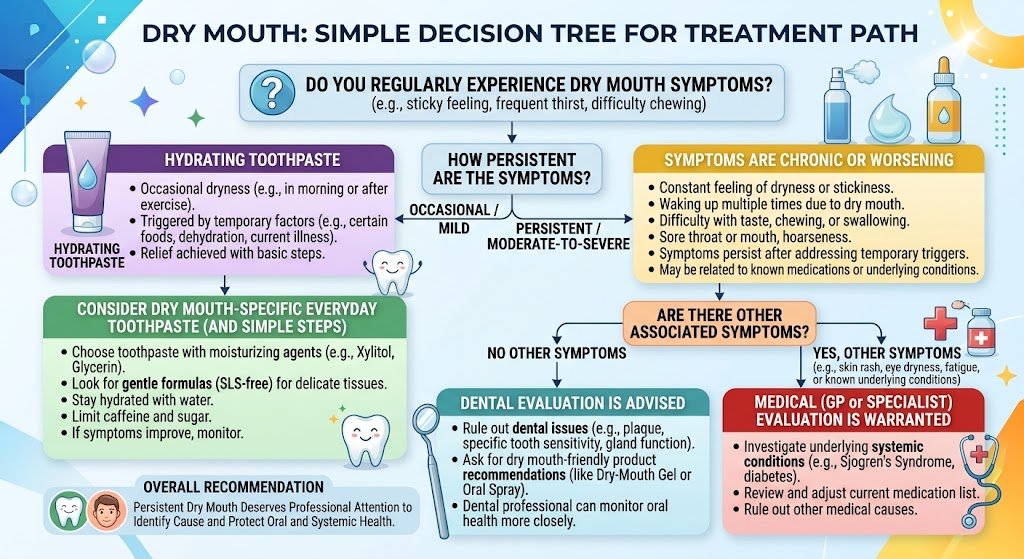
When to See a Dentist or Doctor
Occasional dry mouth can happen for many reasons, but persistent or troublesome dryness should not simply be treated as a toothpaste-shopping problem.
Consider talking with a dentist or doctor if you have:
- Persistent dry mouth
- Frequent new cavities
- Mouth sores
- Burning or significant oral discomfort
- Difficulty chewing or swallowing
- Recurrent oral infections
- Significant sensitivity
- Problems speaking because of dryness
- Dry mouth that started after a medication change
- Dryness that is affecting your daily life
NIDCR explains that dry mouth can have different causes and recommends discussing ongoing symptoms with a healthcare professional so the underlying cause can be identified. [ add a link ]
Your dentist can also assess your cavity risk and determine whether additional fluoride treatment, prescription toothpaste, or other preventive measures are appropriate.
Why This Matters
The right toothpaste can support your daily routine, but it should be viewed as one part of dry-mouth care.
If the underlying problem is caused by medication, a medical condition, dehydration, cancer treatment, or another factor, addressing that cause may be more important than changing toothpaste repeatedly.
Frequently Asked Questions
What Is the Best Toothpaste for Dry Mouth?
The best toothpaste for dry mouth depends on your individual needs, but fluoride, cavity protection, comfortable use, and good ingredient tolerance are important starting points.
Because dry mouth can increase the risk of tooth decay, a fluoride toothpaste is generally a practical choice for everyday oral care. If you also have sensitivity or irritation, choose a formula that addresses those concerns without making brushing uncomfortable.
There is no single toothpaste that is best for every person with dry mouth.
Is Fluoride Toothpaste Good for Dry Mouth?
Yes. Fluoride toothpaste can be particularly useful for people with dry mouth because reduced saliva can increase the risk of tooth decay.
The ADA and NIDCR recommend fluoride toothpaste as part of regular oral care for people experiencing dry mouth. [ add a link ]
If you have a high risk of cavities, your dentist may recommend additional fluoride protection.
Should I Use Fluoride-Free Toothpaste If I Have Dry Mouth?
Not necessarily.
Fluoride-free toothpaste may be a personal choice, but dry mouth can increase cavity risk. Because fluoride helps prevent cavities and supports enamel, removing it from your routine may not be ideal if cavity prevention is a priority.
If you strongly prefer fluoride-free toothpaste, discuss your individual cavity risk with your dentist.
Is SLS Bad for Dry Mouth?
SLS is not automatically bad for everyone with dry mouth.
Some people may find SLS-containing toothpaste irritating, while others use it without problems. If you experience burning, soreness, or irritation while brushing, an SLS-free formula may be worth trying.
The important factor is your individual tolerance, rather than assuming that every SLS-containing toothpaste is harmful.
What Toothpaste Is Best for Dry Mouth and Sensitive Teeth?
Look for a toothpaste that combines fluoride with sensitivity-supporting ingredients and is comfortable enough for regular use.
Stannous fluoride and certain other desensitizing ingredients are used in toothpaste designed for sensitivity. However, sensitivity can have different causes, so persistent or severe sensitivity should be evaluated by a dental professional.
Does Toothpaste Cure Dry Mouth?
No.
Toothpaste supports oral hygiene and can help protect teeth from cavities, but it does not generally cure the underlying cause of dry mouth.
Dry mouth can result from medications, medical conditions, dehydration, radiation treatment, chemotherapy, and other causes. Treatment therefore depends on why saliva production has decreased.
How Often Should I Brush If I Have Dry Mouth?
A common recommendation is to brush twice a day with fluoride toothpaste.
Use gentle brushing rather than aggressive scrubbing. Also clean between your teeth regularly and maintain routine dental visits.
If your dentist has given you a different routine because of your individual risk, follow that advice.
What Can I Use Besides Toothpaste for Dry Mouth?
Depending on your needs, options can include:
- Drinking water regularly
- Sugar-free gum
- Sugar-free candies or mints
- Saliva substitutes
- Dry-mouth gels or sprays
- A humidifier when appropriate
- Professional fluoride treatments when recommended
NIDCR and the ADA both describe hydration, saliva-stimulating products, saliva substitutes, and fluoride as parts of dry-mouth management. [ add a link ]
The appropriate combination depends on the severity and cause of your dry mouth.
Does Dry Mouth Cause Cavities?
Dry mouth does not directly create every cavity, but reduced saliva can increase the risk of tooth decay.
Saliva helps wash away food particles and contributes minerals that support tooth health. When saliva is reduced, the mouth loses some of that natural protection.
That is why cavity prevention becomes especially important when dry mouth is persistent.
When Should I See a Dentist for Dry Mouth?
You should consider professional advice when dry mouth is persistent, severe, or accompanied by problems such as frequent cavities, mouth sores, burning, difficulty swallowing, recurrent infections, or significant discomfort.
A dentist or doctor can also help investigate possible causes and determine whether you need additional fluoride protection or other treatment.
How We Would Choose the Best Toothpaste for Dry Mouth
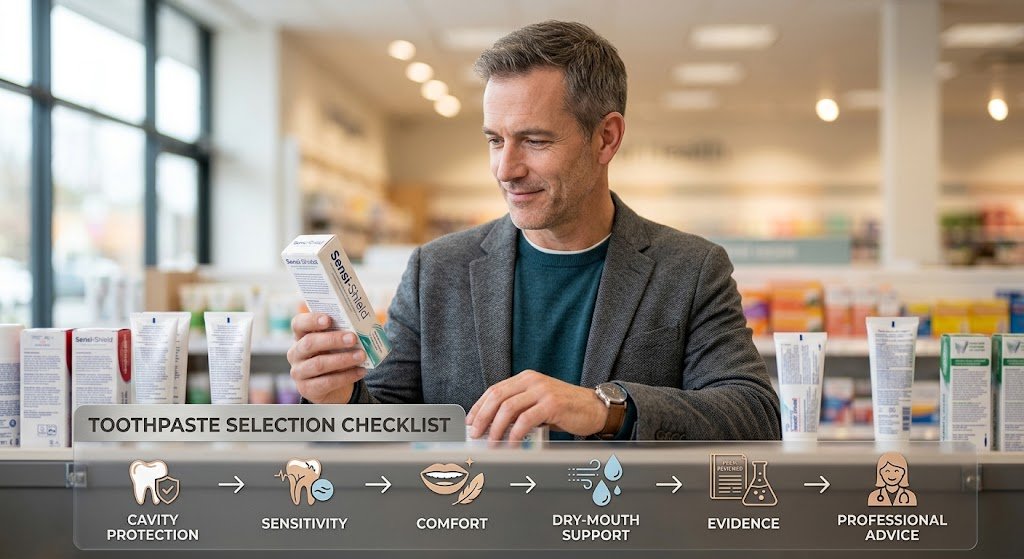
Instead of selecting a toothpaste simply because it has “dry mouth” printed on the package, use a simple decision process.
Step 1: Check Cavity Protection
Start with fluoride if cavity prevention is important to you.
This is particularly relevant when reduced saliva has increased your risk of tooth decay.
Step 2: Check Your Sensitivity
If cold, hot, sweet, or brushing causes sensitivity, consider a toothpaste formulated for sensitive teeth.
Step 3: Check Your Comfort
If your current toothpaste causes burning or irritation, consider whether the flavor, SLS, or another ingredient may be contributing.
Step 4: Consider Dry-Mouth-Specific Products
If your main problem is lack of moisture rather than brushing discomfort, a toothpaste alone may not provide enough symptom relief.
You may benefit from a separate dry-mouth product designed for temporary moisture or comfort.
Step 5: Check the Evidence
Look beyond phrases such as:
- “Natural”
- “Clean”
- “Maximum moisture”
- “Extra whitening”
- “Detox”
- “Chemical-free”
Look for clear ingredient information and credible evidence.
The ADA Seal can also be useful when available because products carrying the Seal have gone through an evaluation process for specific claims.
Step 6: Consider Your Dentist’s Advice
If you have frequent cavities or severe dry mouth, your needs may be different from someone with occasional dryness.
A dentist can help determine whether standard OTC fluoride toothpaste is enough or whether additional protection is appropriate.
What Makes a Dry-Mouth Toothpaste Worth Buying?
A good product should solve a real problem without creating another one.
For most people, the following combination is more useful than a long list of marketing claims:
Fluoride + cavity protection + comfortable formula + good ingredient tolerance + consistent daily use
If you also need sensitivity relief, add that requirement.
If you need moisture relief, consider a separate dry-mouth product rather than expecting toothpaste to perform every function.
This is an important distinction when comparing products on Amazon. A toothpaste can be excellent for brushing and cavity protection without being the strongest option for temporary dry-mouth relief.
How to Compare Dry-Mouth Toothpaste Before Buying
Use this quick checklist when comparing products:
| What to Check | Why It Matters |
| Fluoride | Supports cavity prevention |
| Fluoride type | Identifies the active fluoride ingredient |
| Sensitivity ingredients | Useful if teeth are sensitive |
| SLS | May matter if you experience irritation |
| Flavor | Important for everyday comfort |
| Dry-mouth claims | Check what the product actually promises |
| Ingredient transparency | Makes comparison easier |
| ADA Seal | Useful evidence-based quality signal when applicable |
| Price per ounce | Helps compare value |
| Current label | Formulas can change |
Always verify the current product label before purchasing because formulas, package sizes, claims, and availability can change.
