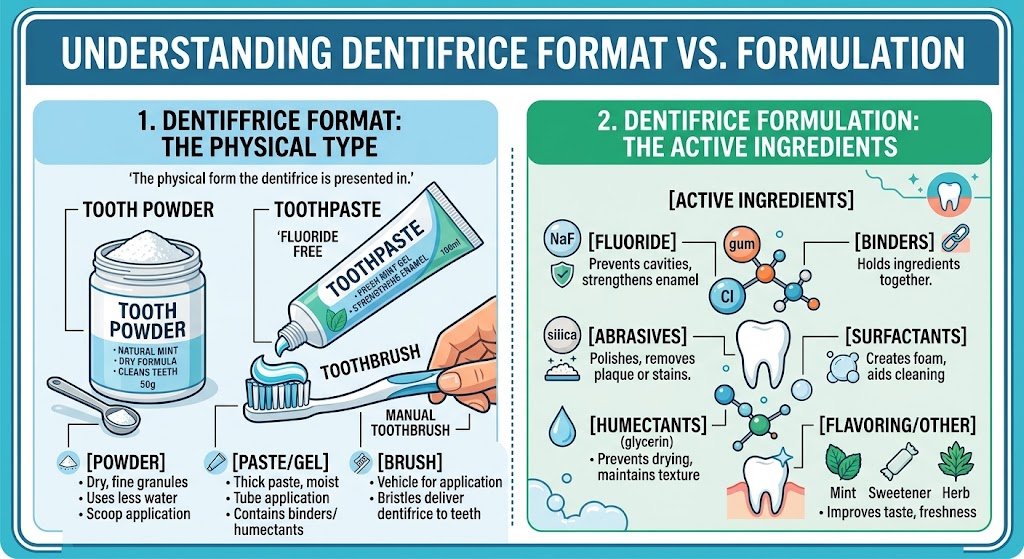
Tooth powder is a dry form of dentifrice used with a toothbrush to clean teeth. Unlike conventional toothpaste, which is usually a paste or gel, tooth powder is formulated as a dry blend of ingredients.
But the format alone doesn’t tell you whether a tooth powder is a good choice. The more important questions are what it contains, whether it provides the oral-health function you need, and how it fits your individual dental needs.
The American Dental Association notes that dentifrices can be formulated as gels, pastes, or powders, including products designed to deliver anticaries ingredients to teeth. (American Dental Association)
If you’re considering making the switch, this guide explains how tooth powder works, how it compares with toothpaste, what to look for on the label, and when a powdered dentifrice may—or may not—make sense.
What Is Tooth Powder?
Tooth powder is a powdered dentifrice that you apply to a toothbrush and use for brushing.
Its basic purpose is similar to toothpaste: help clean tooth surfaces and, depending on the formulation, deliver ingredients intended to provide additional oral-health benefits.
The important distinction is that “tooth powder” describes the product’s physical form, not its effectiveness or ingredient quality.
A tooth powder may contain ingredients such as:
- Fluoride compounds
- Calcium carbonate
- Silica-based abrasives
- Sodium bicarbonate
- Xylitol
- Flavoring agents
- Other active or inactive ingredients
The exact formulation can vary considerably between products.
For example, one powder might be fluoride-containing and designed around cavity prevention, while another may be fluoride-free and marketed around ingredient preferences. Treating both as interchangeable simply because they’re powders would overlook the information that matters most.
The FDA’s OTC anticaries framework, as summarized by the ADA, defines a dentifrice as an abrasive-containing dosage form that can be a gel, paste, or powder for delivering an anticaries drug to teeth. (American Dental Association)
So tooth powder isn’t inherently an alternative-health product. It is a format of dentifrice.
How Does Tooth Powder Work?
Tooth powder works primarily as part of the same brushing process used with toothpaste: a toothbrush mechanically disrupts and removes plaque and food debris from tooth surfaces.
The powder’s ingredients can perform additional functions.
For example:
- Abrasives can help clean surfaces and remove some extrinsic stains.
- Fluoride can help prevent tooth decay.
- Desensitizing ingredients may help reduce dentin sensitivity in appropriate formulations.
- Flavoring agents affect the sensory experience.
- Sweeteners such as xylitol may be used for taste and formulation purposes.
The American Dental Association identifies fluoride compounds as anticaries ingredients and notes that abrasive ingredients such as silica and calcium carbonate can help clean teeth and remove surface stains. (American Dental Association)
This means it’s useful to separate two questions:
What does brushing do?
The toothbrush provides mechanical cleaning.
What does the formulation add?
The ingredients can provide functions such as cavity prevention, sensitivity relief, or surface-stain removal, depending on the formulation.
That distinction becomes especially important when deciding whether tooth powder is a suitable replacement for your current toothpaste.
Tooth Powder vs. Toothpaste
Tooth powder and toothpaste are different physical formats of dentifrice. Neither format is automatically superior in every situation.
| Feature | Tooth Powder | Toothpaste |
| Physical form | Dry powder | Paste or gel |
| Used with a toothbrush | Yes | Yes |
| Abrasive ingredients | Depends on formulation | Depends on formulation |
| Fluoride | Depends on product | Common in fluoride toothpastes |
| Moisture content | Generally low | Generally higher |
| Packaging | Container, jar, pouch, or similar | Commonly tube or pump |
| Ingredient choices | Vary by product | Vary by product |
| Cavity-protection claims | Depend on formulation | Depend on formulation |
The most important point is that powder versus paste isn’t the same decision as fluoride versus fluoride-free or abrasive versus gentle.
Those are separate characteristics.
A person might prefer tooth powder because they like the texture, packaging, ingredients, or portability. Someone else might prefer conventional toothpaste because it is familiar, easier to dispense, or available in a formulation that better matches their dental needs.
There is also some clinical evidence specifically examining tooth powders. One randomized controlled trial involving 154 adults with plaque-induced gingivitis reported statistically significant reductions in plaque and gingival-index scores in its tooth-powder group compared with the toothpaste control used in that study. However, that result came from a particular product and study population; it does not establish that tooth powder as a category is universally superior to toothpaste. (PubMed)
That distinction matters. A study of one formulation shouldn’t be turned into a blanket claim about every tooth powder.
Which one should you choose?
Start with your oral-health priorities rather than the format.
If cavity prevention is a major concern, investigate the active ingredients first.
If you’re interested primarily in a particular ingredient or product format, compare the formulation and manufacturer’s directions.
If you have sensitivity, enamel concerns, recurrent cavities, or another dental condition, the right product may depend more on those circumstances than on whether the product comes as a powder or paste.
Does Tooth Powder Contain Fluoride?
Some tooth powders can contain fluoride, while others are fluoride-free.
You need to check the specific product.
This is one of the most important things to understand before buying because fluoride has an established role in preventing dental caries.
The CDC explains that fluoride helps children and adults prevent cavities. It works by helping replace minerals lost from teeth during acid attacks and making the tooth surface more resistant to further mineral loss. (CDC)
The ADA likewise identifies sodium fluoride, sodium monofluorophosphate, and stannous fluoride as fluoride compounds used as anticaries agents in toothpaste. Its current guidance states that toothpaste carrying the ADA Seal for cavity-protection claims must contain fluoride. (American Dental Association)
If cavity prevention is your priority
Pay close attention to the active ingredients rather than choosing a product simply because it is labeled “natural,” “clean,” or “fluoride-free.”
The ADA states that fluoride-containing toothpaste is the most commonly used form of self-applied fluoride and that U.S. over-the-counter fluoride toothpastes generally contain 1,000–1,500 ppm fluoride. (American Dental Association)
That does not mean every fluoride-free tooth powder is inappropriate for every person. It means fluoride status is an important variable in the decision.
Someone with a high risk of cavities should not assume that replacing a fluoride dentifrice with a fluoride-free powder is an equivalent choice.
What Ingredients Should You Look for in Tooth Powder?
There isn’t one universal ingredient list that makes a tooth powder right for everyone.
Instead, evaluate the ingredients according to the result you’re trying to achieve.
Fluoride
If preventing cavities is important to you, fluoride deserves particular attention.
Fluoride helps reduce the effects of acid-related mineral loss and supports remineralization of early tooth damage. The CDC recommends fluoride as part of cavity-prevention strategies for children and adults. (CDC)
For U.S. products, common fluoride compounds include:
- Sodium fluoride
- Sodium monofluorophosphate
- Stannous fluoride
The presence of fluoride doesn’t automatically tell you everything about a product, but it is a significant consideration when cavity prevention is the goal.
Hydroxyapatite
Hydroxyapatite is a calcium-phosphate mineral associated with the mineral component of teeth and bones.
It has become increasingly visible in alternative oral-care products, including some formulations positioned as fluoride alternatives.
If you are specifically considering hydroxyapatite, evaluate the actual formulation and evidence rather than assuming that the ingredient automatically makes one product superior to another.
Calcium Carbonate
Calcium carbonate can serve as an abrasive ingredient in dentifrice formulations.
Its presence isn’t automatically a positive or negative. The relevant question is how the finished formulation behaves and what the manufacturer intends it to accomplish.
Hydrated Silica
Hydrated silica is another commonly used abrasive.
Abrasives help mechanically clean tooth surfaces and can contribute to removal of extrinsic stains. The ADA lists silica-based abrasives among ingredients used for cleaning and surface-stain removal. (American Dental Association)
But don’t interpret “abrasive” as automatically meaning “damaging.” What matters is the finished formulation and how it is used.
Xylitol
Xylitol can be used as a sweetener and formulation ingredient in oral-care products.
Its presence shouldn’t be interpreted as proof that a product provides all of the cavity-prevention benefits associated with fluoride.
If you’re considering xylitol specifically, evaluate the complete formulation rather than selecting a product based on one ingredient alone.
Other ingredients
You may also encounter:
- Sodium bicarbonate
- Glycerin
- Flavoring agents
- Other sweeteners
- Plant-derived ingredients
- Binders or other formulation aids
The important principle is simple: don’t judge the whole product from one ingredient.
A transparent ingredient list is more useful than a front label full of broad claims.
Is Tooth Powder Safe for Enamel?
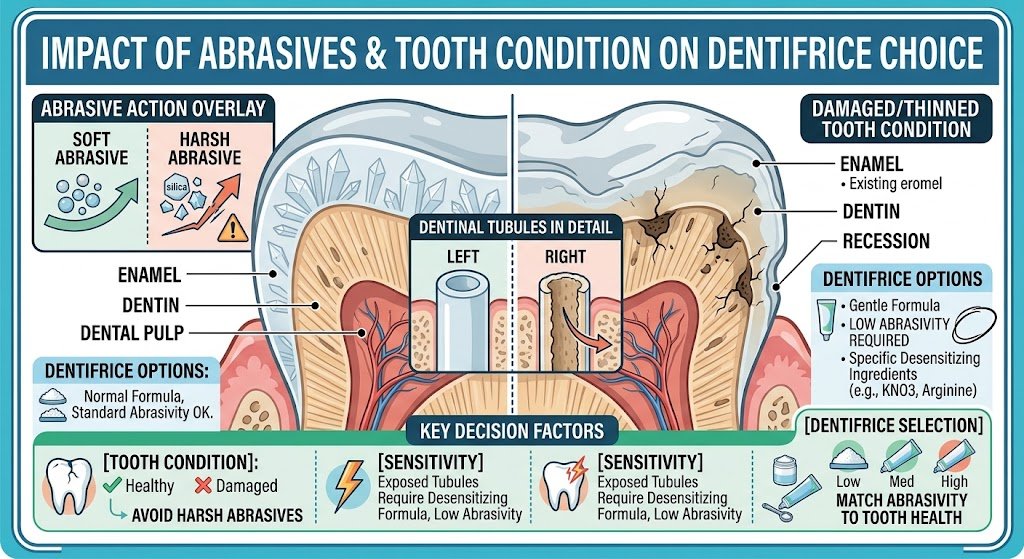
A powdered format does not automatically mean a product is too abrasive for enamel.
Likewise, a toothpaste in a smooth paste or gel isn’t automatically gentle.
The relevant issue is the abrasivity and formulation of the finished dentifrice, together with how aggressively it is used.
The ADA notes that dentifrice abrasives can help clean teeth and remove surface stains. It also cautions that RDA values below 250 should not be used quantitatively to rank toothpaste safety because those values do not directly correspond to clinical changes in enamel. (American Dental Association)
That is useful context because it prevents a common mistake: treating one ingredient or one laboratory number as a complete measure of a product’s safety.
How to use a powder more carefully
Follow the manufacturer’s directions and avoid aggressive scrubbing.
If you have:
- Significant tooth sensitivity
- Enamel erosion
- Exposed dentin
- Gum recession
- Tooth pain
- A diagnosed dental condition
don’t assume that switching formats will solve the underlying problem.
A dentist can help determine whether your sensitivity or enamel concerns require something more specific than a change in dentifrice.
Is Tooth Powder Good for Sensitive Teeth?
It depends on the formulation and the reason for your sensitivity.
“Tooth powder” isn’t a treatment category for sensitivity by itself.
The ADA identifies several desensitizing ingredients used in toothpaste, including stannous and potassium-containing formulations and arginine, and cites evidence supporting certain self-applied formulations for reducing dentin hypersensitivity. (American Dental Association)
That means someone shopping specifically for sensitivity relief should look beyond the word “powder.”
Ask:
- Does the product contain an ingredient intended for sensitivity?
- What does the manufacturer say the product is designed to do?
- Is the formulation appropriate for everyday use?
- Do I know why my teeth are sensitive?
If sensitivity is persistent, severe, or localized to one tooth, changing toothpaste or tooth powder may not address the underlying cause.
How to Choose a Tooth Powder
Once you’ve decided that the powdered format suits you, the next step is evaluating individual products.
1. Decide whether you want fluoride
This is the first major decision for many shoppers.
If cavity prevention is a priority, look carefully for an appropriate fluoride formulation.
If you’re specifically seeking fluoride-free oral care, understand that this is a meaningful choice rather than merely a cosmetic preference.
Don’t assume that “fluoride-free” means healthier for everyone.
2. Identify your primary goal
Ask what you actually want the product to accomplish.
Your priority might be:
- Everyday cleaning
- Cavity prevention
- A fluoride-free formulation
- A particular ingredient
- Sensitivity support
- A different texture
- Travel convenience
- Packaging preferences
- A simpler ingredient list
This immediately narrows the products worth considering.
3. Read the active ingredients
Don’t let the front of the package make the decision for you.
Terms such as:
- Natural
- Clean
- Pure
- Chemical-free
- Detoxifying
- Mineral-based
don’t tell you enough about a dentifrice’s oral-health function.
Read the ingredient list and the product’s actual claims.
4. Consider the abrasive system
Abrasives have a legitimate role in cleaning, but more aggressive polishing isn’t necessarily better.
Be skeptical of products that encourage unusually forceful brushing or imply that dramatic surface polishing is required for healthy teeth.
Your goal is effective daily cleaning—not maximum scrubbing.
5. Follow the manufacturer’s directions
Different products can have different instructions for dispensing and brushing.
Use the amount recommended on the product packaging and follow its directions rather than assuming every tooth powder should be used identically.
6. Consider packaging and convenience
This is one area where tooth powder may appeal to certain shoppers.
A dry product can be convenient for people who prefer a small container or want a different packaging format.
But convenience should remain secondary to the product’s oral-health characteristics.
7. Compare cost per use
Don’t compare products solely by the price of the container.
Consider:
- Product quantity
- Recommended amount per use
- Number of uses
- Refill availability
- Shipping cost
- How frequently you’ll need to replace it
A more expensive container isn’t necessarily more expensive—or better—per brushing.
Who Might Prefer Tooth Powder?
Tooth powder may appeal to people who:
- Prefer a dry oral-care format
- Don’t like conventional toothpaste textures
- Want to explore different formulations
- Prefer certain packaging formats
- Want a compact product for travel
- Have a specific ingredient preference
- Simply enjoy trying alternative dentifrice formats
There is no need to treat those preferences as either inherently better or worse.
If the formulation fits your needs and you can use the product comfortably and consistently, the format may work well for your routine.
Who Should Be More Careful?
Some situations deserve more attention than simply choosing a new product.
Talk with a dentist before making a major change to your oral-care routine if you have:
- Recurrent cavities
- Significant or persistent sensitivity
- Tooth pain
- Persistent gum bleeding
- Suspected enamel erosion
- Exposed tooth roots
- Recently completed dental treatment
- A high risk of dental caries
For these people, the important question isn’t simply whether tooth powder is convenient.
It’s whether the specific product provides the type of oral-health support appropriate for their situation.
The CDC emphasizes that fluoride helps prevent cavities in both children and adults, while individual fluoride needs can depend on oral-health circumstances. (CDC)
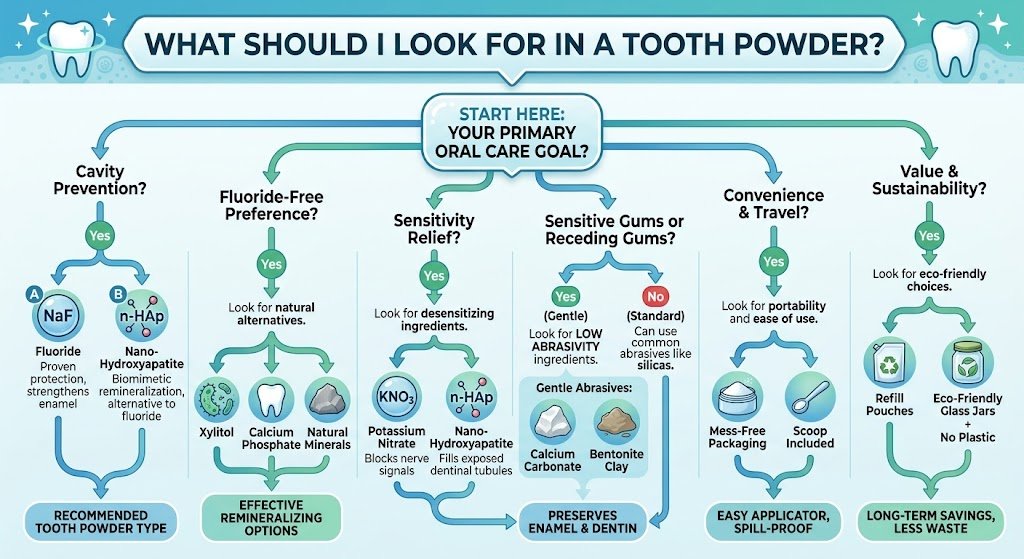
What Makes a Tooth Powder Worth Buying?
There isn’t one universal “best” tooth powder.
The right product depends on what you’re trying to accomplish.
| Your priority | What to evaluate first |
| Cavity prevention | Fluoride status and anticaries formulation |
| Fluoride-free preference | Complete formulation and your individual cavity risk |
| Ingredient-conscious shopping | Full ingredient list and specific product claims |
| Sensitivity | Appropriate desensitizing formulation and underlying cause |
| Everyday cleaning | Formulation, brushing instructions, and usability |
| Travel | Packaging, portability, and dispensing |
| Value | Cost per use rather than container price |
| Specific ingredient | Evidence and complete formulation, not just ingredient presence |
This is also the point where affiliate recommendations can be useful.
Instead of asking readers to buy the product with the most impressive marketing, the article should help them identify which type of product fits their priorities.
Should You Buy Tooth Powder?
If you like the idea of a powdered dentifrice, there’s no reason to judge it solely by its format.
Tooth powder can be a legitimate form of dentifrice, and clinical research has examined powdered formulations for outcomes such as plaque and gingivitis. But individual studies of specific products shouldn’t be generalized to every tooth powder on the market. (PubMed)
The more useful question is:
Does this particular product have the formulation and characteristics that match my oral-health needs?
For someone focused on cavity prevention, fluoride deserves serious consideration because its role in preventing cavities is well established. (CDC)
For someone interested in tooth powder because of packaging, texture, ingredients, or personal preference, those factors can be evaluated alongside the product’s actual oral-health characteristics.
In other words, don’t buy a tooth powder because it says “natural” on the label.
Buy it because you understand what it contains, what it is intended to do, and why those characteristics make sense for you.
Frequently Asked Questions
What is tooth powder?
Tooth powder is a dry form of dentifrice used with a toothbrush. Like toothpaste, it can contain abrasive and functional ingredients, but its physical form is powdered rather than a paste or gel. The ADA recognizes powder as one possible dentifrice format. (American Dental Association)
Is tooth powder better than toothpaste?
Not inherently. Tooth powder and toothpaste are formats, while the formulation determines important characteristics such as active ingredients and intended benefits.
Does tooth powder contain fluoride?
Some tooth powders may contain fluoride and others may be fluoride-free. Check the specific product’s ingredient and active-ingredient information rather than assuming based on the product format.
Is fluoride important in tooth powder?
If cavity prevention is a priority, fluoride is an important consideration. The CDC identifies fluoride as an effective tool for preventing cavities in children and adults. (CDC)
Can tooth powder damage enamel?
A powdered format does not automatically mean that a product will damage enamel. Abrasivity depends on the formulation and how it is used. Avoid aggressive brushing and seek professional advice if you already have enamel or sensitivity concerns.
Can you use tooth powder every day?
Many tooth powders are designed for routine brushing, but you should follow the directions for the specific product. If you have a high risk of cavities or another dental condition, discuss your oral-care routine with a dentist.
Is fluoride-free tooth powder better?
There is no universal answer. Some people deliberately prefer fluoride-free products, but fluoride has established cavity-prevention benefits. Fluoride-free should therefore be treated as a specific preference or decision, not as an automatic synonym for healthier.
What should I look for when buying tooth powder?
Start with your primary oral-health goal. Then check the fluoride status, active ingredients, abrasive system, manufacturer’s directions, ingredient transparency, packaging, and cost per use.
Is tooth powder good for sensitive teeth?
It depends on the formulation and the cause of your sensitivity. A powder isn’t automatically better or worse for sensitive teeth simply because it is powdered.
Can tooth powder replace toothpaste?
A tooth powder can function as a dentifrice, but whether a specific product is an appropriate replacement depends on its formulation and your oral-health needs. In particular, don’t assume that a fluoride-free powder provides the same cavity-prevention benefits as a fluoride dentifrice.
Conclusion
Tooth powder is best understood as another format of dentifrice, not automatically as a healthier or more natural version of toothpaste.
When choosing one, look beyond the packaging. Consider the active ingredients, fluoride status, abrasive system, intended purpose, directions, convenience, and your own oral-health needs.
If cavity prevention is important to you, fluoride deserves particular attention. If you’re choosing tooth powder because of ingredient preferences, packaging, or texture, compare the complete formulation rather than relying on broad marketing terms.
The goal isn’t to find the most unusual tooth powder.
It’s to find a product that makes sense for your teeth, your priorities, and your everyday routine.
