If you brush your teeth with fluoride toothpaste, the usual recommendation is to spit out the excess toothpaste but not rinse your mouth with water immediately afterward.
Why? Rinsing right away can wash away or dilute the concentrated fluoride left on your teeth after brushing. Keeping some fluoride in contact with your teeth for longer gives it more opportunity to help protect against tooth decay. The American Dental Association (ADA) has specifically advised that people can spit out the excess toothpaste and avoid water immediately after brushing. (ADA News)
That does not mean rinsing is dangerous or that you have ruined your brushing routine if you have always rinsed. Brushing thoroughly with fluoride toothpaste twice a day remains one of the most important parts of everyday oral care. (CDC)
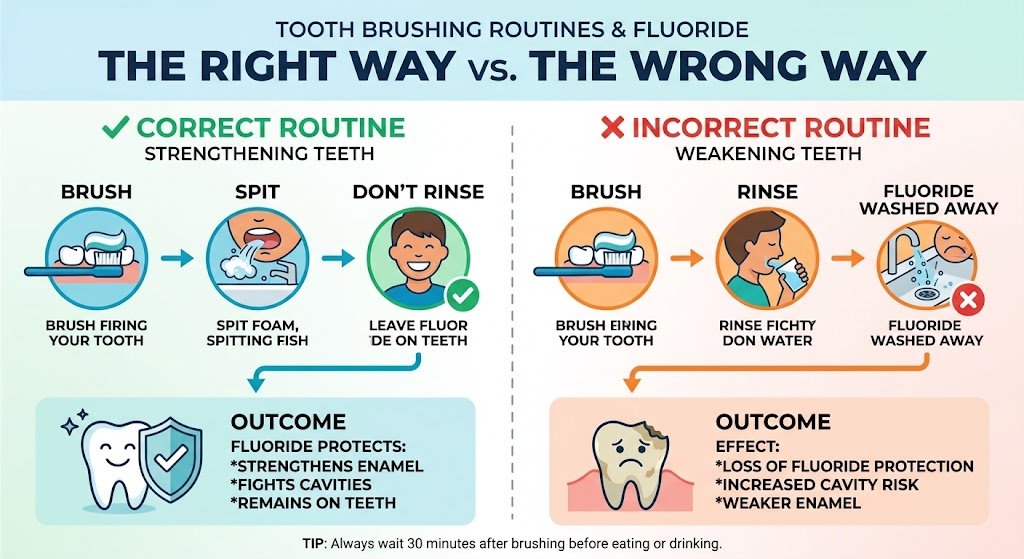
Should You Rinse After Brushing?
For most people using fluoride toothpaste, no—you generally should not rinse with water immediately after brushing.
Instead:
- Brush your teeth thoroughly with fluoride toothpaste.
- Spit out the excess toothpaste.
- Avoid rinsing immediately with water.
- If you use mouthwash, consider using it at a different time rather than immediately after brushing.
The reason is simple: fluoride is one of the key ingredients responsible for the cavity-prevention benefit of fluoride toothpaste. Immediately washing your mouth with water can reduce the amount of fluoride remaining around your teeth. (ADA News)
For more information about fluoride itself, see our guide to [ What Is Fluoride? → /fluoride/what-is-fluoride/ ] and [ How Does Fluoride Prevent Cavities? → /fluoride/how-fluoride-prevents-cavities/ ].
Why Is It Better Not to Rinse After Brushing?
The main reason is fluoride exposure.
When you brush with fluoride toothpaste, you are not simply cleaning away food and plaque. You are also delivering fluoride to the surfaces of your teeth.
Fluoride can help strengthen enamel and make teeth more resistant to acids involved in tooth decay. The ADA notes that leaving fluoride from toothpaste on the teeth after brushing can help maximize this benefit. (ADA News)
If you immediately rinse with a large amount of water, you remove much of the toothpaste residue instead of allowing that fluoride to remain in contact with your teeth.
Think of it this way:
Brushing removes plaque + fluoride toothpaste delivers fluoride + spitting leaves some fluoride behind.
Adding a vigorous water rinse immediately afterward can interfere with the last step.
This is why the simple advice “spit, don’t rinse” is commonly recommended after fluoride toothbrushing. The NHS gives the same practical advice, explaining that immediate rinsing washes away the concentrated fluoride remaining from the toothpaste. (nhs.uk)
What Should You Do Immediately After Brushing?
The easiest routine is:
1. Brush for about two minutes
Brush all tooth surfaces carefully rather than concentrating only on the front teeth.
The CDC recommends brushing at least twice a day with fluoride toothpaste. (CDC)
If you need help improving your brushing routine, see [ How Often Should You Brush? → /toothpaste/how-often-to-brush/ ].
2. Spit out the excess toothpaste
After brushing, spit out the toothpaste that remains in your mouth.
You do not need to try to remove every trace of toothpaste.
3. Skip the immediate water rinse
Instead of filling your mouth with water and rinsing several times, simply finish by spitting.
This leaves more of the fluoride from the toothpaste available around the teeth. (ADA News)
4. Avoid turning the routine into a complicated ritual
You do not need to measure water, count every second, or worry if you accidentally rinse once.
The bigger priority is maintaining a consistent oral-care routine, including brushing twice daily with fluoride toothpaste.
What If You Really Want to Rinse After Brushing?
Some people dislike the feeling or taste of leftover toothpaste and strongly prefer rinsing.
If that is your habit, you do not need to panic.
The ADA has cited dental guidance suggesting that people who prefer to rinse can use a small amount of water rather than vigorously rinsing, or delay the rinse rather than doing it immediately. (ADA News)
The important distinction is between:
A small, gentle rinse
and
A large, vigorous rinse that washes away most of the toothpaste residue.
If you have a high risk of cavities or your dentist has specifically told you not to rinse after brushing, follow that individualized advice.
And if you have been rinsing after every brushing for years, there is no reason to assume you have damaged your teeth simply because of that habit. ADA guidance emphasizes that people who have been rinsing should not be overly concerned, particularly when they are otherwise brushing regularly with fluoride toothpaste. (ADA News)
Should You Rinse After Non-Fluoride Toothpaste?
The main reason to avoid immediate rinsing is the fluoride in fluoride toothpaste.
If a toothpaste does not contain fluoride, the specific fluoride-retention benefit does not apply.
However, that does not automatically mean non-fluoride toothpaste is the best choice for everyone.
For people looking for cavity protection, fluoride toothpaste has an important advantage because fluoride helps prevent tooth decay. The CDC recommends brushing with fluoride toothpaste, and the ADA also recognizes fluoride toothpaste as providing an added cavity-prevention benefit. (CDC)
Before choosing a toothpaste, check its active ingredients and intended use rather than choosing solely based on flavor, whitening claims, packaging, or marketing language.
You can learn more in [ How to Read Toothpaste Ingredients → /how-to-read-toothpaste-ingredients/ ].
What About Mouthwash After Brushing?
This is where things can become confusing.
You might think:
“If I should not rinse with water, can I rinse with mouthwash instead?”
Generally, using mouthwash immediately after brushing is not the best way to preserve the fluoride from your toothpaste.
The NHS recommends using fluoride mouthwash at a different time from brushing because using it immediately after brushing can wash away the more concentrated fluoride from toothpaste. (nhs.uk)
A practical routine could therefore look like this:
Morning:
Brush → spit → no immediate rinse
Later in the day:
Use mouthwash if it is appropriate for you and according to the product directions
Night:
Brush → spit → no immediate rinse
However, there is an important qualification.
The ADA notes that the best order for oral-care products can depend on their ingredients and the manufacturer’s directions. In some circumstances, specific product instructions may recommend rinsing after brushing. (American Dental Association)
So if your dentist has recommended a particular mouthwash or your product label gives specific instructions, follow those directions.
And remember: mouthwash is not a substitute for brushing and cleaning between the teeth.
Does Rinsing After Brushing Cause Cavities?
Not directly.
Rinsing after brushing does not mean that you will automatically develop cavities.
The concern is that immediately rinsing can reduce the amount of fluoride remaining on the teeth, potentially reducing one of the benefits of fluoride toothpaste.
Tooth decay is influenced by several factors, including oral hygiene, fluoride exposure, diet, saliva, and individual cavity risk.
So it is more accurate to say:
Not rinsing can help maximize the topical fluoride benefit of fluoride toothpaste.
It would be inaccurate to say:
“If you rinse, you will get cavities.”
The latter is far too simplistic.
If you have always rinsed after brushing, focus on improving your routine going forward rather than worrying about past behavior.
Does Not Rinsing Help Protect Enamel?
It can help maintain fluoride contact with the tooth surface.
Fluoride supports the mineral structure of teeth and helps make enamel more resistant to acids involved in tooth decay. Keeping fluoride from toothpaste in the mouth for longer can therefore support its protective role. (ADA News)
However, “not rinsing” is only one small part of enamel protection.
Other important habits include:
- Brushing regularly with fluoride toothpaste
- Cleaning between the teeth
- Limiting frequent exposure to sugary foods and drinks
- Following your dentist’s recommendations
- Getting professional dental care when needed
What About Eating or Drinking After Brushing?
There is no need to turn this into a complicated rule.
The key point is that immediately washing away toothpaste reduces the amount of fluoride remaining on your teeth.
Some dental guidance recommends avoiding food and drinks for a period after brushing, while exact timing recommendations can vary. For example, some NHS guidance recommends waiting around 30 minutes, but this should not be presented as a universal U.S. rule. (North Tees NHS Trust)
For everyday U.S. readers, the most important takeaway is simpler:
Brush with fluoride toothpaste, spit out the excess, and avoid immediately rinsing it away.
If your dentist has given you specific instructions about eating, drinking, fluoride treatments, or a prescription toothpaste, follow those instructions.
Should Children Rinse After Brushing?
Children need extra attention because they are more likely to swallow toothpaste.
The CDC recommends that children brush twice a day with fluoride toothpaste and that parents supervise young children and teach them to spit rather than swallow the toothpaste. (CDC)
For young children, the amount of toothpaste matters.
The CDC recommends:
- Under age 3: no more than a rice-grain amount of fluoride toothpaste
- Ages 3–6: no more than a pea-sized amount
- Young children should be supervised and taught to spit rather than swallow toothpaste. (CDC)
For children younger than 2, the CDC recommends consulting a doctor or dentist about fluoride toothpaste and other fluoride products. (CDC)
This means parents should not simply tell a young child to use a large amount of toothpaste and then rinse repeatedly.
Instead, use the appropriate amount and teach the child how to spit it out.
For more information, see [ Fluoride Toothpaste for Children → /fluoride/fluoride-toothpaste-for-children/ ].
What About Children’s Mouthwash?
Children’s mouthwash should not be treated like toothpaste.
The ADA says mouthrinse is generally not recommended for children younger than 6 unless directed by a dentist. Young children may not have a well-developed swallowing reflex and may accidentally swallow the product. (American Dental Association)
If your child needs a fluoride mouth rinse or another oral-care product, ask their dentist about the appropriate product and age.
What If You Accidentally Rinse?
Nothing to worry about.
If you brushed with fluoride toothpaste and then instinctively rinsed with water, you have not undone all the benefits of brushing.
Simply make the adjustment next time:
Brush → spit → skip the water rinse.
The ADA has specifically noted that people who have been rinsing immediately after brushing should not be overly concerned, especially if they are otherwise brushing twice daily for at least two minutes. (ADA News)
Consistency matters more than perfection.
Common Mistakes People Make After Brushing
Mistake 1: Rinsing vigorously with a lot of water
This can wash away the fluoride-containing toothpaste residue you just applied.
Better approach: spit out the excess and leave the remaining fluoride in place.
Mistake 2: Using mouthwash immediately after toothpaste
Mouthwash can rinse away some of the concentrated fluoride left by toothpaste.
Better approach: use mouthwash at another time when appropriate. (nhs.uk)
Mistake 3: Using too much toothpaste
More toothpaste does not automatically mean better cleaning.
For young children especially, using excessive fluoride toothpaste can increase the amount they may swallow.
Better approach: use the amount appropriate for the person’s age and follow your dentist’s guidance.
Mistake 4: Focusing on rinsing while ignoring brushing technique
Whether you rinse or not matters less than failing to brush thoroughly and consistently.
Better approach: make twice-daily brushing with fluoride toothpaste the foundation of your routine.
Mistake 5: Assuming every mouthwash and toothpaste combination works the same way
Oral-care products can contain different active ingredients, and manufacturers may provide specific instructions.
Better approach: check the label and ask your dentist or dental hygienist if you are unsure.
When Might Your Dentist Tell You to Do Something Different?
General oral-care advice is useful, but your dentist may recommend something different based on your individual situation.
For example, your dentist may recommend a specific toothpaste, fluoride treatment, mouth rinse, or rinsing routine because of your cavity risk, dental treatment, sensitivity, gum condition, or another oral-health concern.
The ADA also notes that product ingredients can affect how toothpaste and mouthrinse should be used together. (American Dental Association)
So the general rule is:
Follow standard guidance unless your dental professional has given you personalized instructions.
If you have recently had dental treatment or are using a prescription-strength oral-care product, do not change the instructions without checking with your dental professional.
What Kind of Toothpaste Should You Use?
If your main goal is cavity prevention, start by looking for a fluoride toothpaste rather than choosing solely based on flavor or cosmetic claims.
The CDC recommends brushing at least twice daily with fluoride toothpaste. (CDC)
The right toothpaste can depend on your specific needs.
For example, you might be looking for:
- Cavity protection
- Sensitivity relief
- Whitening
- Gum-care support
- Children’s oral care
- A particular ingredient preference
The important thing is to match the toothpaste to your needs while still considering whether it provides fluoride-based cavity protection.
Amazon Affiliate Buying Tip
If you are shopping for toothpaste online, avoid choosing a product simply because it has attractive packaging, a large number of reviews, or a marketing phrase such as “advanced,” “maximum,” or “natural.”
Instead, check:
- Whether it contains fluoride
- The active ingredient
- The product’s intended purpose
- Age recommendations where applicable
- Any relevant warnings
- Whether it matches your dental needs
- Whether your dentist has recommended a particular type
For an affiliate site, this is where product recommendations should remain useful rather than turning the article into an advertisement.
[ AMAZON PRODUCT CATEGORY: Fluoride toothpaste / cavity-protection toothpaste ]
Frequently Asked Questions
Is it better to spit or rinse after brushing?
For most people using fluoride toothpaste, spit rather than immediately rinse with water. This helps avoid washing away the fluoride left from brushing. (ADA News)
How long should I wait before rinsing after brushing?
There is no need to make a precise waiting period the main focus of your routine. The simplest approach is to spit out excess toothpaste and avoid rinsing immediately. ADA dental guidance has also suggested that people who prefer to rinse can use a small amount of water or delay rinsing. (ADA News)
Can I rinse with mouthwash after brushing?
It is generally better to use mouthwash at a different time if your goal is to keep the concentrated fluoride from your toothpaste on your teeth. However, product ingredients and instructions can differ, so follow the label or your dentist’s recommendation. (nhs.uk)
What happens if I rinse after brushing?
Rinsing immediately can wash away or dilute some of the fluoride left by toothpaste. It does not mean your brushing was useless or that you will automatically develop cavities. (ADA News)
Should children rinse after brushing?
Children should be taught to spit out toothpaste rather than swallow it. The CDC recommends age-appropriate amounts of fluoride toothpaste and supervision for young children. (CDC)
Should I rinse after brushing with fluoride toothpaste?
Usually, no. Spit out the excess toothpaste and avoid immediately rinsing with water so more fluoride can remain around your teeth. (ADA News)
Is rinsing after brushing bad for your teeth?
Not necessarily. Rinsing can reduce the amount of fluoride remaining from toothpaste, but it does not automatically damage your teeth. If you have always rinsed, simply consider changing the habit going forward.
Can I drink water after brushing?
Drinking water soon after brushing can reduce the amount of toothpaste fluoride remaining in your mouth. If possible, avoid immediately washing away the toothpaste residue. If you have specific dietary, medication, or dental instructions, follow your healthcare professional’s advice.
Is it okay to rinse if I don’t like the taste of toothpaste?
Yes. If you strongly prefer to rinse, the ADA has cited guidance suggesting a small amount of water rather than a vigorous rinse, or delaying the rinse. (ADA News)
Is not rinsing more important if I get cavities easily?
It may be particularly useful for people at higher risk of cavities because preserving fluoride exposure after brushing can help maximize the protective benefit of fluoride toothpaste. (ADA News)
The Bottom Line: Spit, Don’t Rinse
If you want the simplest answer to “Should you rinse after brushing?”, it is:
Brush with fluoride toothpaste, spit out the excess, and don’t immediately rinse with water.
The reason is not that water is harmful. The reason is that rinsing can remove or dilute the fluoride that toothpaste leaves behind. Keeping that fluoride around your teeth for longer can help support its cavity-prevention benefit. (ADA News)
If you have always rinsed after brushing, don’t worry. You have not ruined your teeth. Start by changing the habit at your next brushing session.
And remember that the bigger picture matters: brush consistently with fluoride toothpaste, use the appropriate amount, clean between your teeth,
