The key to evaluating toothpaste ingredients is to understand what each ingredient does, what evidence supports its use, and whether the formula fits your dental needs. An unfamiliar chemical name does not automatically mean an ingredient is harmful, and a “natural” or “non-toxic” label does not automatically make a product safer.
This guide explains common toothpaste ingredients, potential causes of irritation, how to read product labels, and what to compare before buying. You’ll also learn when a product preference is reasonable and when a dental professional’s advice is more useful than changing toothpaste on your own.
How to Think About Toothpaste Ingredient Safety
How to Think About Toothpaste Ingredient Safety
Toothpaste safety is not a simple matter of dividing ingredients into “good” and “bad” lists. An ingredient’s function, the finished formula, directions for use and a person’s individual sensitivities all matter.
Start by separating three questions:
- What does the ingredient do? It may help prevent cavities, remove surface stains, create foam, retain moisture or improve flavor.
- What does the evidence say? Look for credible information about the ingredient in toothpaste, rather than relying on a social media post or a product’s marketing claims.
- Is the formula right for you? A product may suit many people but still contain an ingredient that irritates someone with a particular sensitivity or allergy.
Safety and effectiveness are also different considerations. A toothpaste may avoid an ingredient you prefer not to use but lack a dental benefit you need. The better choice is one that meets your oral-health needs, provides clear labeling and does not contain ingredients you know you cannot tolerate.
Active Ingredients That Support Dental Health
Active ingredients provide a specific intended benefit. In the United States, fluoride compounds are widely used in toothpaste to help prevent tooth decay.
Common fluoride active ingredients include:
- Sodium fluoride
- Stannous fluoride
- Sodium monofluorophosphate
Fluoride helps strengthen tooth enamel and supports remineralization, the process through which minerals are returned to weakened areas of enamel. The American Dental Association (ADA) explains the role of fluoride and other toothpaste ingredients in its toothpasteguidancetoothpaste guidance. addalinkadd a link
What should you check on the label?
Look for the active ingredient and the product’s stated purpose. Read the directions and warnings instead of relying only on large claims printed on the front of the tube.
The ADA Seal of Acceptance can also be a useful signal. Products that carry the Seal have been evaluated against the ADA’s requirements for safety and effectiveness. However, the Seal does not mean that a product is suitable for every person or that nobody can react to an ingredient.
What about fluoride-free toothpaste?
Some shoppers prefer fluoride-free formulas, including products containing hydroxyapatite. These options should not automatically be considered equivalent to fluoride toothpaste for cavity prevention. The evidence and intended claims may differ by ingredient and product.
If you have frequent cavities, a history of dental decay or other factors that increase your risk, ask your dentist before replacing a fluoride toothpaste with a fluoride-free alternative.
For a more detailed comparison of these approaches, see addalink—AnchorText:”hydroxyapatiteversusfluoride”—Destination:”Hydroxyapatitevs.Fluoride”add a link — Anchor Text: “hydroxyapatite versus fluoride” — Destination: “Hydroxyapatite vs. Fluoride”.
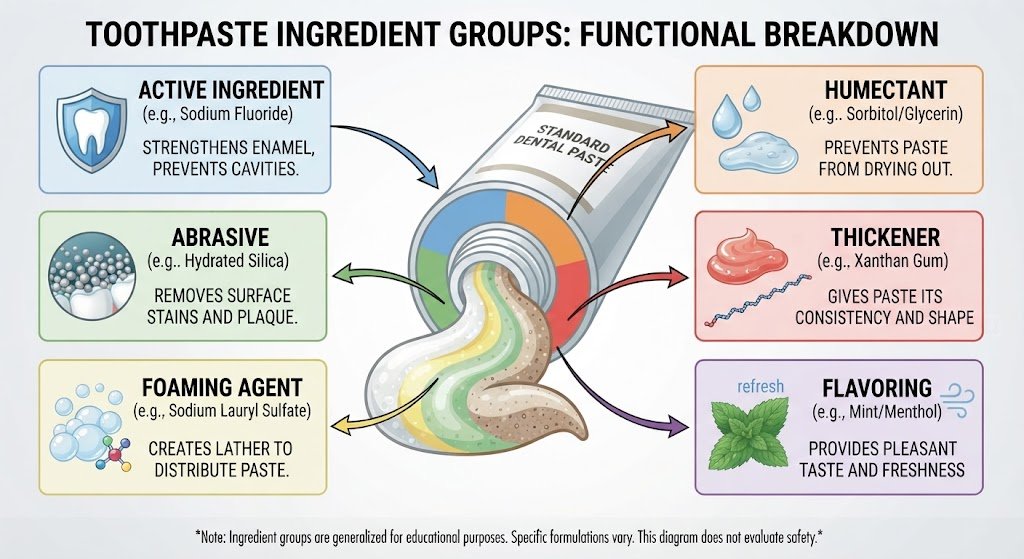
Common Toothpaste Ingredients and What They Do
Toothpaste is a formula made from ingredients with different purposes. Understanding those purposes makes it easier to assess a label without treating every unfamiliar name as a warning sign.
| Ingredient or group | Main purpose | What to consider |
| Sodium fluoride, stannous fluoride or sodium monofluorophosphate | Helps prevent cavities | Check the active ingredient, intended benefit and directions. |
| Hydrated silica | Helps clean teeth and remove surface stains | Cleaning and whitening performance depends on the finished formula and how it is used. |
| Calcium carbonate | Can function as a cleaning abrasive | Its presence alone does not establish that a toothpaste is harmful. |
| Sodium lauryl sulfate (SLS) | Helps create foam | Some people may prefer an SLS-free formula if they experience irritation or recurrent oral ulcers. |
| Glycerin and sorbitol | Help retain moisture and maintain texture | These ingredients commonly serve formulation purposes. |
| Thickeners and binders | Help maintain paste or gel consistency | Their role is generally to keep the formula stable and usable. |
| Flavoring agents and sweeteners | Improve taste | Some flavoring ingredients can trigger reactions in susceptible people. |
| Desensitizing ingredients | Help reduce tooth sensitivity in suitable formulas | Check the stated purpose and follow the product directions. |
| Preservatives and stabilizers | Help maintain product quality | Evaluate the full formula rather than assuming an entire ingredient category is unsafe. |
The ADA describes several of these ingredient functions in its toothpasteoverviewtoothpaste overview. addalinkadd a link
Are foaming ingredients necessary?
Sodium lauryl sulfate, commonly called SLS, is a foaming agent used in some toothpastes. Foam changes how toothpaste feels and spreads during brushing, but more foam does not automatically mean better cleaning.
Some people report irritation with particular formulas. If you experience recurring discomfort, comparing a toothpaste containing SLS with an SLS-free alternative may be reasonable. Research on SLS and oral symptoms has limitations, so it would be inaccurate to say that everyone needs to avoid it.
addalink—AnchorText:”SLSintoothpaste:benefitsanddrawbacks”—Destination:”Futurearticle:SLSinToothpaste”add a link — Anchor Text: “SLS in toothpaste: benefits and drawbacks” — Destination: “Future article: SLS in Toothpaste”
What about abrasives?
Abrasives help remove debris and surface stains. Their presence does not automatically mean that a toothpaste will damage teeth. The finished formulation, brushing technique and individual dental condition all matter.
If you have significant tooth wear, exposed roots or concerns about enamel, ask your dentist whether a toothpaste with particular cleaning or abrasivity characteristics would be appropriate. Do not assume that every whitening toothpaste is suitable for every dental situation.
Toothpaste Ingredients That May Cause Problems for Some People
Most ingredient concerns need to be evaluated in context. Some people use a toothpaste without difficulty, while others may experience irritation or an allergic reaction to a particular ingredient.
Flavoring agents and essential oils
Mint, cinnamon and other flavoring ingredients give toothpaste its taste. However, certain flavoring substances can trigger reactions in susceptible individuals. Toothpaste-associated contact allergy has been documented in the medical literature.
Possible symptoms may include redness, swelling, peeling or soreness around the lips or inside the mouth. These symptoms can have other causes, so they do not prove an allergy on their own.
A published review of toothpaste contact allergy discusses reported reactions and the challenges of identifying their causes. addalinkadd a link
If you suspect a flavoring allergy, keep the product packaging and ingredient list so you can discuss them with a dentist or healthcare professional.
SLS and oral irritation
SLS is not an ingredient that everyone needs to avoid. However, some people with oral irritation or recurrent aphthous ulcers may benefit from trying an alternative formula.
If you suspect SLS contributes to your symptoms, compare ingredient lists and consider asking a dental professional about an appropriate alternative. Do not assume SLS is responsible for every mouth sore, and do not overlook other ingredients in the same product.
What should you do if toothpaste causes symptoms?
If you develop new or recurring discomfort after switching toothpaste:
- Stop using the suspected product if you think it is causing a reaction.
- Keep the packaging so you can review the ingredient list with a professional.
- Ask a dentist or healthcare professional for advice if symptoms persist, recur or are severe.
- Seek urgent medical attention for signs of a serious allergic reaction, such as difficulty breathing or rapidly progressing swelling.
Do not deliberately use a suspected allergen again just to test whether symptoms return. A clinician can help assess possible causes and determine whether further evaluation is appropriate.
Are Natural, Clean and Non-Toxic Toothpastes Safer?
Terms such as “natural,” “clean” and “non-toxic” can describe how a brand positions its product, but they do not by themselves establish that a toothpaste is safer or more effective.
A natural formula may still contain flavoring ingredients that irritate a particular person. A conventional formula may provide an important dental benefit, such as cavity protection. Neither product should be judged solely by whether its ingredients sound familiar.
Before choosing a product, ask:
- What dental benefit is it designed to provide?
- Which active ingredient supports that benefit?
- Is the full ingredient list available?
- Does it contain anything I already know I react to?
- Are its claims supported by credible evidence?
- Are its directions and warnings clear?
In the United States, toothpaste intended to prevent cavities may be subject to both drug and cosmetic requirements. The FDA provides information about U.S. cosmetic labeling requirements and related distinctions. addalinkadd a link
A marketing phrase is not a substitute for checking the label, evaluating the intended benefit and considering your own dental needs.
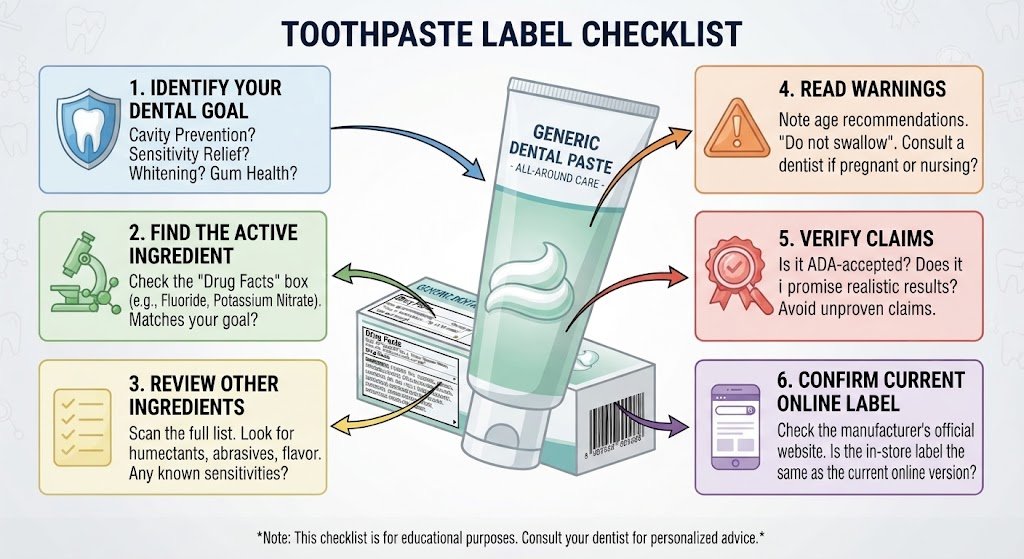
How to Check a Toothpaste Label
Use this checklist whenever you compare toothpaste in a store or online.
Step 1: Identify your main dental goal
Decide what matters most: cavity prevention, sensitivity relief, surface-stain removal or avoiding a known ingredient trigger. If you have several needs, identify your priorities and ask a dentist if you are unsure which should come first.
Step 2: Find the active ingredient
Read the active ingredient information when provided. Check the ingredient name, stated purpose and directions. Do not rely only on the product name or the claims displayed prominently on the packaging.
Step 3: Review the rest of the formula
Look for ingredients you already know you cannot tolerate. If you have previously experienced symptoms associated with particular flavorings or foaming agents, check whether those ingredients appear in the formula.
Do not label an ingredient unsafe simply because it has a long or unfamiliar name.
Step 4: Read warnings and directions
Check the product’s age guidance, warnings, instructions for use and precautions. Children may need different amounts of toothpaste and adult supervision, so caregivers should follow age-appropriate guidance rather than guessing.
Step 5: Check the evidence behind the claims
A claim such as “whitening,” “sensitive” or “natural” should prompt you to look for the specific benefit and supporting information. Where relevant, check whether the product has the ADA Seal and understand what that Seal evaluates.
Step 6: Verify the product before buying
When shopping online, inspect the current package label and product information if available. Listings may contain outdated photographs or incomplete descriptions. If a specific ingredient matters because of a known allergy or sensitivity, verify the current formula with the manufacturer instead of relying on a search snippet.
How to Choose Toothpaste for Your Needs
The most suitable toothpaste depends on the benefit you need and any personal restrictions you have.
If cavity prevention is your priority
Look for a toothpaste intended for anticavity use and check its active ingredient and directions. Fluoride toothpaste has an established role in cavity prevention. If you are considering a fluoride-free product, discuss the implications with your dentist if your cavity risk is elevated.
If your teeth are sensitive
Compare toothpastes specifically formulated for sensitivity. Look for a clearly stated purpose and an appropriate desensitizing active ingredient. If sensitivity is new, severe or persistent, have it assessed instead of assuming that toothpaste alone will solve the problem.
If you want to avoid SLS
An SLS-free toothpaste may be worth considering if you prefer not to use this foaming agent or suspect it contributes to your symptoms. Check the complete label: switching away from SLS does not automatically eliminate every possible irritant.
If you prefer hydroxyapatite toothpaste
Check the product’s stated purpose, full ingredient list and supporting evidence. Do not assume every hydroxyapatite product has the same formulation or that it is automatically interchangeable with fluoride toothpaste for every person.
If whitening is your priority
Determine whether you want to remove surface stains or address a different type of discoloration. Compare the product’s intended method and directions. Ask a dentist before using whitening products if you have significant sensitivity, exposed roots or other dental concerns.
How to Compare Toothpaste Products Before Buying
Once you understand your needs, compare a small number of products using the same criteria. This is more useful than choosing the one with the most impressive marketing.
| Comparison point | What to check |
| Dental purpose | Does it address your main need? |
| Active ingredient | Is it clearly identified and appropriate for the intended benefit? |
| Full ingredient list | Can you check for ingredients you prefer to avoid? |
| Warnings and directions | Are they clear and suitable for the intended user? |
| Evidence or quality signals | Are relevant claims supported? Does the ADA Seal apply? |
| Personal suitability | Does the formula account for known sensitivities? |
| Cost | Compare package size and price per ounce, not just the headline price. |
| Product information | Can you verify the current formula before ordering? |
If you are ready to shop, compare addalink—AnchorText:”fluoridetoothpasteoptions”—Destination:”BestFluorideToothpasteadd a link — Anchor Text: “fluoride toothpaste options” — Destination: “Best Fluoride Toothpaste for cavity protection or addalink—AnchorText:”ingredient−conscioustoothpasteoptions”—Destination:”BestNon−ToxicToothpaste”add a link — Anchor Text: “ingredient-conscious toothpaste options” — Destination: “Best Non-Toxic Toothpaste” if your priority is comparing formulas and ingredient disclosures.
Before ordering, verify the current label and follow the product directions. A product that fits one person’s preferences may not be the right choice for someone else.
Frequently Asked Questions
What toothpaste ingredients should I look for?
Start with the active ingredient and the dental benefit you need. For cavity prevention, check whether the product is intended for anticavity use and review its directions. Then examine the remaining ingredients for known personal triggers and make sure the label provides enough information to assess the formula.
Which toothpaste ingredients can cause irritation?
Some flavoring agents, essential oils, SLS and other ingredients have been associated with irritation or allergic reactions in some people. This does not mean everyone will react to them. If symptoms recur, seek professional advice rather than assuming you have identified the cause yourself.
Is fluoride toothpaste safe for everyday use?
Fluoride toothpaste is widely used for cavity prevention when used according to product directions. The appropriate product and instructions can depend on age and individual circumstances. Ask a dentist for personalized advice if you have specific concerns about fluoride or your risk of cavities.
Is natural toothpaste safer than regular toothpaste?
Not automatically. “Natural” is not enough to establish that a formula is safer or more effective. Evaluate its intended benefit, active ingredient, complete formula, directions and any known sensitivities.
Should I avoid SLS in toothpaste?
Not everyone needs to avoid SLS. It is used as a foaming agent, but some people may prefer an SLS-free formula if they experience irritation or recurrent oral ulcers. Consider the full formula and consult a dental professional if symptoms persist.
How can I check toothpaste ingredients before buying online?
Look for the current package label, active ingredients, complete ingredient list, warnings and directions. Do not rely only on the product title or promotional claims. If an ingredient matters because of a known allergy or sensitivity, verify the current formula with the manufacturer.
What should I do if toothpaste causes burning or mouth sores?
Stop using the suspected product if you think it is causing the symptoms and seek advice if discomfort persists, recurs or is severe. Keep the packaging and ingredient list to help a dentist or healthcare professional assess possible causes. Do not assume one ingredient is responsible without proper evaluation.
Conclusion
A useful toothpaste ingredient safety check starts with the product’s purpose, active ingredient and directions—not a list of ingredients to fear. Learn what the main ingredient groups do, consider your dental needs and check for substances you already know you cannot tolerate.
Be cautious with broad “natural,” “clean” and “non-toxic” claims. Compare the complete formula and credible evidence instead. If you are choosing toothpaste for a particular dental condition or suspect an ingredient reaction, a dentist can help you select an appropriate option.
Before you buy: confirm the current label, review the directions and choose the formula that fits your needs rather than relying on marketing language alone.
