A toothpaste ingredient list can look like a long collection of unfamiliar names. But you do not need to recognize every ingredient to understand what you are buying.
A useful toothpaste ingredient checker should help you answer three questions:
- What does each ingredient do?
- Which ingredients matter most for my dental goal?
- Does this formula fit my preferences and needs?
The important part is to look at the whole formula, rather than deciding that one ingredient is automatically good or bad.
Toothpastes contain both active and inactive ingredients. Active ingredients can provide specific oral-health benefits, while supporting ingredients help with things such as texture, moisture, flavor, and formulation. (American Dental Association)
This guide will show you how to check a toothpaste ingredient list, understand the major ingredients, compare two formulas, and choose a toothpaste category based on what you actually need.
Affiliate disclosure: Some links on this page may be affiliate links. If you purchase through one of these links, we may earn a commission at no additional cost to you. Our recommendations are based on ingredient function, product purpose, available evidence, and reader usefulness.
How to Use This Toothpaste Ingredient Checker
You do not need to become a chemist to evaluate toothpaste.
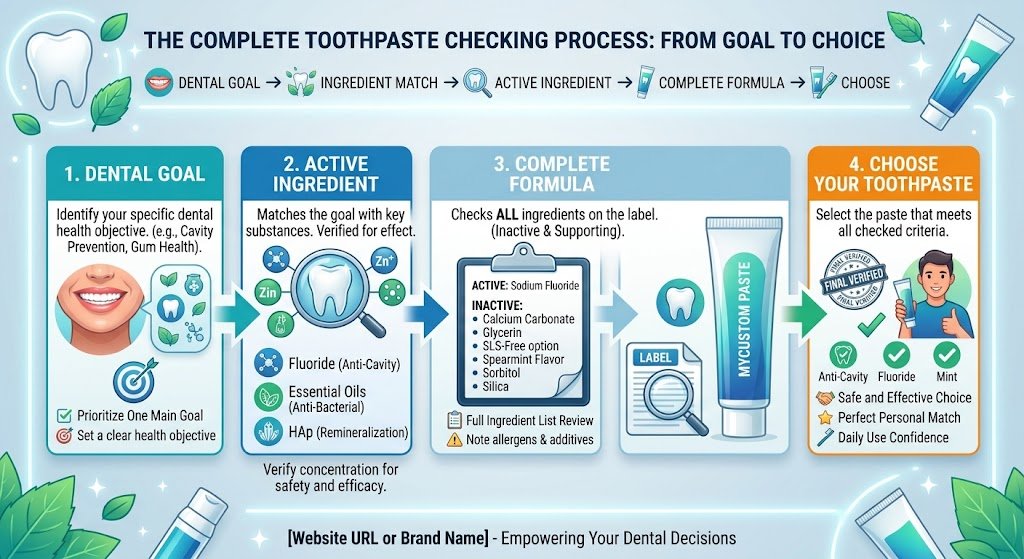
Use this five-step process whenever you want to check a formula.
Step 1: Find the Full Ingredient List
Start with the actual ingredient list on the toothpaste package or the manufacturer’s product information.
Do not rely only on claims such as:
- Natural
- Clean
- Whitening
- Gentle
- Mineral
- Advanced
- Fresh
- Sensitive
These words may describe how a product is marketed, but they do not tell you everything about its formulation.
The ingredient list gives you a better starting point.
Step 2: Identify the Active Ingredient
Next, find the ingredient responsible for the toothpaste’s main dental purpose.
For cavity protection, common fluoride active ingredients include:
- Sodium fluoride
- Stannous fluoride
- Sodium monofluorophosphate
The American Dental Association identifies these fluoride-containing compounds as anticaries agents used in toothpaste, and the FDA’s OTC anticaries monograph specifies conditions for their use in dentifrice products. (American Dental Association)
For sensitivity, look for ingredients used in desensitizing formulas, including potassium-based ingredients, arginine, or stannous fluoride. The ADA summarizes evidence supporting several of these approaches for reducing dentin hypersensitivity pain. (American Dental Association)
Step 3: Identify Your Main Dental Goal
Before deciding whether an ingredient is useful, ask what you want your toothpaste to do.
Is your main goal:
- Cavity protection?
- Sensitive teeth?
- Enamel care?
- Whitening?
- Gum and plaque care?
- A fluoride-free formula?
- An SLS-free formula?
- A simpler ingredient list?
Your answer changes which ingredients deserve the most attention.
For example, a person looking for cavity protection may prioritize a recognized anticaries active ingredient. Someone dealing with sensitivity may pay more attention to desensitizing ingredients.
Step 4: Check Personal Preferences and Tolerance
After identifying the active ingredient, look at ingredients that matter specifically to you.
You may want to check for:
- SLS
- Particular flavoring ingredients
- Ingredients you already know you do not tolerate
- Fluoride, if you specifically want a fluoride-free formula
- Ingredients you prefer to avoid for personal reasons
This is where an ingredient checker becomes more useful than a simple “safe” or “unsafe” list.
A formula can be appropriate for one person and uncomfortable for another.
Step 5: Evaluate the Complete Formula
Finally, step back and look at the toothpaste as a whole.
The goal is not:
“Find a toothpaste with the fewest ingredients.”
Instead, ask:
Does this formula contain ingredients that make sense for my dental goal, and does anything in the formula conflict with my preferences or tolerance?
That approach keeps you from overreacting to one unfamiliar ingredient while still giving you a practical way to identify ingredients worth investigating.
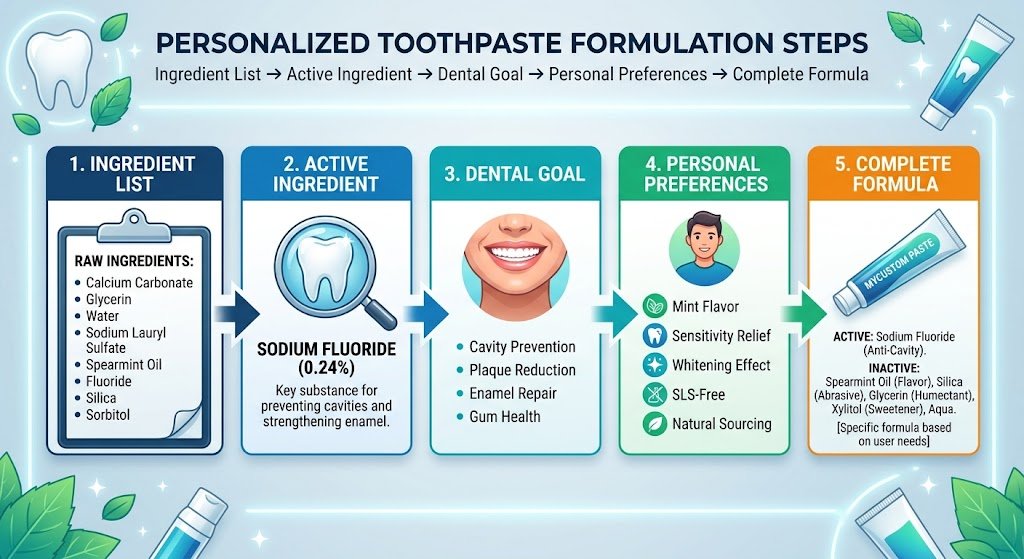
What Does Each Toothpaste Ingredient Do?
The easiest way to understand a toothpaste formula is to organize ingredients by function.
| Ingredient or group | Main role | Why it may matter |
| Fluoride | Cavity protection | Important anticaries active |
| Hydroxyapatite | Active ingredient in some fluoride-free formulas | Relevant to fluoride-free shoppers |
| Potassium-based ingredients | Sensitivity care | Used in desensitizing formulas |
| Arginine | Sensitivity care | Used in some desensitizing formulas |
| Hydrated silica | Abrasive | Helps with mechanical cleaning |
| Calcium carbonate | Abrasive | Helps remove surface debris |
| Glycerin | Humectant | Helps retain moisture |
| Xylitol | Sweetener | Contributes to taste and formulation |
| SLS | Surfactant | Creates foam |
| Flavoring | Taste | Makes toothpaste more pleasant to use |
The important distinction is that these ingredients do different jobs.
For example, fluoride is not included simply to make toothpaste taste better, while glycerin is not included to provide the same anticaries function as fluoride.
Understanding the role of an ingredient is the first step toward deciding whether it matters to you.
Fluoride
Fluoride is one of the most important toothpaste ingredients to understand.
The ADA explains that fluoride helps prevent tooth decay and supports remineralization of early enamel lesions. Fluoride toothpaste is also the most commonly used form of self-applied topical fluoride. (American Dental Association)
In the U.S., over-the-counter fluoride toothpastes generally contain between 1,000 and 1,500 ppm fluoride, and the active fluoride compound can be sodium fluoride, sodium monofluorophosphate, or stannous fluoride. (American Dental Association)
That means “fluoride toothpaste” is not necessarily one identical formula.
The specific fluoride compound is worth checking.
Sodium Fluoride
Sodium fluoride is an established anticaries active ingredient.
Its role is different from supporting ingredients such as flavoring, humectants, or thickeners.
When checking a toothpaste, finding sodium fluoride tells you that the formula is using a recognized fluoride active ingredient for cavity protection under the applicable U.S. requirements. (FDA Access Data)
If cavity protection is your main reason for buying toothpaste, this is the type of ingredient that deserves more attention than whether the tube uses words such as “natural” or “clean.”
Stannous Fluoride
Stannous fluoride is another fluoride active ingredient used in toothpaste.
It is relevant to ingredient checking for two reasons.
First, it is an established anticaries fluoride ingredient. Second, the ADA discusses stannous fluoride among ingredients used in toothpaste for dentin hypersensitivity. (American Dental Association)
That makes stannous fluoride particularly interesting when you are looking for a toothpaste that addresses more than one oral-care concern.
However, the presence of stannous fluoride alone should not be treated as proof that a particular product is the right choice for everyone. The complete formula and intended use still matter.
Sodium Monofluorophosphate
Sodium monofluorophosphate is another fluoride compound used as an anticaries active ingredient.
The FDA’s OTC anticaries monograph includes sodium monofluorophosphate among the fluoride ingredients that may be used in dentifrice products under specified conditions. (FDA Access Data)
If you are comparing two fluoride toothpastes, therefore, seeing sodium fluoride in one and sodium monofluorophosphate in another does not mean one ingredient is automatically “good” and the other is “bad.”
They are different fluoride compounds serving an anticaries purpose.
Hydroxyapatite
Hydroxyapatite is a calcium-phosphate mineral related to the mineral structure of teeth.
It is particularly relevant to ingredient checking because it appears in some fluoride-free toothpaste formulas.
Research has examined hydroxyapatite oral-care products for caries-related outcomes, including systematic reviews and clinical studies. The evidence is useful for understanding why hydroxyapatite is used, but it should not be simplified into the claim that hydroxyapatite is universally better than fluoride.
If you are specifically looking for fluoride-free toothpaste, hydroxyapatite is an ingredient worth understanding before you compare products.
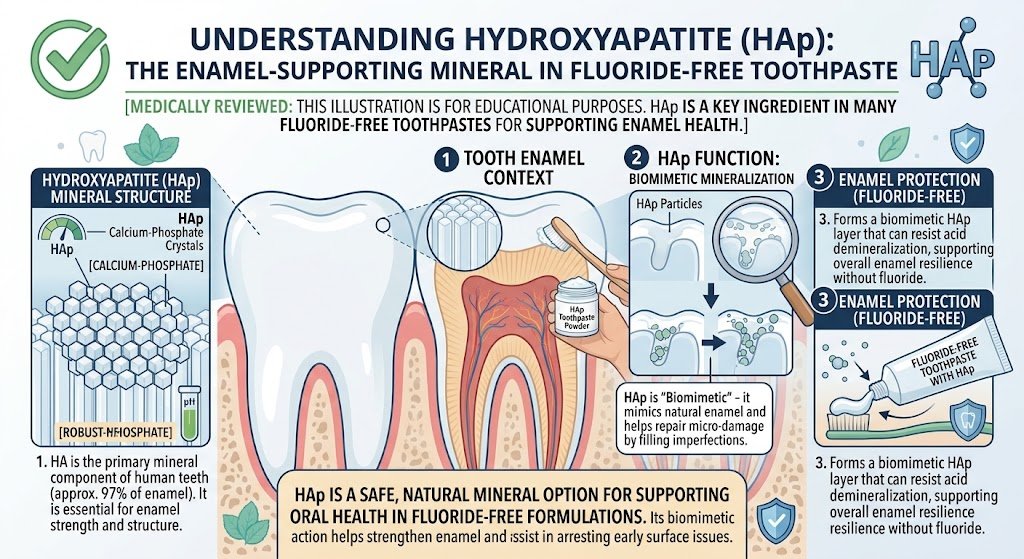
Potassium-Based Ingredients
Potassium-based ingredients are commonly associated with toothpaste designed for sensitive teeth.
The purpose is different from the cavity-protection role of fluoride.
If cold drinks, hot foods, sweet foods, or other triggers regularly cause tooth discomfort, a toothpaste designed for sensitivity may deserve closer attention than a general-purpose formula.
The ADA cites evidence supporting potassium-based desensitizing approaches, including formulations that combine potassium with stannous ingredients. (American Dental Association)
This does not mean that every sensitivity toothpaste will work the same way for every person. Product formulation, regular use, and the underlying cause of sensitivity all matter.
Arginine
Arginine is another ingredient used in toothpaste for dentin sensitivity.
The ADA’s toothpaste guidance discusses arginine among desensitizing ingredients and cites a systematic review supporting certain arginine-containing toothpaste approaches for reducing dentin hypersensitivity pain. (American Dental Association)
For an ingredient checker, the useful takeaway is simple:
If sensitivity is your main concern, arginine is an ingredient worth recognizing on the label.
It should not, however, be treated as a universal requirement for every toothpaste.
Glycerin
Glycerin is primarily a supporting ingredient.
It acts as a humectant, helping a toothpaste formula retain moisture and maintain a usable texture.
That means glycerin is an excellent example of why ingredient checkers should explain function rather than simply classify ingredients as good or bad.
Seeing glycerin on an ingredient list does not tell you whether the complete toothpaste is appropriate for you.
Xylitol
Xylitol is a sugar alcohol commonly used as a sweetener in oral-care products.
In toothpaste, it can contribute to taste and formulation.
But do not confuse the presence of xylitol with the toothpaste’s main anticaries active ingredient.
If cavity protection is your primary goal, check the actual active ingredient rather than assuming that a toothpaste containing xylitol provides the same function as a fluoride-containing toothpaste.
Hydrated Silica
Hydrated silica is commonly used as an abrasive.
Abrasives help with the mechanical cleaning action of toothpaste by helping remove surface debris and stains during brushing.
The word “abrasive” can sound negative, but an abrasive ingredient is not automatically a problem.
The more useful question is:
How does the complete formula fit my cleaning needs and brushing habits?
The presence of hydrated silica alone does not tell you that a toothpaste is excessively abrasive.
Calcium Carbonate
Calcium carbonate can also be used as an abrasive in toothpaste.
Like hydrated silica, its function is related to mechanical cleaning.
When you see calcium carbonate on an ingredient list, do not automatically treat it as a warning sign.
Instead, consider:
- Why is it included?
- What is the toothpaste designed to do?
- Is the formula intended for whitening, everyday cleaning, sensitivity, or another purpose?
- Does it fit your personal needs?
An ingredient checker should give you this context instead of simply assigning a “good” or “bad” label.
Sodium Lauryl Sulfate (SLS)
Sodium lauryl sulfate, commonly shortened to SLS, is a surfactant used in some toothpastes.
One of its familiar roles is creating foam during brushing.
Some people prefer SLS-free toothpaste because they find certain SLS-containing formulas irritating. Published clinical literature has also reported oral inflammatory reactions associated with SLS-containing toothpaste in individual cases. (PubMed)
That does not mean everyone needs to avoid SLS.
If you tolerate SLS-containing toothpaste without problems, its presence alone does not establish that the product is unsuitable for you.
If you repeatedly experience irritation with particular toothpaste formulas, however, comparing SLS-containing and SLS-free formulas can be a reasonable part of your product-selection process.
Flavoring Ingredients
Flavoring is another part of toothpaste that can be easy to overlook.
Mint, spearmint, cinnamon-related flavors, and other flavoring compounds can make brushing more pleasant. But some people can experience irritation or allergic reactions to toothpaste flavoring ingredients.
A recent survey and earlier literature have documented a range of potential toothpaste allergens, while clinical reports describe toothpaste-related contact reactions. (PubMed)
This is another reason not to interpret an ingredient list as a universal safety score.
If a particular toothpaste consistently causes burning, irritation, swelling, or unusual oral discomfort, the flavoring system is one part of the formula that may deserve investigation.
Persistent or significant symptoms should be discussed with a dental or medical professional rather than handled solely by changing toothpaste.
Toothpaste Ingredients for Different Dental Goals
There is no single list of “best” ingredients that applies equally to every toothpaste shopper.
The more useful approach is to start with the dental goal and then identify the ingredient categories relevant to that goal.
For Cavity Protection
If cavity protection is your main goal, fluoride is the ingredient category to understand first.
Common fluoride active ingredients in U.S. toothpaste include:
- Sodium fluoride
- Stannous fluoride
- Sodium monofluorophosphate
The ADA identifies these as anticaries fluoride compounds used in toothpaste. (American Dental Association)
The FDA also specifies permitted fluoride active ingredients and formulation conditions for OTC anticaries dentifrices. (FDA Access Data)
For Sensitive Teeth
If sensitivity is the main problem, focus on toothpaste formulated with recognized desensitizing ingredients.
Relevant ingredients include:
- Potassium-based ingredients
- Arginine
- Stannous fluoride
The ADA cites evidence for several of these approaches in reducing dentin hypersensitivity pain. (American Dental Association)
For Enamel Support
For enamel-related concerns, fluoride and hydroxyapatite are two ingredient categories worth understanding.
Fluoride has an established role in preventing tooth decay and supporting remineralization of early enamel lesions. (American Dental Association)
Hydroxyapatite is used in some fluoride-free formulas and has been investigated in clinical research.
The choice between these approaches should be based on your dental needs and preferences rather than a simple “natural versus chemical” argument.
For Whitening
Whitening toothpaste may use abrasive ingredients to help remove external stains. Some formulas may also use peroxide-based ingredients.
When checking a whitening formula, do not assume that a stronger stain-removal claim automatically makes it a better everyday toothpaste.
If sensitivity or abrasive cleaning is a concern, consider the formula’s overall purpose and how you brush.
For Gum and Plaque Care
For gum and plaque concerns, pay attention to the toothpaste’s active ingredients and stated purpose rather than relying only on the front-of-package claim.
A toothpaste can support an everyday oral-care routine, but persistent bleeding, swelling, pain, or other concerning symptoms should not be treated as something an ingredient checker can diagnose or solve.
For Ingredient-Conscious Shoppers
If your main goal is choosing a toothpaste with certain ingredients excluded, define your criteria before you start comparing products.
For example, you may specifically want:
- SLS-free toothpaste
- Fluoride-free toothpaste
- A simpler ingredient list
- No particular flavoring ingredient
- Ingredients you already know you tolerate
This gives you a much more useful shopping framework than simply searching for a product labeled “clean” or “natural.”
[ ARTICLE CONTINUES — NEXT PART STARTS WITH: H2: “Ingredients You May Want to Treat With Caution”]
Part 1 is complete through the main ingredient and dental-goal framework.
Ingredients You May Want to Treat With Caution
An ingredient checker should not divide toothpaste ingredients into simple “good” and “bad” groups. An ingredient can have a useful purpose in a formula while still being something a particular person may want to avoid because of sensitivity, irritation, preference, or a specific dental goal.
The better question is:
What does this ingredient do, and does it make sense for you?
Sodium Lauryl Sulfate (SLS)
Sodium lauryl sulfate, commonly called SLS, is a surfactant. It helps toothpaste spread and creates the foaming action many people associate with brushing.
SLS is not automatically a problem for everyone. However, some reports have described oral irritation or inflammatory reactions associated with SLS-containing toothpaste.
If you regularly notice burning, irritation, or discomfort when using a particular toothpaste, comparing the ingredient list with an SLS-free formula can be a reasonable step. A dentist can help if symptoms continue or are difficult to identify.
Flavoring Ingredients
Flavor is one of the easiest parts of a toothpaste formula to overlook.
Mint, menthol, cinnamon, and other flavoring ingredients can make toothpaste feel fresh, but certain flavoring substances can cause contact reactions in susceptible people. Reviews of toothpaste-related contact allergy have reported reactions involving flavoring ingredients.
This does not mean flavored toothpaste is unsafe for everyone.
If a toothpaste repeatedly causes burning around your mouth, irritation inside your mouth, or other unusual symptoms, checking the flavoring portion of the ingredient list may help you identify a pattern.
Strong Whitening Formulas
Whitening toothpaste often relies on ingredients that help remove surface stains. Many formulas use abrasive cleaning ingredients for this purpose.
That does not automatically make an abrasive ingredient harmful. The important point is that the cleaning approach should match your teeth and your reason for using the product.
For example, someone mainly looking for everyday cavity protection may not need a strongly stain-focused formula. Someone concerned about surface staining may specifically want those cleaning properties.
Essential Oils and Strong Flavor Components
An ingredient being plant-derived or “natural” does not automatically mean it will work for every person.
Some natural flavoring substances can still cause irritation or contact reactions in susceptible individuals. That is why an ingredient checker should focus on function and personal tolerance, rather than assuming that natural ingredients are always better.
If you already know that certain flavors or oils bother you, that personal history can be more useful than a generic “natural” or “clean” label.
Fluoride Should Not Automatically Go on an “Avoid” List
Fluoride is sometimes discussed as though it is simply a problematic ingredient. That is too broad.
In the U.S., fluoride is an established anticaries active ingredient in toothpaste. Common fluoride forms include sodium fluoride, sodium monofluorophosphate, and stannous fluoride. The ADA explains that fluoride helps prevent tooth decay and supports remineralization of early enamel lesions.
So when using a toothpaste ingredient checker, the useful question is not:
“Does this toothpaste contain fluoride?”
Instead, ask:
“Do I want a fluoride toothpaste for my dental needs, or am I specifically looking for a fluoride-free formula?”
That distinction keeps ingredient checking practical rather than fear-based.
Ingredients You Personally Know You Cannot Tolerate
Your own experience matters.
If you repeatedly experience irritation after using a specific toothpaste and the same ingredient appears across those products, that is useful information to discuss with a dental professional.
A toothpaste ingredient checker can help you spot patterns, but it cannot diagnose an allergy, contact reaction, or other oral condition.
If irritation, swelling, sores, pain, or other symptoms persist, professional evaluation is more appropriate than simply switching between products.
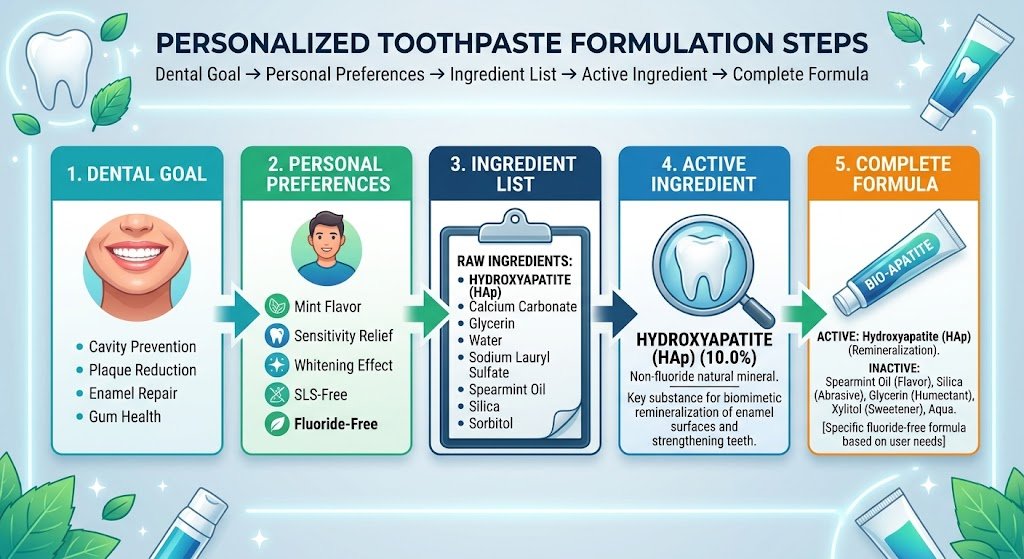
How to Read a Toothpaste Ingredient Label
Once you understand what common ingredients do, reading the label becomes much easier.
You do not need to memorize every chemical name. Instead, use a repeatable process.
Step 1: Find the Active Ingredient
Start with the active ingredient rather than the marketing claims on the front of the package.
For U.S. fluoride toothpastes, common anticaries active ingredients include:
- Sodium fluoride
- Sodium monofluorophosphate
- Stannous fluoride
The FDA’s OTC anticaries framework includes these fluoride ingredients for toothpaste formulations.
If the product is marketed around sensitivity, enamel support, whitening, or another dental benefit, check what ingredient is actually responsible for that claim.
Step 2: Identify What the Active Ingredient Is Supposed to Do
Next, connect the active ingredient to the dental goal.
For example:
| Ingredient or ingredient type | What to look for |
| Fluoride | Cavity protection |
| Stannous fluoride | Fluoride protection plus sensitivity-related benefits |
| Potassium-based ingredients | Sensitivity-focused formulas |
| Hydroxyapatite | Mineral-based enamel/remineralization positioning |
| Abrasives | Surface cleaning and stain removal |
| SLS | Foaming and surfactant function |
| Humectants | Help keep toothpaste from drying out |
| Flavoring | Taste and fresh-mouth sensation |
The ingredient itself is only one part of the decision. The entire formula and your intended use matter.
Step 3: Look at the Supporting Ingredients
After identifying the active ingredient, scan the rest of the list.
You may see ingredients that:
- Keep the toothpaste moist
- Control thickness
- Help ingredients mix
- Provide texture
- Create foam
- Improve flavor
- Help remove surface deposits
- Maintain the stability of the formula
For example, glycerin can function as a humectant, while ingredients such as hydrated silica or calcium carbonate can serve as cleaning or abrasive components.
These ingredients may not be the reason you purchased the toothpaste, but they help explain how the formula works.
Step 4: Check for Your Personal “Watch List”
This is where an ingredient checker becomes more useful than simply searching for a list of “toxic” ingredients.
Create your own short watch list.
It might include:
- SLS
- Certain flavoring ingredients
- Ingredients you have previously reacted to
- Ingredients you personally prefer to avoid
- Ingredients that do not fit your dental goal
Your watch list should be based on your needs and preferences, not fear about unfamiliar chemical names.
Step 5: Compare the Complete Formulas
Suppose two toothpastes both say they are for sensitive teeth.
Do not stop at the front label.
Compare:
- Active ingredient
- Fluoride status
- Sensitivity ingredients
- Abrasive ingredients
- Surfactants
- Flavoring
- Other supporting ingredients
Two products can target the same dental problem while using different formulas.
That is why a complete ingredient list provides more useful information than a single marketing claim.
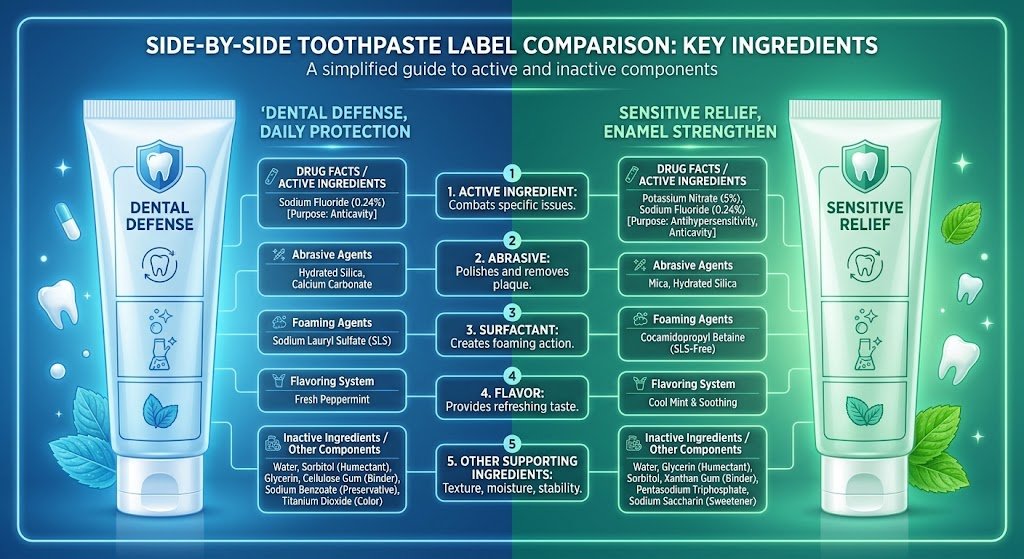
Toothpaste Ingredient Checker: A Quick Decision Framework
When you are standing in a store or comparing products online, use this simple framework.
1. What Is My Main Dental Goal?
Start with the reason you need the toothpaste.
Is it mainly for:
- Everyday cavity protection?
- Sensitive teeth?
- Enamel support?
- Surface stain removal?
- Gum and plaque care?
- A fluoride-free option?
- Avoiding a specific ingredient?
Your answer determines which ingredients deserve the most attention.
2. What Is the Main Active Ingredient?
Find the active ingredient and understand its purpose.
For fluoride toothpaste, the specific fluoride form can be identified directly from the label. The ADA identifies sodium fluoride, sodium monofluorophosphate, and stannous fluoride as common fluoride actives in U.S. toothpaste.
3. Does the Formula Fit My Preferences?
Now look beyond the active ingredient.
You may prefer:
- SLS-free formulas
- Less strongly flavored formulas
- Fluoride-free formulas
- Simpler ingredient lists
- Certain ingredient types
- Specific product formats
These are personal selection criteria rather than universal rules.
4. Does the Formula Fit My Dental Needs?
A toothpaste that looks appealing because of its ingredient list may still not be the right choice for your particular dental concern.
For example, someone focused on cavity prevention may prioritize an anticaries active ingredient, while someone with sensitivity may pay closer attention to ingredients used in sensitivity-focused formulas.
5. Is There a Trade-Off?
Most toothpaste choices involve some type of trade-off.
You might be choosing between:
- Fluoride and fluoride-free
- Strong stain removal and a gentler cleaning approach
- Strong mint flavor and a milder flavor
- A simple formula and a formula containing several functional ingredients
There is no need to turn these trade-offs into “safe versus unsafe” arguments.
The goal is to understand what you are buying.
How Toothpaste Ingredients Work Together
A toothpaste is not just one active ingredient mixed with water.
It is a formula in which different ingredients perform different jobs.
Think of it as a small system:
Active ingredient → provides the primary dental benefit
Abrasive → helps with cleaning
Humectant → helps maintain moisture
Surfactant → helps spread and foam
Thickener → helps create the desired texture
Flavoring → affects taste and mouthfeel
Other supporting ingredients → help maintain the formula
This is why removing one ingredient can sometimes change more than one characteristic of the product.
For example, removing a foaming ingredient may change the way toothpaste feels during brushing. Changing an abrasive system can affect the cleaning experience. Changing flavor ingredients can change how fresh the toothpaste feels.
The ingredient checker therefore works best when you look at the whole formula, not one ingredient in isolation.
Ingredient Combinations for Different Toothpaste Needs
Looking at combinations can make ingredient checking even easier.
For Cavity Protection
If cavity prevention is your main concern, begin by checking whether the toothpaste contains an appropriate anticaries active ingredient.
For conventional U.S. toothpaste, fluoride is the key active ingredient used for anticaries protection.
Then consider the rest of the formula based on your preferences.
For Sensitive Teeth
Sensitivity-focused toothpaste may contain ingredients such as stannous fluoride, potassium-based ingredients, or arginine. The ADA identifies these as desensitizing agents used in toothpaste and cites evidence supporting reductions in dentin hypersensitivity with regular use of certain formulations.
When checking a label, look for the ingredient intended to address sensitivity rather than relying only on the word “sensitive” on the package.
For Enamel Support
If enamel support is your focus, check what the formula is designed to provide.
Fluoride has an established role in preventing decay and supporting remineralization of early enamel lesions. Hydroxyapatite is another ingredient category commonly used in toothpaste formulations and is often selected by people specifically looking for mineral-based formulas.
For Whitening
For whitening-focused toothpaste, pay attention to the cleaning and stain-removal approach.
Look beyond the word “whitening” and check the actual formula. A whitening claim does not tell you by itself which ingredients are responsible for the cleaning effect.
If you have sensitivity concerns, this is another reason to consider the complete formula rather than choosing based only on the front label.
For Ingredient-Conscious Shoppers
If your goal is to avoid certain ingredients, create a personal checklist.
For example:
My toothpaste checklist
- Main dental goal identified
- Active ingredient checked
- Fluoride preference checked
- SLS preference checked
- Flavoring checked
- Abrasive/whitening approach checked
- Known personal triggers checked
- Full ingredient list reviewed
This turns ingredient checking into a practical process instead of an endless search for unfamiliar ingredient names.
[ ARTICLE CONTINUES — NEXT PART STARTS WITH: H2: “How to Choose a Toothpaste After Checking the Ingredients” ]
How to Choose a Toothpaste After Checking the Ingredients
Once you have checked the ingredient list, the next step is to turn that information into a practical product choice.
You do not need to find a toothpaste with the longest list of desirable ingredients. You need a formula that matches your dental goal, ingredient preferences, and personal tolerance.
Use these steps before making a purchase.
1. Start With Your Main Dental Need
Choose the toothpaste based on the problem you are actually trying to address.
For example:
- Cavity protection: Look for an appropriate anticaries active ingredient.
- Sensitive teeth: Look for ingredients used in sensitivity-focused formulas.
- Enamel support: Consider formulas designed around enamel-supporting ingredients.
- Surface stains: Look for a toothpaste designed for stain removal.
- Ingredient sensitivity: Focus on the ingredients you personally want to avoid.
- Fluoride-free preference: Confirm that the complete formula is actually fluoride-free.
This prevents a common mistake: choosing a toothpaste because its ingredient list looks impressive even though it does not match your main need.
2. Check the Active Ingredient Before the Marketing Claims
Words such as “natural,” “clean,” “whitening,” “fresh,” or “advanced” describe how a product is marketed. They do not replace the ingredient list.
Look for the actual active ingredient and determine what function it provides.
For example, if cavity prevention is your priority, check whether the toothpaste contains a fluoride active ingredient used for anticaries protection. The ADA identifies sodium fluoride, sodium monofluorophosphate, and stannous fluoride as common fluoride actives in U.S. toothpastes.
3. Check Ingredients You Personally Want to Avoid
Now use your personal watch list.
You might be checking for:
- SLS
- Certain flavoring ingredients
- Specific ingredients you have previously reacted to
- Fluoride, if you specifically want a fluoride-free formula
- Certain sweeteners, dyes, or other ingredients based on personal preference
This is where a toothpaste ingredient checker becomes personal.
Two people can look at exactly the same formula and make different choices because their dental needs and preferences are different.
4. Consider the Cleaning Approach
Look at the abrasive ingredients and the product’s purpose.
Abrasives help with mechanical cleaning and can contribute to the removal of surface deposits. But “more abrasive” should not automatically be treated as “better cleaning.”
If you are specifically looking for a gentler cleaning approach, compare formulas designed with lower abrasivity in mind.
5. Think About Flavor and Mouthfeel
Flavor is not just a cosmetic detail.
If a toothpaste feels unpleasant, burns, or repeatedly causes irritation, you may be less comfortable using it consistently.
A person who prefers a mild toothpaste may therefore choose a different formula from someone who wants a strong mint sensation.
The goal is not to find the strongest flavor. It is to find one that you can comfortably use as directed.
6. Compare the Whole Formula
Before buying, compare the complete ingredient lists of two or three products.
Ask:
What is the active ingredient?
What ingredients provide cleaning?
What creates the texture or foam?
What provides flavor?
Are there ingredients I specifically want to avoid?
Does the overall formula fit my dental goal?
This approach gives you more information than comparing front-label claims alone.
7. Consider the Product Category
After checking the formula, you can narrow your choices by category.
For example:
- Fluoride toothpaste
- Stannous fluoride toothpaste
- Hydroxyapatite toothpaste
- Sensitive toothpaste
- Low-abrasive toothpaste
- SLS-free toothpaste
- Fluoride-free toothpaste
These categories are useful starting points, but the ingredient list should still be checked before purchase.
Toothpaste Types to Consider
Instead of treating one ingredient as universally superior, it is more useful to understand the main toothpaste categories and what type of shopper may be interested in each.
Fluoride Toothpaste
Fluoride toothpaste is widely used for cavity prevention. In the U.S., common fluoride actives include sodium fluoride, sodium monofluorophosphate, and stannous fluoride.
This category may be relevant if your primary goal is conventional anticaries protection.
Stannous Fluoride Toothpaste
Stannous fluoride is a fluoride active ingredient used in toothpaste.
It can be especially relevant when you want fluoride protection while also looking at sensitivity-focused benefits. The ADA lists stannous fluoride among toothpaste desensitizing agents.
When comparing products, check the complete formula rather than assuming every stannous fluoride toothpaste is identical.
Hydroxyapatite Toothpaste
Hydroxyapatite is another toothpaste ingredient that attracts shoppers looking for mineral-based formulas.
When evaluating a hydroxyapatite toothpaste, check the actual ingredient list and the specific type of hydroxyapatite used in the formula.
If you are comparing fluoride and hydroxyapatite formulas, focus on their ingredients, intended benefits, and your own dental needs rather than treating the comparison as a simple “good versus bad” choice.
Sensitive Toothpaste
Sensitive toothpaste is designed around ingredients intended to help with dentin hypersensitivity.
Common ingredients to look for include stannous fluoride, potassium-based ingredients, and arginine.
If sensitivity is your main concern, do not choose only because the package says “for sensitive teeth.” Check which ingredient supports that positioning.
Low-Abrasive Toothpaste
Low-abrasive formulas may interest people who want to pay closer attention to the cleaning system of their toothpaste.
The important point is to evaluate abrasivity as part of the complete formula and intended use rather than assuming that every abrasive ingredient is problematic.
SLS-Free Toothpaste
SLS-free toothpaste is mainly relevant to shoppers who prefer to avoid SLS or who have noticed that certain toothpaste formulas cause irritation.
SLS is used as a surfactant and foaming agent, and reports exist of oral inflammatory reactions associated with SLS-containing toothpaste.
That does not mean everyone needs an SLS-free toothpaste. It simply gives ingredient-conscious shoppers another formula characteristic to compare.
How to Compare Two Toothpastes Using the Ingredient Checker
Imagine you have two products in front of you.
Toothpaste A
- Contains fluoride
- Contains SLS
- Strong mint flavor
- Contains an abrasive cleaning system
Toothpaste B
- Contains fluoride
- Does not contain SLS
- Uses a milder flavor
- Uses a different abrasive system
Which one should you choose?
The ingredient checker does not automatically answer that question.
Instead, ask:
Do I want fluoride?
If yes, both products may meet that basic preference.
Do I want to avoid SLS?
If yes, the second formula fits that particular preference.
Do I tolerate strong mint flavor?
If yes, the first may still be acceptable from a flavor perspective.
What is my main dental goal?
If sensitivity, cavity prevention, or another specific concern is involved, compare the active ingredients and product claims more closely.
This is the key principle:
An ingredient checker should help you compare formulas, not make the decision for you.
What “Natural” or “Clean” Means When Checking Ingredients
Terms such as “natural toothpaste” and “clean toothpaste” are popular search terms, but they should not replace ingredient-level evaluation.
A product can use natural ingredients and still contain an ingredient you personally do not tolerate.
Likewise, a conventional toothpaste can contain familiar functional ingredients that are appropriate for its intended use.
So instead of asking:
“Is this toothpaste natural?”
ask:
- What is the active ingredient?
- What does it do?
- What are the supporting ingredients?
- Are there ingredients I want to avoid?
- Does the formula match my dental goal?
- Can I comfortably use it?
That gives you a more useful comparison.
How to Use a Toothpaste Ingredient Checker When Shopping on Amazon
If you are shopping online, ingredient checking becomes slightly different because you may not be able to inspect the physical package.
Start with the product’s ingredient information.
Check the Full Ingredient List
Do not rely only on:
- Product title
- Product description
- “Natural” claim
- “Clean” claim
- “Whitening” claim
- “Sensitive” claim
- Product images
Find the complete ingredient information whenever it is available.
Confirm the Exact Product
Make sure the ingredient list belongs to the exact product and variant you are considering.
A brand may sell several versions of toothpaste with different active ingredients, flavors, or supporting ingredients.
Compare Formulas, Not Just Brands
If you are deciding between two products, compare the ingredient lists directly.
A brand name tells you very little about the formula by itself.
Use Product Pages for Convenience, Not as a Substitute for Your Checklist
Amazon can make product discovery and purchasing convenient, but your ingredient checklist should remain the same.
Goal → Active ingredient → Supporting ingredients → Personal watch list → Complete formula → Product choice
That process keeps the shopping decision focused on the toothpaste rather than the marketing around it.

Toothpaste Ingredient Checker: Quick Checklist
Before purchasing a toothpaste, save this checklist:
Dental Goal
- I know what I want the toothpaste to help with.
- I checked the active ingredient.
- I understand what that active ingredient does.
Formula
- I reviewed the complete ingredient list.
- I checked the abrasive/cleaning ingredients.
- I checked the surfactant.
- I checked the flavoring.
- I checked other ingredients relevant to my preferences.
Personal Preferences
- I checked whether it contains fluoride.
- I checked whether it contains SLS.
- I checked for ingredients I personally want to avoid.
- The flavor and texture are acceptable to me.
Final Decision
- The formula matches my dental goal.
- I am not choosing it only because of a marketing claim.
- I compared it with at least one alternative when appropriate.
[ ARTICLE CONTINUES — NEXT PART STARTS WITH: H2: “Frequently Asked Questions About Toothpaste Ingredients” ]
Frequently Asked Questions About Toothpaste Ingredients
What is a toothpaste ingredient checker?
A toothpaste ingredient checker is a simple way to review a toothpaste label and understand what its ingredients do.
Instead of judging an ingredient only by its name, you look at:
- Its function
- Whether it is active or inactive
- Your dental goal
- Your personal preferences
- Your known sensitivities or reactions
- How the complete formula works together
This makes it easier to compare toothpastes without relying only on marketing claims.
How do I check if a toothpaste has good ingredients?
Start by identifying the active ingredient and its purpose.
Then review the supporting ingredients, including abrasives, humectants, surfactants, flavoring, and thickeners.
There is no universal list of ingredients that makes every toothpaste “good” for every person. A formula should be evaluated according to its intended purpose and your individual needs.
What are the main active ingredients in toothpaste?
Common active ingredients in U.S. toothpaste include:
- Sodium fluoride
- Sodium monofluorophosphate
- Stannous fluoride
These are fluoride ingredients used for anticaries purposes.
Other toothpaste formulas may focus on ingredients used for sensitivity or other specific product benefits.
Is fluoride a bad ingredient in toothpaste?
Fluoride should not automatically be classified as a bad ingredient.
Fluoride is an established anticaries ingredient in toothpaste, and the ADA describes its role in helping prevent tooth decay and supporting remineralization of early enamel lesions.
Whether you want a fluoride or fluoride-free toothpaste is a separate product-selection question.
If you are considering a fluoride-free formula, make sure you understand what active ingredient or formulation is being used instead.
What does SLS do in toothpaste?
SLS stands for sodium lauryl sulfate.
It is a surfactant that helps toothpaste spread and contributes to foaming.
Some people may experience irritation with certain SLS-containing formulas, while others use them without an issue. Reports in the medical literature have described oral inflammatory reactions associated with SLS-containing toothpaste.
If you suspect SLS is bothering you, comparing an SLS-free formula can help you determine whether the change makes a difference.
Should I avoid toothpaste with SLS?
Not necessarily.
SLS is not something that everyone needs to avoid. It becomes more relevant if you have a known preference against it or notice recurring irritation with particular toothpaste formulas.
An ingredient checker should help you identify SLS so that you can make an informed comparison.
Are toothpaste flavoring ingredients safe?
Flavoring ingredients serve an important sensory purpose, but certain flavoring substances can cause contact reactions in susceptible people. Reviews of toothpaste-related contact allergy have identified flavoring ingredients among potential causes.
This does not mean that flavored toothpaste is generally unsafe.
If you experience repeated irritation after using a particular toothpaste, checking the flavoring ingredients may be worthwhile.
Is natural toothpaste better than conventional toothpaste?
“Natural” does not automatically mean better for every person.
The useful approach is to compare the actual formula.
Look at the active ingredient, cleaning ingredients, flavoring, surfactants, and any ingredients you personally want to avoid.
What ingredients should I avoid in toothpaste?
There is no universal avoid list that applies equally to everyone.
Instead, separate ingredients into three groups:
Ingredients that may be relevant to your dental goal:
These are ingredients you may specifically want because of the function they provide.
Ingredients you may personally prefer to avoid:
For example, SLS or certain flavors.
Ingredients that have caused you a known reaction:
These deserve particular attention when comparing formulas.
What ingredients are good for sensitive teeth?
Toothpaste designed for sensitivity may contain ingredients such as stannous fluoride, potassium-based ingredients, or arginine. The ADA identifies these as desensitizing agents used in toothpaste.
When checking a sensitivity toothpaste, look for the ingredient responsible for the sensitivity-focused claim instead of relying only on the product name.
What ingredients help protect against cavities?
For conventional U.S. anticaries toothpaste, fluoride is the primary active ingredient category to check.
Common fluoride actives include:
- Sodium fluoride
- Sodium monofluorophosphate
- Stannous fluoride
The ADA and FDA identify these fluoride ingredients in relation to anticaries toothpaste.
If cavity protection is your main goal, start your ingredient check with the active ingredient before evaluating secondary preferences.
What is hydroxyapatite in toothpaste?
Hydroxyapatite is a mineral ingredient used in some toothpaste formulas.
People often look for it when they want a mineral-based toothpaste option or are comparing hydroxyapatite formulas with fluoride formulas.
When evaluating a hydroxyapatite toothpaste, check the complete formula and the product’s intended use rather than assuming that the presence of hydroxyapatite alone determines whether the toothpaste is right for you.
Does a longer ingredient list mean a worse toothpaste?
No.
Ingredient count alone does not tell you whether a toothpaste is appropriate.
Different ingredients perform different jobs, and a formula may need several supporting ingredients to achieve its texture, stability, flavor, cleaning properties, and intended function.
Instead of counting ingredients, ask what each major ingredient contributes to the formula.
Should I choose a toothpaste with fewer ingredients?
A shorter ingredient list may appeal to ingredient-conscious shoppers, but fewer ingredients does not automatically mean a better formula.
A better approach is to identify the ingredients that matter to you.
For example, a person concerned about flavor sensitivity may focus on flavoring, while someone focused on cavity protection may first check the active anticaries ingredient.
Can an ingredient checker tell me if a toothpaste is safe?
An ingredient checker can help you understand a formula and identify ingredients that may be relevant to your preferences.
It cannot determine whether a toothpaste is appropriate for every person or diagnose an allergy, irritation, oral disease, or other dental condition.
If you have persistent symptoms, speak with a dentist or other qualified healthcare professional.
Can I use the same ingredient checker for every toothpaste?
Yes.
The same basic process works across most toothpaste categories:
1. Identify your goal.
2. Find the active ingredient.
3. Understand its function.
4. Review supporting ingredients.
5. Check your personal watch list.
6. Compare the complete formula.
7. Choose the product that fits your needs and preferences.
This makes the process reusable when you switch brands or try a different toothpaste category.
Final Toothpaste Ingredient Checker
Understanding toothpaste ingredients does not require memorizing every chemical name on the package.
The most useful approach is to look at the formula in context.
Start with the active ingredient. Then identify the ingredients responsible for cleaning, moisture, texture, foam, and flavor. After that, consider your specific dental goal and any ingredients you personally want to avoid.
Most importantly, do not let one ingredient define the entire product.
A toothpaste formula is a combination of ingredients working together. The right choice depends on what you need the toothpaste to do, what you prefer to include or exclude, and how well you tolerate the complete formula.
When comparing products, use this simple sequence:
Dental goal → Active ingredient → Ingredient functions → Personal watch list → Complete formula → Product choice
That is the purpose of a toothpaste ingredient checker: to make the ingredient list easier to understand so you can make a more informed toothpaste choice.
Ab article ka main body complete ho gaya hai. Ab Step 5 ke required implementation, SEO, affiliate aur QA assets de raha hoon.
