Toothpaste helps prevent cavities by doing more than simply making your teeth feel clean. When used with regular brushing, it helps remove plaque while delivering ingredients that protect tooth enamel from the acids responsible for tooth decay.
For most conventional cavity-prevention toothpastes, fluoride is the key active ingredient. Fluoride helps strengthen enamel, replace minerals lost during early acid attacks, and make teeth more resistant to future decay.
But toothpaste is only one part of cavity prevention. Your toothbrush physically removes plaque, while toothpaste helps support that process and provides protective ingredients. Your diet, brushing habits, cleaning between your teeth, and regular dental care also matter.
In this guide, you will learn how toothpaste prevents cavities, how fluoride works, whether toothpaste can reverse early decay, which ingredients matter, and how to choose a toothpaste for better cavity protection.
How Do Cavities Form?
Before understanding how toothpaste prevents cavities, it helps to understand how a cavity develops in the first place.
Your mouth naturally contains bacteria. Some of these bacteria become part of a sticky layer called dental plaque, which forms on your teeth.
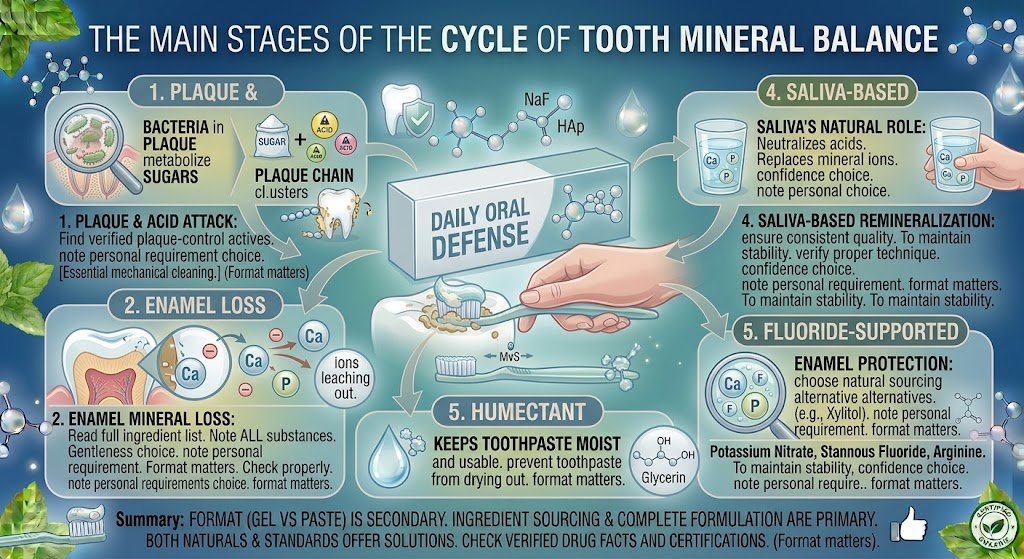
When you eat or drink foods and beverages containing sugars and certain carbohydrates, bacteria in plaque can use them and produce acids. These acids can attack the minerals in your tooth enamel.
This process is called demineralization.
Your teeth are not completely defenseless against this process. Saliva naturally contains minerals that can help replace some of the minerals lost from enamel. This process is called remineralization.
The problem develops when your teeth experience repeated acid attacks and mineral loss begins to outweigh mineral replacement.
Over time, enamel can become weaker. Early tooth decay can develop, and if the process continues without being controlled, a permanent cavity can eventually form.
A simplified version of the process looks like this:
Plaque + sugars and carbohydrates → acids → mineral loss → weakened enamel → possible cavity
This is why cavity prevention is not simply about removing visible food from your teeth.
It is about controlling the conditions that allow tooth decay to develop.
Toothpaste helps with this process in several ways, especially when it contains fluoride.
How Does Toothpaste Prevent Cavities?
Toothpaste helps prevent cavities through two major actions:
- Brushing with toothpaste helps remove plaque and debris from tooth surfaces.
- Fluoride toothpaste delivers fluoride that helps protect enamel against the decay process.
The toothbrush provides much of the physical cleaning.
As you move the bristles across your teeth, they disturb plaque and help remove material from the tooth surface. Toothpaste works alongside the toothbrush by helping the formula spread across the teeth and providing ingredients that support cleaning and oral-health protection.
Plaque Control Reduces the Source of Acid Attacks
Plaque is not simply leftover food.
It is a microbial biofilm that develops on the teeth. When plaque remains on the tooth surface, the bacteria within it can contribute to acid production after exposure to fermentable carbohydrates.
Regular brushing helps physically disturb and remove this buildup.
This is one reason why brushing is such an important part of cavity prevention.
However, removing plaque is only one part of the process.
Fluoride Adds Protection That Brushing Alone Does Not Provide
Fluoride gives toothpaste an additional cavity-prevention function.
It is not primarily a scrubbing ingredient. Instead, fluoride interacts with the tooth surface and helps the enamel deal with the effects of acid exposure.
Fluoride can help replace minerals lost during early stages of tooth decay and can make enamel more resistant to future acid attacks.
So the roles can be separated like this:
| Part of the routine | Main role |
| Toothbrush bristles | Physically disturb plaque and debris |
| Toothpaste abrasives | Help remove surface deposits |
| Fluoride | Helps protect enamel and prevent tooth decay |
| Saliva | Naturally supplies minerals and supports the mouth’s protective processes |
| Interdental cleaning | Helps clean areas a toothbrush may not reach |
The result is not that toothpaste “kills cavities.”
Rather, toothpaste helps create conditions that make tooth decay less likely to develop or progress.
How Does Fluoride Prevent Tooth Decay?
Fluoride is one of the most important ingredients to understand if your main goal is cavity prevention.
It works primarily through its effects on the tooth surface.
When enamel is exposed to acids, minerals can be removed. Fluoride helps the tooth respond to this process by supporting remineralization and making enamel more resistant to acid-related damage.
Fluoride Helps Remineralize Early Enamel Damage
Your teeth constantly go through a cycle of mineral loss and mineral replacement.
During an acid attack, minerals can leave the enamel. Later, minerals from saliva can help replace some of them.
Fluoride can support this remineralization process.
This is particularly important during the early stages of tooth decay, when enamel has lost minerals but a permanent hole has not yet developed.
Instead of thinking about fluoride as a substance that simply “fills cavities,” it is more accurate to think of it as helping the tooth surface become better able to withstand and recover from the early stages of acid-related damage.
Fluoride Makes Enamel More Resistant to Acid
Enamel is the hard outer layer of your teeth, but it can still be damaged by repeated exposure to acids.
Fluoride helps make the tooth surface more resistant to acid-related mineral loss.
This matters because cavity development is a repeated process rather than one single event.
A person may experience many cycles of:
Acid attack → mineral loss → mineral recovery
If protective factors consistently outweigh damaging factors, the tooth can remain healthy.
If damaging factors repeatedly win, enamel can progressively weaken.
Fluoride helps shift this balance toward protection.
Fluoride Works at the Tooth Surface
One useful point about fluoride toothpaste is that its benefit is closely connected to topical exposure.
When you brush with fluoride toothpaste, fluoride is placed directly around the teeth. This allows it to interact with the tooth surfaces and the surrounding oral environment.
That is different from thinking of toothpaste as something that needs to be absorbed into the body to “work.”
The goal is to provide fluoride where the tooth needs its protective effects.
Fluoride Also Helps During Repeated Acid Challenges
The mouth does not experience one acid attack and then stop.
Eating and drinking can create repeated opportunities for acid production, particularly when sugary or fermentable foods and drinks are consumed frequently.
Fluoride helps teeth better tolerate these challenges.
This is why consistent use matters. The value of fluoride toothpaste comes from making it part of a regular oral-hygiene routine rather than treating it like an occasional treatment.
Does Brushing Remove the Bacteria That Cause Cavities?
Brushing helps control the bacteria-containing plaque on your teeth, but it does not sterilize your mouth.
And it does not need to.
Your mouth naturally contains many microorganisms. The goal of brushing is to control plaque accumulation and remove deposits from tooth surfaces.
When you brush, the bristles physically disturb plaque.
Toothpaste helps the process by spreading across the tooth surface and providing ingredients that support cleaning and protection.
This distinction is important:
The toothbrush provides mechanical plaque removal.
The toothpaste provides cleaning support and delivers active ingredients.
Neither should be viewed as completely replacing the other.
Why Plaque Removal Matters
Plaque can contain bacteria capable of producing acids when exposed to certain carbohydrates.
Removing plaque regularly reduces the amount of this biofilm sitting on the teeth.
But brushing does not reach every part of the mouth equally well.
Plaque can remain:
- Along the gumline
- Between teeth
- Around crowded teeth
- Around dental appliances
- In other difficult-to-reach areas
This is why cavity prevention should not be reduced to choosing a toothpaste alone.
A good toothpaste used with poor brushing habits will not provide the same benefit as an appropriate toothpaste used consistently and correctly.
Can Toothpaste Reverse a Cavity?
This question needs an important distinction.
Early tooth decay and an established cavity are not the same thing.
In the early stage, enamel may lose minerals without having a permanent hole.
At this stage, the decay process may sometimes be stopped or reversed through measures that improve the balance between mineral loss and mineral repair.
Fluoride is one of the important tools used for this purpose.
But once enough tooth structure has been lost to create an actual cavity, toothpaste cannot simply rebuild the missing tooth structure.
In other words:
Early mineral loss: May be stopped or reversed in some circumstances.
Established cavity: Cannot simply be brushed away with toothpaste.
This distinction is important because phrases such as “repair your cavities naturally” can make toothpaste sound like a substitute for dental treatment.
It is not.
If a cavity has formed, a dental professional can determine the extent of the damage and whether treatment is necessary.
Toothpaste is primarily a preventive and protective part of oral care, not a replacement for treatment of established tooth decay.
What Toothpaste Ingredients Help Prevent Cavities?
Not every toothpaste ingredient has the same job.
Some ingredients help clean the tooth surface. Others control texture, moisture, taste, or foaming. A smaller group of active ingredients is specifically associated with cavity prevention.
Understanding these differences can make toothpaste labels much easier to evaluate.
Sodium Fluoride
Sodium fluoride is a common fluoride compound used in toothpaste for cavity protection.
Its role is primarily protective rather than abrasive.
It supplies fluoride that can interact with the tooth surface and support enamel protection and remineralization.
Stannous Fluoride
Stannous fluoride is another fluoride compound used in toothpaste.
It provides anticaries protection and can also be included in formulas designed to address other oral-health concerns.
This means that when comparing toothpastes, looking only at whether a product contains “fluoride” may not tell you everything about its formulation.
The specific active ingredient and the product’s intended purpose can also matter.
Sodium Monofluorophosphate
Sodium monofluorophosphate is another fluoride compound used in toothpaste.
Like other fluoride anticaries ingredients, its purpose is connected to preventing tooth decay rather than physically scrubbing plaque from the tooth surface.
The American Dental Association recognizes sodium fluoride, stannous fluoride, and sodium monofluorophosphate among fluoride compounds used as anticaries agents in toothpaste.
Other Ingredients Have Different Jobs
A toothpaste may also contain ingredients designed for:
- Surface cleaning
- Sensitivity
- Tartar control
- Whitening
- Flavor
- Texture
- Moisture retention
- Foaming
For example, an abrasive can help remove surface deposits, while a sensitivity ingredient may target discomfort.
These ingredients can make one formula more appropriate for a particular person, but they should not be confused with the primary anticaries role of fluoride.
For ingredient-conscious shoppers, this distinction is especially useful: the absence or presence of a particular ingredient does not automatically tell you whether a toothpaste provides strong cavity protection. You need to understand what the active ingredients are designed to do.
[ ARTICLE CONTINUES — NEXT PART STARTS WITH: H2: “Fluoride vs Fluoride-Free Toothpaste for Cavities” ]
Part 2 of 3 — continuing exactly from the previous stopping point.
Fluoride vs Fluoride-Free Toothpaste for Cavities
If cavity prevention is your main goal, one of the biggest decisions you may face is whether to use fluoride toothpaste or a fluoride-free formula.
The important thing to understand is that cleaning and cavity prevention are related, but they are not the same thing.
A fluoride-free toothpaste can still help with mechanical cleaning because the toothbrush removes plaque and the toothpaste may contain abrasives and other ingredients that support surface cleaning.
However, fluoride has a specific role in protecting enamel and preventing tooth decay.
The National Institute of Dental and Craniofacial Research explains that fluoride can help prevent tooth decay and can stop or reverse early tooth decay.
The American Dental Association also recognizes fluoride compounds as anticaries active ingredients in toothpaste.
That does not mean every fluoride-free toothpaste is automatically a poor product.
Someone may choose a fluoride-free formula because of personal preferences, ingredient concerns, or a recommendation from a dental professional. But it is important not to assume that a toothpaste provides the same cavity-prevention protection simply because it makes the teeth feel clean.
What Is the Main Difference?
Think about the two functions separately:
| Function | Fluoride Toothpaste | Fluoride-Free Toothpaste |
| Mechanical cleaning | Yes, when brushed properly | Yes, when brushed properly |
| Helps remove plaque | Yes | Yes |
| Fluoride-based cavity protection | Yes | No |
| Supports remineralization through fluoride | Yes | No |
| Can provide other active ingredients | Depending on formula | Depending on formula |
The exact formulation matters, but if cavity prevention is the primary goal, fluoride is an important consideration.
What About Hydroxyapatite Toothpaste?
Hydroxyapatite is another ingredient used in some toothpaste formulas and is often discussed as an alternative to fluoride.
It is a calcium-phosphate mineral related to the mineral structure of teeth.
This makes hydroxyapatite an interesting ingredient for people who want to understand alternatives, but it should not be presented as automatically identical to fluoride simply because both are associated with enamel care.
If you are deciding between the two, look at the evidence, product formulation, your cavity risk, and your dentist’s advice.
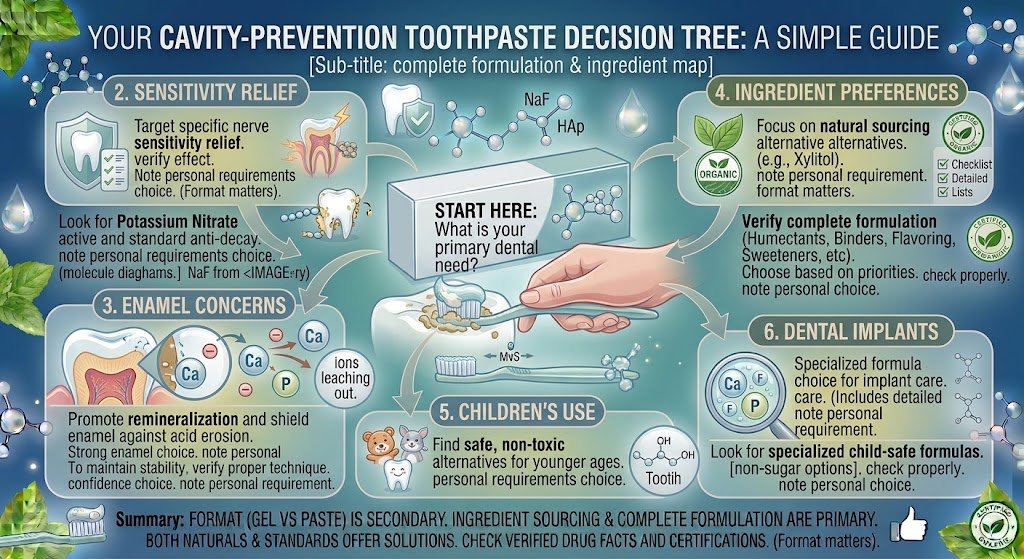
How to Choose Toothpaste for Cavity Prevention
Once you understand how cavities develop and how toothpaste works, choosing a product becomes much simpler.
You do not need to choose toothpaste based on the loudest marketing claim. Instead, focus on the features that actually relate to your oral-health needs.
1. Start With the Active Ingredient
If cavity prevention is your primary goal, check the active ingredient section on the package.
Common fluoride compounds found in toothpaste include:
- Sodium fluoride
- Stannous fluoride
- Sodium monofluorophosphate
The American Dental Association lists these among fluoride compounds used as anticaries agents in toothpaste.
This is more useful than choosing a product simply because the front label says “natural,” “clean,” “advanced,” or “enamel care.”
2. Look for Reliable Verification
The ADA Seal of Acceptance can be a useful additional signal when comparing oral-care products.
Products seeking the ADA Seal are evaluated against requirements relevant to their category, including information concerning safety and efficacy.
For cavity-protection toothpaste, fluoride is an important part of the ADA’s requirements.
[ add a link ]
The Seal does not mean you must choose one specific brand. It simply gives consumers another way to evaluate whether a product has gone through an established professional review process.
3. Match the Toothpaste to Your Other Needs
Cavity prevention may be your primary concern, but you may have another oral-health issue at the same time.
For example:
Cavities + sensitive teeth:
A toothpaste formulated for sensitivity may be more practical than choosing a basic cavity toothpaste and ignoring sensitivity.
Cavities + ingredient preferences:
You may want to compare different fluoride formulations and other ingredients rather than relying only on the word “non-toxic.”
Cavities + SLS preference:
If you prefer to avoid SLS, look for a formula that combines your ingredient preference with appropriate cavity protection.
Cavities + enamel concerns:
Consider how the toothpaste approaches enamel protection and whether the active ingredients match your needs.
4. Consider the ADA Seal as a Selection Filter, Not the Entire Decision
A seal can help narrow your choices, but it should not be the only factor.
You may still need to consider:
- Your age
- Cavity history
- Tooth sensitivity
- Taste preference
- Texture
- Ingredient preferences
- Product availability
- Price
- Advice from your dentist
The goal is to find a toothpaste that provides appropriate cavity protection and that you will actually use consistently.
5. Choose a Formula You Can Use Every Day
A toothpaste can have an appropriate active ingredient and still be a poor personal fit if its taste or texture makes you avoid brushing.
Consistency matters.
If one formula has a flavor you dislike, makes your mouth uncomfortable, or otherwise makes your routine difficult, another suitable formula may be easier to use regularly.
This is particularly relevant when choosing toothpaste for children.
6. Pay Attention to Children’s Needs
Children are not simply small adults when it comes to toothpaste use.
The appropriate amount of fluoride toothpaste depends on age, and young children need supervision because they may swallow toothpaste.
The ADA recommends using a smear of fluoride toothpaste about the size of a grain of rice for children younger than 3 years and a pea-sized amount for children ages 3 to 6, with supervision and encouragement to spit out excess toothpaste.
For a child with a high cavity risk or other specific dental concern, the child’s dentist can provide individualized guidance.
What Habits Matter Alongside Toothpaste?
Even the right toothpaste cannot prevent cavities by itself.
Cavity prevention works best as a complete routine.
Brush Twice a Day
The American Dental Association recommends brushing twice a day for two minutes with fluoride toothpaste.
This gives your teeth regular exposure to fluoride while helping remove plaque.
The important part is not simply owning fluoride toothpaste. You need to use it consistently.
Clean Between Your Teeth
Toothbrush bristles cannot effectively reach every surface between your teeth.
Plaque can accumulate in these areas, so interdental cleaning is an important part of a complete oral-hygiene routine.
Depending on your teeth and dental needs, this may involve dental floss or another interdental cleaning method recommended by your dental professional.
Pay Attention to Frequent Sugar Exposure
Sugar does not directly “turn into a cavity.”
The concern is what happens when bacteria metabolize fermentable carbohydrates and produce acids that attack tooth minerals.
Frequent exposure can give the teeth repeated opportunities for acid attacks.
This is why cavity prevention involves more than selecting toothpaste.
Keep Up With Dental Care
Regular dental visits can help identify early problems before they become larger ones.
A dentist can also identify whether you have factors that increase your cavity risk and recommend an appropriate preventive strategy.
If you frequently develop cavities despite brushing regularly, do not assume that buying a stronger toothpaste is the only answer.
Your dentist may need to investigate other contributing factors.
Common Cavity-Prevention Mistakes
Brushing Harder Instead of Brushing Thoroughly
More pressure does not automatically mean more plaque removal.
The goal is careful, thorough cleaning rather than aggressive scrubbing.
Choosing Toothpaste Only by Marketing Claims
Words such as “natural,” “clean,” or “non-toxic” do not tell you everything about cavity protection.
Check the active ingredients and understand their intended role.
Assuming a Clean Feeling Means Cavity Protection
A strong mint flavor or intense foaming can make your mouth feel exceptionally fresh.
That feeling does not necessarily tell you how well the toothpaste protects against cavities.
Thinking Fluoride Repairs Every Cavity
Fluoride can help with early mineral loss, but an established cavity is not something toothpaste can simply brush away.
Ignoring Between-Teeth Cleaning
Even excellent brushing leaves some areas difficult to reach.
Cleaning between the teeth helps address these spaces.
Using Toothpaste Inconsistently
A toothpaste cannot provide its intended benefits if you rarely use it.
A simple formula that you comfortably use twice every day can be more useful than a complicated product that you constantly avoid.
Assuming “More Ingredients” Means Better Protection
A longer ingredient list does not automatically mean better cavity prevention.
Focus on the purpose of the active ingredients and whether the overall formula fits your needs.
[ ARTICLE CONTINUES — NEXT PART STARTS WITH: H2: “Frequently Asked Questions About How Toothpaste Prevents Cavities” ]Part 3 of 3 — continuing exactly from the previous stopping point.
Frequently Asked Questions About How Toothpaste Prevents Cavities
How does toothpaste prevent cavities?
Toothpaste helps prevent cavities mainly by supporting the removal of plaque and, when it contains fluoride, helping teeth resist acid-related mineral loss.
Brushing spreads the toothpaste across the teeth, while the toothbrush physically removes plaque and food debris. Fluoride provides additional protection by helping strengthen enamel and supporting remineralization after early mineral loss.
Toothpaste works best as part of a complete oral hygiene routine rather than as a stand-alone cavity treatment.
What ingredient in toothpaste prevents cavities?
Fluoride is the main toothpaste ingredient with an established role in cavity prevention. Common fluoride compounds include sodium fluoride, stannous fluoride, and sodium monofluorophosphate.
These ingredients provide fluoride in different chemical forms, but their purpose in toothpaste is related to protecting teeth against the processes that lead to tooth decay.
Does toothpaste remove plaque?
Toothpaste can support plaque removal, but the toothbrush and brushing technique do much of the physical work.
Abrasive and cleansing ingredients in toothpaste can help remove deposits and surface debris, while brushing mechanically disrupts plaque. However, plaque can remain in areas that are difficult to reach, especially between teeth.
That is why cleaning between the teeth is an important part of cavity prevention in addition to brushing.
Can toothpaste reverse a cavity?
Toothpaste cannot reverse a developed cavity or rebuild a tooth that has already formed a physical hole.
However, early stages of mineral loss can sometimes be stopped or repaired through remineralization before a permanent cavity develops. Fluoride plays an important role in this process.
If you already have tooth pain, sensitivity, a visible hole, or another sign of decay, toothpaste should not be considered a substitute for a dental examination.
Does fluoride-free toothpaste prevent cavities?
Fluoride-free toothpaste can help clean the teeth, but it does not provide the same established fluoride-based cavity-prevention benefit.
Some fluoride-free toothpastes contain ingredients such as hydroxyapatite or xylitol and may be designed for specific oral-care goals. However, the evidence and recommended use can differ depending on the ingredient and the person’s individual cavity risk.
Does brushing alone prevent cavities?
Brushing twice a day is one of the most important parts of cavity prevention, but it is not the only factor.
Cavities can also be influenced by how frequently teeth are exposed to fermentable carbohydrates, plaque accumulation, saliva, fluoride exposure, oral hygiene between teeth, and individual cavity risk.
A strong routine combines regular brushing with cleaning between teeth, sensible dietary habits, and professional dental care when needed.
How often should I use fluoride toothpaste?
For most people, regular brushing with fluoride toothpaste is part of a twice-daily oral hygiene routine.
The exact amount of toothpaste and guidance for young children can differ by age and individual circumstances. Children should follow age-appropriate dental guidance rather than simply using the same amount as an adult.
Can toothpaste prevent cavities between teeth?
Toothpaste can help protect the surfaces of teeth that are reached during brushing, but brushing alone does not effectively clean every space between teeth.
Plaque can accumulate between teeth where a toothbrush may not reach well. Cleaning between the teeth therefore complements brushing and helps address an area where cavities can develop.
This is especially important for people who have crowded teeth, dental restorations, braces, or other areas where plaque is difficult to remove.
The Bottom Line
Toothpaste helps prevent cavities through several connected actions.
First, brushing with toothpaste helps physically disrupt and remove plaque from tooth surfaces. Second, toothpaste ingredients can help clean the teeth and remove surface debris. Most importantly for conventional cavity-prevention toothpaste, fluoride helps teeth resist acid-related mineral loss and supports the remineralization of early enamel damage.
The key point is that toothpaste does not prevent cavities simply because it makes your mouth feel clean. Its cavity-prevention value depends on the ingredients it contains, how consistently it is used, how effectively plaque is removed, and the rest of your oral-health routine.
For someone choosing toothpaste specifically for cavity prevention, start by looking at the active ingredients and the product’s intended purpose rather than relying only on terms such as “natural,” “clean,” “whitening,” or “non-toxic.”
