Most people think toothpaste is what “cleans” their teeth. In reality, toothpaste and your toothbrush work together. The toothbrush provides the physical action that loosens plaque and debris, while toothpaste helps that process through ingredients such as mild abrasives, fluoride, surfactants, and other agents designed for specific oral-health needs.
So, how toothpaste cleans teeth depends on more than foam or flavor. Different ingredients perform different jobs: some help remove surface deposits, some help protect enamel, some support cavity prevention, and others are included for concerns such as sensitivity or stains.
This guide explains what happens during brushing, how toothpaste ingredients contribute to cleaning, why abrasives matter, why toothpaste foams, and how to choose a formula based on what you actually want it to do.
How Does Toothpaste Clean Your Teeth?
To understand how toothpaste cleans teeth, start with an important distinction:
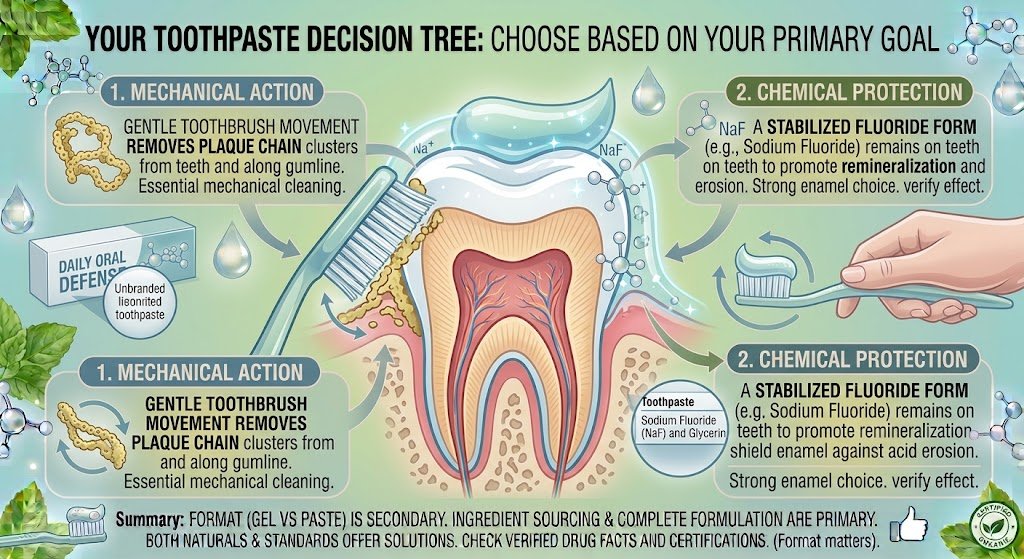
The toothbrush does most of the physical plaque removal, while toothpaste helps improve the cleaning process and delivers ingredients that provide additional benefits.
When you brush, the bristles move across the tooth surfaces and along the gumline. This movement can disturb plaque, food particles, and other material that has accumulated on the teeth.
Toothpaste is spread between the bristles and across the tooth surface. As you brush, its ingredients mix with saliva and water, creating a paste or slurry that moves around the mouth.
That mixture can perform several jobs at once:
- Mild abrasives help remove surface deposits and stains.
- Fluoride can help protect teeth from decay.
- Surfactants help spread the toothpaste throughout the mouth.
- Flavoring makes brushing more pleasant.
- Some ingredients are designed for sensitivity, enamel support, or other specific needs.
The result is not simply “cleaner teeth.” A suitable toothpaste can also help support the conditions that keep teeth healthier between dental visits.
The Toothbrush Provides the Mechanical Cleaning
Your toothbrush is important because plaque is a physical layer that has to be disturbed and removed.
Brushing creates friction between the bristles, toothpaste, saliva, and tooth surfaces. This mechanical action helps break up plaque and remove loose debris.
Toothpaste cannot replace this action.
A toothpaste could contain useful ingredients, but if it is simply placed on a tooth without brushing, it will not provide the same mechanical cleaning effect.
This is why brushing technique matters. Reaching the outer, inner, and chewing surfaces of the teeth helps expose more areas to the toothbrush and toothpaste.
For broader oral-hygiene guidance, readers should also follow recommendations from authoritative dental and government health sources.
[ add a link ]
Toothpaste Helps the Bristles Work Across the Tooth Surface
Toothpaste changes the environment in which brushing happens.
As it mixes with saliva, toothpaste becomes easier to spread across the teeth. Its ingredients are carried around the mouth as you brush rather than remaining in one small area.
This is especially important because the mouth contains many different surfaces. Plaque can accumulate near the gumline, between teeth, around orthodontic appliances, and in grooves on the chewing surfaces.
Toothpaste helps create a consistent slurry that allows cleaning ingredients to interact with these surfaces during brushing.
What Do Toothpaste Abrasives Do?
One of the most important answers to “how toothpaste cleans teeth” involves abrasives.
Abrasives are small particles included in toothpaste to help mechanically remove surface deposits. They work together with toothbrush bristles rather than replacing them.
Common abrasive ingredients include substances such as:
- Calcium carbonate
- Hydrated silica
- Other approved polishing agents used in toothpaste formulations
During brushing, these particles help create controlled friction against the tooth surface.
The goal is to remove unwanted material without unnecessarily damaging the tooth.
Abrasives Help Remove Surface Stains
Some discoloration sits on the outside of the tooth.
For example, certain foods and drinks can contribute to external staining. Surface deposits can make teeth look darker or less clean even when the underlying tooth structure has not changed color.
Abrasive toothpaste can help polish away some of these external deposits.
That is different from changing the natural internal color of a tooth.
This distinction matters when evaluating whitening toothpaste. A toothpaste that removes surface stains is not necessarily bleaching the tooth or changing its intrinsic color.
Why More Abrasive Does Not Mean Better
It may seem logical that a stronger abrasive would produce cleaner or whiter teeth. That is not necessarily true.
Toothpaste needs a balance between cleaning performance and tooth-surface protection. Excessive or inappropriate abrasion can be undesirable, particularly for people who already have issues such as enamel wear or exposed dentin.
The important question is therefore not:
“Which toothpaste is the most abrasive?”
A better question is:
“Does this toothpaste provide effective cleaning without being unnecessarily harsh for my needs?”
People concerned about enamel wear, sensitivity, or frequent staining may want to pay closer attention to the formulation rather than simply choosing the strongest-feeling toothpaste.
How Does Toothpaste Remove Plaque?
Plaque is a sticky microbial biofilm that develops on tooth surfaces.
It is not simply leftover food. It contains microorganisms embedded in a structured layer that can remain attached to teeth if it is not regularly disrupted.
Brushing physically disturbs this layer.
Toothpaste supports the process by providing abrasives and other ingredients that help the toothpaste spread and interact with the tooth surfaces.
This means the cleaning process has several parts:
- Bristles contact the tooth.
- Brushing motion disturbs plaque.
- Toothpaste spreads across the surface.
- Abrasives help polish away surface deposits.
- Saliva and water create a toothpaste slurry.
- Active ingredients remain available to provide their intended benefits.
This is one reason brushing consistently is more important than simply choosing a toothpaste with an impressive ingredient list.
Does Toothpaste Kill All the Bacteria in Your Mouth?
No.
Your mouth naturally contains many microorganisms, and the goal of daily oral hygiene is not to make the mouth completely bacteria-free.
Instead, brushing helps control plaque accumulation and remove the biofilm from tooth surfaces.
Some toothpaste ingredients can have additional effects on the oral environment, but it is misleading to think of toothpaste as a product that simply sterilizes the mouth.
This distinction is important when evaluating products marketed around “antibacterial” or “natural” ingredients. An ingredient’s presence does not automatically mean the finished toothpaste provides a specific clinical benefit.
Why Does Toothpaste Foam?
Foam is one of the most noticeable things that happens when you brush.
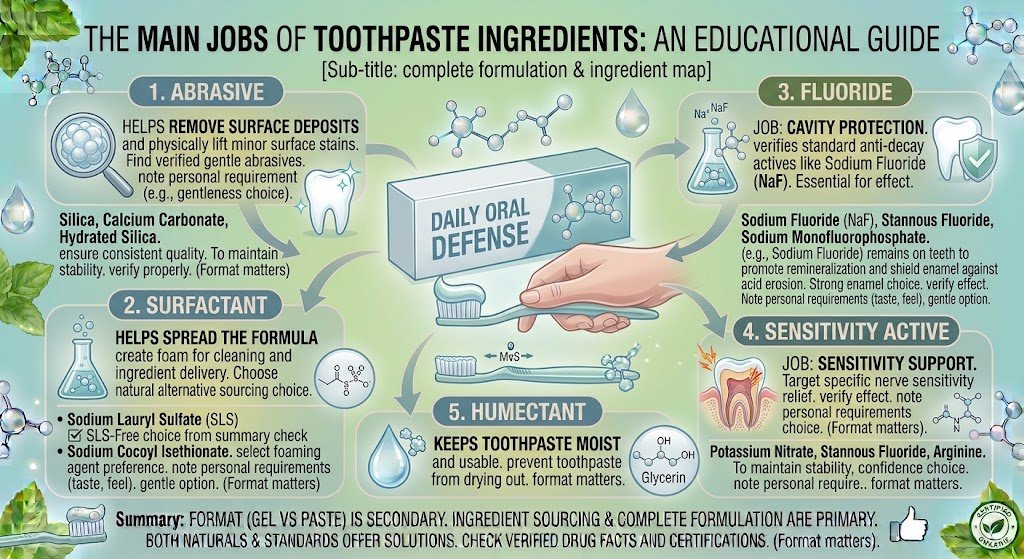
Many toothpastes contain surfactants, which help the toothpaste spread and disperse during brushing. Sodium lauryl sulfate, commonly called SLS, is one example of a surfactant used in some toothpaste formulations.
When surfactants interact with water, saliva, and the movement of brushing, they can produce foam.
But foam itself is not what removes plaque.
A toothpaste does not need to produce a large amount of foam to be capable of cleaning teeth.
Does More Foam Mean Cleaner Teeth?
Not necessarily.
Foam can make brushing feel more thorough because it spreads the toothpaste and creates a noticeable sensation in the mouth. But the amount of foam is not a simple measurement of cleaning effectiveness.
This is an important distinction for people who prefer low-foam or SLS-free toothpaste.
If someone dislikes the sensation of SLS or experiences irritation with a particular formula, an SLS-free toothpaste may be worth considering. The decision should be based on the person’s needs and the overall formulation rather than assuming that less foam automatically means better cleaning.
What Is SLS Actually Doing?
SLS primarily serves a formulation and sensory role. It helps toothpaste spread and contributes to the foaming experience during brushing.
It should not be confused with the abrasive ingredients responsible for much of the polishing action.
This gives us a useful way to think about toothpaste:
Different ingredients can contribute to different parts of the brushing experience.
One ingredient may help with texture. Another may help with cleaning. Another may help prevent cavities. Another may address sensitivity.
There is no single ingredient responsible for everything toothpaste does.
[ARTICLE CONTINUES — NEXT PART STARTS WITH: H2: “How Do Different Toothpaste Ingredients Help Clean or Protect Teeth?”]
Part 2 of 3 — continuing exactly from the previous stopping point.
How Do Different Toothpaste Ingredients Help Clean or Protect Teeth?
Toothpaste is not made with one ingredient that does all the cleaning. Different ingredients have different jobs. Some help remove surface deposits, some help the toothpaste spread, some keep the formula stable, and others help protect teeth from problems such as cavities or sensitivity.
Understanding these roles makes it easier to see why a toothpaste can be designed for a specific purpose without every ingredient being a “cleaning” ingredient.
Fluoride Helps Protect Teeth From Cavities
Fluoride does not scrub plaque from your teeth. Its main role is to help strengthen teeth and make them more resistant to acid-related damage.
When bacteria in plaque use sugars from food and drinks, they produce acids that can contribute to enamel mineral loss. Fluoride helps support the remineralization process and can make enamel more resistant to future acid attacks.
This is an important distinction: toothpaste can clean your teeth while its active ingredients provide additional protection.
For people whose main concern is cavity prevention, fluoride toothpaste may therefore be more important than choosing a toothpaste simply because it produces a lot of foam or feels especially “clean” after brushing.
Calcium Carbonate and Hydrated Silica Help Polish the Tooth Surface
Calcium carbonate and hydrated silica are examples of abrasive ingredients that can help remove surface deposits during brushing.
Their job is not to dissolve the tooth. Instead, they are formulated to provide controlled mechanical cleaning when combined with toothbrush bristles.
The important factor is how the entire toothpaste formula is designed, rather than simply choosing the toothpaste with the strongest abrasive effect.
A toothpaste that is too aggressive for a particular person may not be a better choice simply because it produces a stronger polishing effect.
Humectants Keep Toothpaste From Drying Out
Ingredients such as glycerin and sorbitol are commonly used as humectants. They help retain moisture and keep toothpaste in a usable consistency.
These ingredients are not primarily responsible for removing plaque.
Their role is more about formulation performance. A toothpaste needs to remain smooth and spreadable so that it can be distributed across the teeth during brushing.
This illustrates an important point about toothpaste: not every ingredient needs to clean teeth directly. Some ingredients make it possible for the formula to work properly and provide a consistent brushing experience.
Flavoring and Sweeteners Make Brushing Easier to Tolerate
Flavoring ingredients can give toothpaste its minty or otherwise recognizable taste. Sweeteners may also be used to improve the taste without functioning as ordinary tooth-cleaning abrasives.
These ingredients do not scrub plaque away.
However, they can influence whether someone enjoys using a toothpaste enough to brush consistently. Daily brushing depends partly on finding a toothpaste with a taste and texture that you can comfortably use.
For people who experience irritation from particular ingredients, however, the formula matters more than simply choosing a stronger flavor.
Potassium Nitrate and Other Ingredients Can Target Tooth Sensitivity
Some toothpaste formulas are designed specifically for sensitive teeth.
Potassium nitrate is one ingredient commonly used in sensitivity-focused toothpaste. Certain formulations may also use stannous fluoride or other ingredients depending on the product’s purpose.
These ingredients are not abrasive cleaners. Instead, they are included to address a particular oral-care need while the toothpaste still performs its basic brushing and cleaning function.
If sensitivity is your main concern, the better question is not simply “Which toothpaste cleans the most?” but “Which toothpaste provides adequate cleaning while also addressing my specific dental need?”
Xylitol Is Used in Some Toothpaste Formulas
Xylitol is a sugar alcohol used in some oral-care products, including certain toothpastes.
It can contribute to the overall formulation and is often associated with oral-health products because it is not fermented by oral bacteria in the same way as ordinary dietary sugars.
However, xylitol should not be treated as a replacement for brushing, fluoride, or other evidence-based dental care.
Hydroxyapatite Is Used in Some Toothpaste as an Alternative Active Ingredient
Hydroxyapatite is a calcium-phosphate mineral that is closely related to the mineral structure found in teeth and bones.
Some toothpaste formulas use hydroxyapatite as an active ingredient intended to support enamel and tooth-surface mineral care.
Nano-hydroxyapatite is a smaller-particle form that is also used in some oral-care formulations.
For shoppers comparing different toothpaste formulas, understanding the role of hydroxyapatite can be more useful than simply looking for a label such as “natural” or “clean.”
Does Fluoride Make Toothpaste Better at Cleaning?
Not exactly.
Fluoride and cleaning perform different jobs.
The toothbrush and toothpaste’s mechanical ingredients help remove plaque and surface deposits. Fluoride, meanwhile, helps protect teeth against cavities and supports enamel mineral balance.
That means a toothpaste can be excellent at physically cleaning the tooth surface without fluoride being responsible for that cleaning action.
At the same time, a toothpaste used for daily oral hygiene is not judged only by how clean the teeth feel immediately after brushing. Long-term protection matters too.
For people at risk of cavities, fluoride can be an important part of daily toothpaste use.
The distinction becomes especially important when comparing fluoride toothpaste with fluoride-free or hydroxyapatite formulas. The question is not simply which one “cleans better.” You also need to consider the active ingredient, cavity risk, sensitivity, enamel needs, and individual dental circumstances.
Does Toothpaste Remove Tartar?
Toothpaste can help control plaque and remove some surface buildup during regular brushing, but hardened tartar is different from soft plaque.
Plaque is a soft, sticky biofilm that can be disturbed through brushing. If plaque remains on the teeth and mineralizes, it can become calculus, commonly called tartar.
Once tartar has hardened onto the tooth surface, ordinary brushing and toothpaste generally cannot simply brush it away.
This is why trying to find an extremely abrasive toothpaste as a way to “scrub off tartar” is not a good strategy. Stronger scrubbing is not the same thing as effective oral hygiene.
Regular brushing helps control plaque before it hardens, while professional dental cleaning may be needed when calculus has already formed.
Does Toothpaste Whiten Teeth?
Some toothpastes can make teeth appear cleaner or brighter by helping remove surface stains.
Coffee, tea, tobacco, and some foods and drinks can contribute to staining on the outer tooth surface. Abrasive ingredients can help remove some of these external deposits during brushing.
But this is different from changing the natural internal color of a tooth.
A whitening toothpaste may therefore improve the appearance of surface-stained teeth without working like a professional bleaching treatment.
This is another reason why “stronger cleaning” should not automatically be interpreted as “better whitening.” A toothpaste needs to balance stain removal with appropriate care for the tooth surface.
For someone with enamel concerns, sensitivity, or frequent whitening use, the formula’s overall characteristics matter more than choosing the most aggressive-feeling toothpaste.
Does the Type of Toothpaste Change How It Cleans?
Yes, but usually because different formulas prioritize different needs.
An everyday toothpaste may focus on plaque control and cavity protection. A sensitivity toothpaste may include ingredients intended to reduce sensitivity. A whitening toothpaste may emphasize surface-stain removal. An SLS-free toothpaste may use a different surfactant system or formulation approach.
This does not mean one category is automatically “stronger” at cleaning.
The better choice depends on the person’s oral-health needs and how well the toothpaste can be used consistently.
For an ingredient-conscious shopper, the goal is to find a toothpaste that provides effective everyday cleaning without unnecessarily choosing ingredients that do not suit their preferences or needs.
Part 3 of 3 — continuing from the exact stopping point and completing the article.
What Makes a Toothpaste Good for Daily Cleaning?
A good daily toothpaste does not need to produce the most foam, feel the strongest, or contain the most abrasive ingredients.
Instead, it should provide effective cleaning while fitting your oral-health needs.
When evaluating a toothpaste for everyday use, consider these factors:
Appropriate Cleaning Power
The toothpaste should help remove plaque and surface deposits when used with proper brushing technique.
More abrasive does not automatically mean better. The goal is controlled cleaning rather than aggressive scrubbing.
An Active Ingredient That Matches Your Needs
Different people may have different priorities.
Someone with a high cavity risk may prioritize fluoride. Someone dealing with sensitivity may look for a sensitivity-focused formula. Someone interested in hydroxyapatite may prefer a toothpaste containing that ingredient.
The most useful toothpaste is therefore not necessarily the one with the longest ingredient list. It is the one whose formulation makes sense for your particular oral-care goal.
A Formula You Can Use Consistently
Even a well-formulated toothpaste cannot help much if you dislike using it and regularly skip brushing.
Taste, texture, foaming level, and mouthfeel can all influence the brushing experience.
If a toothpaste makes brushing uncomfortable, choosing another appropriate formula may make it easier to maintain a consistent routine.
Clear Ingredient Information
For shoppers interested in non-toxic or ingredient-conscious products, transparency is also important.
Instead of relying only on marketing terms such as “natural,” “clean,” or “non-toxic,” look at the actual ingredient list and understand what each major ingredient is doing.
This approach gives you more useful information than a front-label claim alone.
How to Choose Toothpaste Based on Your Cleaning Goal
The best toothpaste depends partly on what you want your daily brushing routine to accomplish.
If Your Main Goal Is Everyday Plaque Cleaning
Look for a toothpaste designed for regular use and pair it with proper brushing.
Remember that the toothbrush provides much of the physical plaque disruption. Toothpaste supports the process through its formulation and active ingredients.
If Your Main Goal Is Surface-Stain Removal
A whitening toothpaste may be useful when the main issue is staining on the outside of the teeth.
However, whitening toothpaste should not be confused with professional bleaching or treatments that change intrinsic tooth color.
If Your Teeth Are Sensitive
Consider a toothpaste specifically formulated for sensitive teeth rather than simply choosing a toothpaste that feels extremely powerful.
Sensitivity-focused ingredients can serve a different purpose from abrasives.
If You Are Focused on Enamel Protection
Look for a formula designed around enamel care and consider the active ingredients it contains.
Fluoride and hydroxyapatite are two ingredients commonly discussed in connection with enamel and mineral support.
If Cavity Prevention Is Your Priority
Cleaning plaque is only part of cavity prevention.
The toothpaste’s active ingredients matter as well, particularly when choosing a formula intended for regular cavity protection.
If You Prefer an SLS-Free Formula
SLS-free toothpaste can provide a different brushing experience for people who prefer to avoid sodium lauryl sulfate or who find certain formulas irritating.
The absence of SLS does not mean the toothpaste cannot clean effectively. Cleaning depends on the entire formula and proper brushing technique.
Common Mistakes That Can Reduce Cleaning Effectiveness
Even a well-formulated toothpaste cannot compensate for poor brushing habits.
Brushing Too Hard
More pressure does not necessarily mean cleaner teeth.
Aggressive brushing can be unnecessarily harsh on the teeth and gums. The goal is controlled, thorough brushing rather than scrubbing as hard as possible.
Focusing Only on Foam
A large amount of foam can make toothpaste feel active, but foam itself is not proof that plaque is being removed more effectively.
Surfactants help the toothpaste spread and create the familiar foaming sensation, but the toothbrush still performs the main mechanical cleaning action.
Brushing for Too Little Time
Quickly moving the toothbrush around the mouth and stopping after a few seconds can leave areas untouched.
Consistent, thorough brushing is more important than choosing a toothpaste simply because it feels powerful.
Ignoring the Gumline
Plaque can accumulate around the gumline, so brushing should not focus only on the visible centers of the teeth.
A complete oral-hygiene routine also involves areas that a toothbrush alone may not fully clean.
Assuming “Natural” Automatically Means Better
A toothpaste being marketed as natural does not automatically make it more effective for plaque control, cavities, sensitivity, or enamel care.
The same is true in reverse: a conventional ingredient is not automatically harmful simply because it sounds unfamiliar.
The better approach is to evaluate the ingredients according to their purpose, evidence, concentration where relevant, and suitability for your needs.
Choosing Based Only on Marketing Claims
Words such as “clean,” “natural,” “chemical-free,” or “non-toxic” can be useful signals of a product’s positioning, but they do not tell you everything about how the toothpaste works.
Look at the actual formulation and identify what provides cleaning, cavity protection, sensitivity support, or other intended benefits.
Frequently Asked Questions
How does toothpaste clean teeth?
Toothpaste helps clean teeth primarily by working together with the toothbrush. Bristles physically disturb plaque and debris, while toothpaste ingredients such as mild abrasives help remove surface deposits and spread the formula across the tooth surface.
What ingredient actually cleans teeth?
There is no single ingredient responsible for all cleaning. Toothbrush bristles provide the main mechanical action, while abrasives such as hydrated silica or calcium carbonate can help remove surface deposits. Other ingredients support the formula in different ways.
Does toothpaste remove plaque?
Yes, toothpaste can assist with plaque removal when used with proper brushing. However, the physical action of brushing is a major part of plaque disruption.
Plaque is a sticky biofilm, so consistent and thorough brushing is important.
Does toothpaste remove tartar?
Toothpaste can help control plaque before it hardens, but it generally cannot remove established hardened tartar simply through brushing. Professional dental cleaning may be required to remove calculus.
Does toothpaste whiten teeth?
Some whitening toothpastes can help remove surface stains, making teeth look cleaner or brighter. This is different from bleaching the internal color of teeth.
Does more foam mean better cleaning?
No. Foam mainly comes from surfactants interacting with water or saliva during brushing. More foam does not automatically mean that more plaque is being removed.
Is fluoride necessary for toothpaste to clean teeth?
Fluoride is not what physically scrubs plaque away. Its major role is cavity protection and supporting the tooth’s resistance to acid-related mineral loss.
Therefore, cleaning and fluoride protection should be thought of as two related but different functions.
Can toothpaste clean between teeth?
Toothpaste and brushing can clean the surfaces that the toothbrush reaches, but a toothbrush cannot effectively clean every space between teeth.
Interdental cleaning methods may be needed for areas that toothbrush bristles cannot adequately reach.
The Bottom Line
Toothpaste does not clean teeth by itself.
The toothbrush provides the main physical action that disrupts plaque and removes debris. Toothpaste supports that process with ingredients that can help polish the tooth surface, distribute the formula, improve its texture, and deliver active ingredients for specific oral-health goals.
Abrasives can help remove surface deposits. Surfactants help toothpaste spread and foam. Fluoride can help protect against cavities. Other ingredients may address sensitivity, enamel care, or other needs.
The most important lesson is that a toothpaste that feels stronger is not necessarily cleaning better.
Instead, choose a formula that matches your oral-health needs, use an appropriate brushing technique, and focus on consistent daily oral hygiene.
If you are comparing non-toxic or ingredient-conscious toothpastes, the next step is to look beyond the marketing label and examine the actual ingredients, their purpose, and the evidence behind the claims.
Affiliate Disclosure
This article may contain affiliate links. If you purchase a product through one of these links, we may earn a commission at no additional cost to you. Our recommendations are based on product information, ingredient considerations, and the needs discussed in this guide.
