If you are wondering how much toothpaste you should use, the answer depends mainly on age and the person’s individual dental needs. Young children need much smaller amounts than adults, while adults should focus on using fluoride toothpaste correctly rather than covering the entire toothbrush with paste.
For children, age-specific guidance is especially important because young children may swallow toothpaste. The American Dental Association recommends a rice-sized smear for children younger than 3 and a pea-sized amount for children ages 3 to 6. [ add a link — Anchor Text: “ADA toothpaste guidance” — Destination: “American Dental Association toothpaste guidance” ]
For adults, the important point is not to assume that more toothpaste means cleaner teeth. The amount should be practical and appropriate for the product and person’s needs, while brushing technique, frequency, and duration remain central to good oral hygiene.
This guide explains how much toothpaste to use at different ages, why children need different amounts, whether more toothpaste cleans better, and how to choose and use toothpaste without unnecessary waste.
How Much Toothpaste Should Adults Use?
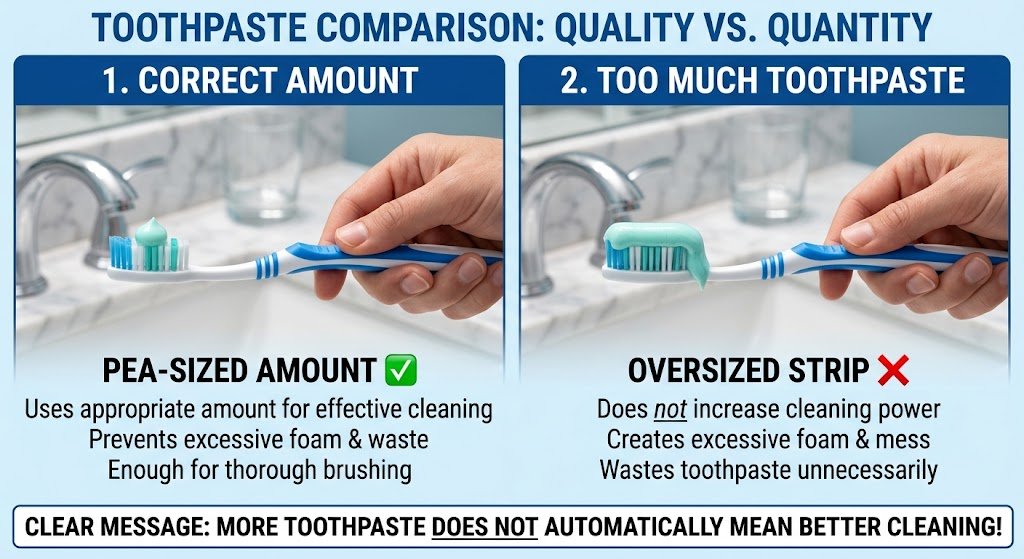
Adults do not need to cover the entire toothbrush head with a long strip of toothpaste.
A common mistake is assuming that a larger amount of toothpaste will provide a deeper clean. In reality, toothpaste is only one part of the brushing process. The way you move the toothbrush, how thoroughly you clean the teeth and gumline, and how consistently you brush are all important.
For most adults, the practical goal is to use enough toothpaste to distribute fluoride and other useful ingredients across the teeth without unnecessarily covering the brush with a large amount of paste.
The exact amount does not need to be measured with a ruler or kitchen scale. Instead, follow the directions on the toothpaste packaging and any instructions provided by your dentist.
Does an Adult Need a Pea-Sized Amount?
You may have heard that everyone should use a pea-sized amount of toothpaste.
That advice is particularly associated with children’s toothpaste guidance. The ADA specifically recommends a rice-sized smear for children under 3 and a pea-sized amount for children ages 3 to 6. It should not automatically be treated as a universal measurement for every adult. [ add a link — Anchor Text: “recommended toothpaste amounts for children” — Destination: “American Dental Association toothpaste guidance” ]
For adults, the more important considerations are:
- Use an appropriate fluoride toothpaste when suitable.
- Apply a practical amount rather than an unnecessarily large strip.
- Brush thoroughly rather than relying on extra toothpaste.
- Follow the product’s instructions.
- Follow personalized dental advice when you have specific oral-health needs.
If you are using a prescription or specially formulated toothpaste, the instructions from your dentist or the product manufacturer should take priority over general guidance.
Why More Toothpaste Isn’t Necessarily Better
Putting more toothpaste on the brush can make brushing feel more substantial because there is more foam, flavor, or product in your mouth.
That does not mean your teeth are receiving a proportionally better cleaning.
A large amount can also make some people want to spit sooner because of the stronger taste or increased foaming. If that makes someone rush through brushing, using more toothpaste may actually work against a consistent routine.
The goal is effective brushing, not a large amount of toothpaste.
For adults, focus on brushing all accessible tooth surfaces and along the gumline rather than increasing the amount of paste.
How Much Toothpaste Should Children Use?
Children need different toothpaste guidance because they may not yet be able to reliably spit out toothpaste.
The amount becomes especially important when fluoride toothpaste is involved. Fluoride is valuable for preventing tooth decay, but young children should be supervised so they use the appropriate amount and avoid swallowing toothpaste.
The ADA provides age-specific guidance that makes this easier for parents and caregivers.
Children Under 3
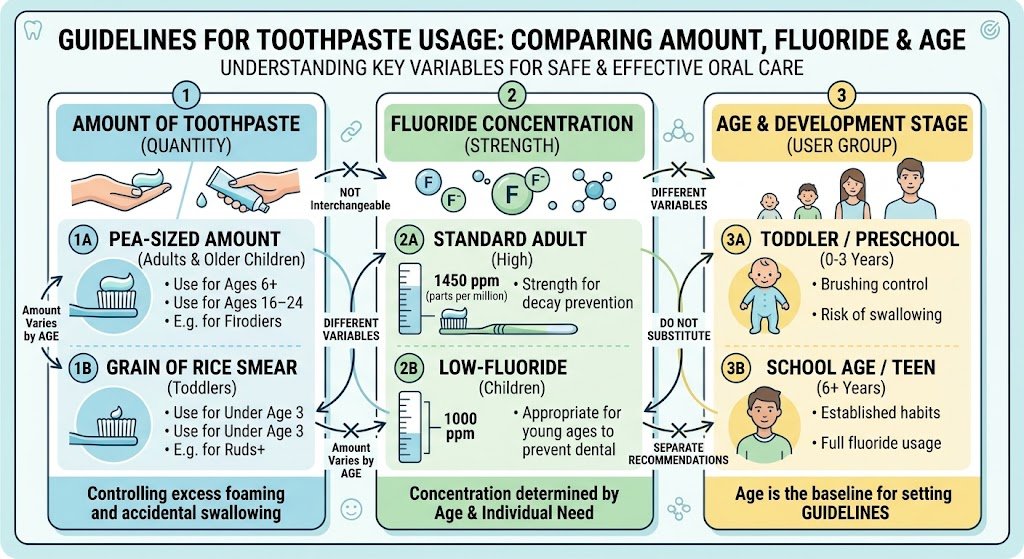
For children younger than 3, the ADA recommends using a smear of fluoride toothpaste approximately the size of a grain of rice.
This is a very small amount compared with the long strip of toothpaste commonly shown in advertisements.
The purpose is to provide the benefits of fluoride while limiting the amount of toothpaste available to be swallowed.
Parents and caregivers should help young children brush rather than expecting them to manage the entire process independently.
Children Ages 3 to 6
For children ages 3 to 6, the ADA recommends a pea-sized amount of fluoride toothpaste.
At this age, children are becoming more independent with brushing, but supervision is still important.
Parents can help by putting the toothpaste on the toothbrush themselves and reminding the child to spit rather than swallow it.
The pea-sized recommendation is therefore an age-specific child recommendation, not a rule that should simply be copied for every person in the household.
Why Children Need Less Toothpaste
The main issue is not that a small amount somehow cleans children’s teeth better.
It is about using an appropriate amount while considering the possibility that a young child may swallow some toothpaste.
Children’s developing teeth are also one reason fluoride exposure needs to be managed appropriately.
This is why parents should pay attention to both the type of toothpaste and the amount used.
A child who repeatedly swallows toothpaste may need additional guidance from a dentist or pediatric dental professional.
Should Children Use Fluoride Toothpaste?
For most children, fluoride toothpaste is an important part of cavity prevention when used appropriately.
The key is to use the age-appropriate amount and supervise brushing according to the child’s age and ability.
Parents should not assume that fluoride toothpaste needs to be avoided simply because a child might swallow some. Instead, follow established dental guidance on the amount and brushing routine.
If a child has a particular dental condition, elevated cavity risk, or has been given specific instructions by a dentist, those instructions should take priority.
Does More Toothpaste Clean Your Teeth Better?
No. Using more toothpaste does not automatically make your teeth cleaner.
Toothpaste can provide important ingredients such as fluoride, but brushing effectiveness depends on the complete routine.
Think of toothbrushing as several parts working together:
Toothpaste + toothbrush + technique + coverage + frequency + time
If you put twice as much toothpaste on the brush but rush through brushing, you have not necessarily improved the routine.
Likewise, using a small amount of toothpaste does not mean much if you consistently miss areas of the mouth.
What Matters More Than Using Extra Toothpaste?
Focus on:
- Reaching the front, back, and chewing surfaces of the teeth
- Cleaning around the gumline
- Brushing consistently
- Using fluoride toothpaste when appropriate
- Spending enough time brushing
- Replacing a worn toothbrush or brush head when needed
For general adult oral care, the ADA recommends brushing twice a day with fluoride toothpaste. [ add a link — Anchor Text: “ADA guidance on brushing and fluoride toothpaste” — Destination: “American Dental Association oral-health guidance” ]
The important takeaway is simple:
Don’t use a larger amount of toothpaste to compensate for an incomplete brushing routine.
A good brushing technique and consistent routine are more important than creating a thick layer of toothpaste foam.
[ARTICLE CONTINUES — NEXT PART STARTS WITH: H2: “How Much Toothpaste Should You Use With Fluoride Toothpaste?” ]
How Much Toothpaste Should You Use With Fluoride Toothpaste?
If you use fluoride toothpaste, the amount you put on your toothbrush is only one part of the bigger picture. Fluoride concentration, age, brushing habits, and how much toothpaste is swallowed all matter.
For adults, there is usually no need to measure toothpaste precisely. Use a practical amount that lets you brush all tooth surfaces comfortably without covering the entire brush head with a large strip of paste. The goal is to use the toothpaste as part of a consistent brushing routine rather than relying on a larger amount to improve the result.
For children, the amount is more specific. The American Dental Association recommends a rice-sized smear for children younger than 3 and a pea-sized amount for children ages 3 to 6 when using fluoride toothpaste. [ add a link — Anchor Text: “ADA fluoride toothpaste guidance” — Destination: “American Dental Association fluoride toothpaste guidance” ]
It is also important to understand that the amount of toothpaste and the concentration of fluoride are not the same thing. A larger amount of a lower-fluoride toothpaste is not automatically equivalent to a smaller amount of a higher-fluoride product. Toothpaste labels and dental recommendations can help determine whether a product is appropriate for your needs.
For adults and older children who can reliably spit out toothpaste, the main focus should be regular brushing with an appropriate fluoride toothpaste, rather than trying to maximize the amount used each time.
Does Fluoride Amount Depend on How Much Toothpaste You Use?
Yes. The amount of toothpaste used affects how much of its ingredients are placed in the mouth during brushing.
This is particularly important for young children because they may swallow some toothpaste instead of spitting it out. That is one reason age-specific amounts are recommended.
However, this does not mean you should simply use as little toothpaste as possible. The right approach is to use the age-appropriate amount and follow guidance from a dentist or other qualified dental professional when individual circumstances require something different.
If you are comparing fluoride and fluoride-free options, remember that the decision involves more than toothpaste quantity. Fluoride is widely used for cavity prevention, while fluoride-free products may be selected for different reasons. Your cavity risk and dental history can make this choice more important than the amount of toothpaste placed on the brush.
Does Toothpaste Amount Change for Sensitive Teeth, Dry Mouth, or Other Needs?
For most people, a special dental condition does not automatically mean they should use a much larger amount of toothpaste. Instead, the type of toothpaste and brushing approach may matter more.
If you have a specific dental condition, follow the product instructions and your dentist’s recommendations rather than increasing the amount on your own.
Sensitive Teeth
If you have sensitive teeth, using more toothpaste is not necessarily the answer.
A toothpaste formulated for sensitive teeth may contain ingredients intended to help reduce sensitivity, but the product needs to be used consistently and according to its directions. Brushing too aggressively can also contribute to discomfort, so technique matters alongside toothpaste choice.
If sensitivity continues, becomes severe, or is limited to one particular tooth, it is worth discussing it with a dentist. Tooth sensitivity can have different causes, and simply adding more toothpaste will not address all of them.
Dry Mouth
People with dry mouth may need to pay particular attention to their overall oral-care routine because reduced saliva can increase the risk of oral problems.
Using a larger amount of toothpaste does not solve the underlying issue. Instead, product selection, regular brushing, hydration when appropriate, and professional dental advice may be more useful.
If dry mouth is persistent, discuss it with a healthcare professional or dentist, especially if it is affecting eating, speaking, sleeping, or oral comfort.
Older Adults
Older adults do not automatically need a larger amount of toothpaste simply because they are older.
What may change is the person’s dental situation. Some older adults may have more complex dental needs, sensitivity, exposed root surfaces, dental restorations, or difficulty handling a toothbrush.
In these cases, the right toothpaste and toothbrush may be more important than increasing the amount of toothpaste.
If brushing is difficult because of limited hand strength or movement, an electric toothbrush or an easier-to-grip handle may be worth discussing with a dental professional.
Braces
People with braces generally do not need to cover the entire toothbrush with toothpaste.
Instead, careful brushing around brackets, wires, the gumline, and other hard-to-reach areas becomes especially important. Orthodontic appliances can create additional places where food and plaque collect, so brushing technique and thoroughness matter.
If your orthodontist has given you specific toothpaste or brushing instructions, follow those recommendations.
How to Put the Right Amount of Toothpaste on Your Brush
Getting the right amount of toothpaste does not need to be complicated.
A simple routine can help:
- Choose the appropriate toothpaste. For many people, this means a fluoride toothpaste unless a dental professional has recommended another option.
- Use the age-appropriate amount. Young children need much less toothpaste than adults.
- Place the toothpaste on the bristles. There is no need to spread a long strip across the entire toothbrush head.
- Brush all tooth surfaces carefully. Move the brush along the front, back, and chewing surfaces of the teeth and around the gumline.
- Brush for enough time. A small amount of toothpaste cannot make up for a rushed brushing session.
- Spit after brushing rather than swallowing the toothpaste. This is particularly important for children who are still learning how to spit reliably.
- Follow specific dental instructions. Your dentist may recommend a different product or routine based on your oral-health needs.
The most useful habit is consistency. Measuring toothpaste perfectly every morning and night is less important than using an appropriate amount and brushing thoroughly and regularly.
Common Mistakes When Using Toothpaste
Even when people use a good toothpaste, simple habits can make their routine less effective or less practical.
Covering the Entire Brush With Toothpaste
A long strip of toothpaste covering the whole toothbrush may look like the correct amount because it is common in advertisements and product images.
But you do not need to fill the entire brush head with toothpaste to clean your teeth effectively. Using a practical amount is enough to incorporate the toothpaste into your brushing routine.
Assuming More Means Better
More toothpaste can create more foam and a stronger flavor, but that does not automatically mean cleaner teeth.
The cleaning process still depends heavily on how thoroughly you brush. Increasing the amount of toothpaste should not be used as a substitute for improving brushing technique or spending enough time on each area.
Giving Young Children Too Much
This is one of the more important mistakes to avoid.
Young children may swallow toothpaste, so giving them an adult-sized amount is unnecessary. Follow age-specific guidance and supervise children during brushing.
For children younger than 3, the ADA recommends a rice-sized smear. For children ages 3 to 6, it recommends a pea-sized amount.
Ignoring Toothpaste Swallowing
Spitting toothpaste out is a skill that develops with age.
If a young child frequently swallows toothpaste, parents and caregivers should pay attention to both the amount being used and the child’s brushing habits. Do not simply give the child more toothpaste because they seem to like the taste or foam.
If you are concerned about repeated swallowing or your child’s fluoride exposure, ask a dentist for personalized guidance.
Focusing on Toothpaste Amount Instead of Brushing Technique
Toothpaste cannot compensate for poor brushing technique.
Even the right amount will not be very helpful if you consistently miss the gumline, rush through brushing, or fail to clean the back and chewing surfaces of the teeth.
Think of toothpaste as one part of the routine—not the entire routine.
Choosing Toothpaste Based Only on Marketing
Terms such as “natural,” “clean,” “whitening,” or “advanced” can make a toothpaste sound appealing, but the marketing message does not tell you how much toothpaste to use.
Look at the actual ingredients, fluoride information when relevant, intended use, and your own dental needs.
For people who are trying to avoid certain ingredients, understanding the label is more useful than simply choosing a product because its packaging says “natural.”
Should You Use More Toothpaste If You Have Cavities?
Usually, having cavities does not mean you should simply use more toothpaste.
If you are at higher risk of cavities, what matters is using an appropriate toothpaste and following a consistent oral-care routine. Fluoride toothpaste can play an important role in cavity prevention, but increasing the amount beyond what is appropriate does not automatically provide extra protection.
Your dentist may recommend a particular fluoride toothpaste, brushing routine, or other preventive measures if you have a history of cavities or an elevated risk of tooth decay.
It is also useful to separate toothpaste amount from toothpaste type. Someone with frequent cavities may benefit more from using the right toothpaste consistently than from putting a larger amount on the toothbrush.
If you are getting cavities despite brushing regularly, talk with your dentist. Factors such as diet, oral hygiene, dry mouth, medications, existing dental problems, and individual cavity risk can all affect your needs.
Toothpaste Amount for Adults vs. Children
The simplest way to remember the difference is that children need age-specific amounts, while adults generally do not need to measure out an exact pea-sized portion.
| Age or situation | General toothpaste amount | Main consideration |
| Under 3 years | Rice-sized smear | Use an age-appropriate amount and supervise brushing |
| Ages 3–6 | Pea-sized amount | Help children use the correct amount and spit rather than swallow |
| Adults | Practical amount; no universal pea-sized rule | Focus on appropriate toothpaste, thorough brushing, and consistency |
| Special dental needs | Follow product/dental guidance | The toothpaste type and brushing routine may matter more than using more |
The child-specific amounts above follow ADA guidance. Adults should not assume that the child recommendation is a strict universal measurement for every adult.
Frequently Asked Questions
Is a pea-sized amount of toothpaste enough for adults?
A pea-sized amount can be a practical amount for some adults, but it is not a universal ADA rule for adults. Adults generally do not need to cover the entire toothbrush with toothpaste. Focus on using an appropriate product and brushing thoroughly.
How much toothpaste should a 2-year-old use?
For children younger than 3, the ADA recommends a rice-sized smear of fluoride toothpaste. Young children should be supervised during brushing to help prevent unnecessary swallowing.
How much toothpaste should a 5-year-old use?
For children ages 3 to 6, the ADA recommends a pea-sized amount of fluoride toothpaste. Parents or caregivers should continue supervising brushing and encourage the child to spit out the toothpaste.
Does using more toothpaste make your teeth cleaner?
No. More toothpaste does not automatically produce better cleaning. Brushing technique, coverage, frequency, and brushing time are important parts of an effective routine.
Should adults use fluoride toothpaste?
For most adults, fluoride toothpaste is an important part of cavity prevention. Individual needs can vary, so people with specific dental conditions or professional recommendations should follow their dentist’s advice.
Should you use more toothpaste if you have sensitive teeth?
Not necessarily. Using a toothpaste designed for sensitive teeth and following its directions is generally more useful than simply increasing the amount. Persistent or severe sensitivity should be evaluated by a dentist.
Can children use too much toothpaste?
Yes. Young children may swallow toothpaste, which is why age-specific amounts are recommended. Parents should use the appropriate amount and supervise brushing.
Does toothpaste amount matter more than brushing technique?
No. The amount matters, especially for young children, but effective brushing also depends on reaching all tooth surfaces, using appropriate technique, brushing regularly, and spending enough time brushing.
Conclusion
So, how much toothpaste should you use? The answer depends mainly on age.
Children younger than 3 should use a rice-sized smear, while children ages 3 to 6 should use a pea-sized amount according to American Dental Association guidance. Adults do not need to follow a strict pea-sized rule or cover the entire toothbrush with toothpaste.
The bigger lesson is that more toothpaste does not mean better cleaning. A practical amount, an appropriate toothpaste, thorough brushing, regular brushing, and good technique all work together.
If you have sensitive teeth, cavities, dry mouth, braces, or another specific dental concern, choosing the right toothpaste and following professional advice may be more important than increasing the amount you use.
For most people, the goal is simple: use the right amount for your age, brush thoroughly, and make good oral hygiene a consistent habit.
