If you brush your teeth every day, you probably know that toothpaste is supposed to clean them. But how does toothpaste work once you put it on your toothbrush?
Toothpaste works together with your toothbrush to remove plaque, food debris, and some surface stains. Depending on its formula, it can also deliver active ingredients that help prevent cavities, support enamel, reduce tooth sensitivity, or address other oral-health concerns.
The toothbrush provides much of the physical cleaning action, while toothpaste helps with cleaning and delivers ingredients to the tooth surfaces. Understanding this difference makes it easier to choose toothpaste based on what you actually need rather than choosing only because of its flavor, foam, or marketing claims.
This guide explains how toothpaste works from brushing and plaque removal to fluoride, abrasives, foam, enamel, hydroxyapatite, and different toothpaste formulas.
How Does Toothpaste Work?
Toothpaste works through several processes at the same time.
When you brush, the toothbrush moves across your teeth and gums. This physical movement helps disturb plaque and food debris. At the same time, the toothpaste spreads across the tooth surfaces and supplies cleaning ingredients and, depending on the formula, active ingredients.
A simple way to think about it is:
Toothbrush movement + toothpaste ingredients → cleaning + active ingredient delivery
The exact effect depends on the toothpaste formula.
For example, a fluoride toothpaste is designed to provide fluoride for cavity prevention, while a sensitivity toothpaste may contain an ingredient intended to help manage sensitivity. A hydroxyapatite toothpaste uses a different approach and may be chosen by people interested in enamel support or fluoride alternatives.
The American Dental Association explains that toothpaste contains both active and inactive ingredients. Abrasives help clean teeth, while active ingredients such as fluoride can provide specific oral-health benefits.
Toothbrush and Toothpaste Work Together
One of the easiest mistakes to make is assuming that toothpaste does all the cleaning.
It does not.
Your toothbrush provides the physical movement needed to disturb plaque and debris. Toothpaste supports that process with ingredients that help clean the tooth surface and deliver active compounds.
This means that toothpaste cannot compensate completely for poor brushing.
If someone uses an excellent toothpaste but brushes too quickly, misses areas of the mouth, or uses an ineffective technique, the toothpaste alone cannot solve the problem.
Good oral hygiene therefore depends on the combination of:
- Regular brushing
- Effective brushing technique
- Appropriate toothpaste
- Cleaning between the teeth
- Other dental care appropriate to the individual
The National Institute of Dental and Craniofacial Research recommends brushing twice a day with fluoride toothpaste as part of daily oral hygiene.
Toothpaste Helps Remove Plaque and Debris
Plaque is a sticky film that develops on tooth surfaces. It contains bacteria and other material that can remain attached to the teeth.
When you brush, the bristles physically disturb this film.
Toothpaste contributes through its cleaning ingredients, particularly abrasives. These ingredients help the brushing process remove material from the tooth surface.
This is one reason toothpaste should be thought of as part of a cleaning system, rather than as a chemical product that simply “kills everything” in your mouth.
Your mouth naturally contains microorganisms. The goal of daily brushing is to control plaque and maintain oral hygiene, not to sterilize the mouth.
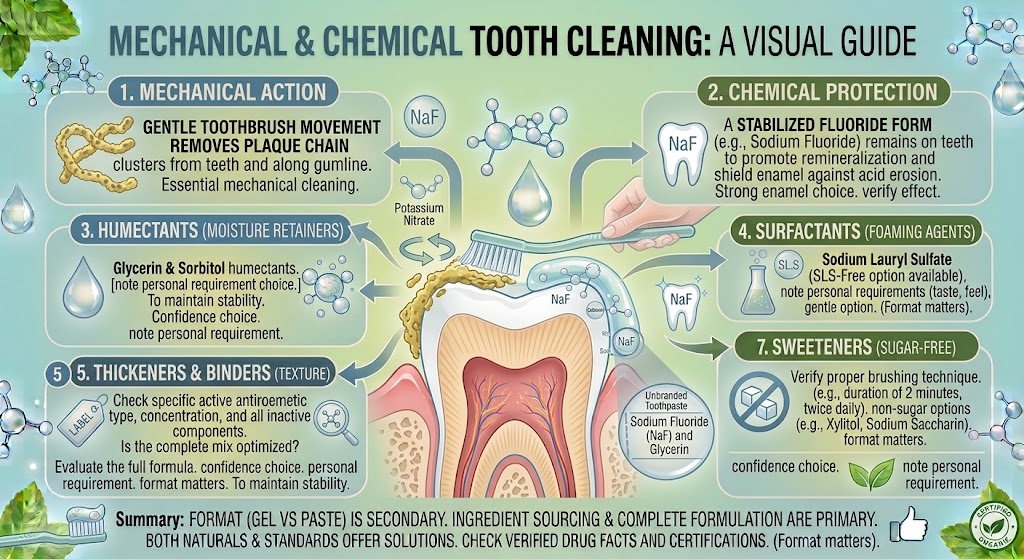
How Does Toothpaste Clean Your Teeth?
Toothpaste cleans teeth mainly through the combination of mechanical brushing and cleaning ingredients.
The toothbrush physically moves across the tooth surface. Toothpaste helps this process by providing ingredients that can loosen, polish, and remove surface deposits.
Among the most important cleaning ingredients are abrasives.
What Do Abrasives Do?
Abrasives are ingredients added to toothpaste to help clean the teeth.
Common examples include:
- Calcium carbonate
- Hydrated silica
- Silicates
- Other mineral-based cleaning agents
These ingredients are not intended to scrape away the tooth itself. In a properly formulated toothpaste, their purpose is to help remove plaque, food debris, and surface deposits during brushing.
Abrasives can also help with surface stains.
For example, coffee, tea, and certain foods can contribute to stains on the outside of teeth. Cleaning and polishing ingredients may help remove some of these external deposits.
This is different from changing the natural internal color of a tooth.
The ADA identifies abrasives as an important toothpaste ingredient group used for cleaning and removing surface stains.
Why More Abrasive Does Not Mean Better
It might seem logical that a more abrasive toothpaste would produce cleaner teeth.
But more abrasive does not automatically mean better.
Toothpaste needs appropriate cleaning ability, but excessive or unnecessarily aggressive brushing is not the goal. Your brushing technique, tooth condition, and toothpaste formulation all matter.
Toothpaste abrasivity is commonly discussed using the Relative Dentin Abrasivity, or RDA, scale. This provides a standardized way to evaluate abrasivity, but the number should not be treated as a simple “higher is bad, lower is good” ranking.
If you have tooth sensitivity, exposed dentin, enamel concerns, or another reason to pay attention to abrasivity, it can be useful to learn how different formulas approach cleaning.
How Does Fluoride Toothpaste Work?
Fluoride is one of the most important toothpaste ingredients to understand because it does more than help clean the teeth.
It provides an active ingredient that helps protect against tooth decay.
To understand how fluoride works, it helps to understand two processes:
Demineralization and remineralization.
Your teeth are exposed to acids during everyday eating and drinking. Bacteria in plaque can produce acids when they metabolize carbohydrates. These acids can cause minerals to leave the enamel.
That mineral loss is called demineralization.
Your saliva naturally helps return minerals to the teeth. This process is called remineralization.
Fluoride supports this protective process and helps make the tooth surface more resistant to acid attacks.
The National Institute of Dental and Craniofacial Research explains that fluoride can help prevent tooth decay and can help reverse early stages of decay by supporting the replacement of lost minerals.
Fluoride and Enamel
Enamel is the hard outer layer of your teeth.
Although enamel is highly mineralized, it is constantly exposed to conditions that can cause mineral loss. Food, drinks, plaque bacteria, and acids can all influence this process.
Fluoride helps protect enamel by supporting remineralization and making the tooth surface more resistant to acid-related mineral loss.
This is why fluoride toothpaste has a role that goes beyond simply making your mouth feel clean.
It provides a specific active ingredient designed to help protect teeth against decay.
Common fluoride compounds found in toothpaste include:
- Sodium fluoride
- Stannous fluoride
- Sodium monofluorophosphate
Different fluoride compounds have different chemical properties, but they are all used as active ingredients in toothpaste formulations designed for cavity prevention.
Fluoride and Early Tooth Decay
There is an important difference between early mineral loss and a fully developed cavity.
When enamel is beginning to lose minerals, fluoride can support remineralization and help prevent the process from progressing.
But toothpaste should not be described as something that can simply rebuild a large hole in a tooth.
Once significant tooth structure has been lost, professional dental treatment may be necessary.
This distinction is especially important when evaluating toothpaste marketed as “remineralizing.” Supporting early mineral repair is not the same as replacing tooth structure that has already disappeared.
How Does Toothpaste Affect Plaque and Bacteria?
Plaque is central to understanding why regular brushing matters.
Plaque contains bacteria that interact with food particles and produce acids. These acids can contribute to the demineralization of tooth enamel.
The process can be simplified as:
Plaque → bacterial activity → acid production → mineral loss → increased risk of tooth decay
Brushing interrupts this process by physically disturbing and removing plaque.
Toothpaste contributes cleaning ingredients and, in many formulas, active ingredients such as fluoride.
However, it would be inaccurate to think of toothpaste simply as a product that “kills bacteria.”
Your mouth naturally contains many microorganisms, and healthy oral care is not about eliminating every microorganism. The goal is to control plaque, support the teeth and gums, and reduce factors that contribute to oral disease.
This is also why toothpaste should not replace brushing technique, cleaning between teeth, or professional dental care when needed.
Why Does Toothpaste Foam?
Foam is one of the most noticeable things about toothpaste.
When you brush, some toothpastes produce a large amount of foam while others produce very little.
The difference often comes from surfactants, also called detergents.
Sodium lauryl sulfate, or SLS, is a common example.
Surfactants help toothpaste spread across the mouth and can create the foaming effect people associate with brushing.
But foam is not the same thing as cleaning power.
A toothpaste that produces a lot of foam is not automatically more effective than a low-foaming toothpaste.
What Does SLS Do?
SLS is included in some toothpaste formulas because it has useful formulation properties.
It can help distribute the toothpaste during brushing and create foam.
However, some people prefer SLS-free toothpaste because of personal ingredient preferences or because certain formulas may cause irritation for them.
That does not mean that every toothpaste containing SLS is automatically harmful.
The better question is:
What role does SLS play, and is an SLS-containing formula suitable for you?
If you specifically want to avoid SLS, check the ingredient list rather than relying only on terms such as “natural,” “clean,” or “non-toxic.”
What Do Other Toothpaste Ingredients Do?
Fluoride and abrasives often receive the most attention, but toothpaste contains several other ingredients that help the formula work properly.
These supporting ingredients may control moisture, texture, taste, foam, or other characteristics. Some formulas also contain additional active ingredients for specific concerns such as sensitivity, enamel support, or whitening.
Understanding these ingredients helps you read a toothpaste label without assuming that every ingredient has the same purpose.
Humectants Help Keep Toothpaste Moist
Humectants are ingredients that help toothpaste retain moisture.
Common examples include:
- Glycerin
- Sorbitol
- Propylene glycol
Without moisture-control ingredients, toothpaste could dry out and lose the consistency needed for normal brushing.
Humectants therefore have more to do with the physical properties of the toothpaste than with directly preventing cavities.
This is an important distinction when reading an ingredient list. Not every ingredient is there to provide a direct oral-health benefit. Some ingredients make it possible for the product to have the right texture and remain usable.
Thickeners and Binders Control Texture
Toothpaste needs to stay together as a smooth mixture.
Thickeners and binders help maintain its consistency and prevent the different components from separating too easily.
These ingredients help determine whether toothpaste feels:
- Thick or thin
- Smooth or gritty
- Easy to squeeze from the tube
- Easy to spread across the teeth
The exact combination varies between formulas.
A toothpaste designed as a gel may have a different texture from a traditional paste, but both still need a formulation that allows the active and supporting ingredients to be distributed effectively during brushing.
Flavoring Makes Brushing More Pleasant
Most people would not enjoy brushing with a completely neutral-tasting product.
Flavoring ingredients provide the taste and sensation associated with toothpaste. Mint is especially common, but formulas can use other flavors as well.
Flavoring does not necessarily make toothpaste more effective at cleaning.
Its main purpose is to make the brushing experience more acceptable and encourage consistent use.
That matters because a toothpaste can only contribute to daily oral hygiene when people actually use it.
Sweeteners Improve Taste
Toothpaste may contain sweeteners to improve its taste.
These are generally different from ordinary table sugar.
Examples can include:
- Xylitol
- Sorbitol
- Other non-sugar sweetening ingredients
A toothpaste needs to taste acceptable because unpleasant flavor can make regular brushing less appealing.
However, seeing a particular sweetener on a label does not automatically mean that the toothpaste is better. The active ingredient and overall formulation remain more important when evaluating the product’s oral-health purpose.
Ingredients for Tooth Sensitivity
Some toothpaste formulas are specifically designed for people who experience sensitive teeth.
Sensitivity can occur when areas of the tooth become more exposed or when the tooth’s protective structures are compromised.
Depending on the formula, toothpaste for sensitivity may contain ingredients such as potassium nitrate or certain stannous fluoride formulations.
These products are designed around a different need than a toothpaste marketed primarily for whitening or general cavity prevention.
If sensitivity is your main concern, look for a toothpaste formulated specifically for that purpose instead of choosing based only on whether the product is labeled “natural” or “non-toxic.”
Ingredients for Whitening
Whitening toothpaste can use different approaches to improve the appearance of teeth.
Some formulas mainly use cleaning and polishing ingredients to remove surface stains. Others may contain ingredients intended to chemically affect certain stains.
This distinction matters because removing surface stains is not the same as changing the natural internal color of a tooth.
If your teeth look darker because of coffee, tea, tobacco, or other external staining, a toothpaste designed for stain removal may help with the appearance of the surface.
But toothpaste is not a substitute for every type of professional whitening treatment.
Does Toothpaste Repair or Rebuild Teeth?
This is one of the most misunderstood parts of toothpaste marketing.
Some toothpastes are described as “remineralizing,” “enamel strengthening,” or “repairing.” These terms need to be understood carefully.
Remineralization Is Not the Same as Rebuilding a Tooth
Your teeth naturally undergo cycles of mineral loss and mineral replacement.
When acids cause minerals to leave enamel, the process is called demineralization.
Saliva supplies minerals that can contribute to remineralization.
Fluoride can support this process and help make teeth more resistant to acid attacks.
So when toothpaste is described as supporting remineralization, it does not mean that toothpaste can grow a new layer of enamel or fill a large cavity.
A useful distinction is:
| Situation | What toothpaste can do |
| Early mineral loss | Can support remineralization, particularly with fluoride |
| Surface plaque | Helps with cleaning when combined with brushing |
| Surface stains | Some formulas can help remove them |
| Established cavity | Cannot simply replace lost tooth structure |
| Missing tooth structure | Requires professional dental treatment |
This distinction helps prevent unrealistic expectations about what toothpaste can accomplish.
Can Toothpaste Rebuild Enamel?
No toothpaste can simply grow back enamel that has been permanently lost.
However, toothpaste containing fluoride can help support the remineralization of early weakened areas of enamel.
This is one reason fluoride toothpaste is used for cavity prevention.
If enamel has experienced substantial physical or chemical damage, the appropriate treatment depends on the cause and severity. Toothpaste alone should not be treated as a universal repair treatment.
Can Toothpaste Repair a Cavity?
Toothpaste cannot fill an established cavity.
If tooth structure has been destroyed by decay, brushing cannot simply replace that missing structure.
The role of toothpaste is primarily preventive and supportive. It can help remove plaque and, when formulated with fluoride, help protect against the processes that contribute to tooth decay.
If you suspect you already have a cavity, professional dental evaluation is more appropriate than relying on a toothpaste marketed as a “cavity repair” product.
Does Fluoride-Free Toothpaste Work?
Fluoride-free toothpaste can still clean your teeth.
The toothbrush physically removes plaque and debris, while toothpaste can contain abrasives and other ingredients that support cleaning.
The bigger question is what happens beyond cleaning.
Fluoride has an established role in preventing tooth decay. Therefore, “Does fluoride-free toothpaste clean?” and “Does fluoride-free toothpaste provide the same cavity-prevention benefit as fluoride toothpaste?” are separate questions.
For someone who has a high risk of cavities, the decision to use fluoride-free toothpaste should not be based only on marketing preferences.
Individual dental history, cavity risk, age, and professional dental advice can all matter.
Why Do People Choose Fluoride-Free Toothpaste?
People choose fluoride-free formulas for different reasons.
Some are interested in alternative active ingredients such as hydroxyapatite. Others have specific ingredient preferences or simply want a formula without fluoride.
If you are considering a fluoride-free toothpaste, look beyond the absence of fluoride.
Ask:
- What is the active ingredient?
- What is the toothpaste intended to do?
- Does it address my main oral-health concern?
- What cleaning ingredients does it contain?
- Is the formula appropriate for my situation?
This approach is more useful than treating “fluoride-free” as either automatically good or automatically bad.
How Does Hydroxyapatite Toothpaste Work?
Hydroxyapatite is a calcium-phosphate mineral closely related to the mineral found in teeth and bones.
It has become increasingly common in toothpaste formulas, particularly products positioned around enamel support, sensitivity, and fluoride alternatives.
The basic idea is different from simply using toothpaste as a cleaning product.
Hydroxyapatite is intended to interact with the tooth surface because its mineral composition is related to the mineral structure of enamel.
However, not all hydroxyapatite toothpaste formulas are identical.
They can differ in:
- Type of hydroxyapatite
- Particle characteristics
- Concentration or formulation
- Other active ingredients
- Abrasives
- Flavoring
- Intended use
What Is Nano-Hydroxyapatite?
Nano-hydroxyapatite refers to hydroxyapatite particles manufactured at a very small scale.
You may see it listed on toothpaste marketed for enamel support, sensitivity, or as a fluoride alternative.
The important point is not simply that “nano” appears on the label.
When evaluating a product, consider the complete formulation, the evidence supporting the intended use, and whether it fits your oral-health needs.
Does Natural or Non-Toxic Toothpaste Work Differently?
It can, depending on the ingredients used.
“Natural” and “non-toxic” are broad descriptions rather than one specific toothpaste formula.
One toothpaste marketed as natural may contain fluoride. Another may use hydroxyapatite. One may contain SLS, while another may be SLS-free.
The differences can involve:
- Active ingredients
- Abrasives
- Surfactants
- Sweeteners
- Flavoring
- Preservatives
- Texture
- Fluoride status
This means you cannot determine how well a toothpaste works simply from the word “natural.”
Natural Does Not Automatically Mean More Effective
An ingredient’s source does not tell you everything about its function or suitability.
A naturally derived ingredient can still cause irritation in some people. A synthetic ingredient can have a specific useful function in a carefully formulated product.
Instead of asking only whether toothpaste is natural, ask:
What does the formula do, and is it appropriate for my oral-health needs?
This is particularly important if you are choosing a toothpaste because of concerns about ingredients.
How to Choose Toothpaste Based on How It Works
Once you understand the basic mechanism of toothpaste, choosing a product becomes much easier.
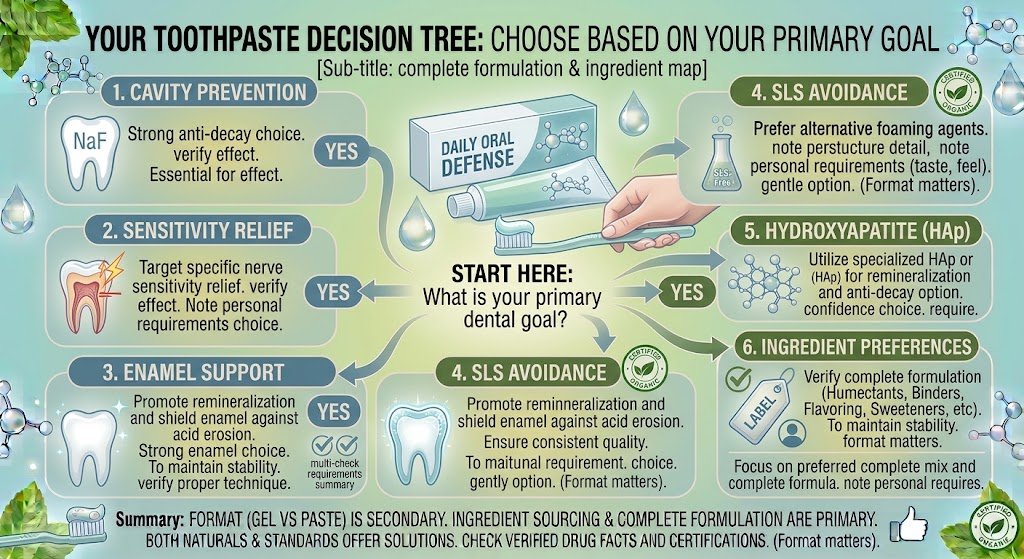
Start with your primary oral-health goal, then examine the formula.
If Your Main Goal Is Cavity Prevention
Look at the active ingredient first.
Fluoride toothpaste is widely used for cavity prevention because fluoride helps protect enamel and supports remineralization.
Common fluoride compounds include:
- Sodium fluoride
- Stannous fluoride
- Sodium monofluorophosphate
Do not choose a toothpaste simply because the package says “strong,” “clean,” or “natural.” Check what active ingredient is actually present.
If Your Main Goal Is Sensitive Teeth
Look for a toothpaste specifically formulated for sensitivity.
Ingredients such as potassium nitrate or certain stannous fluoride formulas may be used for sensitivity-focused products.
It is also worth considering the toothpaste’s abrasivity and whether the flavoring or other ingredients are comfortable for you.
If sensitivity continues or becomes severe, toothpaste should not be treated as a substitute for finding the underlying dental cause.
If Your Main Goal Is Enamel Protection
Look for ingredients and formulas designed around enamel protection and remineralization.
Fluoride is an established ingredient for cavity prevention and enamel protection. Hydroxyapatite is used in some formulas designed around similar consumer goals.
Your choice should depend on your needs rather than assuming that one ingredient is universally best for everyone.
If You Want an SLS-Free Formula
Check the ingredient list for sodium lauryl sulfate.
Do not assume that a toothpaste is SLS-free simply because it uses terms such as “natural,” “clean,” or “non-toxic.”
If you prefer to avoid SLS, look specifically for a formula that does not list it.
If You Want Hydroxyapatite
Check whether hydroxyapatite or nano-hydroxyapatite is part of the formula.
Then evaluate the rest of the toothpaste.
A useful checklist includes:
- Active ingredient
- Intended purpose
- Abrasive system
- Other active ingredients
- Flavoring
- Surfactants
- Overall ingredient transparency
This prevents one ingredient from becoming the entire basis of your purchase decision.
If You Want a Non-Toxic Toothpaste
Start by defining what “non-toxic” means for your own selection criteria.
You might prioritize:
- Transparent ingredient labeling
- An active ingredient appropriate for your needs
- No ingredients you personally want to avoid
- Suitable cleaning characteristics
- A formula designed for your oral-health goal
- Clear manufacturer information
The goal should be to evaluate the whole formula, not simply count how many ingredients sound natural.
[ ARTICLE CONTINUES — NEXT PART STARTS WITH: H2: “Frequently Asked Questions” ]
Part 3 — Continuation
Frequently Asked Questions
How does toothpaste clean your teeth?
Toothpaste helps clean teeth by working together with a toothbrush. The toothbrush physically removes plaque and food debris, while toothpaste provides ingredients that help with cleaning, stain removal, cavity prevention, sensitivity, and other oral-health needs.
A toothpaste formula usually contains mild abrasives that help remove surface deposits without relying only on brushing force.
Does toothpaste actually remove plaque?
Yes, but the toothbrush does most of the physical plaque removal.
Toothpaste supports the process by helping the bristles move across the tooth surface and by providing ingredients that support oral hygiene. The most important factor is still brushing thoroughly and regularly, especially along the gumline and other areas where plaque can collect.
How does fluoride toothpaste work?
Fluoride helps make teeth more resistant to acid damage and supports the remineralization of early areas of enamel damage.
This is why fluoride toothpaste is widely used for cavity prevention. When used as directed, fluoride toothpaste can provide ongoing protection during regular brushing.
Does toothpaste rebuild enamel?
Toothpaste cannot rebuild a missing piece of enamel like a dentist can restore a damaged tooth.
However, some toothpaste ingredients can support remineralization of early enamel damage. Fluoride is especially important for this process, while hydroxyapatite-based formulas are also designed to interact with the mineral structure of teeth.
The important distinction is that supporting remineralization is not the same as growing back enamel that has already been physically lost.
Does fluoride-free toothpaste work?
Fluoride-free toothpaste can still clean teeth because cleaning depends heavily on the toothbrush, brushing technique, and the formula’s cleaning ingredients.
However, fluoride-free and fluoride toothpaste should not be treated as automatically equivalent for cavity prevention. Fluoride has a specific role in preventing and controlling early tooth decay.
People considering fluoride-free toothpaste should therefore look beyond marketing terms and understand what active ingredients the product uses and what oral-health goal it is intended to support.
Does toothpaste need to foam to work?
No.
Foam mainly changes how toothpaste feels and spreads around the mouth. Surfactants such as SLS can create more foam, but more foam does not automatically mean better cleaning.
A toothpaste can clean effectively without producing a large amount of foam.
How do I choose toothpaste for sensitive teeth?
Start by identifying what is causing your sensitivity and what the toothpaste is designed to do.
Some formulas contain ingredients such as potassium nitrate that are commonly used for sensitivity. Certain fluoride formulas may also provide cavity protection while addressing sensitivity.
If sensitivity is frequent, severe, or getting worse, toothpaste selection should not replace a dental evaluation because sensitivity can have several causes.
Can toothpaste whiten teeth?
Some toothpaste can make teeth look whiter by removing or reducing surface stains.
This is different from changing the natural color of the tooth. Abrasives and certain whitening ingredients can help with external stains, but toothpaste generally has limited ability to change deeper, intrinsic discoloration.
For that reason, a whitening toothpaste should be selected according to the type of discoloration and the condition of the teeth.
The Bottom Line
So, how does toothpaste work?
Toothpaste does not perform one single job. It is a formula designed to work alongside your toothbrush.
The toothbrush provides the main physical cleaning action. Toothpaste then adds ingredients that can support that process in different ways:
- Abrasives help remove surface deposits and stains.
- Fluoride helps protect against tooth decay and supports enamel remineralization.
- Surfactants help distribute toothpaste across the mouth and can create foam.
- Sensitivity ingredients can help reduce sensitivity.
- Hydroxyapatite is used in some formulas to support the mineral structure of teeth.
- Flavoring and sweeteners improve the brushing experience without being the primary reason toothpaste cleans teeth.
- Humectants and thickeners help maintain the product’s texture and stability.
The most important lesson is that toothpaste should be chosen based on what you want it to do, rather than simply choosing a product because it says “natural,” “clean,” “non-toxic,” or “whitening” on the package.
If your main concern is cavity prevention, look closely at the active ingredient and fluoride content. If you have sensitivity, focus on ingredients and formulas designed for that purpose. If you want to avoid SLS or prefer hydroxyapatite, check the complete ingredient list rather than relying only on front-label claims.
The best toothpaste is ultimately the one that fits your oral-health needs, contains ingredients appropriate for those needs, and is something you can use consistently as part of a good brushing routine.
Affiliate Disclosure
This article may contain affiliate links. If you purchase a product through one of these links, we may earn a commission at no additional cost to you. Our recommendations are based on ingredient information, product purpose, usability, and other evaluation criteria rather than the commission we may receive.
