If you are comparing SLS vs SLS-free toothpaste, the answer depends on what you want from your toothpaste.
SLS, or sodium lauryl sulfate, is a detergent/surfactant commonly used in toothpaste. It helps create foam and contributes to the way toothpaste spreads and interacts with deposits during brushing. SLS-free toothpaste simply leaves sodium lauryl sulfate out of the formulation. The American Dental Association lists SLS among toothpaste detergents used for foaming action. (ADA)
That does not mean SLS toothpaste is automatically bad or that SLS-free toothpaste is automatically better. For most people, the more useful question is whether you tolerate SLS well and whether the rest of the toothpaste meets your oral-health needs.
SLS-free toothpaste may be particularly worth considering if you experience recurrent canker sores, oral irritation, or dislike the strong foaming sensation of conventional toothpaste. Research has found potential benefits for people with recurrent aphthous ulcers, although the evidence is not strong enough to say that everyone needs to avoid SLS. (PubMed)
This guide explains what SLS actually does, how SLS-free toothpaste compares, whether removing SLS affects cleaning, who may benefit from switching, and what to look for when choosing an SLS-free toothpaste.
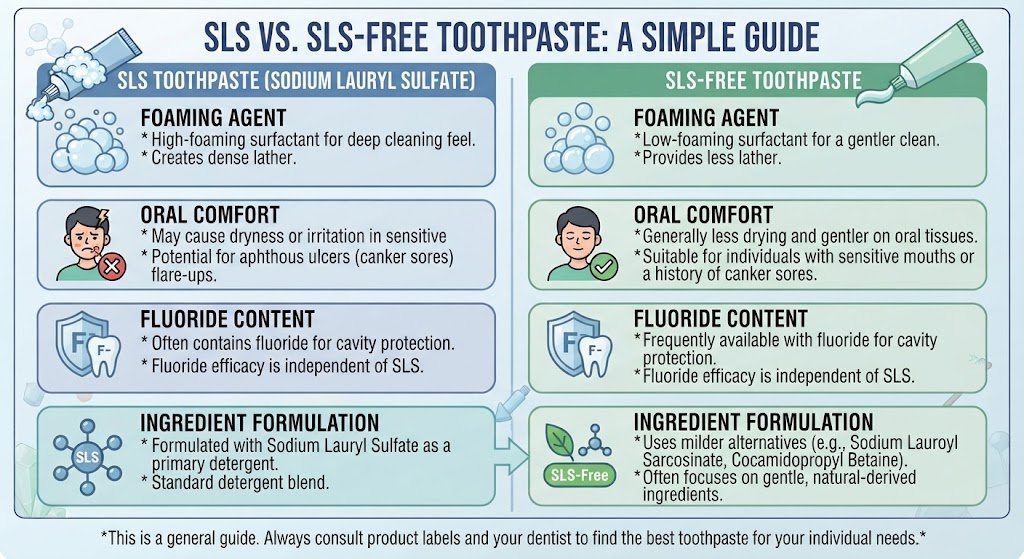
SLS vs SLS-Free Toothpaste: Quick Answer
The biggest difference is simple: SLS toothpaste contains sodium lauryl sulfate, while SLS-free toothpaste does not.
But that difference does not tell you which toothpaste will work better for you.
| Feature | SLS Toothpaste | SLS-Free Toothpaste |
| Sodium lauryl sulfate | Present | Absent |
| Foaming | Usually stronger | Usually lower, depending on formula |
| Cleaning ability | Can clean effectively | Can also clean effectively |
| Oral comfort | Fine for many people | May be preferable for some sensitive users |
| Canker-sore concerns | May be less suitable for some people | Worth considering if ulcers recur |
| Fluoride | May contain fluoride | May also contain fluoride |
| “Natural” by definition | No | No |
| Suitable for everyone | Not necessarily | Not necessarily |
A randomized clinical trial comparing an SLS-containing and SLS-free dentifrice found no significant difference between the tested products in plaque, gingival bleeding, or gingival abrasion. Participants did, however, rate the SLS-containing toothpaste more favorably for taste, freshness, and foaming. (PubMed Central (PMC))
So this is not really a battle between a “good” toothpaste and a “bad” toothpaste.
It is a question of formulation, personal tolerance, oral-health needs, and preference.
What Is SLS in Toothpaste?
Sodium lauryl sulfate is a surfactant, also commonly described as a detergent. Surfactants help ingredients interact with water and can help toothpaste spread throughout the mouth during brushing.
Toothpaste contains many different types of ingredients. Depending on the product, these can include abrasives, fluoride or other active ingredients, humectants, flavoring agents, sweeteners, thickening agents, and detergents.
SLS belongs to the detergent portion of the formulation.
Why Is SLS Added to Toothpaste?
One of the most noticeable reasons is foaming.
When you brush with an SLS-containing toothpaste, the surfactant helps produce the familiar foam that spreads through your mouth.
The ADA explains that detergents such as sodium lauryl sulfate are used for foaming action and may increase the solubility of plaque and deposits during brushing. (ADA)
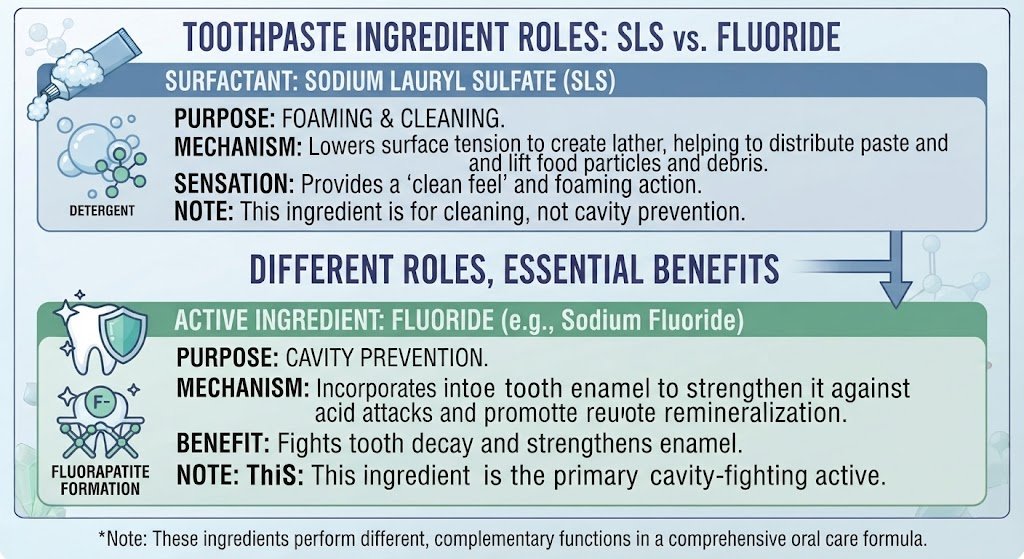
SLS can therefore contribute to the overall brushing experience, but it is important not to confuse its role with that of an active ingredient such as fluoride.
SLS is not the ingredient you should look at when asking whether a toothpaste provides fluoride-based cavity protection.
Does SLS Actually Clean Your Teeth?
SLS contributes to the formulation and cleaning experience, but brushing does most of the physical work.
The toothbrush mechanically disrupts plaque, while toothpaste provides ingredients that can assist cleaning and address specific oral-health goals.
That means removing SLS from a toothpaste does not automatically remove its ability to clean teeth.
A properly formulated SLS-free toothpaste can still contain abrasives and active ingredients and can be used as part of a normal oral-hygiene routine.
Why Does SLS Make Toothpaste Foam?
SLS helps lower surface tension and allows the toothpaste to produce foam when mixed with saliva and water during brushing.
The important thing to remember is:
More foam does not automatically mean better cleaning.
Foam is partly a sensory experience. Some people like it because it makes brushing feel thorough and refreshing. Others prefer a toothpaste that produces less foam.
What Does SLS-Free Toothpaste Mean?
SLS-free toothpaste is formulated without sodium lauryl sulfate.
That is the specific meaning of the term.
It does not automatically mean the toothpaste is:
- Fluoride-free
- Natural
- Organic
- “Chemical-free”
- Better for everyone
- Free from every possible irritant
This distinction is important because toothpaste marketing can make several different ingredient choices sound like one thing.
For example, you can have an SLS-free fluoride toothpaste. You can also have an SLS-free toothpaste that uses hydroxyapatite instead of fluoride.
The absence of SLS tells you only one part of the formulation.
What Replaces SLS?
There is no single replacement that every SLS-free toothpaste must use.
Some formulations use alternative surfactants, while others use different approaches to achieve the desired texture, spreading, or foaming characteristics.
This is one reason you should not judge an SLS-free toothpaste simply by seeing what is missing.
You should also look at what is present.
If you have a sensitive mouth, for example, removing SLS may not solve the problem if another ingredient in the formula is responsible for your irritation.
The ADA notes that toothpaste reactions can involve several ingredients, including flavoring agents such as peppermint, spearmint, and cinnamon, as well as ingredients such as SLS and cocamidopropyl betaine. (ADA)
SLS vs SLS-Free Toothpaste: Key Differences
The practical differences between the two types of toothpaste become clearer when you look at specific characteristics.
1. Foaming
SLS-containing toothpaste generally produces a more noticeable foam.
For many people, that is simply a preference. They associate the foam with a fresh, thorough brushing experience.
SLS-free toothpaste may produce less foam, although this depends on the formulation.
If you prefer a low-foam toothpaste, SLS-free may feel more comfortable.
2. Oral Comfort
This is one of the main reasons people investigate SLS-free toothpaste.
Many people can use SLS-containing toothpaste without noticeable problems. Others report irritation or discomfort with particular toothpaste formulations.
Importantly, you should not automatically assume SLS is responsible for every reaction.
Toothpaste contains multiple ingredients, and flavoring compounds and other components can also cause irritation or allergic reactions in susceptible people. (ADA)
So if your mouth becomes irritated after brushing, an SLS-free toothpaste can be one reasonable change to test, but it is not the only possible explanation.
3. Cleaning Performance
One of the most common concerns is:
“If I remove SLS, will my toothpaste stop cleaning properly?”
Available clinical evidence does not support a simple yes.
In an eight-week randomized clinical trial, the tested SLS-free dentifrice was as effective as the SLS-containing dentifrice for the measured plaque and gingival bleeding outcomes. The researchers also found no significant difference in gingival abrasion. (PubMed Central (PMC))
That does not mean every SLS-free toothpaste on the market performs identically.
The study compared specific formulations, not every toothpaste available today.
The better takeaway is that SLS is not the only factor determining whether toothpaste can be effective.
4. Fluoride
SLS and fluoride have completely different roles.
This is an important point when shopping.
An SLS-free toothpaste can contain fluoride, just as an SLS-containing toothpaste can contain fluoride.
So don’t assume:
SLS-free = fluoride-free.
If cavity prevention is important to you, check the toothpaste’s active ingredients separately from its surfactant.
5. Taste and Brushing Experience
The clinical trial mentioned above found that participants preferred the SLS-containing toothpaste for taste, freshness, and foaming. (PubMed Central (PMC))
That is useful because toothpaste selection is not purely about laboratory performance.
If a toothpaste feels unpleasant, tastes bad, or does not fit your preferences, you may be less satisfied with your routine.
At the same time, personal preference should not be confused with evidence that one formulation is clinically superior.
6. Canker-Sore Considerations
This is where the comparison becomes more meaningful for a particular group of users.
Research on recurrent aphthous stomatitis—commonly called recurrent canker sores—has found potential benefits from SLS-free dentifrice.
A systematic review of randomized trials found reductions in ulcer number, duration, episodes, and pain with SLS-free dentifrice compared with SLS-containing dentifrice, although the authors said additional well-designed studies are still needed. (PubMed)
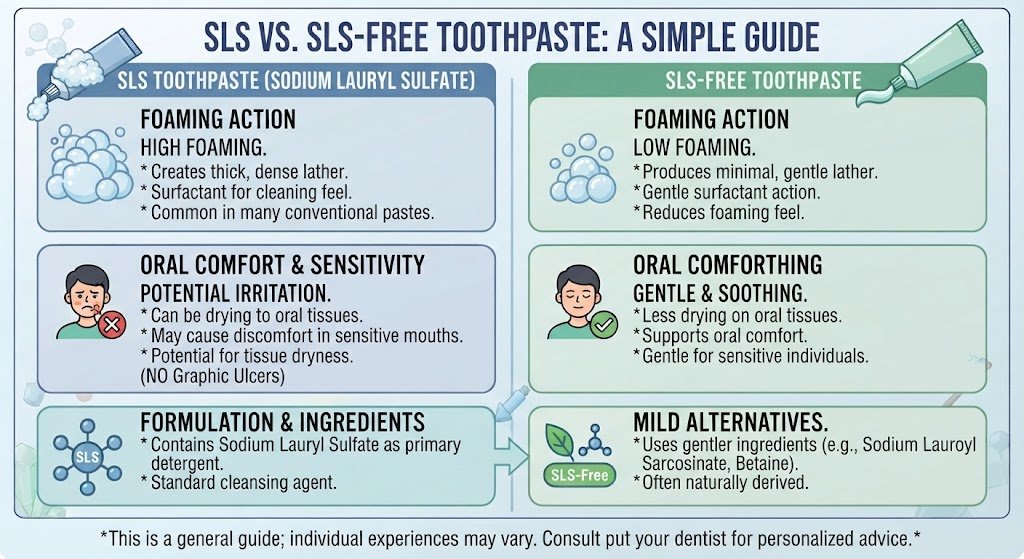
Is SLS Bad for Your Mouth?
There is no good reason to reduce the entire question to “SLS is bad” or “SLS is completely harmless.”
The evidence is more complicated.
SLS has useful properties as a toothpaste surfactant, and it is widely used. At the same time, published research has reported possible oral effects such as mucosal irritation, desquamation, and ulceration, particularly in certain contexts. A scoping review concluded that evidence suggesting benefits from SLS-free toothpaste for recurrent aphthous ulcers is limited and that additional research is needed. (PubMed)
The ADA also lists SLS among toothpaste ingredients that have been reported as possible irritants or allergens. (ADA)
So a better question is:
Does your particular toothpaste seem to be causing a problem for you?
If you have no irritation, no recurring mouth ulcers, and you like your current toothpaste, there may be little reason to change solely because it contains SLS.
If you repeatedly notice irritation or have recurrent canker sores, trying an SLS-free formulation is a reasonable option to discuss or test.
SLS and Canker Sores: Does SLS-Free Help?
For people who regularly experience canker sores, the SLS question becomes more relevant.
Recurrent aphthous stomatitis involves recurring painful ulcers inside the mouth. Researchers have investigated whether toothpaste detergents such as SLS can affect these ulcers.
A 2019 systematic review included four double-blind randomized controlled trials involving 124 participants. The review found that SLS-free dentifrice significantly reduced several measured outcomes, including ulcer number, duration, number of episodes, and pain. However, the authors emphasized that more well-designed trials are needed to strengthen the evidence. (PubMed)
Another randomized crossover clinical trial involving people with recurrent aphthous stomatitis found that SLS-free toothpaste significantly reduced ulcer duration and mean pain scores, although it did not significantly reduce the number of ulcers or episodes. (PubMed)
These results are useful, but they should not be turned into an absolute promise.
A fair conclusion is:
If you frequently get recurrent canker sores, an SLS-free toothpaste may be worth trying.
It does not mean SLS is the cause of every canker sore, and it does not mean switching toothpaste will eliminate ulcers for everyone.
If mouth ulcers are unusually frequent, severe, persistent, or accompanied by other symptoms, toothpaste changes should not replace professional dental or medical evaluation.
Does SLS-Free Toothpaste Clean as Well?
For many shoppers, this is the most important practical question.
The answer is generally yes, an SLS-free formulation can still provide effective cleaning, but the exact performance depends on the entire formula.
The randomized clinical trial discussed earlier compared an SLS-free toothpaste with an SLS-containing toothpaste and found no significant differences in plaque, gingival bleeding, or gingival abrasion over the study period. (PubMed Central (PMC))
This helps separate two things that are often confused:
Foaming ≠ cleaning effectiveness.
A toothpaste can create a lot of foam and feel very powerful without that foam itself being responsible for removing all plaque.
Your toothbrush, brushing technique, toothpaste abrasives, active ingredients, and overall formulation all contribute to the result.
The trial also found that participants preferred the SLS-containing toothpaste for foaming, taste, and freshness. (PubMed Central (PMC))
So the choice can partly come down to what you prefer:
- Want more foam? SLS-containing toothpaste may feel better.
- Prefer less foam? SLS-free may be more comfortable.
- Concerned about recurrent canker sores? SLS-free may be worth trying.
- Concerned about cavities? Look separately at the toothpaste’s cavity-protection active.
Does SLS-Free Toothpaste Prevent Cavities?
SLS is not the ingredient you should focus on first when evaluating cavity protection.
Instead, look at the toothpaste’s active cavity-protection ingredients.
For people who choose fluoride toothpaste, fluoride is the ingredient that deserves particular attention when considering cavity prevention.
This means an SLS-free toothpaste can still be designed for daily cavity protection.
The important distinction is:
SLS status and fluoride status are separate decisions.
You can find:
- SLS-containing fluoride toothpaste
- SLS-free fluoride toothpaste
- SLS-containing fluoride-free toothpaste
- SLS-free fluoride-free toothpaste
Therefore, if you decide to avoid SLS, don’t accidentally assume that you also need to avoid fluoride.
If you have a history of cavities or a high risk of tooth decay, your toothpaste choice should be based on your individual dental needs rather than the “SLS-free” label alone.
Who Should Consider SLS-Free Toothpaste?
SLS-free toothpaste can be worth considering if your mouth does not feel comfortable after brushing or if you regularly deal with canker sores.
You may want to try an SLS-free formula if:
- You frequently get recurrent canker sores.
- Your toothpaste seems to cause burning, irritation, or unusual mouth discomfort.
- You dislike the strong foaming sensation of conventional toothpaste.
- You prefer a simpler toothpaste formula with fewer ingredients that may irritate your mouth.
- You have already tried changing toothpaste and noticed that some formulas feel more comfortable than others.
The strongest reason to try SLS-free toothpaste is usually personal tolerance, not the idea that SLS is automatically dangerous.
It is also important to remember that SLS may not be the only ingredient responsible for irritation. Flavoring agents, essential oils, and other ingredients can also cause oral irritation or contact reactions in some people. The American Dental Association notes that several toothpaste ingredients can act as potential irritants or allergens.
If irritation continues even after switching to SLS-free toothpaste, look at the entire ingredient list rather than assuming SLS was the cause.
Who May Not Need to Avoid SLS?
Not everyone needs to switch to SLS-free toothpaste.
If you currently use an SLS-containing toothpaste, have no mouth irritation, do not regularly experience canker sores, and are happy with its cleaning experience, there may be no strong reason to change simply because the ingredient is SLS.
SLS is primarily used as a surfactant and foaming agent. It is not the ingredient responsible for fluoride’s cavity-protection function, and removing SLS does not automatically make a toothpaste better for every person.
In other words:
SLS-free does not automatically mean better, and SLS-containing does not automatically mean bad.
Your toothpaste should first meet your main oral-health needs. After that, comfort and ingredient preferences can guide the choice.
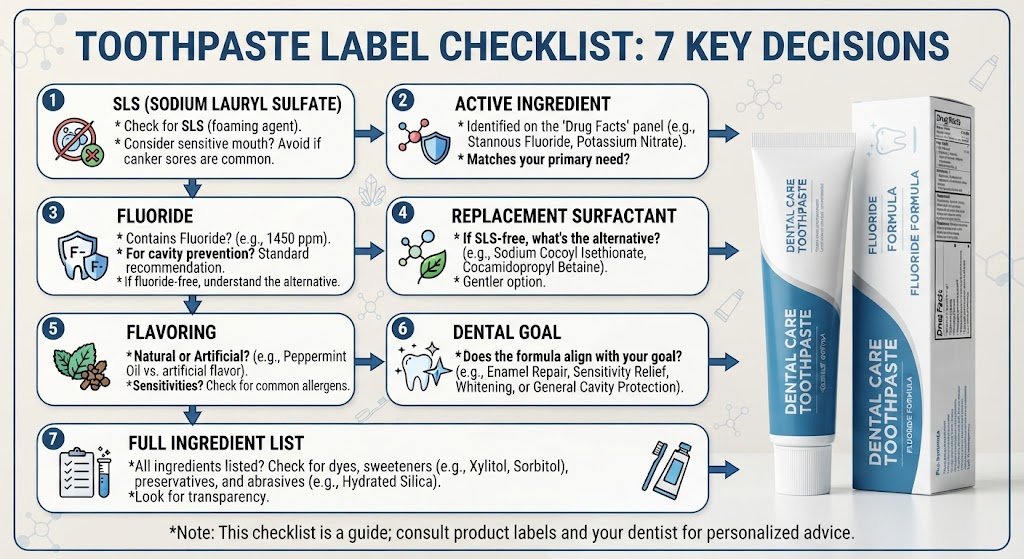
How to Choose an SLS-Free Toothpaste
If you decide to switch, do not choose a toothpaste based only on the words “SLS-free” on the front of the package.
Check these factors instead.
1. Confirm That SLS Is Actually Absent
Read the ingredient list and look for sodium lauryl sulfate or SLS.
This is where learning how to read toothpaste labels becomes useful.
2. Check the Active Ingredient
Next, look at what the toothpaste is designed to do.
For example, a toothpaste may use fluoride for cavity prevention, while another may use hydroxyapatite as its main mineral-based active ingredient.
Do not assume that removing SLS gives you cavity protection. The active ingredient still matters.
3. Decide Whether You Want Fluoride
If cavity prevention is a major priority, pay attention to whether the toothpaste contains fluoride.
The American Dental Association recognizes fluoride toothpaste as an important part of routine oral care. Your individual dental needs and cavity risk should guide the choice.
4. Look at the Replacement Surfactant
SLS-free does not necessarily mean surfactant-free.
Manufacturers may use other cleansing or foaming ingredients instead. If your goal is to reduce irritation, pay attention to the whole formula, not just whether SLS appears on the label.
5. Check the Flavoring
A toothpaste can be SLS-free and still contain strong flavoring agents or essential oils.
If you have a sensitive mouth, a simpler or less intense flavor profile may be more comfortable.
6. Match the Toothpaste to Your Main Goal
Choose based on your actual reason for switching.
| Your main goal | What to prioritize |
| Cavity prevention | Appropriate fluoride toothpaste |
| Recurrent canker sores | SLS-free formula and simple ingredient profile |
| Sensitive teeth | Toothpaste designed for sensitivity |
| Mineral-based option | Hydroxyapatite toothpaste |
| Avoiding foaming | Low-foam or SLS-free formula |
| Ingredient-conscious shopping | Transparent ingredient list |
7. Compare the Whole Formula
A good toothpaste choice is not based on one ingredient.
Look at the active ingredient, abrasives, flavoring, sweeteners, preservatives, surfactants, and any ingredients you personally know you do not tolerate.
That approach is more useful than simply searching for a toothpaste with a “clean” label.
Best Types of SLS-Free Toothpaste to Consider
There is no single best SLS-free toothpaste for everyone. Different formulas are designed for different needs.
SLS-Free Fluoride Toothpaste
This is a logical option for people who want to avoid SLS while still prioritizing fluoride-based cavity protection.
When comparing products, check the fluoride active ingredient and follow the product’s directions.
SLS-Free Toothpaste for Sensitive Teeth
If your main problem is tooth sensitivity rather than mouth irritation, look for a toothpaste specifically formulated for sensitive teeth.
SLS-free may improve mouth comfort, but it does not automatically make a toothpaste effective for tooth sensitivity.
SLS-Free Hydroxyapatite Toothpaste
Some people prefer hydroxyapatite toothpaste because they want a mineral-based alternative to conventional fluoride formulas.
If you are considering this category, compare the specific formulation rather than assuming every hydroxyapatite toothpaste works the same way.
SLS-Free Toothpaste for Canker-Sore Concerns
If recurrent canker sores are your main reason for switching, an SLS-free formula is one category worth considering.
Research suggests that SLS-free dentifrices may reduce some measures associated with recurrent aphthous ulcers, although the evidence is still limited and results across studies are not identical.
If ulcers are frequent, severe, unusually persistent, or accompanied by other symptoms, talk with a dental or medical professional rather than relying only on a toothpaste change.
SLS vs SLS-Free Toothpaste: Which Should You Buy?
The simplest way to decide is to start with your oral-health goal, then consider SLS.
Choose an SLS-free toothpaste if:
- You regularly experience canker sores.
- Your current toothpaste seems irritating.
- You prefer less foaming.
- You want to test whether removing SLS improves mouth comfort.
- You are comfortable comparing the complete ingredient list.
An SLS-containing toothpaste may still be reasonable if:
- You tolerate it well.
- You like its taste and foaming.
- You have no recurring mouth irritation.
- It provides the active ingredient you need for your dental goals.
- You have no specific reason to avoid SLS.
The important point is that SLS is only one part of a toothpaste formula.
A better toothpaste decision asks:
Does this toothpaste provide the oral-health benefit I need, while also being comfortable for me to use every day?
That is a more useful question than simply asking whether a toothpaste contains SLS.
SLS vs SLS-Free Toothpaste FAQs
Is SLS-free toothpaste better than regular toothpaste?
Not automatically. SLS-free toothpaste may be a better personal choice for people who experience irritation, dislike strong foaming, or have recurrent canker sores. Someone who tolerates SLS well may not need to avoid it.
Does SLS cause canker sores?
Research suggests SLS may contribute to discomfort or ulcer-related symptoms in some people with recurrent aphthous stomatitis. However, the evidence is not strong enough to say that SLS causes every person’s canker sores.
Does SLS-free toothpaste clean your teeth?
Yes. Removing SLS does not mean a toothpaste cannot clean teeth. Toothpaste formulations can use other ingredients for cleaning and foaming. One clinical trial found no significant differences in plaque, gingival bleeding, or gingival abrasion between the specific SLS-containing and SLS-free formulations tested.
Does SLS-free toothpaste prevent cavities?
It can, provided the toothpaste contains an appropriate cavity-protection active ingredient. SLS itself is not what provides fluoride’s cavity-protection benefit.
Does SLS-free mean fluoride-free?
No. SLS and fluoride have different roles. A toothpaste can be both SLS-free and fluoride-containing.
Why does SLS-free toothpaste foam less?
SLS is a strong foaming surfactant commonly used to create the familiar lather people associate with toothpaste. SLS-free formulas may use different surfactants or lower-foaming formulations.
Should I switch to SLS-free toothpaste if I get canker sores?
It may be worth trying, particularly if your canker sores are recurrent. Research suggests some people with recurrent aphthous ulcers may benefit from SLS-free toothpaste, but other ingredients and underlying causes can also contribute.
Can SLS-free toothpaste still contain irritating ingredients?
Yes. SLS is only one possible irritant. Flavoring agents, essential oils, and other ingredients may cause problems for some people. Always check the complete ingredient list.
Conclusion
SLS and SLS-free toothpaste are not simply a case of “bad” versus “good.”
SLS is mainly used as a surfactant and foaming ingredient. SLS-free toothpaste removes that ingredient but can still provide effective oral cleaning when properly formulated.
For most people, the better choice depends on comfort, dental needs, active ingredients, and personal tolerance.
If you frequently experience canker sores or irritation, trying an SLS-free toothpaste can be a reasonable step. If you tolerate your current toothpaste well, there may be no need to switch solely because it contains SLS.
Before buying, check the complete ingredient list and make sure the toothpaste fits your main goal—whether that is cavity prevention, sensitive teeth, hydroxyapatite, or simply a more comfortable brushing experience.
Affiliate Disclosure
This article may contain affiliate links. If you purchase a product through one of these links, we may earn a commission at no additional cost to you. Our recommendations are based on product ingredients, intended use, formulation, and reader needs—not on commission alone.
