Natural and conventional toothpastes can both help clean your teeth, but they are not all designed the same way. The biggest differences usually come down to the active ingredients, the formula’s intended benefits, and your personal preferences.
Natural toothpaste is not automatically safer or more effective, and conventional toothpaste is not automatically better for everyone. A better approach is to look beyond the label and compare the ingredients, cavity-protection benefits, potential irritants, and the specific dental needs the toothpaste is designed to address.
In this guide, you’ll learn how natural and conventional toothpaste differ, what ingredients actually matter, how fluoride fits into the decision, and how to choose a toothpaste based on your needs rather than marketing claims.
What Is Natural Toothpaste?
Natural toothpaste is a broad category of toothpaste marketed around ingredients that may be plant-derived, mineral-based, naturally sourced, or perceived as more environmentally or ingredient-conscious.
Depending on the product, natural toothpaste may contain ingredients such as:
- Plant extracts
- Essential oils
- Xylitol
- Calcium-based ingredients
- Silica
- Herbal ingredients
- Naturally derived flavoring ingredients
However, there is no single formula that defines all natural toothpaste.
One natural toothpaste may contain fluoride, while another may be fluoride-free. One may contain SLS, while another may be SLS-free. Some products focus on sensitivity, some on whitening, and others simply aim to provide a simpler ingredient profile.
That means the word “natural” does not tell you whether a toothpaste will provide the particular dental benefit you need.
It also does not automatically tell you whether every ingredient is safer. A naturally derived ingredient can still cause irritation or an allergic reaction in a sensitive person, while a synthetic ingredient can have a well-established purpose in a toothpaste formula.
The more useful question is:
What does this specific toothpaste contain, what is it designed to do, and is it appropriate for me?
What Is Conventional Toothpaste?
Conventional toothpaste is a broad term for mainstream toothpaste formulas that use established ingredients to clean teeth and provide specific oral-health benefits.
A conventional toothpaste may contain:
- Fluoride compounds for cavity prevention
- Abrasives for cleaning and surface-stain removal
- Humectants to maintain moisture
- Detergents to create foam
- Flavoring ingredients
- Sweeteners
- Thickeners and stabilizers
- Ingredients designed for sensitivity or other specific concerns
For example, fluoride toothpastes commonly use sodium fluoride, sodium monofluorophosphate, or stannous fluoride as active ingredients. The American Dental Association identifies fluoride as an important ingredient for preventing tooth decay. [ add a link — Anchor Text: “ADA guidance on toothpaste ingredients” — Destination: “American Dental Association toothpaste guidance” ] (ADA)
But conventional does not mean every product contains the same ingredients.
There are conventional toothpastes that are SLS-free, fluoride-free, designed for sensitive teeth, or formulated with ingredients that appeal to people looking for simpler formulas.
So the comparison is not really:
Natural = good vs. conventional = bad
It is better understood as:
Formula A vs. Formula B — which one better matches your oral-health needs and ingredient preferences?
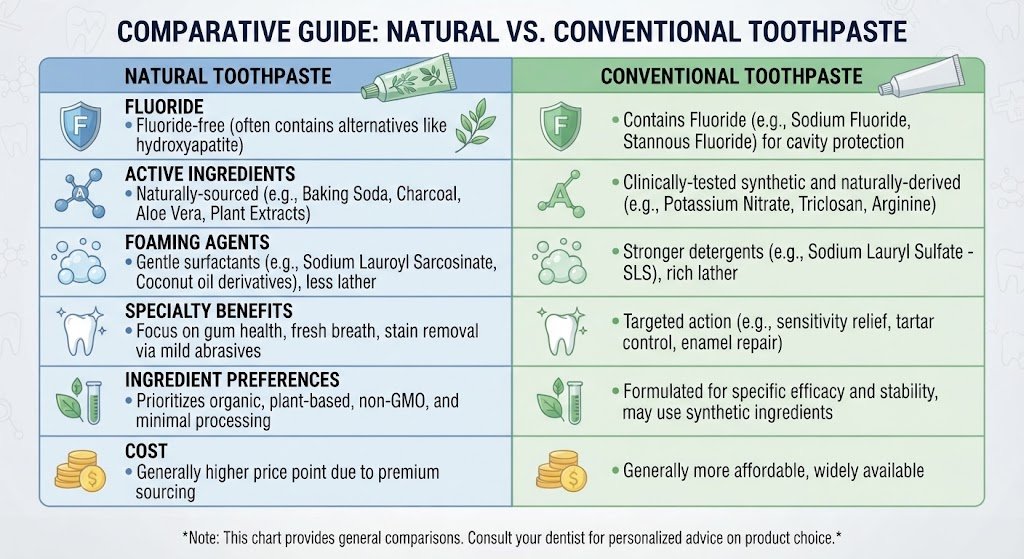
Natural vs. Conventional Toothpaste: Key Differences
Because both categories contain many different formulas, there is no single ingredient list that represents every natural or conventional toothpaste.
| Feature | Natural toothpaste | Conventional toothpaste |
| Ingredient approach | Often emphasizes plant-derived, mineral-based, or naturally derived ingredients | May use both synthetic and naturally derived ingredients |
| Fluoride | May contain fluoride or be fluoride-free | May contain fluoride or be fluoride-free |
| Cavity protection | Depends on active ingredients and evidence | Depends on active ingredients and evidence |
| Foaming | Some formulas avoid SLS or use alternative detergents | Some formulas use SLS or other foaming agents |
| Flavor | Often includes herbal, mint, or essential-oil flavors | Commonly available in a wide range of flavors |
| Specialty benefits | Depends on the individual product | Depends on the individual product |
| Ingredient preferences | May appeal to people seeking certain types of ingredients | May appeal to people prioritizing established or specific active ingredients |
| Price | Varies widely | Varies widely |
The important point is that the category itself does not determine effectiveness.
For example, two toothpastes can both be marketed as natural but have completely different active ingredients. Likewise, two conventional toothpastes can differ substantially in their fluoride type, sensitivity ingredients, abrasives, flavoring, and other components.
Fluoride Is One of the Most Important Differences to Check
If preventing cavities is one of your main goals, fluoride deserves special attention.
Fluoride toothpaste has an established role in preventing tooth decay. The ADA explains that fluoride helps strengthen tooth enamel and supports remineralization during the early stages of tooth decay. Its general home-care guidance recommends brushing twice daily with fluoride toothpaste. [ add a link — Anchor Text: “ADA guidance on fluoride toothpaste” — Destination: “American Dental Association fluoride guidance” ] (ADA)
This is one reason you should not assume that a toothpaste is appropriate for cavity prevention simply because it is labeled natural.
Does natural toothpaste contain fluoride?
It can.
The word “natural” does not automatically mean fluoride-free. Some products marketed toward ingredient-conscious consumers contain fluoride, while others deliberately leave it out.
Always check the product’s active-ingredient information rather than making an assumption based on the front of the package.
In the U.S., common fluoride active ingredients in toothpaste include:
- Sodium fluoride
- Sodium monofluorophosphate
- Stannous fluoride
The FDA’s OTC anticaries monograph includes fluoride active ingredients and requirements for applicable anticaries products. [ add a link — Anchor Text: “FDA requirements for anticaries toothpaste” — Destination: “FDA OTC Anticaries Drug Products Monograph” ] (FDA DPS Admin)
What about fluoride-free toothpaste?
Fluoride-free toothpaste is a separate product choice, not simply another name for natural toothpaste.
Some fluoride-free formulas use hydroxyapatite or other ingredients intended to support oral health. Hydroxyapatite has received research attention, but that does not mean every hydroxyapatite toothpaste should automatically be treated as equivalent to fluoride toothpaste for every person or every outcome.
If you have frequent cavities or have been advised by your dentist to use fluoride toothpaste, talk with your dental professional before switching to a fluoride-free formula.
What Do Common Toothpaste Ingredients Actually Do?
Instead of judging an ingredient because its name sounds chemical or unfamiliar, first understand its role.
Toothpaste contains both active and inactive ingredients. Abrasives can help clean teeth and remove surface stains, detergents can create foam, humectants help retain moisture, and thickeners help maintain the product’s consistency. (ADA)
| Ingredient or ingredient group | Common role | What to consider |
| Sodium fluoride | Helps prevent cavities | Important when cavity prevention is a priority |
| Sodium monofluorophosphate | Fluoride source | Evaluate the product’s stated cavity-prevention purpose |
| Stannous fluoride | Fluoride active ingredient | Review the product’s specific claims and directions |
| Hydroxyapatite | Used in some fluoride-free formulas | Look at evidence for the specific benefit being claimed |
| Hydrated silica | Abrasive | Helps clean teeth and remove surface stains |
| Calcium carbonate | Abrasive | Used in some toothpaste formulations |
| SLS | Detergent/foaming agent | Some people prefer to avoid it because of personal sensitivity or preference |
| Glycerin and sorbitol | Humectants | Help maintain moisture and texture |
| Flavoring agents | Improve taste | Some individuals may be sensitive to certain flavoring ingredients |
| Thickeners | Maintain texture and stability | Help create the desired consistency |
Does more foam mean better cleaning?
No.
Foam is primarily a characteristic of the formula. A toothpaste does not need to produce a large amount of foam to be useful.
Sodium lauryl sulfate, commonly called SLS, is one detergent used for foaming action. Other formulas may use different detergents or reduce foaming altogether. (ADA)
If you enjoy a foaming toothpaste and tolerate it well, there is no need to avoid SLS simply because it sounds unfamiliar. If you prefer an SLS-free formula or notice discomfort with a particular toothpaste, an SLS-free product may be worth considering.
Should you avoid ingredients with complicated names?
Not automatically.
Ingredient names are often technical because they identify specific substances used for a particular purpose. A complicated name does not tell you whether the ingredient is beneficial, unnecessary, irritating, or unsafe.
Instead, ask:
- What does the ingredient do?
- Why is it included?
- Is there evidence supporting the product’s claimed benefit?
- Do I personally tolerate the formula?
- Does the toothpaste meet my primary dental need?
That approach is much more useful than treating every unfamiliar ingredient as a potential toxin.
Are Natural Toothpaste Ingredients Safer?
Not automatically.
Natural ingredients can be useful, but “natural” is not a scientific guarantee of safety, effectiveness, or gentleness.
For example, some natural toothpaste formulas use essential oils or botanical extracts for flavor or other purposes. People can have different sensitivities to individual ingredients, regardless of whether those ingredients are naturally derived.
The same principle applies to conventional toothpaste. The presence of a synthetic ingredient does not automatically mean that the entire formula is harmful.
What does the research say about natural vs. conventional toothpaste?
Research comparing herbal or natural-style toothpaste with conventional toothpaste does not support a simple conclusion that one entire category is always superior.
A systematic review examining herbal and conventional dentifrices for dental-caries prevention included 10 studies and reported similar antimicrobial activity in the included evidence, but the authors also noted that all included studies had a high risk of bias and that the evidence was limited. (PubMed)
Another systematic review examining herbal and conventional dentifrices for plaque and gingivitis found mixed findings and concluded that longer-term randomized studies were needed. (PubMed)
More recent evidence reviews have also emphasized limitations such as short study durations and possible publication bias when evaluating herbal oral-care products. (PubMed)
The practical lesson is simple:
Do not treat “natural” as proof of superiority, and do not treat “conventional” as proof of superiority either. Evaluate the individual formula and the evidence behind its intended benefit.
What About SLS and Mouth Irritation?
Some people prefer toothpaste without SLS because they feel more comfortable using low-foam or SLS-free formulas.
If you regularly notice mouth discomfort, irritation, or sores after using a particular toothpaste, pay attention to the timing and consider whether changing products makes a difference.
However, do not assume SLS is automatically the cause. Flavoring ingredients and other components can also be relevant.
Persistent or severe mouth sores, swelling, pain, or other unusual symptoms should be evaluated by a dental or medical professional rather than managed only by switching toothpaste.
How to Choose Between Natural and Conventional Toothpaste
The easiest way to make the decision is to start with your dental need instead of the marketing label.
1. If cavity prevention is your top priority
Start by checking the active ingredient.
Fluoride toothpaste has strong established support for cavity prevention, and the ADA Seal of Acceptance includes fluoride toothpaste products that have demonstrated safety and efficacy for helping prevent tooth decay. [ add a link — Anchor Text: “fluoride toothpaste options” — Destination: “Best Fluoride Toothpaste” ] (ADA)
If you have a high risk of cavities, follow the advice of your dentist rather than choosing a toothpaste solely because it has a “natural” or “clean” label.
2. If ingredient preferences are your main priority
Make a list of the ingredients or characteristics that matter to you.
For example, you may prefer:
- Fluoride-containing toothpaste
- Fluoride-free toothpaste
- SLS-free toothpaste
- Fewer flavoring ingredients
- A particular sweetener
- A hydroxyapatite formula
- A product with a transparent ingredient list
Then compare products within that category.
This is more useful than searching for a toothpaste simply because it says “natural.”
3. If you have sensitive teeth
Look for a toothpaste specifically designed for sensitivity rather than assuming that natural ingredients will automatically make brushing more comfortable.
Certain toothpaste formulas contain desensitizing ingredients, and the ADA notes that specific active ingredients have evidence for reducing dentin hypersensitivity. (ADA)
If sensitivity is new, severe, persistent, or focused around a particular tooth, toothpaste selection should not replace a dental examination.
4. If whitening is your goal
Look beyond the word “whitening.”
Some whitening toothpastes primarily help remove surface stains through their abrasive ingredients, while other products may use additional ingredients or mechanisms.
A natural label does not automatically mean a whitening toothpaste is gentler, and a conventional label does not automatically mean it is too abrasive.
Consider the specific formula and your sensitivity level.
5. If you simply want a cleaner ingredient profile
Define what “cleaner” means to you.
You might want to avoid:
- SLS
- Certain flavoring ingredients
- Artificial colors
- Particular sweeteners
- Specific preservatives
That’s a reasonable product preference, but it should remain separate from the question of whether the toothpaste provides the dental benefit you need.
For example, an SLS-free toothpaste can meet an ingredient preference while still containing fluoride for cavity protection.
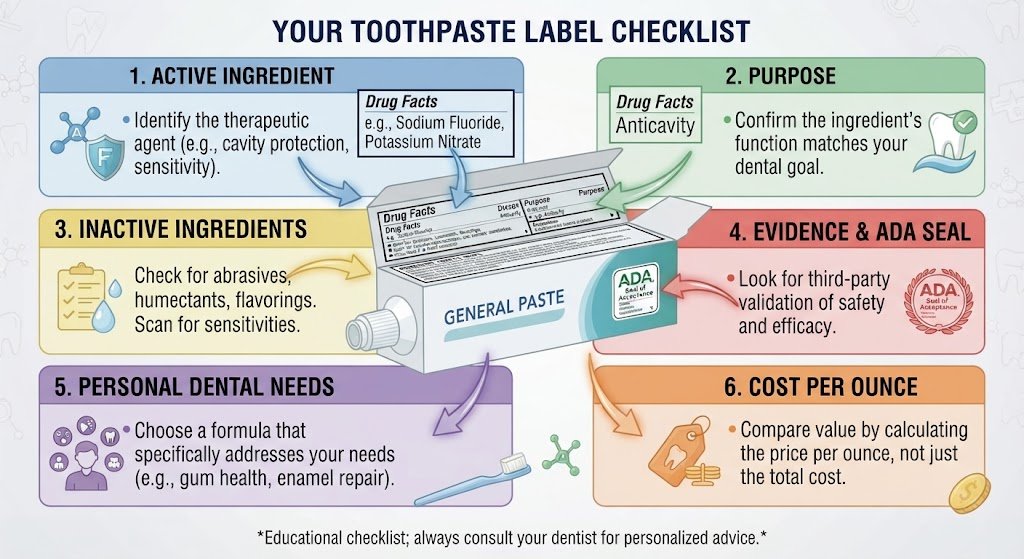
How to Check a Toothpaste Label Before Buying
Use this checklist before adding a toothpaste to your cart.
Step 1: Find the active ingredient
Start with the active ingredient rather than the marketing claims on the front of the package.
If cavity prevention is your priority, determine whether the toothpaste contains fluoride and identify the fluoride compound.
Step 2: Identify the product’s main purpose
Is it intended for:
- Cavity prevention?
- Sensitivity?
- Whitening?
- Gingivitis-related care?
- General cleaning?
- A particular ingredient preference?
A toothpaste designed for one purpose may not be the ideal choice for another.
Step 3: Read the inactive ingredients
Look for ingredients you specifically want to include or avoid.
Don’t automatically reject an ingredient because its name sounds technical. Find out what role it plays first.
Step 4: Check for evidence or credible evaluation
The ADA Seal can be a useful signal when it applies to the specific benefit you care about. The ADA explains that products carrying its Seal have undergone evaluation against requirements for their specific claims. (ADA)
The Seal does not mean a toothpaste is the best product for every person. It also does not mean every toothpaste without the Seal is ineffective.
Step 5: Consider your own dental history
Your personal needs matter more than a generic “natural vs. conventional” debate.
If you have:
- Frequent cavities
- Tooth sensitivity
- Gum problems
- Enamel concerns
- Persistent mouth irritation
- A dental treatment plan
ask your dentist which type of toothpaste makes sense for you.
Step 6: Compare cost and size
Don’t compare products based only on the package price.
A toothpaste that costs more per tube may contain a different amount of product. Compare cost per ounce when possible.
For Amazon purchases, also check the current product listing, ingredient information, package size, and seller details before buying. Product formulas and listings can change over time.
Natural vs. Conventional Toothpaste: Which Is Better for You?
There is no universal winner.
Your choice can be simplified by matching the toothpaste to your most important need.
| Your priority | What to look for |
| Cavity prevention | Appropriate fluoride toothpaste and credible cavity-prevention information |
| Ingredient preferences | A clear ingredient list that fits your preferences |
| SLS avoidance | A clearly labeled SLS-free formula |
| Sensitive teeth | Toothpaste formulated for dentin sensitivity |
| Whitening | A formula designed to address surface stains or the specific whitening goal |
| Fluoride-free preference | A fluoride-free formula with a clear explanation of its intended benefits |
| Natural ingredients | Specific ingredients you prefer, rather than relying only on the word “natural” |
| Balanced choice | Appropriate active ingredient + tolerable formula + credible product information |
The key is to avoid making the category itself the deciding factor.
If two products meet your dental needs, you can then use secondary preferences—such as flavor, foam level, ingredient sourcing, packaging, or price—to make the final decision.
When Is a Natural Toothpaste a Reasonable Choice?
A natural toothpaste can be a reasonable choice when:
- Its ingredients match your preferences.
- It provides the dental benefit you are looking for.
- You understand whether it contains fluoride.
- You tolerate the formula well.
- Its claims are supported by credible information.
- It fits your budget and routine.
For readers who want to explore ingredient-conscious formulas, a dedicated product guide can make the next step easier.
The important point is that the toothpaste should meet your oral-health needs before ingredient preferences become the deciding factor.
When Is Conventional Toothpaste a Reasonable Choice?
Conventional toothpaste can be a good choice when it provides the active ingredient and features that match your needs.
For example, someone primarily concerned about cavity prevention may prefer a fluoride toothpaste with an established evidence base. Someone who wants fluoride but dislikes SLS can look for a fluoride toothpaste that is also sulfate-free.
The categories overlap more than marketing often suggests.
You do not have to choose between “natural” and “effective.”
A product can have an ingredient profile you prefer while also providing a clearly defined oral-health benefit.
Frequently Asked Questions
Is natural toothpaste better than conventional toothpaste?
No category is automatically better. Natural and conventional toothpastes contain many different formulas, so the better choice depends on the active ingredients, intended benefit, evidence, tolerability, and your personal dental needs.
Is natural toothpaste as effective at preventing cavities?
It depends on the individual formula. Fluoride toothpaste has an established role in cavity prevention. Some natural toothpastes contain fluoride, while others do not, so check the active ingredients instead of assuming that every natural toothpaste provides the same cavity protection.
Is fluoride-free toothpaste safe to use?
A fluoride-free toothpaste may be appropriate for some people, but safety and cavity-prevention effectiveness are separate questions. If you frequently develop cavities or have been advised to use fluoride toothpaste, discuss a switch with your dentist.
Are natural toothpaste ingredients always safer?
No. Natural ingredients can still cause irritation or sensitivity in some people. Likewise, synthetic ingredients are not automatically harmful. Evaluate each ingredient according to its purpose, evidence, formulation, and your individual response.
Is SLS-free toothpaste better?
SLS-free toothpaste can be a useful option for people who prefer to avoid SLS or who find a particular formula uncomfortable. However, SLS-free does not automatically mean that a toothpaste is more effective or safer for everyone.
Can natural toothpaste contain fluoride?
Yes. Some products marketed as natural contain fluoride, while others are fluoride-free. Check the active-ingredient section of the product rather than relying on the word “natural.”
How do I choose between natural and conventional toothpaste?
Start with your primary oral-health need. Then check the active ingredient, intended benefit, ingredient list, evidence, tolerability, and price. Use “natural” or “conventional” as a secondary preference rather than the main measure of quality.
Conclusion: Choose the Formula, Not Just the Label
Natural vs. conventional toothpaste is not really a question of choosing between a “good” category and a “bad” one.
The better approach is to evaluate the specific toothpaste.
Look at the active ingredient first. Consider cavity protection and your individual dental needs. Then review the other ingredients, ingredient preferences, taste, sensitivity, cost, and any credible product evaluation.
If you prefer natural or ingredient-conscious products, you can absolutely use those preferences as part of your decision. Just make sure the product still provides the oral-health benefits you need.
Choose based on the formula, not just the label.
And if you have frequent cavities, persistent sensitivity, gum problems, or other dental concerns, let your dentist’s advice take priority over general natural-versus-conventional marketing claims.
