Sodium lauryl sulfate (SLS) is a foaming ingredient found in many toothpastes. It is not necessarily bad for your health, but some people may benefit from switching to an SLS-free formula, particularly if they experience recurring canker sores or mouth irritation.
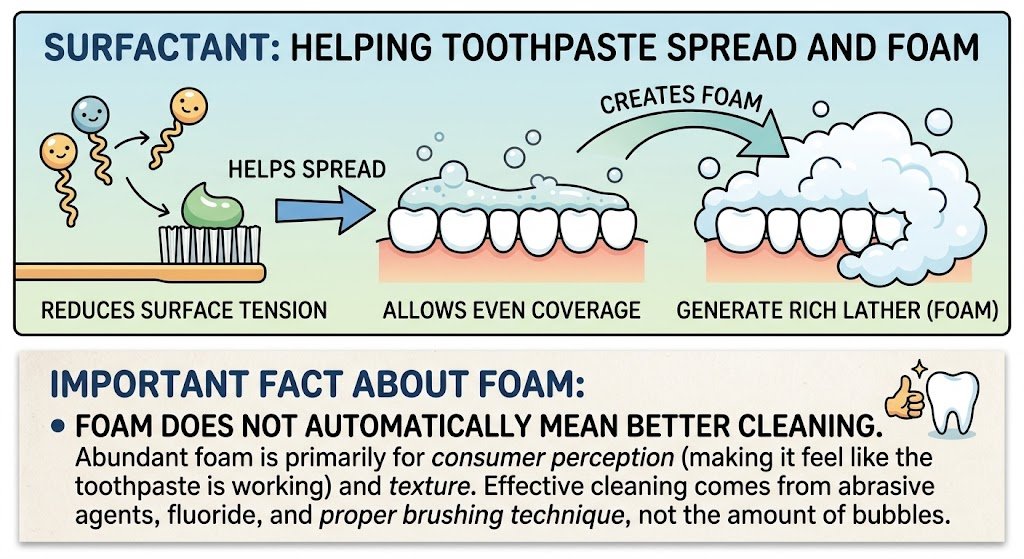
SLS helps toothpaste spread and foam during brushing. Research suggests that toothpaste without SLS may improve certain symptoms in some people with recurrent mouth ulcers, although the evidence remains limited.
Whether you should avoid SLS depends on how well you tolerate your current toothpaste, your oral-health needs, and the benefits offered by an alternative. This guide explains what the research says, how to identify SLS on an ingredient label, and how to choose an SLS-free toothpaste without overlooking cavity protection.
What Is SLS in Toothpaste?
Sodium lauryl sulfate, commonly called SLS, is a surfactant used in toothpaste and other personal-care products. A surfactant helps ingredients mix and spread, and SLS contributes to the foam many people associate with brushing.
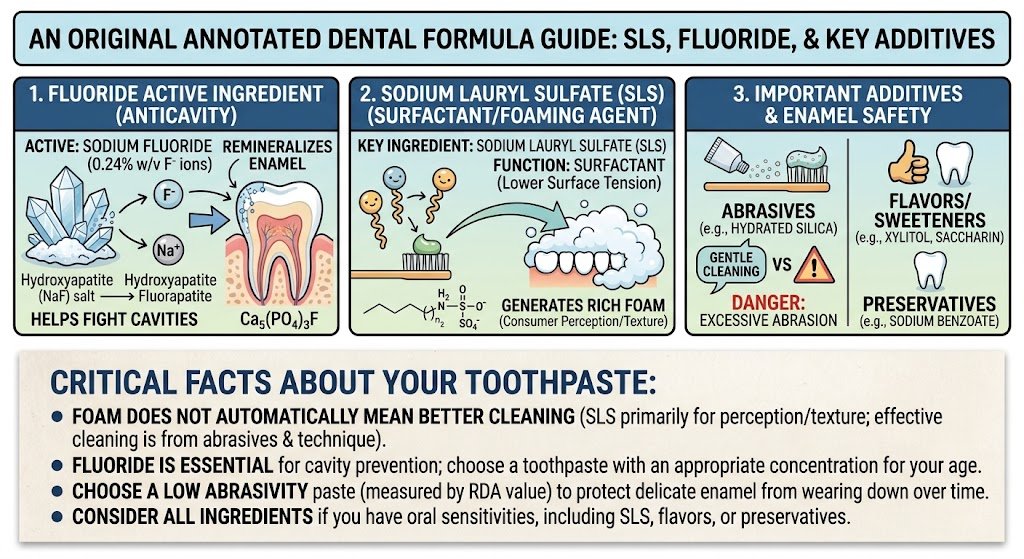
In toothpaste, SLS primarily acts as a detergent and foaming agent. It helps distribute the formula around the mouth and contributes to the familiar foamy texture.
The American Dental Association (ADA) explains that detergents such as SLS are used for their foaming action and may help increase the solubility of plaque and deposits during brushing.
However, foam is not the same as cleaning effectiveness. Toothpaste performance depends on its overall formulation, your brushing technique, and the ingredients that provide specific oral-health benefits.
For example, fluoride helps strengthen enamel and prevent tooth decay. SLS does not replace fluoride, and a toothpaste does not have to contain SLS to provide cavity protection.
You may see sodium lauryl sulfate listed among a toothpaste’s ingredients. Sodium dodecyl sulfate is another name for the same compound. If you want to avoid SLS, check the ingredient list of the exact product you plan to purchase rather than relying on marketing descriptions alone.
Is SLS in Toothpaste Bad for Your Health?
Not necessarily. SLS is not automatically harmful simply because it is a chemical or detergent. However, it can irritate oral tissues in some circumstances, and people differ in how they tolerate toothpaste ingredients.
To evaluate the issue fairly, it helps to separate three concepts.
- Irritation: An ingredient may cause discomfort or inflammation in the tissue it contacts.
- Sensitivity or allergy: An individual may react to a particular ingredient or formulation.
- General toxicity: A broader claim that an ingredient causes harm to the body under normal conditions of use requires separate evidence.
These are different questions. Evidence that SLS can irritate oral tissues does not, by itself, establish that ordinary brushing with an SLS-containing toothpaste causes systemic harm.
The ADA identifies SLS as one of the toothpaste ingredients that may contribute to oral irritation in susceptible individuals. Other ingredients, including certain flavorings and formulation agents, may also cause irritation or allergic reactions.
For people who brush comfortably and have no relevant symptoms, there is no compelling reason to switch solely because their toothpaste contains SLS.
For people who repeatedly experience mouth irritation or canker sores, trying a different formulation may be reasonable.
The key is to evaluate your actual needs rather than assuming that every toothpaste containing SLS is unsafe.
What Does Research Say About SLS and Canker Sores?
Canker sores, also known as recurrent aphthous ulcers, are painful sores that develop inside the mouth. Researchers have investigated whether SLS-containing toothpaste may contribute to symptoms in people who experience these ulcers repeatedly.
A 2019 systematic review examined four crossover trials involving 124 participants. The review reported improvements in several ulcer-related outcomes when participants used SLS-free toothpaste, including measures involving ulcer number, duration, recurrence, and pain. However, the authors concluded that better-designed studies were needed.
A separate 2022 scoping review also examined reported side effects of SLS in toothpaste and discussed the limitations of the available evidence.
These findings suggest that some people with recurrent canker sores may benefit from using toothpaste without SLS. They do not establish that SLS causes every canker sore or that everyone will experience improvement after switching.
What does this mean for you?
If you experience recurring canker sores, an SLS-free toothpaste may be worth trying. If you make a change, keep the rest of your oral-care routine consistent where practical so you can better judge whether the new formulation seems to help.
However, do not assume toothpaste is the only possible cause. Mouth ulcers can have multiple contributing factors, and persistent or severe symptoms may require professional assessment.
Contact a dentist or healthcare professional if ulcers persist, recur frequently, become unusually severe, or interfere with eating and drinking.
What Side Effects Can SLS Cause?
SLS is most relevant to this discussion because of its potential effects on the tissues inside the mouth. Whether a particular person experiences symptoms depends on individual tolerance and the complete toothpaste formulation.
Mouth irritation and sensitivity
Some people may experience discomfort, redness, or irritation of the oral lining when using a toothpaste containing SLS. However, these symptoms are not specific to SLS and may have other causes.
Flavorings, other surfactants, and additional formulation ingredients may also contribute to oral discomfort in susceptible individuals.
If you repeatedly notice irritation after brushing, review your toothpaste ingredients and consider discussing a formulation change with your dentist.
Canker sores and oral ulcers
Research suggests that SLS-free toothpaste may improve certain ulcer-related outcomes for some people with recurrent canker sores. The evidence is limited, and a change in toothpaste will not necessarily prevent future ulcers.
If you suspect a connection, an SLS-free formula may be a reasonable option to discuss with a dental professional.
Does SLS damage tooth enamel?
The research discussed here does not establish that ordinary use of SLS-containing toothpaste damages tooth enamel.
It is important to distinguish potential irritation of soft oral tissues from damage to the hard surface of a tooth. They are different issues and require different evidence.
When choosing toothpaste, pay attention to established oral-health needs, including cavity prevention, rather than treating the absence of SLS as proof that a formula is better in every respect.
Does SLS cause dry mouth or systemic harm?
It would be misleading to claim that SLS in toothpaste universally causes dry mouth or systemic illness. Oral dryness and discomfort can have many causes, including other ingredients, medications, and underlying conditions.
If you experience persistent dryness, burning, swelling, or other concerning symptoms, ask a dental or medical professional to help identify the cause rather than assuming SLS is responsible.
Who Should Consider SLS-Free Toothpaste?
SLS-free toothpaste may be worth considering if you experience recurring canker sores, suspect that your current toothpaste irritates your mouth, or prefer a formula that produces less foam.
You may have a practical reason to try an alternative if:
- You experience recurring mouth ulcers and want to explore whether toothpaste formulation makes a difference.
- Your current toothpaste appears to trigger discomfort or irritation.
- A dental professional has advised you to avoid a particular ingredient.
- You prefer the taste, texture, or foaming characteristics of an SLS-free product.
On the other hand, if your toothpaste is comfortable, provides appropriate cavity protection, and meets your oral-health needs, you may not gain a meaningful benefit by switching.
Remember that SLS is not the only ingredient that can cause irritation. An SLS-free product may still contain flavorings or other ingredients that do not suit you.
If symptoms continue after changing toothpaste, seek professional advice rather than repeatedly buying different products without investigating other possible causes.
How to Identify SLS on a Toothpaste Label
The simplest way to determine whether a toothpaste contains SLS is to check its ingredient list.
Look for sodium lauryl sulfate. Sodium dodecyl sulfate is another name for SLS, although the terminology shown on retail packaging may vary.
Do not assume a product is SLS-free simply because it is described as natural, clean, gentle, or non-toxic. Those marketing terms do not necessarily identify which surfactant a formulation contains.
Also, distinguish SLS from sodium laureth sulfate (SLES). They are related but different ingredients, so the names should not be treated as interchangeable.
Before purchasing an SLS-free toothpaste:
- Check the current ingredient list on the packaging or manufacturer’s product page.
- Confirm that the exact formulation meets your ingredient preference.
- Review the fluoride content and intended use.
- Check for other ingredients you already know you do not tolerate.
Product formulas can change, so verify the current label instead of relying entirely on an older review or product description.
How to Choose an SLS-Free Toothpaste
If you decide to try an alternative, prioritize your oral-health needs first and your ingredient preferences second.
Keep cavity protection in mind
For most people, maintaining effective cavity protection is more important than choosing a toothpaste based solely on its foaming characteristics.
Fluoride helps strengthen enamel and prevent tooth decay. The ADA’s Seal of Acceptance program evaluates products against applicable requirements, and accepted cavity-protection toothpastes must contain fluoride.
You can choose an SLS-free toothpaste without automatically choosing a fluoride-free formula. Unless your dentist has advised otherwise, look for a suitable fluoride toothpaste that meets your oral-health needs.
Check the complete ingredient list
Verify that the product does not contain SLS if avoiding it is your goal. If you suspect irritation from multiple ingredients, consider the flavorings and alternative surfactants as well.
SLS-free does not mean irritation-free for every person. The complete formula matters.
Consider your specific oral-health needs
Choose a toothpaste designed for your actual needs, whether that means everyday cavity protection or an additional feature such as sensitivity relief.
If you have recurring ulcers, persistent irritation, or another oral-health concern, ask your dentist whether a particular formulation would be appropriate.
Avoid assuming that every specialized toothpaste offers benefits you personally need.
Compare comfort, flavor, and foaming
SLS-free toothpastes vary in taste, texture, aftertaste, and amount of foam. Some use alternative surfactants, while others may have a noticeably different brushing experience.
Less foam does not automatically mean less cleaning. The goal is to find a formula that you tolerate well and can use consistently.
Compare price and verify product details
Compare the price per ounce or gram rather than the package price alone. Check the current ingredient list, fluoride content, package size, and relevant product claims before buying.
If you want help comparing suitable products, explore our guide to
A useful comparison should explain why each product is included, who may find it suitable, and any relevant limitations. Do not treat a product’s marketing language as proof of superior safety or effectiveness.
SLS vs. SLS-Free Toothpaste
Neither type of toothpaste is automatically better for everyone. The main difference is whether the formula contains SLS, but the overall formulation and the user’s needs determine which product makes the most sense.
| Feature | SLS-containing toothpaste | SLS-free toothpaste |
|---|---|---|
| Foaming | SLS contributes to foam | May foam less or use another surfactant |
| Oral comfort | Tolerated by many people; may irritate some | May suit some sensitive users, but is not guaranteed to prevent irritation |
| Recurrent canker sores | May be unsuitable for some people with recurring ulcers | Limited evidence suggests potential benefits for some sufferers |
| Cavity protection | Depends on the complete formulation and active ingredients | Can provide cavity protection when appropriately formulated |
| Ingredient preference | Contains SLS | Avoids SLS, but may contain other surfactants |
| Main consideration | Suitable for people who tolerate the formula | Worth considering when avoiding SLS or investigating possible irritation |
If you have no symptoms and your current toothpaste works well for you, there may be no reason to change. If you have recurring irritation or ulcers, trying an SLS-free formula may be a reasonable next step.
Frequently Asked Questions
Is SLS in toothpaste bad for your health?
Not necessarily. SLS is a foaming ingredient used in many toothpastes. It may irritate some people’s oral tissues, but that does not establish that normal use is universally harmful. If you experience recurring irritation, review your toothpaste ingredients and consider seeking dental advice.
Can SLS in toothpaste cause canker sores?
Research suggests that SLS-free toothpaste may improve certain ulcer-related outcomes in some people with recurrent canker sores. However, the evidence is limited, and SLS is not necessarily the cause of every ulcer.
Is SLS-free toothpaste better than regular toothpaste?
It may be a better personal choice for someone who experiences irritation or recurring canker sores. People who tolerate SLS-containing toothpaste may not gain a meaningful benefit by switching. Compare the full formulation and make sure the alternative provides appropriate cavity protection.
Does SLS damage tooth enamel?
The evidence discussed here does not establish that ordinary use of SLS-containing toothpaste damages enamel. Potential irritation of the soft tissues inside the mouth is a separate issue from damage to the tooth surface.
Is SLS the same as sodium laureth sulfate?
No. SLS and SLES are related surfactants, but they are distinct ingredients. If you want to avoid a specific ingredient, check the full ingredient list instead of treating the two names as interchangeable.
Does SLS-free toothpaste still protect against cavities?
Yes. An SLS-free toothpaste can provide cavity protection when appropriately formulated. Look for a suitable fluoride toothpaste and check whether the product has the ADA Seal of Acceptance when applicable.
How do I know if my toothpaste contains SLS?
Look for sodium lauryl sulfate on the current ingredient list. Do not rely solely on descriptions such as natural, clean, or gentle. Verify the exact product formulation before purchasing.
Should I switch toothpaste if I keep getting mouth ulcers?
An SLS-free toothpaste may be worth trying because limited research suggests possible benefits for some people with recurrent ulcers. However, ulcers can have multiple causes. Consult a dentist or healthcare professional if they persist, recur frequently, become severe, or interfere with eating and drinking.
Final Verdict: Should You Avoid SLS?
You do not necessarily need to avoid SLS in toothpaste. It is a foaming ingredient that many people tolerate, although it may irritate some people’s oral tissues.
If you experience recurring canker sores or mouth irritation, trying an SLS-free toothpaste may be reasonable. Research suggests potential benefits for some people with recurrent ulcers, but it does not guarantee that switching will solve the problem.
When choosing an alternative, verify the ingredient list, prioritize appropriate fluoride protection, and select a formula that suits your needs.
The goal is not to avoid every ingredient with a chemical name. It is to find a toothpaste that you tolerate well and that helps you maintain good oral health.
Affiliate disclosure: We may earn a commission if you purchase through qualifying affiliate links in this article, at no additional cost to you. Recommendations should be based on product suitability and evidence rather than commission rates.
