Xylitol is a sugar alcohol commonly used as a sweetener in toothpaste and other oral-care products. You may have seen it listed on toothpaste labels and wondered whether it actually helps your teeth, whether it prevents cavities, or whether it is simply there to make toothpaste taste better.
The answer is a little more nuanced than “xylitol is good for your teeth.”
Xylitol is different from ordinary sugar and is generally considered less likely to contribute to tooth decay. Some research has also investigated whether xylitol may help reduce cavity risk. However, the evidence for xylitol specifically in toothpaste is not strong enough to treat it as a replacement for established cavity-prevention ingredients such as fluoride.
In this guide, you’ll learn what xylitol does in toothpaste, how it differs from sugar, what the research says about cavities, how to evaluate a xylitol toothpaste, and when choosing one may actually make sense.
What Is Xylitol?
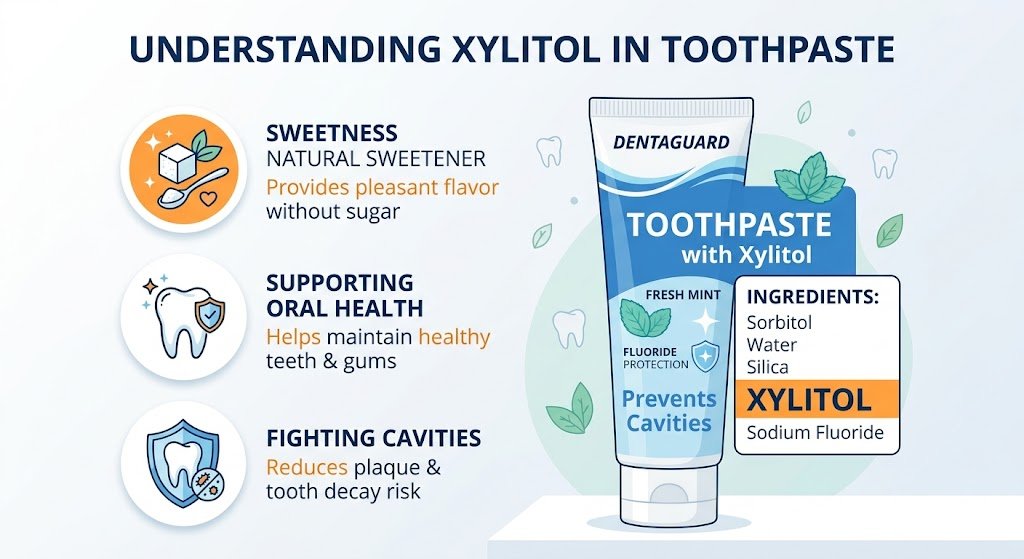
Xylitol is a sugar alcohol, also called a polyol. Despite the word “sugar” in its common description, xylitol is not the same thing as table sugar.
It is used in a variety of products, including foods, chewing gum, mints, and oral-care products. In toothpaste, xylitol can serve as a sweetening ingredient while also being relevant to oral-health research.
One important difference between xylitol and ordinary sugar is how oral bacteria interact with them. Xylitol is not fermented in the same way as fermentable sugars that contribute to acid production in the mouth. This is one reason researchers have investigated whether xylitol could have a role in reducing dental-caries risk.
That does not, however, mean that simply seeing “xylitol” on a toothpaste label proves that the toothpaste will prevent cavities.
The complete formulation matters.
A toothpaste can contain xylitol along with other ingredients that perform very different jobs, such as fluoride for anticaries protection, abrasives for cleaning, humectants for moisture retention, and flavoring ingredients.
Xylitol vs. Sugar
The easiest way to understand xylitol is to compare it with ordinary sugar.
| Feature | Xylitol | Table Sugar |
| Ingredient type | Sugar alcohol/polyol | Sugar |
| Common use in toothpaste | Sweetener and formulation ingredient | Not appropriate as a cavity-promoting sweetener |
| Oral bacteria | Not readily fermented like ordinary sugars | Fermentable by oral bacteria |
| Relationship to cavities | Studied for possible caries-preventive effects | Associated with increased caries risk when consumed frequently |
| Main role in toothpaste | Sweetening and possible oral-health benefit | Generally avoided |
The important point is that xylitol should not be thought of as “sugar that is good for teeth.” It is chemically and metabolically different from ordinary dietary sugar.
The American Dental Association notes that sugar-free sweeteners such as xylitol are less likely to contribute to cavities than fermentable sugars. At the same time, the ADA says the overall evidence for xylitol’s cavity-prevention benefit is not conclusive.
Why Is Xylitol Added to Toothpaste?
Xylitol can have more than one reason for appearing in an oral-care formula.
It Can Sweeten the Toothpaste
Toothpaste is not usually designed to taste completely neutral. Sweeteners can make the overall flavor more pleasant and help balance stronger flavors from ingredients such as mint or other flavoring agents.
Xylitol is useful in this context because it provides sweetness without functioning like ordinary fermentable sugar.
This is one reason you may find it in toothpaste marketed toward people who want a sugar-free or lower-cavity-risk oral-care routine.
It May Have an Oral-Health Role
Xylitol has been studied for possible effects on dental plaque bacteria and caries development.
Researchers have proposed several possible mechanisms, including reducing the availability of fermentable carbohydrates and affecting the environment in which cavity-associated bacteria grow. However, the strength of the evidence depends heavily on how xylitol is delivered, how much is used, how often it is used, and what other preventive measures are present.
This distinction is particularly important for toothpaste.
Research involving xylitol gum, candies, lozenges, and other products cannot automatically be applied to toothpaste. The delivery method is different, and so are the exposure conditions.
It Can Be Part of a Larger Toothpaste Formula
A toothpaste is a mixture of ingredients rather than a single active substance.
For example, a formula may contain:
- Fluoride
- Xylitol
- Abrasives
- Humectants
- Flavoring agents
- Thickening agents
- Water
- Other functional ingredients
Each ingredient can have a different purpose.
The American Dental Association explains that toothpaste formulations may contain ingredients for cleaning, flavor, texture, moisture retention, sensitivity, gingivitis, tartar control, whitening, and other functions.
So when evaluating xylitol toothpaste, it makes more sense to ask “What does the whole formula do?” rather than judging the toothpaste based on xylitol alone.
Does Xylitol Prevent Cavities?
This is probably the most important question for someone considering a xylitol toothpaste.
The short answer is:
Xylitol may have a role in cavity prevention, but the evidence is not strong enough to assume that a xylitol toothpaste by itself provides reliable cavity protection.
Research has produced mixed results.
Some systematic reviews have reported potential benefits from xylitol-containing products, while other reviews have concluded that the evidence is too uncertain to confirm a clear preventive effect.
The distinction between xylitol as an ingredient and xylitol toothpaste as a specific product format is especially important.
A 2024 review specifically examining xylitol toothpaste found that relatively few studies had directly evaluated toothpaste compared with the much larger body of research on products such as chewing gum and other xylitol-containing products.
That means you should be careful with claims suggesting that any toothpaste containing xylitol will prevent cavities.
Xylitol Is Not a Replacement for Fluoride
If your main goal is cavity protection, this is one of the most important distinctions to understand.
The ADA states that toothpastes making an ADA cavity-protection claim must contain fluoride. The FDA also recognizes specific anticaries active ingredients for OTC dentifrices.
So if you are comparing:
Toothpaste A: xylitol but no fluoride
versus
Toothpaste B: fluoride plus xylitol
you should not assume that the xylitol-only option offers the same level of established anticaries protection as a fluoride toothpaste.
This is especially important for people who are at elevated risk of dental caries. Your individual dental history, diet, oral hygiene, medications, saliva flow, and other factors can affect your cavity risk.
What Does the Research Actually Say About Xylitol?
The research is worth looking at carefully because online discussions often make xylitol sound more certain than the evidence supports.
A systematic review and meta-analysis published in 2017 found evidence suggesting that xylitol could reduce dental-caries outcomes, but the authors also identified substantial limitations in the available studies, including concerns about risk of bias.
A Cochrane review found low-quality evidence suggesting that a fluoride toothpaste containing 10% xylitol might reduce caries compared with fluoride-only toothpaste in children. However, the review emphasized that the evidence was limited and that the result came from studies with important limitations.
More recent research has remained cautious. A 2024 systematic review concluded that the preventive effect of xylitol against dental caries could not be confirmed conclusively across the available clinical trials. The studies varied in xylitol dose, frequency, and other factors.
That gives you a much more useful takeaway than simply saying “xylitol prevents cavities”:
Xylitol is a promising oral-care ingredient, but the evidence for its cavity-prevention effect—especially when used in toothpaste—is not strong enough to make it the primary reason to choose a toothpaste.
Is Xylitol Good for Your Teeth?
For most toothpaste shoppers, the better question is not whether xylitol is simply “good” or “bad.”
Instead, consider what role it plays in the overall formula.
Xylitol may be attractive if you want:
- A toothpaste sweetened without ordinary sugar
- An ingredient that has been studied for possible oral-health benefits
- A toothpaste that combines xylitol with established cavity-protection ingredients
- A sugar-free oral-care routine
- A formula that fits your preferences around ingredients
But xylitol should not automatically make you choose one toothpaste over another.
For example, if two toothpastes both contain xylitol but one has a formulation better suited to your actual dental needs, the presence of xylitol alone should not decide the purchase.
Your priorities may instead be:
- Cavity protection
- Sensitivity management
- Enamel protection
- Gum health
- Ingredient preferences
- Flavor and texture
- Whether you prefer fluoride or fluoride-free formulas
Is Xylitol Safe in Toothpaste?
Xylitol is widely used as a sweetener and oral-care ingredient, but “safe” should always be considered in context.
For toothpaste users, the bigger practical question is usually whether the finished product is appropriate for their needs and whether they use it as directed.
One important distinction is that swallowing toothpaste is different from brushing with toothpaste and spitting it out.
Toothpaste is formulated for oral use, but it is not intended to be consumed as food.
This becomes especially relevant for young children, who may swallow toothpaste while learning to brush.
Can Xylitol Cause Side Effects?
Large amounts of xylitol consumed orally can cause digestive symptoms in some people because sugar alcohols can have gastrointestinal effects.
That issue is more relevant to products designed to be eaten or consumed, such as large amounts of xylitol-containing foods, candies, or supplements, than to the small amount of toothpaste normally used for brushing.
Still, toothpaste should be used as directed rather than intentionally swallowed.
If you notice irritation, discomfort, or another unusual reaction after switching toothpaste, stop using the product and discuss the reaction with a dentist or other appropriate healthcare professional.
Xylitol vs. Other Toothpaste Sweeteners
Xylitol is not the only sweetener that can appear in toothpaste.
Other sweetening ingredients may be used to improve taste without adding ordinary table sugar to the formulation.
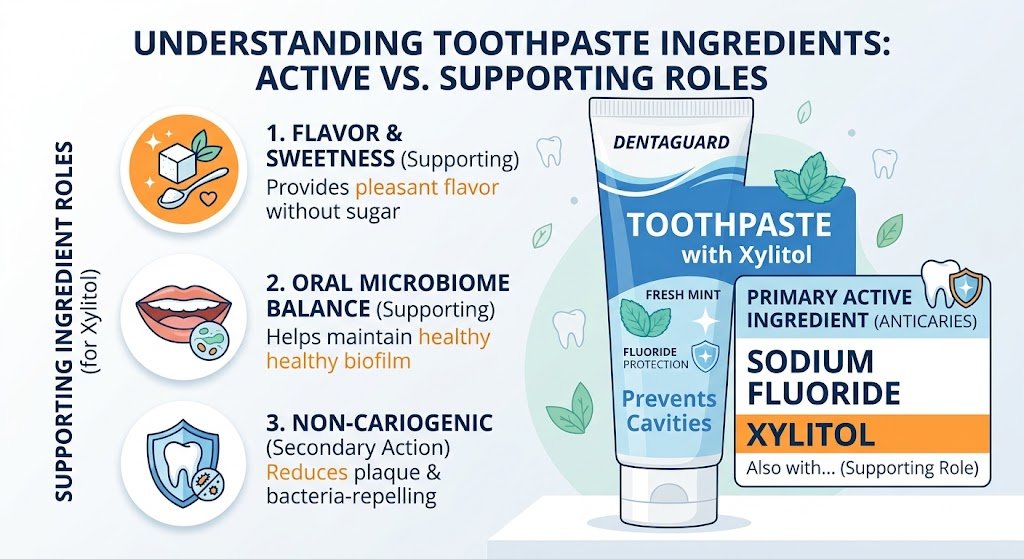
One commonly encountered example is sorbitol, which can also serve as a humectant and sweetener in toothpaste formulations.
This is why simply finding a sweet ingredient on the label does not tell you everything about how a toothpaste performs.
The ingredient’s function matters.
For example:
- A humectant helps the formulation retain moisture.
- A sweetener helps improve taste.
- An abrasive helps with mechanical cleaning.
- A detergent helps with spreading and foaming.
- A fluoride active ingredient can provide established anticaries protection.
Some ingredients can perform more than one function.
The important lesson is to read the whole ingredient list and the product’s intended purpose, rather than assuming one ingredient determines whether the toothpaste is good or bad.
Should You Choose a Toothpaste With Xylitol?
Xylitol can be a reasonable feature to look for, but it should usually be a secondary selection criterion, not your only one.
If your primary concern is cavity prevention, first look at the toothpaste’s established anticaries protection and whether it fits your dentist’s recommendations.
If your priority is avoiding certain ingredients, evaluate the entire formula rather than assuming that xylitol makes the product automatically “clean” or “non-toxic.”
If you want a hydroxyapatite toothpaste, for example, you may find formulas that contain both hydroxyapatite and xylitol. In that case, the two ingredients should be evaluated for their different roles rather than treated as interchangeable.
For someone specifically looking for xylitol toothpaste, a useful buying checklist is:
- What is the main dental goal?
- Does the toothpaste contain fluoride or another ingredient you specifically want?
- Is xylitol included as part of a broader formulation that fits your needs?
- Are there ingredients you personally need or prefer to avoid?
- Does the toothpaste address sensitivity, enamel, gum, whitening, or another specific concern?
- Is the product appropriate for your age and dental situation?
- Does the product make claims that are supported by credible evidence?
This approach helps prevent a common mistake: choosing a toothpaste because one ingredient sounds impressive while ignoring the rest of the formula.
A Better Way to Compare Xylitol Toothpastes
If you are comparing several products on Amazon or elsewhere, do not start with the question:
“Which one has the most xylitol?”
Instead, start with:
“Which complete formulation best matches my oral-health needs?”
Then use xylitol as one factor in that decision.
That makes the comparison much more useful because the goal is not simply to buy a toothpaste containing xylitol. The goal is to choose a toothpaste that makes sense for your particular dental priorities.
[ARTICLE CONTINUES — NEXT PART STARTS WITH: H2: “Xylitol Toothpaste vs. Fluoride Toothpaste”]
Continuing exactly from the previous stopping point.
Xylitol Toothpaste vs. Fluoride Toothpaste
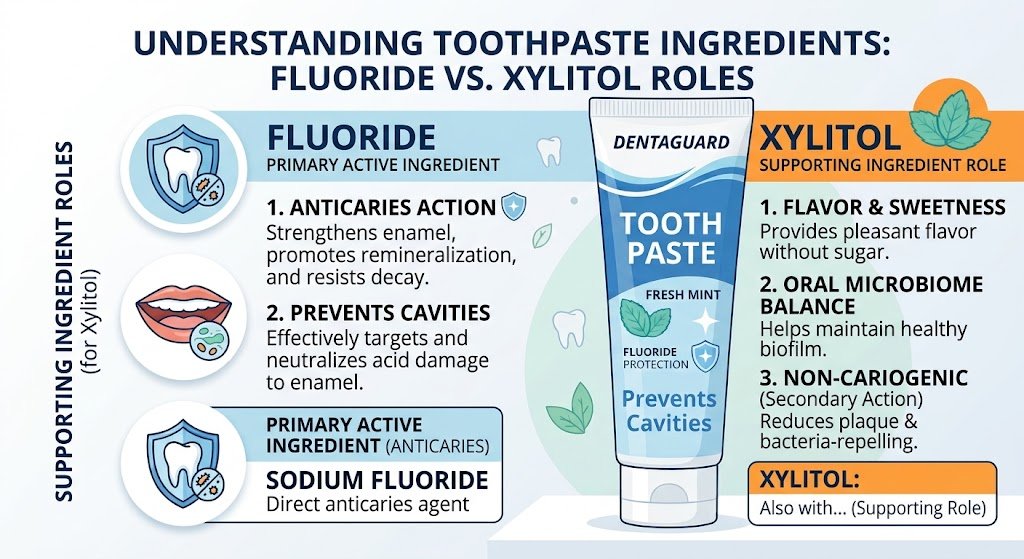
Xylitol and fluoride are not interchangeable toothpaste ingredients. They serve different roles, and the presence of xylitol does not automatically make a toothpaste a substitute for fluoride.
Fluoride has a well-established role in cavity prevention and enamel remineralization. Xylitol is mainly considered a supporting ingredient that may contribute to an oral-health-friendly formula, but the evidence for xylitol specifically in toothpaste is much more limited.
This distinction matters when comparing toothpastes.
What Fluoride Does
Fluoride helps teeth become more resistant to acid attacks and supports the remineralization process when early mineral loss occurs.
For people choosing toothpaste primarily for cavity protection, fluoride concentration and the overall formula are therefore more important considerations than simply looking for xylitol on the ingredient list.
What Xylitol Does
Xylitol is a sugar alcohol used in some oral-care products as a sweetener and for its potential oral-health benefits.
Research has investigated whether xylitol can reduce cavity risk, but results vary depending on the product, amount, frequency, and population studied. Evidence specifically for xylitol toothpaste remains limited.
That means a toothpaste containing xylitol should not automatically be described as a cavity-prevention toothpaste simply because xylitol is present.
Can a Toothpaste Contain Both?
Yes. A toothpaste formula can contain both fluoride and xylitol because they have different functions.
When evaluating such a toothpaste, it is useful to ask:
- Does it contain fluoride?
- What is the fluoride source?
- Is the toothpaste appropriate for your dental needs?
- What other active ingredients does it contain?
- Are there ingredients you personally prefer to avoid?
- Is the complete formula suitable for regular use?
This whole-formula approach is more useful than choosing toothpaste based on one ingredient alone.
Xylitol vs. Sorbitol in Toothpaste
Xylitol and sorbitol are both sugar alcohols commonly used to provide sweetness in oral-care products.
They are similar in that they can make toothpaste taste better without relying on ordinary sugar. However, they are not identical substances, and research has examined whether they have different effects on oral bacteria and caries risk.
Some research has suggested potential advantages for xylitol compared with sorbitol, while other evidence has not established a clear clinical advantage in every setting.
For a toothpaste buyer, this means the presence of xylitol should be viewed as one formula characteristic, not as proof that the toothpaste will perform better than every toothpaste containing sorbitol.
If your main goal is cavity protection, focus first on the active ingredients and the overall evidence behind the toothpaste rather than choosing solely between sweeteners.
How Much Xylitol Is in Toothpaste?
The amount of xylitol can vary between toothpaste formulas.
This creates an important limitation when reading research. A study involving a particular amount of xylitol, a specific product format, or a particular frequency of use does not automatically prove that every toothpaste containing a smaller or different amount will produce the same result.
This is one reason it is difficult to translate general xylitol research directly into a simple rule such as:
“Any toothpaste containing xylitol prevents cavities.”
The evidence does not support such a broad conclusion.
When comparing products, look at the complete ingredient list and the product’s intended function, rather than assuming that more xylitol necessarily means better toothpaste.
Does Xylitol Make Toothpaste Non-Toxic?
No ingredient by itself makes a toothpaste “non-toxic.”
The term non-toxic is often used to describe a broader ingredient-selection philosophy, but toothpaste safety depends on the complete formulation, intended use, exposure, and individual circumstances.
For example, someone looking for a non-toxic toothpaste may care about:
- avoiding certain detergents
- avoiding unnecessary dyes
- avoiding specific flavoring ingredients
- choosing transparent ingredient labels
- selecting an active ingredient appropriate for their dental needs
- considering fluoride or fluoride-free options based on their preferences and dental risk
Xylitol can fit into some ingredient-conscious toothpaste formulas, but its presence alone does not establish that the complete product is safer or better.
Is Xylitol Better Than Sugar in Toothpaste?
Xylitol and ordinary sugar are very different from an oral-health perspective.
Regular dietary sugars can be fermented by oral bacteria and contribute to acid production. Xylitol is a sugar alcohol and is not used by oral bacteria in the same way as ordinary sugar.
This is one reason xylitol is commonly used in sugar-free oral-care products.
However, the fact that xylitol is preferable to sugar does not mean that xylitol toothpaste automatically provides strong cavity protection.
The distinction is important:
Less cavity-promoting than sugar does not mean proven to replace fluoride for cavity prevention.
Toothpaste also needs to be evaluated as a complete product.
Who Might Prefer Xylitol Toothpaste?
Xylitol toothpaste may appeal to people who specifically want a toothpaste containing a sugar alcohol instead of ordinary sugar and who are interested in ingredient-conscious oral-care formulas.
It may also be relevant when comparing different natural, clean-label, or non-toxic toothpaste options.
However, personal preference should come after the primary dental need.
For example:
- Cavity prevention: look closely at fluoride and other evidence-supported active ingredients.
- Sensitive teeth: look for ingredients intended to address sensitivity.
- Enamel concerns: consider ingredients associated with enamel protection or remineralization.
- SLS avoidance: examine the detergent ingredients.
- Ingredient transparency: read the full ingredient list rather than relying only on front-label claims.
- Xylitol preference: use xylitol as an additional selection factor.
Xylitol Toothpaste for Children
Parents may notice xylitol in children’s toothpaste because it can provide sweetness without using ordinary sugar.
But children’s toothpaste should not be selected based on xylitol alone.
The child’s age, ability to spit, cavity risk, toothpaste ingredients, and dental guidance all matter.
For cavity prevention, fluoride remains an important consideration. The appropriate toothpaste and amount should follow current dental guidance for the child’s age and individual needs.
If a child accidentally swallows toothpaste, the situation is different from simply using a toothpaste that contains xylitol. The amount swallowed and the toothpaste’s other ingredients matter.
Xylitol Toothpaste During Pregnancy
There is no reason to assume that the word “xylitol” alone determines whether a toothpaste is appropriate during pregnancy.
Pregnant people should evaluate toothpaste as a complete oral-care product and consider their specific dental needs.
Pregnancy can also make maintaining good oral hygiene especially important, so avoiding a needed dental active ingredient simply because a toothpaste is marketed as “natural” or “non-toxic” may not be helpful.
If you are unsure which toothpaste is appropriate during pregnancy, a dentist can help you choose based on your oral-health needs.
Common Misunderstandings About Xylitol Toothpaste
“Xylitol Prevents Cavities by Itself”
This is too strong.
Research has investigated xylitol for cavity prevention, but the evidence is not consistent enough to treat xylitol toothpaste as a guaranteed cavity-prevention solution.
“Xylitol Toothpaste Is Better Than Fluoride Toothpaste”
This is also an oversimplification.
Xylitol and fluoride have different roles. For people concerned about cavities, fluoride has substantially stronger support as a cavity-prevention ingredient.
“Any Toothpaste With Xylitol Has the Same Benefits”
Not necessarily.
Different formulas may contain different concentrations, active ingredients, abrasives, detergents, flavors, and other components.
“Natural Xylitol Toothpaste Is Automatically Safer”
Not automatically.
“Natural” describes a marketing or ingredient-selection approach, not a universal safety guarantee.
“Xylitol Means You Can Ignore Brushing Habits”
No.
A toothpaste ingredient cannot replace good oral-hygiene habits. Brushing properly and regularly, cleaning between teeth, managing dietary sugar exposure, and maintaining dental care remain important.
How to Read Xylitol on a Toothpaste Label
If you are considering a toothpaste because it contains xylitol, use a simple checklist.
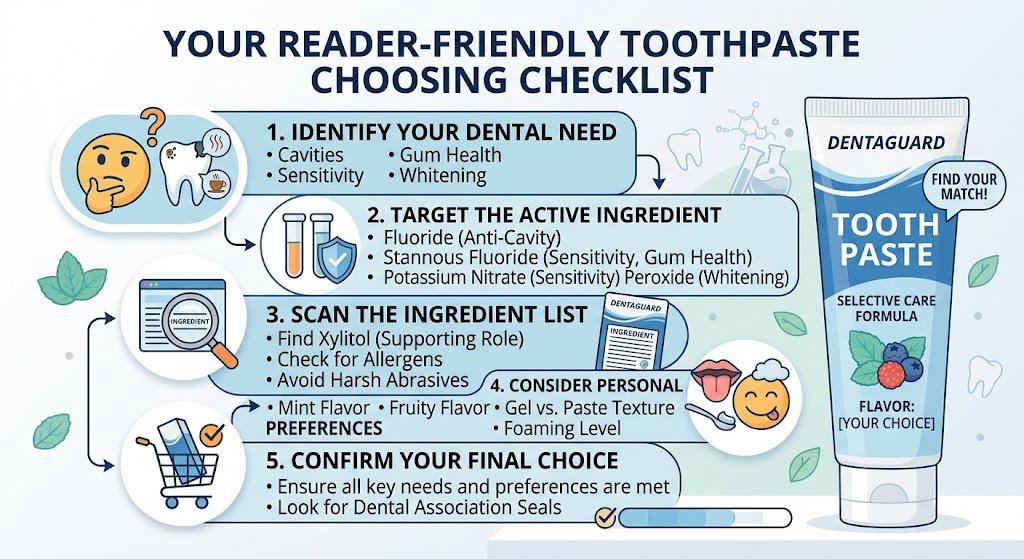
1. Find Xylitol in the Ingredient List
Confirm that xylitol is actually listed rather than relying only on front-label marketing.
2. Identify the Main Active Ingredient
Ask what the toothpaste is primarily designed to do.
For cavity protection, check whether it contains fluoride or another active ingredient appropriate for your needs.
3. Check the Other Ingredients
Look at the complete formula.
Consider detergents, abrasives, flavoring ingredients, sweeteners, dyes, and other components according to your personal preferences and dental needs.
4. Match the Formula to Your Dental Need
A toothpaste designed mainly around xylitol may not be the best choice for someone whose primary concern is sensitivity, cavities, enamel wear, or another specific condition.
5. Avoid Single-Ingredient Thinking
A toothpaste is a complete formulation.
Xylitol can be a useful feature to consider, but it should not be the only reason you choose a toothpaste.
Bottom Line: Is Xylitol Worth Looking for in Toothpaste?
Xylitol is a useful ingredient to understand when comparing toothpastes, particularly if you prefer sugar-free or ingredient-conscious oral-care products.
Research suggests that xylitol may have oral-health benefits, but the evidence is not strong enough to treat xylitol toothpaste as a guaranteed cavity-prevention solution. Evidence for xylitol-containing products also cannot automatically be transferred to every toothpaste formula.
For most people, the better approach is to evaluate the whole toothpaste formula and start with the dental need you are trying to address.
If cavity prevention is the priority, consider the evidence behind fluoride and the toothpaste’s overall formulation. If your priority is avoiding certain ingredients, examine the full ingredient list. If you specifically want xylitol, treat it as an additional feature rather than the only measure of toothpaste quality.
Sources and Further Reading
The evidence discussed in this article should be interpreted carefully because research on xylitol varies by product type, amount, frequency, and study population.
Useful evidence sources include:
