Sodium monofluorophosphate is a fluoride-containing compound used as an active ingredient in some toothpastes to help prevent cavities. You may have seen its name on a toothpaste label and wondered what it actually does, whether it is safe, and how it compares with other fluoride ingredients.
The name can sound complicated, but its role is easier to understand: sodium monofluorophosphate is one way toothpaste can provide fluoride to help protect teeth from decay.
This guide explains what sodium monofluorophosphate is, how it works, its role in cavity and enamel protection, what its concentration means, how it compares with sodium fluoride and stannous fluoride, and what to look for when choosing a toothpaste.
What Is Sodium Monofluorophosphate?
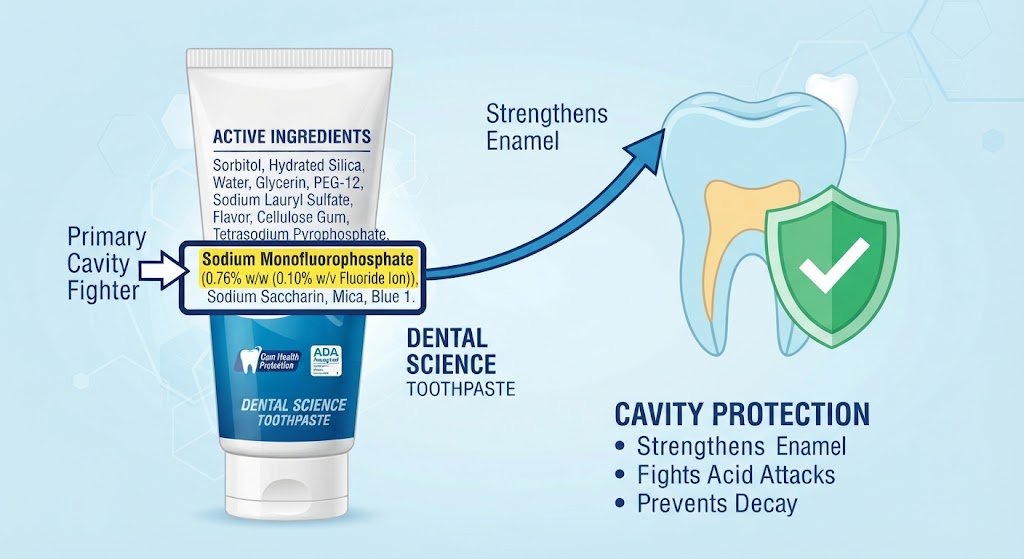
Sodium monofluorophosphate is a fluoride-containing chemical compound used in some toothpaste formulas. It is commonly abbreviated as MFP and is used as an active anticaries ingredient.
The important distinction is that sodium monofluorophosphate is not simply another name for fluoride. It is a specific compound that contains fluoride and can be used to provide fluoride in a toothpaste formulation.
When you brush with toothpaste containing this ingredient, the formula is designed to make fluoride available in the oral environment. Fluoride can then help protect teeth against the processes that lead to tooth decay.
The U.S. Food and Drug Administration recognizes sodium monofluorophosphate as an anticaries active ingredient for certain dentifrice formulations
The American Dental Association also identifies sodium monofluorophosphate as one of the fluoride compounds used in toothpaste for cavity protection.
Why Does the Name Matter?
Understanding the ingredient name helps when you are comparing toothpaste labels.
You may see several different fluoride compounds, including:
- Sodium monofluorophosphate
- Sodium fluoride
- Stannous fluoride
They are different chemical compounds, but they can all be used as fluoride sources in anticaries toothpaste.
So, when a label says sodium monofluorophosphate, it does not mean the toothpaste is fluoride-free. It means the toothpaste uses a particular fluoride-containing compound.
Is Sodium Monofluorophosphate a Type of Fluoride?
Yes, but there is an important distinction.
Sodium monofluorophosphate is a fluoride-containing compound, while “fluoride” is the broader term used when discussing the fluoride component responsible for anticaries benefits.
Think of it this way:
Sodium monofluorophosphate is one chemical form used to deliver fluoride in toothpaste.
This is similar to how toothpaste can contain different fluoride compounds while still being described as a fluoride toothpaste.
For consumers, the practical takeaway is simple: seeing sodium monofluorophosphate on a toothpaste label means you are looking at a fluoride-containing active ingredient, not a completely different category from fluoride toothpaste.
The three commonly encountered fluoride compounds—sodium monofluorophosphate, sodium fluoride, and stannous fluoride—have different chemical structures and formulation characteristics.
That is why comparing toothpaste only by the word “fluoride” can leave out useful information.
Why Is Sodium Monofluorophosphate Used in Toothpaste?
The main reason sodium monofluorophosphate is used in toothpaste is cavity prevention.
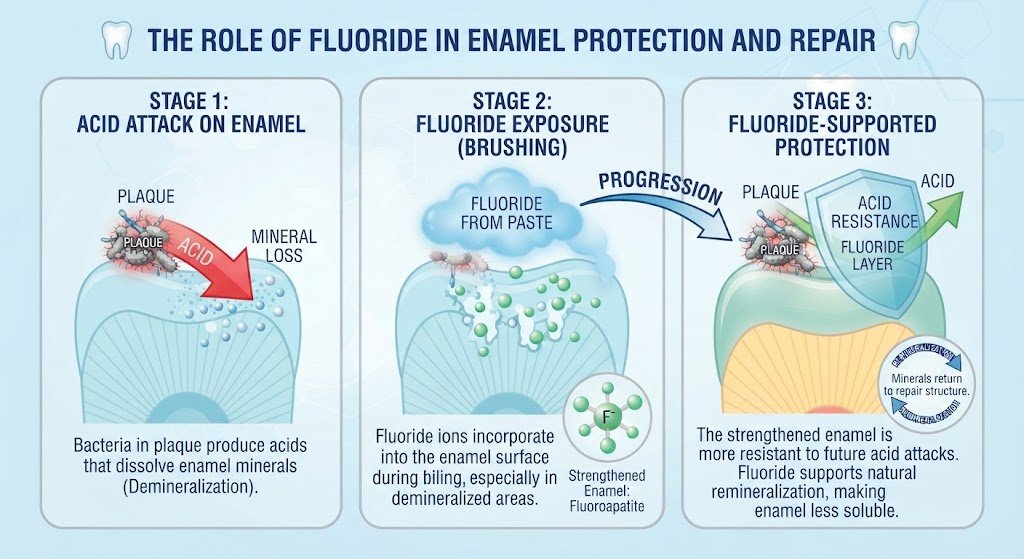
Tooth decay begins when acids produced by bacteria in dental plaque contribute to the loss of minerals from tooth surfaces. Your mouth naturally goes through cycles of mineral loss and repair, but frequent acid attacks can shift that balance toward decay.
Fluoride helps support the teeth during this process.
Sodium monofluorophosphate provides a way for a toothpaste formulation to deliver fluoride during brushing. Regular use of an appropriate fluoride toothpaste can therefore be an important part of a cavity-prevention routine.
Its Main Role: Anticaries Protection
“Anticaries” simply means against dental caries, or cavities.
When you see an anticaries active ingredient on toothpaste packaging, the purpose is related to preventing tooth decay.
That does not mean sodium monofluorophosphate makes teeth immune to cavities. Your overall cavity risk is affected by several factors, including:
- How often your teeth are exposed to acids
- Dental plaque
- Diet and frequent sugar or fermentable-carbohydrate exposure
- Oral hygiene
- Saliva production
- Previous history of cavities
- Certain medications or conditions that affect the mouth
Fluoride toothpaste is one part of that larger picture.
Why Put It in Toothpaste Instead of Using Fluoride Alone?
Toothpaste is designed to bring multiple ingredients together in a form that can be applied directly to the teeth during brushing.
A typical toothpaste formula may include:
- An active ingredient for its intended dental benefit
- Abrasives for cleaning
- Humectants to maintain moisture
- Flavoring ingredients
- Sweeteners
- Thickeners
- Surfactants or foaming ingredients
- Water and other formulation components
Therefore, sodium monofluorophosphate is only one part of the complete toothpaste formula.
This distinction becomes important when you start comparing products. Two toothpastes can contain the same active fluoride compound but still feel and perform differently because their supporting ingredients are not identical.
How Does Sodium Monofluorophosphate Work?
The easiest way to understand its role is to first understand what happens to your teeth throughout the day.
What Happens During an Acid Attack?
Your mouth contains bacteria that can use fermentable carbohydrates from food and drinks. Their activity can produce acids.
Those acids can lower the conditions around the tooth surface and contribute to demineralization, meaning minerals are lost from enamel.
Your saliva naturally helps buffer acids and supplies minerals that support the tooth’s repair process. This is called remineralization.
When acid attacks happen frequently or the balance stays unfavorable, the risk of developing a cavity can increase.
How Fluoride Helps
Fluoride can help teeth become more resistant to acid-related mineral loss and can support the remineralization of early areas of mineral loss.
Sodium monofluorophosphate is one compound used in toothpaste to provide fluoride as part of this process.
The important point is that toothpaste does not simply create a permanent protective coating that makes cavities impossible. Instead, fluoride participates in the ongoing interaction between your teeth, saliva, plaque, and the substances in your mouth.
A Simple Way to Think About It
The process can be simplified like this:
Food and plaque bacteria → acids → mineral loss
Then:
Fluoride exposure + saliva + good oral hygiene → greater support for tooth protection and remineralization
This is one reason consistent brushing matters. A single brushing session cannot permanently prevent future acid attacks. The goal is regular fluoride exposure as part of daily oral hygiene.
Does Sodium Monofluorophosphate Itself “Repair” a Cavity?
No.
Once a tooth has developed a true cavity—a structural defect caused by tooth decay—ordinary toothpaste cannot simply fill the hole.
Fluoride is most useful for preventing decay and supporting early mineral changes, while established cavities may require professional dental treatment.
That distinction is important because words such as “remineralization” can sometimes be misunderstood as meaning that toothpaste can rebuild any damaged tooth.
Does Sodium Monofluorophosphate Prevent Cavities?
Yes. Sodium monofluorophosphate is used in toothpaste as an anticaries active ingredient, meaning its purpose is to help prevent dental caries.
The FDA’s OTC anticaries requirements include sodium monofluorophosphate among the active ingredients that may be used in qualifying dentifrice products under specified conditions.
However, cavity prevention does not depend on one ingredient alone.
A fluoride toothpaste works best as part of a broader oral-care routine that includes regular brushing, cleaning between teeth, sensible dietary habits, and professional dental care when needed.
Why Fluoride Matters for Cavity Prevention
Every day, teeth experience some combination of:
- Acid exposure
- Bacterial plaque
- Mineral loss
- Saliva-mediated repair
- Mechanical cleaning
- Fluoride exposure
Fluoride can shift this balance toward greater protection against decay.
For someone choosing between toothpaste products, the important question is therefore not simply:
“Does this contain sodium monofluorophosphate?”
It is also:
“Does this product provide an appropriate fluoride formulation for my needs, and will I use it consistently as directed?”
That broader question leads to a better purchasing decision.
Does Sodium Monofluorophosphate Strengthen Enamel?
Fluoride can help protect tooth enamel from acid-related mineral loss and support remineralization of early areas of mineral loss.
Enamel is the hard outer layer of a tooth. Although it is highly mineralized, it is not completely unaffected by the acids produced in the mouth.
Regular fluoride exposure can help make the tooth surface more resistant to the conditions that contribute to decay.
But there is an important limitation:
Fluoride toothpaste does not mean severely damaged enamel will simply grow back.
If you have significant enamel erosion, unusual tooth wear, cracks, or persistent pain, changing toothpaste may not address the underlying problem.
The goal of fluoride toothpaste is primarily prevention and protection, not repairing major structural damage.
Is Sodium Monofluorophosphate Safe?
Sodium monofluorophosphate is an established active ingredient used in fluoride toothpaste. For normal toothpaste use, the important principle is to follow the product’s directions and avoid intentionally swallowing toothpaste.
Fluoride is beneficial at appropriate exposure levels, but toothpaste is formulated for brushing—not for consumption.
This is particularly important for young children because they may swallow toothpaste while learning to brush.
What About Swallowing Toothpaste?
A small amount of toothpaste may sometimes be swallowed accidentally, especially by children. The appropriate response depends on the amount, age, product, and circumstances.
The safest routine is to teach children to spit toothpaste out rather than swallow it and to follow the age-specific instructions on the product.
If you are concerned about repeated swallowing or a significant ingestion, contact an appropriate healthcare professional or poison-control resource for guidance.
Does “Chemical-Sounding” Mean It Is Unsafe?
No.
“Sodium monofluorophosphate” is a technical chemical name. The complexity of an ingredient’s name does not determine whether it is safe.
A more useful way to evaluate an ingredient is to consider:
- What the ingredient is
- How it is used
- Its concentration
- The intended exposure
- The product’s directions
- Available evidence and regulatory information
This is a better approach than labeling an ingredient as safe or unsafe simply because its name sounds unfamiliar.
What About Children?
For children, the main considerations are age, toothpaste amount, supervision, and swallowing behavior.
Parents should choose toothpaste appropriate for the child’s age and follow the manufacturer’s directions and dental guidance.
If a child has a high cavity risk or a dentist has recommended a particular fluoride product, follow that individualized advice rather than choosing solely based on the ingredient name.
Sodium Monofluorophosphate Concentration: What Does the Percentage Mean?
This is one of the most confusing parts of toothpaste labels.
You may see a percentage next to sodium monofluorophosphate and assume that a higher percentage automatically means a stronger or better toothpaste.
That is not a reliable way to compare fluoride products.
Sodium monofluorophosphate is a compound containing fluoride, so the amount of the compound and the amount of fluoride available from the formulation are related but not identical concepts.
For certain dentifrice formulations, the FDA OTC anticaries monograph specifies sodium monofluorophosphate concentrations of 0.654% to 0.884%, together with requirements concerning theoretical total fluorine and available fluoride. These specifications apply to the formulations and conditions described by the monograph.
Why Can’t You Compare Percentages Directly?
Consider three toothpaste labels:
- Toothpaste A uses sodium monofluorophosphate.
- Toothpaste B uses sodium fluoride.
- Toothpaste C uses stannous fluoride.
You cannot simply look at the percentage beside each compound and conclude that the product with the largest number contains the most useful fluoride.
The compounds have different molecular structures, so compound percentage is not the same thing as available fluoride.
For consumers, a better label-reading approach is to look at:
- The active fluoride ingredient.
- The stated concentration.
- The product’s intended use.
- Directions and warnings.
- The complete ingredient list.
- Any relevant evidence or dental-organization recognition.
[ ARTICLE CONTINUES — NEXT PART STARTS WITH: H2: “Sodium Monofluorophosphate vs. Other Fluoride Ingredients” ]
Bilkul — Part 2 wahi se continue kar raha hoon jahan Part 1 end hua tha. Repeat nahi kar raha.
Sodium Monofluorophosphate vs. Other Fluoride Ingredients
Sodium monofluorophosphate is only one of several fluoride compounds used in toothpaste. If you are comparing products, the important question is not simply which ingredient has the more familiar name. Instead, look at the type of fluoride, its concentration, the rest of the formula, and whether the toothpaste matches your oral health needs.
The most common comparisons are sodium monofluorophosphate vs. sodium fluoride, stannous fluoride, fluoride-free toothpaste, and hydroxyapatite.
Sodium Monofluorophosphate vs. Sodium Fluoride
Both sodium monofluorophosphate and sodium fluoride are fluoride-containing active ingredients used in toothpaste to help prevent cavities.
The main difference is their chemical form.
Sodium fluoride contains fluoride in a simpler ionic form, while sodium monofluorophosphate is a phosphate-containing fluoride compound. Although they are chemically different, both are used to provide fluoride for anticaries protection.
For someone shopping for everyday cavity protection, the presence of one name rather than the other does not automatically tell you that one toothpaste is better.
Instead, consider:
- The fluoride active ingredient
- The concentration listed on the label
- The toothpaste’s complete ingredient formula
- Your specific dental needs
- Whether the product has appropriate dental or regulatory information
- How consistently you will use it
This is an important point because consumers sometimes assume that a more familiar ingredient name must be more effective. The active fluoride compound is only one part of the toothpaste formula.
If your primary goal is cavity prevention, both sodium monofluorophosphate and sodium fluoride can appear in fluoride toothpastes designed for that purpose.
Practical takeaway: Do not choose between sodium monofluorophosphate and sodium fluoride based on the ingredient name alone. Look at the complete product and its intended use.
Sodium Monofluorophosphate vs. Stannous Fluoride
Stannous fluoride is another fluoride compound used in toothpaste.
The comparison becomes more interesting because stannous fluoride is associated with more than simply delivering fluoride. Depending on the formulation, stannous fluoride toothpaste may also be designed to address concerns such as plaque, gingivitis, sensitivity, or other oral-health needs.
That does not mean every stannous fluoride toothpaste provides the same benefits. The rest of the formulation matters.
Sodium monofluorophosphate, meanwhile, is primarily encountered as a fluoride source in anticaries toothpaste.
When comparing the two, ask what you actually want from the toothpaste.
| Consideration | Sodium Monofluorophosphate | Stannous Fluoride |
| Fluoride source | Yes | Yes |
| Cavity protection | Used for anticaries protection | Used for anticaries protection |
| Chemical form | Fluoride-containing phosphate compound | Tin-containing fluoride compound |
| Other oral-health benefits | Depend on the complete formula | Depend on the complete formula |
| Best comparison method | Look at active ingredient + full formula | Look at active ingredient + full formula |
One should not assume that stannous fluoride is automatically better simply because it may be marketed around several oral-health benefits. Likewise, sodium monofluorophosphate should not be considered inferior simply because its name is less familiar.
The better choice depends on the product’s complete formulation and your specific dental priorities.
Sodium Monofluorophosphate vs. Fluoride-Free Toothpaste
This comparison involves a more important difference: whether the toothpaste contains fluoride as an anticaries active ingredient.
A toothpaste containing sodium monofluorophosphate is a fluoride toothpaste. A genuinely fluoride-free toothpaste does not provide fluoride as its active anticaries ingredient.
For people who are at elevated risk of cavities, removing fluoride from the routine may deserve more careful consideration than simply choosing between two fluoride compounds.
A fluoride-free toothpaste may still contain useful ingredients for cleaning, flavor, sensitivity, or other purposes, but that does not make it equivalent to a fluoride toothpaste for cavity prevention.
This distinction is especially important when shopping for products described as:
- Natural
- Clean
- Non-toxic
- Plant-based
- Chemical-free
- Fluoride-free
Marketing language does not tell you whether a toothpaste provides fluoride-based cavity protection.
If you prefer a fluoride-free toothpaste, understand what you are giving up and why you are making that choice. If you have a history of frequent cavities, ask your dentist whether a fluoride-free routine is appropriate for you.
Sodium Monofluorophosphate vs. Hydroxyapatite
Hydroxyapatite is different from sodium monofluorophosphate because it is not simply another fluoride compound.
Hydroxyapatite is a calcium phosphate mineral related to the mineral component naturally found in teeth and bones. Some toothpastes use hydroxyapatite as an alternative or complementary approach to fluoride-based formulations.
This makes the comparison particularly relevant for people looking for:
- Fluoride-free options
- Remineralizing-focused toothpaste
- Ingredient-conscious oral-care products
- Alternatives to conventional fluoride toothpaste
However, hydroxyapatite toothpaste and fluoride toothpaste should not be treated as interchangeable based only on marketing claims.
If cavity prevention is your main concern, consider the evidence, formulation, your individual risk level, and guidance from your dental professional.
The important distinction is simple:
Sodium monofluorophosphate delivers fluoride, while hydroxyapatite is a calcium-phosphate mineral used in some oral-care formulas.
Who May Benefit From Sodium Monofluorophosphate Toothpaste?
For many people, the main reason to choose a sodium monofluorophosphate toothpaste is straightforward: they want a toothpaste containing fluoride for everyday cavity prevention.
The ingredient may be worth considering if you are:
Looking for Everyday Cavity Protection
If preventing cavities is your primary goal, a fluoride toothpaste can be an important part of a daily oral-hygiene routine.
Sodium monofluorophosphate is one of the fluoride compounds that may be used for this purpose.
The important part is consistency. A fluoride toothpaste cannot provide its intended benefit if you rarely use it or do not brush properly.
Comparing Different Toothpaste Ingredients
If you are reading toothpaste labels and keep seeing sodium monofluorophosphate, understanding what it means can make shopping much easier.
Instead of thinking:
“This sounds like a complicated chemical, so it must be bad.”
you can ask more useful questions:
- What is the active ingredient?
- What is it intended to do?
- How much is present?
- What other ingredients are included?
- Is the product appropriate for my needs?
- What do the directions say?
This approach helps separate ingredient literacy from fear based on chemical names.
Looking for Fluoride Without Choosing Solely by Marketing
Some toothpaste brands emphasize words such as natural, clean, mineral, botanical, or non-toxic.
Those descriptions can be useful for identifying personal preferences, but they should not replace checking the actual active ingredient.
A toothpaste can have a simple-looking marketing message while containing several functional ingredients.
Conversely, an ingredient with a scientific-sounding name can be well-established and intentionally included for a specific purpose.
For fluoride toothpaste, sodium monofluorophosphate is one example of why reading the label is more useful than judging a product by its front packaging.
Trying to Match Toothpaste to Your Actual Dental Risk
Not everyone has the same cavity risk.
Your risk can be influenced by factors such as:
- Previous cavities
- Oral hygiene
- Dietary habits
- Frequent exposure to fermentable carbohydrates
- Dry mouth
- Certain medications
- Saliva flow
- Gum health
- Orthodontic appliances
- Age and individual dental history
If you have recurring cavities or another significant oral-health concern, choosing toothpaste based only on an ingredient trend may not be the best approach.
Your dentist can help determine what type of fluoride toothpaste and overall preventive routine makes sense for you.
Who Should Be More Careful When Choosing?
Sodium monofluorophosphate itself is not a reason for most adults to avoid fluoride toothpaste. The bigger issue is choosing a product that fits your individual situation and using it correctly.
Some groups deserve extra attention.
Young Children
Children may swallow toothpaste rather than spit it out, particularly when they are learning to brush.
That makes toothpaste amount, supervision, and age-appropriate directions important.
Parents should follow the product label and dental guidance rather than assuming that more toothpaste provides more protection.
If you are choosing toothpaste for a young child, pay attention to:
- The recommended age
- The recommended amount
- Fluoride concentration
- Directions for use
- Warnings
- The child’s ability to spit rather than swallow
For children with specific dental risks, a pediatric dentist can provide individualized advice.
People With Frequent Cavities
If you regularly develop cavities, switching toothpaste based only on a “clean” or “natural” label may overlook a more important question: whether your routine is providing adequate cavity prevention.
Frequent cavities can have several causes, so toothpaste is only one part of the picture.
Your dentist may recommend a particular fluoride concentration, brushing routine, or additional preventive measures depending on your risk.
People With Sensitive Teeth
Tooth sensitivity does not automatically mean that you need to avoid sodium monofluorophosphate.
Instead, look at the entire formula.
Some toothpastes contain additional ingredients specifically intended for sensitivity. Therefore, when comparing products, do not stop at the fluoride ingredient.
Look for the active ingredients and the product’s stated purpose.
If sensitivity is severe, persistent, or associated with pain, a dental examination is more useful than repeatedly changing toothpaste.
People With Special Dental Conditions
People with braces, significant enamel wear, dry mouth, recurrent decay, gum disease, or other dental conditions may need a more individualized toothpaste choice.
In these situations, the question is not simply:
“Is sodium monofluorophosphate safe?”
A better question is:
“Does this complete toothpaste formula meet my specific oral-health needs?”
That shift in thinking leads to a more useful product decision.
Is Sodium Monofluorophosphate Good for Sensitive Teeth?
Sodium monofluorophosphate is primarily a fluoride ingredient, so it should not automatically be considered a dedicated sensitivity treatment.
Sensitivity-focused toothpastes may contain additional active ingredients intended to reduce the sensation associated with exposed dentin or other causes of sensitivity.
Therefore, if sensitivity is your main concern, check the complete active-ingredient section rather than selecting a toothpaste based only on sodium monofluorophosphate.
Also consider why your teeth are sensitive.
Sensitivity can be associated with:
- Exposed tooth roots
- Gum recession
- Enamel wear
- Acid erosion
- Cracked teeth
- Dental procedures
- Tooth decay
- Other dental conditions
A toothpaste may help manage symptoms in some situations, but it cannot diagnose or correct the underlying cause.
If sensitivity is new, severe, getting worse, or occurring in one specific tooth, professional evaluation is important.
Is Sodium Monofluorophosphate Good for Gum Health?
Sodium monofluorophosphate should not be treated as a dedicated gum-disease ingredient.
Its primary role in toothpaste is fluoride-based cavity protection.
However, the complete toothpaste formula may contain other ingredients intended to support plaque control or gum health.
This is why two toothpastes containing the same fluoride ingredient can still have different purposes.
When shopping for gum-care toothpaste, check:
- The active ingredients
- The product’s stated uses
- The complete ingredient list
- Any relevant dental claims
- Whether the toothpaste matches your actual symptoms
If you have bleeding gums, persistent swelling, bad breath, tenderness, or gum recession, changing toothpaste alone may not address the underlying problem.
Can You Use Sodium Monofluorophosphate Toothpaste Every Day?
For products intended for regular use, sodium monofluorophosphate can be part of a normal daily fluoride-toothpaste routine when used according to the product directions.
The key is proper use rather than simply using the ingredient more often.
For everyday brushing, follow the product label and dental guidance regarding:
- How often to brush
- How much toothpaste to use
- Brushing technique
- Spitting after brushing
- Whether rinsing is recommended by the specific product instructions
Do not intentionally swallow toothpaste.
For children, the amount and supervision are particularly important because accidental swallowing is more likely.
Does Sodium Monofluorophosphate Make Toothpaste Less “Natural”?
The word “natural” does not have a simple scientific meaning when it comes to toothpaste.
Sodium monofluorophosphate is a chemically defined compound. That does not by itself tell you whether the finished toothpaste is safe, effective, suitable for you, or aligned with your preferences.
Likewise, a toothpaste marketed as natural can still contain ingredients that some consumers may wish to avoid.
A better way to evaluate a toothpaste is to separate the questions:
What does this ingredient do?
Is there evidence for its intended use?
Is the concentration appropriate?
Does the complete formula fit my needs?
Are the directions and warnings clear?
This is a much more reliable approach than using “natural” or “chemical” as a shortcut for deciding whether a toothpaste is appropriate.
What Matters More: the Fluoride Ingredient or the Whole Toothpaste Formula?
The whole formula matters.
Sodium monofluorophosphate tells you about the fluoride source, but it does not tell you everything about the toothpaste.
A finished toothpaste can also contain:
- Abrasives for cleaning and polishing
- Humectants to help maintain texture
- Flavoring ingredients
- Sweeteners
- Thickeners
- Surfactants
- Water
- Preservatives or other formulation components
Some of these ingredients can be particularly relevant if you have sensitivity, irritation, allergies, or specific ingredient preferences.
For example, someone searching for an SLS-free toothpaste should not choose a product simply because it contains sodium monofluorophosphate. They should also check whether the rest of the formula meets their SLS-free requirement.
Similarly, someone looking for a toothpaste for sensitive teeth should evaluate the sensitivity-focused active ingredients rather than relying on the fluoride ingredient alone.
Sodium Monofluorophosphate: The Simple Bottom Line
Sodium monofluorophosphate is a fluoride-containing compound used in toothpaste primarily for cavity prevention.
It is not the same thing as sodium fluoride or stannous fluoride, but all three can serve as fluoride active ingredients in toothpaste.
The most useful things to remember are:
- Sodium monofluorophosphate is a fluoride-containing toothpaste ingredient.
- Its primary purpose is anticaries protection.
- It supports the protective effects associated with fluoride exposure during regular brushing.
- The ingredient name alone does not determine whether a toothpaste is good or bad.
- Concentration and the complete formulation matter.
- A fluoride-free toothpaste is not the same category as a sodium monofluorophosphate toothpaste.
- Hydroxyapatite is a different type of oral-care ingredient and should not be treated as simply another fluoride compound.
- Children require particular attention to toothpaste amount, swallowing, and product directions.
- People with recurring cavities or specific dental problems may need individualized professional advice.
Once you understand these differences, reading a toothpaste label becomes much easier.
[ ARTICLE CONTINUES — NEXT PART STARTS WITH: H2: “How to Choose a Sodium Monofluorophosphate Toothpaste” ]
Part 2 complete. Next part will start directly with “How to Choose a Sodium Monofluorophosphate Toothpaste” and then move into label reading, common mistakes, FAQs, conclusion, and the final SEO/affiliate asset package.
How to Choose a Sodium Monofluorophosphate Toothpaste
If you have decided that you want a toothpaste containing sodium monofluorophosphate, the next step is not simply finding the tube with the ingredient name on the label.
A better approach is to evaluate the toothpaste as a complete product.
Your goal should be to find a formula that provides the fluoride protection you want while also fitting your other oral-care needs and ingredient preferences.
1. Check the Active Ingredient
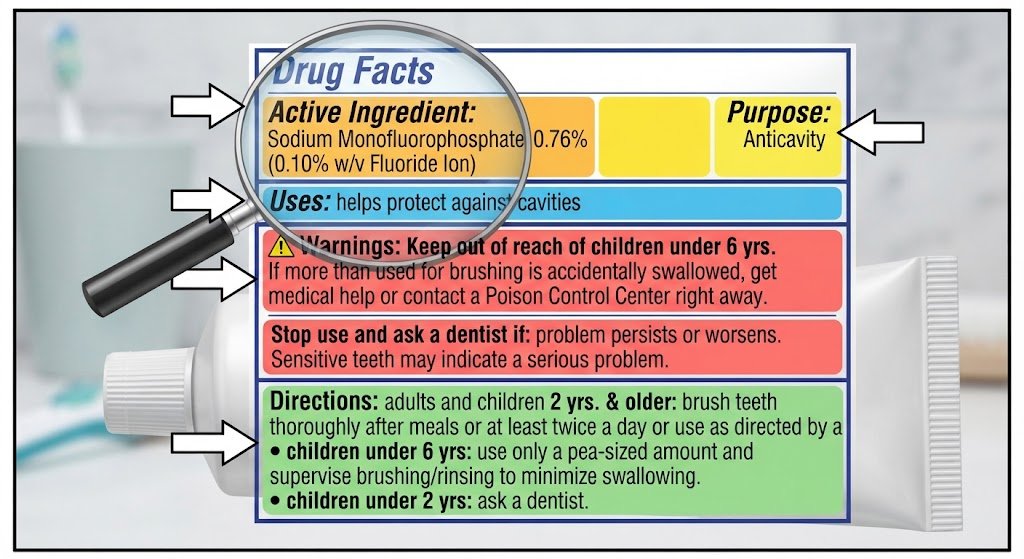
Start with the Drug Facts or active-ingredient section of the package.
Look for sodium monofluorophosphate and check the concentration listed next to it.
This confirms that the toothpaste is using sodium monofluorophosphate as its fluoride active ingredient.
Do not confuse the active ingredient with the long list of inactive ingredients. Both sections are useful, but they answer different questions.
The active ingredient tells you what the product is intended to do. The inactive ingredients describe other components used to make the toothpaste function as a finished formula.
2. Check the Fluoride Concentration
The concentration matters because the amount of an active ingredient is part of how a toothpaste is formulated and regulated.
However, avoid comparing percentages across different fluoride compounds as if they were directly interchangeable.
For example, the percentage shown for sodium monofluorophosphate should not simply be compared with the percentage shown for sodium fluoride or stannous fluoride and interpreted as “higher equals stronger.”
Different compounds have different chemical compositions.
Instead, look for the product’s stated active ingredient, concentration, directions, and intended use.
3. Consider Your Main Dental Goal
Ask yourself what you actually need from your toothpaste.
Your priorities might include:
- Everyday cavity prevention
- Sensitivity management
- Gum-care support
- Whitening
- SLS-free formulation
- Fluoride protection
- A specific ingredient preference
- A toothpaste suitable for a child
- A formula for braces or another dental situation
Sodium monofluorophosphate primarily answers the fluoride question.
It does not automatically answer all of the other questions.
For example, if you want a toothpaste for sensitive teeth, you should look for a formula that specifically addresses sensitivity rather than assuming any toothpaste containing sodium monofluorophosphate will do so.
4. Read the Complete Ingredient List
Once you confirm the active fluoride ingredient, examine the rest of the formula.
This is especially important if you are searching for a toothpaste because of ingredient preferences.
For example, you may want to know whether the product contains:
- Sodium lauryl sulfate (SLS)
- Particular flavoring ingredients
- Specific sweeteners
- Dyes
- Abrasives
- Ingredients you personally know you cannot tolerate
A product can contain sodium monofluorophosphate and still differ significantly from another sodium monofluorophosphate toothpaste because of its other ingredients.
5. Check the Directions and Warnings
Do not skip the directions.
The package tells you how the manufacturer intends the product to be used and includes relevant warnings.
This becomes particularly important for children.
Never assume that using more toothpaste will provide more protection. Follow the product’s directions and age-specific recommendations.
If you are unsure which fluoride toothpaste is appropriate for a child, ask a dentist or pediatric dental professional.
6. Look for Credible Dental Recognition
If a toothpaste carries a recognized dental acceptance or quality designation, consider what that designation actually means.
For example, the ADA Seal of Acceptance can help consumers identify products that have been evaluated against the American Dental Association’s requirements for the applicable category.
However, an acceptance seal should be viewed as one part of your decision, not as a replacement for reading the product label.
Also remember that a product does not become appropriate for every person simply because it has a recognized seal.
Your dental needs still matter.
What to Look for on a Sodium Monofluorophosphate Toothpaste Label
Reading a toothpaste label becomes much easier when you know what information to look for.
Use this simple checklist before buying.
Active Ingredient
Find the active ingredient section.
If the product uses sodium monofluorophosphate, it should be identified there rather than hidden among the inactive ingredients.
Concentration
Check the stated concentration.
This helps you understand how the product is formulated and allows you to compare products more meaningfully within the same category.
Uses
Look at what the product says it is intended to do.
For fluoride toothpaste, cavity prevention is the key use to pay attention to.
Do not assume that every additional marketing statement represents the same level of evidence or applies to every person.
Warnings
Read the warnings, particularly when buying toothpaste for children.
Warnings can contain important information about swallowing and appropriate use.
Directions
Follow the directions provided by the manufacturer.
The amount of toothpaste and frequency of use can matter, especially for younger users.
Inactive Ingredients
This section can help you identify whether the formula contains ingredients that matter to you.
If you are avoiding SLS, certain flavors, dyes, or other ingredients, this is where you should look.
Packaging Claims
Words such as:
- Natural
- Clean
- Gentle
- Mineral
- Whitening
- Fresh
- Herbal
- Non-toxic
can describe how a product is positioned, but they should not replace label evaluation.
The ingredient list and active-ingredient information provide much more useful information for making a toothpaste decision.
Common Mistakes People Make When Choosing Sodium Monofluorophosphate Toothpaste
Understanding the ingredient is helpful, but consumers can still make mistakes when shopping.
Mistake 1: Assuming a Scientific Name Means the Ingredient Is Dangerous
Sodium monofluorophosphate sounds technical because it is the chemical name of a defined compound.
But “sounds chemical” is not a scientific safety test.
Everything in a toothpaste formula is made of chemicals, including ingredients that occur naturally.
The useful questions are about function, amount, exposure, evidence, and appropriate use.
Mistake 2: Assuming the Fluoride Ingredient Is the Entire Formula
Sodium monofluorophosphate is only one ingredient.
Two toothpastes can use the same fluoride compound but have very different formulas.
If you have ingredient sensitivities or preferences, always inspect the rest of the ingredient list.
Mistake 3: Comparing Percentages Without Understanding the Compound
A higher percentage printed next to one fluoride compound does not automatically mean that toothpaste provides “more fluoride protection” than another toothpaste using a different compound.
Chemical composition matters.
Look at the active ingredient and its stated concentration within the context of the product rather than comparing numbers in isolation.
Mistake 4: Choosing Based Only on “Natural” or “Clean” Marketing
A marketing label does not tell you whether a toothpaste provides the type of cavity protection you need.
If preventing cavities is your priority, check whether the toothpaste contains an appropriate fluoride active ingredient or whether you are intentionally choosing a fluoride-free alternative.
Mistake 5: Ignoring Your Dental History
Someone who rarely develops cavities and someone with repeated decay may have very different toothpaste needs.
A toothpaste decision should take your individual risk into account.
If you regularly have cavities, ask your dentist whether your current fluoride routine is adequate.
Mistake 6: Assuming One Toothpaste Solves Every Problem
A toothpaste can be useful for cavity prevention without being the ideal product for sensitivity, gum disease, severe dry mouth, or another dental condition.
Match the toothpaste to the problem you are actually trying to solve.
Mistake 7: Using Too Much Toothpaste
More is not automatically better.
Especially for children, follow age-appropriate directions and supervise brushing when necessary.
Frequently Asked Questions
Is sodium monofluorophosphate the same as fluoride?
Not exactly.
Fluoride is the broader term used when discussing the fluoride ion and fluoride-based dental products. Sodium monofluorophosphate is a specific fluoride-containing compound used as an active ingredient in some toothpastes.
So a toothpaste containing sodium monofluorophosphate is a fluoride toothpaste.
Is sodium monofluorophosphate good for teeth?
It is used in toothpaste to provide anticaries fluoride protection.
Fluoride helps reduce the risk of tooth decay by supporting enamel resistance and remineralization during the ongoing cycles of mineral loss and repair in the mouth.
However, the overall benefit of a toothpaste also depends on regular brushing, diet, oral hygiene, and individual cavity risk.
Does sodium monofluorophosphate prevent cavities?
Yes. Sodium monofluorophosphate is used as an anticaries active ingredient in toothpaste.
It is intended to provide fluoride exposure that helps protect teeth against dental caries when used as directed.
Is sodium monofluorophosphate safe in toothpaste?
It is an established active ingredient used in fluoride toothpaste.
As with other fluoride toothpaste, safe use depends on following the product directions and avoiding intentional swallowing.
Children require additional care because they may be more likely to swallow toothpaste.
Is sodium monofluorophosphate better than sodium fluoride?
Neither ingredient should automatically be considered “better” based only on its name.
Both are fluoride compounds used in toothpaste. The complete formula, concentration, product purpose, individual dental needs, and directions are more useful factors when comparing products.
Is sodium monofluorophosphate better than stannous fluoride?
Not universally.
Both can be used as fluoride active ingredients, but toothpaste formulas can be designed around different oral-health needs.
Stannous fluoride products may include additional formulation benefits depending on the specific product, while sodium monofluorophosphate is commonly used as a fluoride source for anticaries protection.
Compare the complete formula rather than choosing based only on the fluoride compound.
Is sodium monofluorophosphate fluoride-free?
No.
A toothpaste containing sodium monofluorophosphate contains a fluoride active ingredient.
If you specifically want fluoride-free toothpaste, sodium monofluorophosphate is not a fluoride-free option.
Can sodium monofluorophosphate strengthen enamel?
Fluoride can help make tooth enamel more resistant to acid-related mineral loss and support remineralization of early mineral loss.
That does not mean fluoride toothpaste can rebuild severely damaged enamel or repair a cracked or extensively worn tooth.
Does sodium monofluorophosphate whiten teeth?
Sodium monofluorophosphate is primarily used as a fluoride ingredient for cavity protection, not as the main whitening ingredient.
A toothpaste marketed for whitening may contain additional ingredients that help remove surface stains.
Therefore, if whitening is your goal, evaluate the complete formulation rather than expecting the fluoride ingredient itself to whiten teeth.
Does sodium monofluorophosphate cause sensitivity?
Sodium monofluorophosphate should not automatically be considered a cause of tooth sensitivity.
If you experience sensitivity after using a particular toothpaste, consider the complete formula and other possible causes.
Persistent or severe sensitivity should be evaluated by a dental professional because sensitivity can have several underlying causes.
Can children use sodium monofluorophosphate toothpaste?
Children may use fluoride toothpaste when it is appropriate for their age and dental needs, but the amount used and supervision are important.
Follow the specific product directions and recommendations from the child’s dental professional.
Do not assume that children should use the same amount of toothpaste as adults.
How do I know if a toothpaste contains sodium monofluorophosphate?
Check the Active Ingredient section on the package.
It may be listed by its full name, sodium monofluorophosphate, along with its concentration.
Do not rely only on the front of the package because the front may emphasize marketing claims rather than the full active-ingredient information.
Should I avoid sodium monofluorophosphate because I want a non-toxic toothpaste?
Not necessarily.
If you are looking for a “non-toxic” toothpaste, evaluate the actual ingredients and their intended use instead of judging an ingredient solely by its chemical name.
The more useful approach is to identify which ingredients you want to avoid, which benefits you need, and whether the toothpaste provides appropriate cavity protection.
Sodium Monofluorophosphate vs. Other Toothpaste Choices: Quick Guide
If you are still unsure which category to explore, this simplified guide can help.
| If your main goal is… | What to investigate |
| Everyday cavity prevention | Fluoride toothpaste, including sodium monofluorophosphate formulas |
| Comparing fluoride compounds | Sodium monofluorophosphate, sodium fluoride, and stannous fluoride |
| Avoiding fluoride | Fluoride-free toothpaste and alternative active ingredients |
| Exploring hydroxyapatite | Hydroxyapatite toothpaste |
| Sensitivity | Toothpaste specifically formulated for sensitivity |
| Gum-care needs | Formula with ingredients intended for plaque/gum support |
| Avoiding SLS | Check the complete inactive ingredient list |
| Ingredient-conscious shopping | Active ingredients + complete ingredient list + product directions |
| Choosing for a child | Age guidance, fluoride information, amount, and dental advice |
The important lesson is that there is no single ingredient that makes every toothpaste ideal for every person.
When Should You Ask a Dentist?
For routine toothpaste shopping, most adults can start by reading the label and identifying their main dental goal.
Professional advice becomes more useful when you have a specific or persistent problem.
Consider speaking with a dentist if you have:
- Frequent or recurring cavities
- Severe or persistent tooth sensitivity
- Tooth pain
- Bleeding or swollen gums
- Significant enamel wear
- Dry mouth that is affecting your oral health
- Repeated dental decay
- Questions about fluoride use for a child
- Braces or another orthodontic situation
- A known allergy or reaction to toothpaste ingredients
A dentist can consider your complete oral-health history rather than recommending a toothpaste based on one ingredient alone.
Final Takeaway: Is Sodium Monofluorophosphate a Good Toothpaste Ingredient?
Sodium monofluorophosphate is a specific fluoride-containing compound used in toothpaste primarily for cavity prevention.
If you see it listed as an active ingredient, you are looking at a fluoride toothpaste—not a fluoride-free product.
The ingredient can support the fluoride-based protection people use toothpaste for, but the ingredient name should not be the only factor in your buying decision.
A better approach is to look at the complete product:
- Identify the active fluoride ingredient.
- Check its stated concentration.
- Understand the toothpaste’s intended use.
- Read the inactive ingredients.
- Consider your dental needs.
- Follow the product directions.
- Pay particular attention to children’s use and swallowing.
- Seek professional advice when you have recurring or significant dental problems.
Most importantly, do not judge a toothpaste simply because an ingredient name sounds complicated, and do not assume that words such as “natural,” “clean,” or “non-toxic” automatically tell you whether a product is appropriate for cavity prevention.
Sodium monofluorophosphate is best understood as one fluoride-delivery option within a complete toothpaste formula.
The right toothpaste is the one whose active ingredients, overall formulation, directions, and intended benefits fit your individual oral-health needs.
