Introduction
If you have noticed nano-hydroxyapatite on a toothpaste label, you may be wondering what it actually is, whether it works, and whether it is a good alternative to fluoride toothpaste.
Nano-hydroxyapatite, often shortened to nHA, is a nanoscale form of hydroxyapatite, a calcium-phosphate mineral closely related to the mineral component of teeth. It has been studied in oral care for potential benefits including enamel remineralization, early caries prevention, and support for sensitive teeth.
But there is an important distinction between an ingredient that has promising research behind it and an ingredient that is automatically the best choice for everyone.
This guide explains what nano-hydroxyapatite is, how it works, what research says about its potential benefits, how it compares with fluoride, what to know about safety, and what to look for when choosing a nano-hydroxyapatite toothpaste.
What Is Nano-Hydroxyapatite?
Nano-hydroxyapatite is a very small form of hydroxyapatite, a calcium-phosphate material that is closely related to the mineral found in human teeth.
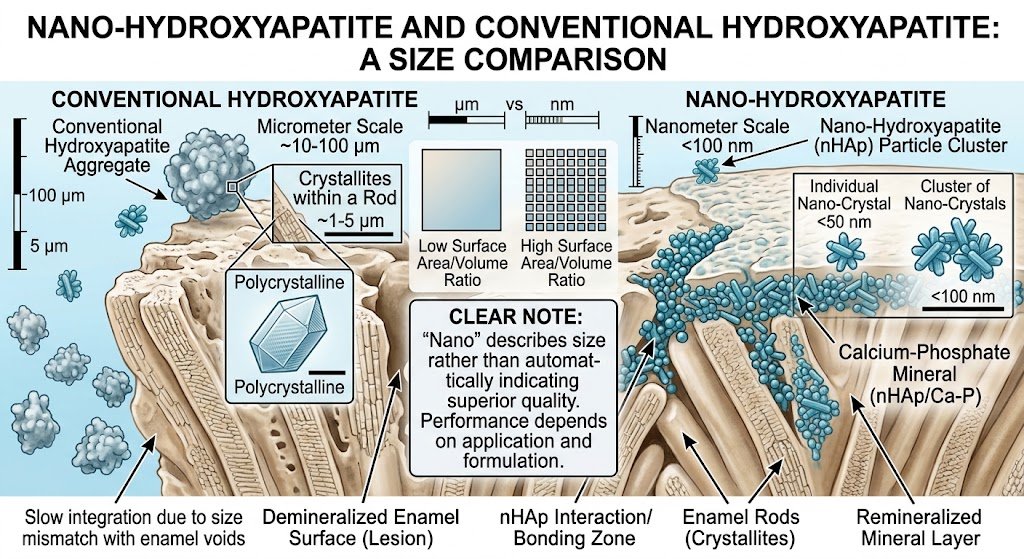
The word “nano” refers to the size of the particles. It does not automatically mean that a toothpaste is better, safer, or more effective.
Hydroxyapatite has attracted interest in dentistry because of its similarity to tooth mineral. Researchers have investigated hydroxyapatite and nano-hydroxyapatite in products designed to interact with enamel and dentin, including toothpaste.
In simple terms, nano-hydroxyapatite is used in oral care because it may help provide a mineral-based approach to protecting and supporting tooth surfaces.
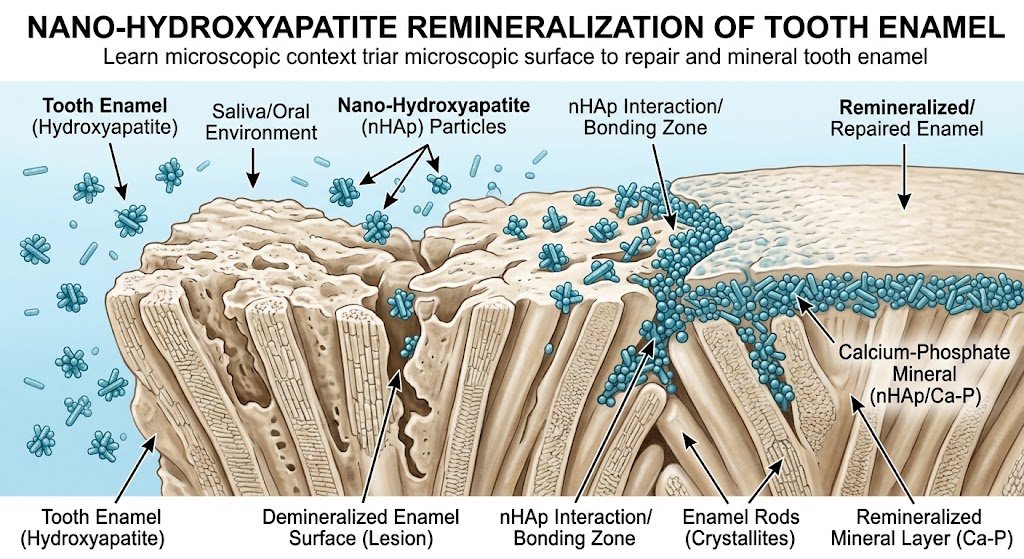
Why Is Nano-Hydroxyapatite Used in Toothpaste?
Your teeth are exposed to a constant cycle of demineralization and remineralization.
When acids in the mouth affect enamel, minerals can be lost from the tooth surface. This is called demineralization.
Saliva naturally helps return minerals to the tooth surface. This is part of remineralization.
Toothpaste can support oral hygiene by helping clean the teeth and, depending on its active ingredients, supporting this mineral balance.
Nano-hydroxyapatite is particularly interesting because its composition is closely related to tooth mineral. Researchers have studied whether these particles can interact with enamel and dentin and support mineral deposition.
That does not mean nano-hydroxyapatite can repair every type of tooth damage.
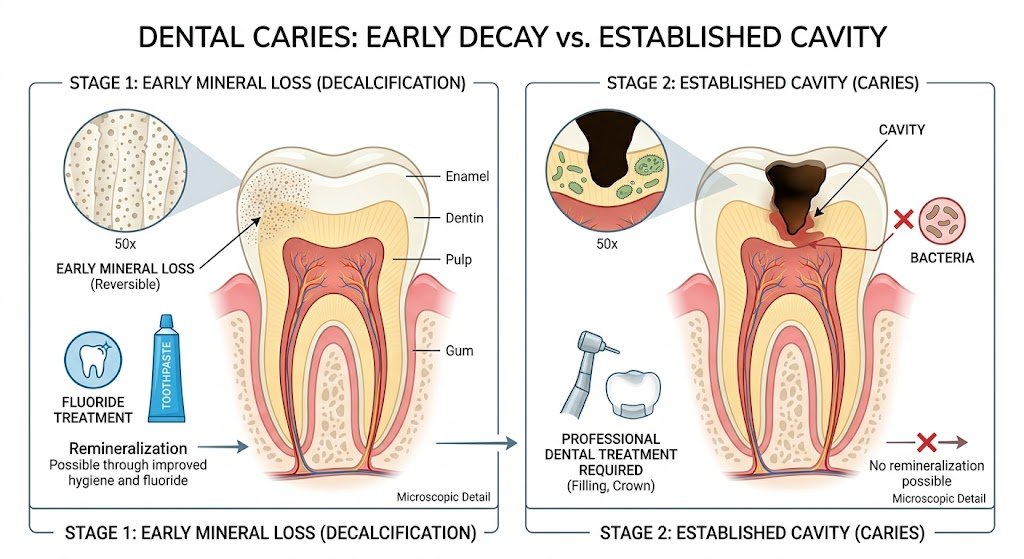
There is a major difference between early mineral loss and an established cavity.
A toothpaste may help support remineralization of an early lesion, but it cannot replace professional treatment for a large cavity, broken tooth, infection, or other significant dental problem.
What Does “Nano” Actually Mean?
The “nano” part describes the particle scale.
At very small sizes, materials can have different surface properties compared with larger particles of the same material. This is one reason researchers have specifically studied nano-hydroxyapatite rather than treating all forms of hydroxyapatite as identical.
However, consumers should not interpret the word “nano” as a quality rating.
A product containing nano-hydroxyapatite still needs to be evaluated based on:
- The actual formulation
- The intended use
- The other ingredients
- The manufacturer’s information
- Available evidence
- Your individual dental needs
In other words, nano is a material characteristic, not a guarantee of performance.
How Does Nano-Hydroxyapatite Work?
To understand why nano-hydroxyapatite is used in toothpaste, it helps to understand what happens to your teeth throughout the day.
Demineralization vs. Remineralization
Tooth enamel is a highly mineralized tissue. It is strong, but it is not completely unaffected by the oral environment.
Foods and drinks can expose teeth to acids. Oral bacteria can also contribute to an acidic environment when they metabolize carbohydrates.
Repeated acid exposure can contribute to mineral loss from enamel.
This process is called demineralization.
At the same time, saliva provides minerals and helps maintain the oral environment. This natural process can contribute to remineralization.
The goal of preventive oral care is not to eliminate demineralization completely. Instead, it is to support a healthy balance between mineral loss and mineral replacement.
Where Does Nano-Hydroxyapatite Fit In?
Nano-hydroxyapatite has been studied because its calcium-phosphate composition is closely related to tooth mineral.
Researchers have investigated whether nHA particles can deposit on tooth surfaces and contribute to remineralization.
This is particularly relevant to early enamel changes, before significant structural damage has occurred.
The important point is that remineralization is not the same as repairing a major cavity.
For example, if an early area of enamel has experienced mineral loss, supporting remineralization may be useful. But if bacteria have already created a substantial hole in the tooth, toothpaste cannot simply rebuild the missing structure.
Can Nano-Hydroxyapatite Rebuild Enamel?
The phrase “rebuild enamel” is often used in oral-care marketing, but it needs context.
A more accurate description is that nano-hydroxyapatite may support remineralization of early mineral loss.
Research has investigated hydroxyapatite and nano-hydroxyapatite for remineralization and early carious lesions, with promising findings in some studies. However, systematic reviews have also identified differences between studies and limitations in the available evidence.
So when a toothpaste says it helps “rebuild” or “remineralize” enamel, look at what the claim actually means.
It should not be interpreted as:
A toothpaste can replace enamel that has been physically lost from a large cavity.
That is not how toothpaste works.
What Are the Potential Benefits of Nano-Hydroxyapatite?
Nano-hydroxyapatite has been studied for several different oral-care applications. The strength of evidence is not necessarily the same for every claimed benefit, so it is useful to separate established concepts from areas where research is still developing.
1. Enamel Mineral Support
One of the main reasons hydroxyapatite is interesting in dentistry is its relationship to tooth mineral.
Because hydroxyapatite is chemically similar to the mineral component of teeth, researchers have investigated whether it can interact with enamel and support mineral deposition.
For consumers, this makes nano-hydroxyapatite particularly relevant when shopping for toothpaste focused on enamel care.
However, enamel care involves more than one ingredient.
Your brushing habits, diet, oral hygiene, saliva, acid exposure, cavity risk, and regular dental care all matter.
Nano-hydroxyapatite should therefore be viewed as one part of an oral-care routine rather than a standalone solution.
2. Support for Remineralization
Remineralization is one of the most important concepts associated with hydroxyapatite toothpaste.
When enamel experiences early mineral loss, the goal is to support the return of minerals to the tooth surface.
Hydroxyapatite-containing oral-care products have been investigated for this purpose, including fluoride-free formulations.
The research is encouraging, but the evidence should still be interpreted carefully because studies can differ in:
- Formulation
- Concentration
- Study duration
- Participant characteristics
- Outcome measurements
- Comparison groups
This is why it is better to say that nano-hydroxyapatite may support remineralization rather than promising that every product will “restore” enamel.
3. Potential Cavity Protection
Another major area of research is dental caries.
Dental caries, commonly called tooth decay or cavities, develops through a complex interaction involving oral bacteria, dietary carbohydrates, acids, tooth susceptibility, and time.
Researchers have studied hydroxyapatite as a potential anti-caries ingredient.
Clinical evidence for hydroxyapatite-containing oral-care products has expanded, including research into fluoride-free formulations.
However, this should not be interpreted as meaning that every nano-hydroxyapatite toothpaste has identical cavity-prevention performance.
The specific formulation matters.
Your individual risk matters too.
Someone who rarely develops cavities may approach toothpaste selection differently from someone who has repeated dental decay.
If cavity prevention is your main concern, you can also explore.
4. Potential Support for Sensitive Teeth
Nano-hydroxyapatite has also been investigated for dentin hypersensitivity, commonly experienced as sharp or uncomfortable reactions to cold, hot, sweet, or touch-related stimuli.
One proposed reason for studying hydroxyapatite in sensitivity care is its potential interaction with exposed dentin.
Dentin contains microscopic tubules. When these tubules are exposed, external stimuli can contribute to sensitivity.
Some clinical research has investigated hydroxyapatite and nano-hydroxyapatite formulations for reducing dentin sensitivity.
That makes this ingredient potentially relevant to people searching for a sensitivity-focused toothpaste.
But sensitivity should not automatically be treated as a toothpaste problem.
Persistent or severe sensitivity can have other causes, including:
- Gum recession
- Enamel wear
- Exposed tooth roots
- Tooth decay
- Cracks
- Aggressive brushing
- Other dental conditions
If sensitivity continues or becomes severe, identifying the cause is more important than simply switching toothpaste.
5. A Fluoride-Free Oral-Care Option
Nano-hydroxyapatite is particularly relevant to people who are researching fluoride-free toothpaste.
Some hydroxyapatite toothpastes do not contain fluoride, making them an option for consumers who specifically want to explore fluoride-free oral care.
However, fluoride-free does not automatically mean:
- Safer
- Better
- More effective
- Suitable for everyone
If you have a high risk of cavities, your toothpaste decision should take your dental history and professional dental advice into account.
The important distinction is:
Nano-hydroxyapatite can be an alternative ingredient to research, but that does not mean it is automatically a universal replacement for fluoride.
What Does the Research Say About Nano-Hydroxyapatite?
This is one of the most important sections of the article because consumers can easily find conflicting claims online.
One page may describe nano-hydroxyapatite as a breakthrough ingredient.
Another may dismiss it entirely.
The scientific evidence is more nuanced.
Research has investigated nano-hydroxyapatite for:
- Remineralization
- Early caries lesions
- Enamel protection
- Dentin sensitivity
- Fluoride-free oral-care formulations
Systematic reviews have reported promising results, but they have also identified limitations such as differences in study methods, formulations, sample sizes, and evidence certainty.
Why Study Quality Matters
Imagine two toothpaste studies.
One study examines a specific formulation for several months in people with a defined oral-health condition.
Another study examines a laboratory tooth sample for a short period.
Both can provide useful information, but they do not answer exactly the same question.
This is why consumers should be careful when a company takes evidence from one type of study and uses it to make a much broader claim about its product.
Evidence about hydroxyapatite as an ingredient is not automatically evidence that every toothpaste containing hydroxyapatite performs identically.
What Can We Reasonably Say?
A careful summary is:
- Nano-hydroxyapatite has been scientifically studied.
- It has potential applications in remineralization and preventive oral care.
- Research has also investigated its role in sensitivity.
- Hydroxyapatite-containing products have growing clinical evidence.
- Some nHA-specific evidence remains limited or heterogeneous.
- The evidence does not justify saying that every nHA toothpaste is better than fluoride toothpaste.
- Product formulation and individual dental needs matter.
This approach is more useful than simply calling the ingredient either “proven” or “unproven.”
Nano-Hydroxyapatite vs. Hydroxyapatite: What’s the Difference?
The names are similar because the materials are closely related.
Hydroxyapatite (HAp) refers to the calcium-phosphate material itself.
Nano-hydroxyapatite (nHA) refers to hydroxyapatite produced or used at the nanoscale.
The difference is primarily related to particle size and the resulting material properties.
At smaller particle sizes, materials can have a greater surface area relative to their volume. This can influence how they interact with surrounding materials and surfaces.
That is one reason researchers have specifically investigated nano-hydroxyapatite for dental applications.
Is Nano-Hydroxyapatite Better Than Regular Hydroxyapatite?
Not automatically.
A smaller particle size can provide different properties, but “nano” should not be treated as a simple quality score.
When comparing two toothpastes, consider more than whether one contains nano-hydroxyapatite.
Look at:
- The complete formula
- The intended purpose
- Other active ingredients
- Fluoride status
- Product directions
- Manufacturer transparency
- Available evidence
- Your individual oral-health needs
[ARTICLE CONTINUES — NEXT PART STARTS WITH: H2: Nano-Hydroxyapatite vs. Fluoride]
Part 1 yahan naturally complete hua hai. “Continue” kahenge to main exactly “Nano-Hydroxyapatite vs. Fluoride” se continue karunga, introduction ya previous sections repeat nahi karunga.
Bilkul — main exact wahi se continue kar raha hoon jahan Part 1 stop hua tha. Same article, same writing-block ID. Koi previous content repeat nahi karunga.
Nano-Hydroxyapatite vs. Fluoride
One of the most important questions when researching nano-hydroxyapatite toothpaste is how it compares with fluoride. The two ingredients are often presented as competing approaches, but they do not have exactly the same evidence base, mechanism, or role in oral care.
Fluoride has been used in dentistry for decades and remains one of the most established ingredients for reducing the risk of dental caries. Nano-hydroxyapatite, meanwhile, is being studied as a mineral-based approach that may support enamel remineralization and other aspects of oral health.
That difference matters when choosing a toothpaste.
How fluoride works
Fluoride can become incorporated into tooth mineral and can help make the tooth surface more resistant to acid attacks. It also supports remineralization and can interfere with the processes involved in cavity development.
For people at elevated risk of cavities, fluoride toothpaste may therefore have an important role in a daily oral-care routine.
How nano-hydroxyapatite works
Nano-hydroxyapatite is structurally related to the mineral found naturally in teeth and bones. In toothpaste, the particles can interact with the tooth surface and may contribute calcium- and phosphate-containing mineral to areas affected by mineral loss.
This makes nHA particularly interesting for people looking for a fluoride-free toothpaste or for those interested in mineral-based enamel care.
However, “mineral-based” does not automatically mean “better.” The relevant question is whether the ingredient and complete toothpaste formula fit your dental needs.
Are they equally effective?
It would be misleading to say that nano-hydroxyapatite is universally better than fluoride—or that fluoride is automatically the right choice for every person.
The evidence for fluoride in cavity prevention is extensive. Hydroxyapatite and nano-hydroxyapatite also have a growing research base, but studies differ in particle characteristics, concentrations, formulations, study duration, and outcomes.
Some research suggests hydroxyapatite-based products can provide meaningful remineralization and caries-prevention benefits, while other research has limitations that make direct comparison difficult.
For someone with a high risk of cavities, frequent decay, dry mouth, or other factors that increase caries risk, it is especially important not to choose a toothpaste based only on marketing claims.
A simple way to think about the difference
| Factor | Nano-Hydroxyapatite | Fluoride |
| Basic role | Supports mineral-based enamel care | Helps prevent and control dental caries |
| Relationship to tooth mineral | Chemically related to tooth mineral | Interacts with tooth mineral and supports acid resistance |
| Fluoride-free option | Yes | No |
| Research base | Growing | Extensive |
| Main consumer interest | Remineralization, enamel care, fluoride-free routines | Cavity prevention |
| Best choice for everyone? | No | No |
| Importance of individual cavity risk | High | High |
The goal is not to choose the ingredient with the most attractive marketing message. The goal is to choose an oral-care approach that matches your actual dental needs.
Is Nano-Hydroxyapatite Safe?
Safety is one of the biggest questions surrounding nano-hydroxyapatite because the word “nano” can make consumers wonder whether extremely small particles create additional risks.
The answer requires some nuance.
Nano-hydroxyapatite has been investigated for oral-care applications, including toothpaste. Research has examined its interaction with tooth structures as well as aspects of its biological safety. However, safety should not be evaluated simply by asking whether something is “nano.”
The specific material, particle characteristics, concentration, formulation, exposure, and intended use all matter.
Why the word “nano” does not automatically mean dangerous
“Nano” describes particle size.
It does not tell you whether a material is safe or unsafe.
Many materials can exist at different particle sizes, and their properties can change as their size changes. This is one reason researchers evaluate nanomaterials separately rather than assuming that a larger version and a nanoscale version behave identically.
For toothpaste, the relevant question is therefore:
What does the research show about this specific type of nano-hydroxyapatite when used in an oral-care formulation?
That is a much more useful question than simply asking whether nanoparticles are present.
What should consumers look for?
When evaluating an nHA toothpaste, look for:
- A clearly identified active ingredient
- A complete ingredient list
- Clear manufacturer information
- Intended age range
- Usage directions
- Transparent product labeling
- Claims that are supported by evidence
- Information about the formulation rather than vague “nano” marketing
It is also important to remember that safety of the ingredient does not automatically make every product containing that ingredient equally suitable.
The complete formulation matters.
A toothpaste can contain nano-hydroxyapatite while also containing flavoring agents, surfactants, sweeteners, abrasives, or other ingredients that may matter to someone with particular sensitivities.
What does the research say about safety?
Research into nano-hydroxyapatite and related calcium-phosphate materials has generally focused on whether the materials are appropriate for oral-care applications and how they interact with biological tissues.
When reviewing this research, pay attention to the difference between laboratory studies, animal studies, and human clinical studies. Results from one type of study cannot automatically be treated as proof of the same outcome in humans using toothpaste every day.
This is one reason responsible product evaluation should avoid absolute statements such as “completely risk-free.”
A better approach is to say that nano-hydroxyapatite has been researched for oral-care use, while recognizing that evidence depends on the specific material and formulation.
Can Children Use Nano-Hydroxyapatite Toothpaste?
Parents often search for nano-hydroxyapatite toothpaste because they want an alternative to conventional fluoride toothpaste.
This question deserves extra care because children’s oral-care needs are different from those of adults.
Young children are also more likely to swallow toothpaste rather than spit it out consistently. That makes age guidance, formulation, amount used, and dental risk particularly important.
Do not choose children’s toothpaste based only on “non-toxic” or “natural”
Marketing terms such as:
- natural
- clean
- non-toxic
- mineral-based
- fluoride-free
- chemical-free
do not by themselves tell you whether a toothpaste is appropriate for a child.
Parents should instead consider the child’s age, cavity risk, ability to spit, dental history, and advice from a dentist.
A product marketed as fluoride-free should not automatically be assumed to provide the same level of cavity protection for every child.
What should parents check?
Before choosing an nHA toothpaste for a child, check:
- Age guidance — Make sure the product is intended for the child’s age group.
- Ingredient information — Read the complete formula rather than focusing only on nHA.
- Amount to use — Follow the manufacturer’s instructions and dental guidance.
- Swallowing behavior — Younger children may swallow some toothpaste.
- Cavity risk — A child with previous cavities may have different needs from a child with low cavity risk.
- Professional guidance — Ask a pediatric dentist or other dental professional when there is uncertainty.
For children with significant cavity risk, parents should be especially cautious about replacing an established preventive approach simply because a product is marketed as a cleaner or more natural alternative.
Can Nano-Hydroxyapatite Help Sensitive Teeth?
Tooth sensitivity occurs when exposed or vulnerable tooth structures respond strongly to stimuli such as cold, heat, sweet foods, or touch.
Nano-hydroxyapatite is being studied as one possible ingredient for sensitivity-focused oral care.
How could it help?
One proposed mechanism is the formation or deposition of mineral material around exposed dentin.
Dentin contains microscopic tubules. When these tubules are exposed, changes in temperature or fluid movement can contribute to sensitivity.
A mineral-containing ingredient that helps reduce exposure of these pathways may potentially reduce sensitivity.
This is one reason hydroxyapatite-based toothpaste has attracted attention among people who experience sensitive teeth.
Does that mean nHA will eliminate sensitivity?
No.
Tooth sensitivity can have many causes, including:
- Gum recession
- Enamel wear
- Aggressive brushing
- Tooth erosion
- Exposed dentin
- Cracked teeth
- Dental procedures
- Cavities
- Other underlying dental problems
A toothpaste can support symptom management, but it does not necessarily address the cause.
If sensitivity is persistent, severe, localized to one tooth, or getting worse, professional evaluation is more appropriate than simply changing toothpaste.
How to Choose a Nano-Hydroxyapatite Toothpaste
Once you understand what nHA is and what the research can—and cannot—tell you, choosing a product becomes much easier.
Instead of searching only for a toothpaste that says “nano-hydroxyapatite,” evaluate the entire product.
1. Check whether nano-hydroxyapatite is actually listed
Do not rely only on the front of the package.
Look at the ingredient list and product information to confirm that nano-hydroxyapatite is actually part of the formulation.
Different manufacturers may describe the ingredient differently, so understanding the ingredient terminology can help.
2. Check the complete ingredient list
The active ingredient is only one part of toothpaste.
Also consider:
- Abrasives
- Surfactants
- Flavoring agents
- Sweeteners
- Humectants
- Preservatives
- Coloring agents
- Other active ingredients
This is especially important if you are trying to avoid specific ingredients because of personal preferences or sensitivity.
3. Decide whether you want fluoride or fluoride-free
This is one of the most important decisions.
If you specifically want a fluoride-free toothpaste, nHA may be one category worth researching.
If cavity prevention is your primary concern, you should understand the evidence and your personal cavity risk before deciding to use a fluoride-free product.
There is no universal answer that applies equally to every adult.
4. Identify your main oral-care goal
Do you primarily want:
- Enamel care?
- Sensitivity support?
- Cavity prevention?
- A fluoride-free formula?
- A simpler ingredient list?
- A toothpaste with hydroxyapatite?
- A particular flavor or texture?
Choosing the goal first prevents you from buying a product simply because the packaging highlights “nano.”
5. Consider your cavity risk
A person who rarely develops cavities may approach toothpaste selection differently from someone with repeated decay.
Factors that can increase cavity risk include certain dietary patterns, dry mouth, previous decay, some medications, and other oral-health conditions.
If your dentist has told you that you have elevated cavity risk, that information should carry more weight than a generic product claim.
6. Evaluate the manufacturer
A trustworthy product page should make it reasonably easy to understand:
- Who makes the toothpaste
- What ingredients it contains
- How it should be used
- Who it is intended for
- What claims the manufacturer is making
- What evidence supports those claims
Transparency is useful because it allows consumers to evaluate a product instead of relying entirely on advertising language.
What to Look for on a Nano-Hydroxyapatite Toothpaste Label
A label can tell you much more than the words on the front of the package.
When comparing products, create a simple checklist.
Nano-hydroxyapatite ingredient
First confirm that the product actually contains nHA and identify how the manufacturer describes it.
Fluoride status
Check whether the product contains fluoride.
Do not assume “hydroxyapatite toothpaste” automatically means fluoride-free. Some formulations may combine different active ingredients.
Intended purpose
Look at whether the toothpaste is marketed for:
- Enamel care
- Sensitivity
- Cavities
- Whitening
- General oral care
The intended purpose can help you compare products within the same category.
Abrasivity
If enamel wear or sensitivity is a concern, abrasivity may matter.
A whitening toothpaste, for example, may use a formulation designed to remove surface stains. That does not necessarily make it appropriate for everyone.
Full ingredient transparency
A product should provide enough information for consumers to understand what they are buying.
If important formulation details are difficult to find, treat that as a reason to investigate further rather than assuming the product is superior.
Common Mistakes When Buying Nano-Hydroxyapatite Toothpaste
The popularity of nHA has created a growing number of marketing claims.
Some mistakes are easy to avoid.
Mistake 1: Assuming “nano” means better
Nano describes particle size.
It does not automatically mean better performance, greater safety, or higher quality.
Mistake 2: Treating every hydroxyapatite product as identical
Different products can use different formulations, concentrations, particle characteristics, and supporting ingredients.
Research on one formulation cannot automatically prove that every toothpaste containing a similar ingredient will produce identical results.
Mistake 3: Assuming fluoride-free means safer for everyone
Some consumers prefer to avoid fluoride. That is a personal choice.
But fluoride-free and “better for everyone” are not interchangeable statements.
Mistake 4: Confusing remineralization with repairing a cavity
Early mineral loss can sometimes be managed through preventive oral-care strategies.
A developed cavity is different.
A toothpaste should not be presented as a substitute for dental treatment when there is an established cavity, structural damage, infection, or another dental condition requiring professional care.
Mistake 5: Choosing based entirely on “clean” marketing
Terms such as “clean,” “natural,” and “non-toxic” can mean different things to different brands.
Instead of relying on a marketing label, inspect the actual ingredients and the evidence behind the product’s claims.
Mistake 6: Ignoring your individual dental needs
The best toothpaste for someone with sensitivity may not be the best choice for someone with repeated cavities.
Your dental history matters.
Who Should Consider Nano-Hydroxyapatite Toothpaste?
Nano-hydroxyapatite toothpaste may be worth researching if you:
- Want a fluoride-free toothpaste
- Are interested in mineral-based oral care
- Want to learn more about enamel remineralization
- Experience mild tooth sensitivity and want to explore mineral-based options
- Prefer products that use hydroxyapatite-related ingredients
- Want to compare fluoride and hydroxyapatite approaches
- Care about ingredient transparency
The key word is consider.
Being a potential candidate does not mean nHA is automatically the best option for you.
Your oral-health history should determine how much weight you give to the different factors.
Who Should Be More Careful?
Some people should avoid making a toothpaste decision based only on general internet claims.
This includes people who:
- Have frequent cavities
- Have recently developed multiple cavities
- Have persistent or severe tooth sensitivity
- Have significant gum problems
- Have dry mouth
- Have unexplained oral pain
- Have a cracked or damaged tooth
- Have children with elevated cavity risk
- Have been given specific preventive instructions by a dentist
In these situations, professional advice can help determine whether changing toothpaste is appropriate.
A toothpaste can be part of prevention, but it cannot replace diagnosis or treatment.
A Simple Nano-Hydroxyapatite Toothpaste Decision Framework
If you are still unsure whether nHA toothpaste makes sense for you, use this five-step framework.
Step 1: Start with your dental goal
Ask:
What problem am I trying to solve?
Is it sensitivity, enamel care, cavity prevention, ingredient preferences, or simply finding a daily toothpaste?
Step 2: Assess your cavity risk
Ask:
Do I frequently get cavities?
If yes, cavity-prevention evidence should receive significant weight in your decision.
Step 3: Decide your fluoride preference
Ask:
Do I specifically want fluoride-free toothpaste?
If the answer is yes, nHA may be a category worth investigating.
If the answer is no, you can compare fluoride and nHA formulations based on your needs rather than treating them as mutually exclusive choices.
Step 4: Evaluate the whole formula
Ask:
What else is in the toothpaste?
Check the complete ingredient list, intended use, age guidance, manufacturer information, and any relevant product claims.
Step 5: Compare evidence with marketing
Finally ask:
Is the claim supported by evidence, or is it simply attractive packaging language?
This final step can prevent many poor purchasing decisions.
For a broader comparison of toothpaste options, you can also use:
Frequently Asked Questions
Is nano-hydroxyapatite the same as hydroxyapatite?
Not exactly.
Nano-hydroxyapatite is a nanoscale form of hydroxyapatite. The underlying material is related, but particle size and resulting properties can differ.
The term “nano” therefore describes a physical characteristic rather than automatically indicating a better product.
Is nano-hydroxyapatite better than fluoride?
Not universally.
Fluoride has a long-established evidence base for cavity prevention. Nano-hydroxyapatite is also being studied for remineralization, enamel care, sensitivity, and caries-related applications.
The evidence should be considered alongside your individual dental needs rather than reduced to a simple “better” or “worse” comparison.
Does nano-hydroxyapatite rebuild enamel?
It is more accurate to say that nano-hydroxyapatite may support remineralization of areas experiencing mineral loss.
That is different from rebuilding an entire tooth or repairing a developed cavity.
Is nano-hydroxyapatite toothpaste fluoride-free?
It can be, but not necessarily.
Always check the product’s ingredient list and labeling rather than assuming that every nHA toothpaste is fluoride-free.
Is nano-hydroxyapatite safe?
Nano-hydroxyapatite has been studied for oral-care applications, including its interaction with dental tissues and aspects of biological safety.
However, safety depends on the specific material and formulation, and consumers should avoid treating “nano” as either an automatic safety warning or an automatic guarantee of safety.
Can nano-hydroxyapatite help sensitive teeth?
It may.
Hydroxyapatite-based ingredients have been investigated for dentin sensitivity, including mechanisms involving mineral deposition and dentinal tubules.
However, persistent or severe sensitivity should be evaluated because sensitivity can have several underlying causes.
Can children use nano-hydroxyapatite toothpaste?
Some products are specifically formulated and marketed for children, but parents should follow age guidance and consider the child’s cavity risk, swallowing behavior, and dental needs.
For children with significant cavity risk, a pediatric dentist can provide individualized guidance.
Does nano-hydroxyapatite prevent cavities?
Research suggests that hydroxyapatite-based oral-care products may have potential for caries prevention and remineralization, but evidence varies by product and study design.
It is therefore better to evaluate the specific formulation and your individual cavity risk than to assume that every nHA toothpaste provides identical cavity protection.
Should I switch to nano-hydroxyapatite toothpaste?
That depends on why you want to switch.
If you are interested in fluoride-free oral care or mineral-based enamel support, nHA may be worth researching.
If you have high cavity risk or have received specific recommendations from your dentist, those factors should come first.
Conclusion: Is Nano-Hydroxyapatite Worth Considering?
Nano-hydroxyapatite is an increasingly researched toothpaste ingredient because it is closely related to the mineral structure of teeth and may support remineralization and other aspects of oral care.
Its biggest appeal is not simply the word “nano.”
The more important point is that it provides another approach to thinking about enamel mineral support, sensitivity, and fluoride-free toothpaste.
At the same time, consumers should avoid exaggerated claims.
Nano-hydroxyapatite is not a magic ingredient, and it should not be presented as a universal replacement for fluoride. Research continues to develop, and different formulations may produce different results.
A sensible approach is to evaluate:
- Your cavity risk
- Your main dental goal
- Whether you want fluoride or fluoride-free toothpaste
- The complete ingredient list
- The product’s intended use
- Manufacturer transparency
- Evidence behind the claims
- Your dentist’s recommendations when you have specific dental concerns
If you are comparing products, start with the formulation rather than the marketing headline. Look for a clearly identified nano-hydroxyapatite ingredient, transparent labeling, appropriate directions, and a formula that matches your needs.
For readers who want to compare complete toothpaste options rather than ingredients alone:
