Glycerin is a common ingredient in toothpaste, but its name can make some people wonder whether it is actually necessary—or whether it is something to avoid.
The short answer: glycerin is mainly used as a humectant, which means it helps toothpaste retain moisture and maintain a smooth, usable texture. The American Dental Association lists glycerol (another name for glycerin) among the humectants used in toothpaste. (ADA)
But glycerin is not the ingredient that makes toothpaste effective against cavities. Ingredients such as fluoride have a different role. So if you are comparing toothpastes, the better question is not simply “Does it contain glycerin?” but “What else is in the formula, and does the toothpaste fit my oral-health needs?”
What Is Glycerin in Toothpaste?
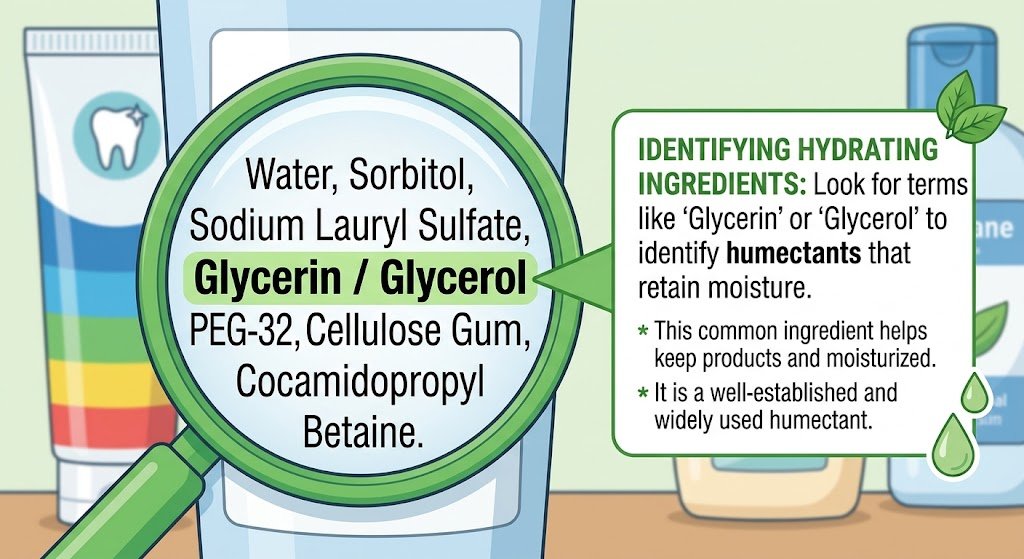
Glycerin, also called glycerol, is a clear, colorless ingredient with moisture-retaining properties. In toothpaste, it is primarily used as a humectant.
A humectant helps hold onto water. In a toothpaste formula, this matters because toothpaste needs to remain moist and have a consistent texture rather than becoming dry and difficult to spread.
The ADA specifically identifies glycerol, along with ingredients such as sorbitol and propylene glycol, as humectants that minimize water loss in toothpaste. (ADA)
In practical terms, glycerin helps contribute to characteristics such as:
- Moisture retention
- Smooth texture
- Consistent toothpaste consistency
- Easier dispensing from the tube
- A more pleasant brushing experience
Glycerin is therefore primarily a formulation ingredient, not the main therapeutic ingredient responsible for preventing cavities.
Glycerin vs. Glycerol
You may see either glycerin or glycerol when researching toothpaste ingredients.
They refer to the same chemical substance. The FDA’s ingredient database lists glycerin under several names, including glycerine and glycerol. (HFP App External)
So if a toothpaste label says glycerin and another says glycerol, that difference alone does not mean one product uses a fundamentally different ingredient.
Why Is Glycerin Added to Toothpaste?
The main reason is simple: to help control moisture in the toothpaste formula.
Toothpaste contains water and other ingredients that need to remain properly distributed throughout the product. Without appropriate moisture control, the formula could become less pleasant to use or lose the consistency expected from toothpaste.
Research on toothpaste formulation describes humectants such as glycerol and sorbitol as ingredients used to help retain water and maintain toothpaste consistency over time. (PubMed Central (PMC))
1. It Helps Prevent the Toothpaste From Drying Out
A tube of toothpaste may be opened and closed repeatedly. The formulation needs to remain usable throughout its intended shelf life.
Glycerin helps reduce water loss from the formulation, which is one reason humectants are commonly included in toothpaste. (ADA)
2. It Helps Maintain Texture
Nobody wants toothpaste that becomes unusually hard, crumbly, or difficult to spread.
Humectants contribute to maintaining the physical properties of toothpaste, helping the product remain suitable for brushing.
3. It Supports the Overall Formulation
Glycerin is only one part of a toothpaste formula. It works alongside ingredients that perform other functions.
For example:
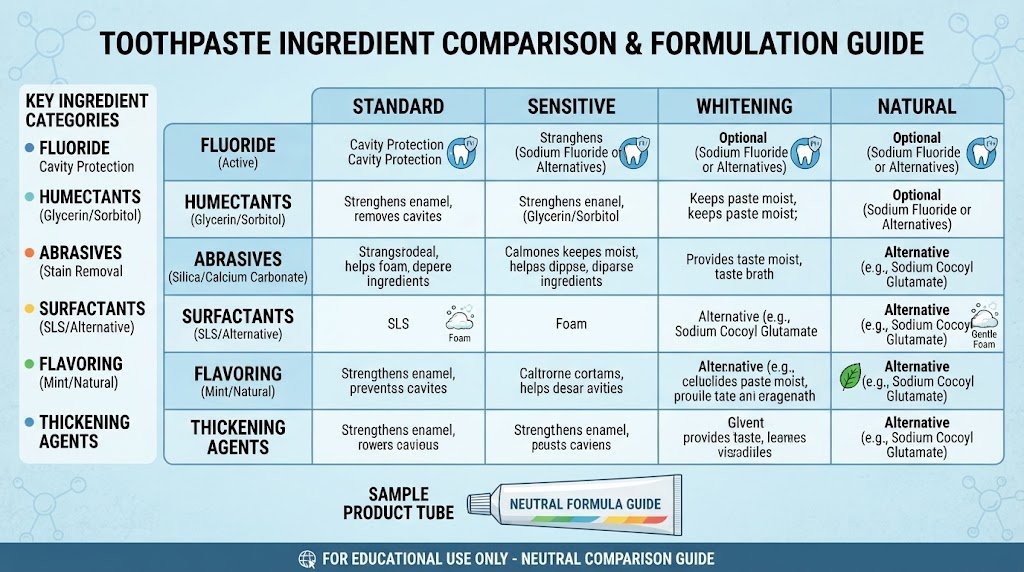
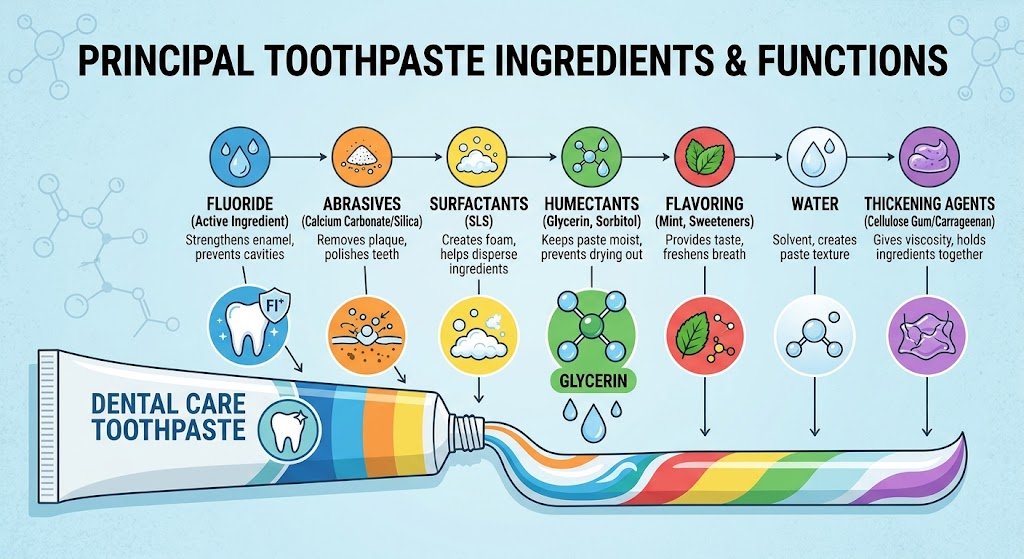
| Ingredient type | Main purpose |
| Glycerin / glycerol | Helps retain moisture |
| Fluoride compounds | Help prevent cavities |
| Abrasives | Help mechanically remove plaque, debris, and some surface stains |
| Surfactants | Help with foaming and dispersion |
| Flavoring | Provides taste and freshness |
| Thickeners | Help stabilize texture |
The important point is that different ingredients have different jobs. Glycerin should not be evaluated as though it is supposed to perform the same function as fluoride or an abrasive.
Is Glycerin in Toothpaste Safe?
For most people, glycerin in toothpaste is not something that needs to be automatically avoided.
The Cosmetic Ingredient Review’s safety assessment concluded that glycerin is safe as a cosmetic ingredient under the conditions evaluated, and the assessment includes oral-care uses among glycerin’s functions. (PubMed)
The FDA also identifies glycerin as a substance used for technical purposes including humectant, solvent or vehicle, stabilizer or thickener, and other functions in food-related applications. (HFP App External)
However, “glycerin is generally considered safe” does not mean every toothpaste containing glycerin is automatically the right choice for every person.
The complete formula matters.
For example, someone choosing toothpaste may also care about:
- Fluoride or fluoride-free formulation
- SLS or SLS-free formulation
- Tooth sensitivity
- Abrasivity
- Flavoring ingredients
- Specific dental conditions
- Children’s use
- Personal ingredient sensitivities
A Note About Ingredient Quality
There is an additional manufacturing-quality consideration worth understanding.
The FDA has warned manufacturers about the need to properly test glycerin used in certain oral drug products because glycerin can be associated with the risk of contamination by diethylene glycol (DEG) and ethylene glycol (EG) if appropriate controls are not followed. (U.S. Food and Drug Administration)
This does not mean ordinary toothpaste containing glycerin is inherently dangerous. Rather, it illustrates why ingredient quality, manufacturing controls, and reputable manufacturers matter.
For consumers, the practical takeaway is to look at the whole product and manufacturer, rather than treating the word “glycerin” on an ingredient label as proof that a toothpaste is unsafe.
Does Glycerin Cause Cavities?
Glycerin itself is not the active ingredient you should look to for cavity protection.
When evaluating a toothpaste for cavity prevention, the more important question is whether it contains an appropriate anticaries active ingredient, such as fluoride, when fluoride is appropriate for the individual.
The FDA’s OTC anticaries monograph defines anticaries drugs as ingredients intended to aid in the prevention and prophylactic treatment of dental cavities. (Access Data FDA)
The ADA likewise distinguishes between toothpaste components based on their functions. Humectants such as glycerol help minimize water loss, while fluoride compounds have an anticaries role. (ADA)
So it would be misleading to look at a toothpaste label and conclude:
“It contains glycerin, therefore it protects against cavities.”
Glycerin and fluoride have different jobs.
If cavity prevention is your main concern, evaluate the toothpaste’s cavity-protection ingredients rather than making glycerin the deciding factor.
Does Glycerin Prevent Toothpaste From Working?
There is no good reason to assume that simply having glycerin in a toothpaste means the toothpaste cannot work.
Toothpaste is a multi-ingredient formulation. Its effectiveness depends on the ingredients that are intended to provide particular oral-health benefits, as well as how the product is formulated and used.
Glycerin’s primary role is moisture retention and formulation stability, not cavity prevention or enamel remineralization.
This distinction is important because online discussions sometimes turn one ingredient into the entire story.
A better way to evaluate toothpaste is to ask:
- What is the toothpaste designed to do?
- Which ingredient provides that function?
- Is that ingredient present in an appropriate formulation?
- Does the product fit your specific oral-health needs?
- Are there ingredients you personally need or prefer to avoid?
That approach is much more useful than automatically avoiding one common formulation ingredient.
Is Glycerin the Same as Sugar?
No.
The words can be confusing because glycerin has a sweet taste and is chemically different from the sugars people commonly mean when discussing cavity-causing foods.
More importantly, toothpaste formulation and dietary sugar are not the same thing.
The ADA notes that sugar and other cariogenic ingredients are not permitted in ADA-Accepted toothpastes. (ADA)
So seeing glycerin on a toothpaste ingredient list should not lead you to assume that the toothpaste is simply adding table sugar to your mouth.
Is Vegetable Glycerin Better Than Regular Glycerin?
“Vegetable glycerin” is a marketing and sourcing term that can indicate glycerin derived from vegetable oils.
However, the source of glycerin alone does not tell you whether a toothpaste is better for your teeth.
If your goal is to choose a toothpaste based on oral-health performance, look beyond whether the label says:
- Glycerin
- Vegetable glycerin
- Glycerol
Instead, evaluate the entire ingredient list and the product’s intended purpose.
For someone building a non-toxic or ingredient-conscious toothpaste routine, this is particularly important. “Natural,” “plant-based,” or “vegetable” does not automatically mean that a toothpaste is more effective for cavities, sensitivity, enamel protection, or other dental concerns.
Should You Avoid Glycerin in Toothpaste?
For most shoppers, glycerin should not be an automatic reason to reject a toothpaste.
There may be personal reasons someone prefers a different formulation, but the presence of glycerin alone does not tell you whether a toothpaste is good or bad.
Instead, use a broader checklist.
If You Care About Cavity Protection
Look at the toothpaste’s anticaries active ingredient and the overall formulation.
If You Have Sensitive Teeth
Look for ingredients and formulations specifically intended for sensitivity rather than focusing only on glycerin.
If You Prefer SLS-Free Toothpaste
Check the complete ingredient list for sodium lauryl sulfate and consider whether an SLS-free formulation better matches your preferences.
If You Prefer Hydroxyapatite
Glycerin can still appear in a hydroxyapatite toothpaste because it serves a different formulation role.
The presence of glycerin does not tell you whether the toothpaste does or does not contain hydroxyapatite.
How to Read Glycerin on a Toothpaste Ingredient List
When you inspect a toothpaste label, glycerin may appear among many other ingredients.
Don’t evaluate it in isolation.
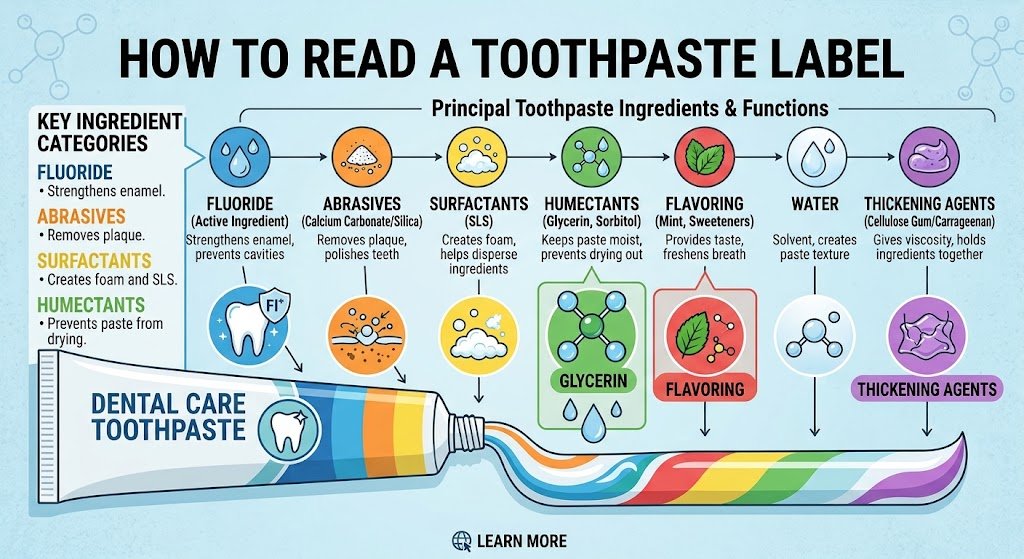
Instead, separate the ingredients according to their role.
For example:
Formulation ingredients
- Glycerin
- Sorbitol
- Thickeners
- Water
Cleaning ingredients
- Abrasives
Active oral-health ingredients
- Fluoride compounds
- Other ingredients intended for specific dental benefits
Sensory ingredients
- Flavoring
- Sweeteners
This makes ingredient lists much easier to understand.
What Should You Look for Instead of Just Avoiding Glycerin?
If your goal is to find a toothpaste that fits a “clean” or “non-toxic” approach, don’t make glycerin the only deciding factor.
A better evaluation framework is:
| What to evaluate | Why it matters |
| Cavity protection | Helps determine whether the toothpaste meets your cavity-prevention needs |
| Active ingredients | Tells you which ingredients are intended to provide specific dental benefits |
| Abrasivity | Relevant when choosing products for enamel and dentin considerations |
| SLS | Important for people who specifically prefer SLS-free formulas |
| Flavoring | Relevant if you experience irritation or dislike strong flavors |
| Sweeteners | Useful to check when reviewing the complete formula |
| Personal needs | Sensitivity, cavities, braces, dry mouth, and other concerns can change the best choice |
| Manufacturer quality | Helps you evaluate product reliability and ingredient sourcing |
The key lesson is simple:
A toothpaste should be evaluated as a complete formulation, not by one ingredient name.
That is especially important when shopping for a “non-toxic” toothpaste, because the term itself does not tell you exactly what the product contains or how well it addresses your oral-health needs.
When Might Glycerin Matter to a Toothpaste Buyer?
Glycerin becomes more relevant when you are comparing the formulation and texture of different toothpastes.
You may notice differences between products in:
- Texture
- Moisture
- Thickness
- Mouthfeel
- Ease of spreading
- Overall brushing experience
Glycerin is one of the ingredients that can contribute to these characteristics.
But if two toothpastes both contain glycerin, that does not mean they are equivalent. Their active ingredients, abrasives, surfactants, flavors, and other formulation components can be very different.
This is why ingredient comparison works best when you compare functions and the complete formula, rather than simply counting ingredients you recognize or dislike.
What About Glycerin-Free Toothpaste?
Some consumers specifically search for glycerin-free toothpaste because they have encountered claims online that glycerin interferes with remineralization or somehow prevents teeth from benefiting from other toothpaste ingredients.
Those claims should be treated carefully.
The presence of glycerin by itself does not establish that a toothpaste is ineffective. Glycerin’s recognized role in toothpaste is primarily as a humectant that helps retain moisture. (ADA)
If you are considering a glycerin-free toothpaste, evaluate the reason for choosing it.
For example:
- Do you have a personal sensitivity?
- Do you prefer a particular formulation philosophy?
- Does the product provide the active ingredient you want?
- Is it appropriate for your dental needs?
- Are you choosing it because of evidence, or because of a claim you saw online?
That distinction can prevent you from rejecting otherwise suitable toothpaste simply because one ingredient has received attention on social media or alternative-health websites.
[ARTICLE CONTINUES — NEXT PART STARTS WITH: H2: “How Glycerin Compares With Other Toothpaste Humectants”]
How Glycerin Compares With Other Toothpaste Humectants
Glycerin is not the only humectant used in toothpaste. Toothpaste formulas may also use ingredients such as sorbitol or propylene glycol to help retain moisture and maintain the desired texture.
The main purpose is similar: helping the toothpaste stay moist, stable, and easy to use. The presence of one humectant instead of another does not automatically make a toothpaste better or worse for your teeth.
The American Dental Association explains that humectants such as glycerol, propylene glycol, and sorbitol help minimize water loss from toothpaste.
Glycerin vs. Sorbitol
Both glycerin and sorbitol can function as humectants in toothpaste.
Their role is mainly related to the formulation rather than directly cleaning teeth or preventing cavities.
If you are comparing two toothpastes, it is usually more useful to look at the complete ingredient list and the toothpaste’s intended purpose than to choose one simply because it contains glycerin or sorbitol.
Glycerin vs. Propylene Glycol
Propylene glycol can also help retain moisture in toothpaste.
Again, this does not mean that a toothpaste containing propylene glycol is automatically better or worse than one containing glycerin. These ingredients can serve formulation purposes, while other ingredients are responsible for characteristics such as fluoride-based cavity protection, cleaning, flavor, or sensitivity support.
Does the Humectant Change Toothpaste Performance?
Not by itself.
A toothpaste is a complete formulation. Its performance depends on how its ingredients work together and what the product is designed to do.
For example, if your priority is cavity protection, the relevant question is not simply:
“Does this toothpaste contain glycerin?”
A more useful question is:
“Does this toothpaste contain an appropriate anticaries active ingredient, and does the overall formulation fit my needs?”
This distinction is especially important when comparing glycerin-containing toothpaste with glycerin-free toothpaste.
Does Glycerin Affect Fluoride in Toothpaste?
Glycerin should not be treated as a replacement for fluoride or as the ingredient responsible for fluoride’s anticaries effect.
In a fluoride toothpaste, glycerin can serve a formulation role while fluoride serves the anticaries role.
This is why removing glycerin does not automatically make a toothpaste more effective for preventing cavities.
For someone choosing toothpaste primarily for cavity protection, the presence, type, and appropriate use of an anticaries active ingredient deserve more attention than whether glycerin appears in the ingredient list.
The FDA’s OTC anticaries monograph identifies fluoride ingredients used in anticaries dentifrices.
Is Glycerin a Problem for Sensitive Teeth?
Glycerin itself is not the main ingredient you would normally look at when choosing toothpaste for sensitive teeth.
Tooth sensitivity is a different concern from toothpaste texture or moisture retention. People with sensitive teeth may instead look for formulations designed specifically for sensitivity and ingredients commonly used for that purpose.
For example, potassium nitrate is used in some sensitivity toothpastes, while other formulations may use different approaches.
That means avoiding glycerin does not automatically solve tooth sensitivity.
If sensitivity is your main concern, evaluate the whole toothpaste formulation and its intended use rather than focusing on glycerin alone.
Can Glycerin Cause Mouth Irritation?
A toothpaste can cause irritation for some people because of different ingredients in the overall formula.
If someone experiences burning, soreness, peeling tissue, or another unusual reaction after using a toothpaste, it is not enough to assume that glycerin is responsible.
Toothpaste contains multiple ingredients, including flavoring agents, detergents, preservatives, sweeteners, and other formulation components. Any investigation into a reaction should consider the entire ingredient list.
If you repeatedly develop irritation after using a particular toothpaste, discussing the reaction with a dentist or healthcare professional can help determine the appropriate next step.
What Does “Vegetable Glycerin” Mean on a Toothpaste Label?
You may see vegetable glycerin listed instead of simply glycerin.
The term generally describes the source of the glycerin rather than giving it a completely different function in the toothpaste.
For a toothpaste buyer, the more important question is still how the ingredient fits into the complete formulation.
If your goal is to choose a toothpaste based on a particular standard—such as fluoride-free, SLS-free, hydroxyapatite-based, or a specific ingredient preference—you should evaluate the complete ingredient list instead of assuming that “vegetable” automatically means safer or more effective.
This is an important distinction for non-toxic toothpaste research because an ingredient’s source and an ingredient’s function are two different things.
Should You Choose Glycerin-Free Toothpaste?
There is no simple rule that everyone should avoid glycerin.
A glycerin-free toothpaste may make sense if you have a specific personal preference or are deliberately comparing simpler formulations. But removing glycerin does not automatically make a toothpaste better for cavity protection, enamel, sensitivity, or gum health.
Instead, consider your actual oral-health goal.
If Your Main Goal Is Cavity Protection
Look first at the toothpaste’s anticaries active ingredient and whether the product is appropriate for your needs.
If Your Main Goal Is Sensitive Teeth
Look for a toothpaste formulated for sensitivity rather than assuming glycerin-free is the answer.
If Your Main Goal Is Avoiding Certain Ingredients
Use the complete ingredient list to check for the ingredients you personally want to avoid.
If Your Main Goal Is a Non-Toxic Toothpaste
Think beyond one ingredient.
A useful evaluation should consider the toothpaste’s active ingredients, supporting ingredients, formulation purpose, transparency, and whether the product matches your specific dental needs.
Glycerin in Toothpaste: What Actually Matters?
The biggest takeaway is simple:
Glycerin is primarily a formulation ingredient, not the ingredient you should use to judge whether a toothpaste is good or bad for your teeth.
It helps toothpaste retain moisture and maintain a usable consistency. Other ingredients have different jobs.
When evaluating toothpaste, consider:
- Cavity protection: What anticaries active ingredient does it contain?
- Sensitivity: Is the formulation designed for sensitive teeth?
- Enamel: Does it fit your enamel-care needs?
- Gum health: Does it address your specific oral-health concern?
- Ingredient preferences: Are there ingredients you specifically want to avoid?
- Formulation: Do the ingredients work together for the product’s intended purpose?
- Transparency: Can you clearly understand what the product contains and what it is designed to do?
This approach is more useful than treating one ingredient as either universally “good” or “bad.”
Glycerin in Toothpaste: Bottom Line
Glycerin is commonly used in toothpaste as a humectant, helping the formula retain moisture and maintain its consistency. The ADA identifies glycerol, along with ingredients such as sorbitol and propylene glycol, as humectants used to minimize water loss in toothpaste.
For most toothpaste buyers, the presence of glycerin alone is not a good reason to reject a product.
If you are choosing a non-toxic toothpaste, focus on the complete formulation and your specific dental needs. Glycerin is only one part of that equation.
If you are comparing products, pay particular attention to the ingredients that directly relate to your goal—such as anticaries ingredients for cavity protection or ingredients intended for sensitivity—rather than assuming that glycerin-free automatically means healthier.
Frequently Asked Questions About Glycerin in Toothpaste
Is glycerin safe in toothpaste?
Glycerin is a commonly used toothpaste ingredient that functions primarily as a humectant. Safety should be considered in the context of the complete formulation, ingredient quality, and intended use.
Does glycerin cause cavities?
Glycerin is not the active ingredient responsible for anticaries protection in toothpaste. When evaluating cavity protection, look at the toothpaste’s anticaries active ingredient and the overall formulation.
Is vegetable glycerin better than glycerin?
“Vegetable glycerin” generally refers to the source of glycerin. The name alone does not establish that a toothpaste is more effective or safer.
Should I avoid glycerin in toothpaste?
There is no general need to avoid glycerin simply because it is glycerin. If you have a specific reason for choosing a glycerin-free product, evaluate the complete formulation and make sure the alternative still meets your oral-health needs.
Does glycerin whiten teeth?
Glycerin itself is not a tooth-whitening active. Whitening performance depends on the overall toothpaste formulation and the ingredients used for cleaning or whitening.
Is glycerin the same as sugar?
No. Glycerin and common dietary sugars are different substances and serve different purposes in a toothpaste formulation.
Why is glycerin added to toothpaste?
Its main formulation role is to help retain moisture and maintain the toothpaste’s consistency.
Can you buy toothpaste without glycerin?
Yes, some toothpaste products are formulated without glycerin. However, glycerin-free does not automatically mean that the toothpaste is more effective or better suited to your dental needs.
What to Look for When Comparing Glycerin-Containing Toothpaste
If you are standing in front of several toothpaste options, glycerin should usually be one small part of your evaluation, not the deciding factor.
A practical comparison can look like this:
| What to Check | Why It Matters |
| Anticaries active | Relevant to cavity protection |
| Fluoride or other active approach | Helps you understand the toothpaste’s intended purpose |
| Sensitivity ingredients | Important if sensitivity is your concern |
| Abrasive system | Relevant to cleaning and enamel considerations |
| Detergents | Useful when evaluating formulation preferences |
| Flavoring ingredients | May matter if you experience irritation |
| Humectants such as glycerin | Mainly related to moisture and texture |
| Complete ingredient list | Helps you evaluate the product as a whole |
The goal is not to find a toothpaste with the fewest ingredients.
The goal is to find a toothpaste whose formulation makes sense for your needs.