If you have ever checked a toothpaste ingredient label, you may have noticed calcium carbonate listed among the ingredients and wondered what it actually does.
Calcium carbonate is commonly used in toothpaste as an abrasive ingredient. Its main job is to help mechanically clean the teeth and remove surface deposits and stains during brushing. It is different from fluoride, which serves a primary anticaries role in fluoride toothpaste.
That distinction matters because seeing the word “calcium” on a toothpaste label does not automatically mean the ingredient is rebuilding enamel or preventing cavities.
In this guide, you’ll learn what calcium carbonate does in toothpaste, how it cleans teeth, how it relates to whitening and abrasivity, whether it can affect enamel or sensitive teeth, how it compares with other toothpaste ingredients, and what to look for when choosing a toothpaste.
What Is Calcium Carbonate in Toothpaste?
Calcium carbonate is a chemical compound made from calcium, carbon, and oxygen. It occurs naturally in materials such as limestone, chalk, and some shells, but the calcium carbonate used in toothpaste is an ingredient selected for its functional properties.
In toothpaste, its most important role is generally as an abrasive.
An abrasive is a material that helps physically remove deposits from the tooth surface when toothpaste is combined with brushing action.
The American Dental Association lists calcium carbonate among the abrasive ingredients that may be used in toothpaste. American Dental Association: Toothpastes
This does not mean calcium carbonate is simply a “scrubbing powder.” Toothpaste is a carefully formulated mixture containing multiple ingredients, and each ingredient can have a different purpose.
For example:
- Calcium carbonate can provide abrasive cleaning.
- Fluoride compounds can provide anticaries benefits.
- Flavoring ingredients provide taste.
- Humectants help keep toothpaste from drying out.
- Surfactants can help spread the toothpaste and create foam.
- Thickening agents help maintain the desired texture.
So when evaluating calcium carbonate in toothpaste, it is more useful to ask what role it plays in the complete formula rather than deciding whether the ingredient is simply good or bad.
Is Calcium Carbonate the Same as Calcium for Your Teeth?
Not exactly.
Although calcium carbonate contains calcium, you should not interpret its presence in toothpaste as meaning that the toothpaste is delivering calcium to your teeth in the same way a dedicated remineralizing formulation might be designed to do.
Its primary function in conventional toothpaste is generally related to abrasion and cleaning.
This is an important distinction because ingredient names can make a toothpaste sound more complicated than it really is.
What Does Calcium Carbonate Do in Toothpaste?
The simplest answer is:
Calcium carbonate is mainly used as an abrasive to help toothpaste clean the tooth surface during brushing.
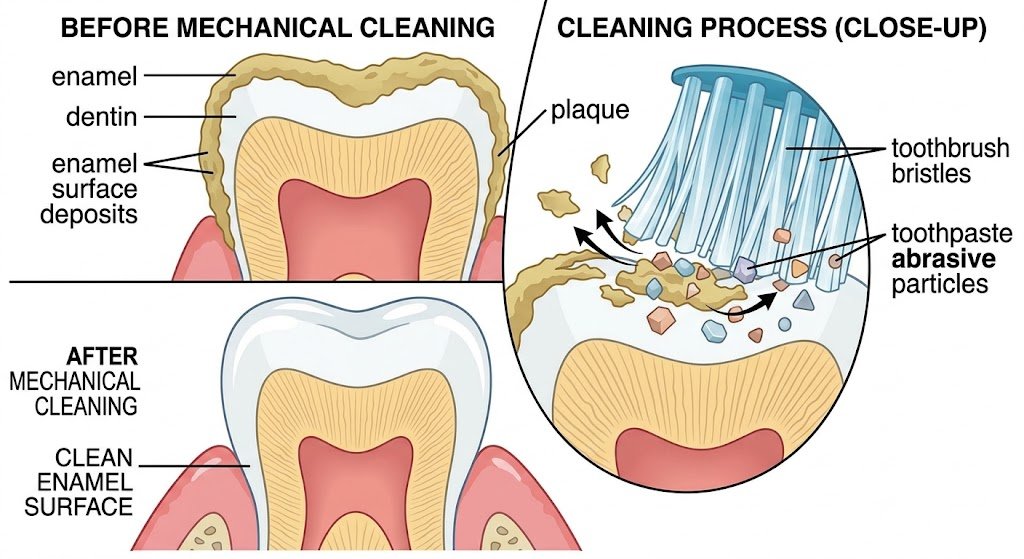
When you brush, the toothbrush provides mechanical movement while toothpaste provides ingredients that help with cleaning. An abrasive such as calcium carbonate can assist in removing surface deposits and extrinsic stains.
This is different from a toothpaste ingredient that works through a biological or chemical process.
Think of the cleaning process as a combination:
Toothbrush movement + toothpaste + abrasive particles + saliva + rinsing = removal of surface deposits
The abrasive does not work independently. The way the entire toothpaste is formulated, the toothbrush being used, brushing pressure, brushing frequency, and the condition of the tooth surface all influence the overall cleaning experience.
Does Calcium Carbonate Remove Plaque?
Toothbrushing with toothpaste helps mechanically clean the teeth and disrupt plaque.
However, it would be misleading to say that calcium carbonate alone is responsible for removing plaque.
Plaque removal is primarily associated with mechanical oral hygiene, especially effective brushing and cleaning between teeth.
The abrasive ingredient contributes to the cleaning action of the toothpaste, but it should not be treated as a standalone plaque-prevention treatment.
Does Calcium Carbonate Remove Surface Stains?
It can contribute to the removal of extrinsic or surface stains through mechanical cleaning.
Surface stains can develop from substances such as coffee, tea, tobacco, and other strongly colored foods or drinks.
Removing these deposits can make teeth appear cleaner or brighter.
However, this leads to an important distinction between surface stain removal and tooth bleaching.
How Does Calcium Carbonate Clean Your Teeth?
Calcium carbonate contributes to toothpaste cleaning through its abrasive properties.
When you brush, the particles in toothpaste come into contact with the tooth surface. Along with the movement of the toothbrush, they can help loosen and remove deposits from the outer surface.
The important point is that abrasive does not automatically mean harmful.
A toothpaste needs some degree of cleaning action to help remove deposits. The goal is to achieve useful cleaning while avoiding unnecessary wear to tooth structures.
This is why toothpaste formulation matters.
A useful way to think about the process is:
External stain or deposit → toothpaste + toothbrush movement → mechanical removal → cleaner tooth surface
Research has examined calcium-carbonate-containing toothpaste in relation to cleaning performance and the abrasivity of enamel and dentin. The findings should be interpreted based on the specific formulation being studied rather than assuming that every toothpaste containing calcium carbonate behaves identically. PubMed research on calcium-carbonate toothpaste
Why Doesn’t More Abrasion Always Mean Better Cleaning?
It might seem logical that a more abrasive toothpaste would clean better because it could remove deposits more aggressively.
But oral care is not that simple.
Teeth are biological structures, not kitchen surfaces.
The goal is not to remove as much material as possible. The goal is to clean effectively while maintaining healthy tooth surfaces.
That’s why factors such as:
- Abrasive type
- Particle characteristics
- Complete toothpaste formulation
- Brushing pressure
- Toothbrush type
- Brushing frequency
- Exposure to acidic foods and drinks
- Existing enamel or dentin wear
can all matter.
This is also why you should be cautious about judging a toothpaste based on one ingredient alone.
Does Calcium Carbonate Whiten Teeth?
Calcium carbonate can help with surface-stain removal, but that is not the same as bleaching the teeth.
This distinction is important because the word “whitening” is used in different ways in toothpaste marketing.
Surface Stain Removal
Extrinsic stains develop on the outside of the tooth.
For example, regular consumption of:
- Coffee
- Tea
- Red wine
- Tobacco
- Dark-colored foods
can contribute to surface discoloration.
An abrasive toothpaste can help remove some of these deposits during normal brushing.
The result may be a cleaner-looking and brighter tooth surface.
Tooth Bleaching
Bleaching is different.
A bleaching product is intended to change the color of the tooth through a chemical process rather than simply removing material sitting on the outside.
Therefore, a toothpaste containing calcium carbonate should not automatically be described as a bleaching product simply because its abrasive ingredients can help remove surface stains.
Does More Abrasive Toothpaste Mean Whiter Teeth?
Not necessarily.
More aggressive abrasion is not automatically better for cosmetic results.
If someone is concerned about discoloration, the better approach is to consider why the teeth look darker, whether the discoloration is on the surface or within the tooth, and what type of whitening product is appropriate.
For people with sensitivity, enamel wear, or exposed dentin, aggressively pursuing stain removal may also be counterproductive.
The goal should be effective cleaning without unnecessary abrasion.
Is Calcium Carbonate Safe for Teeth?
Calcium carbonate is commonly used in toothpaste, including as an abrasive ingredient.
But the question “Is calcium carbonate safe?” is too broad if it is considered separately from the rest of the toothpaste.
A more useful question is:
Is the complete toothpaste appropriately formulated and appropriate for the way I use it?
Abrasivity is influenced by the formulation and by how the toothpaste is used.
For example, someone who brushes very aggressively several times a day may experience a different amount of mechanical wear than someone who uses a gentle brushing technique.
Likewise, a person with healthy enamel may have different concerns from someone with significant enamel erosion, exposed dentin, or gum recession.
Can Calcium Carbonate Damage Enamel?
It would be inaccurate to say that simply having calcium carbonate in toothpaste means the toothpaste will damage enamel.
The relevant issue is abrasive wear from the complete toothpaste and brushing process.
Tooth enamel is the hard outer layer of the tooth, but hard does not mean completely resistant to wear.
Repeated mechanical forces can contribute to tooth wear, particularly when combined with other factors such as acidic exposure and aggressive brushing.
This is why a balanced toothpaste formula and appropriate brushing technique matter more than simply looking for or avoiding one abrasive ingredient.
What About Dentin?
Dentin lies underneath enamel and is less resistant to mechanical wear.
When dentin becomes exposed—for example, because of gum recession or loss of enamel—it can become more vulnerable to sensitivity and abrasion.
This does not mean people with exposed dentin must automatically avoid calcium carbonate. Instead, it means they may have a stronger reason to pay attention to toothpaste abrasivity and brushing technique.
Brushing Technique Matters Too
Even a well-formulated toothpaste can be used too aggressively.
Avoid treating brushing like scrubbing a hard surface.
A gentle, controlled brushing technique is generally more appropriate than pressing as hard as possible.
If you have persistent sensitivity, gum recession, visible enamel wear, or other dental concerns, toothpaste selection should be considered alongside professional dental advice.
What Is RDA in Toothpaste?
If you research toothpaste abrasivity, you may encounter the term RDA, which stands for Relative Dentin Abrasivity.
RDA is a standardized measurement related to the abrasivity of toothpaste against dentin under specified testing conditions.
It can be useful when discussing toothpaste abrasivity, but it should not be interpreted as a simple:
Low number = safe
High number = dangerous
score.
The American Dental Association explains that RDA values should not be used quantitatively to rank the safety of toothpastes and notes that dentifrices accepted under its Seal program have an RDA of 250 or less. ADA guidance on toothpaste abrasivity and RDA
Why Is RDA Important?
RDA provides a way to discuss and compare abrasivity under standardized testing conditions.
But the number does not tell the whole story about what will happen in someone’s mouth.
Real-world factors include:
- How hard the person brushes
- How often they brush
- Toothbrush design
- Individual tooth condition
- Acid exposure
- Gum recession
- How the complete toothpaste is formulated
So if you see a toothpaste marketed around a particular RDA value, don’t use that number alone to decide whether the product is right for you.
Does Calcium Carbonate Automatically Have a High RDA?
There is no single RDA value that applies to every toothpaste containing calcium carbonate.
Different formulations can behave differently.
This is another reason to avoid judging an entire toothpaste based only on the presence of calcium carbonate.
Calcium Carbonate vs. Silica in Toothpaste
Calcium carbonate and silica can both serve as abrasive ingredients in toothpaste, but they are different materials and can be formulated differently.
| Feature | Calcium Carbonate | Silica |
| Common toothpaste role | Abrasive | Abrasive |
| Helps mechanical cleaning | Yes | Yes |
| Can contribute to surface-stain removal | Yes | Yes |
| Automatically harmful? | No | No |
| Performance depends on formulation | Yes | Yes |
| Same chemical ingredient? | No | No |
The important question is not simply:
“Which abrasive is better?”
Instead ask:
Which complete toothpaste formulation best matches my oral-health needs?
A toothpaste containing silica is not automatically safer simply because it does not contain calcium carbonate. Likewise, calcium carbonate is not automatically a problem simply because it is an abrasive.
The formulation, abrasivity, intended use, and your individual needs all matter.
Calcium Carbonate vs. Baking Soda
Baking soda, or sodium bicarbonate, is another ingredient that can appear in toothpaste.
It should not be confused with calcium carbonate.
Both can contribute to cleaning, but they have different chemical properties and may play different roles within a particular formulation.
Calcium carbonate is commonly used as an abrasive. Sodium bicarbonate can also contribute to cleaning and may provide other formulation characteristics depending on the product.
There is no universal rule that says:
calcium carbonate toothpaste is better than baking soda toothpaste
or the opposite.
Instead, evaluate the complete product.
Look at:
- Active ingredients
- Abrasive system
- Fluoride status
- Intended use
- Sensitivity considerations
- Full ingredient list
- Manufacturer directions
This whole-formula approach is more useful than selecting a toothpaste based on one ingredient name.
[ ARTICLE CONTINUES — NEXT PART STARTS WITH: H2: Calcium Carbonate vs. Hydroxyapatite ]
Bilkul — yeh raha next written part, previous section ke exact continuation se:
Calcium Carbonate vs. Hydroxyapatite
Calcium carbonate and hydroxyapatite can both appear in toothpaste, but they serve different purposes.
Calcium carbonate is mainly used as an abrasive ingredient. It helps the toothpaste clean the tooth surface by providing controlled mechanical cleaning during brushing.
Hydroxyapatite is a calcium-phosphate mineral that is closely related to the mineral structure of teeth. Some toothpastes use hydroxyapatite as part of a mineral-care or enamel-support approach.
That means these ingredients should not be treated as interchangeable.
| Feature | Calcium Carbonate | Hydroxyapatite |
| Main role | Abrasive and cleaning | Mineral/enamel-care ingredient |
| Helps with surface cleaning | Yes | Not its primary role |
| Related to tooth mineral | Contains calcium, but is not tooth enamel | Closely related to tooth mineral |
| Same as fluoride? | No | No |
| Used in toothpaste for | Cleaning and polishing | Mineral and enamel-care formulations |
The important point is that seeing calcium in the name of calcium carbonate does not mean it works in the same way as hydroxyapatite.
If your main goal is understanding hydroxyapatite toothpaste, its proposed benefits, and how it compares with fluoride, see our guide to hydroxyapatite in toothpaste.
Which One Is Better?
There is no universal answer because the ingredients have different jobs.
If you are evaluating toothpaste for everyday cleaning, calcium carbonate may simply be part of the abrasive system. If you are specifically looking for a toothpaste formulated around hydroxyapatite, you should evaluate the product based on its complete ingredient list and intended purpose.
The best choice depends on what you want your toothpaste to do—not simply which ingredient sounds more natural or more advanced.
Calcium Carbonate and Fluoride: Are They the Same Thing?
No. Calcium carbonate and fluoride are not the same thing, and they do not perform the same primary function in toothpaste.
This distinction is important because toothpaste ingredient lists can contain several ingredients with completely different jobs.
Calcium carbonate is commonly used as an abrasive. Fluoride compounds are used as anticaries active ingredients in fluoride toothpaste.
The American Dental Association identifies abrasives such as calcium carbonate as ingredients that help remove surface deposits, while fluoride is used to help prevent cavities.
Some toothpastes can contain both calcium carbonate and fluoride. In that situation, the calcium carbonate helps with the toothpaste’s cleaning function while the fluoride provides the anticaries function.
Why This Difference Matters
It would be incorrect to look at the word “calcium” in calcium carbonate and assume that calcium carbonate can replace fluoride for cavity prevention.
These ingredients should be evaluated according to their actual roles.
For example:
- Calcium carbonate: mainly contributes to mechanical cleaning.
- Fluoride: an anticaries active used to help prevent cavities.
- Hydroxyapatite: used in some formulations for mineral and enamel-care purposes.
- Flavoring ingredients: mainly affect taste and freshness.
- Humectants: help maintain the toothpaste’s texture and moisture.
- Surfactants: help spread the toothpaste and create foam in many formulas.
This is why reading toothpaste labels requires looking at the whole formulation, rather than judging a product from one ingredient.
If fluoride is an important part of your toothpaste decision, you can also compare products in our best fluoride toothpaste guide.
Does Calcium Carbonate Prevent Cavities?
Calcium carbonate should not be considered a substitute for a recognized anticaries active ingredient simply because it contains calcium.
Its main toothpaste function is abrasive cleaning rather than cavity prevention.
Cavities develop through a complex process involving oral bacteria, dietary sugars and acids, tooth structure, saliva, and other factors. Simply having calcium carbonate in toothpaste does not mean that the toothpaste provides the same cavity-prevention benefits associated with fluoride.
For this reason, when choosing toothpaste for cavity protection, look beyond the ingredient list for calcium carbonate and identify the product’s actual anticaries active ingredient.
In the United States, fluoride compounds are commonly used as anticaries active ingredients in toothpaste products. The FDA’s OTC anticaries monograph provides requirements for recognized anticaries ingredients and their use in these products.
What Should You Look For?
If cavity prevention is your priority, consider:
- Whether the toothpaste contains a recognized anticaries active.
- Whether the product is intended for cavity protection.
- Whether it fits your individual dental needs.
- Whether you can use it consistently as directed.
- Whether your dentist has recommended a particular type of toothpaste.
Calcium carbonate can still have an important role in the formula. It simply should not be confused with the ingredient responsible for the toothpaste’s anticaries function.
Is Calcium Carbonate Good for Sensitive Teeth?
Calcium carbonate is not primarily a sensitivity-relief ingredient.
Tooth sensitivity can occur when dentin becomes exposed or when the tooth’s protective structures are compromised. People with sensitive teeth may therefore need to pay attention not only to the ingredients designed for sensitivity but also to how abrasive their toothpaste is.
A toothpaste containing calcium carbonate is not automatically unsuitable for sensitive teeth. The important question is how the complete formulation behaves and whether it is appropriate for your individual dental condition.
For people with sensitivity, factors such as these may deserve more attention:
- The toothpaste’s overall abrasivity
- Brushing pressure
- Toothbrush bristle firmness
- Frequency of brushing
- Exposure of dentin
- Gum recession
- Acid erosion
- Whether the toothpaste contains an ingredient specifically intended for sensitivity
Abrasivity is particularly relevant when someone already has exposed dentin or other factors that make the tooth surface more vulnerable.
If sensitivity is your main concern, see our guide to the best toothpaste for sensitive teeth.
Don’t Blame One Ingredient Automatically
It is easy to see “calcium carbonate” on a label and assume it is responsible for sensitivity or enamel problems. That conclusion is too simple.
A toothpaste is a complete formulation. Its cleaning performance depends on the type and amount of abrasive, particle characteristics, other ingredients, brushing technique, and how the product is used.
So instead of asking:
“Is calcium carbonate bad for sensitive teeth?”
A better question is:
“Is this particular toothpaste appropriate for my teeth and my brushing habits?”
That shift leads to a more useful and evidence-based decision.
Who Should Pay More Attention to Toothpaste Abrasivity?
Not everyone needs to worry about toothpaste abrasivity to the same degree.
For many people, toothpaste abrasives are simply part of normal daily cleaning. However, some people may have more reason to consider the overall abrasivity of their toothpaste.
This may include people with:
- Exposed dentin
- Gum recession
- Existing tooth sensitivity
- Significant enamel wear
- Acid erosion
- A history of aggressive brushing
- Frequent use of whitening products
- Dental conditions that make tooth surfaces more vulnerable
Brushing Technique Matters Too
Toothpaste is only one part of the equation.
Someone using a highly aggressive brushing technique may place more mechanical stress on the teeth than someone using gentle pressure and an appropriate toothbrush.
That means choosing toothpaste based only on one ingredient can miss an important part of the picture.
A sensible approach is to combine:
Appropriate toothpaste + gentle brushing + suitable toothbrush + regular dental care.
If you already have sensitivity, enamel wear, recession, or another dental concern, your dentist can help determine whether a particular toothpaste is appropriate for you.
How to Choose a Toothpaste With Calcium Carbonate
If you find calcium carbonate in a toothpaste ingredient list, you do not necessarily need to avoid the product.
Instead, evaluate the toothpaste based on what you actually need.
1. Check the Main Purpose of the Toothpaste
First, determine what the product is designed to do.
Are you looking for:
- Everyday cleaning?
- Cavity protection?
- Sensitive-teeth care?
- Whitening?
- Enamel care?
- Fluoride-free toothpaste?
- Ingredient-conscious toothpaste?
Your goal should guide your decision.
2. Look at the Active Ingredients
Do not stop at calcium carbonate.
Check the rest of the label and identify whether the toothpaste contains an active ingredient that matches your goal.
For example, someone mainly concerned about cavity protection should pay attention to the anticaries active rather than choosing a toothpaste simply because it contains or does not contain calcium carbonate.
3. Consider the Complete Ingredient List
A toothpaste contains more than its abrasive.
Other ingredients can affect:
- Flavor
- Foaming
- Texture
- Moisture
- Preservation
- Sensitivity
- Overall formulation
This is why ingredient evaluation should be done as a complete process.
If you are learning how to evaluate toothpaste ingredients, our toothpaste ingredients to avoid guide can help you understand the label more carefully.
4. Think About Your Dental Needs
Your toothpaste should match your mouth—not simply a trend.
Someone with healthy teeth and no sensitivity may have different priorities from someone with exposed dentin, frequent sensitivity, enamel erosion, or a high cavity risk.
5. Don’t Assume “Natural” Means Better
Calcium carbonate can be found in products marketed around natural or mineral-based ingredients, but “natural” does not automatically mean that a toothpaste is more effective or appropriate for every person.
Look at the formulation, intended purpose, evidence, and your own dental needs.
6. Look for Transparent Product Information
A good toothpaste label should make it reasonably clear what the product is designed to do and what ingredients it contains.
When possible, look for reliable information about:
- Ingredients
- Active ingredients
- Intended benefits
- Usage directions
- Dental indications
- Quality or professional acceptance claims
If a product makes a strong dental claim, check whether that claim is supported by credible evidence rather than relying only on marketing language.
Should You Avoid Calcium Carbonate in Toothpaste?
For most people, there is no general reason to avoid calcium carbonate simply because it is calcium carbonate.
Its use as an abrasive does not automatically make a toothpaste unsafe or damaging to teeth.
The better approach is to evaluate the entire toothpaste.
Ask:
- What is the toothpaste designed to do?
- What active ingredients does it contain?
- How abrasive is the overall formulation?
- Do I have sensitive teeth or exposed dentin?
- Am I using proper brushing technique?
- Does the toothpaste fit my dental needs?
- Is the product information transparent?
Calcium carbonate can be a useful functional ingredient in toothpaste. The question is not whether the ingredient sounds good or bad in isolation.
The real question is whether the finished toothpaste is appropriate for you.
Common Myths About Calcium Carbonate in Toothpaste
Myth 1: Calcium Carbonate Is the Same as Fluoride
False.
Calcium carbonate and fluoride have different roles. Calcium carbonate is mainly used for abrasive cleaning, while fluoride is used as an anticaries active in fluoride toothpaste.
Myth 2: Any Toothpaste With Calcium Carbonate Will Damage Enamel
False.
The presence of calcium carbonate alone does not tell you how abrasive the finished toothpaste is or how it will affect your teeth during normal use.
The complete formulation and brushing behavior matter.
Myth 3: Calcium Carbonate Is a Tooth-Repair Ingredient Because It Contains Calcium
Not necessarily.
Chemical ingredients that contain calcium do not all work in the same way. Calcium carbonate’s primary role in toothpaste is generally associated with abrasive cleaning, not direct repair of cavities.
Myth 4: More Abrasive Toothpaste Means Better Whitening
False.
Abrasives can help remove some surface stains, but increasing abrasion is not the same as bleaching the natural color of teeth.
Effective whitening depends on the type of discoloration and the method being used.
Myth 5: You Must Avoid Calcium Carbonate If You Have Sensitive Teeth
Not automatically.
People with sensitivity may need to pay closer attention to toothpaste abrasivity, but the presence of calcium carbonate alone does not determine whether a product is suitable.
The whole formula and your dental condition matter.
Myth 6: Calcium Carbonate Is Always Better Than Silica
There is no simple winner.
Both can be used as abrasive ingredients, and their performance depends on the formulation and intended use.
Instead of choosing based on one ingredient name, evaluate the finished toothpaste.
Simple Calcium Carbonate Toothpaste Buying Checklist
Before buying a toothpaste containing calcium carbonate, use this quick checklist:
Toothpaste Checklist
☐ Check the purpose
Know whether the toothpaste is intended for cavity protection, sensitivity, whitening, everyday cleaning, or another goal.
☐ Check the active ingredient
Do not confuse calcium carbonate with an anticaries or sensitivity active.
☐ Read the complete ingredient list
Look beyond the front label and marketing claims.
☐ Consider abrasivity
This can be particularly important if you have sensitivity, exposed dentin, gum recession, enamel wear, or use whitening toothpaste frequently.
☐ Consider your brushing habits
Gentle technique matters. More pressure does not necessarily mean cleaner teeth.
☐ Don’t assume “natural” equals better
Evaluate evidence and formulation instead of relying on marketing language.
☐ Look for trustworthy product information
Professional acceptance or credible third-party information can provide additional context when available.
☐ Match the toothpaste to your needs
Your dental condition should influence your choice more than a single ingredient.
FAQ About Calcium Carbonate in Toothpaste
What does calcium carbonate do in toothpaste?
Calcium carbonate is mainly used as an abrasive ingredient. It helps toothpaste mechanically clean tooth surfaces during brushing and can contribute to the removal of surface deposits and stains.
Is calcium carbonate safe in toothpaste?
Calcium carbonate can be safely used as part of toothpaste formulations. However, the suitability of a particular toothpaste depends on its complete formulation, abrasivity, intended use, and the individual’s dental needs.
Does calcium carbonate whiten teeth?
It can help remove some external or surface stains through mechanical cleaning. This is different from bleaching the natural color of teeth.
Does calcium carbonate damage enamel?
Not simply because it is present. Toothpaste abrasivity depends on the complete formulation and how the toothpaste is used. Brushing technique and individual dental conditions also matter.
Is calcium carbonate better than silica?
Neither ingredient is automatically better for every toothpaste. Both can function as abrasives, and their performance depends on the finished formulation and intended purpose.
Is calcium carbonate the same as fluoride?
No. Calcium carbonate is mainly an abrasive ingredient, while fluoride is used as an anticaries active in fluoride toothpaste.
Does calcium carbonate prevent cavities?
Calcium carbonate should not be treated as a substitute for a recognized anticaries active ingredient. Its primary role is cleaning rather than cavity prevention.
Is calcium carbonate good for sensitive teeth?
Calcium carbonate is not primarily a sensitivity-relief ingredient. People with sensitive teeth may want to pay closer attention to the overall abrasivity and whether the toothpaste contains an ingredient intended for sensitivity.
Should I avoid calcium carbonate in toothpaste?
There is no general reason for everyone to avoid it. Instead, evaluate the complete toothpaste formulation and whether it matches your dental needs.
Why do some toothpastes contain calcium carbonate?
Manufacturers can use calcium carbonate as an abrasive to help with mechanical cleaning and removal of surface deposits during brushing.
Conclusion: Should You Avoid Calcium Carbonate in Toothpaste?
Calcium carbonate is a common toothpaste ingredient with a straightforward primary role: it helps provide mechanical cleaning as an abrasive.
It is not the same as fluoride, and it should not be treated as a substitute for an anticaries active. It also should not automatically be considered harmful simply because it is abrasive.
The most useful way to evaluate calcium carbonate is to look at the complete toothpaste formulation.
Consider the toothpaste’s purpose, active ingredients, overall abrasivity, your brushing technique, and your own dental needs. If you have sensitive teeth, exposed dentin, gum recession, enamel wear, or another dental concern, those factors deserve particular attention.
Most importantly, don’t judge toothpaste by one ingredient alone.
A toothpaste containing calcium carbonate may be perfectly reasonable for one person and less appropriate for another depending on the person’s goals and dental condition.
