If you have ever checked a toothpaste label and noticed ingredients such as peppermint oil, spearmint oil, or cinnamon oil, you may have wondered: Are essential oils safe in toothpaste?
For most people, essential oils used as toothpaste flavoring can be tolerated without a problem. But that does not mean every essential oil or every toothpaste formula is suitable for everyone. Some people can experience mouth irritation or an allergic reaction to certain flavoring ingredients.
The American Dental Association notes that ingredients such as peppermint, spearmint, and cinnamon can be associated with contact reactions involving the mouth and surrounding skin.
That distinction matters if you are choosing a natural or non-toxic toothpaste. Natural does not automatically mean irritation-free, and the presence of an essential oil does not by itself tell you whether a toothpaste is good or bad.
This guide explains why essential oils are added to toothpaste, which ones are common, what the evidence says about oral health, and who may want to consider an essential-oil-free formula.
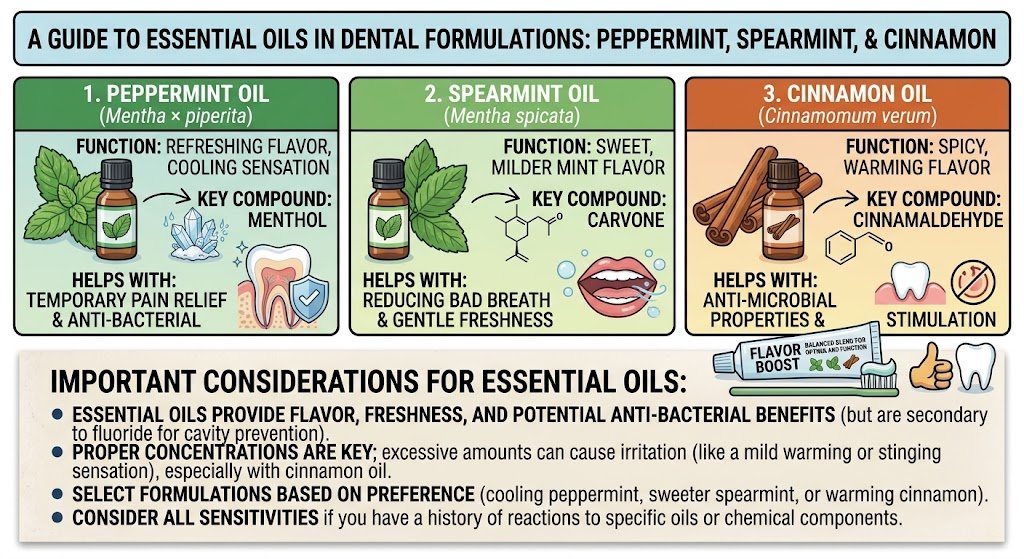
What Are Essential Oils?
Essential oils are concentrated aromatic substances obtained from plants. They contain compounds that give plants their characteristic smell and flavor.
In toothpaste, essential oils are usually present for flavoring and sensory purposes. For example, peppermint oil can contribute a strong mint flavor and a cooling sensation, while cinnamon oil provides a warmer, spicy flavor.
The term “essential” does not mean that the oil is essential for healthy teeth. It simply refers to a type of concentrated plant-derived oil.
This is an important distinction when reading a toothpaste ingredient list. An essential oil may contribute to the taste or overall formulation, but it is not the same thing as a cavity-protection ingredient such as fluoride.
Why Are Essential Oils Used in Toothpaste?
Essential oils can serve several purposes in toothpaste, but their role depends on the specific ingredient and the complete formula.
Flavor
One of the most obvious reasons is flavor.
Toothpaste needs to taste acceptable enough that people will actually use it regularly. Mint oils are common because they provide the familiar fresh flavor associated with toothpaste.
Fresh Sensation
Some essential oils contain compounds that create a cooling or strong sensory effect.
For example, peppermint contains menthol-related compounds that can make the mouth feel cool and fresh after brushing.
That fresh sensation, however, should not be confused with proof that the toothpaste has removed more plaque or provided better cavity protection.
Formulation and Marketing
Essential oils are also common in products marketed as natural, botanical, or plant-based.
That can make a toothpaste appealing to people who want to avoid certain synthetic flavoring ingredients. But the word “natural” should not be used as a shortcut for judging safety.
A plant-derived ingredient can still cause irritation or allergy in a sensitive person.
Potential Antimicrobial Activity
Some essential oils have demonstrated antimicrobial activity in laboratory or oral-care research. Essential oils are also used in certain mouthwash formulations.
However, this is where it is important to separate different types of evidence.
Research showing benefits from an essential-oil mouthwash should not automatically be interpreted as proof that essential oils in toothpaste provide the same benefit.
Systematic reviews have found evidence that certain essential-oil mouthrinses can help reduce plaque and gingivitis when used as part of oral hygiene.
Toothpaste is a different product. It is brushed onto the teeth, used for a relatively short period, and then normally spit out. Its overall effectiveness depends on the complete formulation and how it is used.
So if your main goal is cavity prevention, enamel protection, or another specific dental need, look beyond the essential-oil label.
Which Essential Oils Are Common in Toothpaste?
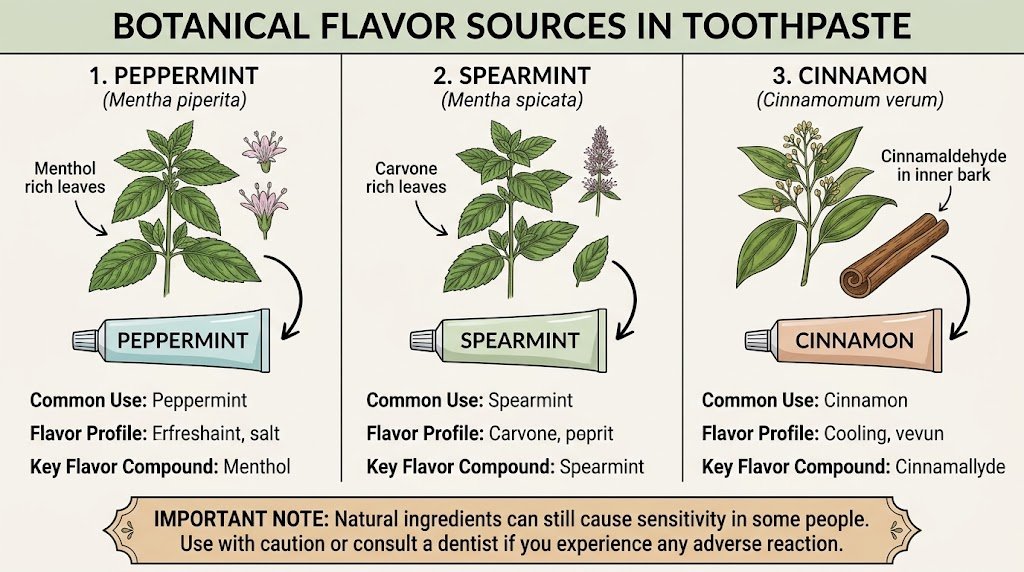
Several essential oils and aromatic compounds may appear in oral-care products. The most familiar examples include peppermint, spearmint, and cinnamon.
Peppermint Oil
Peppermint oil is one of the most recognizable flavoring ingredients in toothpaste.
It can provide:
- A strong mint flavor
- A cooling sensation
- A fresh-mouth feeling
- A familiar toothpaste taste
For many people, peppermint-flavored toothpaste is completely acceptable.
However, some people may experience burning, irritation, or other discomfort when exposed to certain flavoring ingredients. Peppermint and related flavoring compounds are among the ingredients the ADA discusses in relation to oral contact reactions.
If a toothpaste consistently causes discomfort and peppermint oil is present on the label, it may be worth comparing the formula with a different toothpaste that uses another flavor system.
Spearmint Oil
Spearmint oil is another common source of mint flavor.
Compared with peppermint, spearmint generally has a different flavor profile, but its purpose in toothpaste is similar: helping create a recognizable and refreshing taste.
Spearmint is also included among toothpaste ingredients that can be associated with contact reactions in susceptible individuals.
If you notice symptoms after switching to a toothpaste containing spearmint, do not assume that because the ingredient comes from a plant it cannot be responsible for the reaction.
Cinnamon Oil
Cinnamon oil is used to provide a distinctive spicy flavor.
It is less universally associated with the traditional “mint toothpaste” experience, but it can appear in natural or specialty oral-care products.
Cinnamon-related flavoring ingredients are particularly relevant when investigating unexplained oral irritation because the ADA identifies cinnamon among potential causes of contact reactions related to toothpaste.
If cinnamon-flavored toothpaste produces burning, redness, swelling, peeling, or persistent discomfort, the complete ingredient list should be reviewed rather than assuming the sensation means the toothpaste is working.
Are Essential Oils Safe in Toothpaste?
For many people, essential oils in toothpaste can be used without noticeable problems. But “safe” is not an all-or-nothing label.
The more useful question is:
Is this particular toothpaste formula well tolerated by this particular person?
Several factors can influence that answer.
The Specific Essential Oil Matters
Peppermint, spearmint, cinnamon, and other oils contain different chemical compounds. A person who tolerates one flavor may not necessarily tolerate another.
The Complete Formula Matters
Essential oils are only one part of a toothpaste.
A toothpaste may also contain:
- Fluoride or another active ingredient
- Abrasives
- Humectants
- Surfactants
- Sweeteners
- Preservatives
- Flavoring compounds
- Other botanical ingredients
Therefore, blaming or praising one ingredient without considering the complete formula can be misleading.
For example, if someone develops irritation after using a new toothpaste, the essential oil may be relevant, but it is not automatically the only possible cause.
Individual Tolerance Matters
People can respond differently to the same toothpaste.
Someone may brush comfortably with a strongly flavored peppermint toothpaste, while another person may prefer a mild or flavor-free formula.
This is especially relevant for people who already experience mouth irritation or who have repeatedly noticed discomfort after changing toothpaste.
Can Essential Oils Irritate Your Mouth?
Yes, they can in some people.
The mouth contains delicate oral tissues, and certain toothpaste ingredients can cause irritation or contact reactions in susceptible individuals.
Possible symptoms may include:
- Burning or stinging
- Redness
- Swelling
- Peeling or shedding of the surface tissue
- Soreness
- Ulcer-like changes
- Irritation around the lips or mouth
The ADA describes oral reactions associated with toothpaste ingredients such as flavoring agents and essential oils, including reactions involving the oral mucosa, tongue, gingiva, and lips.
But there is an important distinction between irritation and allergy.
Irritation can occur because a substance is unpleasant or damaging to sensitive tissue. An allergy involves an immune response to a particular substance.
You should not assume that every burning sensation means you have an allergy.
Likewise, you should not ignore persistent symptoms simply because the toothpaste is marketed as natural.
Can You Be Allergic to Essential Oils in Toothpaste?
Yes. Some people can develop a contact allergy to flavoring ingredients used in toothpaste.
The reaction can involve the mouth, lips, or skin around the mouth. The ADA specifically identifies ingredients such as peppermint, spearmint, and cinnamon among potential sources of contact reactions associated with toothpaste.
An important point is that an ingredient does not have to be synthetic to cause an allergic reaction.
This is one reason why choosing toothpaste based only on phrases such as:
- Natural
- Plant-based
- Botanical
- Herbal
- Clean
can be misleading.
Those descriptions may tell you something about how the product is marketed, but they do not tell you whether your mouth will tolerate every ingredient.
If you repeatedly develop symptoms after using a particular toothpaste, stop treating the problem as simply a preference for a stronger or milder flavor. Reviewing the ingredient list and discussing persistent symptoms with a dental or medical professional may be appropriate.
Are Essential Oils Good for Your Teeth?
Essential oils are not automatically “good for teeth” simply because they come from plants.
Their role depends on the specific ingredient, its concentration, the product formulation, and the purpose for which it is being used.
For example, an essential oil may provide flavor and a fresh sensation. Some essential oils also have antimicrobial properties that have been studied in oral-care products.
But that does not make essential oil the primary ingredient responsible for preventing cavities.
If cavity prevention is your priority, pay attention to the toothpaste’s active ingredients and the recommendations that apply to your dental needs.
The same principle applies if your main concern is enamel, sensitivity, gingival health, or another specific oral-health issue.
Can Essential Oils Help With Plaque?
There is evidence that certain essential-oil mouthrinses can help with plaque control.
For example, systematic reviews have reported plaque and gingival benefits from essential-oil mouthwash used as part of an oral-hygiene routine.
But this evidence needs to be interpreted correctly.
Essential-oil mouthwash is not the same as essential-oil toothpaste.
Mouthwash is designed to contact oral tissues throughout the mouth as a rinse. Toothpaste is applied during brushing and then spit out. The formulation, exposure pattern, active ingredients, and intended use are different.
So it would be inaccurate to say:
“Essential oils reduce plaque, therefore any toothpaste containing essential oils is better for plaque.”
The research does not justify that broad conclusion.
Instead, consider essential oils as one part of the formula and evaluate the toothpaste according to its actual purpose.
For someone choosing toothpaste for everyday cavity protection, for example, the presence of peppermint oil should not outweigh the importance of the toothpaste’s cavity-protection ingredient and overall formulation.
Can Essential Oils Help With Gingivitis?
Essential oils have been studied in oral-care products for gingivitis, particularly in mouthrinses.
Several systematic reviews have found that certain essential-oil mouthrinses can provide additional plaque and gingival benefits when used alongside mechanical oral hygiene.
However, the same evidence should not be used to claim that an essential-oil toothpaste will necessarily treat or prevent gingivitis.
That distinction is especially important in an article about toothpaste safety.
If your goal is improving gum health, look at the entire oral-care routine rather than focusing on one flavoring ingredient.
Brushing technique, frequency, interdental cleaning, the toothpaste’s active ingredients, and individual dental risk can all matter.
[ARTICLE CONTINUES — NEXT PART STARTS WITH: H2: “Natural Does Not Mean Risk-Free”]
Part 1 intentionally stops at a natural section boundary. The next part will continue directly with “Natural Does Not Mean Risk-Free” and move through sensitive mouths, children, pregnancy, label reading, essential-oil-free options, decision framework, FAQ, conclusion, and the final implementation assets.
Continuing exactly from the previous stopping point—no repetition.
Natural Does Not Mean Risk-Free
One of the easiest mistakes to make when choosing a toothpaste is assuming that natural automatically means safer.
Essential oils are plant-derived, but plant-derived ingredients can still cause irritation or allergic reactions in some people. The same principle applies to other botanical ingredients.
This does not mean essential oils are inherently dangerous. It means that “natural” is not enough information to judge whether a toothpaste is right for you.
A better approach is to ask:
- What does each ingredient do?
- Is it an active ingredient or mainly a flavoring?
- Does the formula address your dental needs?
- Do you tolerate the flavor and other ingredients?
- Are there ingredients you already know cause problems for you?
This whole-formula approach is more useful than dividing toothpaste into simple categories such as “natural = good” and “synthetic = bad.”
Are Essential Oils Safe for Sensitive Mouths?
If your mouth is easily irritated, a strongly flavored toothpaste may not always be the most comfortable option.
This does not mean everyone with a sensitive mouth must avoid essential oils. Instead, it means personal tolerance becomes more important.
If you notice burning, soreness, peeling, or irritation after brushing, consider looking at the entire ingredient list. Flavoring ingredients are one possible source of the problem, but other ingredients can also contribute.
For someone with recurring sensitivity, a simpler toothpaste formula may be worth considering. This can make it easier to identify which products are comfortable and which ones are not.
If symptoms continue despite changing products, or if you have unexplained oral lesions or significant swelling, it is better to seek professional dental or medical advice rather than repeatedly testing different toothpastes yourself.
Should You Avoid Peppermint Oil in Toothpaste?
Not necessarily.
Peppermint oil is a common toothpaste flavoring ingredient, and many people use peppermint-flavored toothpaste without problems.
There is no general reason for everyone to avoid peppermint oil simply because it is an essential oil.
However, if you repeatedly notice discomfort with peppermint-flavored toothpaste, trying a different formula may be reasonable.
For example, you could compare:
- Peppermint-flavored toothpaste
- Spearmint-flavored toothpaste
- Mildly flavored toothpaste
- Essential-oil-free toothpaste
The goal is not to label peppermint as “bad.” The goal is to find a formula that provides the oral-health benefits you need without causing unwanted symptoms.
Should You Avoid Cinnamon Oil in Toothpaste?
Again, not everyone needs to avoid cinnamon oil.
Cinnamon can provide a distinctive flavor, but cinnamon-related flavoring ingredients are among those associated with contact reactions from toothpaste in susceptible people.
If a cinnamon-flavored toothpaste causes burning, soreness, redness, swelling, or other persistent symptoms, switching to a different flavor system may be worth considering.
If the symptoms are significant or continue after stopping the suspected product, professional evaluation is more appropriate than assuming the cinnamon is definitely responsible.
Essential Oils vs. Other Toothpaste Ingredients
Essential oils are only one category of toothpaste ingredients. Their purpose is different from many of the ingredients responsible for cleaning, cavity protection, or sensitivity management.
| Ingredient category | Main role in toothpaste | What to consider |
| Essential oils | Flavor and sensory experience; some have antimicrobial properties studied in oral-care products | May not be tolerated by everyone |
| Fluoride | Helps prevent cavities and supports enamel remineralization | Important for people choosing fluoride toothpaste for cavity protection |
| Hydroxyapatite | Mineral-based active ingredient used in some toothpastes | Consider the specific formulation and evidence |
| Abrasives | Help remove surface deposits during brushing | Excessive abrasivity can be undesirable for some users |
| Surfactants | Help spread the toothpaste and create foam | Some people prefer formulas without certain surfactants |
| Humectants | Help keep toothpaste from drying out | Usually a formulation function rather than the main dental benefit |
| Sweeteners | Improve taste without functioning as ordinary tooth-decay-causing sugar | Check the complete ingredient list |
This comparison shows why judging a toothpaste from one ingredient alone can be misleading.
A toothpaste can contain peppermint oil and still be designed around cavity protection. Another toothpaste may be essential-oil-free but still contain ingredients that do not fit a particular person’s preferences or needs.
The better question is not:
“Does this toothpaste contain essential oils?”
It is:
“Does this complete formula fit my dental needs and do I tolerate it?”
Are Essential Oils Better Than Synthetic Flavoring?
There is no simple rule that essential-oil flavoring is automatically better than synthetic flavoring.
A natural flavoring and a synthetic flavoring can have different chemical compositions and different tolerability profiles. The important issue for an individual user is whether the complete toothpaste formula is appropriate and well tolerated.
If you are choosing a toothpaste because you want fewer ingredients, the ingredient list can help you compare products. But the number of ingredients alone does not determine whether a toothpaste is effective or suitable.
Likewise, choosing a toothpaste simply because it contains plant-derived ingredients does not guarantee that it will be gentler.
For people with known flavoring sensitivities, the most practical approach may be to identify ingredients they need to avoid and look for a formula that meets their dental requirements without those ingredients.
Are Essential Oils Safe in Children’s Toothpaste?
Children require additional care when choosing and using toothpaste because the appropriate product and amount depend on age and individual circumstances.
Essential oils should not be viewed as a reason to automatically choose or reject a child’s toothpaste.
Instead, parents should focus on the complete product and the child’s oral-health needs. The toothpaste should be appropriate for the child’s age and should be used according to dental guidance.
Flavor is also important in a practical sense. A toothpaste that a child strongly dislikes may make regular brushing harder.
At the same time, a very strong flavor is not necessary simply because it creates a stronger “fresh” feeling.
For children, it is especially important not to treat a natural or essential-oil-containing toothpaste as automatically safer than another option.
Parents should also pay attention to how much toothpaste is used and whether the child tends to swallow it.
Are Essential Oils Safe During Pregnancy?
Pregnancy can make people more cautious about ingredients, including essential oils.
However, the presence of an essential oil in toothpaste does not by itself establish that a toothpaste is unsafe during pregnancy.
Toothpaste is a topical oral-care product used in a small amount and normally spit out. The relevant question is the safety of the specific product and its ingredients, not simply whether the product contains something described as an essential oil.
If you are pregnant and have concerns about a particular toothpaste, especially if you have unusual symptoms or have been advised to avoid a specific ingredient, discuss the product with your dentist or healthcare professional.
It is also important not to replace an effective cavity-prevention routine with a product chosen solely because it is labeled natural.
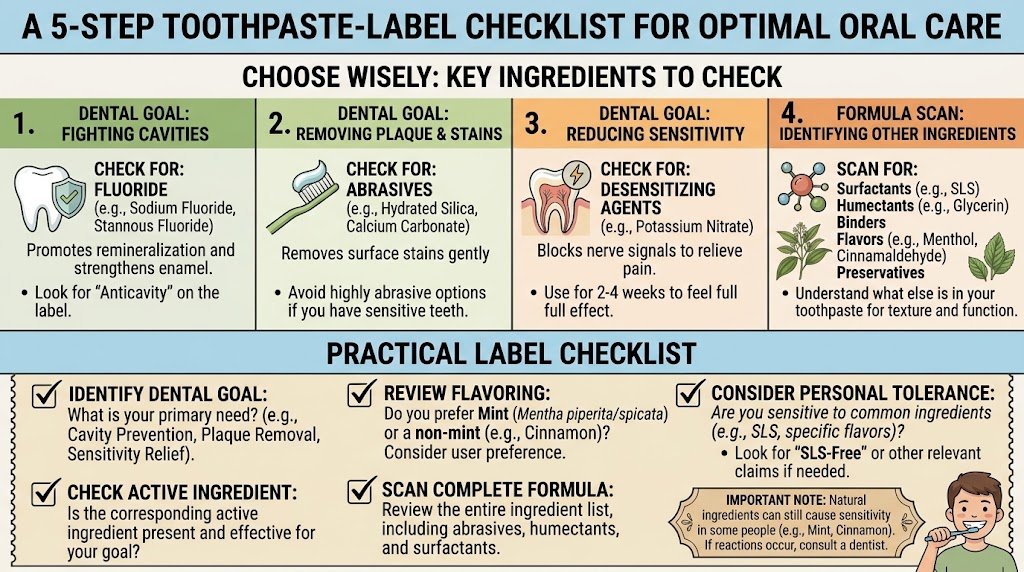
How to Choose Toothpaste With Essential Oils
If you want a toothpaste that contains essential oils, you do not necessarily need to avoid the category.
Instead, use a simple checklist.
1. Start With Your Dental Goal
Ask what you actually want the toothpaste to do.
Your priority may be:
- Cavity prevention
- Sensitivity relief
- Enamel support
- Gum health
- Whitening
- Bad-breath control
- A preference for certain ingredients
The answer should influence your toothpaste choice more than the marketing label.
2. Check the Active Ingredient
Look at the ingredient responsible for the toothpaste’s main dental function.
Do not assume peppermint oil, cinnamon oil, or another essential oil is the ingredient providing cavity protection.
If cavity prevention is your priority, check whether the toothpaste contains an appropriate cavity-protection active ingredient.
3. Review the Flavoring Ingredients
If you have experienced irritation from toothpaste before, pay closer attention to flavoring ingredients.
Look for ingredients such as:
- Peppermint
- Spearmint
- Cinnamon
- Menthol
- Other flavoring compounds
The exact ingredient names can vary by formulation.
4. Consider the Rest of the Formula
Do not stop after finding one essential oil.
Review the full ingredient list and consider other ingredients that may matter to you, such as fluoride, surfactants, abrasives, sweeteners, and other flavoring agents.
5. Pay Attention to Your Own Response
If a toothpaste feels comfortable and meets your dental needs, there may be no reason to avoid it simply because it contains an essential oil.
If it repeatedly causes irritation, consider another formula.
This is a more useful approach than assuming one ingredient is universally good or bad.
Who May Prefer Essential-Oil-Free Toothpaste?
Essential-oil-free toothpaste may be worth considering for people who:
- Have repeatedly experienced irritation with strongly flavored toothpaste
- Suspect a flavoring ingredient contributes to their symptoms
- Prefer a milder taste
- Want to simplify the number of flavoring ingredients
- Have been advised by a professional to avoid a particular ingredient
An essential-oil-free formula is not automatically better for everyone.
It can simply be another option for someone who does not tolerate certain flavoring ingredients.
When comparing these products, make sure removing essential oils does not cause you to overlook more important factors, such as the toothpaste’s active ingredients and suitability for your dental needs.
Future content opportunity: A dedicated guide to essential-oil-free toothpaste could help readers compare formulas, understand who may prefer them, and evaluate what to look for beyond flavoring ingredients.
What If Toothpaste Keeps Irritating Your Mouth?
If a toothpaste repeatedly causes irritation, do not assume that stronger burning means better cleaning.
A practical first step is to stop using the suspected toothpaste and review its ingredient list.
Pay particular attention to:
- Flavoring ingredients
- Essential oils
- Menthol
- Surfactants
- Other ingredients that were introduced when the symptoms started
If changing toothpaste resolves the symptoms, that information can be useful when discussing the issue with a dental professional.
However, persistent or severe symptoms deserve professional evaluation. Mouth irritation can have multiple causes, and toothpaste may not always be responsible.
Symptoms such as persistent sores, significant swelling, extensive peeling, or recurring unexplained lesions should not simply be managed by continuously switching products.
Essential Oils in Toothpaste: A Simple Decision Framework
If you are still unsure whether to choose a toothpaste with essential oils, use this simple framework:
Step 1: Do you tolerate the toothpaste?
If yes, there may be no reason to avoid essential oils solely because they are present.
If no, investigate the formula rather than assuming the problem is caused by one ingredient.
Step 2: Does it meet your dental goal?
A toothpaste should be selected according to what you need from it, whether that is cavity prevention, sensitivity support, enamel care, or another goal.
Step 3: Are you choosing it because it is “natural”?
Remember that natural does not automatically mean safer or more effective.
Step 4: Have you experienced repeated irritation?
If yes, consider a different flavor or an essential-oil-free formula and seek professional advice if symptoms persist.
Step 5: Are you relying on essential oils for a dental benefit?
Be careful not to transfer evidence from essential-oil mouthwash directly to toothpaste. Evidence for one product type does not automatically establish the same benefit for another.
This framework keeps the decision focused on what matters: your dental needs, the complete formulation, the available evidence, and your own tolerance.
Frequently Asked Questions
Are essential oils safe in toothpaste?
For many people, essential oils in toothpaste can be tolerated. However, some people may experience irritation or contact reactions to flavoring ingredients such as peppermint, spearmint, or cinnamon.
Can essential oils irritate your mouth?
Yes. Certain toothpaste flavoring ingredients, including some essential oils, can cause irritation or contact reactions in susceptible people. Symptoms may include burning, redness, swelling, peeling, or soreness.
Can you be allergic to essential oils in toothpaste?
Yes. Some people can develop contact allergies to flavoring ingredients used in toothpaste. Peppermint, spearmint, and cinnamon are among ingredients associated with oral contact reactions.
Is peppermint oil safe in toothpaste?
Peppermint oil is commonly used as a toothpaste flavoring and is tolerated by many people. However, some individuals can experience irritation or contact reactions, so personal tolerance matters.
Is cinnamon oil safe in toothpaste?
Cinnamon oil can be used as a toothpaste flavoring, but cinnamon-related flavoring ingredients can cause contact reactions in susceptible individuals. If a cinnamon toothpaste repeatedly causes irritation, consider another formula.
Are essential oils good for your teeth?
Essential oils are mainly relevant to toothpaste as flavoring ingredients, although some have antimicrobial properties that have been studied in oral-care products. They should not automatically be considered the main source of cavity protection or other dental benefits.
Can essential oils help with plaque?
Certain essential-oil mouthrinses have evidence supporting plaque-control benefits. However, that evidence should not automatically be applied to toothpaste containing essential oils because the two products are formulated and used differently.
Should people with sensitive mouths avoid essential oils?
Not necessarily. Some people with sensitive mouths may tolerate essential oils without problems, while others may find certain flavoring ingredients irritating. If toothpaste repeatedly causes discomfort, comparing a milder or essential-oil-free formula may be reasonable.
Are essential oils safe in children’s toothpaste?
The presence of an essential oil does not by itself determine whether a child’s toothpaste is appropriate. Parents should consider the child’s age, the complete formulation, appropriate toothpaste use, and dental guidance.
Should you avoid essential oils during pregnancy?
The presence of an essential oil in toothpaste does not by itself mean the product is unsafe during pregnancy. If you have concerns about a particular ingredient or product, discuss it with your dentist or healthcare professional.
Is essential-oil toothpaste better than regular toothpaste?
Not automatically. Essential oils may contribute flavor and other formulation characteristics, but toothpaste should be evaluated according to its complete formula and your specific dental needs.
Does natural toothpaste mean safer toothpaste?
No. Natural ingredients can still cause irritation or allergic reactions. A better approach is to evaluate the complete ingredient list, the toothpaste’s intended dental benefits, and your own tolerance.
Bottom Line
So, are essential oils safe in toothpaste?
For many people, yes—but they are not automatically suitable for everyone.
Peppermint, spearmint, cinnamon, and other flavoring ingredients can make toothpaste taste fresh and enjoyable, but some people may experience irritation or contact reactions.
The biggest mistake is judging a toothpaste by one label claim.
Natural does not automatically mean safer. Essential oils do not automatically make a toothpaste better. And essential-oil-free does not automatically mean a toothpaste is better either.
Instead, evaluate:
- Your dental goal
- The toothpaste’s active ingredients
- The complete ingredient list
- Your history of irritation or sensitivity
- The evidence supporting the product’s intended benefits
If you tolerate an essential-oil-containing toothpaste and it meets your dental needs, there may be no reason to avoid it simply because it contains plant-derived oils.
If a toothpaste repeatedly irritates your mouth, however, an alternative formula—including an essential-oil-free option—may be worth considering.
For readers comparing “clean” or “non-toxic” toothpastes, the same principle applies: look at the complete formula rather than judging a product by whether one ingredient sounds natural or synthetic.
