If you are considering hydroxyapatite toothpaste, one of the first questions to ask is simple: Is hydroxyapatite safe?
For the specific hydroxyapatite materials and oral-care uses that have been evaluated, current evidence is generally reassuring. However, that does not mean every material described as “hydroxyapatite” has identical safety evidence. This is especially important with nano-hydroxyapatite, where particle size, shape, surface characteristics, concentration, and intended use can affect how the material is evaluated.
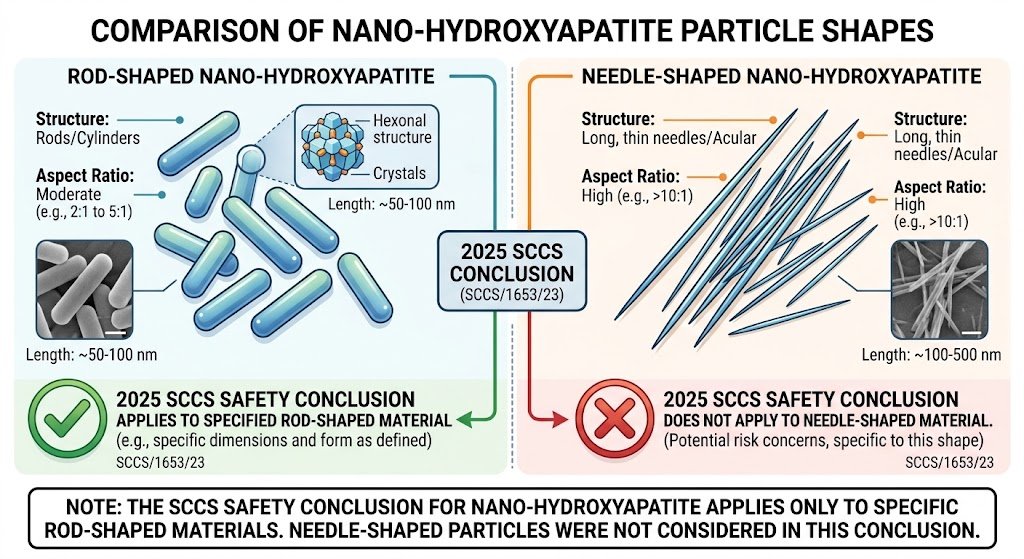
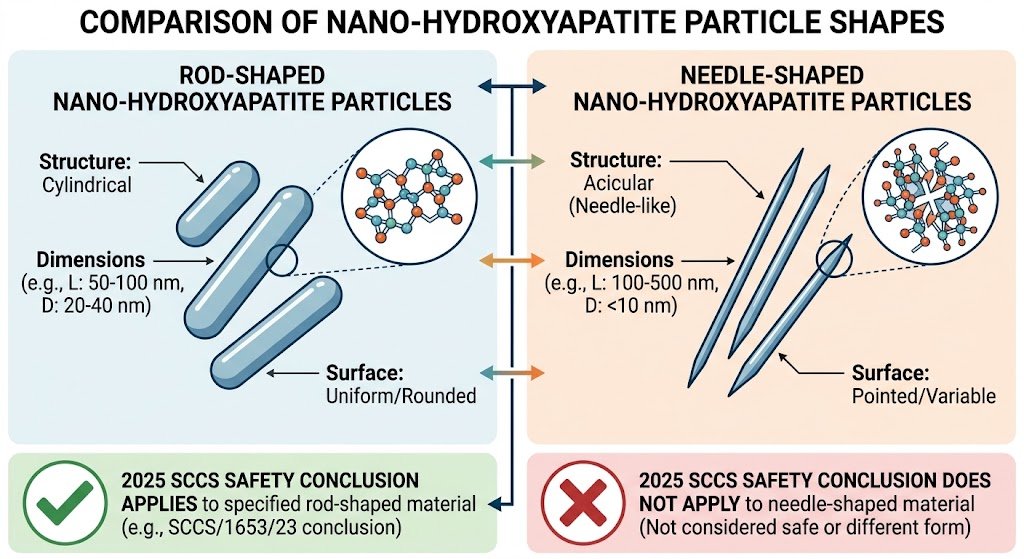
The European Commission’s Scientific Committee on Consumer Safety (SCCS), for example, concluded in 2025 that a specifically characterized form of nano-hydroxyapatite could be considered safe in toothpaste at concentrations up to 29.5% under the conditions evaluated. That conclusion applies to defined rod-shaped, uncoated, unmodified particles and does not apply to needle-shaped nano-hydroxyapatite.
So the better question is not simply “Is hydroxyapatite safe?” It is:
Which type of hydroxyapatite is being used, in what product, at what concentration, and what does the evidence say about that specific material and use?
This guide explains what current research says about hydroxyapatite safety, nano-hydroxyapatite, swallowing toothpaste, possible side effects, fluoride comparisons, and what to look for when choosing a hydroxyapatite toothpaste.
What Is Hydroxyapatite?
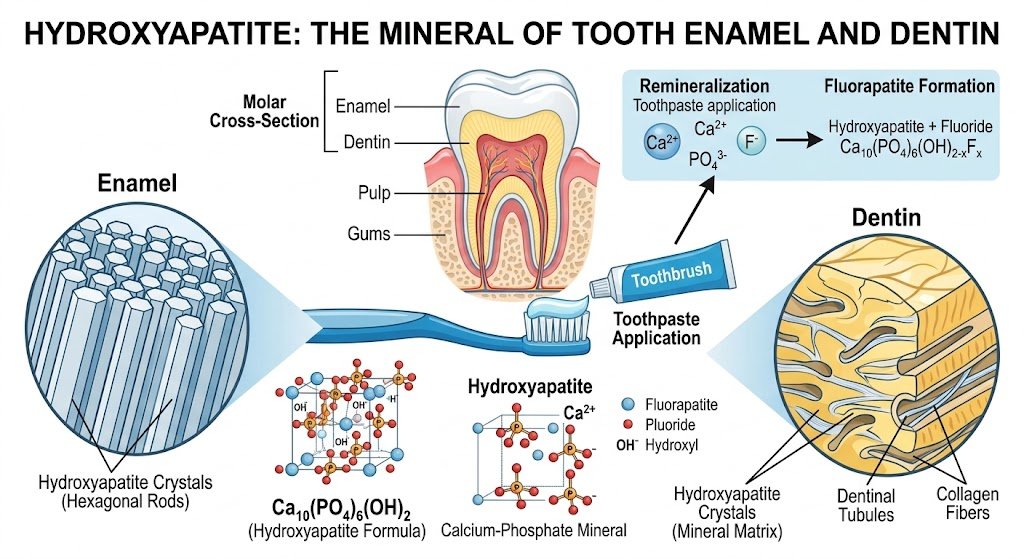
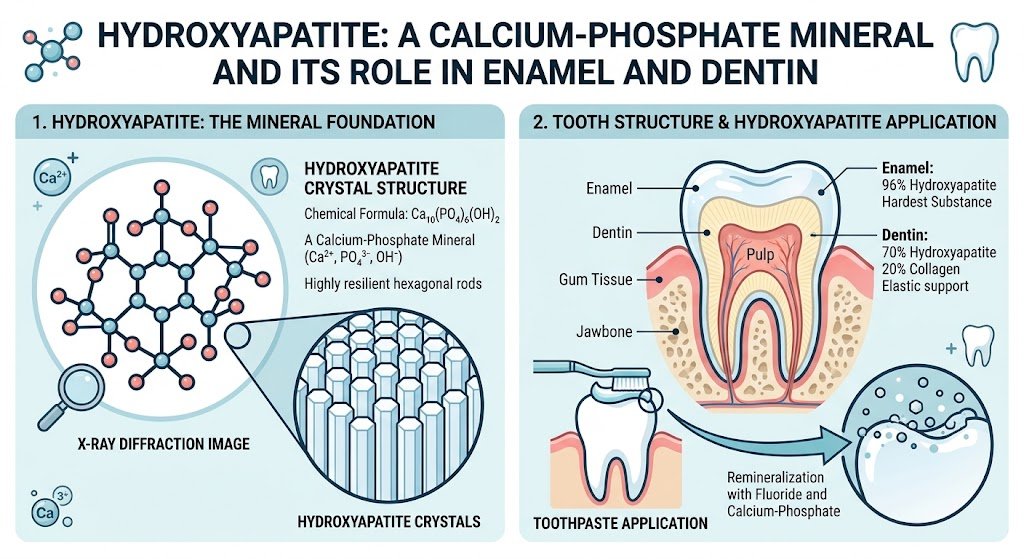
Hydroxyapatite is a calcium phosphate mineral closely related to the mineral found naturally in teeth and bones. In dentistry, the ingredient is used in oral-care products because it can interact with tooth surfaces and is being studied for applications such as remineralization and caries prevention.
Tooth enamel is largely mineral, with hydroxyapatite being an important component of that mineral structure. Dentin also contains a substantial mineral component, although its structure differs from enamel.
This relationship with natural tooth mineral is one reason hydroxyapatite has attracted interest as a toothpaste ingredient.
You may see several terms used on toothpaste labels or in research:
- Hydroxyapatite (HAp): The general material name.
- Nano-hydroxyapatite (nano-HAp): Hydroxyapatite produced with nanoscale particle characteristics.
- Calcium phosphate: A broader chemical family that includes hydroxyapatite.
- Biomimetic hydroxyapatite: A term commonly used for materials designed to resemble aspects of natural tooth mineral.
These terms should not automatically be treated as interchangeable. In particular, nano-HAp needs its own safety discussion because nanomaterials can require evaluation based on characteristics such as particle size and shape.
Is Hydroxyapatite Safe in Toothpaste?
For the hydroxyapatite materials studied in oral-care applications, the available evidence does not support treating hydroxyapatite as inherently toxic simply because it is used in toothpaste.
A 2024 systematic review and meta-analysis examined clinical evidence for hydroxyapatite-containing oral-care products. The researchers retrieved 18 studies and included 5 clinical trials and 8 in-situ trials in the meta-analysis. The review reported growing evidence for fluoride-free hydroxyapatite oral-care products and described hydroxyapatite as safe if swallowed. However, the authors’ financial disclosures are important: two authors were employed by Dr. Kurt Wolff GmbH & Co. KG, and all authors had received travel grants from the company.
That does not automatically invalidate the research. It does mean the evidence should be interpreted transparently rather than presented as completely independent.
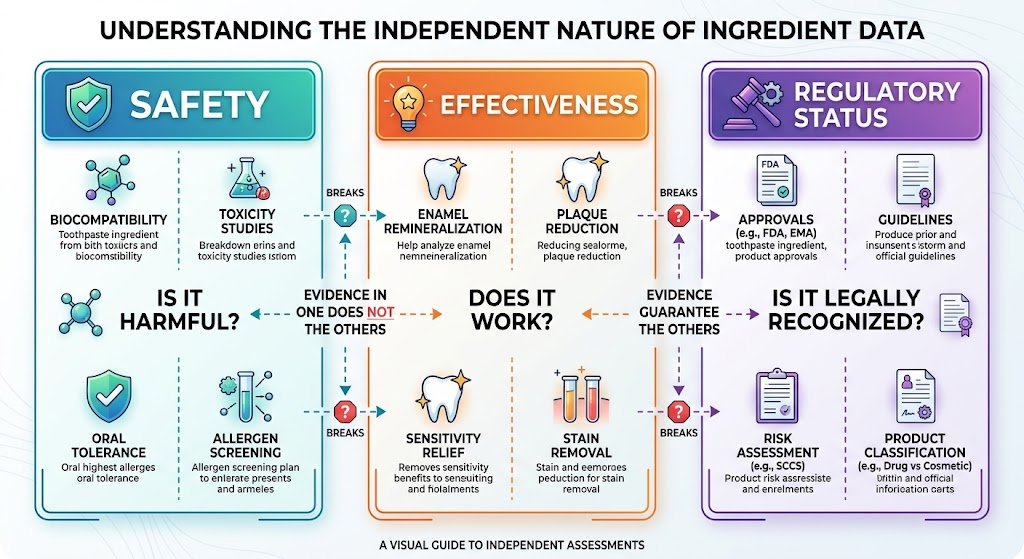
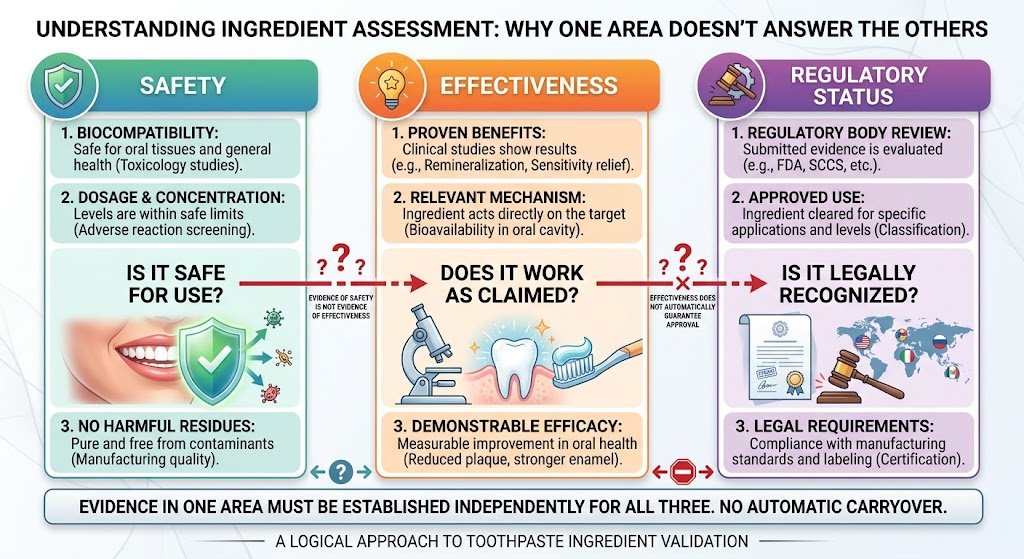
There is another important distinction: ingredient safety is not the same thing as product effectiveness or regulatory status.
A toothpaste can contain an ingredient that has a favorable safety profile without that ingredient being recognized by US regulators as an approved active ingredient for every dental claim a manufacturer might make.
This distinction becomes particularly important when evaluating hydroxyapatite toothpaste in the United States.
What About Nano-Hydroxyapatite?
Nano-hydroxyapatite deserves more specific attention because “nano” describes characteristics that can change how a material behaves and how its safety is evaluated.
The most useful evidence here is not simply a statement that “nanoparticles are safe” or “nanoparticles are dangerous.” Instead, safety assessments look at the specific material being evaluated.
In its 2025 opinion, the European Commission’s SCCS concluded that the specified nano-hydroxyapatite material was safe for use in toothpaste up to 29.5% under the assessed conditions. The evaluated material consisted of rod-shaped particles with defined aspect-ratio requirements, was uncoated and unmodified, and had a specified maximum particle length. The SCCS specifically stated that the opinion did not apply to nano-hydroxyapatite composed of or containing needle-shaped particles.
This is an important lesson for consumers:
“Nano-hydroxyapatite” is not enough information by itself to establish that two products have identical safety evidence.
The characteristics of the material matter.
Is Nano-Hydroxyapatite Safe?
Based on current regulatory evidence, certain specifically characterized forms of nano-hydroxyapatite have been considered safe for toothpaste use under defined conditions.
But that statement needs an important qualification.
The 2025 SCCS conclusion was not a blanket declaration that every possible nano-hydroxyapatite material is safe. It applied to a material with specified characteristics, including rod-shaped particles, defined aspect ratios, no coating or surface modification, and a specified particle-length range. Needle-shaped particles were outside the scope of the positive safety conclusion.
This is why a responsible article about hydroxyapatite safety should avoid two extreme claims:
“All nanoparticles are dangerous.”
and
“All nano-hydroxyapatite is completely safe.”
Neither statement accurately reflects how scientific safety assessments work.
Why Does Particle Shape Matter?
Particle shape can influence how a nanomaterial interacts with biological systems. That is one reason regulatory assessments can specify particle characteristics rather than evaluating a material based only on its chemical name.
Earlier SCCS assessments had raised concerns about needle-shaped nano-hydroxyapatite and concluded that the available evidence was insufficient for some other materials. Later assessments evaluated more specifically characterized materials and reached more favorable conclusions for defined forms.
The important takeaway is that newer safety conclusions should be read in the context of the exact material they cover.
For consumers, this means transparency from the manufacturer is useful. If a toothpaste uses nano-hydroxyapatite, the company should ideally provide clear information about the ingredient rather than relying entirely on vague “mineral toothpaste” or “non-toxic” marketing.
What Happens If You Swallow Hydroxyapatite Toothpaste?
Accidentally swallowing a small amount of toothpaste is a common practical concern, especially for children.
Research on hydroxyapatite-containing oral-care products has considered ingestion exposure, and the 2025 SCCS assessment reported that unintentionally ingested hydroxyapatite nanoparticles in the evaluated oral-care use scenario would undergo rapid dissolution in gastric fluid and did not raise a nano-specific safety concern under the conditions assessed.
However, this should not be interpreted as an instruction to swallow toothpaste.
Toothpaste is designed to be brushed onto the teeth and then spit out. The fact that an ingredient has been evaluated for accidental exposure does not mean intentional ingestion is recommended.
For children, the issue deserves particular attention because younger children may have difficulty spitting toothpaste reliably.
If someone accidentally swallows an unusual or large amount of toothpaste, particularly a child, the appropriate response depends on the product, amount, age, symptoms, and other ingredients. When there is uncertainty, contact a healthcare professional or an appropriate poison-control service rather than assuming that every toothpaste has the same risk profile.
Does Hydroxyapatite Have Side Effects?
Hydroxyapatite should not automatically be blamed for every reaction that occurs after switching toothpaste.
A toothpaste is a complete formulation, not just one active ingredient. It can contain flavoring agents, abrasives, surfactants, humectants, preservatives, sweeteners, and other ingredients.
If your mouth becomes irritated after switching to a hydroxyapatite toothpaste, the cause could potentially be another component of the formula rather than hydroxyapatite itself.
Possible problems worth paying attention to include:
- Burning or irritation in the mouth
- Unusual redness
- Peeling or soreness of oral tissues
- A reaction that repeatedly appears after using the same product
- Symptoms that improve after stopping the product and return when it is used again
That does not prove that a particular ingredient caused the reaction, but it is a reason to stop assuming that “natural” or “mineral-based” automatically means irritation-free.
What About Allergic Reactions?
True allergy to hydroxyapatite itself should not be assumed without evidence.
If you develop swelling, significant irritation, rash around the mouth, or other concerning symptoms after using a toothpaste, the full ingredient list should be considered.
Flavoring compounds and other formulation ingredients can be relevant when investigating toothpaste-related reactions.
Persistent or severe symptoms deserve professional evaluation rather than repeated experimentation with different toothpaste products.
Why the Whole Formula Matters
When comparing hydroxyapatite toothpastes, don’t stop at the words “contains hydroxyapatite.”
Look at the entire ingredient list.
Two products can use the same general active ingredient while having very different formulations.
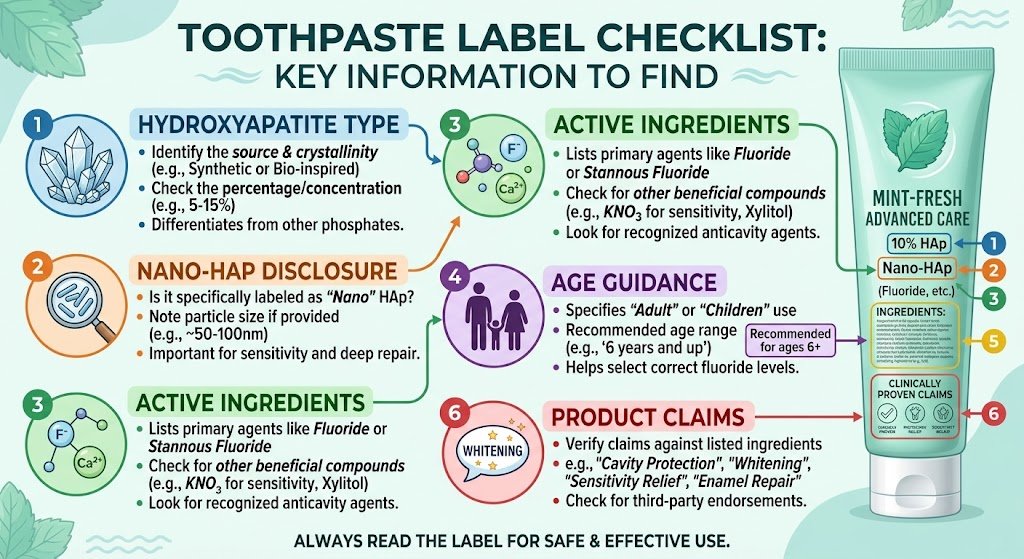
For a safety-conscious buyer, useful questions include:
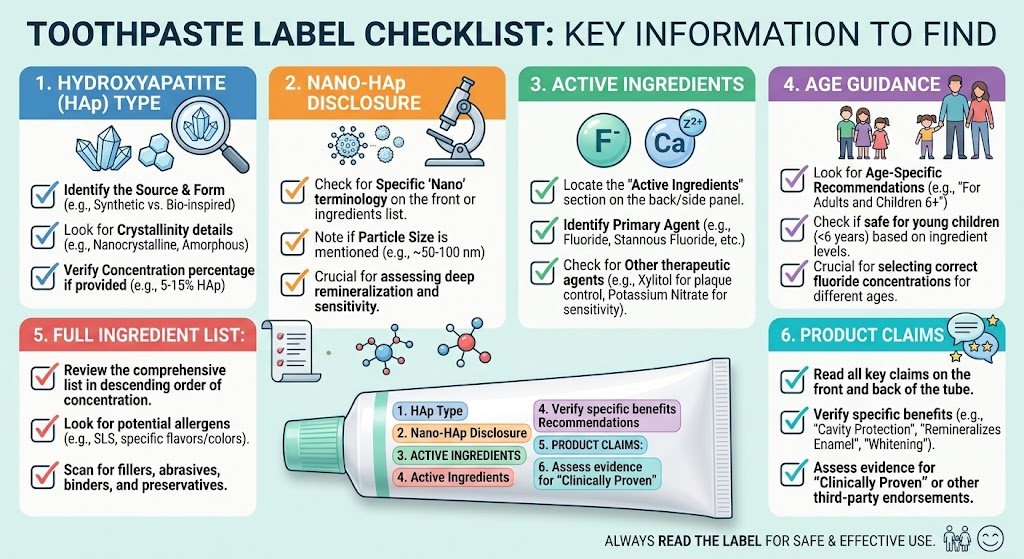
- What type of hydroxyapatite is used?
- Is it identified as nano-hydroxyapatite?
- Does the manufacturer provide meaningful information about the ingredient?
- What other active ingredients are included?
- What flavoring and surfactant ingredients are present?
- Is the product intended for adults or children?
- Are the product’s claims supported by credible evidence?
- Are the directions clear?
This approach is more useful than trying to classify an entire toothpaste as “safe” or “unsafe” based on one ingredient alone.
Is Hydroxyapatite Safer Than Fluoride?
This is where many articles oversimplify the issue.
It is tempting to say:
“Hydroxyapatite is safer because it is natural.”
But natural does not automatically mean safer, and fluoride’s safety and effectiveness have been extensively evaluated when used as directed.
The American Dental Association states that fluoride is a safe and effective agent for preventing and controlling dental caries when used as directed. The ADA also explains that fluoride helps remineralize enamel and makes tooth mineral more resistant to acid attack.
At the same time, hydroxyapatite has been investigated as a fluoride-free oral-care ingredient, and recent systematic reviews have expanded the evidence base for its potential role in caries prevention and remineralization.
The more useful comparison therefore looks like this:
| Question | Hydroxyapatite | Fluoride |
| Related to natural tooth mineral? | Yes | Interacts with tooth mineral and promotes fluoridated mineral formation |
| Used in toothpaste? | Yes | Yes |
| Available in fluoride-free formulas? | Yes | No |
| Evidence for dental use? | Growing | Extensive |
| US OTC anticaries regulatory position | Different from fluoride | Established active ingredients |
| Does formulation matter? | Yes | Yes |
| Does “natural” automatically mean safer? | No | No |
The FDA’s US OTC anticaries framework lists fluoride compounds such as sodium fluoride, sodium monofluorophosphate, and stannous fluoride as anticaries active ingredients. Hydroxyapatite is not listed as a permitted anticaries active ingredient under that monograph.
That is a regulatory distinction, not proof that hydroxyapatite is inherently unsafe.
For example, in a November 2024 warning letter, the FDA said that certain Dr. Brite oral-care products containing hydroxyapatite were being marketed as unapproved new drugs because hydroxyapatite was being used as an active ingredient for anticaries and other oral-health claims that did not conform to the applicable OTC requirements.
That should not be rewritten as “the FDA says hydroxyapatite toothpaste is dangerous.” The FDA’s action concerned the products’ regulatory status, claims, and applicable drug requirements.
This distinction is important because safety, effectiveness, and regulatory status are three different questions.
[ARTICLE CONTINUES — NEXT PART STARTS WITH: H2: “What Does the Research Say About Hydroxyapatite Safety?”]
::
Is Hydroxyapatite Safe? What the Research Says About Hydroxyapatite Toothpaste
If you are considering hydroxyapatite toothpaste, one of the first questions to ask is simple: Is hydroxyapatite safe?
For the specific hydroxyapatite materials and oral-care uses that have been evaluated, current evidence is generally reassuring. However, that does not mean every material described as “hydroxyapatite” has identical safety evidence. This is especially important with nano-hydroxyapatite, where particle size, shape, surface characteristics, concentration, and intended use can affect how the material is evaluated.
The European Commission’s Scientific Committee on Consumer Safety (SCCS), for example, concluded in 2025 that a specifically characterized form of nano-hydroxyapatite could be considered safe in toothpaste at concentrations up to 29.5% under the conditions evaluated. That conclusion applies to defined rod-shaped, uncoated, unmodified particles and does not apply to needle-shaped nano-hydroxyapatite. Public Health
So the better question is not simply “Is hydroxyapatite safe?” It is:
Which type of hydroxyapatite is being used, in what product, at what concentration, and what does the evidence say about that specific material and use?
This guide explains what current research says about hydroxyapatite safety, nano-hydroxyapatite, swallowing toothpaste, possible side effects, fluoride comparisons, and what to look for when choosing a hydroxyapatite toothpaste.
What Is Hydroxyapatite?
Hydroxyapatite is a calcium phosphate mineral closely related to the mineral found naturally in teeth and bones. In dentistry, the ingredient is used in oral-care products because it can interact with tooth surfaces and is being studied for applications such as remineralization and caries prevention.
Tooth enamel is largely mineral, with hydroxyapatite being an important component of that mineral structure. Dentin also contains a substantial mineral component, although its structure differs from enamel.
This relationship with natural tooth mineral is one reason hydroxyapatite has attracted interest as a toothpaste ingredient.
You may see several terms used on toothpaste labels or in research:
- Hydroxyapatite (HAp): The general material name.
- Nano-hydroxyapatite (nano-HAp): Hydroxyapatite produced with nanoscale particle characteristics.
- Calcium phosphate: A broader chemical family that includes hydroxyapatite.
- Biomimetic hydroxyapatite: A term commonly used for materials designed to resemble aspects of natural tooth mineral.
These terms should not automatically be treated as interchangeable. In particular, nano-HAp needs its own safety discussion because nanomaterials can require evaluation based on characteristics such as particle size and shape.
Is Hydroxyapatite Safe in Toothpaste?
For the hydroxyapatite materials studied in oral-care applications, the available evidence does not support treating hydroxyapatite as inherently toxic simply because it is used in toothpaste.
A 2024 systematic review and meta-analysis examined clinical evidence for hydroxyapatite-containing oral-care products. The researchers retrieved 18 studies and included 5 clinical trials and 8 in-situ trials in the meta-analysis. The review reported growing evidence for fluoride-free hydroxyapatite oral-care products and described hydroxyapatite as safe if swallowed. However, the authors’ financial disclosures are important: two authors were employed by Dr. Kurt Wolff GmbH & Co. KG, and all authors had received travel grants from the company. PubMed
That does not automatically invalidate the research. It does mean the evidence should be interpreted transparently rather than presented as completely independent.
There is another important distinction: ingredient safety is not the same thing as product effectiveness or regulatory status.
A toothpaste can contain an ingredient that has a favorable safety profile without that ingredient being recognized by US regulators as an approved active ingredient for every dental claim a manufacturer might make.
This distinction becomes particularly important when evaluating hydroxyapatite toothpaste in the United States.
What About Nano-Hydroxyapatite?
Nano-hydroxyapatite deserves more specific attention because “nano” describes characteristics that can change how a material behaves and how its safety is evaluated.
The most useful evidence here is not simply a statement that “nanoparticles are safe” or “nanoparticles are dangerous.” Instead, safety assessments look at the specific material being evaluated.
In its 2025 opinion, the European Commission’s SCCS concluded that the specified nano-hydroxyapatite material was safe for use in toothpaste up to 29.5% under the assessed conditions. The evaluated material consisted of rod-shaped particles with defined aspect-ratio requirements, was uncoated and unmodified, and had a specified maximum particle length. The SCCS specifically stated that the opinion did not apply to nano-hydroxyapatite composed of or containing needle-shaped particles. Public Health
This is an important lesson for consumers:
“Nano-hydroxyapatite” is not enough information by itself to establish that two products have identical safety evidence.
The characteristics of the material matter.
Is Nano-Hydroxyapatite Safe?
Based on current regulatory evidence, certain specifically characterized forms of nano-hydroxyapatite have been considered safe for toothpaste use under defined conditions.
But that statement needs an important qualification.
The 2025 SCCS conclusion was not a blanket declaration that every possible nano-hydroxyapatite material is safe. It applied to a material with specified characteristics, including rod-shaped particles, defined aspect ratios, no coating or surface modification, and a specified particle-length range. Needle-shaped particles were outside the scope of the positive safety conclusion. Public Health
This is why a responsible article about hydroxyapatite safety should avoid two extreme claims:
“All nanoparticles are dangerous.”
and
“All nano-hydroxyapatite is completely safe.”
Neither statement accurately reflects how scientific safety assessments work.
Why Does Particle Shape Matter?
Particle shape can influence how a nanomaterial interacts with biological systems. That is one reason regulatory assessments can specify particle characteristics rather than evaluating a material based only on its chemical name.
Earlier SCCS assessments had raised concerns about needle-shaped nano-hydroxyapatite and concluded that the available evidence was insufficient for some other materials. Later assessments evaluated more specifically characterized materials and reached more favorable conclusions for defined forms. Public Health
The important takeaway is that newer safety conclusions should be read in the context of the exact material they cover.
For consumers, this means transparency from the manufacturer is useful. If a toothpaste uses nano-hydroxyapatite, the company should ideally provide clear information about the ingredient rather than relying entirely on vague “mineral toothpaste” or “non-toxic” marketing.
What Happens If You Swallow Hydroxyapatite Toothpaste?
Accidentally swallowing a small amount of toothpaste is a common practical concern, especially for children.
Research on hydroxyapatite-containing oral-care products has considered ingestion exposure, and the 2025 SCCS assessment reported that unintentionally ingested hydroxyapatite nanoparticles in the evaluated oral-care use scenario would undergo rapid dissolution in gastric fluid and did not raise a nano-specific safety concern under the conditions assessed. Public Health
However, this should not be interpreted as an instruction to swallow toothpaste.
Toothpaste is designed to be brushed onto the teeth and then spit out. The fact that an ingredient has been evaluated for accidental exposure does not mean intentional ingestion is recommended.
For children, the issue deserves particular attention because younger children may have difficulty spitting toothpaste reliably.
If someone accidentally swallows an unusual or large amount of toothpaste, particularly a child, the appropriate response depends on the product, amount, age, symptoms, and other ingredients. When there is uncertainty, contact a healthcare professional or an appropriate poison-control service rather than assuming that every toothpaste has the same risk profile.
Does Hydroxyapatite Have Side Effects?
Hydroxyapatite should not automatically be blamed for every reaction that occurs after switching toothpaste.
A toothpaste is a complete formulation, not just one active ingredient. It can contain flavoring agents, abrasives, surfactants, humectants, preservatives, sweeteners, and other ingredients.
If your mouth becomes irritated after switching to a hydroxyapatite toothpaste, the cause could potentially be another component of the formula rather than hydroxyapatite itself.
Possible problems worth paying attention to include:
- Burning or irritation in the mouth
- Unusual redness
- Peeling or soreness of oral tissues
- A reaction that repeatedly appears after using the same product
- Symptoms that improve after stopping the product and return when it is used again
That does not prove that a particular ingredient caused the reaction, but it is a reason to stop assuming that “natural” or “mineral-based” automatically means irritation-free.
What About Allergic Reactions?
True allergy to hydroxyapatite itself should not be assumed without evidence.
If you develop swelling, significant irritation, rash around the mouth, or other concerning symptoms after using a toothpaste, the full ingredient list should be considered.
Flavoring compounds and other formulation ingredients can be relevant when investigating toothpaste-related reactions.
Persistent or severe symptoms deserve professional evaluation rather than repeated experimentation with different toothpaste products.
Why the Whole Formula Matters
When comparing hydroxyapatite toothpastes, don’t stop at the words “contains hydroxyapatite.”
Look at the entire ingredient list.
Two products can use the same general active ingredient while having very different formulations.
For a safety-conscious buyer, useful questions include:
- What type of hydroxyapatite is used?
- Is it identified as nano-hydroxyapatite?
- Does the manufacturer provide meaningful information about the ingredient?
- What other active ingredients are included?
- What flavoring and surfactant ingredients are present?
- Is the product intended for adults or children?
- Are the product’s claims supported by credible evidence?
- Are the directions clear?
This approach is more useful than trying to classify an entire toothpaste as “safe” or “unsafe” based on one ingredient alone.
Is Hydroxyapatite Safer Than Fluoride?
This is where many articles oversimplify the issue.
It is tempting to say:
“Hydroxyapatite is safer because it is natural.”
But natural does not automatically mean safer, and fluoride’s safety and effectiveness have been extensively evaluated when used as directed.
The American Dental Association states that fluoride is a safe and effective agent for preventing and controlling dental caries when used as directed. The ADA also explains that fluoride helps remineralize enamel and makes tooth mineral more resistant to acid attack. ADA
At the same time, hydroxyapatite has been investigated as a fluoride-free oral-care ingredient, and recent systematic reviews have expanded the evidence base for its potential role in caries prevention and remineralization. PubMed
The more useful comparison therefore looks like this:
| Question | Hydroxyapatite | Fluoride |
| Related to natural tooth mineral? | Yes | Interacts with tooth mineral and promotes fluoridated mineral formation |
| Used in toothpaste? | Yes | Yes |
| Available in fluoride-free formulas? | Yes | No |
| Evidence for dental use? | Growing | Extensive |
| US OTC anticaries regulatory position | Different from fluoride | Established active ingredients |
| Does formulation matter? | Yes | Yes |
| Does “natural” automatically mean safer? | No | No |
The FDA’s US OTC anticaries framework lists fluoride compounds such as sodium fluoride, sodium monofluorophosphate, and stannous fluoride as anticaries active ingredients. Hydroxyapatite is not listed as a permitted anticaries active ingredient under that monograph. ADA
That is a regulatory distinction, not proof that hydroxyapatite is inherently unsafe.
For example, in a November 2024 warning letter, the FDA said that certain Dr. Brite oral-care products containing hydroxyapatite were being marketed as unapproved new drugs because hydroxyapatite was being used as an active ingredient for anticaries and other oral-health claims that did not conform to the applicable OTC requirements. U.S. Food and Drug Administration
That should not be rewritten as “the FDA says hydroxyapatite toothpaste is dangerous.” The FDA’s action concerned the products’ regulatory status, claims, and applicable drug requirements.
This distinction is important because safety, effectiveness, and regulatory status are three different questions.
[ARTICLE CONTINUES — NEXT PART STARTS WITH: H2: “What Does the Research Say About Hydroxyapatite Safety?”]
::
:
What Does the Research Say About Hydroxyapatite Safety?
When evaluating hydroxyapatite safety, it helps to separate safety research from research asking whether hydroxyapatite works.
A study showing that hydroxyapatite can help with remineralization or caries prevention does not automatically prove every possible hydroxyapatite formulation is safe. Likewise, a regulatory safety assessment of a specific nano-hydroxyapatite material should not automatically be applied to every material sold under the same general name.
The strongest approach is to look at several types of evidence together:
- Laboratory research
- In-situ studies
- Human clinical trials
- Systematic reviews
- Toxicological assessments
- Regulatory safety evaluations
Recent research has expanded the evidence base for hydroxyapatite-containing oral-care products. A 2024 systematic review and meta-analysis evaluated clinical evidence for hydroxyapatite in caries prevention and included multiple clinical and in-situ studies. The authors concluded that the evidence for fluoride-free hydroxyapatite oral-care products has grown and that hydroxyapatite shows potential as an anticaries active ingredient. (pubmed.ncbi.nlm.nih.gov)
A separate 2025 systematic review examined fluoride-free hydroxyapatite toothpaste for preventing progression and supporting remineralization of initial caries lesions. The review found promising evidence but also noted the limited number of eligible in-situ randomized controlled trials, which means the evidence should not be treated as unlimited or definitive. (pubmed.ncbi.nlm.nih.gov)
What Does This Mean for Safety?
The overall picture is more reassuring than alarming for the hydroxyapatite materials and uses that have actually been evaluated.
But there are still important limits.
Research does not justify statements such as:
- “Every hydroxyapatite toothpaste is completely safe.”
- “Nano-hydroxyapatite has zero risks.”
- “Hydroxyapatite is safer than every other toothpaste ingredient.”
- “More hydroxyapatite always means a safer or better product.”
A responsible conclusion is narrower:
Current evidence supports the safety of specific hydroxyapatite materials used in studied oral-care applications, while safety conclusions should remain tied to the material, formulation, concentration, and intended use.
That is especially important when discussing nano-hydroxyapatite because regulatory assessments have defined which particle characteristics fall within their conclusions.
What About Research Limitations?
Hydroxyapatite research has several limitations worth understanding.
First, not every study asks the same question. Some investigate enamel remineralization, some examine caries lesions, and others focus on sensitivity or dentinal tubule occlusion. These results should not automatically be treated as toxicology evidence.
Second, different products may use different formulations. A clinical result from one toothpaste cannot automatically be transferred to every product containing hydroxyapatite.
Third, some published research has disclosed financial relationships with manufacturers. That does not make the research unusable, but it is a reason to consider the total evidence rather than relying on a single favorable study.
For a consumer, this means evidence quality matters more than marketing language.
Is Hydroxyapatite Toothpaste Safe for Children?
Children require extra care when evaluating any toothpaste because they may swallow more toothpaste than adults.
The question is therefore not only:
“Is hydroxyapatite safe?”
It is also:
“Is this particular toothpaste appropriate for this child’s age, use pattern, and dental needs?”
That distinction matters.
A hydroxyapatite toothpaste marketed for adults should not automatically be assumed to be appropriate for a young child simply because the active ingredient itself has a favorable safety profile.
Parents should check:
- The product’s recommended age
- Directions for use
- Whether the child can reliably spit
- The complete ingredient list
- The manufacturer’s guidance
- The child’s individual cavity risk
- Advice from the child’s dentist
It is also important not to assume that fluoride-free automatically means safer for children.
Fluoride has an extensive evidence base for preventing dental caries, and the ADA recommends fluoride toothpaste for routine cavity prevention when used appropriately. (ada.org)
Parents considering a fluoride-free hydroxyapatite toothpaste should therefore make the decision based on the child’s individual needs rather than treating “natural” or “fluoride-free” as a universal safety advantage.
For a child with a high risk of cavities, previous dental decay, or other oral-health concerns, a dentist can help determine which toothpaste and fluoride strategy is appropriate.
How to Choose a Safe Hydroxyapatite Toothpaste
Once you understand the evidence, choosing a product becomes much easier.
Instead of looking for a toothpaste that simply says “non-toxic” or “natural,” evaluate the actual formulation.
1. Check What Type of Hydroxyapatite It Uses
Look at the ingredient list and product information.
Does the manufacturer identify:
- Hydroxyapatite?
- Nano-hydroxyapatite?
- Another calcium-phosphate ingredient?
If the product specifically uses nano-hydroxyapatite, look for meaningful information about the material rather than relying on the word “nano” as either a positive or negative signal.
The goal is transparency.
2. Look at the Whole Ingredient List
Hydroxyapatite is only one component of a toothpaste formula.
Depending on the product, you may also find:
- Flavoring agents
- Surfactants
- Humectants
- Sweeteners
- Abrasives
- Preservatives
- Other active ingredients
If you have a history of mouth irritation or sensitivity to toothpaste ingredients, the complete formula may matter more to you than whether the product uses hydroxyapatite.
3. Understand the Fluoride Status
Some hydroxyapatite toothpastes are fluoride-free. Others may combine hydroxyapatite with fluoride or other active ingredients.
Don’t assume that one approach is automatically appropriate for everyone.
If your main concern is cavity prevention, consider your individual risk and the established role of fluoride. If you specifically want a fluoride-free toothpaste, hydroxyapatite may be one category worth researching.
The decision should be based on your oral-health needs, not simply on the label “clean” or “non-toxic.”
4. Look for Clear Product Information
A trustworthy manufacturer should make it reasonably easy to understand:
- What the product contains
- Who it is intended for
- How it should be used
- What claims it makes
- What type of hydroxyapatite it uses, where relevant
Be more cautious about products that make broad claims such as:
- “100% toxin-free”
- “No chemicals”
- “Guaranteed to rebuild teeth”
- “Completely risk-free”
- “Better than fluoride for everyone”
These phrases are not substitutes for evidence.
5. Consider Your Specific Dental Need
A safe toothpaste is not necessarily the right toothpaste for every person.
For example:
If your main concern is sensitivity:
You may want a formula specifically designed for sensitive teeth and should also consider its abrasivity and other desensitizing ingredients.
If your main concern is cavities:
Look at the evidence for the toothpaste’s active ingredients and consider your personal cavity risk.
If you have frequent mouth irritation:
Review the complete ingredient list and consider whether flavoring agents or surfactants could be contributing to the problem.
If you are buying for a child:
Pay close attention to age guidance, swallowing behavior, and professional dental advice.
If you want fluoride-free toothpaste:
Hydroxyapatite can be a category to investigate, but don’t confuse a fluoride-free preference with proof that every fluoride-free product is superior.
6. Don’t Assume a Higher Amount Is Automatically Better
More of an ingredient is not automatically better.
Safety assessments and clinical evidence are generally connected to particular concentrations and formulations.
For nano-hydroxyapatite, this is especially important because the 2025 SCCS opinion applies to a specific material and concentration range under defined conditions. (health.ec.europa.eu)
If a product provides clear formulation information, that can make it easier to compare it with the evidence.
7. Consider Abrasivity
Hydroxyapatite itself doesn’t tell you how abrasive an entire toothpaste will be.
A toothpaste can contain hydroxyapatite and still contain other abrasive components.
If you have sensitive teeth, enamel wear, gum recession, or another reason to be cautious about abrasion, consider choosing a product designed for gentle daily cleaning.
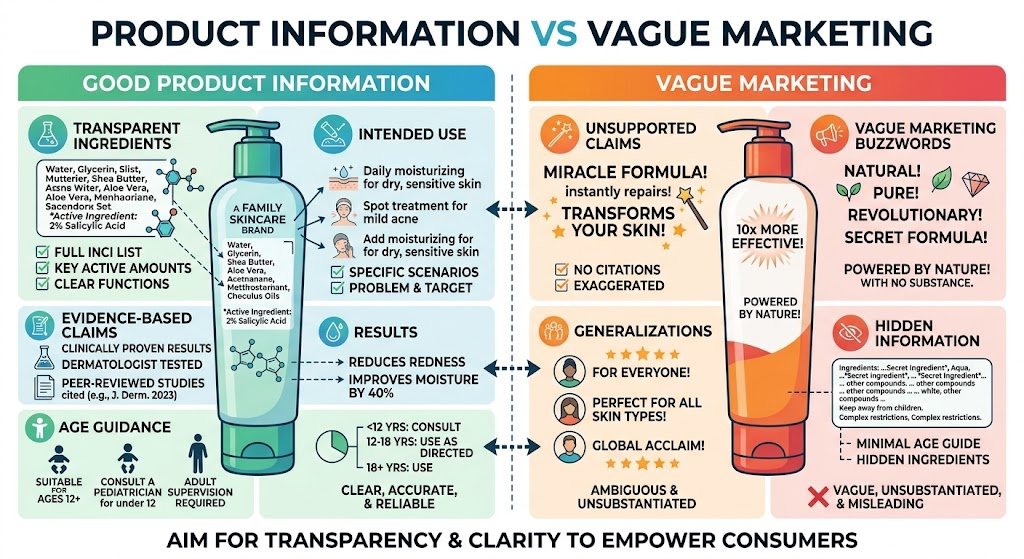
8. Look for Evidence, Not Just Marketing
A useful product page should make it possible to understand what the manufacturer is actually claiming.
Ideally, you should be able to distinguish between:
What is known
and
What the company is claiming.
For example, “contains hydroxyapatite” is a straightforward ingredient statement.
“Guaranteed to rebuild damaged teeth” is a much stronger claim and should require much stronger evidence.
This distinction helps prevent marketing language from becoming a substitute for scientific evidence.
Hydroxyapatite Toothpaste Safety Checklist
Before buying a hydroxyapatite toothpaste, use this quick checklist:
- The exact hydroxyapatite ingredient is identified.
- Nano-hydroxyapatite is clearly disclosed if used.
- The manufacturer provides useful product information.
- The full ingredient list is available.
- The intended age is clearly stated.
- Directions for use are easy to find.
- The product does not rely entirely on exaggerated “non-toxic” claims.
- You have considered the toothpaste’s fluoride status.
- You have considered other active ingredients.
- The formula fits your particular oral-health needs.
- You understand what the available research actually supports.
This checklist can also help when comparing several products on Amazon. Instead of choosing based only on star ratings or attractive packaging, compare the actual formulation and claims.
When Does a Hydroxyapatite Toothpaste Become a Product Worth Considering?
This is the point where product research becomes useful.
If you have decided that you want to explore hydroxyapatite toothpaste, look for products that make the important information easy to verify.
You can start by comparing:
- Hydroxyapatite type
- Nano-HAp disclosure
- Fluoride status
- Other active ingredients
- Full ingredient list
- Intended user
- Sensitivity-related features
- Abrasivity information where available
- Manufacturer transparency
- Current price and package size
If you prefer nano-hydroxyapatite specifically, compare the products using the same criteria rather than assuming that every nano-HAp toothpaste has identical characteristics.
The goal is not to find a toothpaste with the most impressive marketing language. It is to find a product whose formulation, intended use, evidence, and your own dental needs line up.
When Should You Talk to a Dentist Instead of Switching Toothpaste?
Hydroxyapatite toothpaste can be part of an oral-care routine, but it cannot diagnose or treat every reason a tooth might hurt.
If you have persistent or severe dental symptoms, switching toothpaste should not be your only response.
Consider professional dental evaluation if you experience:
- Persistent tooth pain
- Severe or worsening sensitivity
- Pain that occurs without an obvious trigger
- Pain when biting or chewing
- Facial or gum swelling
- A suspected cracked tooth
- Signs of a cavity
- Persistent gum problems
- Symptoms that do not improve after changing toothpaste
Tooth sensitivity can have several causes, including exposed dentin, gum recession, enamel wear, cavities, cracked teeth, or other dental problems. The correct solution depends on the cause.
A toothpaste may help with symptoms in some situations, but it cannot replace diagnosis when an underlying dental problem is present.
FAQs About Hydroxyapatite Safety
Is hydroxyapatite safe in toothpaste?
Current evidence is generally reassuring for the hydroxyapatite materials and oral-care applications that have been studied. However, safety should be considered in relation to the specific material, formulation, concentration, and intended use rather than assuming every hydroxyapatite product is identical.
Is nano-hydroxyapatite safe?
Certain specifically characterized nano-hydroxyapatite materials have received favorable safety assessments. In 2025, the European Commission’s SCCS concluded that a specified rod-shaped, uncoated and unmodified nano-HAp material could be considered safe in toothpaste up to 29.5% under the conditions assessed. The conclusion did not apply to needle-shaped particles. (health.ec.europa.eu)
Can you swallow hydroxyapatite toothpaste?
Toothpaste should still be used as directed and generally spit out after brushing. Research has evaluated accidental oral exposure to hydroxyapatite, but that does not mean intentionally swallowing toothpaste is recommended. If a child or adult swallows a large or unusual amount, seek appropriate professional or poison-control guidance.
Does hydroxyapatite toothpaste have side effects?
Hydroxyapatite has not been established as a broadly harmful toothpaste ingredient based on the available evidence. However, people can react to individual toothpaste formulations, and symptoms such as mouth irritation may involve other ingredients such as flavoring agents or surfactants. Persistent reactions should be discussed with a dental or medical professional.
Is hydroxyapatite safer than fluoride?
There is no simple universal answer. Fluoride has a long history of research and established use for cavity prevention when used as directed. Hydroxyapatite is also being studied and is used in fluoride-free toothpaste. Safety, effectiveness, and regulatory status are separate questions, so a claim that one ingredient is simply “safer” for everyone oversimplifies the evidence.
Is hydroxyapatite toothpaste safe for children?
The answer depends on the particular product, the child’s age, the formulation, swallowing behavior, and the child’s dental needs. Parents should follow the product’s age and use directions and consider professional dental guidance, especially when choosing fluoride-free toothpaste for a child with elevated cavity risk.
Is hydroxyapatite FDA approved?
This question needs careful wording. The FDA’s OTC anticaries monograph specifies certain fluoride compounds as permitted anticaries active ingredients. Hydroxyapatite is not listed as an OTC anticaries active ingredient in that monograph. This is a regulatory distinction and should not be interpreted as proof that hydroxyapatite itself is unsafe. (fda.gov)
Is hydroxyapatite safe for long-term use?
Available research is reassuring for studied oral-care applications, but it is better to avoid claiming that every hydroxyapatite formulation has been proven safe for unlimited long-term use. Evidence depends on the specific material and formulation. Choosing a transparent product and following its directions is more appropriate than assuming that all products containing hydroxyapatite are identical.
Bottom Line: Is Hydroxyapatite Safe?
For the hydroxyapatite materials and oral-care applications that have been studied, current evidence is generally reassuring.
But “hydroxyapatite is safe” should not be treated as a blanket statement covering every possible material, concentration, formulation, or product claim.
The distinction becomes particularly important with nano-hydroxyapatite. Current European safety evidence supports specific rod-shaped nano-HAp material under defined conditions, while other particle types are not automatically covered by that conclusion.
When choosing a hydroxyapatite toothpaste, look beyond the front of the package. Check the exact ingredient, the full formulation, intended age, fluoride status, manufacturer information, and the evidence behind the product’s claims.
And remember that safety is only one part of the decision. You also need to consider whether the toothpaste is appropriate for your cavity risk, sensitivity, oral-health needs, and personal preferences.
If you want to explore products, compare them based on evidence and formulation rather than simply choosing the one with the strongest “natural” or “non-toxic” marketing.
