Sensitive teeth can make ordinary things—cold water, ice cream, hot drinks, or even cool air—uncomfortable. If you’re looking for a gentler toothpaste option, you may have come across hydroxyapatite for sensitive teeth.
This guide explains why teeth become sensitive, how hydroxyapatite may help, what the research shows, how it compares with other sensitivity ingredients, and what to look for when choosing a hydroxyapatite toothpaste.
What Causes Sensitive Teeth?
To understand why hydroxyapatite may help, it first helps to understand what is actually causing the sensitivity.
What Is Dentin Hypersensitivity?
Dentin hypersensitivity is the sharp, short-lasting discomfort that can occur when exposed tooth surfaces react to stimuli such as cold, heat, touch, or certain foods and drinks.
Dentin sits underneath the enamel and contains microscopic channels called dentinal tubules. When dentin becomes exposed, these tubules can provide a pathway through which external stimuli affect the sensitive structures inside the tooth.
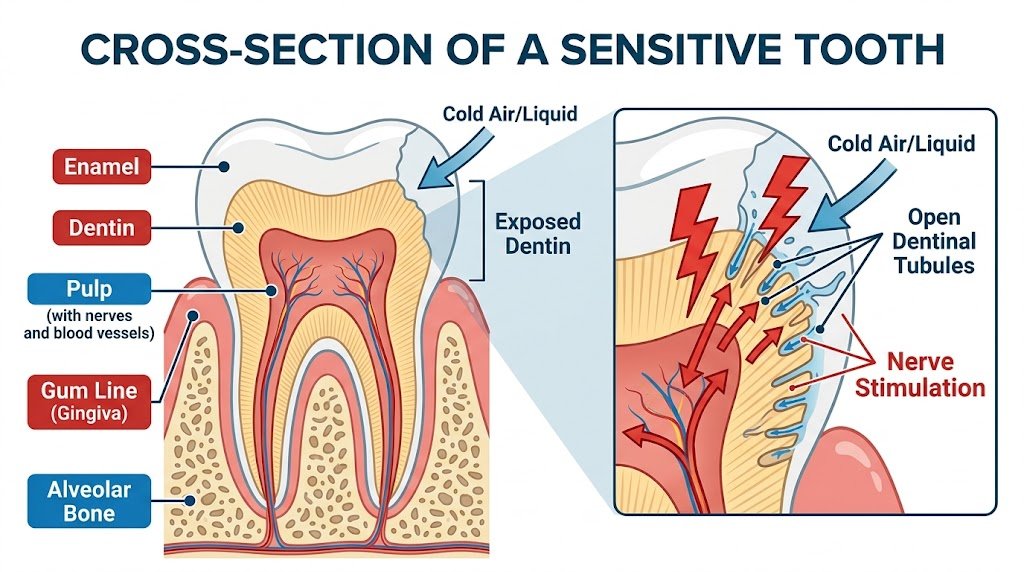
One commonly discussed explanation is that movement of fluid within these tubules can stimulate nerves inside the tooth. This is why a sip of cold water may produce a sudden “zing” when dentin is exposed.
Why Does Dentin Become Exposed?
Several situations can contribute to exposed dentin, including:
- Gum recession
- Enamel wear
- Acid erosion
- Aggressive or abrasive brushing
- Tooth wear around the gumline
- Some dental procedures
- Other forms of tooth-surface loss
Sensitivity does not always have one single cause. A person with sensitivity from gum recession may have a different underlying problem from someone whose tooth hurts because of decay or a cracked tooth.
That distinction matters because toothpaste can help manage sensitivity, but it cannot diagnose the reason a particular tooth hurts.
If sensitivity is severe, persistent, worsening, occurs in only one tooth, or is accompanied by swelling or other unusual symptoms, a dental examination is more appropriate than simply switching toothpaste.
Why Dentinal Tubules Matter
For hydroxyapatite, dentinal tubules are particularly important.
If a toothpaste ingredient can deposit mineral material over exposed dentin and reduce the openness or permeability of these tubules, it may reduce the ability of external stimuli to trigger sensitivity.
That is one of the main reasons researchers have investigated hydroxyapatite for sensitive teeth.
What Is Hydroxyapatite?
Hydroxyapatite is a calcium-phosphate mineral associated with the mineral structure of human teeth and bones.
In teeth, hydroxyapatite-related mineral makes up much of the hard mineral component of enamel and contributes to the structure of dentin.
Because of this similarity to natural tooth mineral, hydroxyapatite has attracted interest as an ingredient in oral-care products.
Hydroxyapatite and Natural Tooth Mineral
Hydroxyapatite toothpaste is not simply ordinary toothpaste with a different name. The ingredient is intended to interact with mineralized tooth surfaces.
In the context of sensitivity, the important question is not just:
“Does hydroxyapatite exist naturally in teeth?”
The more useful question is:
Can hydroxyapatite-containing toothpaste interact with exposed dentin in a way that reduces sensitivity?
That is what clinical and laboratory research has investigated.
What Is Nano-Hydroxyapatite?
You may also see nano-hydroxyapatite, sometimes abbreviated as n-HAp, on toothpaste labels.
“ Nano” refers to the scale of the particles. It does not automatically mean that a toothpaste will be better simply because it contains the word “nano.”
Researchers have investigated nano-hydroxyapatite for dentin hypersensitivity, including whether very small particles can interact with or deposit within areas associated with sensitivity.
The important point for shoppers is that particle size is only one part of a toothpaste formulation. The complete ingredient list, concentration, formulation, intended use, and evidence behind the product also matter.
How Can Hydroxyapatite Help Sensitive Teeth?
The main reason hydroxyapatite is interesting for sensitive teeth is its potential interaction with exposed dentin and dentinal tubules.
Hydroxyapatite and Dentinal Tubules
When dentin is exposed, its microscopic tubules can become accessible to the oral environment.
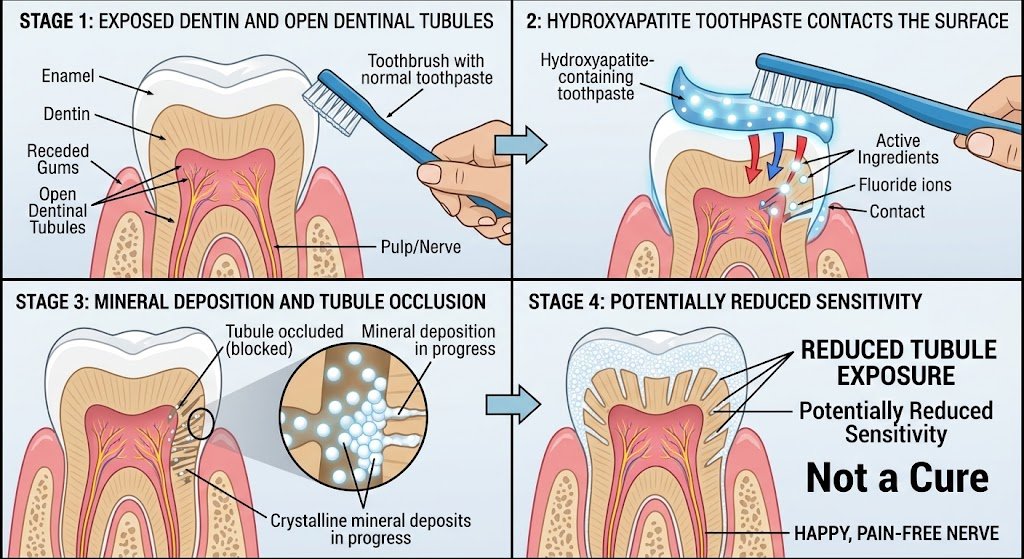
Research on hydroxyapatite-containing oral-care products has investigated whether mineral particles can deposit on these surfaces and contribute to tubule occlusion.
In simple terms:
Exposed dentin → open or accessible tubules → external stimulus → sensitivity
Hydroxyapatite is being studied as one way of changing that surface:
Hydroxyapatite-containing toothpaste → mineral interaction with exposed dentin → tubule occlusion/decreased permeability → potentially less sensitivity
This does not mean that every product completely seals every tubule or that sensitivity disappears immediately. The actual effect depends on the formulation and the individual situation.
How Tubule Occlusion May Reduce Sensitivity
The proposed mechanism is relatively straightforward.
If the openings of exposed dentinal tubules become covered or blocked by mineral material, movement of fluid through those tubules may be reduced.
Less fluid movement can mean less stimulation from certain external triggers.
That gives hydroxyapatite a different role from simply making the toothpaste taste pleasant or providing a polishing effect.
Its potential value is related to its interaction with the mineralized tooth surface.
Hydroxyapatite and Mineral Interaction
Hydroxyapatite is also relevant because sensitive areas may be associated with mineral loss or exposed tooth surfaces.
A hydroxyapatite-containing toothpaste can provide a source of calcium-phosphate mineral at the tooth surface. Research has investigated whether this contributes to mineral deposition and surface repair at a microscopic level.
However, it is important to use the word remineralization carefully.
Remineralization does not mean that a toothpaste can grow back a large piece of tooth that has physically been lost.
If enamel or tooth structure has been substantially worn away, toothpaste cannot simply recreate the original tooth structure.
The more realistic discussion is about surface mineral interaction, mineral deposition, and reducing factors associated with sensitivity.
Does Hydroxyapatite Toothpaste Actually Reduce Sensitivity?
This is one of the most important questions because an ingredient can sound scientifically interesting without necessarily producing a meaningful benefit for people.
The available research is encouraging, but it should be interpreted carefully.
These findings make hydroxyapatite a legitimate ingredient to consider—not merely a marketing concept.
But there are important limitations.
Research Does Not Mean Every Product Works the Same
Studies may use different:
- Hydroxyapatite formulations
- Particle sizes
- Concentrations
- Brushing protocols
- Comparison products
- Study durations
- Sensitivity measurements
- Patient populations
So you should not automatically assume that the results from one specific study apply identically to every toothpaste sold online.
This is especially important when shopping on Amazon, where products can use similar terminology while having substantially different formulations.
Evidence Should Be Interpreted Alongside the Product Formula
A better question than:
“Does hydroxyapatite work?”
is:
“What does the evidence say about hydroxyapatite, and does the specific toothpaste I’m considering contain a formulation that makes sense for my needs?”
That distinction keeps the article evidence-based while still helping you make a practical purchasing decision.
Hydroxyapatite vs Fluoride for Sensitive Teeth
Hydroxyapatite and fluoride are often presented as if consumers have to choose one because one is “natural” and the other is not.
That is too simplistic.
They have different roles and should be evaluated according to the person’s oral-health needs.
What Fluoride Does
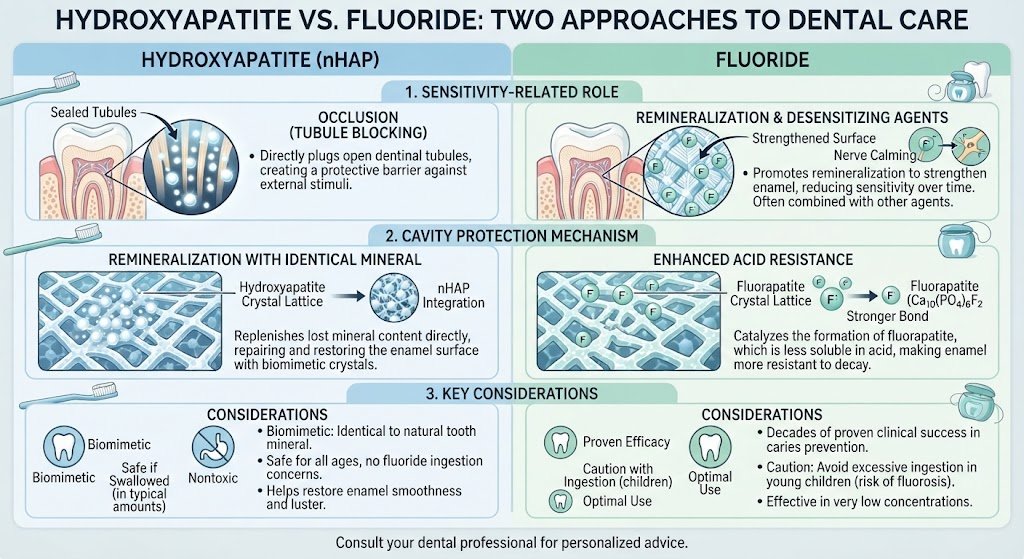
Fluoride is an established anticaries ingredient used in toothpaste to help prevent tooth decay.
That makes fluoride particularly important for people who have meaningful cavity risk.
What Hydroxyapatite Does
Hydroxyapatite is being studied for several interactions with tooth surfaces, including its potential role in remineralization and dentin hypersensitivity.
For sensitive teeth, the relevant mechanism is its potential to interact with exposed dentin and reduce dentinal-tubule permeability or occlude tubules.
So the two ingredients should not be described as identical substitutes.
Can You Use a Fluoride Toothpaste Instead?
Yes. A fluoride toothpaste can also be an appropriate choice for someone with sensitive teeth, particularly when cavity prevention is an important priority.
Some fluoride formulations also contain ingredients specifically used for sensitivity.
This means a shopper should not assume:
fluoride = bad for sensitivity
or:
hydroxyapatite = automatically better than fluoride.
The better decision depends on the person’s oral-health needs and the formulation being considered.
What About Fluoride-Free Hydroxyapatite Toothpaste?
Fluoride-free hydroxyapatite toothpaste may appeal to consumers who specifically want a fluoride-free formulation.
However, choosing fluoride-free toothpaste means you should understand what you are giving up in terms of the established cavity-prevention role of fluoride.
This is particularly important for people with higher cavity risk.
The goal should not be to choose a toothpaste based on a single ingredient being fashionable or controversial. The goal is to choose a formulation that matches your actual oral-health priorities.
Hydroxyapatite vs Other Sensitive-Teeth Ingredients
Hydroxyapatite is not the only ingredient used in products designed for sensitive teeth.
Understanding the alternatives makes it easier to decide whether a hydroxyapatite toothpaste is actually the right fit.
| Ingredient | Main role | What to consider |
| Hydroxyapatite | Mineral interaction and potential tubule occlusion | Research supports its investigation for dentin hypersensitivity |
| Potassium nitrate | Desensitizing ingredient | Commonly used in sensitivity-focused toothpaste |
| Stannous fluoride | Fluoride plus sensitivity-related benefits | Can provide cavity protection while addressing sensitivity |
| Arginine | Desensitizing approach | Used in some sensitivity toothpaste formulations |
| Combination formulas | Multiple mechanisms | Evaluate the complete formula rather than one ingredient |
Hydroxyapatite vs Potassium Nitrate
These ingredients approach sensitivity differently.
Potassium nitrate has traditionally been used in sensitivity toothpaste to reduce the excitability of the nerves associated with sensitivity.
Hydroxyapatite, in contrast, is commonly discussed in relation to the tooth surface and dentinal-tubule occlusion.
That means the choice does not have to be based on which ingredient sounds more advanced.
Instead, consider:
- What kind of formula you prefer
- Whether you also need fluoride
- Whether the product contains multiple active ingredients
- What the available clinical evidence says
- Whether your sensitivity persists despite regular use
Hydroxyapatite vs Stannous Fluoride
Stannous fluoride is especially relevant because it can serve more than one purpose.
It provides fluoride for cavity prevention and is also used in toothpaste formulations designed to help with sensitivity.
For someone who wants sensitivity support and an established fluoride-based anticaries ingredient, a stannous fluoride formulation may be worth considering.
For someone specifically looking for a fluoride-free mineral-based toothpaste, hydroxyapatite may be more appealing.
Neither choice should be treated as universally correct.
The better choice depends on the individual’s priorities.
How to Choose a Hydroxyapatite Toothpaste for Sensitive Teeth
Once you understand the mechanism and evidence, product selection becomes much easier.
Instead of choosing a toothpaste because its packaging says “natural,” “mineral,” or “nano,” look at the actual formulation.
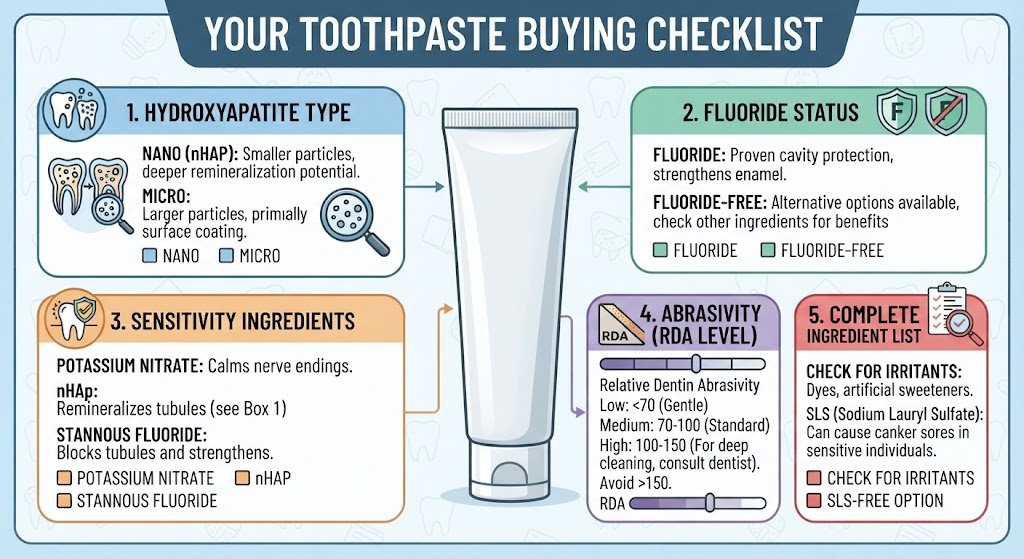
1. Check the Hydroxyapatite Type
First determine whether the product uses:
- Hydroxyapatite
- Nano-hydroxyapatite
- Another calcium-phosphate ingredient
If the product specifically promotes nano-hydroxyapatite, look for transparent ingredient information rather than relying on the word “nano” as proof of superior performance.
2. Decide Whether You Want Fluoride
This is one of the most important decisions.
If cavity prevention is a major concern, consider whether a fluoride-containing formula better fits your needs.
If you specifically want fluoride-free toothpaste, hydroxyapatite may be one ingredient to investigate.
Do not make this decision solely because one ingredient is marketed as “cleaner” or “safer.”
3. Look for Additional Desensitizing Ingredients
A hydroxyapatite toothpaste does not necessarily need to contain HAp alone.
Depending on the formula, you may find other ingredients intended to address sensitivity.
For example, some products combine mineral ingredients with desensitizing compounds.
A combination formula may be worth considering if you want more than one mechanism, but the ingredients should still be evaluated individually.
4. Consider Abrasivity
A toothpaste’s ability to clean is useful, but excessive mechanical wear is not something you want to ignore when dealing with already sensitive teeth.
Look at the overall formulation and brushing technique rather than assuming that every whitening or polishing toothpaste is appropriate for sensitivity.
If enamel wear or exposed dentin is a concern, a lower-abrasion approach may be worth discussing with your dentist.
5. Read the Full Ingredient List
Don’t stop at the front of the tube.
Check:
- Active ingredients
- Hydroxyapatite form
- Fluoride status
- Flavoring ingredients
- Surfactants
- Sweeteners
- Abrasive ingredients
- Other sensitivity ingredients
This is especially important if you have previously experienced irritation from toothpaste.
6. Match the Formula to Your Actual Problem
The “best” toothpaste for someone with mild cold sensitivity may not be the best option for someone with:
- significant gum recession
- frequent cavities
- enamel erosion
- persistent pain
- a suspected cracked tooth
The product should fit the problem—not the other way around.
Common Mistakes When Buying Hydroxyapatite Toothpaste
Choosing a Product Just Because It Says “Nano”
Nano-hydroxyapatite is an interesting area of research, but “nano” should not be treated as a guarantee of better results.
Particle characteristics, formulation, concentration, and the rest of the ingredients all matter.
Assuming Fluoride-Free Automatically Means Better
Fluoride-free may be a personal preference, but it does not automatically mean that a toothpaste is better for everyone.
If cavity prevention is a priority, fluoride’s established role needs to be considered.
Ignoring Abrasivity
Someone with sensitive teeth may focus so heavily on the active ingredient that they overlook the rest of the formula and their brushing habits.
Aggressive brushing and unsuitable toothpaste can work against the goal of protecting exposed tooth surfaces.
Expecting Immediate Results
Sensitivity is not always resolved after one brushing.
Clinical studies may evaluate products over weeks or longer, and individual responses vary.
If sensitivity continues or becomes worse, changing toothpaste repeatedly may not address the underlying problem.
Looking Only at Marketing Claims
Words such as:
- “repair”
- “rebuild”
- “natural”
- “mineral”
- “advanced”
- “professional”
do not tell you everything you need to know.
Look at the ingredients, intended use, evidence, and limitations instead.
Assuming Toothpaste Can Diagnose the Cause
A toothpaste may help with routine dentin hypersensitivity, but it cannot tell you whether pain is caused by decay, a crack, gum disease, erosion, or another dental problem.
That is why persistent or unusual pain deserves professional evaluation.
When Hydroxyapatite Toothpaste May Not Be Enough
Hydroxyapatite toothpaste may be reasonable to consider for routine tooth sensitivity, but not every case of tooth pain is ordinary dentin hypersensitivity.
You should consider seeing a dentist if:
- sensitivity is severe
- pain keeps returning or is getting worse
- one tooth is significantly more sensitive than the others
- pain occurs without an obvious trigger
- you have swelling
- you suspect a cavity
- a tooth may be cracked
- symptoms started after dental treatment and do not improve
- sensitivity is accompanied by other unusual symptoms
This matters because treating the symptom without addressing the cause can delay appropriate care.
For example, toothpaste may be useful for sensitivity caused by exposed dentin, but it is not a substitute for treating a cavity or repairing a damaged tooth.
The practical takeaway is simple:
Use toothpaste as part of your oral-care routine, but don’t use it as a substitute for a dental diagnosis when something feels wrong.
Frequently Asked Questions
Is hydroxyapatite good for sensitive teeth?
Hydroxyapatite is a reasonable ingredient to consider for sensitive teeth because clinical research has investigated its ability to reduce dentin hypersensitivity, particularly through interaction with exposed dentin and dentinal tubules. However, results can vary by formulation and person. It should not be presented as a guaranteed cure for every type of tooth sensitivity.
How does hydroxyapatite reduce tooth sensitivity?
Hydroxyapatite may help by interacting with exposed dentin and contributing to the occlusion of dentinal tubules. By reducing the pathways through which external stimuli can affect sensitive structures inside the tooth, it may reduce sensitivity. The exact effect depends on the formulation and the cause of the sensitivity.
Does hydroxyapatite block dentinal tubules?
Research has investigated hydroxyapatite’s ability to deposit on exposed dentin and contribute to dentinal-tubule occlusion. This is one of the main mechanisms proposed for its potential desensitizing effect. It is more accurate to say that HAp may help reduce tubule exposure or permeability than to promise that it completely seals every tubule.
Is nano-hydroxyapatite better for sensitive teeth?
Nano-hydroxyapatite has been studied for dentin hypersensitivity and may interact with tooth surfaces differently because of its particle size. However, “nano” alone does not prove that a product will work better for an individual. The full formulation and supporting evidence should be considered.
How long does hydroxyapatite toothpaste take to work?
There is no single timeframe that applies to everyone. Research studies can evaluate sensitivity over different periods, and individual responses vary. If sensitivity does not improve with appropriate oral care, or if it becomes worse, the underlying cause should be evaluated rather than simply using more toothpaste.
Is hydroxyapatite better than potassium nitrate?
Not necessarily. They have different proposed mechanisms. Hydroxyapatite is studied in relation to the tooth surface and dentinal-tubule occlusion, while potassium nitrate is a commonly used desensitizing ingredient. The better choice depends on the individual’s needs and the complete toothpaste formulation.
Can I use hydroxyapatite toothpaste every day?
Many hydroxyapatite toothpastes are designed for routine oral care, but follow the instructions on the specific product. If you have significant sensitivity, dental disease, or another oral-health condition, personalized guidance from a dental professional may be appropriate.
Can hydroxyapatite toothpaste replace fluoride toothpaste?
A fluoride-free hydroxyapatite toothpaste may be an option for people who specifically want fluoride-free oral care, but fluoride has an established role in cavity prevention. Whether replacing fluoride makes sense depends on the individual’s oral-health needs and cavity risk. It should not be assumed that HAp and fluoride provide exactly the same benefits.
What should I look for in hydroxyapatite toothpaste?
Look beyond the front label. Check the hydroxyapatite type, fluoride status, other desensitizing ingredients, complete ingredient list, abrasivity considerations, and the product’s intended use. A transparent formula with claims that can be supported by evidence is preferable to a product relying mainly on marketing language.
When should I see a dentist for sensitive teeth?
See a dentist if sensitivity is severe, persistent, worsening, localized to one tooth, occurs without an obvious trigger, or comes with swelling or other concerning symptoms. Sensitivity can have causes that toothpaste alone cannot address, including cavities, cracks, gum problems, or significant tooth wear.
Bottom Line: Is Hydroxyapatite Worth Considering for Sensitive Teeth?
Hydroxyapatite is a legitimate ingredient to consider if you’re looking for toothpaste for sensitive teeth.
But the smartest approach is not to choose a toothpaste simply because it says “hydroxyapatite” or “nano-hydroxyapatite.”
Consider the whole formula.
Ask:
- Does it contain hydroxyapatite or nano-hydroxyapatite?
- Do you want fluoride or fluoride-free toothpaste?
- Does it contain another desensitizing ingredient?
- Is the formula appropriate for your sensitivity concerns?
- Are the product’s claims supported by evidence?
- Could your sensitivity have another underlying cause?
The goal is not simply to find a toothpaste with a popular ingredient. It is to find a formulation that fits your sensitivity, your oral-health needs, and your preferences.
