To understand the connection between hydroxyapatite and enamel, start with a simple fact: enamel is largely made of mineral crystals that are closely related to hydroxyapatite. That is one reason hydroxyapatite has attracted attention as an ingredient in toothpaste designed to support enamel.
But “supports enamel” does not mean that toothpaste can simply grow lost enamel back. Enamel constantly goes through cycles of mineral loss and mineral replacement, and hydroxyapatite may play a role in supporting that mineral balance.
In this guide, you’ll learn what enamel is made of, how hydroxyapatite interacts with it, what remineralization actually means, how hydroxyapatite toothpaste fits into the process, how nano-hydroxyapatite differs, and how HAp compares with fluoride.
What Is Tooth Enamel Made Of?
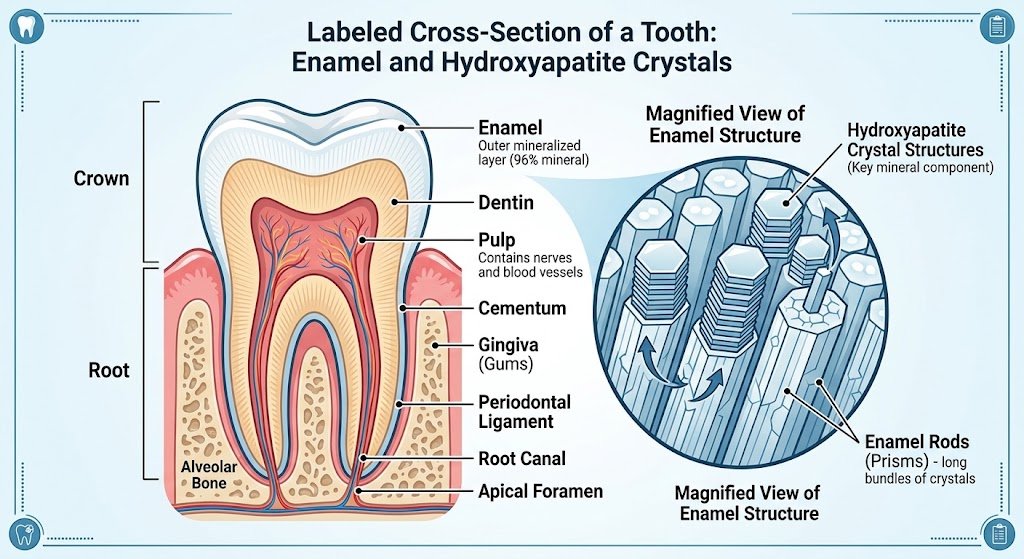
Tooth enamel is the hard outer layer that protects the visible part of your teeth. It is highly mineralized and provides a strong barrier between the softer tissues inside the tooth and the oral environment.
The main mineral component of enamel is a calcium-phosphate mineral arranged into tiny crystals. These crystals are commonly described as being structurally similar to hydroxyapatite.
That relationship is important because enamel is not a completely solid, unchanging surface.
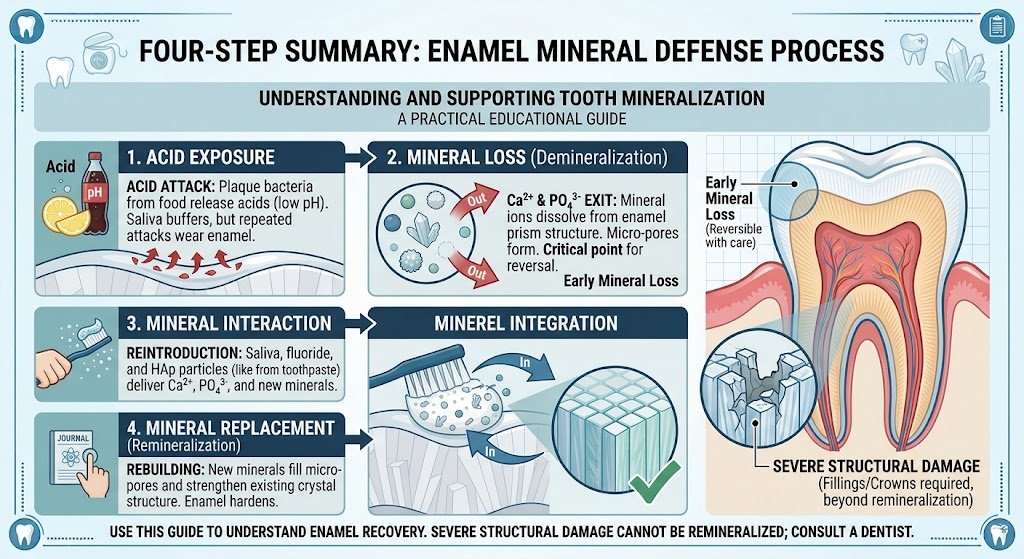
Every day, acids produced by oral bacteria and acids from foods and drinks can contribute to mineral loss from the enamel surface. At other times, minerals from saliva and the surrounding oral environment can move back into areas where mineral has been lost.
This ongoing process is generally described as:
Demineralization → mineral loss → remineralization → mineral replacement
The balance between these processes matters for enamel health.
Why Is Enamel Vulnerable to Acids?
Although enamel is extremely hard, it is not immune to chemistry.
When the environment around the tooth becomes sufficiently acidic, minerals can dissolve from the enamel surface. Repeated or prolonged acid exposure can contribute to enamel demineralization and, under certain circumstances, erosion or dental caries.
The source of the acid can differ.
For example:
- Bacteria in dental plaque can produce acids when they metabolize fermentable carbohydrates.
- Acidic foods and drinks can directly expose teeth to low-pH conditions.
- Frequent acid exposure can give enamel less opportunity to recover between episodes.
This does not mean that every acidic food or drink causes visible enamel damage. The overall oral environment, frequency of exposure, saliva, hygiene, diet, and other factors all matter.
Where Does Hydroxyapatite Fit Into Enamel?
This is where the relationship between hydroxyapatite and enamel becomes especially interesting.
Hydroxyapatite is a calcium-phosphate mineral closely associated with the mineral phase of teeth and bones. Because enamel contains hydroxyapatite-like mineral crystals, researchers have investigated whether hydroxyapatite can interact with tooth surfaces in ways that support mineral restoration.
That is the basic idea behind using hydroxyapatite in toothpaste.
What Is Hydroxyapatite?
Hydroxyapatite is a calcium-phosphate mineral with the chemical formula Ca₁₀(PO₄)₆(OH)₂.
For a beginner, the most important point is not memorizing the formula. It is understanding its relationship to your teeth.
Hydroxyapatite is closely related to the mineral that gives enamel much of its hardness and structure. This makes it different from an ingredient that has no relationship to tooth mineral but happens to be used for another purpose in toothpaste.
Hydroxyapatite Is a Natural Mineral in Teeth
The mineral component of enamel contains hydroxyapatite-like crystals.
However, natural tooth mineral is not necessarily identical in every chemical detail to perfectly pure laboratory hydroxyapatite. Biological tooth mineral can contain substitutions and other characteristics that reflect the complex environment in which teeth develop.
So it is more accurate to say:
Enamel contains a hydroxyapatite-based mineral phase.
That relationship is one reason hydroxyapatite is described as a biomimetic material in some dental research.
“Biomimetic” essentially means designed to imitate or work in a way that is inspired by natural biological structures or processes.
Why Does Hydroxyapatite Matter to Enamel?
Because hydroxyapatite is closely related to tooth mineral, researchers have studied whether externally supplied hydroxyapatite can interact with enamel.
The proposed benefits include:
- supporting mineral deposition on tooth surfaces
- helping remineralize areas of early mineral loss
- interacting with exposed mineral surfaces
- potentially reducing mineral loss under certain conditions
- supporting a mineral-rich surface environment
The important word is support.
Hydroxyapatite toothpaste should not be described as a way to replace an entire section of enamel that has already been physically lost.
Hydroxyapatite in Toothpaste vs Hydroxyapatite in Enamel
There is another important distinction.
The hydroxyapatite used in a toothpaste is an added ingredient. It is not simply the same enamel material extracted from another tooth.
The properties of the HAp used in toothpaste can depend on factors such as:
- particle size
- particle shape
- purity
- concentration
- surface characteristics
- formulation
- other ingredients in the toothpaste
This is why two products that both contain “hydroxyapatite” may not necessarily have identical performance.
How Does Hydroxyapatite Interact With Enamel?
This is the central question behind using hydroxyapatite in oral care.
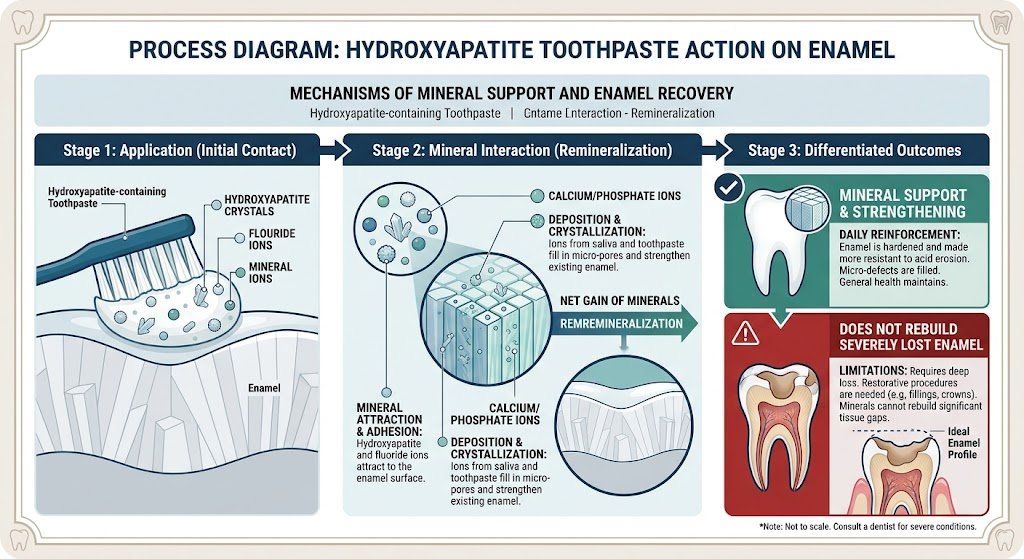
When you brush with a hydroxyapatite toothpaste, the toothpaste creates temporary contact between the HAp-containing formulation and the surfaces of your teeth.
During that contact, hydroxyapatite particles can interact with the mineral surface of enamel.
The exact behavior depends on the formulation and conditions, but the basic concept is that calcium-phosphate mineral can participate in the mineral environment at the tooth surface.
What Happens When HAp Contacts Enamel?
Think of enamel as a mineral surface rather than an inert piece of glass.
When hydroxyapatite-containing toothpaste is brushed over the teeth, particles are placed into the oral environment and can come into contact with enamel.
Some of those particles may interact with the tooth surface or contribute to a mineral-rich layer.
Researchers have investigated these interactions using different laboratory, in-situ, and clinical methods.
The important limitation is that a laboratory demonstration of mineral interaction does not automatically mean that every toothpaste containing HAp produces the same clinical result.
The complete formulation matters.
Can Hydroxyapatite Deposit on the Tooth Surface?
Hydroxyapatite has been studied for its ability to form or contribute to mineral-rich deposits on tooth surfaces.
This is one proposed reason it may help support enamel that has experienced early mineral loss.
However, “deposit” should not be interpreted as “grow a new layer of natural enamel.”
The tooth surface is a complex biological environment. Saliva, proteins, plaque, pH, food, brushing, and other ingredients can all influence what happens at the surface.
A useful way to think about the process is:
HAp-containing toothpaste → contact with enamel → mineral interaction → potential mineral deposition/remineralization support
rather than:
HAp toothpaste → instant new enamel
That distinction keeps the science realistic.
Why Is Hydroxyapatite Called Biomimetic?
Hydroxyapatite is often described as biomimetic because it is closely related to the mineral phase naturally present in teeth.
The idea is to use a material that resembles an important component of the structure being supported.
This is particularly relevant to enamel because enamel is already highly mineralized.
Instead of introducing an unrelated substance and expecting it to transform the tooth surface, hydroxyapatite-based approaches investigate whether a tooth-related mineral can participate in restoring or supporting mineral balance.
That does not automatically prove that HAp is superior to other active ingredients.
It simply explains why hydroxyapatite makes scientific sense as an ingredient to investigate for enamel care.
Hydroxyapatite and Enamel Remineralization
The word remineralization is central to discussions about hydroxyapatite and enamel.
But it is often misunderstood.
Remineralization does not mean that a damaged tooth automatically grows a brand-new layer of enamel. It refers to minerals returning to areas of tooth structure that have experienced mineral loss.
What Is Demineralization?
Demineralization occurs when minerals leave the tooth’s mineral structure.
Acidic conditions can shift the balance toward mineral loss. If this happens repeatedly or extensively, the tooth can become more vulnerable to decay or other forms of damage.
Early mineral loss may not look like a hole in the tooth.
That is important because a cavity is not necessarily the first event in the process.
A tooth can experience mineral changes before a visible cavity develops.
This is one reason preventive oral care focuses on maintaining the mineral balance of enamel rather than waiting until structural damage is obvious.
What Is Remineralization?
Remineralization is the opposite side of that process.
Minerals can return to areas of enamel that have experienced mineral loss. Saliva naturally contributes minerals and helps maintain the oral environment around the teeth.
Hydroxyapatite is being studied because it can provide calcium-phosphate mineral directly within a toothpaste formulation.
This gives HAp a different but related role in the overall mineral-balance discussion.
Where Does Hydroxyapatite Fit?
Hydroxyapatite may interact directly with the tooth surface and contribute mineral material that is chemically related to enamel.
This is particularly interesting for early mineral changes, when the basic enamel structure is still present.
The concept can be simplified as:
Acid exposure
↓
Mineral leaves enamel
↓
Early mineral loss develops
↓
Minerals become available again
↓
Remineralization can occur
Hydroxyapatite toothpaste is intended to participate in the final part of this process by bringing a tooth-related calcium-phosphate mineral into contact with the tooth surface.
However, remineralization is influenced by more than toothpaste.
Saliva, oral hygiene, diet, acid exposure, fluoride exposure, bacterial plaque, and individual dental risk all contribute to the overall environment.
Can Remineralization Restore Lost Enamel?
This needs a careful answer.
Remineralization can help restore minerals to early areas of enamel mineral loss, but it cannot simply replace enamel that has been physically removed.
For example, if an early enamel lesion has lost some mineral while the overall structure remains intact, remineralization can potentially strengthen or restore mineral within that area.
But if enamel has been significantly worn away, chipped, or destroyed, toothpaste cannot simply recreate the missing structure.
That is an important difference between:
Mineral loss
and
Structural loss
A toothpaste may support the former under appropriate conditions, but it should not be marketed as a replacement for professional treatment of substantial enamel damage.
Can Hydroxyapatite Toothpaste Help Protect Enamel?
Hydroxyapatite toothpaste is designed to bring HAp into contact with the tooth surface during brushing.
That makes the toothpaste formulation important.
It is not enough to ask:
“Does this toothpaste contain hydroxyapatite?”
A better question is:
“What type of hydroxyapatite does it contain, how is the complete formulation designed, and what evidence supports the intended use?”
A toothpaste can contain several functional ingredients, including abrasives, humectants, surfactants, flavoring agents, sweeteners, and active ingredients.
The performance of the finished product depends on how these components work together.
Why Formulation Matters
Two toothpastes can both contain hydroxyapatite while having different:
- particle characteristics
- concentrations
- supporting ingredients
- abrasivity
- flavor systems
- fluoride status
- intended uses
That means evidence about hydroxyapatite as an ingredient should not automatically be treated as evidence that every HAp toothpaste provides exactly the same result.
This distinction is especially important when shopping online, where product descriptions may emphasize one ingredient without explaining the complete formulation.
What Can HAp Toothpaste Realistically Do?
The most reasonable way to describe the potential role of HAp toothpaste is that it may support enamel mineral balance and remineralization, particularly when used as part of consistent oral hygiene.
It should not be presented as a treatment that:
- regrows large areas of missing enamel
- reverses advanced cavities
- replaces dental restorations
- guarantees protection against decay
If you have visible enamel loss, persistent sensitivity, a broken tooth, or suspected cavities, toothpaste selection should not replace professional dental evaluation.
Nano-Hydroxyapatite and Enamel: Is It Different?
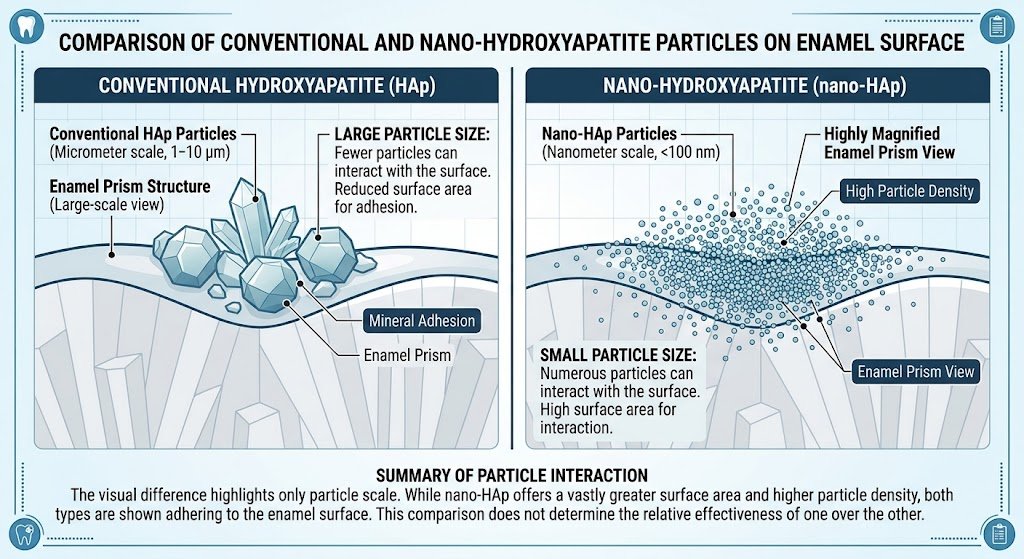
Nano-hydroxyapatite, often abbreviated as nano-HAp, is hydroxyapatite produced or formulated with particles in the nanoscale range.
The underlying mineral is still hydroxyapatite, but particle size can influence the physical behavior of the material.
That is why nano-HAp has received particular attention in research on biomimetic dental materials and toothpaste.
What Is Nano-Hydroxyapatite?
The word “nano” refers to the scale of the particles.
Smaller particles can have different surface-area characteristics and may interact differently with tooth surfaces compared with larger particles.
Researchers have therefore investigated nano-HAp for applications including enamel remineralization, surface mineral deposition, and sensitivity.
But nano-HAp should not be treated as a magic version of hydroxyapatite.
The rest of the formulation still matters.
Why Is Nano-HAp Used in Toothpaste?
One reason researchers are interested in nano-HAp is its ability to interact closely with mineralized tooth surfaces.
Because enamel is made primarily of very small mineral structures, a material with nanoscale characteristics may provide opportunities for close interaction with the enamel surface.
However, the actual performance of a product depends on more than particle size.
Relevant factors include:
- particle characteristics
- concentration
- formulation
- brushing behavior
- exposure time
- oral environment
- other toothpaste ingredients
So “nano-HAp” is useful information when comparing products, but it is not enough by itself to determine which toothpaste is better.
Is Nano-HAp Better for Enamel?
Not automatically.
A smaller particle size does not mean that every nano-HAp toothpaste will outperform every conventional HAp toothpaste.
The evidence needs to be considered in the context of the specific material and formulation being studied.
This is an important lesson for product research:
Don’t judge a toothpaste solely by the word “nano.”
Look at the complete formulation and the evidence relevant to that product category.
Hydroxyapatite vs Fluoride for Enamel
Hydroxyapatite and fluoride are often compared because both have roles in toothpaste and enamel protection, but they work through different mechanisms.
| Factor | Hydroxyapatite | Fluoride |
| Relationship to teeth | Closely related to tooth mineral | Interacts with tooth mineral |
| Main concept | Provides calcium-phosphate mineral related to enamel | Supports remineralization and increases resistance of tooth mineral to acid |
| Fluoride-free option | Yes | No |
| Cavity-prevention evidence | Growing | Extensive and long-established |
| Enamel relevance | Mineral interaction and remineralization research | Established role in caries prevention and remineralization |
| Product choice | Depends on formulation and individual needs | Widely recommended for cavity prevention |
Fluoride has a much longer history of research and clinical use for preventing dental caries.
Hydroxyapatite takes a different approach. Because it is closely related to tooth mineral, researchers have investigated whether it can interact directly with enamel and contribute to remineralization.
That makes HAp scientifically interesting, but it does not mean the evidence for HAp and fluoride should be treated as identical.
Which Is Better for Enamel?
There is no responsible one-word answer for every person.
If the primary concern is cavity prevention, fluoride has extensive evidence and remains a standard component of anticaries toothpaste.
If someone specifically wants to explore fluoride-free hydroxyapatite toothpaste, HAp has a growing research base and may be a reasonable category to investigate, depending on individual dental needs.
Your cavity risk matters.
Someone with frequent cavities, high sugar exposure, dry mouth, orthodontic appliances, or another factor that raises caries risk may need a different approach from someone with a low cavity risk.
That is why switching toothpaste should not be based on the assumption that one ingredient is universally better.
Does the Research Support Hydroxyapatite for Enamel?
Research on hydroxyapatite has expanded considerably, particularly around remineralization, sensitivity, and caries prevention.
However, the most useful way to interpret the evidence is to look at what was actually studied.
A laboratory experiment showing that HAp interacts with enamel is different from a clinical trial showing that people using a particular toothpaste experienced a specific oral-health outcome.
What Do Systematic Reviews Show?
That is encouraging, but it does not mean that every unanswered question has been settled.
Different studies can use:
- different HAp materials
- different concentrations
- different toothpaste formulations
- different study populations
- different comparison groups
- different study durations
- different outcome measures
These differences make it important not to turn a general research finding into an absolute product claim.
Ingredient Evidence vs Product Evidence
This distinction is particularly important for affiliate content.
Suppose research supports hydroxyapatite’s ability to interact with enamel.
That does not automatically prove that every toothpaste containing hydroxyapatite will perform identically.
A better evidence hierarchy is:
Material evidence → formulation evidence → clinical evidence → real-world product performance
The more closely the evidence matches the actual product and intended use, the more useful it becomes for a purchasing decision.
That is why a trustworthy buying guide should examine the entire formulation instead of simply searching for the word “hydroxyapatite” on the label.
Is Hydroxyapatite Toothpaste Safe for Enamel?
Hydroxyapatite has been studied as an oral-care ingredient, but safety should be considered in the context of the complete toothpaste formulation.
A toothpaste contains more than its headline active ingredient.
For example, people may react to certain flavoring ingredients, surfactants, essential oils, preservatives, or other components even when the toothpaste contains hydroxyapatite.
What About Nano-Hydroxyapatite?
Nano-HAp requires particular attention because safety depends on the specific material characteristics.
The important takeaway is not simply:
“Nano-HAp is safe.”
The more accurate interpretation is:
A particular nano-HAp material can be assessed for safety under particular conditions.
That distinction matters when evaluating products.
What About Abrasivity?
A toothpaste can also affect enamel through its physical cleaning characteristics.
Abrasives help remove deposits from tooth surfaces, but more abrasive does not automatically mean better oral care.
For people concerned about enamel wear or sensitivity, abrasivity can therefore be a useful product-selection attribute.
This is another reason to evaluate the complete formulation rather than choosing a toothpaste solely because it contains HAp.
How to Choose a Hydroxyapatite Toothpaste for Enamel
Once you understand how hydroxyapatite relates to enamel, choosing a product becomes much easier.
Instead of looking for a single “best” ingredient, evaluate the toothpaste according to your specific goal.
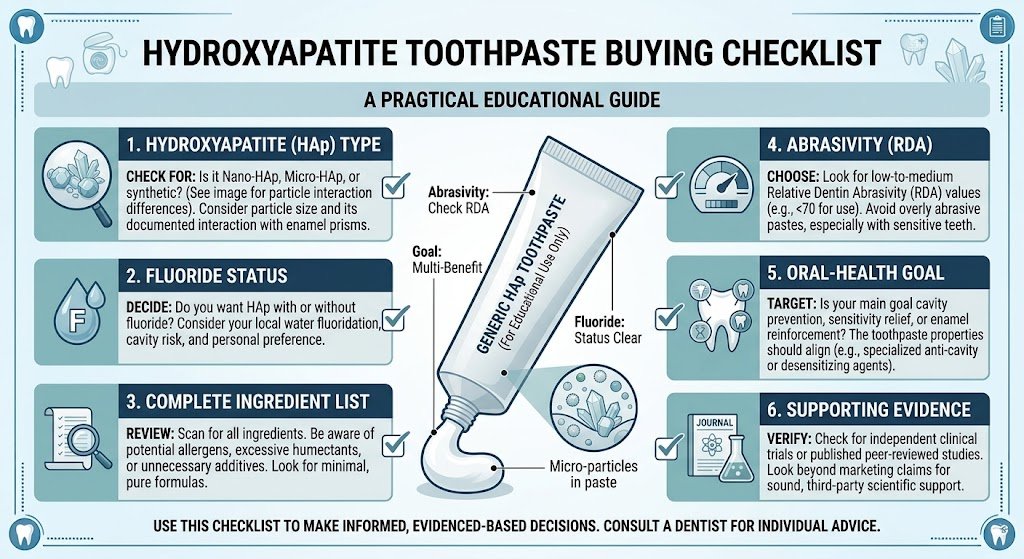
1. Check the Type of Hydroxyapatite
First, determine what form of HAp the product uses.
If the manufacturer specifies nano-hydroxyapatite, note that information. If it simply lists hydroxyapatite, check the available product information for more detail.
The goal is not to assume one form is automatically superior. It is to understand what you are buying.
2. Check the Fluoride Status
If you want fluoride-free toothpaste, verify the complete ingredient list.
Don’t rely only on phrases such as:
- mineral toothpaste
- natural toothpaste
- biomimetic toothpaste
- enamel toothpaste
These descriptions do not necessarily tell you whether fluoride is present.
If you are comfortable using fluoride, you can also consider products that combine different approaches where appropriate.
3. Look at the Complete Ingredient List
Hydroxyapatite is only one part of the formulation.
Consider:
- active ingredients
- abrasives
- surfactants
- flavoring agents
- sweeteners
- preservatives
- dyes or coloring ingredients
If you are trying to avoid a particular ingredient, verify it directly rather than assuming that “clean” or “natural” means the product meets your preference.
4. Consider Abrasivity
If enamel protection is your main concern, abrasivity is worth considering.
A product marketed for whitening, for example, may use a formulation designed to remove surface stains. That does not automatically make it inappropriate, but it means you should consider the complete product rather than assuming all toothpastes clean in exactly the same way.
5. Match the Product to Your Goal
Ask what you actually want the toothpaste to do.
| Your main goal | What to prioritize |
| General enamel care | Evidence-based HAp formulation and good daily oral hygiene |
| Fluoride-free option | Confirm fluoride-free status |
| Sensitivity | Consider a formula specifically designed for sensitivity |
| Cavity prevention | Consider your personal cavity risk and the evidence for fluoride and HAp |
| Ingredient-conscious shopping | Read the complete ingredient list |
| Lower-abrasion preference | Look for reliable information about abrasivity |
This approach is more useful than choosing a toothpaste simply because the package says “hydroxyapatite.”
6. Look for Evidence, Not Just Marketing
A product may use attractive phrases such as:
- enamel repair
- mineral restoration
- biomimetic
- natural mineral
- advanced remineralization
Those terms can be useful descriptions, but they should not replace evidence.
A stronger product evaluation asks:
What exactly is in the formula? What is the intended benefit? What evidence supports that type of formulation?
This is where product comparison becomes genuinely useful.
Common Mistakes When Choosing HAp Toothpaste
Assuming HAp Automatically Rebuilds Enamel
Hydroxyapatite may support remineralization, but it cannot simply recreate large amounts of enamel that have already been physically lost.
Assuming Nano-HAp Is Always Better
Particle size is only one attribute. Formulation and evidence matter too.
Ignoring Fluoride Evidence
Choosing a fluoride-free toothpaste is a personal or product preference for some people, but it should not be based on the assumption that fluoride has no role in enamel or cavity prevention.
Looking Only at the Front of the Package
Marketing claims can tell you what the manufacturer wants to emphasize. The ingredient list and supporting evidence tell you much more about the actual product.
Assuming Every HAp Toothpaste Is the Same
Different products can use different formulations and HAp materials.
Ignoring Your Personal Cavity Risk
A person who frequently develops cavities may have different toothpaste needs from someone with a low cavity risk.
If you are considering switching away from fluoride and have a history of frequent decay, discussing the decision with a dentist is sensible.
Frequently Asked Questions About Hydroxyapatite and Enamel
Is hydroxyapatite naturally found in enamel?
Yes. Enamel’s mineral component contains hydroxyapatite-like calcium-phosphate crystals. This close relationship to tooth mineral is one reason hydroxyapatite is studied as a biomimetic ingredient for oral care.
Does hydroxyapatite strengthen enamel?
Hydroxyapatite may support enamel mineralization and remineralization, particularly when mineral has been lost at an early stage. However, “strengthen” should not be interpreted as meaning that toothpaste can rebuild large areas of enamel that have already been physically lost.
Can hydroxyapatite rebuild enamel?
It is more accurate to discuss hydroxyapatite in terms of remineralization and mineral support. Early mineral loss can potentially be remineralized, but toothpaste cannot simply regenerate severely damaged or missing enamel.
Can HAp toothpaste remineralize enamel?
Research has investigated hydroxyapatite toothpaste for remineralization and early caries lesions. Results are promising, but the evidence depends on the specific material, formulation, and study design. Product-level claims should therefore be evaluated carefully.
Is hydroxyapatite better than fluoride for enamel?
There is no universal answer. Hydroxyapatite and fluoride work differently. Fluoride has a much longer-established evidence base for cavity prevention, while hydroxyapatite has a growing body of research, including studies of fluoride-free formulations.
Is nano-hydroxyapatite safe?
Safety depends on the specific material and formulation. A 2025 European Commission safety assessment addressed a specified form of nano-hydroxyapatite under defined conditions. That assessment should not automatically be generalized to every possible nano-HAp material.
Can hydroxyapatite help sensitive teeth?
Hydroxyapatite has been studied for dentin sensitivity and may be relevant to some sensitivity-focused formulations. However, ongoing or unexplained sensitivity can have several causes, so persistent symptoms should be evaluated by a dental professional.
Should I use hydroxyapatite toothpaste every day?
Follow the directions for the specific product and maintain a consistent oral-hygiene routine. Whether HAp toothpaste is appropriate for daily use depends on the product formulation and your individual oral-health needs.
Bottom Line: Hydroxyapatite and Enamel
The connection between hydroxyapatite and enamel makes sense at a basic mineral level: enamel contains a hydroxyapatite-based mineral phase, and hydroxyapatite used in oral-care products is being studied for its ability to interact with tooth surfaces and support remineralization.
The important limitation is that remineralization is not the same as regrowing lost enamel.
Hydroxyapatite toothpaste may be an interesting option for people who want a mineral-based toothpaste, including those considering fluoride-free formulations. But product choice should be based on the complete formulation, evidence, fluoride status, abrasivity, and your individual dental needs.