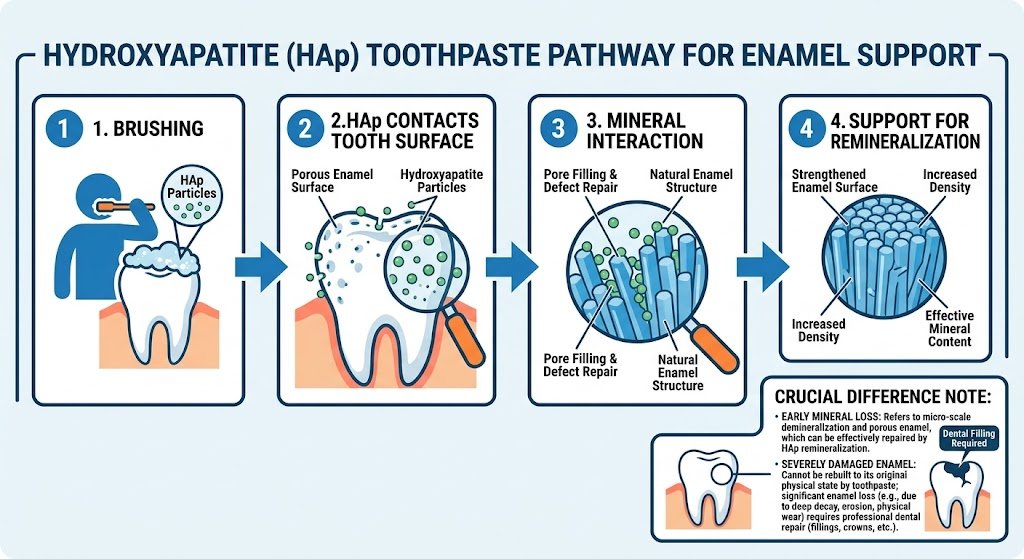
If you have seen hydroxyapatite toothpaste advertised as a way to support enamel or remineralization, you may be wondering what actually happens when you brush with it.
Hydroxyapatite toothpaste works by using a calcium-phosphate mineral that is closely related to the mineral found in teeth. Researchers have studied hydroxyapatite-containing oral-care products for their interaction with tooth surfaces, remineralization, and prevention or progression of early caries lesions.
The important part is understanding what that means in practical terms. Hydroxyapatite toothpaste is not simply “putting new enamel on your teeth,” and it should not be assumed to work exactly like fluoride toothpaste.
This guide explains how hydroxyapatite toothpaste interacts with teeth, what remineralization really means, how nano-hydroxyapatite fits into the picture, what research shows, and what to look for if you are considering a hydroxyapatite toothpaste.
What Is Hydroxyapatite?
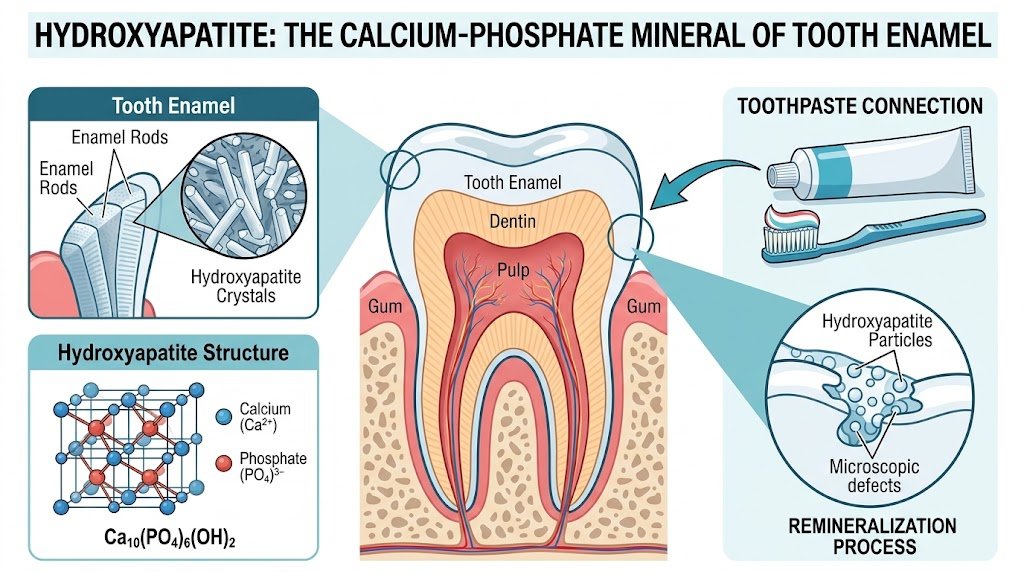
Hydroxyapatite is a calcium-phosphate mineral. It belongs to the apatite family and is closely associated with the mineral component of hard tissues such as teeth and bones.
A commonly used chemical representation is:
Ca₁₀(PO₄)₆(OH)₂
However, the mineral found naturally in biological tissues is more complex than a perfectly pure laboratory version of that formula.
Hydroxyapatite in Your Teeth
To understand why hydroxyapatite is used in toothpaste, start with enamel.
Tooth enamel is the hard outer layer of a tooth and is highly mineralized. Its mineral structure is based largely on calcium-phosphate apatite crystals.
Throughout the day, your teeth are exposed to conditions that can shift the balance between mineral loss and mineral return.
For example, acids produced by bacteria in dental plaque can contribute to demineralization. Saliva and other factors can support the return of minerals to the tooth surface.
This ongoing process is one reason researchers are interested in ingredients that interact with tooth mineral.
Why Is Hydroxyapatite Used in Toothpaste?
Hydroxyapatite is used in some toothpaste formulations because its mineral composition is closely related to the mineral found in teeth.
The idea is relatively straightforward:
If tooth mineral is involved in maintaining the structure of enamel, an ingredient closely related to that mineral may be useful in oral-care formulations designed to support the tooth surface.
That does not mean the ingredient can simply replace any enamel that has been lost.
Instead, hydroxyapatite toothpaste is studied in relation to processes such as remineralization, demineralization control, and caries prevention.
Recent systematic reviews have examined clinical and in-situ evidence for hydroxyapatite-containing oral-care products, including fluoride-free formulations.
How Does Hydroxyapatite Toothpaste Work?
The simplest explanation is:
Hydroxyapatite toothpaste brings a tooth-mineral-related material into contact with the tooth surface during brushing, where it can participate in mineral-related processes that have been studied for remineralization and protection against mineral loss.
But there is more to the process than that one sentence.
A useful way to understand it is to follow what happens from brushing to the tooth surface.
Step 1: You Brush With the Toothpaste
When you brush, the toothpaste spreads over the surfaces of your teeth.
The toothpaste is not just a cleaning paste. A dentifrice can contain active ingredients intended to provide specific oral-health benefits, along with ingredients responsible for texture, flavor, cleaning, and other properties.
In a hydroxyapatite toothpaste, hydroxyapatite is included as an active ingredient or functional component of the formulation.
The exact formulation matters because not every hydroxyapatite toothpaste is identical.
Step 2: Hydroxyapatite Comes Into Contact With the Tooth Surface
During brushing, hydroxyapatite-containing toothpaste contacts enamel and other surfaces in the mouth.
Because hydroxyapatite is chemically related to tooth mineral, researchers have investigated whether these particles can interact with enamel and become associated with the tooth surface.
This is one reason the ingredient is often described as biomimetic.
“Biomimetic” does not mean that the toothpaste literally recreates a natural tooth.
It means the material is designed or used in a way that relates to biological structures or processes.
Step 3: Mineral-Related Interactions Can Occur at the Tooth Surface
A tooth that has experienced early mineral loss is not necessarily structurally destroyed.
In the early stages of demineralization, minerals can be lost from the tooth surface.
Under favorable conditions, minerals can also return.
Hydroxyapatite has been studied because it can interact with these mineralized tooth surfaces and may contribute to remineralization-related processes.
This is particularly important when discussing initial or early caries lesions, rather than large established cavities.
Step 4: The Goal Is to Support the Mineral Balance
The mouth is not a static environment.
Tooth surfaces constantly experience changes caused by:
- Food and drinks
- Acids
- Bacterial activity
- Saliva
- Brushing
- Mineral availability
- Oral hygiene habits
When mineral loss exceeds mineral replacement over time, tooth structure can become progressively damaged.
A toothpaste containing hydroxyapatite is intended to support oral care within this larger process.
The important point is that one brushing session does not suddenly rebuild a damaged tooth.
The potential benefit is related to repeated oral-care use and the interaction between the toothpaste, tooth surface, saliva, plaque, diet, and overall oral-health habits.
What Happens When Hydroxyapatite Contacts Enamel?
This is where the science becomes more interesting.
Enamel contains apatite-based mineral, so hydroxyapatite is chemically relevant to the surface being treated.
Research has investigated whether hydroxyapatite particles can become deposited or associated with enamel surfaces and contribute to mineral-related changes.
However, the exact behavior can depend on factors such as:
- Particle characteristics
- Formulation
- Concentration
- Tooth-surface condition
- Exposure conditions
- Study design
This is why it is too simplistic to say:
“Hydroxyapatite toothpaste replaces your enamel.”
That statement makes the process sound much more dramatic and certain than the evidence supports.
A more accurate explanation is that hydroxyapatite is investigated for its ability to interact with tooth mineral and support processes associated with remineralization and caries prevention.
Can Hydroxyapatite Deposit on the Tooth Surface?
Hydroxyapatite-containing oral-care products have been studied for their ability to interact with and deposit mineral on tooth surfaces.
The exact mechanism and extent of deposition can vary between formulations and experimental conditions.
This distinction matters because research performed in a laboratory or controlled study does not automatically tell you exactly what will happen with every commercial toothpaste in everyday use.
A product’s formulation, concentration, particle characteristics, brushing habits, and exposure time can all matter.
Why Is Hydroxyapatite Called Biomimetic?
Hydroxyapatite is often described as a biomimetic oral-care ingredient because it is chemically related to the mineral component of teeth.
The concept is attractive because the ingredient is not completely unrelated to the material it is being used around.
But “biomimetic” should not be interpreted as:
- Identical to natural enamel
- Able to regenerate an entire tooth
- Guaranteed to repair every type of damage
- Automatically superior to fluoride
It simply describes the relationship between the material and biological mineral structures.
What Is Remineralization, and Why Does It Matter?
Remineralization is one of the most important concepts for understanding how hydroxyapatite toothpaste is supposed to work.
Your teeth can lose minerals and regain minerals.
The process is not simply “damage happens” followed by “toothpaste fixes it.”
Instead, tooth mineral is continuously affected by the conditions in the mouth.
What Is Demineralization?
Demineralization occurs when acids cause minerals to leave the tooth structure.
Dental plaque bacteria can produce acids when they metabolize fermentable carbohydrates. Repeated acid exposure can shift the balance toward mineral loss.
If this process continues without enough recovery, the affected area can progress toward dental caries.
This is why cavity prevention is not about one ingredient alone.
It also involves:
- Plaque control
- Diet
- Saliva
- Toothbrushing
- Fluoride exposure where appropriate
- Individual cavity risk
- Regular dental care
What Is Remineralization?
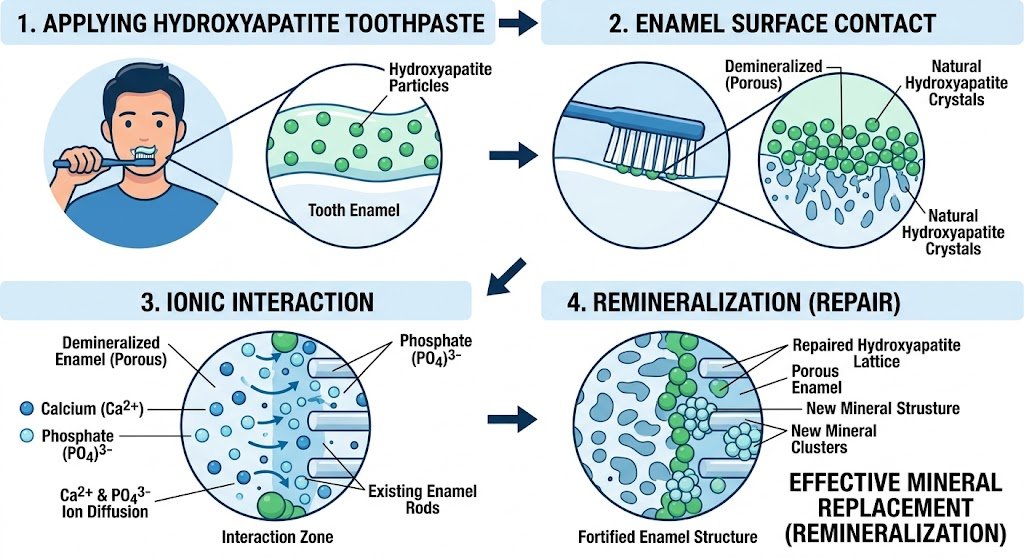
Remineralization is the return or deposition of minerals into partially demineralized tooth structure.
It is particularly relevant to early mineral changes, before a tooth has developed a large structural cavity.
Hydroxyapatite is interesting in this context because it supplies a material closely related to tooth mineral.
Researchers have therefore investigated whether hydroxyapatite-containing toothpaste can promote remineralization and reduce the progression of early caries lesions.
A 2025 systematic review specifically evaluated fluoride-free hydroxyapatite toothpastes for remineralization and prevention of initial caries lesions. The review included four eligible in-situ randomized controlled trials and found no significant differences in some caries-progression measures compared with fluoride toothpaste, while other measured outcomes differed. The authors described hydroxyapatite as a promising fluoride-free option, but the relatively small evidence base is important to keep in mind.
Can Remineralization Repair Enamel?
This needs a careful answer.
Remineralization can support early mineral loss, but it does not mean that toothpaste can regenerate a completely new layer of enamel after substantial enamel has been physically lost.
Think of the difference between:
Early mineral loss
and
Major structural damage
They are not the same problem.
An early, non-cavitated lesion may have the potential to undergo mineral-related changes under favorable conditions.
A large cavity, fractured tooth, or substantial loss of tooth structure requires professional dental evaluation and treatment.
This distinction is important because the phrase “rebuild enamel” is commonly used in toothpaste marketing.
When evaluating that claim, ask what the manufacturer actually means by “rebuild.”
It may be referring to supporting remineralization of an early demineralized surface rather than recreating the original tooth structure.
How Does Hydroxyapatite Help With Cavities?
Cavities, or dental caries, develop through a complex process involving acids, bacteria, tooth surfaces, saliva, and other factors.
Hydroxyapatite toothpaste is being studied as one way to influence this process.
The basic relationship looks like this:
Acid exposure → mineral loss → early lesion → possible remineralization → progression or stabilization
The goal of preventive oral care is to keep the balance from consistently moving toward mineral loss and lesion progression.
Hydroxyapatite and Early Caries
Hydroxyapatite is particularly relevant to research on initial caries lesions because these early lesions involve mineral changes before the tooth has developed a large cavitated defect.
Research has examined whether hydroxyapatite-containing products can help reduce demineralization and promote remineralization in these situations.
A 2024 updated systematic review and meta-analysis included clinical and in-situ evidence involving hydroxyapatite oral-care products. The review reported that the clinical evidence base for fluoride-free hydroxyapatite products had expanded, with multiple studies showing anti-caries effects in the absence of fluoride.
That is useful evidence, but it should not be interpreted as proof that every hydroxyapatite toothpaste will provide the same level of protection.
Why Product Formulation Matters
A study may evaluate a specific formulation under specific conditions.
A commercial toothpaste can differ in:
- Hydroxyapatite material
- Particle characteristics
- Concentration
- Other active ingredients
- Abrasives
- Flavoring ingredients
- Surfactants
- Humectants
- Exposure conditions
So there is an important distinction:
Evidence for hydroxyapatite as an ingredient ≠ evidence for every toothpaste containing hydroxyapatite.
This is one of the most important points to remember before buying a product.
Does Hydroxyapatite Prevent Cavities Like Fluoride?
This is where the comparison becomes more complicated.
Fluoride has a much longer-established role in cavity prevention. The ADA identifies fluoride-containing toothpaste as the standard category for toothpaste making an ADA-accepted cavity-prevention claim, and ADA guidance recommends brushing twice daily with fluoride toothpaste.
Hydroxyapatite has a growing research base, including studies comparing fluoride-free hydroxyapatite toothpaste with fluoride toothpaste.
The evidence is promising, but the two ingredients should not be presented as though they have identical histories, mechanisms, or levels of evidence.
For someone with a high risk of cavities, the decision to move away from fluoride should therefore be made carefully and, when appropriate, discussed with a dental professional.
How Does Nano-Hydroxyapatite Work?
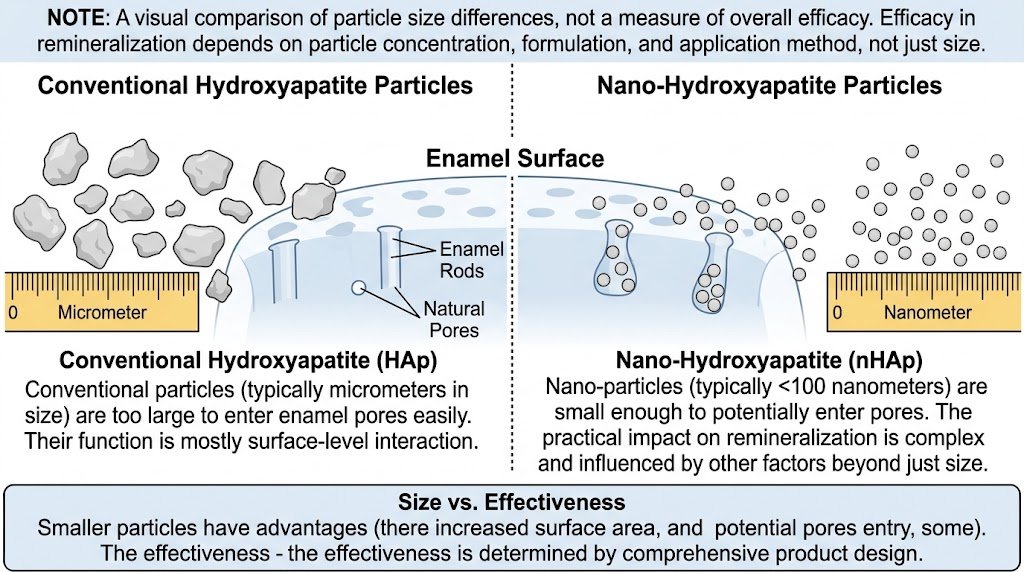
Nano-hydroxyapatite, often shortened to nano-HAp, is hydroxyapatite made with particles in the nanoscale range. The basic mineral is still hydroxyapatite, but the particle size and physical characteristics can change how the material interacts with a tooth surface.
This matters because toothpaste is not simply a container for an ingredient. Particle size, concentration, formulation, brushing habits, and contact with the tooth surface can all affect how an ingredient performs.
What Makes Nano-Hydroxyapatite Different?
Regular hydroxyapatite can contain particles of different sizes. Nano-hydroxyapatite uses much smaller particles.
Because of their small size, nano-HAp particles can have a greater surface area relative to their volume. This is one reason researchers have investigated whether nano-HAp can interact closely with enamel and other tooth surfaces.
The goal is not to create a completely new type of tooth mineral. Nano-HAp is still chemically related to the hydroxyapatite mineral naturally found in teeth.
The difference is primarily in the particle characteristics and how the material is formulated and used.
Why Is Nano-Hydroxyapatite Used in Toothpaste?
The main reason is its potential to support interactions between calcium-phosphate mineral and the tooth surface.
Research has investigated nano-HAp toothpaste for areas such as:
- supporting remineralization of early enamel lesions
- reducing mineral loss
- helping form a mineral-rich layer on the tooth surface
- reducing dentin hypersensitivity
- supporting cavity prevention
However, the results of a toothpaste depend on the complete formulation, not simply the presence of “nano-hydroxyapatite” on the ingredient list.
A toothpaste can contain the same general active ingredient as another product but differ in concentration, particle characteristics, abrasives, flavoring ingredients, and other components.
That is why it is better to evaluate the whole toothpaste formulation rather than assuming every nano-HAp toothpaste works exactly the same way.
Is Nano-Hydroxyapatite Better Than Regular Hydroxyapatite?
Not automatically.
Nano-HAp is often discussed as though smaller particles must always mean better performance. That is too simple.
Particle size can influence how an ingredient behaves, but toothpaste performance depends on more than particle size alone. The formulation, amount of active ingredient, brushing routine, and the condition of the teeth also matter.
So the better question is not:
“Is nano-HAp always better?”
It is:
“Does this particular hydroxyapatite formulation have evidence supporting the benefit I am looking for?”
This distinction is especially important when comparing products.
That is an important reminder: “nano-hydroxyapatite” is a category, not a guarantee that every product has identical characteristics.
Hydroxyapatite vs Fluoride: How Do They Work Differently?
Hydroxyapatite and fluoride are often compared because both are used in toothpastes designed to support protection against tooth decay.
But they do not work in exactly the same way.
| Feature | Hydroxyapatite | Fluoride |
| Basic role | Supplies a calcium-phosphate mineral related to tooth mineral | Helps make tooth mineral more resistant to acid and supports remineralization |
| Relationship to enamel | Chemically related to the mineral naturally found in teeth | Interacts with tooth mineral and can promote formation of more acid-resistant fluoridated mineral |
| Used in fluoride-free toothpaste? | Yes | No |
| Used in combination with other ingredients? | Yes | Yes |
| Evidence for cavity prevention | Growing clinical and in-situ evidence | Extensive evidence and long-standing clinical use |
| Same mechanism? | No | No |
| Should they be treated as identical? | No | No |
Fluoride has a much longer history of use in cavity-prevention toothpaste.
Hydroxyapatite takes a different approach. Rather than relying on fluoride to modify the mineral structure, HAp toothpaste provides a calcium-phosphate mineral that is closely related to the mineral already found in teeth.
This does not mean that one ingredient is universally better for every person.
For someone at high risk of cavities, fluoride remains an important option to discuss with a dental professional. Someone specifically looking for a fluoride-free toothpaste may instead investigate hydroxyapatite based on the available evidence and their individual needs.
The important point is to compare the evidence and mechanism, rather than treating “natural,” “mineral-based,” or “fluoride-free” as proof that a toothpaste is automatically safer or more effective.
Does Hydroxyapatite Toothpaste Really Work?
The short answer is yes, there is evidence that hydroxyapatite toothpaste can provide useful oral-health benefits—but the strength of the evidence depends on the specific outcome being studied.
This is where it is important to separate scientific evidence from marketing language.
Research has investigated hydroxyapatite-containing oral-care products for remineralization, enamel protection, sensitivity, and caries prevention.
These findings are encouraging.
But “promising” is not the same as “proven to be identical to fluoride in every situation.”
Why Does the Evidence Need Careful Interpretation?
There are several reasons.
First, studies can use different hydroxyapatite materials and toothpaste formulations.
Second, studies may measure different outcomes. A laboratory measurement of mineral change is not necessarily the same thing as demonstrating fewer cavities in everyday life.
Third, some studies are conducted under controlled or in-situ conditions rather than following large populations for many years.
Fourth, a toothpaste containing hydroxyapatite may contain other ingredients that contribute to the observed result.
For this reason, it is useful to think about the evidence in layers:
Ingredient evidence → formulation evidence → clinical evidence → real-world outcomes
The strongest product-selection decision considers as many of these layers as possible.
Does Positive Research Mean Every HAp Toothpaste Works?
No.
This is one of the most important points for shoppers.
Research on hydroxyapatite does not automatically validate every toothpaste that includes the word “hydroxyapatite” on its label.
A product’s performance can depend on:
- the type of hydroxyapatite used
- particle characteristics
- concentration
- the rest of the toothpaste formulation
- how the product is used
- brushing frequency
- brushing technique
- the person’s oral-health condition
Therefore, a good buying decision should look beyond the ingredient name.
Is Hydroxyapatite Toothpaste Safe?
For most people, hydroxyapatite toothpaste is generally considered a well-tolerated oral-care option when used as directed.
However, “safe” should not be interpreted as meaning that every formulation is identical or that every person will tolerate every toothpaste.
Toothpaste contains multiple ingredients. A person can potentially react to flavoring agents, essential oils, surfactants, preservatives, or other components even when the main active ingredient is hydroxyapatite.
What About Nano-Hydroxyapatite Safety?
Nano-HAp deserves a separate discussion because “nano” refers to particle characteristics rather than automatically defining a product as safe or unsafe.
In 2025, the European Commission’s Scientific Committee on Consumer Safety concluded that a specified form of hydroxyapatite in nano form could be considered safe in toothpaste up to a stated concentration under specific conditions.
This distinction is important when evaluating safety claims.
A product label saying “nano-hydroxyapatite” by itself does not provide all the information needed to determine whether it matches the material evaluated in a particular safety assessment.
Can Hydroxyapatite Toothpaste Cause Irritation?
The hydroxyapatite itself is not the only ingredient worth considering.
Some people can experience irritation from toothpaste because of other components, particularly strong flavoring ingredients, essential oils, or certain surfactants.
If a toothpaste repeatedly causes burning, soreness, peeling, swelling, or another unusual reaction, stopping the product and discussing the symptoms with a dental professional is reasonable.
For people with a history of toothpaste-related irritation, ingredient transparency becomes especially important.
Does Hydroxyapatite Toothpaste Contain Fluoride?
It depends on the product.
Hydroxyapatite toothpaste can be:
- fluoride-free
- formulated with hydroxyapatite and fluoride
- marketed specifically as a fluoride alternative
So seeing “hydroxyapatite” on the front of a toothpaste package does not automatically tell you whether fluoride is present.
The ingredient list is the better place to check.
If you specifically want a fluoride-free product, look for the complete ingredient list and the manufacturer’s description rather than relying only on the product name.
This is particularly important because some toothpastes combine multiple active ingredients.
Why Do Some People Choose Fluoride-Free HAp Toothpaste?
People may choose fluoride-free hydroxyapatite toothpaste for different reasons.
Some specifically want a fluoride-free formulation. Others are interested in biomimetic ingredients or calcium-phosphate technology. Some may simply want to try a different toothpaste category.
Those preferences are different from making a medical claim that fluoride is harmful.
For cavity prevention, fluoride has substantial evidence and remains widely recommended by dental organizations.
If you have frequent cavities, enamel problems, dry mouth, orthodontic appliances, or another condition that increases your cavity risk, it is worth discussing toothpaste choice with your dentist before switching away from fluoride.
Who Might Consider Hydroxyapatite Toothpaste?
Hydroxyapatite toothpaste may be worth considering for adults who are interested in a mineral-based toothpaste and want to explore the evidence behind hydroxyapatite.
It may be particularly relevant if you are looking for:
- a fluoride-free toothpaste
- a toothpaste containing a tooth-related mineral
- an option studied for early enamel remineralization
- a toothpaste formulated around calcium-phosphate chemistry
- an alternative category to conventional fluoride toothpaste
But personal dental risk matters.
Someone with low cavity risk and someone with frequent new cavities do not necessarily need the same toothpaste strategy.
What About People With Sensitive Teeth?
Hydroxyapatite has also been investigated in the context of dentin sensitivity.
Sensitivity can occur when dentin becomes exposed and stimuli such as cold, heat, sweetness, or touch reach areas connected to the tooth’s nerve.
A toothpaste formulated for sensitivity may use ingredients intended to block exposed pathways or otherwise reduce sensitivity.
However, persistent or worsening sensitivity should not simply be treated as a toothpaste problem. It can sometimes be associated with decay, a cracked tooth, gum recession, worn enamel, or another dental issue.
What About People Concerned About Enamel?
Hydroxyapatite may also interest people who want to support enamel mineral balance.
But toothpaste cannot simply replace a missing piece of enamel once significant structural damage has occurred.
If you have visible enamel wear, chips, persistent sensitivity, or suspected erosion, professional dental evaluation is more important than choosing a particular toothpaste alone.
How to Choose a Hydroxyapatite Toothpaste
Once you understand how hydroxyapatite works, the next question is practical:
What should you look for when buying a toothpaste containing HAp?
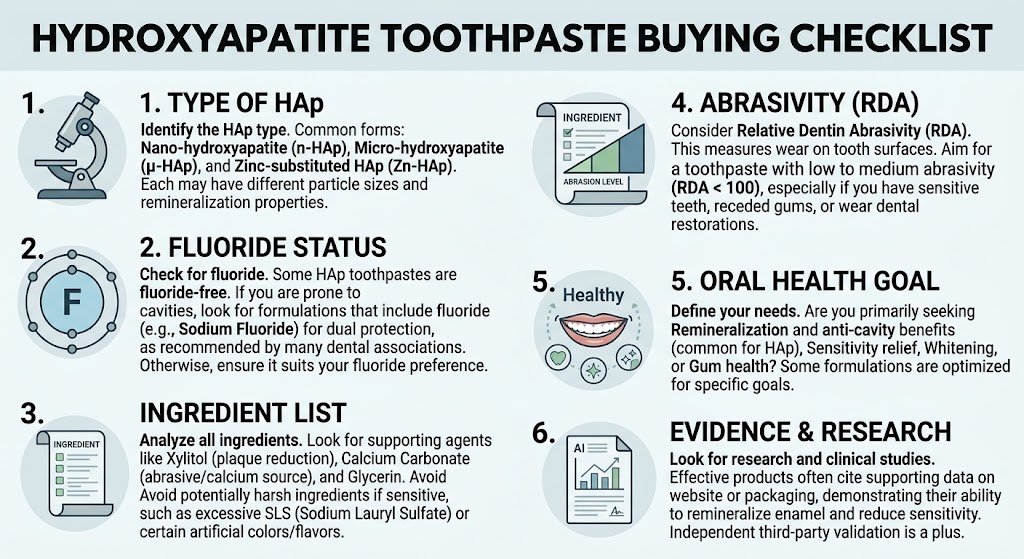
The goal is not to find the product with the longest ingredient list. It is to find a formulation that matches your oral-health needs and preferences.
1. Check That Hydroxyapatite Is Actually Listed
Start with the ingredient list.
Do not assume that words such as “mineral,” “natural,” “remineralizing,” or “biomimetic” mean the product contains hydroxyapatite.
If HAp is the ingredient you specifically want, verify that it is actually identified in the product information.
2. Look at the Type of Hydroxyapatite
If the manufacturer specifies the type, note whether the product uses conventional hydroxyapatite, nano-hydroxyapatite, or another described form.
This does not mean one form should automatically win.
Instead, it gives you useful information for comparing products and checking what evidence applies to that formulation.
3. Consider Why You Want HAp
Your reason for choosing hydroxyapatite should influence the product you select.
For example:
| Your priority | What to look for |
| Fluoride-free toothpaste | Confirm the product is actually fluoride-free |
| Enamel support | Look for a formulation designed around mineral support |
| Sensitivity | Consider whether the complete formula is designed for sensitive teeth |
| Cavity prevention | Evaluate the evidence and discuss your individual risk with a dentist |
| Ingredient simplicity | Check the complete ingredient list rather than the front label |
| Low abrasivity | Look for information about abrasivity when available |
This prevents a common mistake: buying a toothpaste because it contains HAp without asking whether it actually fits your main goal.
4. Check the Rest of the Ingredient List
Hydroxyapatite is only one part of a toothpaste.
Look at other ingredients such as:
- abrasives
- surfactants
- humectants
- flavoring agents
- sweeteners
- preservatives
- coloring ingredients
- additional active ingredients
If you are specifically trying to avoid certain ingredients, check the complete list instead of relying on marketing claims such as “clean” or “natural.”
5. Think About Abrasivity
A toothpaste needs some cleaning ability, but more abrasive does not automatically mean better cleaning.
A person concerned about enamel wear, sensitivity, or aggressive brushing may want to pay particular attention to the product’s abrasivity.
This is one reason “whitening” should not automatically be interpreted as “better cleaning.”
6. Don’t Choose Based Only on “Natural”
Natural does not tell you enough about how a toothpaste works.
A product can be natural and still contain ingredients you personally do not want. Likewise, an ingredient being synthetic does not automatically make it unsafe.
Instead, evaluate:
active ingredients + formulation + evidence + your dental needs
That gives you a much more useful basis for comparison.
7. Compare Products Before Buying
If you are shopping online, compare several products rather than choosing the first toothpaste that mentions hydroxyapatite.
A useful comparison can include:
- type of HAp
- fluoride status
- other active ingredients
- ingredient transparency
- sensitivity considerations
- abrasivity information
- intended use
- manufacturer information
- available evidence
Common Mistakes When Choosing Hydroxyapatite Toothpaste
Hydroxyapatite toothpaste has become more visible, but that also means shoppers can easily misunderstand what the ingredient actually tells them.
Mistake 1: Assuming “Hydroxyapatite” Means “Rebuilds Enamel”
Hydroxyapatite is closely related to tooth mineral, but toothpaste does not rebuild severely damaged enamel like a dental restoration.
Its potential role is better understood in terms of mineral interactions and support for remineralization, particularly in early stages of mineral loss.
Mistake 2: Assuming Nano-HAp Is Automatically Better
Smaller particles can behave differently, but smaller does not automatically mean more effective.
Look at the evidence for the specific material and formulation.
Mistake 3: Treating HAp and Fluoride as Identical
They have overlapping goals in oral care but different mechanisms and different evidence histories.
Fluoride has extensive evidence for cavity prevention.
Hydroxyapatite has a growing evidence base, particularly for fluoride-free formulations, but it should not be described as though the evidence is identical.
Mistake 4: Ignoring the Rest of the Formula
A toothpaste is more than its headline ingredient.
If you are sensitive to certain ingredients, check the complete formulation.
Mistake 5: Choosing a Product Only Because It Says “Clean”
“Clean” is not a standardized scientific description of toothpaste performance.
A better approach is to identify what the product contains, what you want it to do, and what evidence supports those ingredients.
Mistake 6: Forgetting Your Cavity Risk
A toothpaste decision should consider your actual oral-health situation.
Someone who rarely develops cavities may approach the decision differently from someone who frequently develops new decay.
If your cavity risk is high, do not make the decision based only on marketing claims about a fluoride-free alternative.
Frequently Asked Questions About Hydroxyapatite Toothpaste
How does hydroxyapatite toothpaste work?
Hydroxyapatite toothpaste delivers a calcium-phosphate mineral related to the mineral naturally found in teeth. During brushing, the ingredient can interact with the tooth surface and may support mineral deposition and remineralization of early enamel lesions.
Does hydroxyapatite toothpaste rebuild enamel?
It is more accurate to say that hydroxyapatite may support remineralization of early mineral loss rather than rebuild severely damaged enamel.
Once enamel has been substantially lost, toothpaste cannot simply grow the missing structure back.
Does hydroxyapatite toothpaste prevent cavities?
Research suggests hydroxyapatite can have anticaries potential, including evidence from clinical and in-situ studies.
However, fluoride has a much longer-established evidence base for cavity prevention. The choice between fluoride and fluoride-free HAp should therefore take individual cavity risk into account.
Is nano-hydroxyapatite better than hydroxyapatite?
Not necessarily.
Nano-HAp has smaller particle characteristics that may affect how it interacts with tooth surfaces, but product performance depends on the entire formulation and the evidence behind it.
Is hydroxyapatite toothpaste fluoride-free?
It can be, but not every HAp toothpaste is fluoride-free.
Always check the product’s ingredient list and description.
Is hydroxyapatite toothpaste safe?
Hydroxyapatite is used in oral-care products and has been investigated for safety and effectiveness. Specific nano-HAp materials have also undergone regulatory safety assessment under defined conditions.
However, safety assessments apply to the materials and conditions studied, not automatically to every product containing a similar ingredient.
Can hydroxyapatite toothpaste help sensitive teeth?
Hydroxyapatite has been studied for dentin sensitivity, and some formulations may be useful for this purpose.
Persistent sensitivity should still be evaluated by a dentist because sensitivity can have several causes.
How often should you use hydroxyapatite toothpaste?
Follow the directions on the specific product.
Your overall brushing routine also matters. Consistent brushing with an appropriate toothpaste is more important than choosing an ingredient and using it inconsistently.
Can you use hydroxyapatite toothpaste with fluoride toothpaste?
Whether to use one or combine products depends on the specific formulations and your oral-health needs.
If you are considering HAp because you want to replace fluoride, it is useful to first understand your cavity risk and discuss the change with your dentist when appropriate.
Does hydroxyapatite toothpaste work immediately?
No toothpaste should be expected to transform enamel after a single brushing.
Potential mineral-related effects are better understood as part of repeated oral-care use rather than an instant cosmetic change.
Bottom Line
How does hydroxyapatite toothpaste work?
The simplest explanation is that it uses a calcium-phosphate mineral closely related to the mineral naturally found in teeth. During brushing, hydroxyapatite can interact with tooth surfaces and may support mineral deposition and remineralization, particularly around early stages of mineral loss.
Nano-hydroxyapatite uses smaller particles and has been studied for similar oral-care applications, but “nano” should not automatically be treated as a guarantee of better performance.
The evidence for hydroxyapatite toothpaste is encouraging, including research into early caries and remineralization. At the same time, fluoride has a much longer and broader evidence base for cavity prevention.
So the best choice is not simply:
“Hydroxyapatite or fluoride—which one is better?”
A better question is:
“Which toothpaste formulation fits my oral-health needs, cavity risk, ingredient preferences, and the evidence available for the product?”
If you want to explore hydroxyapatite products next, compare the type of HAp, the complete ingredient list, fluoride status, abrasivity, intended purpose, and supporting evidence before buying.