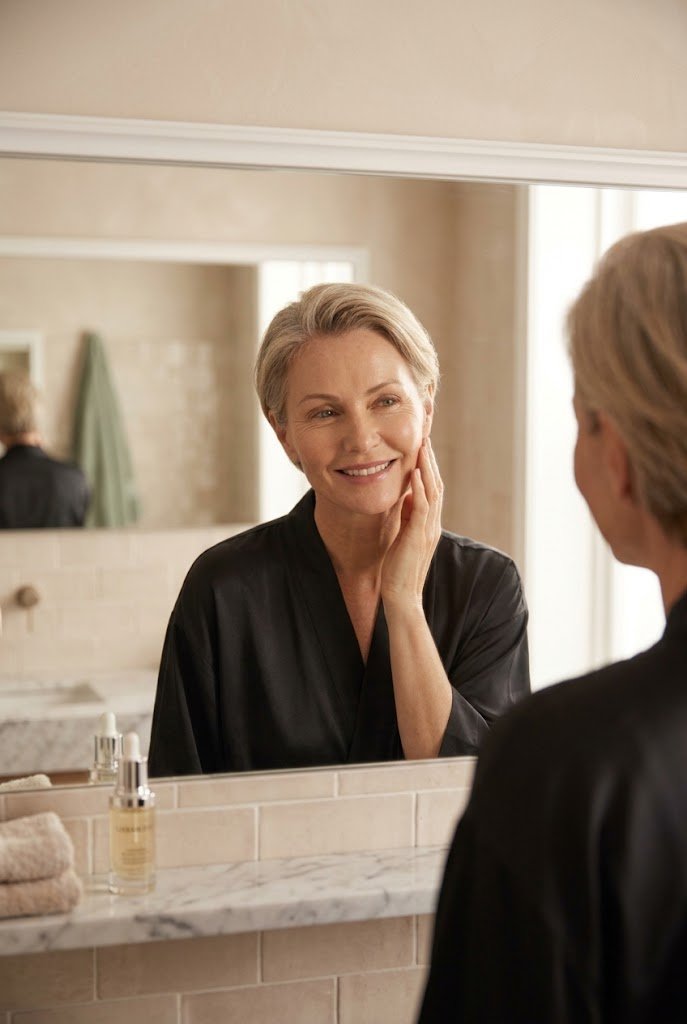
I still remember the exact moment it hit me. We were at a family dinner last fall, and my aunt Linda—she’s 54—leaned across the table to grab the salt. The overhead light caught her forehead, and I noticed deep lines I hadn’t seen before. She caught me staring and laughed it off: “Don’t look so surprised. These wrinkles earned their place.”
But later that evening, she pulled me aside and said something that stuck with me: “I’ve tried so many creams and serums. Some sting, some peel my skin off, and most do absolutely nothing. I just want something that actually works without making my face feel like it’s on fire.”
That conversation sent me down a rabbit hole. Over the next several months, I read through clinical reviews, studied formulation science, and—most importantly—I tested retinol products on willing family members over 40. My mom (58), my aunt Linda (54), and my uncle’s wife, Pam (47), all became my unofficial “test panel.” I tracked what they used, how their skin responded, and what they actually felt comfortable sticking with.
What I learned surprised me. Retinol can make a visible difference for deep wrinkles and fine lines—but the way you choose and use it matters far more than most articles let on. And the biggest barrier isn’t the ingredient itself. It’s the irritation that makes people quit before they ever see results.
If you’ve been asking yourself, “Can retinol actually help my deep wrinkles, and can I use it without my skin freaking out?”—I wrote this article for you. Let’s walk through everything I’ve learned, step by step.
Why Do Deep Wrinkles Become More Visible With Age?
Before we talk solutions, I think it helps to understand what’s actually happening beneath the surface. Because wrinkles aren’t just a “dry skin” problem. They’re structural.
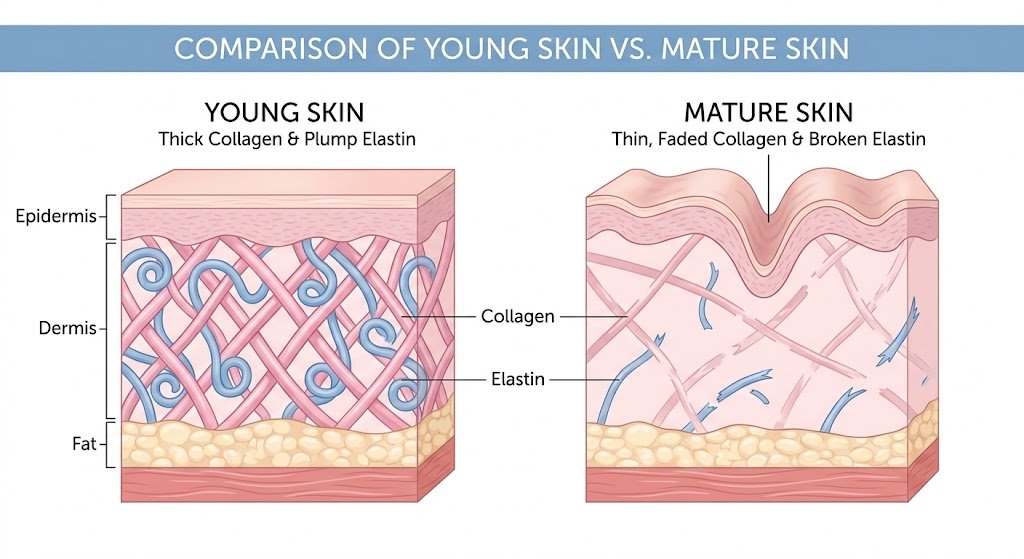
Your skin has two main layers that matter here: the epidermis (the outer layer you see) and the dermis (the deeper layer that gives skin its bounce). In your twenties and early thirties, the dermis is packed with collagen and elastin—proteins that keep skin firm, elastic, and resilient. But as we move through chronological aging, the body naturally slows down production of both.
I noticed this firsthand with my mom. She always had great skin in her forties, but by her mid-fifties, she started pointing out smile lines that seemed to “stay” even when her face was relaxed. That’s a hallmark of the transition from fine lines to deeper wrinkles. Fine lines are often surface-level and temporary at first. Deep wrinkles, on the other hand, reflect actual changes in the dermal structure.
Then there’s photoaging—and this is the big one. Years of cumulative UV exposure from sunlight don’t just cause sunburns. UV radiation breaks down collagen fibers, damages elastin, and accelerates the visible signs of skin aging far beyond what chronological aging alone would do. Research on photoaging consistently highlights wrinkles, skin laxity, and pigmentation changes as the most visible markers.
And it’s not just forehead wrinkles or crow’s feet around the eyes. Photoaging shows up as smile lines around the mouth, a general loss of skin firmness, changes in skin texture, and even enlarged or more visible-looking pores. The skin’s overall elasticity declines, meaning it doesn’t snap back the way it used to.
My aunt Linda’s forehead lines? Those weren’t just from squinting. They were the result of decades of collagen loss layered on top of years of sun exposure she didn’t think much about in her twenties. Understanding this helped me realize that no single product is going to “erase” deep wrinkles overnight—and anyone who promises that isn’t being honest with you. But that doesn’t mean improvement isn’t possible. It just means we need an ingredient with real research behind it.
Can Retinol Really Help With Deep Wrinkles?
Let me be straightforward: retinol is not a miracle cure. I want to say that clearly because the skincare industry loves to oversell things, and I’ve seen too many friends waste money on products that promised the impossible.
But here’s what the evidence actually says. Retinol is a vitamin A derivative and one of the most widely studied topical retinoids used in cosmetic anti-aging products. Research supports its potential to improve visible signs of photoaging, including the appearance of fine lines, wrinkles, and uneven skin texture.
Now, a quick clarification because I see this confused all the time. “Retinoids” is the umbrella term for all vitamin A derivatives. Prescription-strength options like tretinoin are retinoids. Retinol is a specific, over-the-counter retinoid that the skin must convert into its active form (retinoic acid) before it can work. This conversion process is why retinol is generally gentler than prescription retinoids—but it’s also why it requires patience and consistency.
A 2024 review of cosmetic retinoids noted that retinol and related compounds are associated with epidermal and dermal remodeling, which can translate to visible improvements in photoaged skin over time. For mature skin specifically, retinol has been studied for its potential to support a smoother, firmer-looking appearance and to refine overall skin texture.
When I first started reading this research, I was cautiously optimistic. But I needed to see it in real life. So I introduced a retinol product into my mom’s routine and watched carefully over eight weeks. The change wasn’t dramatic in week one or two. But by week six, she mentioned that her skin felt “tighter” and that her smile lines looked slightly softer in the morning. Nothing miraculous—but real, and she noticed it.
How Does Retinol Work on Aging Skin?
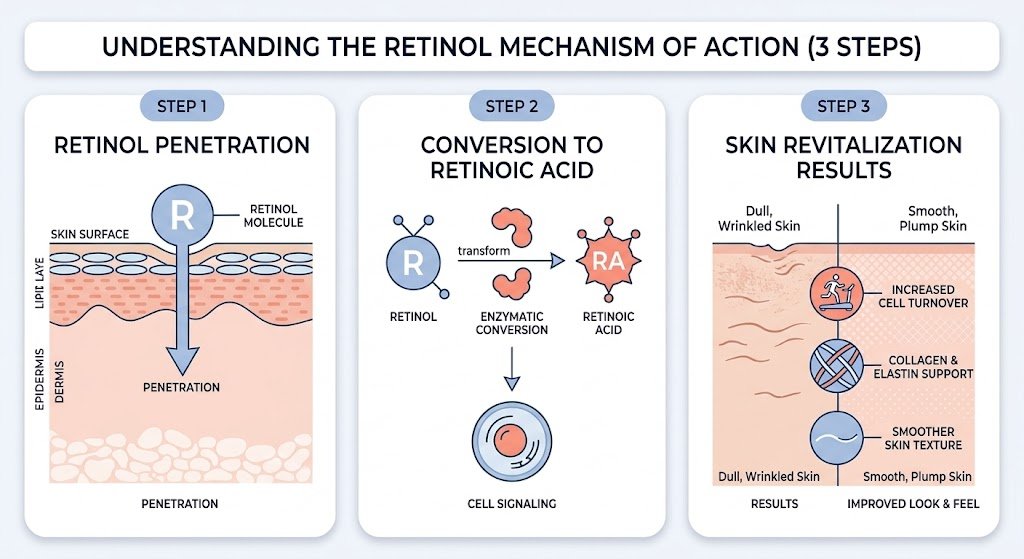
Understanding the mechanism helps set realistic expectations. When applied topically, retinol penetrates the skin and is converted into retinoic acid. This active form interacts with specific receptors in skin cells and is believed to support the natural skin renewal process.
In practical terms, this means retinol may help encourage cellular turnover in the epidermis, support the appearance of collagen in the dermis, and contribute to a more refined-looking skin surface over time. It’s not rebuilding your skin from scratch. It’s supporting the processes your skin already performs—just less efficiently as you age.
This is why consistency matters so much. Retinol for wrinkles isn’t a one-and-done treatment. It’s a long-game ingredient that rewards patience.
Retinol for Fine Lines, Forehead Wrinkles & Crow’s Feet
One question my aunt Pam asked me early on was: “Does retinol work the same on every part of my face?”
The honest answer is that different areas show aging differently. Forehead wrinkles tend to be deeper and more horizontal, often linked to repeated expression and sun exposure. Crow’s feet around the eyes form in thinner, more delicate skin, making them more prone to early visibility. Smile lines and fine lines around the mouth develop from years of movement combined with volume and collagen loss.
Retinol can be used across these areas, but the skin around the eyes is thinner and more sensitive, so a gentler approach is usually wise. During testing, I had my family members apply retinol carefully around the orbital bone—not directly on the eyelid—and they tolerated it well. For forehead wrinkles and deeper facial lines, consistent application over several weeks was where they began noticing a smoother-looking appearance.
Why Does Retinol Sometimes Cause Redness and Dryness?
Here’s where I need to be really honest with you, because this is the section that could have saved my aunt Linda years of frustration.
Retinol irritation is real. And it’s the number one reason people stop using retinol before they ever see benefits.
Common manifestations include redness, dryness, scaling, peeling, burning, and itching. In some cases, people experience what’s sometimes called retinoid dermatitis—a form of irritation that can feel like a mild chemical burn, especially if the skin barrier is already compromised.
The challenge isn’t simply choosing retinol. It’s finding an approach your skin can actually tolerate consistently.
Irritation is influenced by several factors:
the specific retinoid compound, its concentration, how frequently you apply it, the overall formulation, and your individual skin sensitivity.
Mature skin, in particular, can be more prone to irritation because the skin barrier naturally weakens with age. Transepidermal water loss—the technical term for moisture escaping through the skin’s surface—tends to increase, leaving skin drier and more reactive.
During my family testing, my mom experienced mild flaking around her nose during the first two weeks. My aunt Linda, who had a history of sensitive skin, felt a slight burning sensation the first few times she applied retinol. Neither reaction was severe, but both were enough to make them nervous.
This is exactly why I tell people: don’t push through significant irritation. The American Academy of Dermatology specifically notes that while retinoid products may be useful for mild fine lines and wrinkles, people experiencing significant dryness, redness, or inflammation should consult a dermatologist rather than simply forcing their skin to adapt.
The goal isn’t to endure suffering for the sake of results. The goal is to find a sustainable routine your skin accepts.
How to Use Retinol Without Over-Irritating Your Skin
After weeks of trial and error with my family panel, I developed a step-by-step approach that minimized irritation while still allowing the retinol to do its work. Here’s what worked for us:
Step 1: Start gradually. Don’t apply retinol every night from day one. My mom started with twice a week and slowly increased to every other night over three weeks. This gave her skin barrier time to adjust.
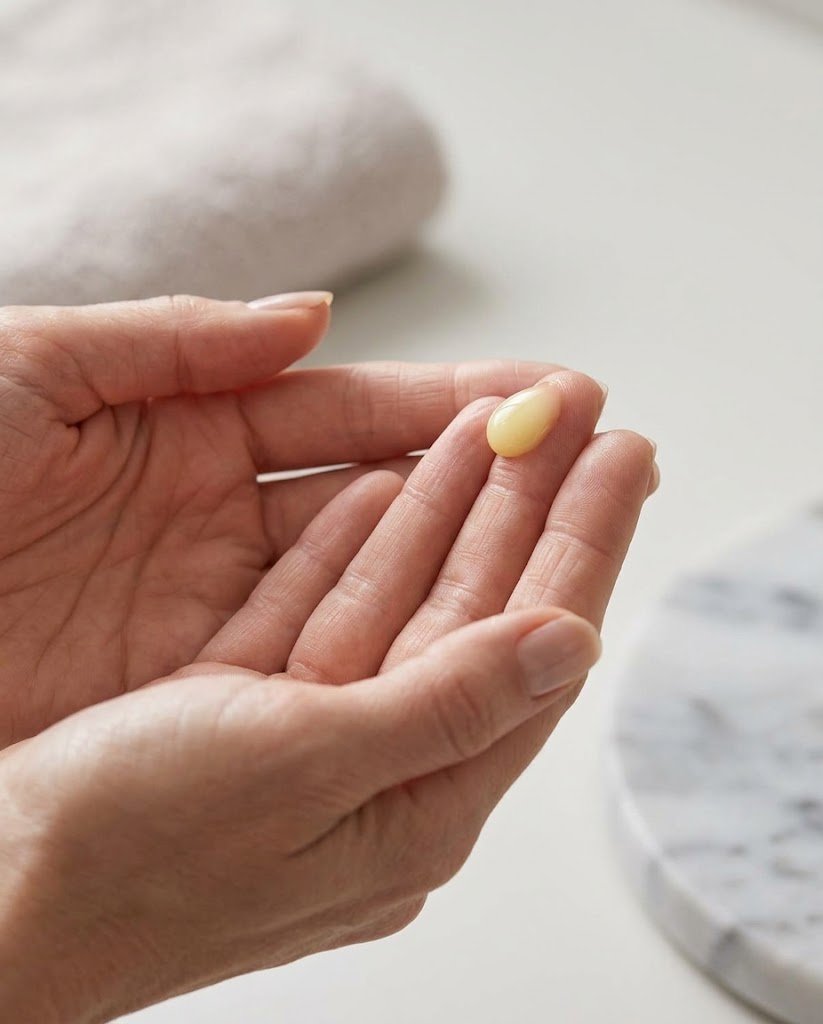
Step 2: Apply as directed. A pea-sized amount for the full face is usually sufficient. More product does not mean faster results—it usually means more irritation.
Step 3: Support the skin barrier. This was a game-changer for my aunt Linda. She started applying a gentle, fragrance-free moisturizer after her retinol, and the dryness she’d been experiencing improved noticeably within a few days. Skin barrier support is not optional when using retinol—it’s essential.
Step 4: Avoid overloading the routine. During the adjustment period, I asked my family members to pause other active ingredients like AHAs, BHAs, and vitamin C serums. Stacking too many actives at once is a fast track to irritation.
Step 5: Use daytime sun protection. Retinol can make skin more sensitive to UV exposure. Wearing a broad-spectrum sunscreen during the day is non-negotiable. I made this a hard rule for everyone in my test group.
Step 6: Monitor how your skin responds. Some mild adjustment is normal. Persistent burning, severe peeling, or worsening redness is not. Listen to your skin.
Step 7: Stay consistent. The improvements my family members noticed didn’t appear in the first week. They showed up gradually between weeks four and eight. Retinol rewards patience, not intensity.
What Should You Look For in a Retinol Serum?
Not all retinol products are created equal. I learned this the hard way when I tested an inexpensive retinol serum on Pam that caused more irritation than any other product we tried—even though it had a lower stated concentration.
The reason? Formulation matters enormously. Research reviews consistently highlight formulation stability and tolerability as critical considerations for retinoid products. Retinol is an inherently unstable molecule—it degrades when exposed to light and air. A poorly stabilized formula may deliver less active retinol to your skin than the label suggests, or it may deliver it in a way that triggers unnecessary irritation.
A recent pooled analysis found that a 0.1% stabilized bioactive retinol showed improvement in photoaging signs over 4–12 weeks, with reported irritation that was relatively limited. The key word there is stabilized. The delivery system, the supporting ingredients, and the overall formulation technology all influence how your skin experiences retinol.
When I evaluate a retinol serum now, I look for evidence of stabilization, a clear concentration disclosure, a formulation designed for skin tolerance, and supporting ingredients that help maintain the skin barrier. These details separate a product you can use consistently from one that ends up half-full in your bathroom cabinet.
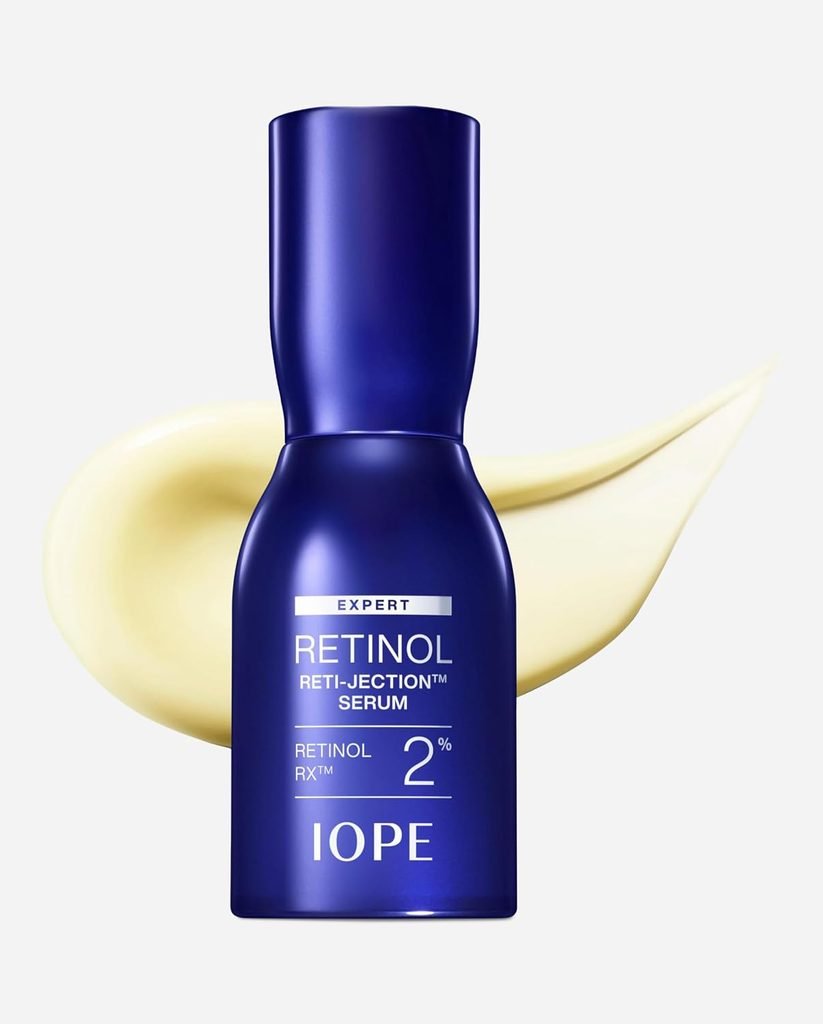
Meet Expert Retinol Reti-Jection™ Serum
This is the product I eventually introduced to my family panel after researching formulation quality—and it’s the one that earned the most consistent, positive feedback.
The Expert Retinol Reti-Jection™ Serum is a retinol-based facial serum designed specifically for an anti-aging skincare routine. The “Reti-Jection™” concept refers to the product’s targeted delivery approach, which the manufacturer designed to help support smoother, firmer-looking skin while aiming for better tolerability compared to some traditional retinol formulations.
What I appreciated most during testing was that it didn’t feel like a “harsh” product. My mom described it as lightweight and easy to layer under her moisturizer. My aunt Linda—who had been burned (literally) by aggressive retinol products in the past—found it comfortable enough to use consistently, which, as we’ve discussed, is the whole point.
I also came across reviews from other users that echoed what my family experienced. Dawn shared: “I loved the IOPE for the beginner and I wanted a stronger Retinol and it is exactly what I needed. Great value!” And Sue Stevens noted: “This retinol does def help smooth the crinkles and imparts a healthier glow. Used only for a week but my complexion looks brighter and more even.”
Reading feedback like Sue’s reminded me of my mom’s experience—that early brightness and more even-looking complexion can show up relatively quickly, even before the deeper wrinkle improvements become visible.
Who Is Retinol Reti-Jection™ Serum For?
Based on my testing and the product’s intended design, this serum is suited for people who:
- Have mature-looking skin with visible fine lines or deep wrinkles
- Are noticing a loss of firmness or uneven-looking skin texture
- Want to incorporate a retinol-based product into their anti-aging routine
- Have struggled with retinol irritation in the past and are looking for a formulation designed with tolerability in mind
It’s not a prescription treatment, and it won’t replace a dermatologist’s guidance for severe skin concerns. But for someone looking to add a researched, retinol-focused step to their skincare routine, it’s a strong option to consider.
How to Add It to Your Nighttime Skincare Routine
Retinol is best used at night because UV exposure can degrade the ingredient and because skin’s natural repair processes are most active during sleep. Here’s the simple routine I recommended to my family:
- Cleanse with a gentle, non-stripping cleanser.
- Apply a pea-sized amount of Retinol Reti-Jection™ Serum to dry skin, avoiding the immediate eye area.
- Follow with a moisturizer to support the skin barrier.
- In the morning, always apply broad-spectrum sunscreen.
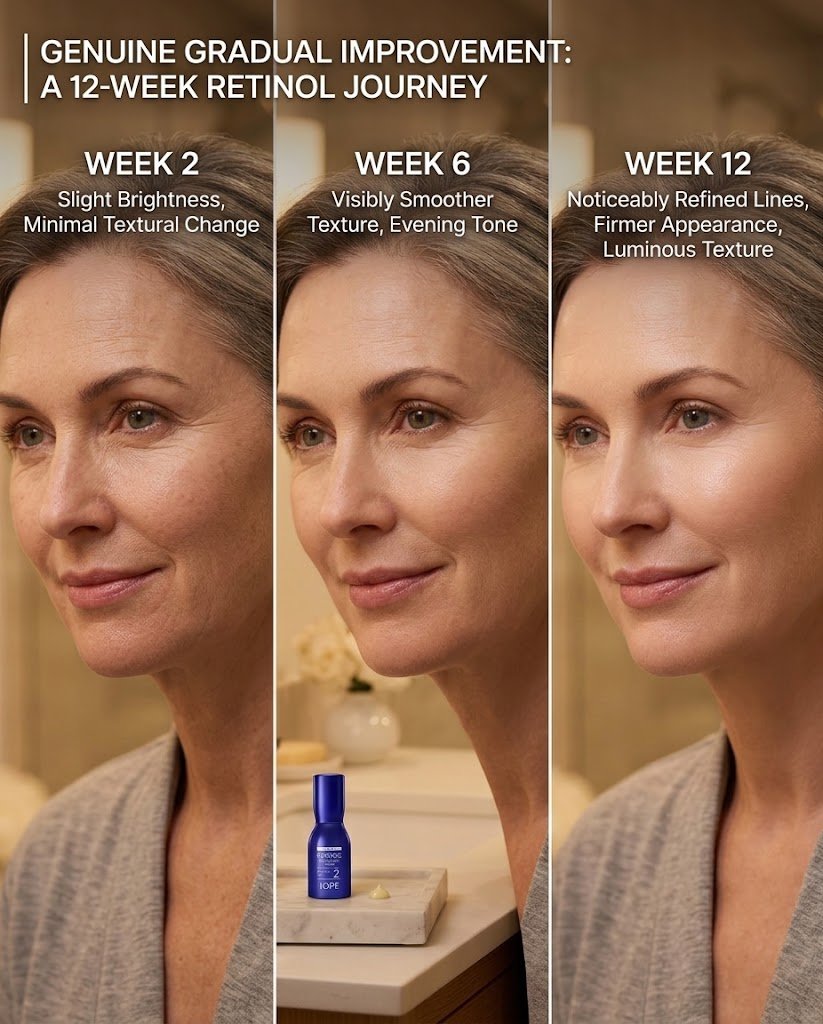
Start with two to three nights per week and gradually increase frequency as your skin adjusts. Consistency over weeks and months is what drives visible results.
Frequently Asked Questions About Retinol for Deep Wrinkles
Q1. Is retinol good for deep wrinkles? Retinol is one of the most researched topical ingredients for visible signs of aging, including deep wrinkles. Research suggests it may support dermal remodeling and a smoother-looking skin surface over time with consistent use.
Q2. How does retinol help with fine lines? Retinol supports the skin’s natural renewal process and may help encourage a more refined epidermal surface, which can make fine lines appear less noticeable.
Q3. Can retinol improve skin firmness? Studies on cosmetic retinoids suggest they may support the appearance of firmer-looking skin by contributing to collagen-related processes in the dermis. Results are gradual and vary by individual.
Q4. Can retinol cause irritation? Yes. Redness, dryness, peeling, and mild burning are common, especially during the initial adjustment period. Starting slowly and supporting the skin barrier can help minimize these effects.
Q5. How often should you use retinol? Most dermatologists recommend starting two to three times per week and gradually increasing frequency as your skin tolerates it. Daily use isn’t necessary for everyone.
Q6. Is retinol suitable for mature skin? Yes, retinol is widely studied for mature skin. However, because mature skin can have a weaker barrier, a gentle formulation and gradual introduction are especially important.
Q7. Can you use retinol if your skin is sensitive? Many people with sensitive skin can use retinol successfully, but it requires a cautious approach: low frequency, a well-formulated product, and strong barrier support. If irritation persists, consult a dermatologist.
Q8. Should retinol be used at night? Yes. Retinol can degrade in sunlight, and nighttime application aligns with the skin’s natural repair cycle. Always use sunscreen the following morning.
Q9. How long does retinol take to show visible results? Most research evaluates retinol improvements over 4–12 weeks of consistent use. Some people notice a brighter-looking complexion earlier, but deeper wrinkle improvements typically take longer.
Q10. What should you use with retinol? A gentle cleanser, a hydrating moisturizer, and a broad-spectrum sunscreen are essential companions. Avoid stacking multiple strong actives during the adjustment period.
Q11. Can retinol improve skin texture? Yes. Retinol’s support for cellular turnover may contribute to a smoother, more refined-looking skin surface over time.
Q12. What is Reti-Jection™? Reti-Jection™ refers to the targeted delivery approach used in the Expert Retinol Reti-Jection™ Serum, designed by the manufacturer to support the appearance of smoother, firmer-looking skin while prioritizing tolerability.
See How It Works
If you’ve read this far, you already know that dealing with deep wrinkles isn’t about finding a magic eraser. It’s about understanding your skin, choosing a well-formulated retinol product, and giving it the time and support it needs to work.
My aunt Linda is still using her retinol serum consistently, and last time I saw her, she didn’t mention irritation once—just that her skin felt “more like herself” again. That’s the kind of realistic, meaningful result I think is worth pursuing.
If you’re ready to explore a targeted retinol approach designed to support smoother, firmer-looking skin with consistent use, take a closer look at the Expert Retinol Reti-Jection™ Serum.
Note: We are amazon affiliators, if you buy from our link we get a some commission, which we can used to test more products. So contribute with us like that. We can tested the products and after that we take a reviews from customers who used these products and trying to publish a genuie results. But if you can find any issues you can contact with directly to the product buyer.