The easiest way to understand a toothpaste label is to check the active ingredient first, learn what the other ingredients do, and then compare the complete formula with your dental needs.
You do not need to memorize every chemical name. Once you understand the main ingredient groups, you can make more informed choices about cavity protection, sensitivity, whitening, and personal ingredient preferences.
1. Start With the Active Ingredient
1. Start With the Active Ingredient
For toothpaste sold in the United States, the active ingredient is one of the first things to check, especially when the product is intended to help prevent cavities.
An active ingredient is the substance intended to provide a product’s stated therapeutic effect. On an over-the-counter (OTC) product, look for the Drug Facts panel and its active ingredient information when applicable.
Common fluoride active ingredients include:
| Ingredient | What it means for label reading |
| Sodium fluoride | A fluoride compound used in anticaries toothpaste |
| Stannous fluoride | A fluoride compound used for cavity protection and in some formulas marketed for additional oral-care benefits |
| Sodium monofluorophosphate | Another fluoride compound used in anticaries toothpaste |
The American Dental Association (ADA) explains the role of fluoride and common toothpaste ingredients in its toothpaste guidance. addalinkadd a link
What to do: Identify the active ingredient, read the stated purpose, and check whether it matches your main dental goal.
If your priority is cavity protection, pay particular attention to the product’s anticaries ingredient and directions. If you are choosing toothpaste for sensitivity or another concern, examine the ingredients and claims relevant to that purpose as well.
Do not assume that a product is right for you simply because its front label uses a phrase such as “clean,” “natural,” or “advanced.”
2. Understand What the Other Ingredients Do
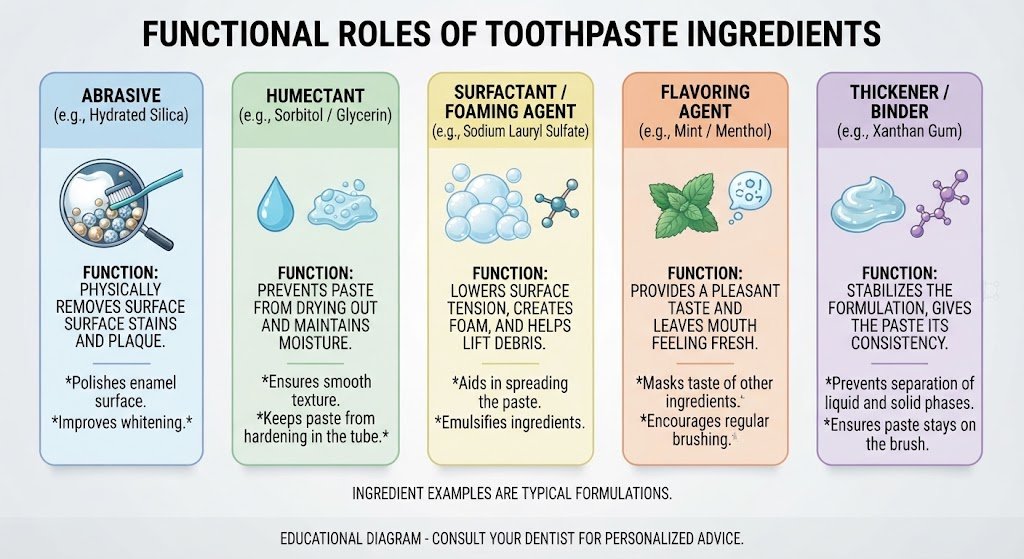
After checking the active ingredient, review the remaining ingredient list. These ingredients help the toothpaste clean, retain moisture, spread across the teeth, create foam, maintain its texture, or provide flavor.
| Ingredient or category | Common function |
| Hydrated silica | Can act as a cleaning abrasive |
| Calcium carbonate | Can act as an abrasive |
| Glycerin | Helps retain moisture |
| Sorbitol | Can function as a humectant and sweetener |
| Sodium lauryl sulfate (SLS) | A surfactant that helps with foaming |
| Flavoring agents | Provide taste and flavor |
| Thickening agents | Help maintain the toothpaste’s consistency |
| Xylitol | A sweetener used in some formulas |
These examples describe common functions. They do not, by themselves, determine whether an entire toothpaste formula is suitable for you.
Abrasives: What helps toothpaste clean?
Abrasives help remove surface deposits during brushing. Hydrated silica and calcium carbonate are examples found in some toothpaste formulas.
The presence of an abrasive does not automatically mean a toothpaste is harmful. The product’s overall formulation, intended use, and how you brush all matter. If you are specifically looking for a toothpaste with a lower-abrasion approach, compare products using reliable product information rather than guessing from one ingredient name.
Humectants: Why is glycerin in toothpaste?
Humectants help a toothpaste retain moisture and maintain its consistency. Glycerin and sorbitol are examples.
Their presence generally relates to how the product is formulated. They are not usually the main reason a person chooses a toothpaste for a specific dental concern.
Surfactants: What does SLS do?
Sodium lauryl sulfate (SLS) is a surfactant that helps ingredients spread and contributes to foaming.
Foam can affect the brushing experience, but more foam does not automatically mean better cleaning. Some people also prefer formulas without SLS, including those who find certain products irritating.
Flavoring ingredients: Why do they matter?
Flavoring ingredients affect a toothpaste’s taste and sensory experience. If you know that a particular flavor or ingredient causes you a problem, check the label when comparing formulas.
The word “flavor” on a label may not tell you every detail about the flavoring mixture. If you have a known allergy or recurring reaction, seek appropriate professional guidance rather than trying to diagnose the cause from the label alone.
3. How to Read a Toothpaste Label Step by Step
Use this process whenever you buy a new toothpaste or compare two products.
Step 1: Identify the product’s purpose
Start with the product’s stated use. It may be intended for cavity protection, sensitivity, whitening, or another oral-care goal.
Treat the front of the package as a starting point—not as a substitute for reading the full label.
Step 2: Find the active ingredient
For an OTC fluoride toothpaste, look for the active ingredient section and identify the fluoride compound listed.
Read the stated purpose and any relevant directions or warnings. If the product does not have a Drug Facts panel, do not assume that every label follows the same format. Examine the product information that is actually provided.
Step 3: Scan the other ingredients
Review the remaining list and look for ingredient functions you recognize:
- Abrasives help with cleaning.
- Humectants help retain moisture.
- Surfactants contribute to spreading and foaming.
- Flavoring agents affect taste.
- Thickening agents help maintain texture.
You do not have to memorize every name. Focus on ingredients that relate to your dental goal or your known preferences.
Step 4: Check your personal requirements
Make a short checklist based on what matters to you. You might want to confirm the fluoride status, avoid a specific ingredient that you know causes a reaction, or compare the cleaning approach of whitening formulas.
Keep personal preferences separate from general safety conclusions. Wanting an SLS-free formula, for example, does not mean that everyone needs to avoid SLS.
Step 5: Read directions and warnings
If the product has a Drug Facts panel, review its uses, warnings, and directions. These sections provide information about the product’s intended use and how it should be used.
The U.S. Food and Drug Administration (FDA) provides an explanation of the OTC Drug Facts label. addalinkadd a link
Step 6: Evaluate the whole formula
Before choosing, ask yourself:
- Does the product’s stated purpose match my main need?
- Have I identified its active ingredient, where applicable?
- Do I understand the main supporting ingredients?
- Have I checked ingredients relevant to my preferences or known sensitivities?
- Have I reviewed the directions and warnings?
- Am I making the choice based on the label rather than a marketing phrase alone?
This final check turns ingredient reading into a practical shopping skill.
4. What Ingredient Order Can and Cannot Tell You
Ingredient order can be useful, but it does not reveal everything about a toothpaste formula.
For cosmetic ingredient declarations, U.S. FDA rules generally require ingredients to be listed in descending order of predominance, subject to exceptions. Products that are both drugs and cosmetics can have additional labeling requirements, including separate declaration of active drug ingredients where applicable.
The rules depend on the product and the type of label. Consult the FDA’s summary of cosmetic labeling requirements for the relevant context. addalinkadd a link
Keep these limitations in mind:
- Do not assume every toothpaste label uses the same presentation. Read the sections in context.
- Do not calculate exact concentrations from ingredient order alone. A list does not necessarily tell you the percentage of every ingredient.
- Do not assume an ingredient listed later is unimportant. An ingredient can have a specific function even when it is present in a smaller amount.
- Do not treat order as a safety ranking. The position of an ingredient alone does not establish whether a complete formula is suitable for you.
If you need a precise concentration or technical detail that the label does not provide, do not guess. Check the manufacturer’s official product information or an appropriate authoritative source.
5. How to Compare Two Toothpaste Ingredient Lists
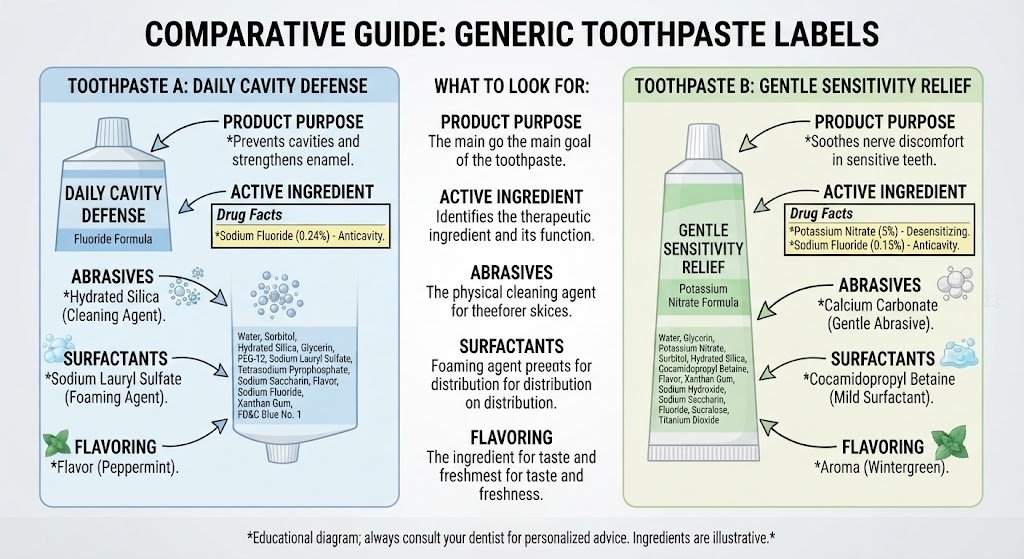
Suppose you are choosing between two toothpastes. Rather than comparing every ingredient name at once, compare the details that matter to your needs.
| What to compare | Toothpaste A | Toothpaste B |
| Product purpose | Read the stated use | Read the stated use |
| Active ingredient | Check the actual label | Check the actual label |
| Fluoride status | Verify from the package | Verify from the package |
| Cleaning ingredients | Identify listed abrasives | Identify listed abrasives |
| Surfactant | Check whether SLS is listed | Check whether SLS is listed |
| Flavoring | Review the available information | Review the available information |
| Directions and warnings | Read the package | Read the package |
This is a comparison framework, not a claim about two specific products.
Imagine that both formulas are intended for cavity protection, but only one lists SLS. If you specifically prefer an SLS-free formula, that difference may help you choose. If SLS is not a concern for you, other attributes may matter more.
Similarly, a whitening toothpaste and a toothpaste formulated for sensitivity may have different purposes. Do not treat them as interchangeable simply because their ingredient lists share several names.
The right choice depends on your dental goal, preferences, and the complete formula—not on one ingredient in isolation.
For a broader product-evaluation framework, see how we evaluate toothpaste. addalink—AnchorText:”howweevaluatetoothpaste”—Destination:”HowWeEvaluateToothpaste”add a link — Anchor Text: “how we evaluate toothpaste” — Destination: “How We Evaluate Toothpaste”
6. Read Toothpaste Ingredients Based on Your Dental Goal
The ingredients worth examining depend partly on why you are buying the toothpaste.
If your priority is cavity protection
Start with the active ingredient and stated purpose. For conventional U.S. anticaries toothpaste, fluoride is an important ingredient category to check.
You can compare options in our guide to fluoride toothpaste. addalink—AnchorText:”fluoridetoothpasteoptions”—Destination:”BestFluorideToothpaste”add a link — Anchor Text: “fluoride toothpaste options” — Destination: “Best Fluoride Toothpaste”
If your teeth are sensitive
Look for products specifically formulated for sensitivity and check their active ingredients. The ADA discusses stannous fluoride, potassium-based ingredients, and arginine in relation to dentin hypersensitivity. addalink—AnchorText:”ADAguidanceontoothpasteingredients”—Destination:”AmericanDentalAssociationtoothpasteguidance”add a link — Anchor Text: “ADA guidance on toothpaste ingredients” — Destination: “American Dental Association toothpaste guidance”
For more detailed product-selection guidance, read our guide to toothpaste for sensitive teeth. addalink—AnchorText:”toothpasteforsensitiveteeth”—Destination:”BestToothpasteforSensitiveTeeth”add a link — Anchor Text: “toothpaste for sensitive teeth” — Destination: “Best Toothpaste for Sensitive Teeth”
If you are comparing hydroxyapatite and fluoride
Identify which ingredient the product contains and what the manufacturer says the formula is intended to do. Do not assume that the presence of one ingredient alone determines the suitability of the complete product.
Explore hydroxyapatite versus fluoride for a more detailed comparison. addalink—AnchorText:”hydroxyapatiteversusfluoride”—Destination:”HydroxyapatitevsFluoride”add a link — Anchor Text: “hydroxyapatite versus fluoride” — Destination: “Hydroxyapatite vs Fluoride”
If your priority is surface-stain removal
Pay attention to the product’s stated purpose and cleaning ingredients. A whitening claim does not, by itself, explain every detail of the formula or guarantee a particular result.
If you want to compare cleaning approaches, see low-abrasive toothpaste options. addalink—AnchorText:”low−abrasivetoothpasteoptions”—Destination:”BestLow−AbrasiveToothpaste”add a link — Anchor Text: “low-abrasive toothpaste options” — Destination: “Best Low-Abrasive Toothpaste”
If you prefer to avoid particular ingredients
Identify the exact ingredient you prefer to avoid, then compare complete labels. For example, an SLS-free formula may suit someone who specifically wants to avoid SLS.
That preference should not be turned into a universal rule. If you experience recurring irritation or discomfort, a dentist or other qualified healthcare professional can help assess possible causes.
For a closer look at ingredient concerns, read our guide to toothpaste ingredients to avoid. addalink—AnchorText:”toothpasteingredientstoexaminemoreclosely”—Destination:”ToothpasteIngredientstoAvoid”add a link — Anchor Text: “toothpaste ingredients to examine more closely” — Destination: “Toothpaste Ingredients to Avoid”
7. Common Mistakes When Reading Toothpaste Labels
Mistake 1: Assuming an unfamiliar name means an ingredient is harmful
Many ingredients have technical names because they serve specific formulation functions. An unfamiliar name alone does not establish that an ingredient is harmful.
Mistake 2: Looking only at the front of the package
Words such as “natural,” “clean,” “whitening,” and “sensitive” do not replace the ingredient list or product directions. Read the supporting information before deciding whether a formula matches your needs.
Mistake 3: Judging the product by one ingredient
A toothpaste is a complete formula. One ingredient’s presence or absence does not tell you everything about the product’s purpose, performance, or suitability.
Mistake 4: Assuming fewer ingredients always means better
A shorter list may appeal to your preferences, but ingredient count alone does not establish whether a toothpaste is suitable for your dental goal.
Mistake 5: Ignoring product variants
A brand may sell multiple formulas with different active ingredients, flavors, or supporting ingredients. Check the exact variant rather than assuming all products from the same brand are identical.
Mistake 6: Treating marketing claims as proof
A phrase such as “natural” does not automatically establish that a product is more effective or suitable for everyone. Look at the actual ingredients, intended use, and reliable evidence behind any specific claim.
8. How to Check Toothpaste Ingredients Before Buying Online
Online shopping makes it easy to compare products, but a product page may not show every detail you need.
Before purchasing:
- Find the ingredient information for the exact product.
- Confirm the specific variant, flavor, and formulation.
- Check the active ingredient and stated purpose, where applicable.
- Compare the ingredients relevant to your dental goal and preferences.
- Review the directions and warnings.
- If the listing is incomplete, check the manufacturer’s official product information.
- Recheck the details on the package when the product arrives.
Do not rely only on the product title, promotional images, customer reviews, or a phrase such as “clean ingredients.”
Once you have verified the formula, compare other practical factors such as package size, price, and availability. If you shop through Amazon, make sure the listing corresponds to the exact variant you intend to buy and that the ingredient information is sufficiently clear.
You can then explore toothpaste options for ingredient-conscious shoppers. addalink—AnchorText:”toothpasteoptionsforingredient−consciousshoppers”—Destination:”BestNon−ToxicToothpaste”add a link — Anchor Text: “toothpaste options for ingredient-conscious shoppers” — Destination: “Best Non-Toxic Toothpaste”
Frequently Asked Questions
How do you read toothpaste ingredients?
Start with the active ingredient and its stated purpose. Review the supporting ingredients, identify their functions, read the directions and warnings, and compare the complete formula with your dental needs and preferences.
What is the active ingredient in toothpaste?
It depends on the formula. Common fluoride active ingredients in U.S. anticaries toothpaste include sodium fluoride, stannous fluoride, and sodium monofluorophosphate. Check the actual label to identify the active ingredient in a particular product.
Are toothpaste ingredients listed in order?
The applicable rules depend on the product and its labeling requirements. Cosmetic ingredient declarations generally follow descending order of predominance, subject to exceptions, while drug-active ingredients may be declared separately. Ingredient order alone does not tell you the exact concentration of each ingredient.
What do inactive ingredients do in toothpaste?
They can help with cleaning, moisture retention, foaming, flavor, texture, and other formulation functions. Their specific roles depend on the product.
What does SLS do in toothpaste?
Sodium lauryl sulfate is a surfactant that helps ingredients spread and contributes to foaming. Some people prefer SLS-free formulas, but that preference is not a universal requirement.
How do I compare two toothpaste labels?
Compare the product’s purpose, active ingredient, fluoride status, cleaning ingredients, flavoring, and any ingredients relevant to your preferences. Then evaluate the complete formula rather than relying on one ingredient or marketing claim.
Can I tell whether a toothpaste is suitable just by reading the ingredients?
The label can help you understand a product and rule out options that do not match your preferences, but it cannot answer every question about your individual dental needs. Consider the product’s stated purpose and reliable evidence, and ask a dentist for guidance when you have a specific dental concern.
Conclusion
Reading a toothpaste label becomes easier when you follow the same process each time: identify the product’s purpose, check its active ingredient, understand the supporting ingredients, and review the directions and warnings.
You do not need to memorize every ingredient or label each one as good or bad. Focus on what the formula is intended to do and which details matter to your dental needs.
Before choosing a toothpaste, remember: check the purpose, understand the ingredients, compare the complete formula, and verify the exact product.
