If you’re choosing between gel and paste toothpaste, you may be wondering whether one cleans better, protects against cavities more effectively, or is better for sensitive teeth.
The short answer is: neither gel nor paste is automatically better.
Gel and paste are different toothpaste formats, but the format itself does not determine the product’s main oral-health benefits. The ingredients, active ingredients, fluoride status, abrasives, and intended purpose matter much more.
So instead of asking only, “Should I buy gel or paste?” a better question is:
Which formulation best fits my dental needs, and do I prefer it as a gel or a paste?
In this guide, we’ll compare gel and paste toothpaste for cavity protection, cleaning, whitening, sensitivity, abrasivity, ingredients, foam, and everyday use. You’ll also learn what to look for when choosing a toothpaste and when it makes sense to consider a specific product category.
Gel vs Paste Toothpaste: The Quick Answer
For most people, gel and paste can both be good choices when the formulation is appropriate for their needs.
The biggest differences are usually related to texture, appearance, mouthfeel, and formulation preferences—not a universal difference in oral-health effectiveness.
| Feature | Gel Toothpaste | Paste Toothpaste |
| Texture | Usually smoother or more gel-like | Usually thicker and creamier |
| Appearance | May be clear, translucent, or colored | Usually opaque |
| Fluoride | Can contain fluoride | Can contain fluoride |
| Cavity protection | Depends on active ingredients | Depends on active ingredients |
| Whitening | Depends on formulation | Depends on formulation |
| Sensitivity relief | Depends on active ingredients | Depends on active ingredients |
| Abrasivity | Depends on formulation | Depends on formulation |
| Foaming | Depends on formulation | Depends on formulation |
| Best reason to choose | Preference + suitable formulation | Preference + suitable formulation |
The American Dental Association describes toothpaste, or dentifrice, as a product that can come in different forms, including gel and paste. Toothpaste formulations can contain abrasives, fluoride compounds, desensitizing ingredients, detergents, humectants, and other ingredients that serve different functions.
That means the word gel or paste on the package does not tell you everything you need to know.
For example, if your main concern is cavities, the presence and type of fluoride may matter much more than whether the toothpaste comes out as a gel or a paste.
If your concern is sensitivity, the active ingredient intended to address sensitivity deserves more attention than the texture.
And if you simply want a toothpaste you enjoy using every day, texture and flavor can become legitimate deciding factors.
What Is Gel Toothpaste?
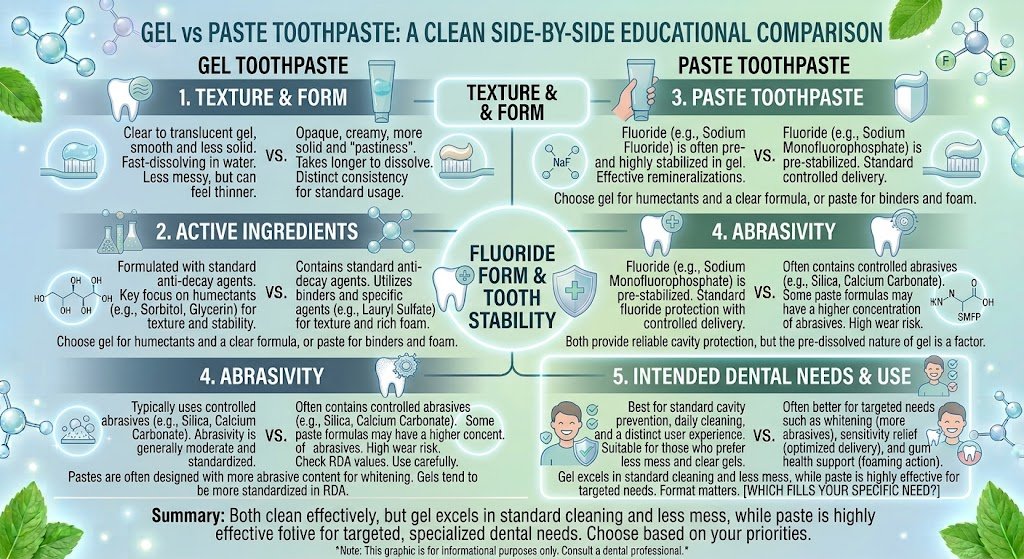
Gel toothpaste is a toothpaste formulation with a gel-like consistency. Depending on the product, it may look clear, translucent, striped, or colored.
The gel texture comes from the way the ingredients are combined and structured within the formulation. It does not automatically mean that the toothpaste is more effective, less abrasive, or better for a particular dental problem.
A gel toothpaste may contain many of the same functional types of ingredients found in traditional paste toothpaste, including:
- Fluoride compounds
- Abrasives
- Humectants
- Thickening or binding ingredients
- Flavoring agents
- Sweeteners
- Detergents
- Other active or inactive ingredients
The specific combination matters.
For example, two gel toothpastes can look very similar but have different active ingredients and therefore be designed for different purposes. One may focus primarily on cavity protection, another may target sensitivity, and another may be marketed for whitening or stain removal.
This is why choosing a gel simply because it looks different from traditional paste is not enough.
Why Do Some People Prefer Gel Toothpaste?
Preference is one of the simplest reasons to choose a gel.
Some people like:
- A smoother mouthfeel
- A particular flavor
- A lighter-feeling texture
- The appearance of translucent or striped gel
- The way a particular gel rinses from the mouth
These preferences are not necessarily indicators of superior cleaning or cavity protection.
However, personal preference still matters.
If you strongly prefer the texture of a particular gel and it meets your oral-health needs, you’re more likely to use it consistently as part of your normal brushing routine.
That makes preference a practical consideration—even if it is not a measure of clinical superiority.
What Is Paste Toothpaste?
Paste toothpaste is the traditional thicker toothpaste format familiar to most consumers.
It generally has a creamy or dense consistency and is usually opaque. Like gel toothpaste, it can be formulated for different oral-health purposes.
Depending on the product, paste toothpaste may contain:
- Fluoride
- Abrasive ingredients
- Humectants
- Thickeners or binders
- Flavoring ingredients
- Detergents
- Sweeteners
- Ingredients intended for specific dental concerns
The important point is that paste is a format, not a single type of formulation.
A cavity-protection paste and a sensitivity paste may have very different active ingredients even though both have a similar physical consistency.
Likewise, two paste toothpastes may have different abrasive systems, flavors, fluoride compounds, or additional ingredients.
So if you’re comparing a gel with a paste, don’t judge the products by consistency alone.
Look at what each product is actually formulated to do.
Gel vs Paste: The Key Differences
The easiest way to compare gel and paste toothpaste is to look at the factors that can actually affect your buying decision.
Texture and Mouthfeel
Texture is the most obvious difference between the two formats.
Gel toothpaste usually feels smoother and more gel-like, while paste toothpaste tends to feel thicker and creamier.
For some people, this is enough to determine their preference.
You may prefer gel because you dislike a heavy or thick toothpaste. Someone else may prefer paste because the thicker consistency feels more familiar.
Neither preference is inherently right or wrong.
The important distinction is:
Mouthfeel can affect your preference, but it does not automatically determine effectiveness.
If two products meet your dental needs equally well, choosing the texture you prefer is reasonable.
Fluoride and Cavity Protection
If your main concern is preventing cavities, fluoride deserves much more attention than whether the toothpaste is gel or paste.
Fluoride is widely used in toothpaste for cavity prevention, and fluoride-containing toothpaste is an important part of routine oral care.
Common fluoride compounds used in toothpaste include:
- Sodium fluoride
- Stannous fluoride
- Sodium monofluorophosphate
The FDA’s OTC anticaries drug framework recognizes fluoride dentifrices in both gel and paste dosage forms.
This is an important distinction because it shows why gel versus paste is not the main cavity-protection question.
Instead, ask:
Does the toothpaste contain an appropriate active ingredient for cavity protection?
For people whose main goal is cavity prevention, our guide to best fluoride toothpaste can provide a more focused comparison of that category.
The same principle applies when comparing products for other dental needs: identify the purpose first, then evaluate the formulation.
Cleaning and Plaque Removal
Both gel and paste toothpaste can contain abrasive ingredients that help remove debris and surface deposits during brushing.
Common toothpaste abrasives include ingredients such as silica and calcium carbonate.
But this does not mean that every gel cleans better than every paste—or vice versa.
Cleaning performance depends on more than texture.
Relevant factors include:
- The toothpaste’s abrasive system
- Your brushing technique
- How long you brush
- How regularly you brush
- Your toothbrush
- The overall formulation
The physical act of brushing is also a major part of removing plaque.
So if you’re deciding between two otherwise suitable products, don’t assume that the one with the more unusual texture must provide better cleaning.
Whitening and Surface Stains
If your goal is whiter-looking teeth, the important question is not simply whether the toothpaste is a gel or paste.
Instead, look at the whitening formulation and what the product is designed to accomplish.
Some whitening toothpastes are formulated to help remove surface stains. Their performance can depend on the ingredients and abrasive system used in the formulation.
A gel can be designed for whitening.
A paste can also be designed for whitening.
Therefore:
Gel does not automatically mean better whitening, and paste does not automatically mean weaker whitening.
If whitening is your priority, compare products based on their intended whitening function, ingredients, and suitability for your teeth.
Be especially careful about assuming that a stronger sensation or more noticeable foam means a stronger whitening effect. Those sensations are not reliable measures of whitening performance.
Abrasivity
Abrasivity is one of the areas where consumers often make assumptions about gel and paste.
A common assumption is:
Gel = gentle
Paste = abrasive
That is too simplistic.
Abrasivity depends on the formulation, not simply on whether the toothpaste is a gel or paste.
Toothpaste may contain abrasive materials that help physically clean the tooth surface and remove surface stains. Different products can use different abrasive systems.
The American Dental Association discusses Relative Dentin Abrasivity, or RDA, as a standardized measure related to dentifrice abrasivity.
However, RDA should not be treated as a simple ranking where a lower number automatically means a universally better toothpaste.
If you’re concerned about enamel wear, exposed dentin, or sensitivity, your dental situation matters more than making a broad assumption based on gel versus paste.
Sensitive Teeth
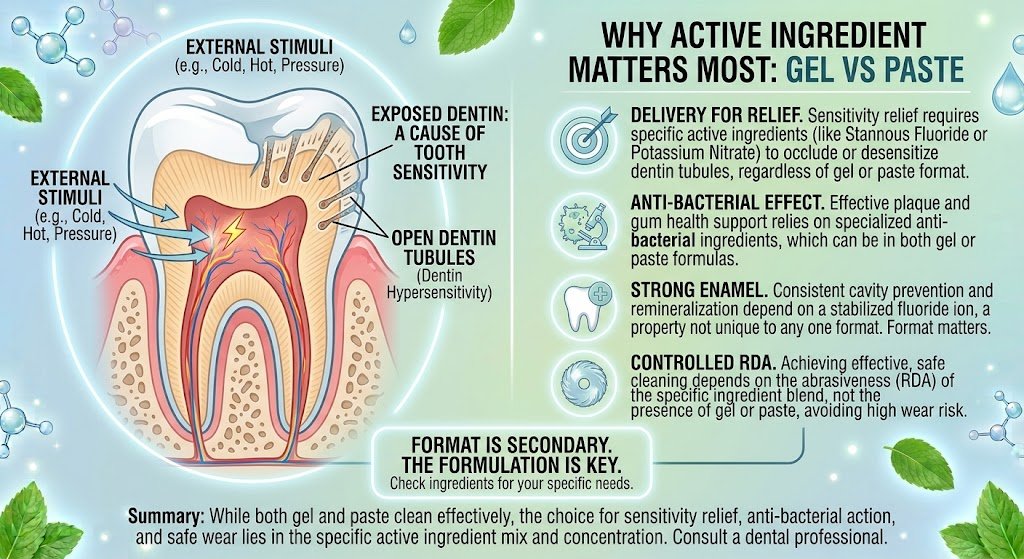
For sensitive teeth, focus on the active ingredient and purpose of the toothpaste, not just its texture.
Some toothpaste formulations contain ingredients intended to help reduce dentin sensitivity.
This means the better question is:
Which formulation is designed for sensitive teeth?
rather than:
Is gel or paste better for sensitivity?
Either format can potentially be formulated for sensitive teeth.
When comparing products, look for:
- A clearly identified sensitivity benefit
- An appropriate active ingredient
- A formulation you can comfortably use regularly
- Other ingredients that fit your preferences
If sensitivity is your main concern, you can explore toothpaste for sensitive teeth for a more focused comparison.
If you have persistent, severe, or worsening sensitivity, don’t rely on toothpaste selection alone. Sensitivity can have different causes and may need professional evaluation.
Gum Health
Gel versus paste is also not the primary factor when choosing toothpaste for gum health.
If your concern is plaque, gingivitis, or another gum issue, look for a formulation intended to address the specific concern and maintain a consistent oral-hygiene routine.
A toothpaste’s physical texture cannot tell you whether it is appropriate for a particular gum condition.
Persistent bleeding, swelling, pain, or other concerning symptoms should be evaluated by a dental professional rather than treated solely by changing toothpaste.
Foam and Rinsing
Foam is another feature that can influence how toothpaste feels during brushing.
Some consumers assume that:
More foam = better cleaning
But that isn’t a reliable rule.
Foaming is influenced by formulation ingredients such as detergents. A toothpaste that produces more foam may simply have a different formulation or create a different sensory experience.
Some people enjoy a foamy toothpaste because it makes their mouth feel freshly cleaned.
Others prefer a low-foam or SLS-free formulation.
If you prefer less foaming, you can compare products based on their ingredient lists rather than assuming that less foam means less effective cleaning.
For readers specifically interested in this issue, an article about why toothpaste foams can provide more detail.
Ingredients
The ingredient list is one of the most useful things to examine when comparing gel and paste toothpaste.
Instead of stopping at the front label, look for the ingredients that relate directly to your goal.
Depending on the product, you may see:
- Fluoride compounds
- Abrasives
- Humectants
- Thickeners
- Detergents
- Flavoring agents
- Sweeteners
- Desensitizing ingredients
- Other active ingredients
The role of each ingredient can be different.
For example, fluoride can be used for cavity protection, abrasives help with physical cleaning, and certain active ingredients can be included for sensitivity or other oral-health purposes.
If you’re trying to avoid particular ingredients, the ingredient list becomes even more important.
Rather than asking whether gel or paste has “better ingredients,” compare the actual formulations of the products you’re considering.
Is Gel Toothpaste Better Than Paste?
Not automatically.
Gel may be the better choice for you if:
- You prefer its texture.
- You like its flavor.
- You prefer its mouthfeel.
- It contains the active ingredient you need.
- Its formulation fits your ingredient preferences.
- You can use it comfortably and consistently.
For example, imagine two toothpaste products designed for the same general purpose. One is a gel and one is a paste. If both fit your needs, there’s no strong reason to choose one solely because it has a particular texture.
Your personal preference can be the deciding factor.
The important thing is not to confuse preference with proof of superior oral-health performance.
Is Paste Toothpaste Better Than Gel?
Paste is not automatically better either.
Paste may be the better choice if:
- You prefer a thicker consistency.
- You like the flavor or mouthfeel.
- The formulation fits your dental needs.
- It contains the active ingredient you’re looking for.
- You prefer the available options in paste form.
Traditional paste remains common because many consumers are comfortable with its texture and because toothpaste manufacturers offer many different formulations in this format.
Again, however, the word paste doesn’t tell you whether the product is better for cavities, sensitivity, whitening, or another concern.
Which Is Better for Different Dental Needs?
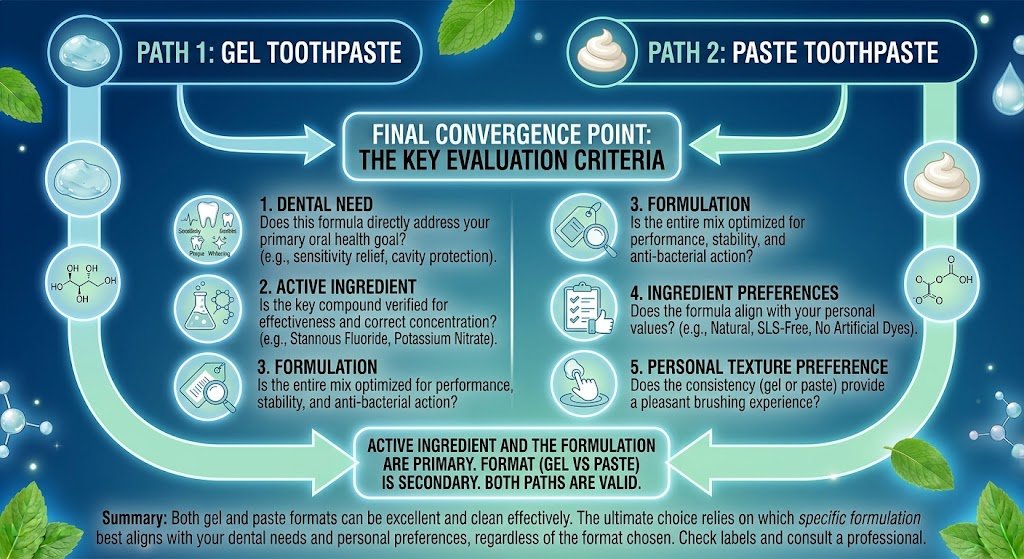
The simplest way to make the decision is to start with why you are buying toothpaste in the first place.
| Your Main Goal | What to Prioritize | Gel or Paste? |
| Cavity prevention | Appropriate fluoride formulation | Either |
| Sensitive teeth | Appropriate desensitizing active | Either |
| Whitening | Suitable stain-removal formulation | Either |
| Gum concerns | Appropriate oral-health formulation | Either |
| Ingredient preferences | Ingredient list | Either |
| Enamel concerns | Suitable formulation and abrasivity | Either |
| Everyday brushing | Effective formulation + preference | Either |
| Texture preference | Mouthfeel | Your choice |
If You Are Concerned About Cavities
Start with the toothpaste’s cavity-protection ingredients.
For many adults, fluoride is an important consideration when choosing toothpaste for everyday cavity prevention.
The ADA recognizes fluoride toothpaste as an effective way to help prevent dental caries.
If cavity prevention is your main goal, it makes more sense to compare appropriate fluoride toothpaste options than to choose based only on whether the toothpaste is gel or paste.
If You Have Sensitive Teeth
Prioritize a toothpaste specifically formulated for sensitivity.
Look at the active ingredient and the product’s stated purpose.
Don’t assume that gel is gentler simply because it feels smoother, or that paste is harsher because it feels thicker.
The formulation matters more.
If You Want Whiter Teeth
Look for a product formulated to help with the type of discoloration you’re trying to address.
For example, surface stains and deeper tooth discoloration are not necessarily the same problem.
A toothpaste may help with certain surface stains, but toothpaste should not be treated as a universal solution for every type of tooth discoloration.
Whether the product is a gel or paste is secondary to what the formulation is designed to do.
If You Are Concerned About Enamel
Don’t choose based solely on texture.
Instead, pay attention to the toothpaste’s abrasive system and your individual dental circumstances.
If you have concerns about enamel wear, exposed dentin, or frequent sensitivity, ask a dental professional which type of toothpaste is appropriate for you.
If You Want Better Gum Health
Focus on the actual oral-health problem rather than the toothpaste format.
Good brushing technique, regular oral hygiene, and appropriate professional care can all matter.
If your gums regularly bleed, swell, or hurt, changing from paste to gel—or gel to paste—may not address the underlying cause.
What Matters More Than Gel vs Paste?
When comparing two toothpastes, use this order of priorities:
1. Identify Your Main Dental Need
First ask what you want the toothpaste to accomplish.
Is your main concern:
- Cavities?
- Sensitivity?
- Whitening?
- Gum health?
- Everyday cleaning?
- Ingredient preferences?
Your answer should guide the rest of your decision.
2. Check the Active Ingredients
Once you know your goal, look at the active ingredients.
For example, someone choosing toothpaste for cavity protection should pay attention to the fluoride formulation rather than simply looking for a gel.
Someone choosing a sensitivity toothpaste should examine the ingredients intended to address sensitivity.
3. Evaluate the Overall Formulation
Consider relevant characteristics such as:
- Abrasives
- Fluoride
- Desensitizing ingredients
- Detergents
- Flavor
- Other active ingredients
This gives you a much clearer picture of what you’re actually buying.
4. Consider Your Ingredient Preferences
If you prefer an SLS-free toothpaste, for example, compare the actual ingredient list.
Don’t assume that all gel toothpastes contain less SLS or that all paste toothpastes contain more.
The product’s formulation is what matters.
5. Consider Personal Preference
Once the important health-related factors are covered, texture becomes a perfectly reasonable deciding factor.
If you prefer gel, choose gel.
If you prefer paste, choose paste.
There is no need to force yourself to use a texture you dislike when both suitable options meet your needs.
6. Look for Reliable Quality Signals
When comparing products, you can also look for trustworthy information about the product’s formulation, intended use, and applicable quality or acceptance standards.
The ADA Seal of Acceptance is one example of a quality signal consumers may encounter when shopping for oral-care products.
However, don’t use a single label as a substitute for evaluating whether a toothpaste actually fits your personal dental needs.
[ ARTICLE CONTINUES — NEXT PART STARTS WITH: H2: “How to Choose the Right Toothpaste” ]
Part 1 complete
This part follows the approved outline and stops at a natural section boundary. The next part will continue directly with “How to Choose the Right Toothpaste”, followed by the remaining article sections, FAQ, conclusion, and then the required implementation packages.
Continuing exactly from the previous stopping point. No repeated introduction or earlier sections.
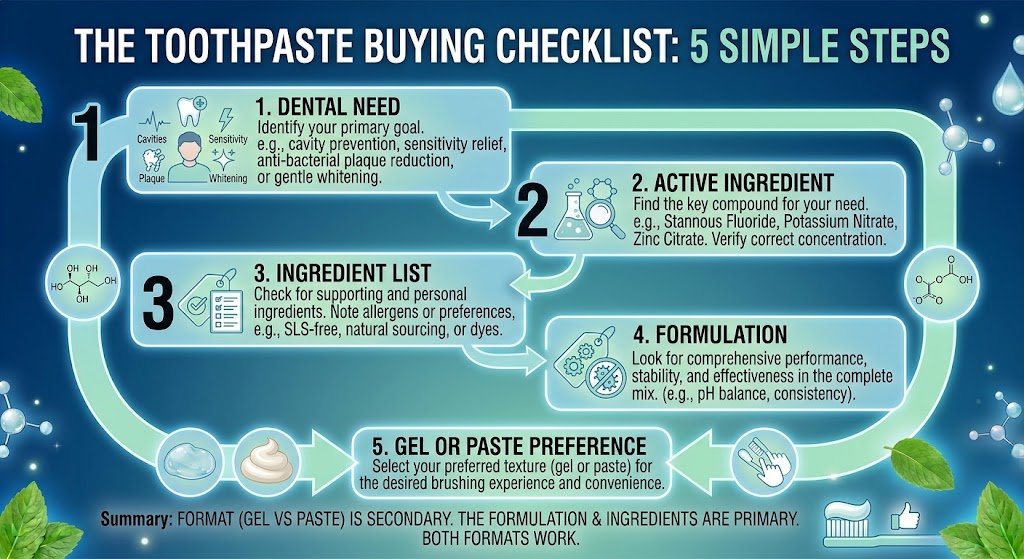
How to Choose the Right Toothpaste
Once you understand that gel and paste are simply different formats, choosing toothpaste becomes much easier.
Instead of starting with the texture, start with your oral-health goal.
Step 1: Decide What You Want the Toothpaste to Do
Think about your main reason for choosing a toothpaste.
You may want:
- Everyday cavity protection
- Sensitivity relief
- Whitening or surface-stain removal
- Support for gum health
- A particular ingredient
- An SLS-free formulation
- A hydroxyapatite formulation
- A toothpaste you simply enjoy using
If you have more than one goal, identify your most important one first.
For example, if you want both cavity protection and whitening, don’t automatically choose a toothpaste because it is labeled “whitening.” Check whether it also provides the type of cavity protection you want.
Step 2: Check the Active Ingredients
After identifying your goal, look at the active ingredients.
This is one of the most important steps because the active ingredient is directly connected to what the product is designed to accomplish.
For cavity protection, check the fluoride information.
For sensitivity, look for an appropriate desensitizing ingredient.
For other specialized purposes, evaluate the active ingredients and the claims on the product label.
The important principle is:
Choose the ingredient for your need, then choose the format you prefer.
Step 3: Read the Ingredient List
The front of a toothpaste package is designed to communicate quickly.
The ingredient list gives you more detail.
If you have specific ingredient preferences, allergies, or sensitivities, reading the ingredient list becomes especially important.
You can use our guide on how to read toothpaste ingredients to understand the different types of ingredients you may encounter.
Step 4: Consider Abrasivity and Your Dental Situation
Abrasives are useful because they help with physical cleaning and surface-stain removal.
But if you have particular concerns about enamel wear, exposed dentin, or sensitivity, don’t assume that gel is automatically gentler than paste.
The formulation matters.
If abrasivity is a major concern for you, look for reliable information about the product rather than judging it by consistency alone.
Step 5: Decide Whether You Prefer Gel or Paste
Now you can consider texture.
If the products you’re comparing meet your needs, choose the one you prefer.
You may prefer:
Gel because:
- You like the smoother texture.
- You prefer the mouthfeel.
- You like a particular gel flavor.
- You prefer how it rinses.
Paste because:
- You prefer the thicker consistency.
- You like the traditional toothpaste feel.
- You prefer the available formulations.
- You like the flavor or texture of a particular paste.
At this point, gel versus paste is a personal preference rather than the main health decision.
Step 6: Consider the Product’s Overall Value
Price can also influence your decision.
A more expensive toothpaste is not automatically better simply because it uses a premium-looking package or makes more claims.
Compare:
- Active ingredients
- Intended purpose
- Amount of product
- Formulation
- Your actual needs
- Cost per use when practical
If two products meet your needs, there’s little reason to pay substantially more simply because one has a more appealing texture.
Gel vs Paste Toothpaste: Pros and Cons
Neither format deserves a blanket “winner” label. Each can be a practical choice depending on the formulation and the person’s preferences.
| Gel Toothpaste | Paste Toothpaste | |
| Texture | Usually smoother and more gel-like | Usually thicker and creamier |
| Appearance | May be translucent or striped | Usually opaque |
| Cavity protection | Depends on active ingredients | Depends on active ingredients |
| Whitening | Depends on formulation | Depends on formulation |
| Sensitivity | Depends on formulation | Depends on formulation |
| Abrasivity | Depends on formulation | Depends on formulation |
| Foaming | Depends on formulation | Depends on formulation |
| Main advantage | Personal texture and formulation preference | Familiar texture and wide formulation choice |
| Main limitation | Texture does not indicate effectiveness | Texture does not indicate effectiveness |
Pros of Gel Toothpaste
Gel toothpaste may appeal to you if you prefer:
- A smooth texture
- A lighter mouthfeel
- Certain gel flavors
- A translucent or striped appearance
- A particular formulation available in gel form
The main advantage is often user preference, rather than an inherent oral-health advantage.
Cons of Gel Toothpaste
The main potential problem is not the gel format itself.
It is assuming that the format tells you what the product can do.
For example, a gel is not automatically:
- Better for cavities
- Better for whitening
- Less abrasive
- Better for sensitive teeth
- Better for enamel
Those characteristics depend on the formulation.
Pros of Paste Toothpaste
Paste may be a good fit if you prefer:
- A thicker consistency
- A traditional toothpaste texture
- Certain paste formulations
- A familiar brushing experience
There are also many specialized toothpaste formulations available in traditional paste form.
Cons of Paste Toothpaste
Again, the main issue is assuming that “paste” automatically means a certain performance level.
Paste is not automatically:
- More abrasive
- Better at cleaning
- Better for cavities
- Better for whitening
- Worse for sensitivity
You need to evaluate the actual formulation.
Is One Format Better for Everyday Brushing?
For everyday brushing, the more useful question is whether the toothpaste fits your oral-health needs and whether you can use it consistently.
If you prefer a gel and it contains the appropriate ingredients for your needs, there is no general reason to avoid it simply because it is a gel.
Likewise, if you prefer paste, there is no need to switch to gel simply because gel may look newer or more modern.
A practical everyday choice should be:
Appropriate for your dental needs + comfortable to use + easy to purchase + affordable enough to use consistently.
This is why texture should usually be considered after the more important formulation factors.
What About Hydroxyapatite Gel vs Paste?
Hydroxyapatite toothpaste adds another layer to the comparison.
Hydroxyapatite is a calcium-phosphate material related to the mineral structure of teeth and is used in some toothpaste formulations.
If you’re considering hydroxyapatite toothpaste, the same basic rule applies:
Compare the formulation first and the format second.
A hydroxyapatite gel and a hydroxyapatite paste should not be considered different simply because one has a gel texture.
Look at:
- Type of hydroxyapatite used
- Concentration where disclosed
- Other active ingredients
- Fluoride status
- Intended use
- Ingredient preferences
- Overall formulation
If you’re specifically interested in this category, see our best hydroxyapatite toothpaste guide.
This is particularly important because consumers sometimes treat “hydroxyapatite” as if it automatically tells them everything about a toothpaste. It doesn’t.
The complete formulation still matters.
What About SLS-Free Gel vs Paste?
If you’re trying to avoid sodium lauryl sulfate, don’t assume that gel automatically means SLS-free.
Likewise, don’t assume that traditional paste automatically contains SLS.
SLS is a detergent that can contribute to foaming, but the presence or absence of SLS depends on the individual formulation.
When this is important to you, check the ingredient list.
You can also learn more about the role and potential concerns surrounding SLS in our guide to whether SLS in toothpaste is bad.
The important takeaway is simple:
SLS-free is a formulation characteristic, not a gel-versus-paste characteristic.
Does Gel Toothpaste Clean as Well as Paste?
There is no simple rule that gel cleans better or worse than paste.
Both can contain abrasive ingredients designed to assist with cleaning.
The actual result depends on the complete formulation and how the toothpaste is used.
Your brushing technique matters too.
A toothpaste cannot compensate for consistently poor brushing habits.
When comparing two products, focus on their intended purpose and formulation rather than assuming that the physical texture predicts cleaning ability.
Does Paste Toothpaste Have More Fluoride?
Not necessarily.
Gel and paste toothpastes can both contain fluoride.
The fluoride status depends on the individual product.
This is why you should check the product’s active ingredients instead of assuming that paste contains more fluoride because it looks thicker.
The FDA’s OTC anticaries framework includes both gel and paste dosage forms for certain fluoride-containing dentifrices.
So, if fluoride is important to you, compare the actual product labeling.
Does More Foam Mean Better Toothpaste?
No.
Foam is largely a sensory characteristic influenced by the toothpaste’s formulation.
Some people enjoy a strong foaming sensation because it makes their mouth feel clean.
Others prefer less foam, particularly if they find strong foaming uncomfortable.
More foam should not be treated as a shortcut for determining which toothpaste provides better oral-health benefits.
If you prefer less foaming, compare ingredient lists and look for formulations that fit your preference.
Should You Buy Gel or Paste Toothpaste?
If you’re still unsure, use this simple decision process:
Choose Gel If:
- You prefer a gel texture.
- You like the mouthfeel.
- The product contains the active ingredient you need.
- The formulation fits your ingredient preferences.
- The price and availability work for you.
Choose Paste If:
- You prefer a thicker texture.
- You like the traditional mouthfeel.
- The formulation fits your dental needs.
- It contains the active ingredient you want.
- The product offers good value for you.
Choose Based on the Dental Need First If:
- You have frequent cavities.
- You have significant tooth sensitivity.
- You’re specifically looking for whitening.
- You have particular ingredient concerns.
- You have a dental condition requiring specific care.
In these situations, don’t let the gel-versus-paste question distract you from the more important issue.
Your dental need should determine the type of formulation you look for.
When Should You Talk to a Dentist Instead of Switching Toothpaste?
Toothpaste can be useful for routine oral care, but it isn’t a substitute for diagnosing dental problems.
Consider professional dental advice if you have:
- Persistent tooth pain
- Significant or worsening sensitivity
- Frequent cavities
- Persistent gum bleeding
- Swollen or painful gums
- Visible tooth damage
- A persistent oral-health problem that does not improve
For example, if your teeth hurt every time you use cold water, simply switching from paste to gel may not address the cause.
The problem could involve sensitivity, decay, gum recession, enamel damage, or another dental issue.
A toothpaste comparison is useful for choosing products, but it cannot diagnose the reason behind a symptom.
Frequently Asked Questions
Is gel toothpaste better than paste toothpaste?
No. Gel and paste are different toothpaste formats, and neither is universally better. The more important factors are the active ingredients, fluoride status, overall formulation, intended dental benefit, and your personal preferences.
Is gel toothpaste good for cavities?
It can be, provided the particular product has an appropriate cavity-protection formulation. The fact that it is a gel does not determine its cavity-protection ability. When cavity prevention is your priority, examine the active ingredients rather than choosing based on texture.
Is paste toothpaste better for cavities?
Not automatically. Paste can contain fluoride and provide cavity protection, but so can gel toothpaste. The individual formulation matters more than the physical consistency.
Does gel toothpaste contain fluoride?
Many gel toothpastes contain fluoride, but not all toothpaste products have the same active ingredients. Check the product label to determine whether fluoride is present and which fluoride compound is used.
Is gel or paste better for sensitive teeth?
Neither format is automatically better for sensitivity. Look for a formulation designed for sensitive teeth and pay attention to the relevant active ingredient. If sensitivity continues or becomes severe, consult a dentist.
Is gel toothpaste less abrasive?
Not necessarily. Abrasivity depends on the toothpaste formulation and its abrasive ingredients. You should not assume that a gel is automatically less abrasive than a paste.
Does paste toothpaste clean better?
Not automatically. Both gel and paste can contain ingredients that help clean teeth. Brushing technique, frequency, duration, toothbrush choice, and the toothpaste formulation all contribute to the cleaning process.
Does more toothpaste foam mean it cleans better?
No. Foaming is influenced by ingredients such as detergents and is not a reliable measure of cleaning effectiveness.
Is fluoride more important than gel versus paste?
For cavity prevention, fluoride status is generally more relevant than whether the toothpaste is a gel or paste. If cavity protection is your main concern, evaluate the active ingredients first.
Should I use gel or paste toothpaste every day?
Either can be appropriate for everyday brushing if the product fits your dental needs and is used as directed. Choose the formulation that meets your needs and the texture you are comfortable using consistently.
Final Verdict: Gel vs Paste Toothpaste
So, which is better: gel or paste toothpaste?
For most people, there is no universal winner.
The better approach is to choose toothpaste in this order:
1. Identify your dental need.
Do you want cavity protection, sensitivity relief, whitening, gum support, or simply an everyday toothpaste?
2. Check the active ingredients.
Make sure the product is actually formulated for your primary goal.
3. Evaluate the formulation.
Consider ingredients, abrasivity, fluoride status, and other characteristics that matter to you.
4. Consider your personal preferences.
Once the important factors are covered, choose the texture and flavor you prefer.
5. Compare products before buying.
If you’re shopping online, compare the actual ingredients and intended benefits instead of assuming that one format is automatically better.
The simplest rule to remember is:
Formula first. Texture second.
A gel toothpaste can be a good choice. A paste toothpaste can also be a good choice. What matters is whether the specific product fits your oral-health needs and whether you can comfortably use it as part of your regular routine.
If you’re ready to compare products, focus on the features that actually matter for your situation before moving to an Amazon purchase. That gives you a better chance of choosing a toothpaste because it fits your needs—not simply because its texture looks appealing.
Affiliate disclosure: If this article contains links to products that may earn the publisher a commission, the relationship should be clearly disclosed to readers before publication.
