Fluoride is a naturally occurring mineral ion that plays an important role in protecting teeth from cavities. It is found in nature, including water and soil, and is also added to many dental products such as toothpaste.
But fluoride is often confused with fluorine, and questions about its safety can make choosing toothpaste confusing.
In this guide, you’ll learn what fluoride actually is, how it protects enamel, why it is used in toothpaste, the common fluoride compounds found on ingredient labels, how much fluoride toothpaste usually contains, and how fluoride compares with fluoride-free options.
What Is Fluoride?
Fluoride is the ionic form of fluorine, a naturally occurring chemical element. Fluoride forms when fluorine gains an electron, creating a negatively charged ion.
In everyday oral health discussions, however, “fluoride” usually refers to fluoride compounds or fluoride ions that are used to help protect teeth.
Fluoride occurs naturally in the environment. It can be present in:
- Groundwater and surface water
- Soil and rocks
- Some foods and beverages
- Dental products
- Community water supplies in areas where water fluoridation is used
Fluoride is especially important in dentistry because it interacts with the mineral structure of teeth.
The outer layer of a tooth is called enamel. Enamel is the hard protective surface that faces constant exposure to acids produced when bacteria in dental plaque metabolize carbohydrates.
Fluoride helps make teeth more resistant to this acid attack and supports the process of repairing early mineral loss.
Is Fluoride the Same as Fluorine?
No. Fluorine and fluoride are related, but they are not the same thing.
Fluorine is a chemical element. It is represented by the symbol F on the periodic table.
Fluoride is the negatively charged ion of fluorine. It is commonly found combined with other elements as fluoride compounds.
This distinction matters because the word “fluorine” can sometimes make fluoride sound more alarming than it is. In toothpaste, you are not simply putting elemental fluorine on your teeth. Toothpaste uses specific fluoride compounds as active ingredients.
For example, common fluoride compounds used in toothpaste include:
- Sodium fluoride
- Stannous fluoride
- Sodium monofluorophosphate
These compounds provide fluoride that can interact with the tooth surface.
Where Does Fluoride Come From?
Fluoride does not exist only because manufacturers put it into toothpaste. It occurs naturally throughout the environment.
Fluoride in Nature
Fluoride is naturally present in rocks, soil, and water. As water moves through geological formations, it can pick up naturally occurring fluoride.
The amount can vary considerably depending on the local environment.
That means fluoride exposure is not necessarily connected to dental products. People can encounter naturally occurring fluoride through drinking water and food as well.
Fluoride in Water
Fluoride can occur naturally in drinking water. In some communities, fluoride is also adjusted in public water supplies as a public-health measure.
In the United States, decisions about community water fluoridation are made at the state or local level.
Fluoridated water and fluoride toothpaste can provide different forms of fluoride exposure. Fluoride toothpaste primarily provides topical exposure, meaning fluoride comes into contact with the teeth during brushing.
Fluoride in Dental Products
Fluoride is also used in products designed to prevent tooth decay, especially toothpaste.
Fluoride toothpaste is one of the most common ways people receive topical fluoride.
The purpose isn’t simply to make toothpaste “stronger.” Fluoride is included because it can interact with the tooth surface and help reduce the effects of acid-related mineral loss.
What Does Fluoride Do to Your Teeth?
The main reason fluoride matters in dentistry is its relationship with demineralization, remineralization, enamel, and cavities.
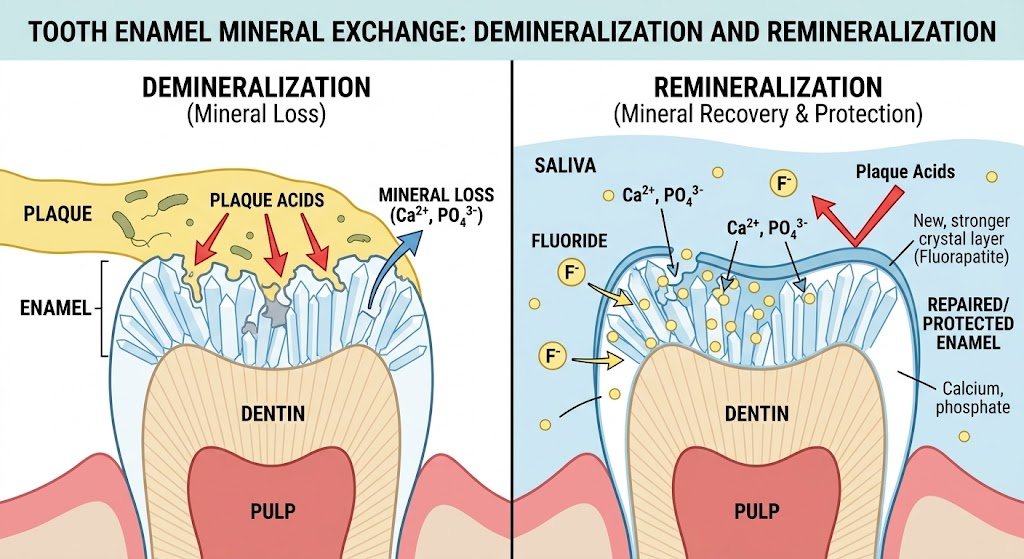
Your teeth are constantly going through cycles of losing and gaining minerals.
Demineralization
When you eat carbohydrates, bacteria in dental plaque can produce acids.
These acids can lower the pH around the teeth and cause minerals to leave the enamel. This process is called demineralization.
If mineral loss continues over time without enough repair, the tooth can become more vulnerable to decay and eventually develop a cavity.
Remineralization
Your saliva naturally helps restore minerals to the tooth surface.
This process is called remineralization.
Fluoride supports this process and helps make the tooth surface more resistant to future acid attacks. It can also help reduce mineral loss from enamel.
This is one reason fluoride toothpaste is used for cavity prevention rather than simply cleaning away food and plaque.
Cavity Prevention
A cavity, also called dental caries, develops when the processes that damage tooth structure outweigh the body’s natural repair processes over time.
Fluoride helps shift this balance in favor of protecting the tooth.
The important point is that fluoride is primarily about reducing the risk and progression of tooth decay, not making teeth completely immune to cavities.
How Does Fluoride Work in Toothpaste?
When you brush with fluoride toothpaste, fluoride is delivered directly to the tooth surfaces.
This is known as a topical fluoride effect.
During brushing, fluoride can interact with the enamel surface and remain available in the mouth for a period afterward. It supports the tooth’s natural defenses against acid-related mineral loss.
The process can be thought of simply:
Brushing → fluoride contacts teeth → enamel receives fluoride → mineral loss is reduced and repair is supported → teeth become better protected against decay.
Fluoride doesn’t replace the need for brushing itself. Toothpaste also contains cleaning ingredients that help remove plaque and debris.
This is why fluoride toothpaste combines two important functions:
- Mechanical cleaning through brushing.
- Cavity protection from fluoride.
What Types of Fluoride Are Used in Toothpaste?
The fluoride listed on a toothpaste label may appear under a specific chemical name.
Three commonly used fluoride active ingredients are sodium fluoride, stannous fluoride, and sodium monofluorophosphate.
Sodium Fluoride
Sodium fluoride is one of the common fluoride compounds used in toothpaste.
On an ingredient label, it may appear as:
Sodium Fluoride
Its role is to provide fluoride for cavity protection.
When comparing toothpastes, don’t judge a product simply because its label contains a chemical-sounding name. The important question is what the ingredient does and how the complete formulation is designed.
Stannous Fluoride
Stannous fluoride is another fluoride compound used in toothpaste.
It provides fluoride while also supplying tin in the form of stannous ions.
Some toothpaste formulations use stannous fluoride because the ingredient can provide benefits beyond basic fluoride delivery, depending on the formulation and the oral-health claims being addressed.
However, different products can use different formulations and concentrations, so the active ingredient alone doesn’t tell you everything about a toothpaste.
Sodium Monofluorophosphate
Sodium monofluorophosphate, often abbreviated as MFP, is another fluoride compound used in toothpaste.
It is included as a source of fluoride for cavity protection.
The American Dental Association identifies sodium fluoride, stannous fluoride, and sodium monofluorophosphate among the fluoride compounds used in toothpaste.
How Much Fluoride Is in Toothpaste?
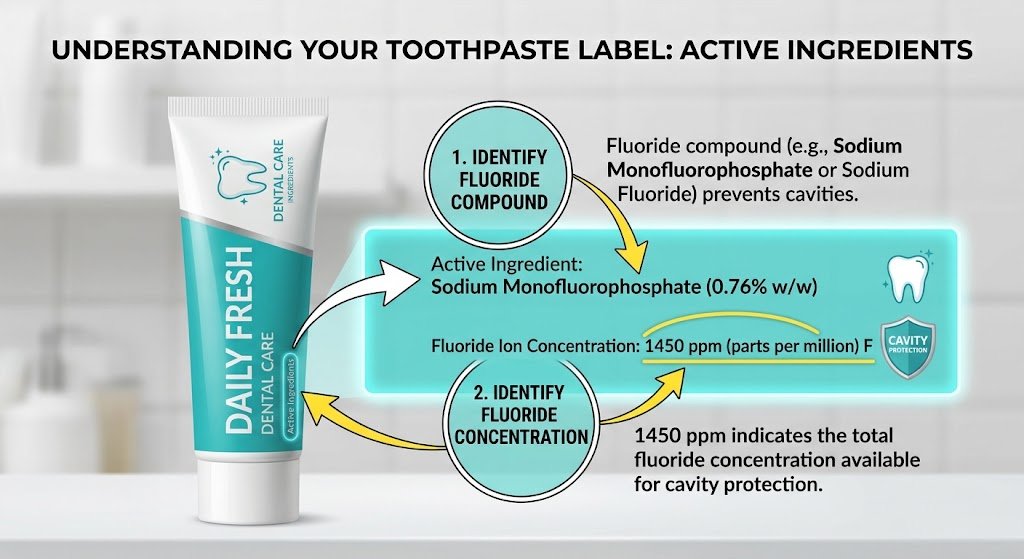
Fluoride toothpaste is not simply classified as “contains fluoride” or “doesn’t contain fluoride.” The concentration matters too.
Fluoride concentration is commonly expressed in parts per million (ppm).
For example, many conventional over-the-counter fluoride toothpastes contain fluoride in the range of approximately 1,000 to 1,500 ppm, depending on the product and formulation.
The exact amount and the active fluoride compound should be checked on the product label.
For children, the amount of toothpaste used is particularly important because young children may swallow toothpaste rather than spit it out.
The CDC recommends a rice-grain-sized smear of fluoride toothpaste for children younger than 3 and a pea-sized amount for children ages 3 through 6. Parents and caregivers should follow age-appropriate dental guidance, especially for very young children.
Is Fluoride Safe?
For most people, fluoride-containing dental products are considered safe and effective when used as directed.
However, dose and exposure matter.
This is an important distinction because saying “fluoride is safe” without explaining how exposure works is incomplete.
Fluoride is beneficial for preventing tooth decay at appropriate levels, but excessive fluoride exposure can cause problems.
One well-known concern from excessive fluoride intake during tooth development is dental fluorosis. Mild fluorosis can appear as changes in the appearance of developing permanent teeth.
This is one reason young children should use only the recommended amount of toothpaste and should be supervised so they learn to spit rather than swallow it.
The goal is not to avoid fluoride at all costs. The goal is to use fluoride appropriately while avoiding unnecessary excessive exposure.
If you have a specific medical condition, unusual fluoride exposure, or concerns about your child’s fluoride intake, a dentist or healthcare professional can help determine the appropriate approach.
Fluoride Toothpaste vs Fluoride-Free Toothpaste
The choice between fluoride and fluoride-free toothpaste often comes down to what you want the toothpaste to accomplish.
Fluoride toothpaste is specifically formulated to provide fluoride for cavity prevention.
Fluoride-free toothpaste does not provide fluoride and may instead focus on other ingredients or preferences, such as hydroxyapatite, xylitol, flavor preferences, or avoiding particular ingredients.
That doesn’t mean every fluoride-free toothpaste is ineffective at cleaning teeth. A toothpaste can still contain cleansing and polishing ingredients without fluoride.
The bigger difference is cavity-protection strategy.
If cavity prevention is your primary concern, fluoride toothpaste has an established role in dental care. If you’re considering fluoride-free toothpaste, it’s worth understanding what active ingredients it uses and why you are choosing it.
Someone looking for a non-toxic toothpaste also doesn’t necessarily have to choose between “natural” and “fluoride.” Those are separate characteristics.
A toothpaste can be evaluated for its fluoride content, cleaning ingredients, flavoring agents, abrasives, surfactants, and other formulation choices.
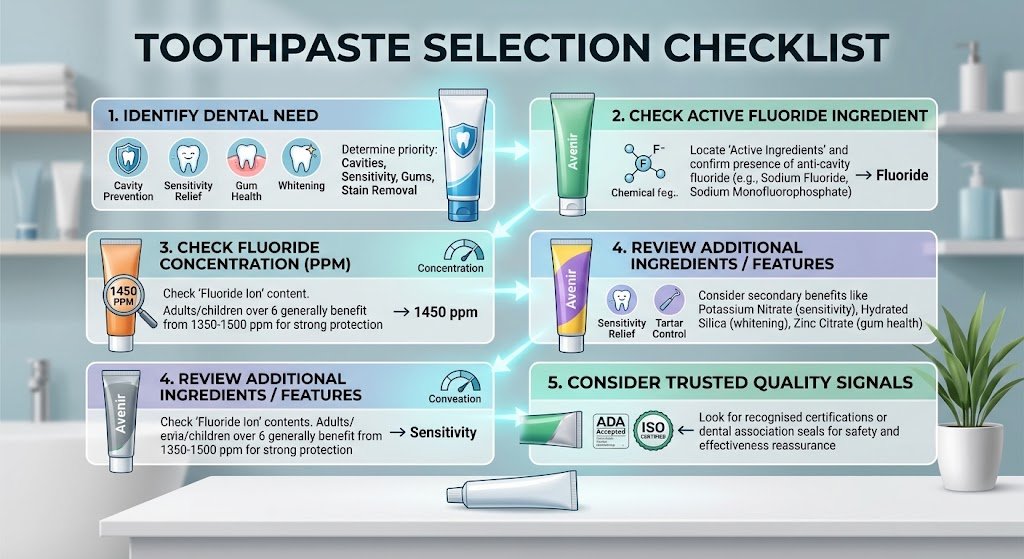
How to Choose a Fluoride Toothpaste
Once you understand what fluoride does, choosing a toothpaste becomes much easier.
Instead of focusing only on marketing terms such as “natural,” “clean,” or “fresh,” look at the actual formulation and the dental need you’re trying to address.
Check the Active Ingredient
Start with the Active Ingredients section of the package.
For a fluoride toothpaste, look for a recognized fluoride compound such as:
- Sodium fluoride
- Stannous fluoride
- Sodium monofluorophosphate
This is more useful than judging the product by its front-label marketing.
Check Fluoride Concentration
Look at the fluoride concentration listed on the package.
For many adult over-the-counter toothpastes, the concentration is within the commonly used 1,000–1,500 ppm range.
Don’t assume that a higher number automatically means a better toothpaste. The appropriate product depends on age, cavity risk, dental needs, and professional advice where necessary.
Consider Your Dental Needs
Fluoride is only one part of choosing toothpaste.
You may also want to consider whether you need toothpaste designed for:
- Sensitive teeth
- Cavity prevention
- Enamel protection
- Gum health
- Whitening
- Bad breath
- Dry mouth
For example, someone with tooth sensitivity may prioritize a formulation containing a recognized sensitivity-focused ingredient rather than choosing solely based on fluoride.
Someone mainly concerned about cavity prevention may want to compare fluoride formulations more closely.
Consider Additional Features
After confirming the basic cavity-protection function, you can consider other formulation preferences.
Depending on your needs, you might look for:
- SLS-free formulas
- Low-abrasive formulas
- Particular flavoring systems
- Hydroxyapatite alongside or instead of fluoride
- Xylitol
- Whitening ingredients
- Formulas designed for sensitive mouths
The key is to treat these as additional selection criteria, not replacements for understanding the active ingredient.
For example, if avoiding SLS is important to you, you can evaluate an SLS-free fluoride toothpaste rather than assuming that “SLS-free” automatically means better.
Look for Reliable Quality Signals
Marketing language can be useful, but it should not be your only method of evaluation.
Look for clear ingredient information and understandable product claims.
For products carrying the ADA Seal of Acceptance, the seal represents that the product has met the ADA’s applicable requirements for safety and effectiveness.
If you’re evaluating toothpaste for a specific dental condition, your dentist’s recommendation can also be more useful than a generic “best toothpaste” label.
Do Adults and Children Need Fluoride?
Fluoride can benefit both adults and children because tooth decay can affect people throughout life.
For adults, brushing twice daily with fluoride toothpaste is a standard part of cavity-prevention guidance.
For children, fluoride can also help protect developing and erupted teeth, but the amount of toothpaste and supervision are important.
Young children may swallow toothpaste, so they should not use the same amount as an adult.
The CDC recommends:
- Under age 3: a rice-grain-sized smear of fluoride toothpaste
- Ages 3–6: a pea-sized amount
- Brushing: generally twice a day
For children younger than 2, the CDC recommends discussing fluoride toothpaste use with a doctor or dentist.
The right fluoride approach can also depend on an individual’s cavity risk. Someone with frequent cavities may receive different recommendations from their dentist than someone with very low cavity risk.
Frequently Asked Questions
What is fluoride in simple terms?
Fluoride is the ionic form of fluorine and occurs naturally in the environment. In dentistry, it is used because it helps protect teeth from mineral loss and cavities.
Is fluoride a natural mineral?
Fluoride occurs naturally in water, rocks, soil, and other environmental sources. It can also be added to dental products and, in some communities, adjusted in public water supplies.
What does fluoride do to teeth?
Fluoride helps strengthen the tooth surface, reduce mineral loss caused by acids, and support remineralization. These effects help protect teeth against cavities.
Why is fluoride added to toothpaste?
Fluoride is added to toothpaste because brushing delivers it directly to the tooth surfaces, where it can help protect enamel and reduce the risk of tooth decay.
Is fluoride the same as fluorine?
No. Fluorine is a chemical element, while fluoride is its negatively charged ionic form. Toothpaste uses fluoride compounds rather than elemental fluorine.
Is fluoride toothpaste safe?
Fluoride toothpaste is considered safe and effective when used as directed. Excessive fluoride exposure, particularly during tooth development, can increase the risk of dental fluorosis, which is why appropriate amounts are important.
How much fluoride is in regular toothpaste?
Many conventional over-the-counter fluoride toothpastes contain around 1,000–1,500 ppm fluoride, although the exact concentration depends on the product.
Is fluoride-free toothpaste better?
Not automatically. Fluoride-free toothpaste may suit people who specifically prefer or need a fluoride-free formulation, but fluoride toothpaste has an established role in cavity prevention. The better choice depends on your oral-health needs and preferences.
Do adults need fluoride toothpaste?
For most adults, fluoride toothpaste is recommended as part of routine cavity-prevention care. Individual recommendations can vary based on dental health and cavity risk.
Bottom Line
So, what is fluoride?
Fluoride is the ionic form of fluorine, a naturally occurring element found throughout the environment. In oral care, its most important role is helping teeth resist acid-related mineral loss and supporting the natural repair of enamel.
That’s why fluoride is commonly used in toothpaste.
When choosing a fluoride toothpaste, don’t stop at the word “fluoride” on the package. Check the active fluoride ingredient, concentration, your dental needs, and the rest of the formulation.
