Choosing between fluoride and fluoride-free toothpaste can be confusing. One toothpaste may focus on cavity protection, while another may highlight hydroxyapatite, natural ingredients, or a fluoride-free formula.
The important question is not simply which label sounds better.
Fluoride toothpaste has an established role in cavity prevention, while some fluoride-free formulas—particularly those containing hydroxyapatite—have growing clinical evidence behind them. The better choice depends on your cavity risk, oral-health needs, ingredient preferences, and the specific formula you choose.
In this guide, we’ll compare fluoride vs. fluoride-free toothpaste, explain the ingredients that matter, discuss the advantages and limitations of each option, and show you what to look for before buying.
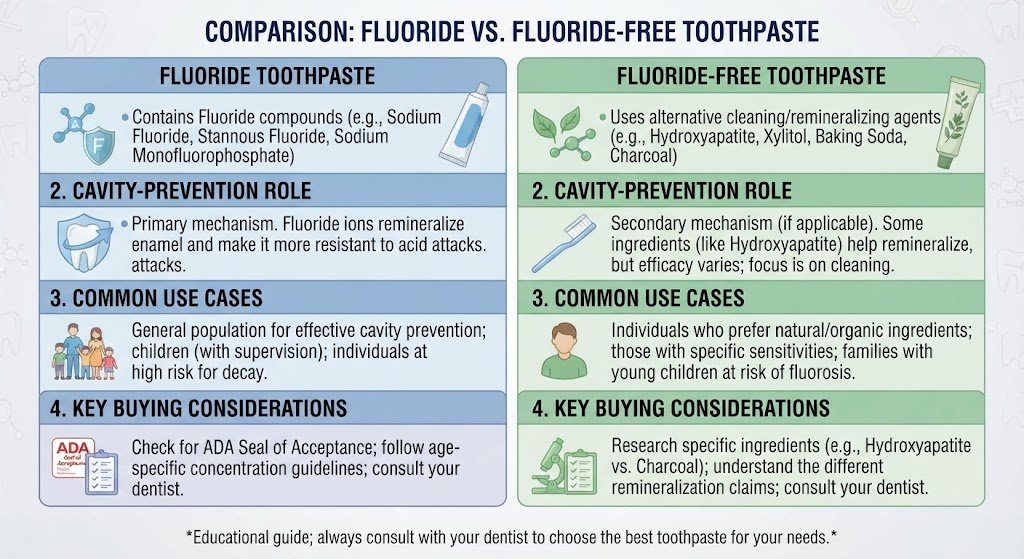
Fluoride vs. Fluoride-Free Toothpaste at a Glance
The simplest way to understand the difference is to look at the active ingredient.
| Feature | Fluoride Toothpaste | Fluoride-Free Toothpaste |
| Contains fluoride | Yes | No |
| Main established use | Cavity prevention | Depends on the active ingredients |
| Common active ingredients | Sodium fluoride, sodium monofluorophosphate, stannous fluoride | Hydroxyapatite and other non-fluoride ingredients |
| Cavity-prevention evidence | Extensive and long-established | Varies by active ingredient and formula |
| ADA cavity-protection Seal | Fluoride is required for this category | Not eligible for the fluoride cavity-protection category |
| Best fit | People prioritizing established cavity protection | People specifically seeking fluoride-free formulas |
| Important consideration | Check the fluoride active ingredient and intended use | Check whether the formula contains a meaningful active ingredient |
The American Dental Association identifies fluoride as an important ingredient for cavity prevention and notes that common fluoride ingredients include sodium fluoride, sodium monofluorophosphate, and stannous fluoride.
If you’re already looking for a fluoride-containing option, you can also compare formulas based on their specific use case rather than simply choosing the first product labeled “fluoride.”
What Is Fluoride Toothpaste?
Fluoride toothpaste contains fluoride as an active ingredient that helps prevent dental caries, commonly called cavities.
Fluoride is not simply included to make toothpaste feel cleaner or fresher. Its main importance is related to what happens at the surface of your teeth.
Everyday eating and drinking can expose teeth to acids that contribute to mineral loss. This process is called demineralization. Fluoride helps support the tooth’s ability to resist these effects and contributes to the remineralization process.
That is one reason fluoride toothpaste has become a standard part of everyday oral care.
The ADA identifies fluoride toothpaste as the most commonly used form of self-applied topical fluoride. In the U.S., over-the-counter fluoride toothpastes generally contain 1,000–1,500 ppm fluoride.
Common fluoride ingredients
When you look at a toothpaste label, you may see one of several fluoride compounds.
Common examples include:
- Sodium fluoride
- Sodium monofluorophosphate
- Stannous fluoride
These ingredients are not simply different names for the same chemical. They are different fluoride compounds used in toothpaste formulations.
For a consumer, however, the more important point is that the toothpaste contains a recognized fluoride active ingredient and is intended for the oral-health purpose you need.
The FDA also has a regulatory framework for over-the-counter anticaries products, including specific fluoride active ingredients.
Fluoride toothpaste can do more than cavity protection
Not every fluoride toothpaste is designed exactly the same way.
Depending on the formula, a toothpaste may also be marketed for:
- Tooth sensitivity
- Whitening
- Tartar control
- Enamel-related concerns
- Bad breath
- Gingivitis-related care
That means “contains fluoride” is only one part of the buying decision.
If you have a specific concern, look at the complete formula and the active ingredients associated with that concern.
What Is Fluoride-Free Toothpaste?
Fluoride-free toothpaste is toothpaste that does not use fluoride as its active ingredient.
That sounds straightforward, but fluoride-free toothpaste is actually a broad category.
Some people choose it because they specifically want to avoid fluoride. Others choose it because they are interested in alternative ingredients such as hydroxyapatite.
Some fluoride-free formulas may also focus heavily on botanical ingredients, flavor preferences, or a simpler ingredient profile.
This creates an important distinction:
“Fluoride-free” tells you what a toothpaste does not contain. It does not automatically tell you what the toothpaste can do.
For example, two fluoride-free toothpastes may have very different formulations and purposes.
One might contain hydroxyapatite as an active ingredient. Another may primarily provide cleaning, flavor, and other cosmetic or sensory benefits.
So if cavity prevention matters to you, don’t stop at the words fluoride-free on the front of the package.
Look at the active ingredients.
What Is Hydroxyapatite?
Hydroxyapatite is one of the most important ingredients to understand if you’re considering fluoride-free toothpaste.
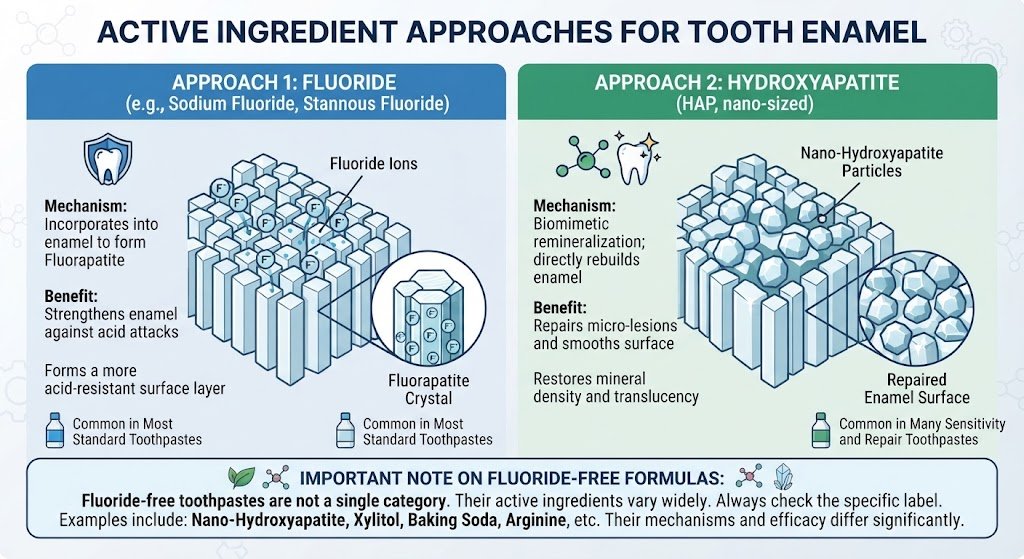
It is a calcium-phosphate mineral closely related to the mineral component of human teeth and bones. Because of this relationship, hydroxyapatite has been studied for its potential role in supporting tooth surfaces and remineralization.
Some toothpaste formulas use hydroxyapatite as the main alternative to fluoride.
Research into hydroxyapatite toothpaste has produced promising results, including clinical studies comparing hydroxyapatite formulas with fluoride toothpaste. However, the evidence base is not identical to the much larger and longer-established body of evidence supporting fluoride toothpaste.
That distinction matters.
It would be misleading to say:
“Hydroxyapatite is exactly the same as fluoride.”
It would also be misleading to say:
“Every fluoride-free toothpaste is ineffective.”
The more accurate approach is to look at the specific active ingredient, formulation, evidence, and user’s oral-health needs.
Fluoride vs. Fluoride-Free: What Is the Real Difference?
The biggest difference is the active ingredient used to support cavity prevention and tooth-surface protection.
With fluoride toothpaste, fluoride is the established anticaries ingredient.
With fluoride-free toothpaste, the formula may use an alternative ingredient such as hydroxyapatite, or it may not contain an equivalent anticaries active ingredient at all.
This means you should not compare the two categories only by looking at words such as:
- Natural
- Clean
- Non-toxic
- Chemical-free
- Fluoride-free
- Mineral-based
Those terms may tell you something about how a product is marketed, but they do not provide the complete picture.
Does fluoride prevent cavities?
Yes. Fluoride toothpaste has a long-established evidence base for reducing dental caries.
This is one of the main reasons fluoride toothpaste remains a standard recommendation for cavity prevention.
For someone who frequently develops cavities, this established evidence may carry more weight than a general preference for a particular ingredient philosophy.
Does fluoride-free toothpaste prevent cavities?
The answer depends on the formula.
A fluoride-free toothpaste containing a studied active ingredient such as hydroxyapatite is very different from a fluoride-free toothpaste that does not contain a comparable anticaries active.
Hydroxyapatite has been investigated in clinical studies and systematic reviews, and the findings are promising. But the correct conclusion is not that every fluoride-free toothpaste works exactly like fluoride toothpaste.
Instead, evaluate the actual product.
Ask:
- What is the active ingredient?
- What is the product designed to do?
- What evidence supports that ingredient?
- Does the formula fit my oral-health needs?
- Do I have a high or low risk of cavities?
These questions are much more useful than deciding based on the word “natural” or “fluoride-free” alone.
Is Fluoride Automatically Better?
Not necessarily in every situation—but for established cavity prevention, fluoride has a significant evidence advantage.
That does not mean everyone must make the same personal choice.
Someone may have a strong preference for a fluoride-free toothpaste and choose a hydroxyapatite formula after considering the available evidence.
Another person may have a history of recurrent cavities and prioritize the established cavity-prevention benefits of fluoride.
The important distinction is between evidence-based oral-health benefits and personal ingredient preferences.
A product can satisfy an ingredient preference without automatically being the strongest choice for every oral-health goal.
A better way to compare the two
Instead of asking:
“Which toothpaste is safer?”
Ask:
“Which toothpaste provides the oral-health benefits I need while fitting my ingredient preferences and personal circumstances?”
That question leads to a much more useful comparison.
Fluoride vs. Hydroxyapatite for Cavity Prevention
Hydroxyapatite is probably the most relevant comparison when someone specifically wants a fluoride-free toothpaste.
Fluoride has decades of research supporting its role in cavity prevention. Hydroxyapatite has a growing body of research examining its potential for remineralization and caries prevention.
Some clinical research has compared hydroxyapatite toothpaste with fluoride toothpaste and found promising results. However, individual studies should not be interpreted as proof that every hydroxyapatite formula is equivalent to every fluoride toothpaste.
The formulation matters.
The concentration matters.
The study population matters.
And most importantly, your own cavity risk matters.
If you rarely get cavities
A person with relatively low cavity risk may place more weight on ingredient preferences, flavor, formulation, or interest in fluoride-free oral care.
If you frequently get cavities
Someone with repeated dental decay may have more reason to prioritize established cavity-prevention strategies and discuss their toothpaste choice with a dentist.
If you want fluoride-free but still care about cavity prevention
A fluoride-free toothpaste containing a studied active ingredient such as hydroxyapatite may be more relevant than a fluoride-free formula chosen only because it has a short or “natural” ingredient list.
This is one of the most important buying lessons in the entire comparison:
Don’t compare fluoride toothpaste with “fluoride-free toothpaste” as if fluoride-free were one single formula.
The active ingredients can be very different.
Does Fluoride-Free Mean Natural?
No.
This is a common misunderstanding.
Fluoride-free describes what is absent from the toothpaste.
Natural is a broader marketing or formulation term and does not automatically tell you whether fluoride is present.
A toothpaste can therefore be:
- Fluoride-containing and marketed around naturally derived ingredients.
- Fluoride-free and formulated with hydroxyapatite.
- Fluoride-free and focused on botanical ingredients.
- Conventional and fluoride-containing.
- Fluoride-free without a comparable anticaries active.
So if your goal is to find a toothpaste with an ingredient-conscious formula, don’t assume that “natural” automatically means better.
Instead, examine the actual ingredients and the purpose of the formula.
What Other Ingredients Should You Compare?
Fluoride status is important, but it is not the only part of a toothpaste formula.
A toothpaste contains multiple ingredients that affect its texture, cleaning action, taste, foaming, and overall user experience.
Understanding a few of the major categories can make shopping much easier.
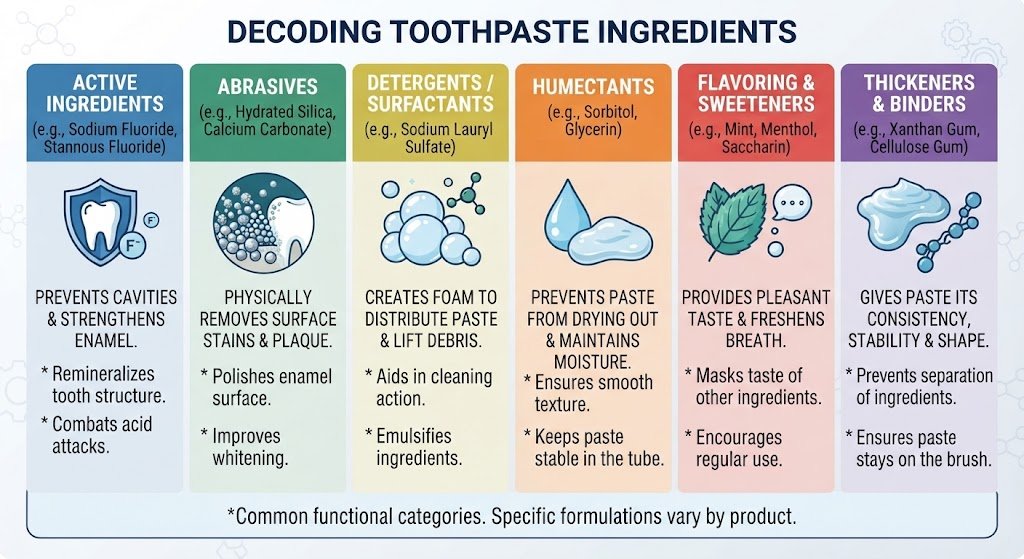
Abrasives
Toothpaste commonly contains abrasive ingredients that help remove surface deposits during brushing.
Examples include:
- Hydrated silica
- Calcium carbonate
Abrasives are useful because toothpaste needs to help physically clean the tooth surface.
But more abrasive does not automatically mean better.
If you have sensitive teeth or are particularly concerned about enamel wear, it can be useful to pay attention to the overall formulation rather than assuming a stronger-feeling toothpaste cleans better.
SLS and other detergents
Sodium lauryl sulfate, commonly called SLS, is a detergent used in some toothpaste formulas.
It helps create the foaming sensation many people associate with brushing.
But foam is mostly a sensory experience.
More foam does not automatically mean better cavity protection.
Some people prefer SLS-free toothpaste because of personal tolerability or ingredient preferences.
If you’re comparing SLS-containing and SLS-free products, focus on your actual experience and the complete formula rather than assuming one category is universally superior.
Flavoring
Flavoring determines much of the taste and freshness you experience while brushing.
Mint is common, but different products can have very different levels of flavor intensity.
If a toothpaste causes repeated burning, irritation, or discomfort, don’t assume that stronger sensations mean stronger cleaning.
Instead, consider whether another formulation is more comfortable for you and discuss persistent irritation with a dental professional.
Humectants and texture ingredients
Ingredients such as glycerin and sorbitol can help toothpaste retain moisture and maintain its expected texture.
These ingredients illustrate why a long ingredient list is not automatically a problem.
A toothpaste contains ingredients for different functions. The goal should not be to eliminate every ingredient with a complicated name.
The better goal is to understand what the important ingredients do and whether the overall formula meets your needs.
How to Choose Between Fluoride and Fluoride-Free Toothpaste
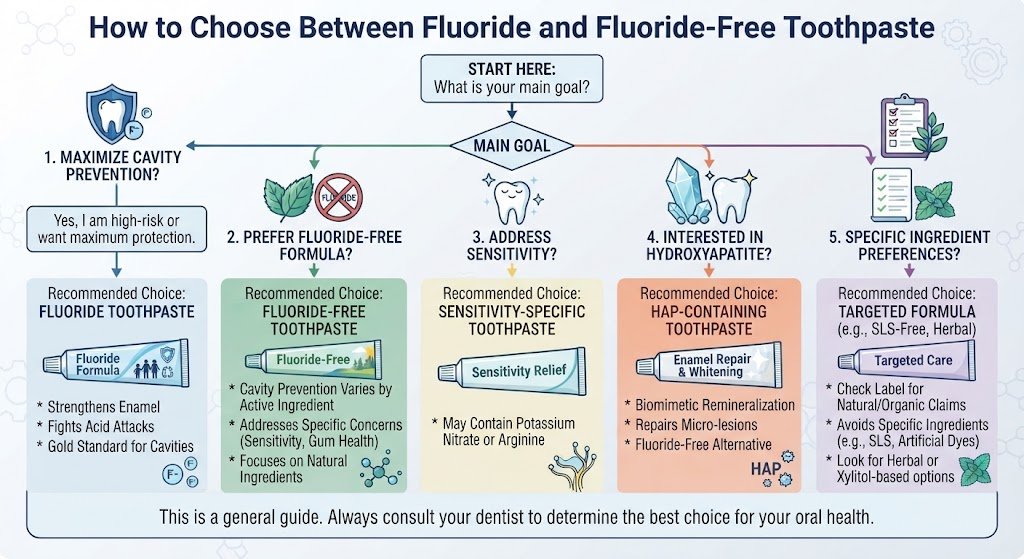
There is no single toothpaste that is the right choice for everyone. The better option depends on what you want your toothpaste to do, your cavity risk, your sensitivity, and whether you specifically want to avoid fluoride.
Start by asking these questions:
1. Is cavity prevention your top priority?
If preventing cavities is your main goal, a fluoride toothpaste has the strongest established evidence and is the conventional choice recommended by dental organizations.
For people who frequently develop cavities, have a history of dental fillings, or have been told by a dentist that they are at higher risk for tooth decay, switching away from fluoride should be a decision made with professional guidance.
2. Do you specifically want fluoride-free toothpaste?
Some people choose fluoride-free toothpaste because of personal preferences, ingredient preferences, or because they want to try a formula based on another active ingredient such as hydroxyapatite.
If that is your preference, do not stop at the words “fluoride-free.” Check the ingredient label to see what the toothpaste uses instead and what benefit that ingredient is intended to provide.
3. Does the toothpaste contain an active ingredient?
This is one of the most useful ways to compare products.
A toothpaste can be fluoride-free without being identical to another fluoride-free toothpaste. One may contain hydroxyapatite, while another may focus on different ingredients or claims.
When comparing products, look for:
- The active ingredient
- Its stated purpose
- The concentration when provided
- Other ingredients relevant to your needs
- Whether the product has credible evidence supporting its claims
This approach is more useful than choosing based only on labels such as “natural,” “clean,” or “non-toxic.”
4. Do you have sensitive teeth?
Sensitivity can change which toothpaste makes the most sense for you.
Some toothpastes contain ingredients specifically intended to help reduce sensitivity. Fluoride toothpaste can also contain sensitivity-focused active ingredients, so choosing fluoride or fluoride-free does not automatically answer the sensitivity question.
If sensitivity is persistent, severe, or getting worse, toothpaste selection should not replace a dental evaluation because sensitivity can have several causes.
5. Are you mainly looking for a specific ingredient?
If you are interested in hydroxyapatite, fluoride, xylitol, SLS-free formulas, or low-abrasive toothpaste, compare products around that specific feature.
For example, someone looking for hydroxyapatite toothpaste should compare hydroxyapatite formulas rather than treating every fluoride-free toothpaste as a hydroxyapatite toothpaste.
This makes the buying decision much more precise.
Fluoride vs. Fluoride-Free Toothpaste for Different Needs
Your dental goal matters more than the marketing category on the front of the package.
| Your main goal | What to look for |
| General cavity prevention | Fluoride toothpaste |
| Higher cavity risk | Discuss fluoride toothpaste with your dentist |
| Fluoride-free preference | Identify the alternative active ingredient |
| Interest in hydroxyapatite | Look for a clearly identified hydroxyapatite formula |
| Sensitive teeth | Look for a toothpaste with a suitable sensitivity-focused active ingredient |
| Avoiding SLS | Check the ingredient list for sodium lauryl sulfate |
| Lower-abrasive option | Look for a formula designed around gentle cleaning |
| Whitening | Check the whitening mechanism and abrasiveness rather than assuming fluoride-free is better |
| Ingredient transparency | Review the complete ingredient list and product claims |
This table is a starting point, not a substitute for individualized dental advice.
What Does the ADA Seal Mean for Toothpaste?
The ADA Seal of Acceptance can be useful when comparing toothpaste, but it is important to understand what the seal actually means.
The American Dental Association evaluates products submitted for the Seal program based on safety and effectiveness for their specific claims. The seal is therefore different from a general “best toothpaste” ranking.
For fluoride toothpaste, the ADA has a specific category for products found to be safe and effective for helping prevent tooth decay.
This makes the seal particularly useful when you want an additional layer of evidence behind a product’s stated oral-health benefit.
However, the absence of an ADA Seal does not automatically mean that a toothpaste is unsafe or ineffective. Products may differ in whether they participate in the program, and you should still evaluate the actual ingredients and claims.
What should you check besides the seal?
Look at:
- The active ingredient
- The purpose of the toothpaste
- The complete ingredient list
- Any claims made on the package
- Your own dental needs
- Whether the product is appropriate for your cavity risk
The goal is not to find the toothpaste with the most impressive package. It is to find a formula that matches your needs and has credible support for the benefit you want.
How to Read a Toothpaste Label
The front of the package is usually designed to communicate benefits quickly. The ingredient list gives you a better starting point for understanding what is actually inside.
Step 1: Find the active ingredient
Look for the ingredient that is responsible for the product’s main therapeutic claim.
For a fluoride toothpaste, this may be sodium fluoride, sodium monofluorophosphate, or stannous fluoride.
For a fluoride-free toothpaste, check whether the product identifies another active ingredient, such as hydroxyapatite.
Step 2: Look at the purpose
A toothpaste may be designed for:
- Cavity protection
- Sensitivity
- Whitening
- Gingivitis
- Tartar control
- Enamel care
- Bad breath
Do not assume that a toothpaste designed for one purpose automatically provides the same benefits as another formula.
Step 3: Check the ingredients you personally care about
If you want to avoid SLS, fragrance, certain flavoring ingredients, or specific sweeteners, look through the ingredient list rather than relying only on front-label claims.
Step 4: Compare similar products
If you are deciding between two hydroxyapatite toothpastes, compare their formulas, active ingredients, intended benefits, and other relevant characteristics.
Likewise, if you are comparing fluoride toothpastes, look at the type of fluoride and the other features that matter to you.
This gives you a much better comparison than simply asking whether one toothpaste is “cleaner” or “more natural.”
Is Fluoride-Free Toothpaste Safe?
“Fluoride-free” does not automatically mean safe, unsafe, better, or worse.
It simply means the toothpaste does not contain fluoride as an active ingredient.
Safety depends on the complete formulation, how the product is used, and the individual using it.
For example, someone may prefer a fluoride-free formula but still need to consider flavoring ingredients, abrasives, detergents, preservatives, or other ingredients that may not suit them.
Similarly, fluoride toothpaste is not automatically appropriate for every possible situation simply because it contains fluoride. Product choice should consider the person’s age, dental needs, and instructions for use.
The important point is to avoid turning “fluoride” and “fluoride-free” into simple good-versus-bad categories.
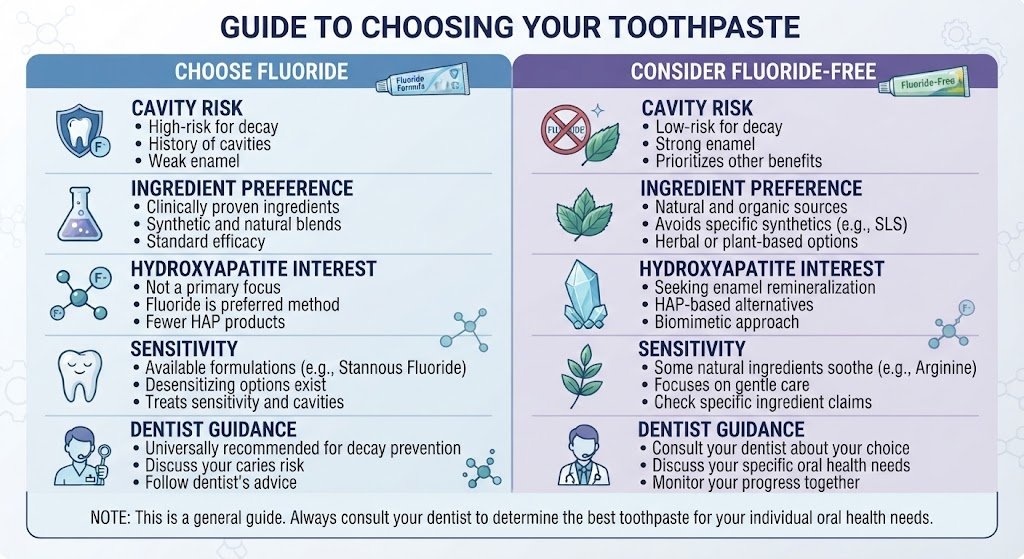
Fluoride vs. Fluoride-Free: Which One Should You Buy?
For most adults who want established cavity protection, fluoride toothpaste remains the most straightforward evidence-based choice.
That does not mean every person must choose the same toothpaste.
If you specifically want a fluoride-free product, look for a well-formulated toothpaste with an active ingredient that matches your goal, and understand what evidence supports that ingredient.
A simple decision framework is:
Choose fluoride toothpaste if:
- Cavity prevention is your primary concern.
- You have a history of cavities.
- Your dentist has recommended fluoride.
- You want the most established anticaries option.
Consider fluoride-free toothpaste if:
- You specifically prefer to avoid fluoride.
- You understand that “fluoride-free” is not itself a therapeutic benefit.
- You are willing to evaluate the alternative active ingredient.
- The formula fits your oral-health needs.
For either option, consider the rest of the formula too. Abrasiveness, SLS, flavoring, sensitivity ingredients, and other formulation choices can matter depending on your individual needs.
Frequently Asked Questions
Is fluoride-free toothpaste better than fluoride toothpaste?
Not universally. Fluoride toothpaste has the strongest established evidence for cavity prevention, while fluoride-free toothpaste represents a broader category with different formulations and active ingredients.
The better choice depends on your dental needs, cavity risk, and ingredient preferences.
Does fluoride-free toothpaste prevent cavities?
Some fluoride-free toothpastes contain alternative active ingredients such as hydroxyapatite that have been studied for oral-health benefits. However, “fluoride-free” by itself does not tell you how effective a toothpaste is for cavity prevention.
Always evaluate the actual active ingredient and the evidence behind the product’s claim.
Is hydroxyapatite as effective as fluoride?
Research on hydroxyapatite has produced promising results, including clinical studies and systematic reviews, but fluoride has a much longer-established evidence base for cavity prevention.
It is therefore more accurate to say that hydroxyapatite is a researched fluoride-free alternative rather than automatically claiming that every hydroxyapatite toothpaste is equivalent to every fluoride toothpaste.
What is the best fluoride toothpaste?
The best fluoride toothpaste depends on what you need beyond cavity prevention.
For example, someone with sensitive teeth may prioritize a sensitivity-focused formula, while another person may want SLS-free ingredients or a low-abrasive formula.
Is fluoride-free the same as non-toxic toothpaste?
No.
“Fluoride-free” describes the absence of fluoride. “Non-toxic” is a broader marketing term that can refer to a brand’s approach to ingredient selection.
Neither label tells you everything about a toothpaste. The complete ingredient list and the product’s intended use are more useful for comparison.
Should people with frequent cavities use fluoride-free toothpaste?
People who frequently develop cavities should be cautious about changing from an established cavity-prevention routine without discussing it with their dentist.
Your dentist can consider your cavity history and other risk factors before recommending whether a fluoride-free option is appropriate.
Does the ADA approve fluoride-free toothpaste?
The ADA Seal program has specific product categories and requirements. The important distinction is that fluoride toothpaste can qualify for the ADA’s anticaries category when it meets the relevant requirements for safety and effectiveness.
Do not interpret the absence of an ADA Seal as proof that a product is unsafe.
Can children use fluoride-free toothpaste?
Children’s toothpaste choices require extra care because age, swallowing risk, cavity risk, and fluoride exposure all matter.
Parents should follow age-appropriate dental guidance rather than assuming that fluoride-free is automatically the safer option for children.
Final Takeaway
The fluoride-versus-fluoride-free debate becomes much easier when you stop treating the two labels as complete descriptions of a toothpaste.
Fluoride toothpaste has a long-established role in cavity prevention and remains the straightforward choice for people prioritizing proven anticaries protection.
Fluoride-free toothpaste is a broader category. Some formulas use ingredients such as hydroxyapatite and may appeal to people who specifically want to avoid fluoride, but the words “fluoride-free” alone do not tell you whether a product is effective for your particular goal.
The smartest way to compare toothpaste is to look beyond the front label:
Identify the active ingredient → understand its purpose → consider your cavity risk → check the full formula → compare evidence → choose according to your needs.
If you are unsure, especially if you have frequent cavities, significant sensitivity, gum problems, or another ongoing dental issue, a dentist can help you choose a toothpaste based on your individual risk rather than a marketing label.
