Choosing toothpaste for a child can be confusing. Parents often have questions about fluoride, toothpaste amounts, fluoride concentration, flavors, ingredients, and whether fluoride-free toothpaste is a better option.
The good news is that the basic decision is simpler than it may seem: children generally benefit from brushing with fluoride toothpaste, but the amount used and adult supervision matter, especially during the early years.
The CDC and American Dental Association recommend using a small amount of fluoride toothpaste and brushing twice a day. For children younger than 3, the recommended amount is about the size of a grain of rice; from ages 3 to 6, use no more than a pea-sized amount.
This guide explains how fluoride toothpaste works for children, how much to use, what to look for when buying one, and when a child may need additional dental guidance.
Why Do Children Need Fluoride Toothpaste?
Fluoride is a mineral that helps protect teeth against cavities. When children brush with fluoride toothpaste, fluoride comes into contact with the tooth surface and helps make enamel more resistant to acid attacks caused by plaque and bacteria.
Children can be particularly vulnerable to tooth decay because newly erupted teeth are susceptible to decay, and young children may not yet have the brushing skills needed to clean every surface effectively.
Fluoride toothpaste therefore serves two purposes:
- It helps physically remove plaque and food debris.
- It provides fluoride that supports the tooth’s defense against decay.
The goal is not to give a child as much fluoride as possible. The goal is to use an appropriate fluoride toothpaste in an appropriate amount and establish consistent brushing habits.
When Should Children Start Using Fluoride Toothpaste?
Dental guidance supports beginning fluoride toothpaste when the first tooth appears, using only a very small amount.
For children younger than 3, the CDC recommends a rice-grain-sized amount and advises parents to consult a doctor or dentist regarding fluoride toothpaste for children under 2.
Once children reach age 3, the amount can increase to no more than a pea-sized amount.
The important point is that parents should not wait until a child is several years old before introducing proper toothbrushing. Oral hygiene begins with the first teeth.
Parents should also help young children brush rather than expecting them to clean their teeth effectively on their own.
How Much Fluoride Toothpaste Should a Child Use?
The amount of toothpaste is one of the most important things parents can control.
| Child’s age | Recommended toothpaste amount |
| Under 3 years | Grain-of-rice-sized smear |
| Ages 3–6 | No more than a pea-sized amount |
| Older children | Follow age-appropriate dental guidance |
The CDC, ADA, and other dental organizations recommend these small amounts because young children may swallow some toothpaste while learning to brush and spit.
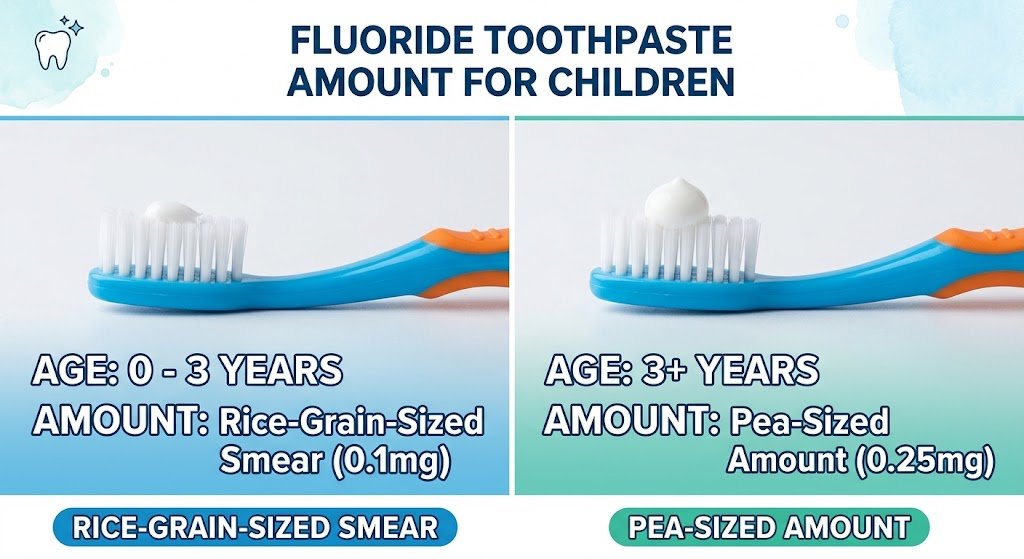
Parents do not need to cover the entire toothbrush head with toothpaste. A large stripe of toothpaste is unnecessary for effective brushing.
For young children, an adult should place the toothpaste on the toothbrush and supervise brushing.
Why Does Toothpaste Amount Matter for Young Children?
Young children are still learning how to control swallowing and spitting. Because of this, they may swallow more toothpaste than an older child or adult.
Using more toothpaste does not automatically provide better protection.
The concern with excessive fluoride ingestion during tooth development is dental fluorosis, which can cause changes in the appearance of developing teeth. The risk is associated with excessive fluoride intake rather than normal use of a small amount of fluoride toothpaste.
This is why parents should focus on three things:
- Use the recommended amount.
- Supervise brushing.
- Teach the child to spit rather than swallow the toothpaste.
The objective is balanced fluoride exposure—not avoiding fluoride completely and not using excessive amounts.
What Fluoride Concentration Should Children’s Toothpaste Have?
Fluoride concentration is an important consideration, but parents should not assume that the toothpaste with the highest fluoride concentration is automatically the best choice for every child.
The appropriate product can depend on the child’s age, cavity risk, dental history, and advice from their dentist.
Many standard fluoride toothpastes are formulated around concentrations commonly used for everyday cavity prevention. Professional organizations, including the American Academy of Pediatric Dentistry, recognize fluoridated toothpaste as an important part of caries prevention.
However, parents should distinguish between:
- Regular children’s fluoride toothpaste
- Higher-fluoride products intended for specific dental situations
- Prescription or professionally recommended fluoride products
Higher-concentration fluoride products should not simply be selected because the number on the label is higher. If a child has a high risk of cavities, a dentist can determine whether additional fluoride treatment or a specific product is appropriate.
Is 1000 ppm Fluoride Toothpaste Suitable for Children?
Around 1,000 ppm fluoride is a commonly discussed concentration in pediatric fluoride guidance, and fluoridated toothpaste around this level has been used for cavity prevention in children.
However, parents should not treat one number as a universal rule for every child.
Product labels, age recommendations, local guidance, and the child’s individual cavity risk all matter. A dentist may also recommend a different fluoride product for a child who has a higher risk of decay.
For everyday shopping, it is more useful to ask:
- Is this actually a fluoride toothpaste?
- Is it appropriate for my child’s age?
- Can I use the recommended small amount?
- Does my child tolerate the flavor and texture?
- Does my child have a dental condition requiring a specific product?
This approach is safer than choosing a toothpaste based only on the highest fluoride number.
Should You Choose Fluoride-Free Toothpaste for a Child?
Fluoride-free toothpaste may appeal to parents who are trying to avoid particular ingredients, but removing fluoride also removes the cavity-prevention benefit provided by fluoride.
The ADA recommends fluoride toothpaste for children because fluoride helps prevent cavities.
That does not mean every child must use exactly the same toothpaste. Children can have different needs, and a dentist may recommend an individualized approach.
If you are considering fluoride-free toothpaste because of concerns about fluoride, discuss the decision with your child’s dentist rather than assuming that fluoride-free automatically means safer or healthier.
For a child who is at increased risk of cavities, replacing fluoride toothpaste without considering the child’s overall cavity-prevention plan may be especially important to discuss with a dental professional.
What Should You Look for in Fluoride Toothpaste for Children?
Once you know that your child should generally use fluoride toothpaste, the shopping decision becomes easier.
Look for a product that fits the child’s age and is practical enough to use consistently.
1. Fluoride
The toothpaste should contain fluoride if fluoride toothpaste has been recommended for your child.
Check the active ingredients on the package rather than relying only on front-label claims such as “natural,” “clean,” or “gentle.”
2. Age-appropriate labeling
Choose a toothpaste that is appropriate for your child’s age and follow the package directions.
Age labeling does not replace professional dental advice, but it can help narrow down suitable products.
3. A flavor your child will tolerate
Children may reject a toothpaste simply because they dislike its flavor.
A mild flavor can make brushing easier to maintain, especially for children who dislike strong mint.
Flavor is a practical consideration, but it should not outweigh the basic requirements of fluoride, appropriate use, and good brushing habits.
4. Ingredients your child may need to avoid
Some children may experience irritation or sensitivity to particular toothpaste ingredients.
If your child repeatedly develops mouth irritation after brushing, talk with a dentist or healthcare professional before simply switching between random products.
5. A simple formula
Parents do not need a toothpaste with a long list of unnecessary features.
For everyday use, focus on the fundamentals: appropriate fluoride, age suitability, tolerability, and a formula the child can use consistently.
Does Children’s Toothpaste Need to Be “Natural”?
Not necessarily.
Words such as “natural,” “clean,” and “plant-based” describe marketing or formulation approaches, but they do not automatically tell you how effectively a toothpaste prevents cavities.
A better approach is to examine what the product actually contains and what it is designed to do.
For a child, important questions include:
- Does it contain fluoride?
- Is it appropriate for the child’s age?
- Can the child tolerate the taste?
- Is the toothpaste used correctly?
- Does the child have special dental needs?
A “natural” label should not be treated as a substitute for evaluating the toothpaste’s active ingredients and intended use.
What Is the Best Toothbrush for a Child?
Toothpaste is only one part of the brushing routine.
Children should use a toothbrush that is appropriate for their mouth and age. A child-sized toothbrush with soft bristles can make brushing more manageable.
The ADA recommends using a child-appropriate toothbrush and brushing twice a day.
For younger children, parents should help with brushing because children do not immediately develop the coordination needed to clean all tooth surfaces properly.
A good children’s toothbrush should be:
- Comfortable for the child’s hand
- Small enough to reach the teeth
- Made with soft bristles
- Easy for the parent to control when assistance is needed
How Often Should Children Brush With Fluoride Toothpaste?
Children should generally brush their teeth twice a day with fluoride toothpaste.
The two most useful times are usually morning and before bed.
The evening brushing session is particularly important because it removes plaque and food debris accumulated throughout the day before the child goes to sleep.
The CDC and ADA recommend twice-daily brushing with fluoride toothpaste.
Parents should help younger children brush and supervise children while they are learning.
Good technique and consistency are more important than covering the toothbrush with a large amount of toothpaste.
Should Children Rinse After Brushing?
Children should be taught to spit out excess toothpaste rather than intentionally swallowing it.
For young children, the main issue is learning proper brushing and spitting behavior while using the correct small amount of toothpaste.
Parents should follow their child’s dental professional’s instructions if the child has special fluoride needs.
The key lesson is simple: use a small amount, brush properly, and avoid swallowing toothpaste.
What If a Child Has Frequent Cavities?
If a child continues developing cavities despite regular brushing, simply buying another toothpaste may not solve the underlying problem.
Cavity risk can involve several factors, including:
- Brushing technique
- Frequency of brushing
- Fluoride exposure
- Diet
- Frequent sugar or carbohydrate exposure
- Oral hygiene
- Tooth development
- Previous dental decay
- Individual cavity risk
Children with a higher risk of cavities may need an individualized prevention plan from a dentist.
A dental professional may recommend additional fluoride treatment, changes to brushing habits, dietary changes, or other preventive measures depending on the child’s situation.
Do not assume that a stronger toothpaste is automatically the solution. The right treatment depends on why the child is developing cavities.
Common Mistakes Parents Make When Choosing Children’s Fluoride Toothpaste
Using too much toothpaste
A large stripe of toothpaste is unnecessary for a young child.
Follow the age-based amount instead.
Choosing fluoride-free toothpaste automatically
Some parents avoid fluoride because they believe fluoride-free means safer. But fluoride has an established role in preventing dental caries.
The decision should consider the child’s actual dental needs rather than marketing claims.
Choosing the highest fluoride concentration
More fluoride is not automatically better for every child.
Higher-fluoride products may have specific uses and should be selected with appropriate professional guidance.
Letting the child brush completely alone
Young children often need help because brushing effectively requires coordination and attention.
Parents should supervise and assist when necessary.
Focusing only on the front label
Words such as “natural,” “clean,” or “sensitive” do not tell you everything about a toothpaste.
Check the active ingredients, directions, age suitability, and other relevant information on the packaging.
When Should a Child See a Dentist?
Children should have regular dental care rather than waiting until they develop tooth pain.
The ADA and pediatric dental guidance support early dental visits, with the first dental visit generally recommended by around the child’s first birthday.
Parents should also seek dental advice if a child:
- Has repeated cavities
- Has tooth pain
- Has swollen or bleeding gums
- Has sensitivity that continues
- Has difficulty eating because of dental discomfort
- Has unusual spots or changes on the teeth
- Needs advice about fluoride exposure
- Has a medical or dental condition that affects oral health
A dentist can assess the child’s actual cavity risk and determine whether standard fluoride toothpaste is sufficient or whether additional preventive treatment is appropriate.
Frequently Asked Questions
What age should a child start using fluoride toothpaste?
Fluoride toothpaste can be introduced when the first tooth appears, using only a very small amount. For children under 2, the CDC advises consulting a doctor or dentist about fluoride toothpaste.
How much fluoride toothpaste should a 2-year-old use?
A child younger than 3 should generally use no more than a grain-of-rice-sized smear of fluoride toothpaste.
How much toothpaste should a 4-year-old use?
Children ages 3 to 6 should use no more than a pea-sized amount of fluoride toothpaste.
Should children use fluoride toothpaste every day?
Yes, fluoride toothpaste is generally recommended for regular twice-daily brushing because fluoride helps prevent cavities.
Is fluoride toothpaste safe for children?
Fluoride toothpaste is widely recommended for children when used in the appropriate amount. Parents should follow age-based guidance, supervise young children, and prevent unnecessary swallowing of toothpaste.
Should I buy fluoride-free toothpaste for my child?
Not automatically. Fluoride provides an important cavity-prevention benefit. If you are considering fluoride-free toothpaste, especially for a child who is prone to cavities, discuss the decision with a dentist.
Is children’s toothpaste better than adult toothpaste?
The label “children’s toothpaste” does not automatically make one product better. What matters is whether the toothpaste is appropriate for the child’s age, contains suitable active ingredients, and can be used correctly.
What if my child swallows toothpaste?
Young children commonly have difficulty spitting while learning to brush. Use only the recommended small amount and supervise brushing. If a child swallows a large amount of toothpaste or you are concerned about a specific exposure, contact an appropriate healthcare professional or poison-control service for guidance.
Can a child use regular family fluoride toothpaste?
Sometimes, but the appropriate choice depends on the child’s age, the product’s ingredients and concentration, and dental guidance. Parents should check the product label and use the correct small amount rather than assuming that a larger amount is safe.
Bottom Line
Choosing fluoride toothpaste for children does not have to be complicated.
The most important factors are fluoride, the correct amount, age suitability, twice-daily brushing, and adult supervision.
For children under 3, use no more than a grain-of-rice-sized smear. From ages 3 to 6, use no more than a pea-sized amount.
Do not choose a toothpaste simply because it has the highest fluoride concentration or because its label says “natural” or “clean.” Instead, consider the child’s age, dental history, cavity risk, ingredient tolerability, and advice from their dentist.
If you are ready to compare products, focus first on age-appropriate fluoride toothpaste, then narrow your choices based on flavor, ingredients, brushing needs, and any specific dental concerns.
