Tooth sensitivity can make everyday things like cold water, hot coffee, sweets, or even brushing uncomfortable. The right toothpaste can help manage sensitivity, but the important part is choosing one based on why your teeth are sensitive and which ingredients are designed to address that problem.
In this guide, we’ll compare the main types of toothpaste used for sensitive teeth, explain ingredients such as potassium nitrate, stannous fluoride, and hydroxyapatite, and show what to look for before buying. We’ll also cover when a sensitivity toothpaste may not be enough and when it’s worth talking with a dentist.
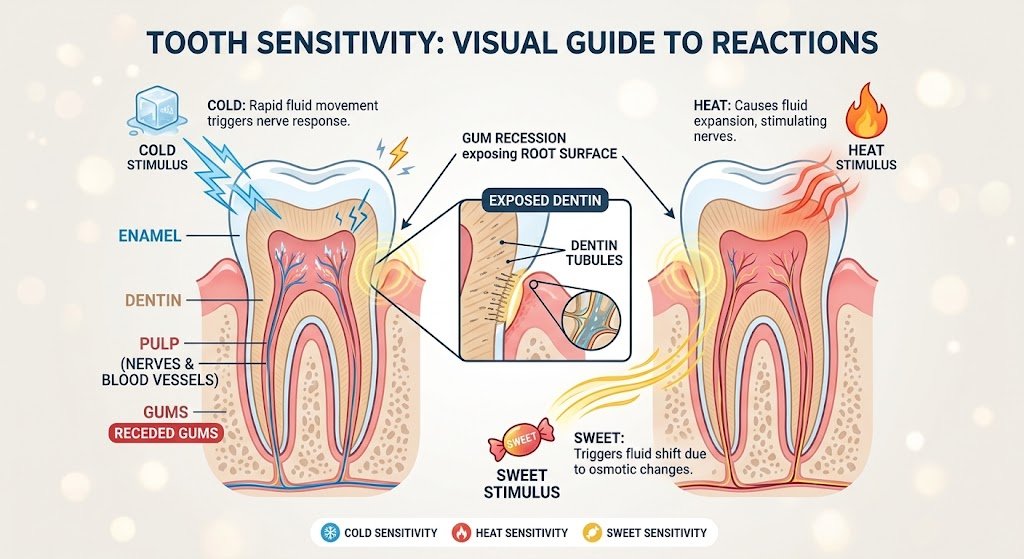
What Causes Tooth Sensitivity?
To choose the right toothpaste, it helps to understand what is actually causing the sensitivity.
A healthy tooth has a hard outer layer called enamel. Under the enamel is dentin, a less mineralized layer containing tiny channels called dentinal tubules. When dentin becomes exposed, external triggers can reach structures connected to the tooth’s nerve and produce a short, sharp sensation.
Sensitivity can develop for several reasons, including:
- Enamel wear or erosion
- Gum recession that exposes the tooth root
- Tooth wear from aggressive brushing
- Acid exposure from foods and drinks
- Cracks or other damage to a tooth
- Dental procedures such as whitening
- Certain oral-health conditions
Not every case of tooth sensitivity has the same cause. That’s why simply choosing a toothpaste labeled “sensitive” isn’t always enough.
For example, someone whose sensitivity comes mainly from exposed dentin may benefit from a desensitizing toothpaste, while persistent sensitivity from a cracked tooth or another dental problem needs professional evaluation.
How Does Sensitive-Toothpaste Work?
Sensitivity toothpastes generally work by reducing the ability of external triggers to stimulate the tooth’s sensitive structures.
Different formulations can do this in different ways.
Some contain ingredients that help reduce nerve response, while others can help block or seal pathways through exposed dentin.
Common ingredients you’ll encounter include:
- Potassium nitrate
- Stannous fluoride
- Fluoride compounds
- Hydroxyapatite
- Other ingredients designed to support enamel or dentin protection
The ingredient list matters more than the front-of-package marketing. Two products can both say “for sensitive teeth” while using different approaches.
How Long Does Sensitive Toothpaste Take to Work?
Don’t necessarily expect sensitivity to disappear after one brushing.
The time required can depend on the cause of sensitivity, the formulation, and how consistently the toothpaste is used. Some people may notice improvement relatively quickly, while others may need continued use.
Follow the product’s directions rather than assuming that using more toothpaste will make it work faster.
If sensitivity is severe, worsening, occurs spontaneously, or remains despite appropriate oral care, toothpaste should not be treated as a substitute for dental evaluation.
What Ingredients Should You Look For in Toothpaste for Sensitive Teeth?
When comparing products, start with the active ingredients and their intended function rather than choosing based only on brand name or packaging.
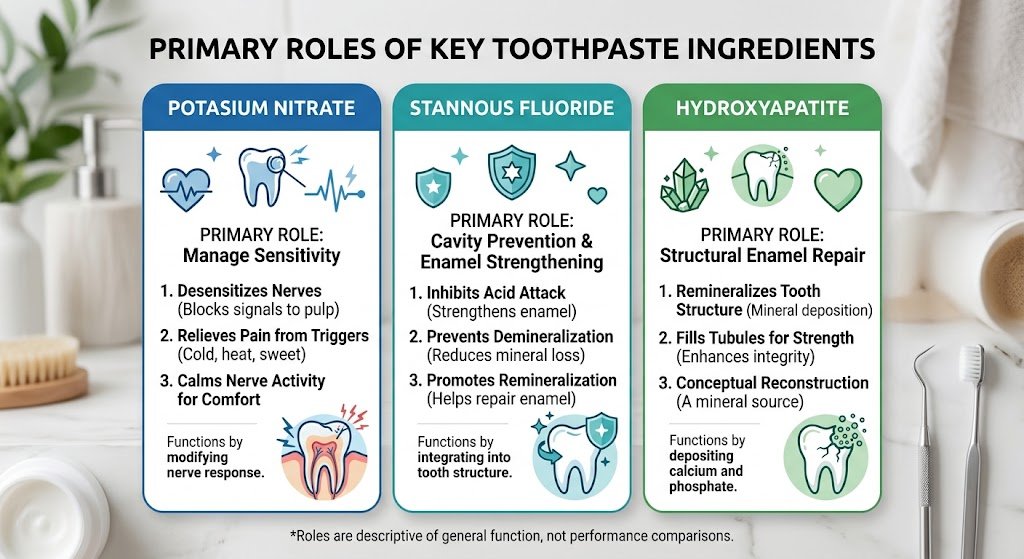
Potassium Nitrate
Potassium nitrate is a commonly used desensitizing ingredient in toothpaste.
It is intended to help reduce the sensitivity response associated with exposed dentin.
This makes potassium nitrate particularly relevant when the main problem is the classic short, sharp sensation caused by things such as:
- Cold drinks
- Hot foods
- Sweet foods
- Air hitting sensitive teeth
- Brushing
If you’re comparing two sensitivity toothpastes and one uses potassium nitrate while another uses a different desensitizing approach, don’t assume one is automatically better. Look at the complete formulation and your particular needs.
Stannous Fluoride
Stannous fluoride is another important ingredient to understand.
It is a fluoride compound that can provide cavity protection while also being used in formulations designed for dentin hypersensitivity.
This can make a stannous-fluoride toothpaste relevant for someone who wants sensitivity care without giving up fluoride-based cavity protection.
However, the presence of an ingredient alone does not mean every product containing it will perform identically. The overall formulation and directions for use still matter.
Hydroxyapatite
Hydroxyapatite is a calcium-phosphate mineral closely related to the mineral structure of teeth.
It has attracted attention in toothpaste formulations because of its potential role in supporting the mineral surface of teeth and addressing sensitivity.
Hydroxyapatite toothpaste is especially relevant for readers who are specifically looking for a fluoride-free option or who want to explore mineral-based formulations.
However, “hydroxyapatite” is not a synonym for “sensitivity toothpaste.” A product needs to be evaluated based on its complete formulation and intended use.
Fluoride
Fluoride is primarily known for helping prevent dental caries, but it is also relevant when you’re selecting toothpaste for sensitive teeth.
If you are prone to cavities as well as sensitivity, cavity protection should remain part of the buying decision.
This is an important distinction: solving sensitivity should not automatically mean ignoring cavity prevention.
For many shoppers, the better question is not simply:
“Which toothpaste stops sensitivity?”
It’s:
“Which toothpaste addresses my sensitivity while also fitting my overall oral-health needs?”
Potassium Nitrate vs. Stannous Fluoride for Sensitive Teeth
If you’re comparing sensitivity toothpastes, potassium nitrate and stannous fluoride are two ingredients you may encounter frequently.
They should not be treated as interchangeable ingredients because they have different properties and can serve different functions within a toothpaste formulation.
| Ingredient | Main reason it appears in toothpaste | What to consider |
| Potassium nitrate | Desensitizing function | Useful when sensitivity is the primary concern |
| Stannous fluoride | Fluoride protection plus sensitivity-related benefits | Relevant when cavity protection and sensitivity care are both priorities |
| Hydroxyapatite | Mineral-based approach to tooth-surface care | Relevant to shoppers considering fluoride-free or hydroxyapatite formulations |
The important takeaway is that ingredient selection should follow the problem you’re trying to solve.
If your priority is sensitivity alone, you may approach the choice differently than someone who has sensitivity plus frequent cavities, enamel concerns, or a preference for fluoride-free toothpaste.
What Else Should You Look for Besides the Active Ingredient?
The active ingredient is important, but it isn’t the only factor.
Fluoride Status
First, decide whether you want a fluoride toothpaste.
For people concerned about cavities, fluoride is an important consideration. The American Dental Association recognizes fluoride as an anticaries active ingredient in toothpaste.
If you’re specifically looking for fluoride-free toothpaste, make that choice deliberately rather than assuming that every “natural” or “clean” toothpaste provides equivalent cavity protection.
Abrasiveness
A toothpaste can contain a useful active ingredient while still being a poor match for someone who is concerned about tooth wear.
A low-abrasive formulation may be worth considering when enamel wear or dentin exposure is part of your sensitivity concerns.
This does not mean that abrasive ingredients are inherently bad. Abrasives help toothpaste remove surface deposits and stains. The issue is finding an appropriate balance between cleaning and unnecessary wear.
If sensitivity is combined with enamel erosion or aggressive brushing, technique and overall oral-care habits matter alongside toothpaste selection.
SLS and Other Irritating Ingredients
Some people specifically avoid sodium lauryl sulfate (SLS) because they find certain formulations irritating.
If you’ve experienced irritation or discomfort with particular toothpaste products, checking the ingredient list can help you identify formulations that may better fit your preferences.
But don’t assume that avoiding one ingredient automatically makes a toothpaste safer or more effective for sensitivity. The entire formulation and your personal response matter.
Flavoring and Essential Oils
Strong flavoring can be another consideration for people who experience oral irritation.
Ingredients such as essential oils and flavoring agents can be useful components of toothpaste, but individual tolerance varies.
If you’ve noticed burning or irritation after brushing, consider the complete ingredient list rather than focusing only on the sensitivity claim printed on the package.
Best Toothpaste for Sensitive Teeth: What to Look For in a Product
Choosing toothpaste for sensitive teeth is not only about finding a product with the word “sensitive” on the package. A better approach is to look at the active ingredients, fluoride status, abrasiveness, flavoring, and your own oral-health needs.
Choose the Right Desensitizing Ingredient
Start by checking the active ingredients.
Potassium nitrate is commonly used in toothpaste designed to manage tooth sensitivity. It is intended to reduce the response of the tooth’s nerve to triggers such as cold, heat, sweets, or brushing.
Stannous fluoride can be another option, particularly for people who want sensitivity care along with fluoride-based cavity protection.
If you prefer a fluoride-free toothpaste, you may come across hydroxyapatite formulations. Hydroxyapatite is a mineral related to the natural mineral component of teeth and is used in some toothpastes for tooth-surface care.
The important point is not to assume that one ingredient automatically makes a toothpaste the right choice for everyone. Your sensitivity, cavity risk, enamel condition, and personal preferences all matter.
Consider Cavity Protection
Sensitivity and cavities are different problems, but they can exist at the same time.
If you are at higher risk of cavities, choosing a toothpaste with an appropriate fluoride active ingredient may be an important consideration. Fluoride helps strengthen teeth against the acids involved in tooth decay.
For readers comparing fluoride and fluoride-free options, see:
A fluoride-free toothpaste may still be suitable for someone who specifically wants that type of formulation, but it should be a deliberate choice rather than something assumed to be better simply because it is marketed as “natural” or “clean.”
Look at Abrasiveness
Toothpaste needs some cleaning ingredients to help remove plaque and surface deposits. However, people with sensitivity may also want to pay attention to how abrasive a toothpaste is.
This is especially relevant if sensitivity is connected with enamel wear, exposed dentin, gum recession, or aggressive brushing.
A toothpaste marketed for whitening may contain ingredients designed to remove surface stains. That does not automatically mean it is inappropriate, but people with sensitive teeth should consider whether whitening is actually a priority.
For a deeper look at this topic:
Consider SLS and Flavoring
Some people prefer toothpaste without sodium lauryl sulfate (SLS), especially if they find certain formulations irritating.
SLS is a foaming ingredient, and avoiding it does not automatically make a toothpaste more effective for sensitivity. The more useful approach is to look at the complete formula and your own tolerance.
Flavoring is another personal consideration. Very strong mint flavors or certain essential oils may feel uncomfortable for people who already experience oral irritation.
If a toothpaste causes burning or discomfort beyond your normal sensitivity, consider switching products and reviewing the complete ingredient list.
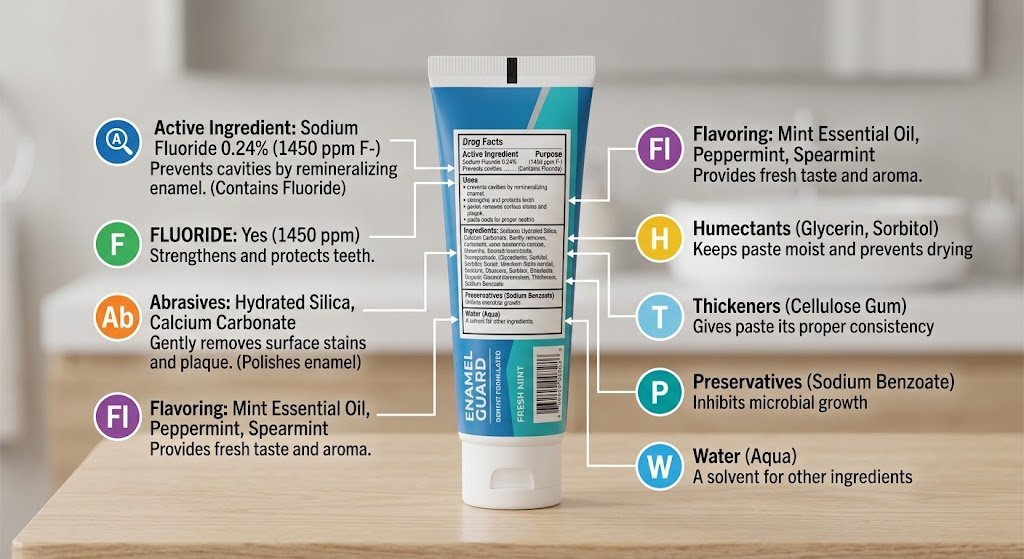
Check the Label Before Buying
Before purchasing a sensitivity toothpaste, check:
- The active ingredient
- Fluoride or fluoride-free status
- The intended purpose of the product
- The full ingredient list
- Any directions or age restrictions
- Whether the product makes claims that are relevant to your needs
- Whether the packaging and product information match the current formulation
Do not choose a toothpaste only because the package says “natural,” “clean,” “whitening,” or “sensitive.” Those terms do not tell you everything about how the toothpaste is formulated.
Types of Toothpaste That May Help Sensitive Teeth
There is no single formulation that every person with sensitive teeth needs. Different types of toothpaste can fit different situations.
Fluoride Toothpaste for Sensitive Teeth
A fluoride toothpaste can make sense when sensitivity and cavity prevention are both concerns.
Some sensitivity-focused formulas combine a fluoride active ingredient with ingredients intended to help manage sensitivity. This can make them useful for people who do not want to separate their cavity-prevention routine from their sensitivity routine.
If you are comparing fluoride toothpaste options, consider the specific fluoride compound, the product directions, and whether the formulation fits your other oral-health needs.
Potassium Nitrate Toothpaste
Potassium nitrate is one of the familiar ingredients found in sensitivity toothpaste.
Its role is different from fluoride’s primary cavity-protection role. Potassium nitrate is included for its desensitizing function, making it particularly relevant when sensitivity is the main reason you are changing toothpaste.
For more information about this ingredient:
When comparing two potassium-nitrate products, do not focus only on the percentage or ingredient name. Look at the complete formulation and follow the manufacturer’s directions.
Stannous Fluoride Toothpaste
Stannous fluoride is a fluoride compound used in some toothpaste formulations for cavity protection and other oral-care benefits, including sensitivity-related applications.
This makes it an interesting option for someone who wants a toothpaste that addresses more than one concern.
However, the presence of stannous fluoride alone does not tell you whether a particular product will be comfortable for you. Texture, flavor, other ingredients, and your individual sensitivity can still affect your experience.
Hydroxyapatite Toothpaste
Hydroxyapatite toothpaste is often considered by people looking for a mineral-based or fluoride-free approach.
Hydroxyapatite is closely related to the mineral found in tooth enamel and dentin. Toothpaste containing hydroxyapatite has therefore received interest as an alternative ingredient for tooth-surface care.
If you are considering this type of toothpaste, make sure you understand whether the specific product is intended for sensitivity, general tooth care, cavity prevention, or another purpose.
SLS-Free Toothpaste
SLS-free toothpaste is another category that may appeal to people who prefer a lower-foaming formulation or who want to avoid SLS.
However, SLS-free does not mean sensitivity-specific.
If sensitivity is your main concern, first look for a formulation that addresses sensitivity. You can then use SLS-free status as an additional preference if it matters to you.
Best Toothpaste for Sensitive Teeth by Different Needs
The phrase “best toothpaste for sensitive teeth” can mean different things depending on what else you want your toothpaste to do.
For Sensitivity Plus Cavity Protection
If you experience sensitivity and are also concerned about cavities, look for a sensitivity-focused toothpaste that provides appropriate fluoride protection.
This approach can help you avoid treating sensitivity as an isolated issue when cavity prevention is also part of your daily oral-care routine.
For People Looking for Fluoride-Free Options
If you specifically want fluoride-free toothpaste, hydroxyapatite products may be worth researching.
The key is to compare the complete product rather than assuming every fluoride-free toothpaste works in exactly the same way.
You can also compare the two approaches here:
For Sensitivity With Enamel Concerns
If your teeth are sensitive and you are also concerned about enamel wear, pay attention to brushing technique, acidic foods and drinks, whitening habits, and toothpaste abrasiveness.
Toothpaste alone cannot correct every cause of enamel damage.
For People Who Prefer a Simpler Formula
If you are trying to reduce ingredients you personally prefer to avoid, read the complete ingredient list rather than relying on marketing terms.
For example, you may decide that you want a toothpaste that is:
- SLS-free
- Free from certain flavoring ingredients
- Fluoride-free
- Hydroxyapatite-based
- Low-abrasive
These preferences can be combined with your actual sensitivity needs.
The goal is to find a product that fits both your oral-health needs and your ingredient preferences.
What to Avoid When Choosing Toothpaste for Sensitive Teeth
Sensitivity can sometimes become worse when people choose toothpaste based only on cosmetic claims.
Avoid Choosing Whitening Over Sensitivity Care
If your teeth are sensitive, whitening may not be your first priority.
Whitening toothpastes are generally designed to address surface stains rather than change the underlying cause of tooth sensitivity. If sensitivity is already making brushing uncomfortable, focus first on an appropriate sensitivity-care routine.
Do Not Assume More Foam Means Better Cleaning
Foaming can make toothpaste feel like it is cleaning more effectively, but foam itself is not the same thing as plaque removal.
Good brushing technique, adequate brushing time, and consistent oral hygiene matter more than how much foam you see.
Do Not Ignore Persistent Sensitivity
Toothpaste can help with some forms of sensitivity, but persistent or unexplained pain should not automatically be treated as a toothpaste problem.
A dentist may need to check for issues such as decay, a damaged tooth, gum problems, or other causes of pain.
How to Use Toothpaste for Sensitive Teeth Correctly
Choosing the right toothpaste is only one part of managing sensitive teeth. How you brush and how consistently you use the toothpaste can also affect your results.
Brush Gently
Brushing harder does not necessarily clean your teeth better. Aggressive brushing can contribute to gum recession and wear on exposed tooth surfaces, which may make sensitivity more noticeable.
Use a soft-bristled toothbrush and gentle pressure. Let the bristles do the cleaning rather than pressing the brush forcefully against your teeth and gums.
Brush Twice a Day
For general oral hygiene, brushing twice a day is commonly recommended.
When using a toothpaste for sensitive teeth, follow the product’s directions rather than applying more toothpaste or brushing more aggressively in an attempt to get faster results.
Give the Toothpaste Time to Work
Sensitivity toothpaste is generally intended to work through regular use rather than as a one-time treatment.
If you have recently switched products, give yourself enough time to determine whether your sensitivity is improving. Avoid constantly changing toothpaste every few days unless the product is causing irritation or another problem.
If your symptoms are getting worse instead of better, the issue may require a dental examination.
Do Not Rinse Excessively After Brushing
Depending on the toothpaste and its instructions, rinsing immediately and repeatedly with large amounts of water can reduce how long the ingredients remain in contact with your teeth.
Follow the directions on your specific toothpaste label.
If the product contains fluoride, follow the manufacturer’s instructions and any advice provided by your dentist.
Watch Your Eating and Drinking Habits
Tooth sensitivity can sometimes be triggered by acidic foods and drinks.
Common examples include:
- Citrus fruits and juices
- Carbonated drinks
- Sports and energy drinks
- Vinegar-based foods
- Other highly acidic foods and beverages
You do not necessarily need to eliminate every acidic food from your diet. Instead, pay attention to patterns that consistently trigger discomfort.
If sensitivity is related to enamel erosion, reducing frequent acid exposure may be particularly important.
When Is Tooth Sensitivity a Sign of a Bigger Problem?
Not every sensitive tooth means there is a serious dental problem. However, sensitivity should not always be treated as something that toothpaste can solve.
Occasional sensitivity after a cold drink may have a different explanation from pain that happens without any obvious trigger.
You should consider talking with a dentist if:
- Sensitivity is severe or keeps getting worse.
- Pain occurs without cold, heat, sweets, or brushing.
- One specific tooth is consistently painful.
- Pain continues after the trigger is removed.
- You have a cracked, chipped, or damaged tooth.
- Your gums are bleeding, swollen, or receding.
- You have signs of tooth decay.
- Sensitivity started after dental treatment and does not improve.
- You are unsure what is causing the discomfort.
A dentist can examine the tooth and surrounding tissues to determine whether the problem is related to exposed dentin, decay, gum recession, enamel damage, a crack, or another condition.
Common Mistakes People Make When Buying Toothpaste for Sensitive Teeth
Choosing a sensitivity toothpaste can become confusing because many products use similar marketing language.
Here are some common mistakes to avoid.
Mistake 1: Choosing Only by the Word “Sensitive”
A toothpaste can be marketed for sensitive teeth, but that label does not tell you everything about the formulation.
Check the active ingredient and the rest of the ingredient list.
Ask:
What is this toothpaste actually designed to do?
Is the main focus sensitivity? Cavity protection? Whitening? Enamel care? Gum care?
The answer can help you compare products more logically.
Mistake 2: Ignoring Fluoride
Some people focus heavily on avoiding certain ingredients and forget about cavity protection.
If you are prone to cavities, fluoride status deserves attention.
For people who specifically want fluoride-free toothpaste, the decision should be intentional and based on their individual oral-care needs.
Mistake 3: Assuming “Natural” Means Better for Sensitive Teeth
Natural and non-toxic are marketing terms that can mean different things depending on the product and the person using it.
A toothpaste can contain plant-based ingredients and still cause irritation for someone who is sensitive to a particular ingredient.
Likewise, a conventional toothpaste is not automatically inappropriate simply because it contains ingredients that sound unfamiliar.
Instead of judging the product by its marketing category, examine the actual formulation.
Mistake 4: Using Whitening Toothpaste When Sensitivity Is the Main Problem
If sensitivity is your biggest concern, choosing a toothpaste primarily because it promises whiter teeth may not be the most appropriate starting point.
First consider why your teeth are sensitive and whether the product contains an ingredient intended for sensitivity care.
Mistake 5: Brushing Too Hard
If you have sensitive teeth, changing toothpaste while continuing aggressive brushing may not address the underlying issue.
Use gentle pressure and a soft-bristled toothbrush.
Your brushing technique is part of the overall sensitivity strategy.
Mistake 6: Changing Products Too Quickly
People sometimes use a toothpaste for only a few days and immediately decide that it does not work.
Sensitivity products are generally intended for consistent use according to their directions. If there is no improvement, or if symptoms are getting worse, consider speaking with a dentist rather than repeatedly switching products.
How We Compare Toothpaste for Sensitive Teeth
If you are comparing several toothpaste products, use the same criteria for each one.
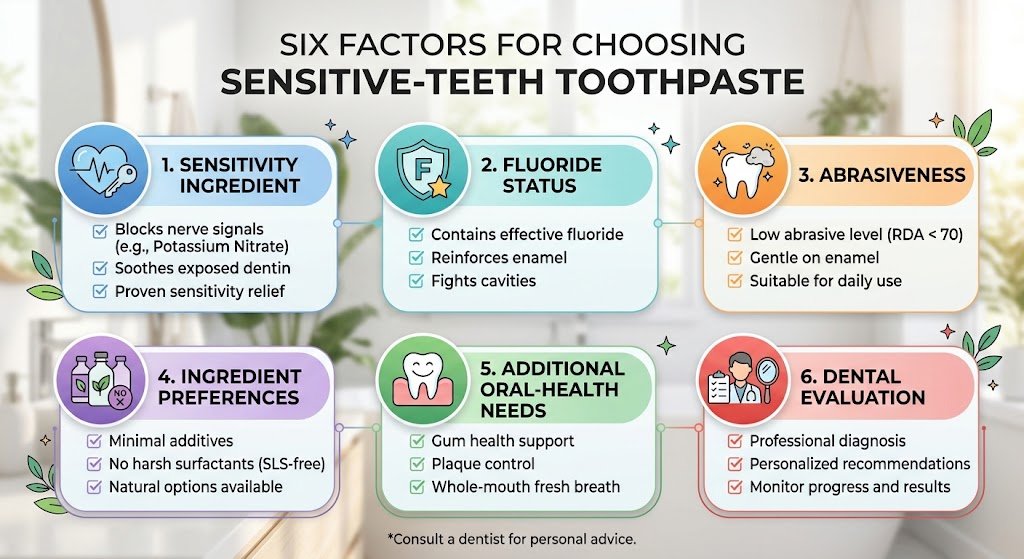
1. Sensitivity Ingredient
First identify whether the product contains an ingredient specifically associated with sensitivity care.
Examples include:
- Potassium nitrate
- Stannous fluoride
- Other ingredients used in sensitivity-focused formulations
Do not judge a product only by the ingredient name. Consider the entire formulation.
2. Fluoride Status
Record whether the toothpaste contains fluoride.
For shoppers who want cavity protection, this can be an important part of the comparison.
For shoppers specifically looking for fluoride-free products, it helps separate products that meet that requirement from those that do not.
3. Additional Oral-Health Benefits
A toothpaste may target more than sensitivity.
Depending on the formulation, it may also be designed for:
- Cavity prevention
- Enamel care
- Gum care
- Plaque control
- Whitening
- Bad breath
- Dry mouth
These additional purposes can help determine whether a product fits your routine.
4. Ingredient Preferences
Some shoppers want to avoid specific ingredients, while others are mainly concerned with active ingredients and dental benefits.
You can compare:
- SLS status
- Flavoring ingredients
- Essential oils
- Sweeteners
- Dyes
- Abrasives
- Other ingredients you personally prefer to avoid
This is where reading the complete ingredient list becomes useful.
5. Product Directions
Always check how the manufacturer tells you to use the toothpaste.
Pay attention to:
- How often to brush
- How much toothpaste to use
- Age recommendations
- Warnings
- Storage instructions
- Any special directions for sensitivity
Product formulations can change, so verify the current package information before publishing specific product details.
Best Toothpaste for Sensitive Teeth: A Simple Buying Checklist
Before adding a toothpaste to your cart, ask these questions:
Does it address my main problem?
If sensitivity is the main concern, look for a formulation designed to help with sensitivity.
Does it provide the type of cavity protection I want?
If you want fluoride toothpaste, confirm that fluoride is listed as an active ingredient.
Does it fit my ingredient preferences?
Check the full ingredient list rather than relying only on front-label claims.
Is it suitable for my other dental concerns?
If you also have enamel wear, cavities, gum problems, or frequent irritation, consider those needs too.
Can I use it consistently?
A toothpaste that you dislike because of its flavor, texture, or other characteristics may be difficult to use consistently.
Do I need a dentist instead of a new toothpaste?
If your sensitivity is persistent, severe, worsening, or unexplained, getting the cause evaluated may be more important than trying another product.
Toothpaste for Sensitive Teeth vs. Regular Toothpaste
Regular toothpaste can provide everyday cleaning and cavity protection, but sensitivity toothpaste is formulated with ingredients intended to address tooth sensitivity.
That does not mean every person with sensitive teeth must use a specialized product forever.
The better question is:
What does your oral-health routine need right now?
Someone with occasional sensitivity may choose a sensitivity-focused toothpaste for a period of time. Another person with ongoing sensitivity may need both an appropriate toothpaste and professional dental care.
The cause of sensitivity matters.
For example, exposed dentin from gum recession is different from pain caused by a cavity or a cracked tooth. A toothpaste may help manage symptoms in some situations, but it cannot repair every underlying dental problem.
Can Hydroxyapatite Toothpaste Help With Sensitive Teeth?
Hydroxyapatite toothpaste has become popular among people looking for mineral-based oral-care products.
Hydroxyapatite is chemically related to the mineral component of teeth, which is why it is used in some toothpaste formulations intended for tooth-surface care.
Some hydroxyapatite products are also marketed toward people concerned about sensitivity.
However, it is important to separate what an ingredient is from what a specific product has been demonstrated to do.
If you are considering hydroxyapatite for sensitivity, check:
- Whether the product is specifically formulated for sensitivity
- Whether it contains fluoride or is fluoride-free
- What other active ingredients are present
- The manufacturer’s directions
- Whether the product fits your cavity-prevention needs
For a deeper explanation of the ingredient:
And for its proposed role in tooth-surface care:
Frequently Asked Questions About Toothpaste for Sensitive Teeth
What is the best toothpaste for sensitive teeth?
There is no single toothpaste that is best for every person with sensitive teeth.
The right choice depends on the cause of your sensitivity and what else you need from your toothpaste. Look for a formulation designed for sensitivity and then consider factors such as fluoride, cavity protection, abrasiveness, ingredients, flavor, and your personal preferences.
If you have persistent or severe sensitivity, finding the cause with a dentist is more important than simply trying different toothpaste products.
Is fluoride toothpaste good for sensitive teeth?
Fluoride toothpaste can be a useful choice for someone who wants sensitivity care together with cavity protection.
Some fluoride formulations also contain ingredients specifically used in sensitivity toothpaste.
If you are unsure whether fluoride is appropriate for your needs, discuss your cavity risk and oral-health history with your dentist.
Is potassium nitrate good for sensitive teeth?
Potassium nitrate is a common ingredient in toothpaste formulated for sensitive teeth.
It is used for its desensitizing role and is intended to reduce the response associated with sensitivity triggers.
When comparing products, look beyond potassium nitrate alone and consider the complete formulation and product directions.
Is stannous fluoride good for sensitive teeth?
Stannous fluoride is a fluoride compound used in some toothpaste formulations that address sensitivity as well as cavity protection.
It can be relevant for people who want both types of benefits in one toothpaste.
However, individual response can vary, so the complete formulation and your oral-health needs should guide your choice.
Is hydroxyapatite toothpaste good for sensitive teeth?
Some hydroxyapatite toothpaste products are formulated or marketed for sensitivity.
Hydroxyapatite is a mineral related to the natural mineral component of teeth, which makes it relevant to people interested in mineral-based oral care.
If you are considering hydroxyapatite toothpaste, check whether the specific product is intended for sensitivity and whether its fluoride status fits your needs.
Is SLS-free toothpaste better for sensitive teeth?
Not necessarily.
SLS-free toothpaste may be preferred by people who want to avoid SLS or who find certain foaming formulations uncomfortable. But SLS-free does not automatically mean that a toothpaste is better at managing tooth sensitivity.
If sensitivity is your primary concern, first look at the ingredients intended to address sensitivity.
Is whitening toothpaste bad for sensitive teeth?
Whitening toothpaste is not automatically bad for everyone with sensitive teeth.
However, if you already experience sensitivity, you should consider whether whitening is necessary and whether the product’s formulation is comfortable for you.
If whitening causes or increases discomfort, consider stopping the product and discussing the issue with a dental professional.
How long does it take for sensitive toothpaste to work?
The time can vary depending on the product, the cause of sensitivity, and how consistently it is used.
Sensitivity toothpaste is generally not something you should expect to completely change the sensation after one brushing.
Follow the product directions and monitor your symptoms. If sensitivity continues, becomes severe, or occurs without an obvious trigger, seek dental advice.
Can sensitive toothpaste repair enamel?
Toothpaste can support daily oral care, but it should not be treated as a way to rebuild a severely damaged tooth.
Enamel does not regenerate in the same way as living tissue. However, fluoride and certain mineral-based ingredients are used in oral-care products to support the mineral balance of tooth surfaces.
If you have significant enamel wear or erosion, the underlying cause should also be addressed.
Can children use toothpaste for sensitive teeth?
Children should use toothpaste appropriate for their age and dental needs.
Do not assume that a toothpaste marketed for adults with sensitive teeth is automatically suitable for a child.
Parents should follow the product’s age guidance and ask a dentist or pediatric dental professional when there is ongoing sensitivity.
Should I stop using toothpaste if it makes my mouth burn?
If a toothpaste causes unusual burning, irritation, swelling, or another concerning reaction, stop using it and seek appropriate advice.
A reaction may be related to an ingredient that your mouth does not tolerate well. Reading the complete ingredient list can help when discussing the issue with a dental professional.
Best Toothpaste for Sensitive Teeth: What Matters Most?
When comparing sensitivity toothpastes, it is easy to get distracted by packaging and marketing claims.
A more useful process is to work from your actual dental needs.
If sensitivity is your main concern, start by identifying the ingredients and formulations intended for sensitivity care.
Then consider:
- Cavity protection — especially if you are at higher risk of tooth decay.
- Fluoride status — decide whether you want a fluoride or fluoride-free formulation.
- Abrasiveness — particularly if enamel wear or exposed dentin is a concern.
- Ingredient preferences — such as SLS, flavoring, essential oils, dyes, or other ingredients you prefer to avoid.
- Additional dental needs — such as enamel care, gum health, whitening, or bad breath.
- Your symptoms — persistent or unusual pain may need professional evaluation.
This approach makes it easier to compare products without assuming that one ingredient or marketing label makes a toothpaste universally better.
How to Choose a Sensitive Toothpaste on Amazon
If you are shopping online, product pages can contain a lot of information, but not all of it should be treated equally.
Start with the product label and ingredient information.
Step 1: Identify the Active Ingredient
Look for the active ingredient listed on the product packaging.
For a sensitivity-focused toothpaste, this may include ingredients such as potassium nitrate or stannous fluoride, depending on the formulation.
Step 2: Check Fluoride Status
If cavity protection is important to you, confirm whether the toothpaste contains fluoride.
Do not assume a product is fluoride-free or fluoride-containing based only on its title.
Step 3: Read the Full Ingredient List
Check ingredients beyond the main active ingredient.
This is especially useful if you have personal preferences regarding:
- SLS
- Flavoring
- Essential oils
- Sweeteners
- Dyes
- Abrasives
- Other ingredients that may cause irritation for you
Step 4: Check Current Product Information
Online listings can change. Packaging, sizes, flavors, and formulations may also change.
Before publishing an affiliate recommendation, verify the current product page and packaging so that the article does not contain outdated information.
Step 5: Compare Price Per Ounce
A lower package price does not always mean lower cost over time.
When comparing similar products, check the amount of toothpaste in each package and calculate the approximate price per ounce.
This gives readers a more useful comparison than looking only at the headline price.
Step 6: Check User Reviews Carefully
Customer reviews can provide useful information about taste, texture, packaging, and individual experiences.
But reviews are personal experiences, not controlled evidence of clinical effectiveness.
For health-related claims, rely on authoritative sources and product documentation rather than using individual reviews as proof.
Amazon Affiliate Product Selection for This Article
For an affiliate article, product recommendations should connect directly to the reader’s needs.
Instead of adding many unrelated toothpaste products, organize recommendations around clearly defined use cases.
For example:
Product Category: Sensitivity + Fluoride
Choose products that are specifically formulated for sensitivity and contain an appropriate fluoride active ingredient.
Amazon CTA placement:
Check current price and availability on Amazon.
[ AMAZON PRODUCT PLACEHOLDER — Verify current product name, active ingredient, fluoride status, package size, and formulation before publishing. ]
Product Category: Fluoride-Free / Hydroxyapatite
Choose a hydroxyapatite toothpaste only after verifying that the current formulation matches the article’s claims.
Amazon CTA placement:
See the current product details on Amazon.
[ AMAZON PRODUCT PLACEHOLDER — Verify hydroxyapatite ingredient, fluoride-free status, flavor, size, and current formulation. ]
Product Category: SLS-Free Sensitivity Option
For readers who specifically prefer an SLS-free formula, select a product that also has a clear sensitivity-related purpose.
Amazon CTA placement:
View the latest price on Amazon.
[ AMAZON PRODUCT PLACEHOLDER — Verify SLS-free status and sensitivity positioning from current packaging/product information. ]
The goal is to make the affiliate section useful rather than turning the article into a long product list.
Final Takeaway
The best toothpaste for sensitive teeth depends on why your teeth are sensitive and what else you need from your toothpaste.
For some people, a toothpaste containing a sensitivity-focused ingredient such as potassium nitrate may be a logical option. Others may prefer a stannous fluoride formulation that combines fluoride protection with sensitivity-related benefits. People specifically looking for fluoride-free or mineral-based oral care may consider hydroxyapatite products.
But the active ingredient is only one part of the decision.
You should also consider fluoride status, abrasiveness, ingredient preferences, flavor, and your other oral-health needs.
Most importantly, do not use toothpaste as a substitute for finding the cause of persistent dental pain. If sensitivity is severe, worsening, localized to one tooth, occurs without an obvious trigger, or continues despite appropriate care, a dental examination can help determine what is actually happening.
