If you are looking for the best low-abrasive toothpaste, you are probably trying to solve a specific problem: clean your teeth effectively without choosing a formula that is unnecessarily abrasive.
That can matter if you have sensitive teeth, enamel wear, gum recession, acid erosion concerns, or simply prefer a gentler toothpaste for everyday brushing.
Toothpaste needs some abrasive action to help remove plaque and surface stains. The challenge is finding the right balance between cleaning and minimizing unnecessary wear. One measurement used to compare toothpaste abrasivity is Relative Dentin Abrasivity (RDA), but RDA should not be treated as a simple “lower is always better” score. The American Dental Association specifically says RDA values should not be used to quantitatively rank toothpaste safety.
In this guide, we’ll explain what low-abrasive toothpaste actually means, how RDA works, what else matters besides abrasivity, and which types of toothpaste are worth considering for different needs.
Best Low-Abrasive Toothpaste at a Glance
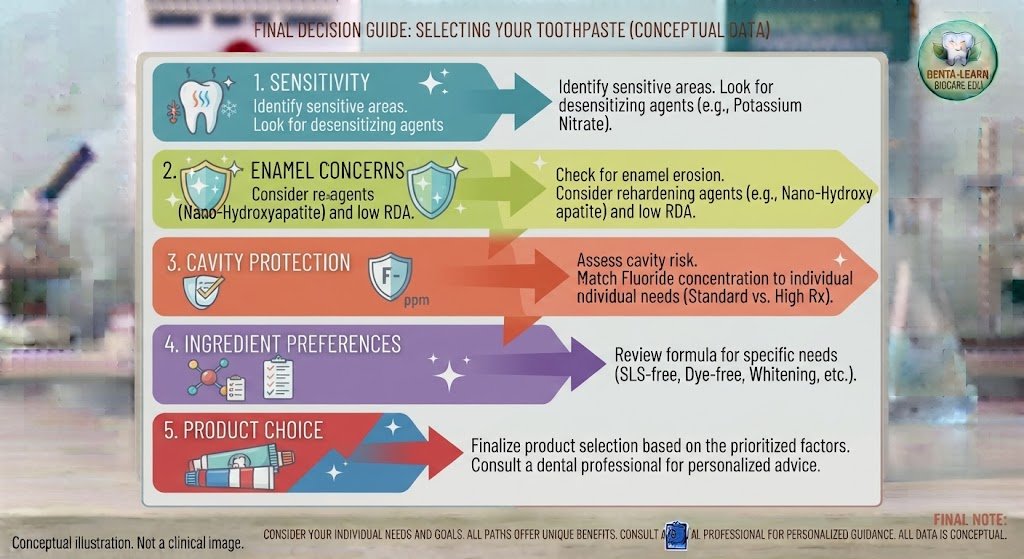
The right low-abrasive toothpaste depends on why you want a gentler formula.
Someone with sensitive teeth may have different priorities from someone concerned about enamel erosion or someone who simply wants a gentle everyday toothpaste.
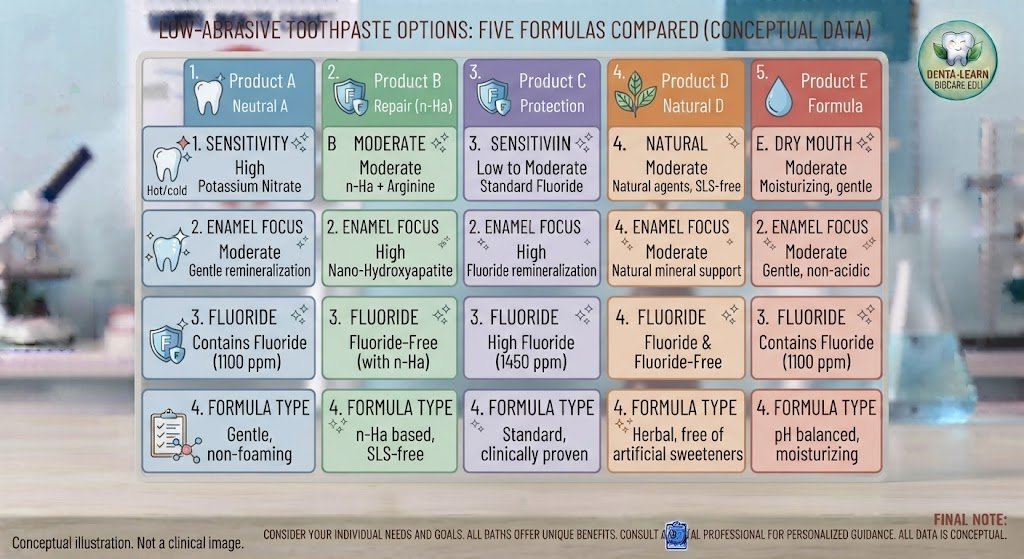
| Toothpaste | Best fit | Fluoride | Main reason to consider |
| Sensodyne Pronamel Daily Protection | Enamel and sensitivity concerns | Yes | Enamel-focused formula |
| CloSYS Sensitive Fluoride Toothpaste | Sensitive mouths and gentle daily care | Yes | Fluoride + low-foaming, SLS-free formula |
| Colgate Sensitive Enamel Health | Sensitivity and enamel-focused care | Check exact version | Mainstream sensitive-tooth option |
| Arm & Hammer Sensitive | Budget-conscious sensitive-teeth shoppers | Check exact version | Sensitive-focused formulas |
| Colgate PreviDent 5000 Sensitive | Specific dentist-directed needs | Prescription strength | Low-abrasion prescription formula |
These are options to compare, not a universal ranking.
The exact formulation matters. Toothpaste brands often sell several versions under similar names, and a whitening, sensitive, enamel, or tartar-control version may not have the same ingredients or abrasivity characteristics.
The ADA explains that RDA is a standardized measurement of dentifrice abrasivity and that dentifrices with an ADA Seal of Acceptance must have an RDA of 250 or less. However, the organization also cautions that RDA values below 250 should not be used to rank toothpaste safety quantitatively.
What Does Low-Abrasive Toothpaste Mean?
Toothpaste is not completely non-abrasive.
In fact, abrasive ingredients are a normal part of toothpaste because they help remove plaque, food debris, and extrinsic surface stains during brushing.
A low-abrasive toothpaste is generally a formula designed to provide cleaning while producing relatively less abrasive action than more aggressive formulations.
That does not mean the toothpaste:
- Contains no abrasive ingredients
- Cannot remove surface stains
- Provides zero tooth wear
- Is automatically better for everyone
- Can reverse existing enamel loss
Instead, it means abrasivity is relatively controlled.
Why Would Someone Want Less Abrasion?
The question becomes more important when part of the tooth surface is vulnerable.
For example, a person may be concerned about:
- Tooth sensitivity
- Gum recession
- Exposed dentin
- Enamel erosion
- Previous tooth wear
- Frequent acidic drinks
- Aggressive brushing
- Highly abrasive whitening toothpaste
Dentin can become exposed when enamel wears or gums recede. The ADA specifically discusses RDA in this context because dentin is more vulnerable when it becomes exposed.
But there is an important balance.
You do not want to eliminate abrasive action completely. Toothpaste still needs to perform its basic cleaning function.
The goal is better described as:
Use enough cleaning action to remove deposits effectively without choosing a formula that is unnecessarily aggressive for your individual needs.
That is why a low-abrasive toothpaste should be evaluated as part of a complete oral-care routine rather than as a standalone solution.
What Is RDA and Why Does It Matter?
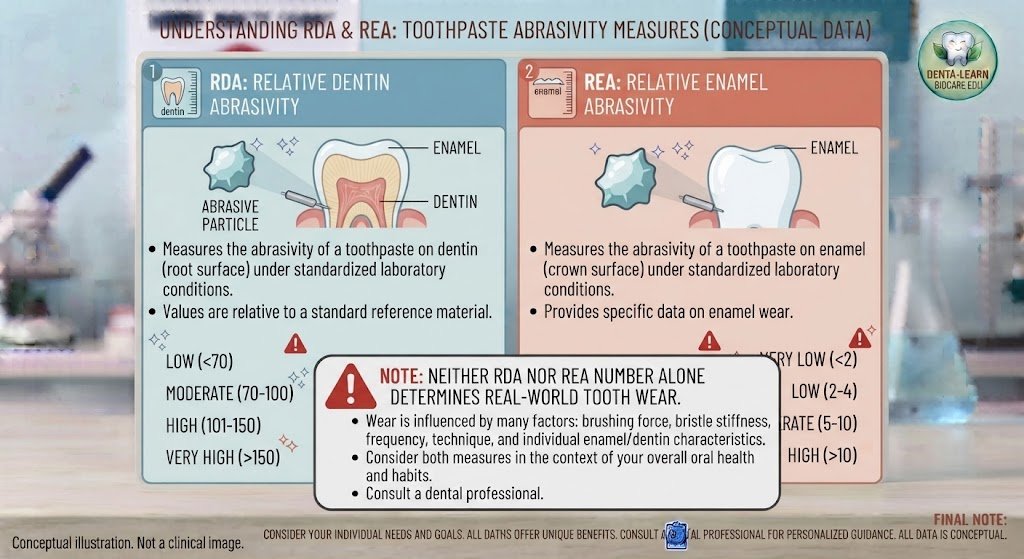
RDA stands for Relative Dentin Abrasivity.
It is a standardized laboratory measurement used to compare the abrasive action of dentifrices against a reference material. The reference abrasive is assigned an RDA value of 100.
In simple terms, RDA helps answer:
“How abrasive is this toothpaste under a standardized test?”
But there is an important limitation.
RDA is not a direct measurement of how much damage your teeth will experience in everyday life.
Is a Lower RDA Always Better?
No.
This is one of the most important points in the entire article.
It is tempting to look at two products and think:
- Product A: RDA 40
- Product B: RDA 80
Therefore, Product A must be twice as safe.
That conclusion is not justified.
The ADA specifically states that RDA should not be used to quantitatively rank the safety of toothpastes. It notes that values below 250 do not directly correspond to potential clinical changes in enamel.
So RDA is better used as one comparison point, not as the entire purchasing decision.
What Else Determines Tooth Wear?
Your actual tooth wear is influenced by more than toothpaste.
Relevant factors include:
- Brushing pressure
- Brushing frequency
- Toothbrush type
- Toothpaste formulation
- Acid exposure
- Tooth surface condition
- Gum recession
- Individual oral-health factors
Research comparing toothpaste abrasivity also shows that cleaning performance and dentin abrasion do not always move together in a simple way. Abrasive type, particle characteristics, and other toothpaste ingredients can affect the relationship between cleaning power and abrasion.
That means a toothpaste does not necessarily need to be extremely abrasive to clean effectively.
What About REA?
You may also encounter another measurement called Relative Enamel Abrasivity (REA).
RDA evaluates abrasivity using dentin, while REA evaluates abrasive effects on enamel.
They are related measurements, but they are not interchangeable.
Research has shown that toothpastes can have substantially different RDA and REA profiles, meaning one abrasivity measurement does not tell the entire story about how a toothpaste interacts with both dentin and enamel.
This is another reason to avoid choosing toothpaste solely by searching for the smallest RDA number you can find.
How Toothpaste Abrasivity Can Affect Enamel and Dentin
To understand why abrasivity matters, it helps to distinguish between enamel and dentin.
Enamel
Enamel is the hard outer covering of the tooth.
It protects the underlying structures and is highly mineralized. Although it is extremely hard, it can still be affected by chemical erosion and mechanical wear.
Acid exposure can soften the tooth surface, while mechanical forces can contribute to wear.
That is why someone who regularly consumes acidic foods or drinks and then brushes aggressively may have different concerns from someone without those exposures.
Dentin
Dentin sits underneath enamel.
When enamel becomes worn or the gums recede, dentin can become exposed. This can make the tooth more vulnerable to sensitivity and mechanical wear.
This is particularly relevant when selecting toothpaste because a person with exposed dentin may have different priorities from someone with intact enamel and no sensitivity.
The ADA specifically notes that dentin may become exposed through enamel wear or gingival recession, which is one reason dentin abrasivity is considered when evaluating toothpaste.
Brushing Pressure Matters Too
Choosing a low-abrasive toothpaste does not mean you can brush harder.
In fact, brushing technique is one of the easiest factors you can control.
If you press heavily with a toothbrush, you may increase mechanical wear even when using a relatively gentle toothpaste.
A better approach is to:
- Use gentle pressure
- Choose an appropriate toothbrush
- Brush thoroughly rather than aggressively
- Follow the toothpaste’s directions
- Ask your dentist or hygienist to evaluate your technique if you have significant sensitivity or tooth wear
This is why toothpaste selection should be viewed as one part of the solution.
Acid Exposure Matters
Tooth wear can involve both chemical and mechanical processes.
Acidic foods and beverages can contribute to erosive tooth wear. Brushing immediately or aggressively against a softened surface can add a mechanical component.
So if enamel erosion is your concern, simply finding a low-abrasive toothpaste may not be enough.
You should also consider:
- How often you consume acidic drinks
- Whether you sip acidic beverages over long periods
- Your brushing technique
- Your fluoride exposure
- Your overall dental health
Recent evidence synthesis has also found that fluoride-containing dentifrices generally provide more consistent experimental protection against erosive tooth wear than non-fluoridated controls, although much of the evidence comes from laboratory and in-situ studies rather than long-term clinical outcomes.
Best Low-Abrasive Toothpaste Options
1. Sensodyne Pronamel Daily Protection
Best fit: people focused on enamel protection and sensitivity
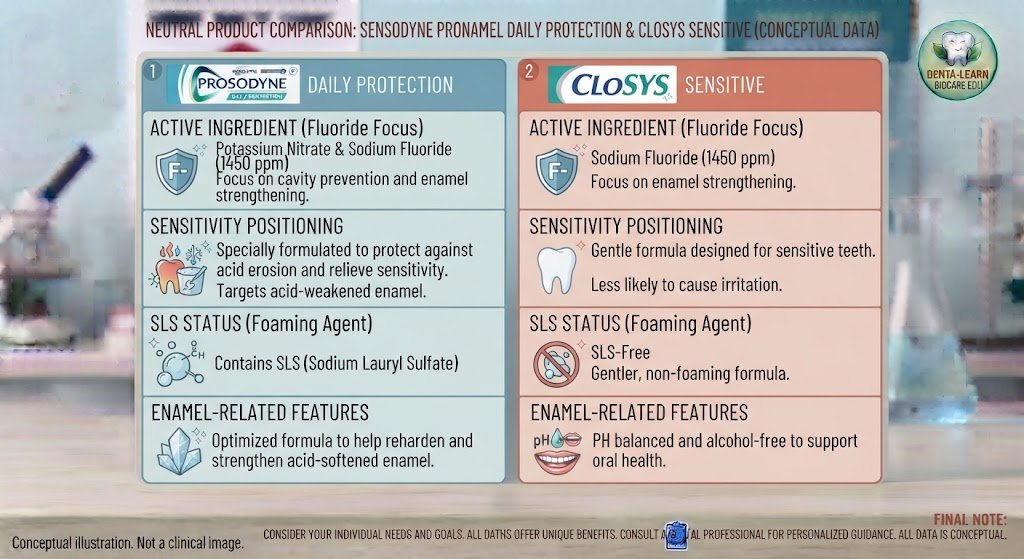
Sensodyne Pronamel Daily Protection is designed around enamel protection and sensitivity.
Sensodyne’s current U.S. product information says Pronamel Daily Protection helps make enamel stronger and more resistant to the effects of dietary acids. It also lists the formula as SLS-free.
That makes it particularly relevant for someone whose main concern is not simply “sensitive teeth,” but the combination of sensitivity + enamel/acid-wear concerns.
The Pronamel line also includes multiple variants, including Daily Protection, Gentle Whitening, Multi-Action, and other formulations. That distinction matters because you should not assume every Pronamel product has identical characteristics.
What stands out:
- Enamel-focused positioning
- Fluoride-containing toothpaste
- SLS-free Daily Protection formula
- Designed for everyday use
- Available in multiple product variants
Potential drawback: If your primary goal is minimum abrasion, do not automatically choose a whitening version simply because it belongs to the Pronamel range. Compare the exact formula and its intended purpose.
2. CloSYS Sensitive Fluoride Toothpaste
Best fit: shoppers who want fluoride with a low-foaming, SLS-free formula
CloSYS Sensitive is another relevant option for people who want a gentle-feeling toothpaste while retaining fluoride.
The current manufacturer information lists 0.24% sodium fluoride as the active ingredient. It also describes the formula as SLS-free, sulfate-free, triclosan-free, and gluten-free, with low foaming.
CloSYS also describes the product as being formulated for sensitive mouths and says it helps prevent cavities and strengthen weakened enamel.
This makes it useful for a shopper who has several preferences at once:
- Fluoride
- Sensitivity-oriented formula
- Low foaming
- SLS-free
- Sulfate-free
What stands out:
- Sodium fluoride
- SLS-free
- Sulfate-free
- Low-foaming formula
- Sensitive-mouth positioning
- Current manufacturer page provides ingredient information
Potential drawback: “Gentle” positioning does not by itself establish a specific RDA value. If exact abrasivity is your deciding factor, look for reliable abrasivity data for the exact product formulation rather than assuming the marketing description equals a particular RDA.
3. Colgate Sensitive Enamel Health
Best fit: shoppers looking for a mainstream sensitive-tooth formula with enamel-focused positioning
Colgate has several sensitive-tooth products, so the exact product name matters.
This category is relevant because shoppers looking for low-abrasive toothpaste often have two related concerns: sensitivity and enamel care.
However, avoid assuming that every Colgate Sensitive product has the same ingredients or abrasivity.
When comparing products, check:
- Exact product name
- Active ingredient
- Fluoride status
- Whitening claims
- Current ingredient list
- Manufacturer information
This is especially important when buying through Amazon, where several similar product names may appear next to one another.
What stands out:
- Large, established oral-care brand
- Multiple sensitivity-oriented options
- Enamel-focused variants
- Easy availability through major retailers
Potential drawback: The large number of Colgate toothpaste variants can make product selection confusing.
If your priority is low abrasion, choose based on the specific formula, not simply the Colgate brand name.
4. Arm & Hammer Sensitive Toothpaste
Best fit: budget-conscious shoppers looking for a sensitive-teeth toothpaste
Arm & Hammer sells several toothpaste formulas designed for different needs, including sensitivity and whitening.
For this article, the important distinction is that you should look specifically for the sensitive-oriented formula, rather than assuming all Arm & Hammer toothpaste has the same abrasive characteristics.
Baking soda is also commonly associated with Arm & Hammer’s oral-care products, but the presence of baking soda by itself does not tell you the product’s overall abrasivity.
The complete formula still matters.
What stands out:
- Sensitive-tooth options
- Mainstream availability
- Often positioned as a value-oriented option
- Multiple formulas for different needs
Potential drawback: Different Arm & Hammer formulas can have different purposes, so a whitening or tartar-control product should not automatically be treated as equivalent to a sensitive formula.
5. Colgate PreviDent 5000 Sensitive
Best fit: people with specific dental needs whose dentist recommends prescription-strength fluoride
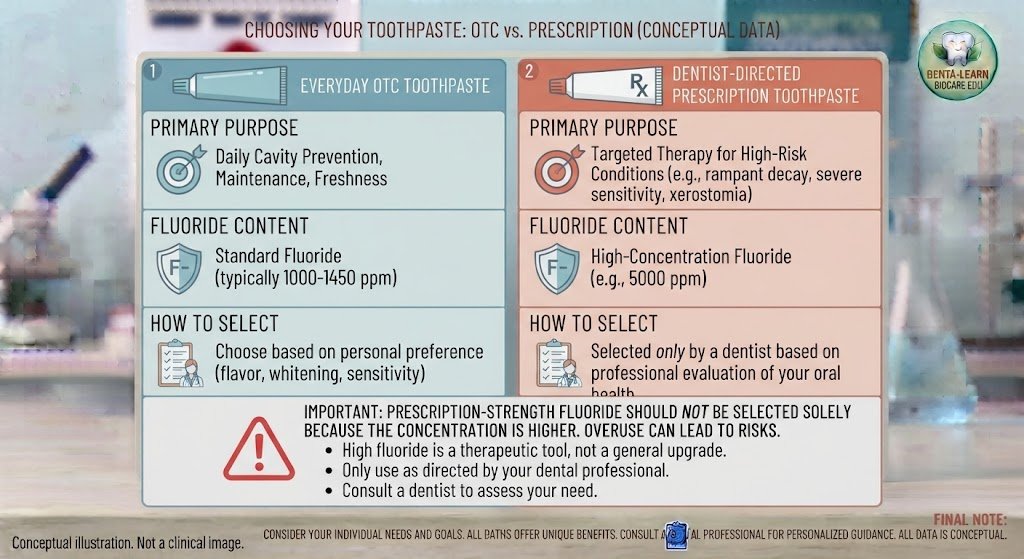
PreviDent 5000 Sensitive is different from the other options because it is a prescription-strength toothpaste rather than a standard OTC product.
Colgate describes PreviDent 5000 Sensitive as a low-abrasion toothpaste for sensitive teeth. It contains 1.1% sodium fluoride and 5% potassium nitrate.
This makes it relevant to the article because it demonstrates an important point:
Low abrasion and strong fluoride protection are not mutually exclusive.
However, this is not a product to choose simply because “5,000 ppm fluoride sounds better.”
The ADA notes that prescription-strength fluoride toothpaste contains 5,000 ppm fluoride, compared with the generally 1,000–1,500 ppm range found in U.S. OTC fluoride toothpaste.
Use prescription-strength products according to your dentist’s instructions.
What stands out:
- Specifically described as low abrasion
- Prescription-strength fluoride
- Potassium nitrate for sensitivity
- Intended for specific dental needs
Potential drawback: This is not a normal Amazon OTC recommendation and should be dentist-directed.
What to Look for in a Low-Abrasive Toothpaste
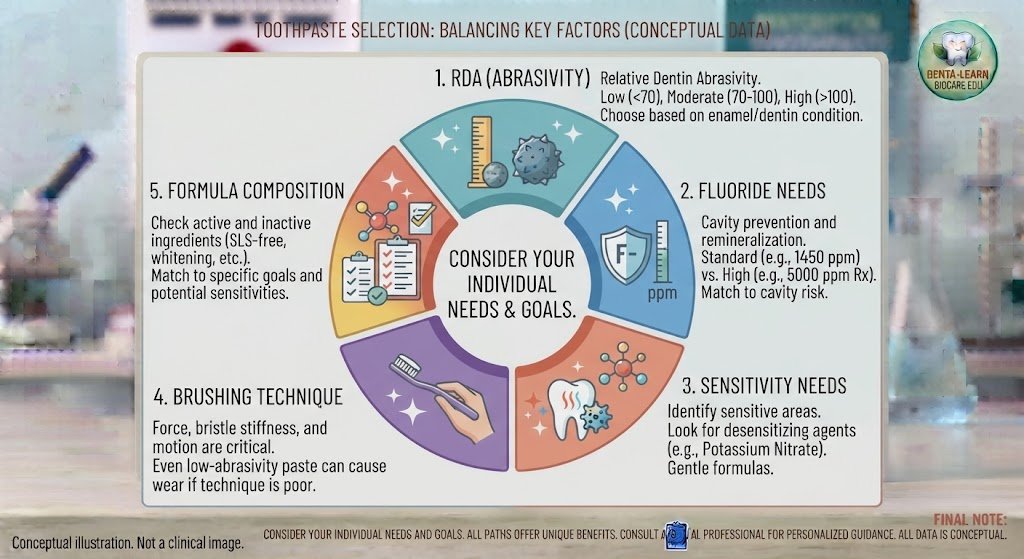
Choosing a low-abrasive toothpaste is not simply about finding the smallest possible RDA number. The goal is to find a formula that gives you effective daily cleaning while fitting your specific oral-health needs.
Here are the factors that matter most.
1. Look for Abrasivity Information When Available
If a manufacturer provides an RDA value or reliable abrasivity information, it can help you understand where a toothpaste falls on the abrasivity scale.
The ADA explains that toothpastes with an RDA of 250 or less are considered safe and effective, but it also specifically warns against using RDA values below 250 to rank toothpastes from “safest” to “least safe.” RDA is a standardized measurement, not a direct prediction of how much enamel a particular person will lose.
So, don’t automatically assume:
Lower RDA = better toothpaste for everyone.
Instead, use abrasivity as one part of your buying decision.
2. Consider Fluoride for Everyday Cavity Protection
A low-abrasive toothpaste does not need to be fluoride-free.
In fact, for many adults, cavity protection is an important reason to use fluoride toothpaste. The ADA notes that fluoride helps strengthen teeth and prevent tooth decay, and OTC fluoride toothpastes in the U.S. generally contain 1,000–1,500 ppm fluoride.
This creates an important distinction:
Low-abrasive describes the physical cleaning characteristics of a toothpaste.
Fluoride describes an active ingredient used for cavity prevention.
They are not competing categories.
If you are specifically trying to protect your teeth from cavities while reducing unnecessary abrasion, look for a low-abrasive formula that also provides appropriate fluoride protection.
3. Match the Formula to Your Sensitivity Needs
If your teeth hurt when you drink something cold, eat something hot, or brush certain areas, look beyond the word “gentle.”
Some toothpastes contain ingredients specifically intended to reduce dentin hypersensitivity. The ADA identifies ingredients such as stannous compounds and potassium-based ingredients among the approaches used in sensitivity toothpastes.
A useful approach is to look for a product that combines:
- Relatively gentle cleaning
- A sensitivity-focused formula
- Fluoride when cavity protection is needed
- Instructions appropriate for everyday use
This is especially relevant if sensitivity is occurring around areas of gum recession or exposed dentin.
4. Be Careful With Whitening Claims
Whitening toothpaste deserves extra attention when you’re specifically looking for low abrasion.
Whitening can mean different things. Some formulas primarily remove surface stains, while others use additional ingredients or technologies designed to affect tooth color.
A toothpaste can be marketed as “gentle whitening” without that phrase telling you its exact RDA.
The ADA explains that abrasive ingredients can physically remove surface stains.
Therefore, don’t choose a toothpaste simply because the package says:
- Gentle whitening
- Deep clean
- Stain removal
- Polish
- Brightening
Instead, check the exact formula and product information.
If enamel wear or sensitivity is your main concern, daily whitening may not be the feature you need most.
5. Don’t Judge Abrasivity From One Ingredient
You may see ingredients such as:
- Hydrated silica
- Calcium carbonate
- Baking soda
- Silicates
- Phosphate salts
These ingredients can have abrasive or cleaning functions, but seeing one of them on an ingredient list does not tell you the exact RDA of the finished toothpaste.
The ADA lists several types of abrasive agents used in toothpaste formulations, including silica, calcium carbonate, silicates, and phosphate salts.
The finished product depends on the complete formulation, including the type, amount, particle characteristics, and other ingredients.
That’s why ingredient-list guessing is not a reliable replacement for actual abrasivity data.
6. Don’t Confuse SLS-Free With Low-Abrasive
SLS-free and low-abrasive mean different things.
Sodium lauryl sulfate, or SLS, is a detergent used primarily for foaming. The ADA lists detergents such as SLS as ingredients used for foaming action.
Removing SLS does not automatically make a toothpaste less abrasive.
You can have:
- SLS-free toothpaste that is not specifically low-abrasive
- Low-abrasive toothpaste that contains a foaming detergent
- Toothpaste that is both SLS-free and designed for gentle cleaning
If you prefer SLS-free products because of your personal ingredient preferences, that’s a separate consideration from abrasivity.
7. Look for Enamel-Erosion Protection When It Fits Your Needs
If acidic drinks or foods are part of your routine, abrasivity is only one part of the picture.
Dental erosion is caused by acids that chemically dissolve tooth structure. Acid exposure can make tooth surfaces more vulnerable to mechanical wear.
For this reason, a toothpaste decision for someone concerned about enamel erosion should consider more than RDA alone.
The ADA recommends a soft-bristle toothbrush and fluoride toothpaste, and notes that normal brushing with a low-abrasion fluoride toothpaste is unlikely to cause erosive enamel wear.
8. Check the Exact Product Version
This is one of the easiest steps to overlook.
A toothpaste brand may have several products with very similar names:
- Original
- Sensitive
- Whitening
- Extra Whitening
- Enamel
- Tartar Control
- Deep Clean
- Repair
- Maximum Strength
Do not assume that every version from the same brand has the same ingredients or abrasivity.
Before buying, check the exact product name, current ingredient list, active ingredient, and product claims.
This is particularly important when purchasing through Amazon, where several versions can appear together on a single search-results page.
How to Choose the Right Low-Abrasive Toothpaste for Your Needs
There is no single low-abrasive toothpaste that makes sense for every person.
Your choice should start with why you want a low-abrasive formula.
If You Have Sensitive Teeth
Prioritize:
- A sensitivity-focused formula
- Gentle daily cleaning
- Fluoride if appropriate for your cavity risk
- A soft-bristle toothbrush
- A brushing technique that does not involve excessive pressure
Sensitivity can have multiple causes, so toothpaste is not always the complete solution.
If You Are Concerned About Enamel Wear
Look for:
- Low-abrasion or gentle-cleaning characteristics
- Fluoride when appropriate
- Enamel-focused claims supported by product information
- A soft-bristle toothbrush
- Good control of acidic food and drink exposure
Remember that enamel erosion is primarily a chemical process caused by acids, while abrasion is a physical process. The two can interact, so simply switching toothpaste may not address the underlying cause.
If You Have Gum Recession or Exposed Dentin
Your goal should be to reduce unnecessary mechanical stress while maintaining effective plaque and cavity control.
Because gum recession can expose dentin, sensitivity may become more noticeable in those areas.
A gentle toothpaste combined with a soft-bristle toothbrush and controlled brushing pressure can be more appropriate than aggressive scrubbing.
If you have significant recession or exposed root surfaces, discuss the cause and appropriate treatment with a dentist.
If Cavity Protection Is Your Main Priority
Don’t sacrifice cavity protection simply because you want a gentle toothpaste.
For most adults shopping for an OTC toothpaste in the U.S., fluoride is an important consideration. The ADA states that OTC fluoride toothpastes generally contain 1,000–1,500 ppm fluoride.
A low-abrasive fluoride toothpaste can therefore make sense when you want both daily cavity protection and gentle cleaning.
If You Prefer a More Ingredient-Conscious Formula
If your concern is not only abrasivity but also the overall ingredient profile, make a separate checklist.
For example, you might prefer:
- SLS-free
- Fewer unnecessary flavoring ingredients
- No specific ingredient you personally avoid
- Transparent ingredient labeling
- A formula that still meets your oral-health needs
But don’t treat “natural,” “clean,” or “non-toxic” as automatic evidence that a toothpaste is less abrasive.
Ingredient philosophy and abrasivity are different evaluation categories.
If You Still Want Whitening
You don’t necessarily have to give up stain removal, but you should be more careful about the formula you select.
If whitening is your primary goal and you have no sensitivity or enamel concerns, a stain-removing formula may be reasonable.
If sensitivity or enamel wear is your primary concern, however, don’t automatically choose the strongest whitening product.
Compare the exact formula and decide which benefit matters most to you.
Common Mistakes When Buying Low-Abrasive Toothpaste
Mistake 1: Assuming the Lowest RDA Is Always Best
A lower RDA number sounds attractive, but the ADA specifically says RDA values should not be used to rank toothpaste safety quantitatively.
The better question is:
Is this toothpaste appropriate for my oral-health needs?
Mistake 2: Choosing Based Only on “Gentle” Marketing
Words such as “gentle,” “mild,” and “enamel safe” can be useful clues, but they do not replace checking the actual product information.
Marketing language should start your research, not end it.
Mistake 3: Assuming SLS-Free Means Low-Abrasive
SLS primarily relates to foaming and detergent function.
It does not tell you the RDA of the finished toothpaste.
Mistake 4: Ignoring Brushing Pressure
Even a gentle toothpaste can be used aggressively.
Tooth wear is influenced by several factors, including toothpaste properties, brushing frequency, brushing force, and toothbrush characteristics.
If you are concerned about abrasion, changing toothpaste while continuing to scrub hard may miss an important part of the problem.
Mistake 5: Assuming Fluoride-Free Is Better for Worn or Sensitive Teeth
Fluoride-free and low-abrasive are not synonyms.
If you need cavity protection, removing fluoride simply because you want a gentle toothpaste may not address your actual goal.
The ADA identifies fluoride toothpaste as a key tool for preventing tooth decay.
Mistake 6: Treating Every Formula From a Brand as Identical
A brand can sell several toothpastes with different purposes and formulations.
Always check the exact product version rather than assuming that information about one formula applies to another.
Mistake 7: Buying Prescription Toothpaste Without Understanding Its Purpose
Prescription-strength fluoride toothpaste is different from ordinary OTC toothpaste.
The ADA notes that prescription fluoride toothpastes contain 5,000 ppm fluoride as sodium fluoride, compared with the generally 1,000–1,500 ppm found in OTC fluoride toothpaste in the U.S.
If a product is prescription-strength, follow your dentist’s instructions rather than treating it as a standard everyday Amazon purchase.
Low-Abrasive Toothpaste Safety and Important Considerations
Low-abrasive toothpaste can be a useful choice for people concerned about unnecessary mechanical wear, but it is not a treatment for every cause of sensitivity or enamel loss.
Low Abrasivity Does Not Reverse Existing Tooth Wear
Once tooth structure has been lost through erosion or other wear processes, simply changing toothpaste does not rebuild the missing structure.
Dental erosion is progressive and irreversible once mineralized tooth structure has been lost, so prevention and management of the underlying cause are important.
Persistent Sensitivity Should Not Be Ignored
Occasional sensitivity can have many causes.
But persistent, worsening, localized, or severe sensitivity deserves professional evaluation because the underlying issue may involve:
- Gum recession
- Exposed dentin
- Tooth decay
- Cracked teeth
- Erosion
- Other dental problems
A gentle toothpaste may support daily care, but it should not be used to delay needed dental treatment.
Brushing Technique Still Matters
Use a soft-bristle toothbrush and avoid aggressive scrubbing.
The ADA specifically recommends brushing with a soft-bristle brush and fluoride toothpaste when managing dental erosion concerns.
The goal is effective cleaning, not maximum pressure.
Fluoride and Age Matter
Adults generally have different toothpaste considerations from young children.
Children should use toothpaste according to age-appropriate dental guidance and should not routinely swallow toothpaste.
If you are choosing toothpaste for a child, ask a dentist or pediatric dental professional which fluoride concentration and amount are appropriate.
Product Formulas Can Change
Manufacturers can change formulations, packaging, product names, or available variants.
For that reason, always verify the current product label and manufacturer information before making a purchase based on an older review.
Frequently Asked Questions
What is the lowest-abrasive toothpaste?
There is no single toothpaste that can be identified as the universally “lowest-abrasive” choice without reliable, current abrasivity data. More importantly, the ADA cautions that RDA values below 250 should not be used to rank toothpaste safety.
If abrasivity is your main concern, look for trustworthy RDA information and consider your sensitivity, cavity risk, brushing habits, and other oral-health needs together.
What RDA is considered low for toothpaste?
There is no universally accepted RDA cutoff that means “low” for every consumer.
The ADA states that toothpastes with an RDA of 250 or less are considered safe and effective and that ADA-accepted toothpastes have an RDA of 250 or less. However, the ADA does not recommend using values below 250 to quantitatively rank toothpaste safety.
Is low-abrasive toothpaste better for enamel?
It can be useful when you are trying to minimize unnecessary mechanical wear, particularly when combined with appropriate brushing technique.
However, enamel wear is influenced by more than toothpaste abrasivity. Acid exposure, brushing behavior, and other factors can contribute to tooth wear.
Is Sensodyne Pronamel a low-abrasive toothpaste?
Sensodyne Pronamel is designed around enamel protection and sensitivity-related needs, but you should not assume that every Pronamel or Sensodyne variant has identical abrasivity.
Check the exact product version and current manufacturer information before treating it as a specific RDA category.
Is whitening toothpaste too abrasive?
Not necessarily.
Whitening toothpaste can use abrasive ingredients to remove surface stains, but the presence of a whitening claim alone does not tell you the exact abrasivity of the formula.
If you have sensitive teeth or concerns about tooth wear, evaluate the specific formula rather than assuming all whitening toothpaste is too abrasive.
Can low-abrasive toothpaste help sensitive teeth?
It may be part of a gentler oral-care routine, particularly when sensitivity is associated with exposed dentin or tooth wear.
However, sensitivity toothpaste may also contain specific desensitizing ingredients. The ADA notes evidence supporting certain active ingredients for reducing dentin hypersensitivity.
Is fluoride necessary in low-abrasive toothpaste?
Low abrasivity and fluoride serve different purposes.
If you need cavity protection, fluoride is an important consideration. The ADA recommends fluoride toothpaste for cavity prevention, and OTC U.S. fluoride toothpaste generally contains 1,000–1,500 ppm fluoride.
Does SLS-free mean low-abrasive?
No.
SLS is primarily a detergent used for foaming. Whether a toothpaste is abrasive depends on the overall formulation and abrasive system.
SLS-free can be a useful personal preference, but it should not be used as a substitute for actual abrasivity information.
Final Thoughts: Choosing a Low-Abrasive Toothpaste
The best low-abrasive toothpaste for you is not necessarily the toothpaste with the smallest number or the most “gentle” wording on the package.
A better approach is to consider the complete picture:
- Abrasivity: Is reliable RDA information available?
- Cavity protection: Does the formula contain fluoride if you need it?
- Sensitivity: Does it contain ingredients intended for sensitive teeth?
- Enamel concerns: Does the formula fit your concerns about erosion or wear?
- Whitening: Do you actually need stain removal?
- Ingredients: Does the formula match your personal preferences?
- Brushing: Are you using a soft brush without excessive pressure?
- Exact formula: Are you evaluating the current version rather than assuming all variants are identical?
For most shoppers, this approach is more useful than simply searching for the toothpaste with the lowest possible RDA.
If you are comparing products for a specific concern, start with your primary need and then use abrasivity as one of the filters. That makes it easier to find a toothpaste that is gentle enough for your situation without unnecessarily giving up cavity protection or other benefits.