Mouth ulcers can make simple things like brushing your teeth uncomfortable. If you keep getting canker sores, you may wonder whether your toothpaste is contributing to the problem.
The answer is sometimes, but not every mouth ulcer is caused by toothpaste. Certain toothpaste ingredients, especially sodium lauryl sulfate (SLS), may be relevant for people who experience recurrent aphthous ulcers. Some research has found that SLS-free toothpaste may reduce ulcer-related symptoms in people with recurrent aphthous stomatitis, although the evidence does not show that SLS is the cause of every ulcer.
Other ingredients, including strong flavorings, may also irritate sensitive oral tissues or cause contact reactions in some people.
This guide explains the relationship between toothpaste and mouth ulcers, what ingredients to pay attention to, whether switching to SLS-free toothpaste makes sense, why you should not automatically switch to fluoride-free toothpaste, and when recurring ulcers need professional evaluation.
Can Toothpaste Cause Mouth Ulcers?
Toothpaste can sometimes contribute to mouth discomfort, irritation, or ulcer-related symptoms, but it is important to distinguish between causing an ulcer, irritating an existing ulcer, and triggering a reaction that resembles an ulcer.
A common type of mouth ulcer is a canker sore, medically known as a recurrent aphthous ulcer. These are painful sores that develop on the soft tissues inside the mouth. They are different from cold sores, which are usually associated with herpes simplex virus and commonly appear on or around the lips.
Toothpaste may be relevant when there is a consistent pattern between a particular formula and your symptoms. For example, you might notice that ulcers or oral soreness repeatedly appear after using a particular toothpaste and improve after changing products.
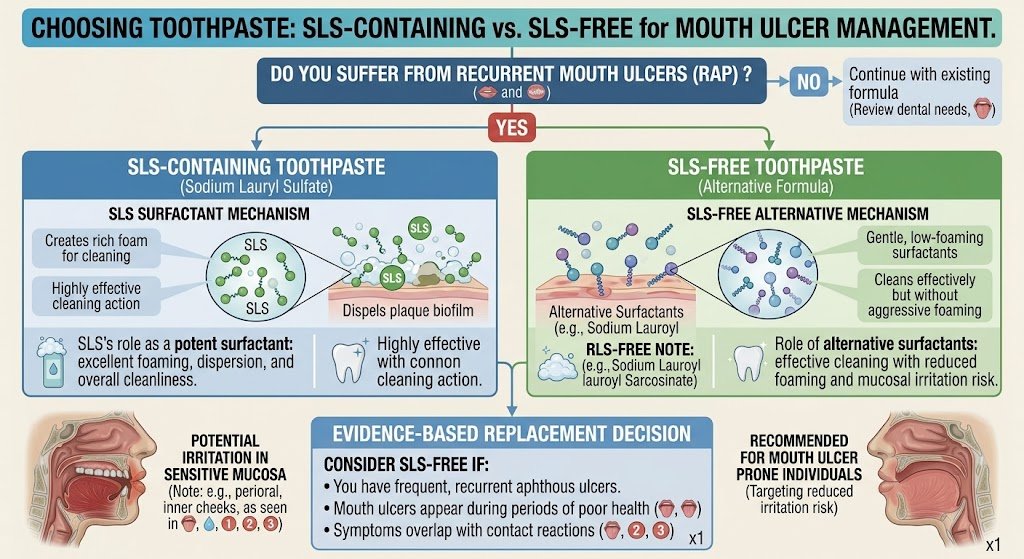
One ingredient that deserves particular attention is sodium lauryl sulfate (SLS), a foaming agent used in many toothpastes. Research has investigated whether removing SLS from toothpaste can benefit people who experience recurrent aphthous ulcers.
However, it would be inaccurate to say that SLS causes all mouth ulcers. Mouth ulcers have many possible causes, and a toothpaste-related issue is only one possibility.
A toothpaste can also cause irritation or a contact reaction without being the underlying cause of a typical canker sore. Flavoring ingredients, for example, can cause reactions involving the lips and oral tissues in some people.
The most useful approach is therefore not to assume that toothpaste is responsible. Instead, look for a repeatable pattern, compare ingredient lists, and consider whether a simpler or SLS-free formula is worth trying while maintaining appropriate oral care.
Can SLS in Toothpaste Make Mouth Ulcers Worse?
What Is SLS?
Sodium lauryl sulfate (SLS) is a surfactant, or detergent-like ingredient, commonly used in personal-care products. In toothpaste, it helps distribute the formula and contributes to the foaming sensation many people associate with brushing.
Foam itself does not determine whether a toothpaste cleans your teeth effectively. The more important question for someone with recurring ulcers is whether a particular formula causes or worsens oral discomfort.
SLS has received particular attention in research involving recurrent aphthous stomatitis (RAS), the clinical term often used for recurring canker sores.
What Does the Research Say?
Clinical research has compared SLS-containing and SLS-free toothpastes in people with recurrent aphthous ulcers.
A systematic review found that SLS-free dentifrice was associated with reductions in some ulcer-related outcomes, including ulcer number, duration, episodes, and pain, compared with SLS-containing dentifrice. However, the review also concluded that more well-designed studies were needed. PubMed systematic review on SLS-free dentifrice and recurrent aphthous stomatitis
That distinction matters.
The evidence provides a reason for someone with recurrent aphthous ulcers to consider trying an SLS-free toothpaste. It does not prove that SLS is the cause of every mouth ulcer, nor does it mean that everyone needs to avoid SLS.
The response can also vary from person to person. If your ulcers continue despite changing toothpaste, another trigger may be involved.
Does Everyone With Mouth Ulcers Need SLS-Free Toothpaste?
No.
An SLS-free formula is best viewed as a reasonable option to consider, particularly when ulcers recur and you suspect your toothpaste may be contributing to irritation.
If you decide to try one, avoid changing several parts of your oral-care routine at the same time. Otherwise, it becomes harder to determine what actually made a difference.
You should also continue considering your normal dental needs. For example, switching from an SLS-containing toothpaste to an SLS-free toothpaste does not automatically mean you need to give up fluoride.
What Other Toothpaste Ingredients May Irritate the Mouth?
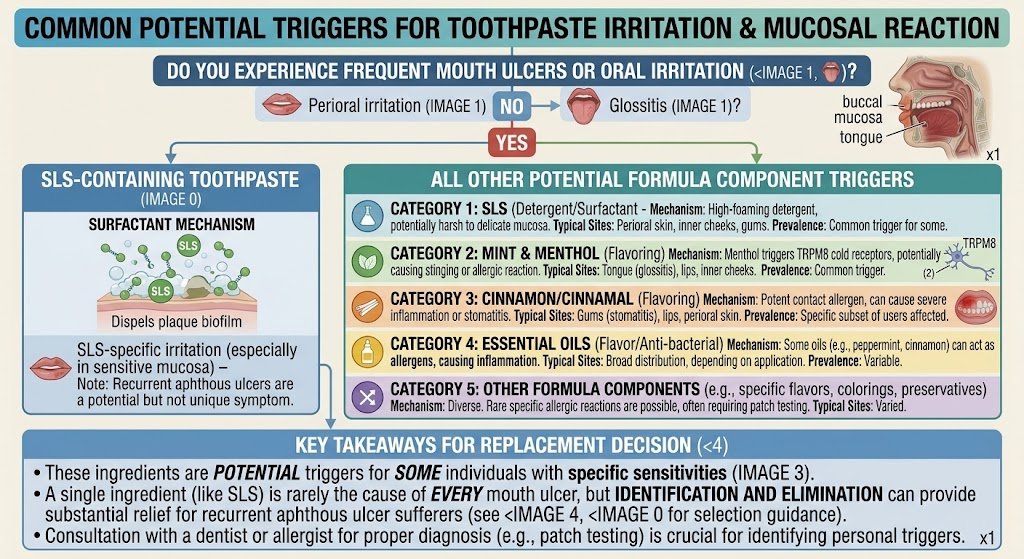
SLS is not the only ingredient worth considering.
If you repeatedly develop mouth soreness, burning, peeling, or ulcer-like symptoms, look beyond one ingredient and compare the entire toothpaste formula.
Strong Mint and Menthol
Mint flavors are common in toothpaste. Peppermint, spearmint, menthol, and related flavor compounds can contribute to a strong cooling or burning sensation.
A strong sensation does not automatically mean that an ingredient is harmful. But if a particular toothpaste consistently causes burning or irritation, its flavor system is worth examining.
Peppermint and Spearmint
Peppermint and spearmint are frequently used to give toothpaste its fresh taste.
For most people, these flavors are well tolerated. However, flavoring substances can cause irritation or allergic contact reactions in susceptible individuals.
This is one reason a “natural” toothpaste is not automatically a better choice for someone with mouth sensitivity. A natural formula can still contain concentrated essential oils or strong botanical flavorings.
Cinnamon and Cinnamal
Cinnamon-related flavoring compounds are another category worth checking when investigating toothpaste-related oral reactions.
If a toothpaste contains cinnamon flavoring and symptoms consistently occur while using that formula, comparing it with a toothpaste that uses a different flavor system can be useful.
Essential Oils and Other Flavoring Agents
Toothpaste can contain numerous flavoring substances. These may be listed individually or represented more generally in the ingredient declaration.
DermNet identifies flavorings as an important source of potential allergic contact reactions associated with toothpaste and other oral-hygiene products. DermNet: Contact reactions to toothpaste and other oral hygiene products
Possible symptoms of a toothpaste-related contact reaction can include irritation, redness, swelling, soreness, peeling, or inflammation involving the lips and oral tissues.
Pyrophosphates and Other Ingredients
Some toothpastes contain pyrophosphates and other ingredients designed for specific purposes, such as helping control tartar.
These ingredients should not automatically be considered causes of mouth ulcers. The point is to recognize that toothpaste formulas differ substantially, and a reaction may be related to an ingredient other than SLS.
The American Dental Association also notes that toothpaste ingredients can rarely cause irritation or allergic reactions in some individuals. American Dental Association toothpaste guidance
The practical lesson is simple: don’t focus on the front of the toothpaste box alone. If you are investigating recurring symptoms, compare the actual ingredient lists.
Mouth Ulcer vs Toothpaste Allergy: What’s the Difference?
A mouth ulcer and a toothpaste-related allergic reaction are not necessarily the same thing.
The terms can overlap in everyday conversation because both situations may involve pain, redness, soreness, or visible changes inside the mouth. But they represent different processes.
| Situation | What it means | What may be noticed |
| Canker sore | A localized ulcer of the oral tissue | Painful round or oval sore |
| Irritation | Tissue reacts to an irritating substance | Burning, soreness, redness, discomfort |
| Contact reaction | A reaction caused by contact with an ingredient | Swelling, redness, soreness, peeling or inflammation |
| Allergic contact reaction | An immune-mediated response after sensitization | Itching, swelling, redness, inflammation or other contact-reaction symptoms |
| Recurrent aphthous stomatitis | Repeated episodes of aphthous ulcers | Recurring painful ulcers inside the mouth |
A toothpaste-related allergic or contact reaction can sometimes produce ulceration or other oral changes, but not every ulcer indicates an allergy.
This distinction is important because removing every ingredient associated with a possible reaction can unnecessarily make toothpaste selection more difficult.
If you suspect a genuine toothpaste allergy, professional assessment may be more useful than repeatedly changing products on your own.
How Can You Tell If Your Toothpaste Is Contributing to Your Ulcers?
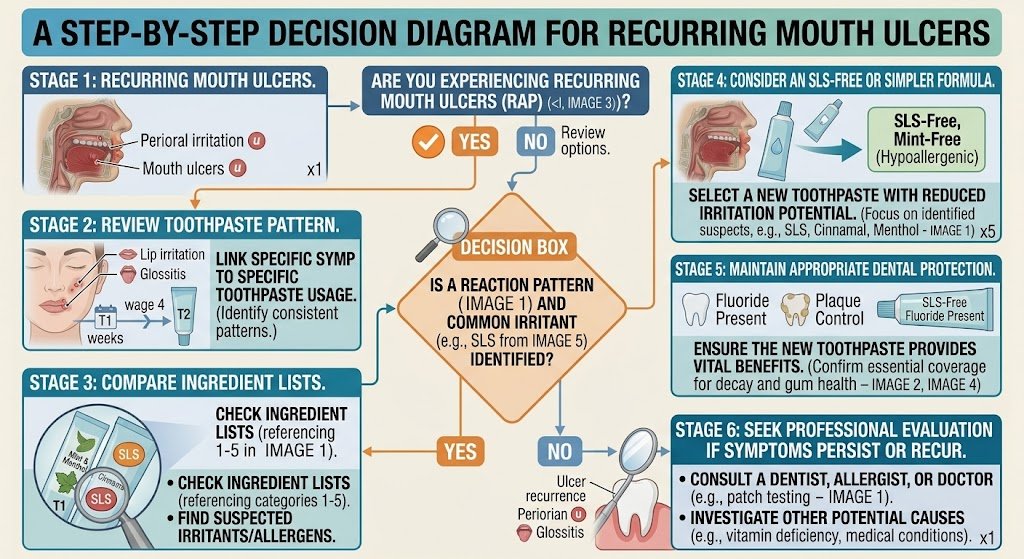
There is no reliable way to diagnose the cause of a mouth ulcer simply by looking at it. But you can look for useful patterns that help you decide whether your toothpaste deserves attention.
Look for a Repeating Pattern
Ask yourself:
- Do ulcers repeatedly appear while using the same toothpaste?
- Did the problem begin after switching formulas?
- Does brushing with the toothpaste consistently cause burning or irritation?
- Do symptoms improve after using a different formula?
- Do the same symptoms return when the original product is used again?
A pattern does not prove causation, but it can provide a useful clue.
Check the Ingredient List
Don’t only look for the words “natural,” “clean,” or “gentle” on the front of the package.
Look at the actual ingredient list and compare your current toothpaste with products you previously tolerated.
Pay particular attention to:
- SLS
- flavoring ingredients
- mint or menthol
- cinnamon-related flavorings
- essential oils
- other ingredients that differ between the formulas
Compare Your Old and New Toothpaste
If you recently changed toothpaste, compare both ingredient lists.
For example, imagine that your previous toothpaste was SLS-free with a mild flavor, while your new toothpaste contains SLS and several strong flavoring ingredients. That difference gives you several possible variables to investigate.
It still does not prove which ingredient is responsible.
Change One Major Variable at a Time
If you switch toothpaste, mouthwash, whitening products, and other oral-care products simultaneously, you may improve your symptoms without knowing what caused the change.
A more controlled approach is to simplify the routine and change one major product at a time when practical.
For suspected allergies or persistent reactions, however, professional testing may be more appropriate than repeated self-experimentation.
Use an Ingredient Tool When Helpful
An ingredient checker can make comparisons easier, particularly when formulas contain many unfamiliar names.
The goal is not to eliminate every unfamiliar ingredient. It is to identify meaningful differences between products and make a more informed decision.
Should You Switch to SLS-Free Toothpaste?
If you experience recurring canker sores and suspect your toothpaste may be contributing to the problem, trying an SLS-free toothpaste is a reasonable option to discuss or consider.
The evidence is most relevant to people with recurrent aphthous ulcers, rather than every type of oral lesion.
A switch may be especially worth considering when:
- your ulcers recur frequently
- your current toothpaste contains SLS
- brushing seems to aggravate oral discomfort
- you have noticed sensitivity to your current formula
- you want to simplify your toothpaste ingredients
But an SLS-free label should not be treated as a guarantee.
Different SLS-free toothpastes can still contain different flavorings, essential oils, active ingredients, and other components. If flavoring is your actual trigger, simply removing SLS may not solve the problem.
That is why SLS status is one selection factor, not the entire decision.
If you are comparing products on Amazon, use the ingredient list and product label as the basis for comparison rather than relying only on marketing language. Product formulas can change, so check the current packaging or manufacturer information before purchasing.
Should You Use Fluoride-Free Toothpaste If You Get Mouth Ulcers?
Not necessarily.
This is one of the easiest mistakes to make when searching for a gentler toothpaste. Someone may decide that because SLS is a concern, the entire formula should be stripped down, including fluoride.
But SLS-free and fluoride-free are separate characteristics.
Fluoride is an active ingredient used to help prevent dental caries. If your goal is to find a toothpaste that is easier on your mouth, you can look for a formula that addresses your suspected trigger while still meeting your cavity-prevention needs.
For many people, that may mean considering an SLS-free fluoride toothpaste, rather than automatically choosing fluoride-free.
The right choice depends on your individual oral-health situation and professional advice.
If you specifically want to understand fluoride-free options, your decision should be based on more than the presence or absence of SLS.
The key takeaway is:
If mouth ulcers are your concern, removing SLS does not automatically require removing fluoride.
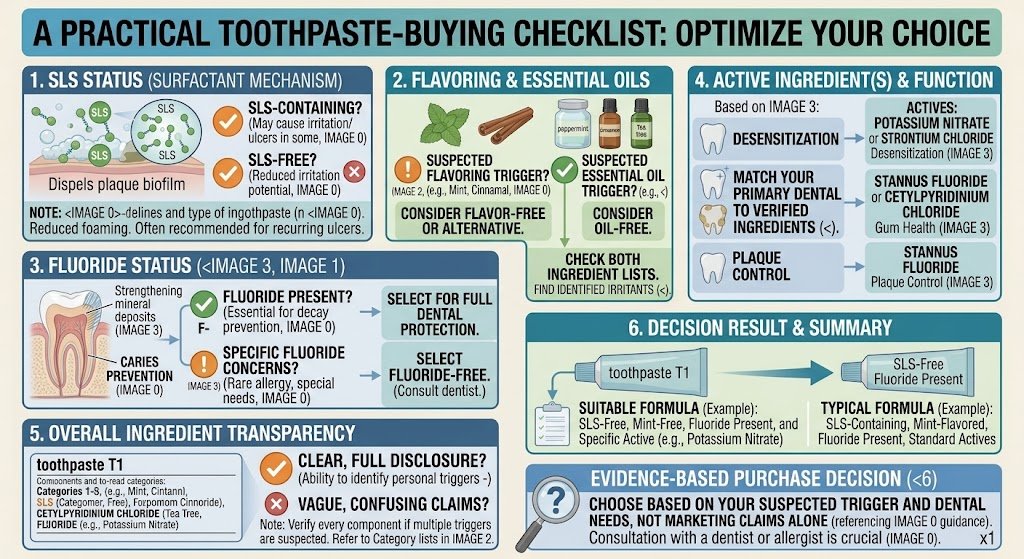
How to Choose a Toothpaste for Frequent Mouth Ulcers
Once you understand the possible triggers, choosing a replacement becomes much easier.
Instead of looking for a toothpaste advertised as “ulcer-proof” or “allergy-safe,” compare the characteristics that actually matter to you.
Start With SLS Status
If you experience recurring aphthous ulcers, an SLS-free formula may be worth trying based on the available evidence.
But check the full ingredient list rather than assuming every SLS-free toothpaste is otherwise similar.
Check the Flavoring Ingredients
If your mouth reacts badly to strong mint, cinnamon, or other flavoring ingredients, choosing a different flavor system may be more useful than focusing exclusively on SLS.
A milder flavor may also make brushing more comfortable when your mouth is already irritated.
Consider a Simpler Formula
A simpler ingredient list can make it easier to compare products and identify differences between formulas.
“Simpler,” however, does not automatically mean “better.” A toothpaste still needs to serve its intended dental purpose.
Don’t Assume Natural Means Better
Natural toothpastes can contain essential oils, botanical extracts, and concentrated flavoring ingredients.
These may be perfectly acceptable for many users but can still be relevant if you have a specific sensitivity or contact reaction.
So compare ingredients, not marketing labels.
Keep Appropriate Fluoride Protection in Mind
If you use fluoride toothpaste for cavity prevention, don’t remove fluoride solely because you are trying to avoid SLS.
Instead, look for products that satisfy both priorities when appropriate:
suspected trigger avoidance + suitable dental protection
Compare the Full Ingredient List
Before buying, check:
- Does it contain SLS?
- What flavoring ingredients does it use?
- Does it contain essential oils?
- Does it contain fluoride?
- What is its active ingredient?
- Is the formula substantially different from the toothpaste you currently use?
- Does it match your dental needs?
If you are considering Amazon products, these criteria are more useful than choosing solely from star ratings or phrases such as “natural,” “clean,” or “non-toxic.”
What If Changing Toothpaste Doesn’t Stop Your Mouth Ulcers?
If your ulcers continue after switching toothpaste, don’t assume that you simply haven’t found the “right” toothpaste yet.
Mouth ulcers can have many possible contributors, including:
- minor trauma or cheek biting
- stress
- certain foods or dietary factors
- nutritional deficiencies
- medications
- hormonal changes
- certain medical conditions
- other oral or systemic factors
This is why recurring ulcers deserve a broader view.
A toothpaste change may be useful as one practical step, particularly when there is a clear relationship between a product and your symptoms. But persistent or frequent ulcers may require evaluation for other causes.
The same principle applies if you develop symptoms that don’t behave like your usual canker sores. A recurring problem should not automatically be attributed to an ingredient simply because that ingredient is frequently discussed online.
When Should You See a Dentist or Doctor?
Most ordinary mouth ulcers resolve on their own, but persistent, unusually severe, or frequently recurring lesions deserve professional attention.
Consider speaking with a dentist or doctor if:
- an ulcer lasts longer than three weeks
- ulcers keep returning
- the sores are unusually large or painful
- you have difficulty eating or drinking
- you develop significant swelling
- you have many ulcers at once
- the symptoms are different from your usual ulcers
- you have other unexplained symptoms
The NHS recommends seeking professional advice for a mouth ulcer that lasts longer than three weeks. NHS mouth ulcer guidance
A dentist can examine the mouth and consider dental or oral causes. A dermatologist or allergist may be useful when a contact allergy is suspected, particularly if symptoms involve the lips or surrounding skin.
Patch testing may sometimes be used when a contact allergy is suspected, but the appropriate evaluation depends on the symptoms and clinical situation.
If you develop severe swelling of the tongue or throat, difficulty breathing or swallowing, fainting, or a rapidly worsening severe reaction, seek emergency medical care rather than trying to identify the toothpaste ingredient yourself.
Frequently Asked Questions
Can toothpaste cause mouth ulcers?
Toothpaste can contribute to oral irritation and may be relevant to recurrent ulcers in some people, but it is not the cause of every mouth ulcer. SLS has been studied in people with recurrent aphthous ulcers, and some evidence suggests that SLS-free toothpaste may improve certain ulcer-related outcomes. Other toothpaste ingredients, particularly flavorings, can also cause irritation or contact reactions in susceptible people.
Can SLS make mouth ulcers worse?
SLS may worsen some ulcer-related symptoms in people who experience recurrent aphthous ulcers. Research comparing SLS-containing and SLS-free toothpaste has found potential benefits from SLS-free formulations, including improvements in some measures of ulcer severity and recurrence. However, this does not mean SLS causes every mouth ulcer or that everyone needs to avoid it.
Is SLS-free toothpaste better for canker sores?
SLS-free toothpaste may be worth trying if you experience recurrent canker sores, especially if your current toothpaste contains SLS. Evidence suggests potential benefits for recurrent aphthous ulcers, but results are not guaranteed. If changing to an SLS-free formula does not help, another cause or another ingredient may be involved.
Should I use fluoride-free toothpaste for mouth ulcers?
Not automatically. SLS-free and fluoride-free are separate choices. If you need or prefer fluoride toothpaste for cavity prevention, you can look for an SLS-free fluoride formula instead of removing fluoride simply because you are investigating mouth ulcers. Your individual dental needs should guide the decision.
What toothpaste ingredients can irritate mouth ulcers?
SLS is one ingredient that has been studied in relation to recurrent aphthous ulcers. Strong flavoring ingredients, including some mint, menthol, and cinnamon-related compounds, may also irritate or trigger contact reactions in susceptible people. The right ingredient to avoid depends on the individual’s symptoms and suspected trigger.
Can mint toothpaste cause mouth irritation?
Mint flavoring does not cause irritation for everyone, but flavoring substances can trigger irritation or allergic contact reactions in some people. If a strong mint toothpaste consistently causes burning, soreness, or other symptoms, comparing it with a milder formula using a different flavor system may be reasonable.
How long should a mouth ulcer last?
Many ordinary mouth ulcers heal without treatment, but a persistent ulcer should not simply be attributed to toothpaste. The NHS recommends seeking professional advice when a mouth ulcer lasts longer than three weeks. Persistent, severe, or frequently recurring ulcers should be evaluated by an appropriate healthcare professional.
What should I do if my mouth ulcers keep coming back?
Look for patterns in your oral-care products, compare toothpaste ingredient lists, and consider whether an SLS-free or simpler formula is worth trying. At the same time, remember that recurrent ulcers can have causes unrelated to toothpaste. If the ulcers continue, are severe, or repeatedly return, speak with a dentist or doctor rather than continuing to change products indefinitely.
Bottom Line
The relationship between toothpaste and mouth ulcers is worth considering, particularly if you experience recurrent canker sores or notice that a specific toothpaste consistently makes your mouth uncomfortable.
SLS is the ingredient with some of the clearest research relevance to recurrent aphthous ulcers, and trying an SLS-free toothpaste may be reasonable for some people. But SLS is not proven to be the cause of every mouth ulcer, and other ingredients—especially certain flavoring substances—can also be relevant.
If you change toothpaste, compare the full ingredient list rather than relying on terms such as “natural” or “clean.” And don’t automatically switch to fluoride-free toothpaste simply because you want to avoid SLS.
The best replacement is one that avoids your suspected trigger while still meeting your oral-health needs.
For broader product-selection guidance, you can continue to:
Affiliate Disclosure: This article may contain affiliate links. If you purchase through one of these links, we may earn a commission at no additional cost to you. Our recommendations are based on the product attributes and selection criteria discussed in the article, not on guaranteed results.
