Dental fluorosis is a change in the appearance of tooth enamel that can happen when a child takes in too much fluoride while their teeth are developing. It commonly appears as faint white spots, lines, or patches on teeth. In the United States, most cases are mild and mainly cosmetic rather than painful or damaging to normal tooth function.
If you have noticed white marks on your child’s teeth, it is understandable to wonder whether they are caused by fluoride, tooth decay, or something else. This guide explains what dental fluorosis looks like, what causes it, how toothpaste and drinking water can contribute to fluoride exposure, whether fluorosis is permanent, and what parents can do to reduce the risk.
What Is Dental Fluorosis?
Dental fluorosis is a change in the appearance of developing tooth enamel caused by excessive fluoride intake while the teeth are forming.
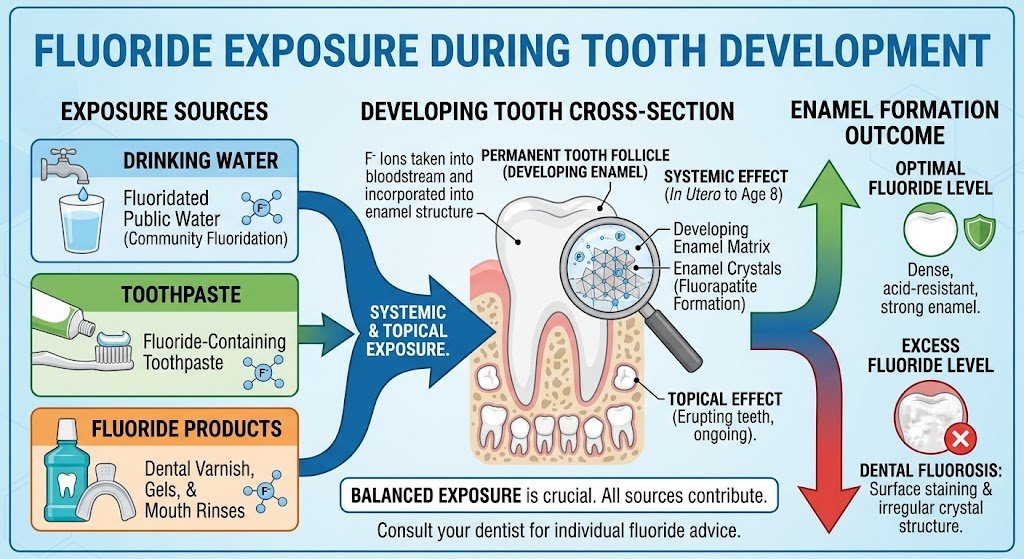
When children’s teeth are developing beneath the gums, fluoride can become incorporated into the enamel. In an appropriate amount, fluoride helps make teeth more resistant to decay. However, too much fluoride during this developmental period can alter how the enamel looks when the teeth eventually appear in the mouth.
Dental fluorosis is therefore closely connected to age and tooth development. It is not something that normally develops simply because an older child or adult uses fluoride toothpaste.
By around age 8, the enamel of the permanent teeth is fully formed, so older children, teenagers, and adults cannot develop new dental fluorosis.
In the United States, dental fluorosis is generally mild. Mild fluorosis may appear as subtle white flecks, spots, or lines and usually does not cause pain or interfere with how the teeth function. Moderate and severe forms are much less common.
What Causes Dental Fluorosis?
The basic cause is excessive fluoride ingestion while teeth are developing.
That does not mean fluoride itself is harmful. Fluoride is widely used to prevent cavities, and appropriate fluoride exposure is an important part of oral health. The concern with fluorosis is getting more fluoride than is appropriate during the period when developing teeth are particularly susceptible.
Fluoride During Tooth Development
Children can receive fluoride from several sources. The total amount matters rather than looking at only one source.
Potential sources include:
- Fluoride toothpaste
- Fluoridated tap water
- Some bottled water
- Fluoride supplements
- Fluoride mouth rinses
- Professionally recommended fluoride products
A child who uses fluoride toothpaste appropriately is not automatically at risk of fluorosis. The concern is excessive ingestion, particularly when multiple fluoride sources are combined during tooth development.
Why Children Are More Susceptible
Young children are more likely to swallow toothpaste rather than spit it out completely. They may also have fluoride exposure from drinking water or other products.
For this reason, parents and caregivers should pay attention to the amount of toothpaste used, supervision, and the child’s overall fluoride exposure.
The American Dental Association and CDC recommend using only a small amount of fluoride toothpaste for young children and supervising brushing.
What Does Dental Fluorosis Look Like?
Dental fluorosis can look different depending on how much fluoride exposure occurred while the teeth were developing.
Mild fluorosis may appear as:
- Small white flecks
- Thin white lines
- Faint white patches
- Slight differences in enamel appearance
More noticeable fluorosis can involve larger areas of enamel. In more severe cases, enamel may develop staining or pitting. The American Dental Association describes the appearance of fluorosis as ranging from white striations to stained pitting of enamel.
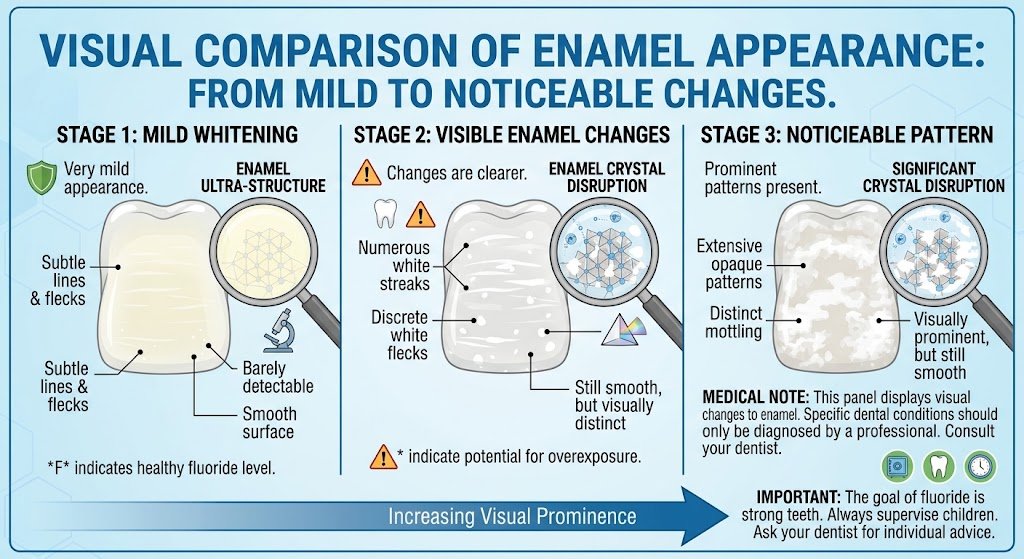
It is important not to diagnose fluorosis based only on a photograph or a description of white spots. Other conditions can also change the color or appearance of children’s teeth.
CDC notes that tooth discoloration can have other causes, including early childhood illness, certain medications, dental infections involving baby teeth, facial trauma, and genetics.
If you are unsure why your child’s teeth have white marks, a dentist can evaluate the pattern, location, tooth development history, and other relevant factors.
Mild, Moderate, and Severe Dental Fluorosis
Dental fluorosis exists on a spectrum.
| General severity | Possible appearance | Main concern |
| Mild | Small white flecks, spots, or lines | Usually cosmetic |
| Moderate | More noticeable enamel changes | Mainly appearance, depending on severity |
| Severe | Extensive enamel changes, staining, or pitting | May involve more significant enamel changes |
These descriptions are useful for understanding the general difference in appearance, but they should not be used as a home diagnostic system.
In the United States, most dental fluorosis is mild and cosmetic. CDC reports that moderate and severe forms are rare.
If your child’s teeth have extensive discoloration, pits, unusual enamel texture, or other changes, professional evaluation is more useful than trying to determine severity at home.
Does Dental Fluorosis Hurt or Damage Teeth?
Most mild dental fluorosis in the United States is not painful and does not affect normal tooth function. Its primary effect is usually the appearance of the enamel.
This is an important distinction because parents sometimes see white marks and immediately assume that their child’s teeth are being damaged by fluoride.
Fluoride has an important role in preventing tooth decay. The issue with dental fluorosis is excessive fluoride ingestion during tooth development, not ordinary appropriate fluoride use.
Severe enamel changes are different and should be evaluated by a dentist.
Also, pain is not something to ignore. If a child has tooth pain, sensitivity, swelling, a visible cavity, or another sudden change, the cause may be something other than fluorosis.
Dental Fluorosis vs Tooth Decay: What’s the Difference?
Dental fluorosis and tooth decay are different conditions, even though both can affect the appearance of teeth.
| Dental fluorosis | Tooth decay |
| Develops while teeth are forming | Develops through the tooth-decay process |
| Related to excessive fluoride ingestion during development | Involves acids produced by bacteria and other factors |
| Often appears as white markings in mild cases | Can produce white, brown, or darker areas as decay progresses |
| Mild cases are usually cosmetic | Can progress into cavities and cause pain |
| Does not develop as a new condition after tooth development is complete | Can occur in erupted teeth |
The distinction is important because a parent might see a white area and assume it is fluorosis when it could represent an early dental problem.
Fluoride actually helps prevent and control dental caries. The American Dental Association recognizes fluoride as an effective cavity-prevention agent when used appropriately.
So, if a white spot has appeared recently or you are unsure what caused it, it is better to have a dentist examine it rather than assuming it is fluorosis.
Can Swallowing Toothpaste Cause Dental Fluorosis?
Yes, repeated excessive ingestion of fluoride toothpaste while teeth are developing can contribute to dental fluorosis.
Young children naturally have more difficulty controlling toothpaste. Some may swallow it while brushing, especially if they like the flavor.
That is why the amount placed on the toothbrush matters.
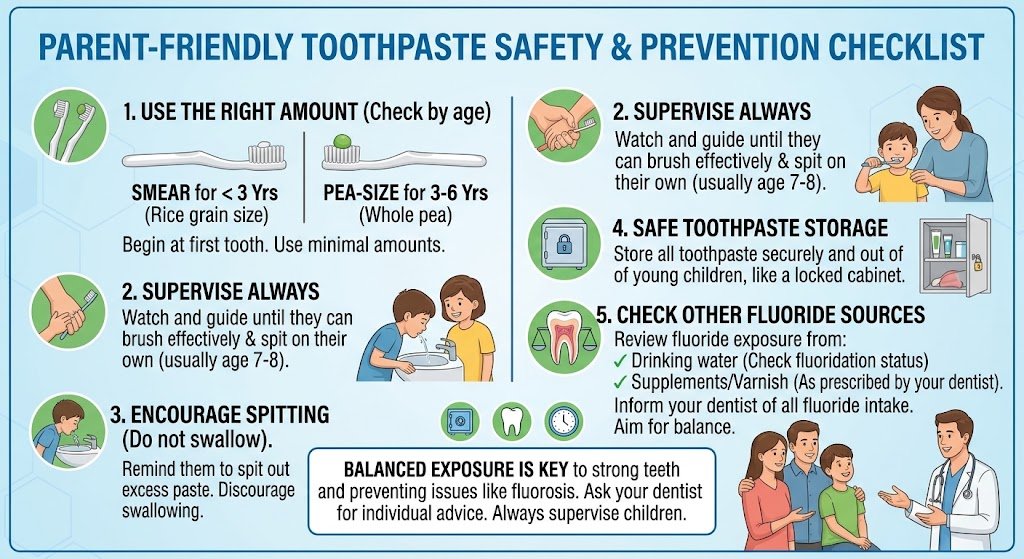
For children younger than 3, CDC recommends no more than a smear about the size of a grain of rice. For children ages 3 to 6, no more than a pea-sized amount should be used. Parents should supervise children and teach them to spit out the toothpaste rather than swallow it.
A small accidental swallow is not the same thing as developing dental fluorosis. Fluorosis is associated with excessive fluoride ingestion during the period when teeth are developing.
The practical goal is therefore not to make parents afraid of every accidental swallow. It is to reduce unnecessary fluoride ingestion by using the appropriate toothpaste amount and supervising young children.
Can Drinking Water Cause Dental Fluorosis?
Drinking water can contribute to a child’s total fluoride exposure.
Fluoride occurs naturally in water, and community water systems may also adjust fluoride levels to help prevent tooth decay. Bottled water, tap water, and private well water can have different fluoride concentrations.
This matters particularly for children under 8 because their permanent teeth are still developing.
If you are unsure about the fluoride level in your child’s drinking water, CDC recommends checking the appropriate water source. For tap water, parents can contact their water provider. Well-water users may need laboratory testing, while bottled-water users can check information from the manufacturer.
Parents should also tell their dentist or pediatrician about the child’s different fluoride sources before using fluoride supplements. Fluoride supplements are not something parents should start independently.
The American Dental Association notes that fluoride supplementation for children depends on factors including drinking-water fluoride levels, age, other fluoride sources, and cavity risk.
Can Adults Get Dental Fluorosis?
Adults cannot develop new dental fluorosis after their permanent tooth enamel has finished forming.
Dental fluorosis occurs during tooth development. CDC explains that by about age 8, the enamel of permanent teeth is fully formed, so older children, teenagers, and adults cannot develop dental fluorosis.
This distinction can be helpful when an adult notices white areas on their teeth.
A white mark that appears later in life should not automatically be called fluorosis. Other causes of tooth discoloration or enamel changes may need to be considered.
If the cause is uncertain, a dentist can evaluate the teeth and determine whether the appearance is consistent with fluorosis or another condition.
Is Dental Fluorosis Permanent?
The enamel changes associated with dental fluorosis do not simply disappear because fluoride exposure stops.
That is because fluorosis occurs while the enamel is developing. Once the tooth has formed and erupted, stopping fluoride exposure does not cause the enamel to grow back into its original form.
However, the appearance of fluorosis can sometimes be managed for cosmetic reasons.
Whether treatment is appropriate depends on:
- How noticeable the changes are
- How extensive they are
- Whether there is staining or pitting
- The person’s age
- Overall tooth health
- The individual’s cosmetic concerns
Mild fluorosis often does not require treatment because it is primarily a cosmetic change.
If appearance is a concern, a dentist can explain appropriate options rather than relying on whitening products, supplements, or home remedies that claim to “reverse” fluorosis.
How Is Dental Fluorosis Treated?
Treatment depends largely on the severity and the reason the person wants treatment.
Does Mild Fluorosis Need Treatment?
Often, mild fluorosis does not require treatment from a health standpoint.
If the enamel changes are very subtle and the teeth function normally, the decision may simply be whether the person wants cosmetic improvement.
For a child, it is especially important to first confirm that the white areas actually represent fluorosis.
Cosmetic Dental Options
When fluorosis is more noticeable, a dentist may discuss cosmetic approaches based on the individual appearance of the teeth.
The appropriate option can vary depending on whether the teeth have:
- Minor white markings
- More extensive discoloration
- Surface irregularities
- Staining
- Pitting
The article should not recommend a single treatment for everyone because treatment depends on the actual condition of the enamel.
When Professional Evaluation Matters
A dental evaluation is particularly useful when:
- You are unsure whether the marks are fluorosis.
- The teeth have pits or significant enamel changes.
- The child has pain or sensitivity.
- The appearance is changing.
- There are signs that could indicate tooth decay.
- You are considering cosmetic treatment.
Do not rely on an online article to diagnose the cause of a child’s tooth discoloration.
How to Prevent Dental Fluorosis in Children
The goal is appropriate fluoride exposure, not avoiding fluoride completely.
Fluoride helps protect teeth from cavities, while excessive ingestion during tooth development can increase the risk of fluorosis. Good prevention therefore focuses on using fluoride products correctly.
1. Use the right amount of toothpaste
For children younger than 3, use no more than a rice-grain-sized smear.
For children ages 3 to 6, use no more than a pea-sized amount.
2. Supervise brushing
Young children may not understand that toothpaste should be spit out rather than swallowed.
CDC recommends that parents watch young children brush and help them develop proper brushing skills.
3. Store toothpaste safely
Do not leave toothpaste somewhere a young child can freely squeeze and swallow large amounts.
The ADA also recommends storing toothpaste where young children cannot access it without parental assistance.
4. Consider all fluoride sources
Look beyond toothpaste.
Consider:
- Drinking water
- Bottled water
- Well water
- Fluoride mouth rinse
- Supplements
- Professionally applied fluoride
If you are concerned about the total amount of fluoride your child receives, discuss it with a dentist or pediatrician.
5. Do not start fluoride supplements on your own
Supplement decisions depend on the child’s age, cavity risk, water fluoride concentration, and other fluoride exposure.
The AAPD states that fluoride recommendations for children should take these factors into account.
Should You Stop Using Fluoride Toothpaste Because of Fluorosis?
Not automatically.
This is one of the most important points for parents.
Seeing or worrying about dental fluorosis does not mean that fluoride toothpaste is inherently harmful or that every child should switch to fluoride-free toothpaste.
Fluoride has a well-established role in preventing tooth decay. The ADA recognizes fluoride as safe and effective when used as directed, and the AAPD recommends appropriate fluoride toothpaste use for children.
The practical concern is excessive ingestion, especially during tooth development.
Instead of making an automatic switch, consider:
- Your child’s age
- How much toothpaste is being used
- Whether the child swallows toothpaste
- Drinking-water fluoride
- Other fluoride products
- The child’s cavity risk
- Advice from the child’s dentist
For children younger than 2, CDC recommends consulting a doctor or dentist about fluoride toothpaste and other fluoride products.
The better question is usually not “Is fluoride good or bad?” but rather:
Is my child getting an appropriate amount of fluoride for their age and individual oral-health needs?
That is a question a dental professional can answer in the context of the child’s complete fluoride exposure and cavity risk.
Choosing a Children’s Toothbrush and Toothpaste
Once the focus shifts from worrying about fluorosis to managing fluoride correctly, simple oral-care tools can make the routine easier.
A children’s toothbrush should generally be appropriate for the child’s age and mouth size, with soft bristles and a design that allows the parent and child to control brushing comfortably.
When choosing children’s oral-care products, consider:
| Feature | Why it matters |
| Age suitability | Helps match the product to the child’s stage |
| Small brush head | Makes reaching children’s teeth easier |
| Soft bristles | Appropriate for gentle brushing |
| Easy grip | Helps children learn brushing skills |
| Parent-friendly design | Makes supervision easier |
| Clear toothpaste information | Helps parents identify fluoride and follow directions |
The product itself should not be presented as a treatment or cure for dental fluorosis.
The goal is simply to make proper brushing, supervision, and toothpaste control easier.
If you are shopping for a children’s toothbrush or a toothpaste-dosing product, compare products based on age suitability, brush design, ease of use, and clear instructions rather than claims that a product can prevent or reverse fluorosis.
Affiliate CTA opportunity: If you need a child-friendly toothbrush or a product that helps make toothpaste dosing easier, compare current age-appropriate options on Amazon based on the features above rather than choosing solely by brand or marketing claims.
Common Mistakes Parents Make
Using too much toothpaste
More toothpaste does not automatically mean better cleaning.
Young children need only a small amount. Using more increases the amount available to swallow.
Letting young children brush completely unsupervised
Children may squeeze extra toothpaste onto the brush or swallow it instead of spitting.
Supervision helps control both the amount used and the brushing routine.
Assuming every white spot is fluorosis
White spots can have multiple causes.
If you are unsure, have a dentist evaluate them instead of trying to diagnose the condition yourself.
Immediately switching to fluoride-free toothpaste
Concern about fluorosis should not automatically lead to removing fluoride from a child’s oral-care routine.
Fluoride is also an important tool for preventing cavities.
Ignoring drinking water
Toothpaste is only one potential source of fluoride.
Tap water, well water, bottled water, and supplements may also contribute to total exposure.
Trying unproven home remedies
Do not rely on products or home remedies claiming to “remove,” “detox,” or “cure” dental fluorosis without appropriate dental evidence.
If appearance is a concern, professional evaluation is the safer starting point.
Frequently Asked Questions About Dental Fluorosis
What is dental fluorosis?
Dental fluorosis is a change in tooth enamel that can occur when a child consumes too much fluoride while the teeth are developing. Mild cases commonly appear as white flecks, spots, or lines and are usually cosmetic.
What causes dental fluorosis?
The underlying cause is excessive fluoride ingestion during tooth development. Possible sources include fluoride toothpaste, drinking water, supplements, and other fluoride-containing products. The total exposure matters.
What does dental fluorosis look like?
Mild fluorosis may appear as faint white lines, spots, or flecks. More severe fluorosis can involve more extensive enamel changes, staining, or pitting. Not every white mark is fluorosis, so uncertain cases should be evaluated by a dentist.
Is dental fluorosis harmful?
Most dental fluorosis in the United States is mild and cosmetic and does not cause pain or interfere with tooth function. Moderate and severe forms are uncommon.
Can swallowing toothpaste cause dental fluorosis?
Repeated excessive ingestion of fluoride toothpaste while teeth are developing can contribute to fluorosis. Using the recommended amount and supervising young children helps reduce unnecessary ingestion.
Can adults develop dental fluorosis?
Adults cannot develop new dental fluorosis after permanent tooth enamel has finished forming. CDC states that by about age 8, the enamel of permanent teeth is fully formed.
Does dental fluorosis go away?
The enamel changes caused by fluorosis do not simply disappear when fluoride exposure stops. However, mild fluorosis may not require treatment, and cosmetic management may be possible when the appearance is a concern.
Should I stop using fluoride toothpaste if my child has fluorosis?
Not automatically. Fluoride helps prevent cavities, and the appropriate approach depends on the child’s age, fluoride exposure, cavity risk, and dental history. Discuss significant concerns with the child’s dentist rather than making a major change based only on the appearance of white spots.
Can dental fluorosis be treated?
Treatment depends on the severity and appearance of the teeth. Mild fluorosis may not require treatment. If cosmetic changes are significant, a dentist can discuss appropriate options after confirming that the condition is actually fluorosis.
Bottom Line
Dental fluorosis is a developmental change in tooth enamel associated with excessive fluoride ingestion while teeth are forming. In the United States, most cases are mild and mainly cosmetic.
For parents, the practical goal is not to fear fluoride but to use it appropriately. Use the recommended amount of children’s toothpaste, supervise brushing, teach children to spit rather than swallow, and consider all relevant fluoride sources, including drinking water and supplements.
If your child has white spots, lines, discoloration, pits, or other unusual enamel changes, do not assume they are fluorosis. A dentist can determine what is causing the appearance and whether any treatment is necessary.
