Yes, toothpaste can cause an allergic or contact reaction in some people, although not every reaction to toothpaste is a true allergy.
If your lips become itchy or swollen, your mouth starts burning, or your gums, tongue, or skin around your mouth become irritated after brushing, toothpaste may be one possible cause. Flavoring agents, certain surfactants, preservatives, and other ingredients can trigger reactions in susceptible people.
The important part is figuring out whether you are dealing with an allergy, simple irritation, or another oral-health problem. This guide explains what toothpaste allergy can look like, which ingredients may be involved, how to investigate a suspected reaction, and what to look for when choosing a replacement toothpaste.
Can Toothpaste Really Cause Allergies?
Yes. Some ingredients used in toothpaste have been reported to cause allergic or contact reactions.
Toothpaste is a mixture of several different ingredients. Depending on the formula, it may contain fluoride, abrasives, detergents, humectants, sweeteners, preservatives, flavoring agents, and other ingredients.
The American Dental Association notes that some toothpaste ingredients have been reported as allergens or contact irritants. These include certain essential oils, fragrance, menthol, sodium lauryl sulfate (SLS), propylene glycol, polyethylene glycol (PEG) compounds, cocamidopropyl betaine, parabens, and pyrophosphates.
However, this does not mean that these ingredients will cause an allergic reaction in everyone who uses them.
Toothpaste contact reactions are considered uncommon, especially considering how frequently toothpaste is used. Flavoring agents are an important group to consider because substances such as peppermint, spearmint, menthol, and cinnamal have been reported in toothpaste-related contact reactions.
There is also an important distinction between an allergic reaction and an irritant reaction.
An allergy involves an immune response to a substance after sensitization. Irritation, on the other hand, can happen when an ingredient directly bothers the tissues without the same type of immune response.
That means burning or soreness after brushing does not automatically prove that you have a toothpaste allergy.
The goal is to identify the pattern, consider the ingredients involved, and get professional advice when the symptoms are persistent, severe, or difficult to explain.
What Does a Toothpaste Allergy Look Like?
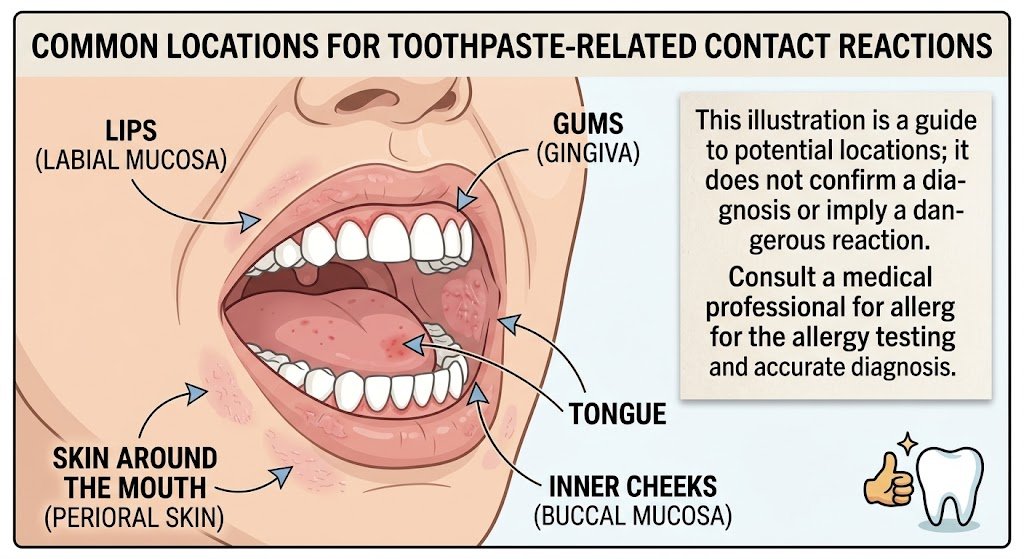
A toothpaste-related allergic or contact reaction can affect the lips, skin around the mouth, or tissues inside the mouth.
Possible symptoms include:
- Itchy lips
- Red or inflamed lips
- Lip swelling
- Dry or peeling lips
- Burning inside the mouth
- Sore or sensitive mouth tissues
- Red or swollen gums
- Tongue irritation
- Peeling or shedding of the surface tissue inside the mouth
- White patches associated with tissue desquamation
- Irritated skin around the mouth
- Repeated discomfort after brushing
The exact symptoms can vary depending on the ingredient involved and where the reaction occurs.
For example, a reaction involving the lips may appear as redness, dryness, itching, or swelling. A reaction inside the mouth may feel more like burning, soreness, or irritation.
DermNet describes toothpaste-related contact reactions involving conditions such as contact cheilitis and contact stomatitis. Flavorings are among the important potential triggers.
A 2026 study examining diagnosed cases of toothpaste-induced contact stomatitis reported findings including white desquamative lesions, redness, and pinpoint hemorrhage. Patients also reported symptoms such as pain, irritation, burning, and swelling.
These symptoms can overlap with other conditions, so they should not be used to diagnose an allergy by themselves.
For example, a sore or burning mouth could have causes unrelated to toothpaste. Similarly, irritated lips could be affected by lip products, foods, environmental exposure, or another personal-care product.
This is why the relationship between the product and the symptoms is often more useful than any single symptom.
If symptoms repeatedly appear after using one toothpaste and improve after that toothpaste is removed, the product becomes a reasonable suspect—but that still does not identify the exact ingredient or prove an allergy.
Toothpaste Allergy vs. Irritation: What’s the Difference?
One of the biggest mistakes people make when researching toothpaste reactions is treating all irritation as an allergy.
The two can look similar, but they are not the same thing.
Allergic Reaction
An allergic contact reaction involves the immune system.
A person becomes sensitized to a particular substance, and later exposure can trigger an inflammatory response.
With toothpaste, this type of reaction can involve the lips, skin around the mouth, or oral tissues.
Possible signs include itching, redness, swelling, soreness, or inflammation. Some reactions may occur after repeated exposure rather than immediately after the first use.
Toothpaste-related allergic contact reactions have been reported with several flavoring substances and other ingredients.
Irritant Reaction
An irritant reaction does not require the same type of immune sensitization.
Instead, an ingredient may directly irritate the skin or oral tissues.
The severity can depend on factors such as the ingredient, concentration, exposure, and the person’s individual sensitivity.
SLS is a useful example. It is a surfactant commonly used in toothpaste, and it can be irritating for some people. That does not mean every person who experiences discomfort from an SLS-containing toothpaste has an SLS allergy.
Why Are They So Easy to Confuse?
Both allergic and irritant reactions can produce similar symptoms:
- Burning
- Redness
- Soreness
- Swelling
- Peeling
- General discomfort
Your symptoms alone may therefore not tell you exactly what is happening.
A healthcare professional may need to consider your history, the timing of symptoms, the products you use, and sometimes additional testing to determine whether a contact allergy is involved.
This distinction is also important when choosing a replacement toothpaste.
If the problem is a particular flavoring, simply switching to an SLS-free toothpaste may not solve it. Likewise, if the problem is irritation from a particular ingredient, labeling the reaction as an “allergy” may cause you to unnecessarily avoid ingredients that you can actually tolerate.
The most useful approach is to identify the suspected trigger rather than treating every toothpaste ingredient as dangerous.
Which Toothpaste Ingredients Can Cause Allergic Reactions?
There is no single ingredient responsible for every toothpaste allergy.
Toothpaste formulas vary, and different people can react to different substances. If you suspect your toothpaste, looking at the complete ingredient list can help you and your healthcare professional investigate possible triggers.
Mint, Menthol, and Other Flavoring Agents
Flavorings deserve particular attention.
Toothpaste needs to taste acceptable, so manufacturers commonly use flavoring agents to provide a minty, fresh, sweet, or other taste.
Peppermint, spearmint, menthol, and related flavoring substances have been reported in toothpaste contact reactions.
This is particularly relevant if you notice that strongly flavored toothpaste causes more discomfort than a milder formula.
However, you should not assume that “mint” is automatically the cause just because your toothpaste tastes minty. A formula can contain multiple flavoring substances, and your reaction may involve another ingredient entirely.
Cinnamon and Cinnamal
Cinnamon flavoring is another potential concern.
Cinnamal, also called cinnamaldehyde, is a flavoring compound that has been associated with contact reactions.
If a cinnamon-flavored toothpaste repeatedly causes lip or mouth symptoms, comparing its ingredient list with a toothpaste you tolerate can provide useful information.
DermNet lists cinnamal among flavoring substances associated with toothpaste contact allergy.
Cocamidopropyl Betaine
Cocamidopropyl betaine is a surfactant used in some personal-care products, including certain oral-care formulas.
It has been reported as a potential contact allergen in toothpaste and other oral-hygiene products.
This is one reason it is not useful to focus exclusively on SLS when investigating a reaction.
If you have reactions to several different toothpaste formulas, comparing their complete ingredient lists may reveal a common ingredient.
Propylene Glycol and PEG Compounds
Propylene glycol and polyethylene glycol compounds may be used in toothpaste formulations for different formulation purposes.
The ADA includes propylene glycol and PEG compounds among toothpaste ingredients that have been reported as potential allergens or contact irritants.
Again, the presence of one of these ingredients does not mean the toothpaste is unsafe for everyone.
The useful question is whether a particular ingredient is relevant to your own reaction.
Preservatives
Preservatives can be used to help maintain product stability and quality.
Some preservatives have been reported in contact-allergy literature. Parabens, for example, are included among toothpaste ingredients that have been reported as potential allergens.
This does not mean that every preservative-containing toothpaste will cause a reaction.
If you suspect a preservative, professional evaluation can help determine whether the ingredient is actually responsible.
Pyrophosphates
Pyrophosphates may be included in tartar-control toothpaste.
They are another example of why a reaction does not necessarily equal an allergy. DermNet notes that high concentrations of pyrophosphates in tartar-control toothpaste can cause irritant contact cheilitis.
If your symptoms started after switching to a tartar-control formula, the change in formula may be worth discussing with your dentist or healthcare professional.
Fluoride and Other Active Ingredients
Fluoride is different from many of the inactive ingredients discussed above because it serves an important oral-health purpose.
Fluoride toothpaste is widely used to help prevent cavities, and the ADA recognizes fluoride toothpaste as an important part of cavity-prevention care.
At the same time, fluoride salts have been reported among potential toothpaste allergens.
That does not mean you should automatically switch to fluoride-free toothpaste if you develop a reaction.
If you have a history of cavities or another dental concern, removing fluoride without considering your overall oral-health needs may not be the right solution.
Instead, if an active ingredient is suspected, discuss the reaction with a dental professional and determine what alternatives are appropriate for you.
Can SLS Cause a Toothpaste Allergy?
Sodium lauryl sulfate, commonly called SLS, is a detergent and surfactant used in many toothpaste formulas.
It helps create the foaming effect people often associate with brushing.
SLS has been reported as a potential contact irritant and allergen, but it is important not to confuse these two possibilities.
A person can experience irritation from an SLS-containing toothpaste without having a true SLS allergy.
Research on SLS and oral tissues has also examined effects such as oral mucosal desquamation, so the evidence should not be reduced to the simple claim that “SLS is toxic” or that everyone should avoid it.
If you repeatedly notice burning, peeling, or discomfort with a toothpaste containing SLS, an SLS-free formula may be a reasonable option to consider.
That does not prove SLS is the cause. It simply removes one possible variable from the formula.
Add the missing safety guidanceReplace repeated link placeholders
Continuing exactly from where we stopped.
How Can You Tell If Your Toothpaste Is Causing the Reaction?
If your lips, mouth, or skin around your mouth keeps reacting, it can be difficult to know whether toothpaste is actually responsible. Many oral-care products contain several ingredients, and you may use more than one product that touches the same area.
A useful first step is to look for a pattern.
If symptoms repeatedly appear after using a particular toothpaste and improve after you stop using it, that makes the toothpaste worth investigating. However, this pattern alone does not prove that you have a true allergy.
Other possible causes include lip products, mouthwash, dental materials, foods, medications, or another oral-care ingredient.
Look at Where the Symptoms Appear
Toothpaste-related reactions often affect areas that come into direct contact with the product.
You may notice symptoms on:
- The lips or lip edges
- Skin around the mouth
- Gums
- Tongue
- Inner cheeks
- The roof of the mouth
- Areas where toothpaste regularly remains after brushing
For example, repeated redness, peeling, itching, or swelling around the lips may be a clue that something in your oral-care routine is causing a reaction.
Check When the Symptoms Started
Think about whether the problem began after:
- Starting a new toothpaste
- Switching toothpaste brands
- Changing to a different flavor
- Using a whitening formula
- Switching to a natural or herbal toothpaste
- Adding a new mouthwash
- Using a toothpaste with a different active ingredient
The timing can help identify a possible trigger, especially when the rest of your routine has stayed the same.
Compare the Ingredient Lists
If you have an older toothpaste that you tolerated well, compare its ingredient list with the toothpaste causing problems.
Look for ingredients that are present in the newer product but absent from the older one. Pay particular attention to flavoring ingredients, fragrances, surfactants, preservatives, and other additives.
This does not mean that the newest ingredient is automatically the allergen. It simply gives you useful information to discuss with a dentist, physician, or dermatologist.
What Should You Do If You Think You Are Allergic to Toothpaste?
If you suspect your toothpaste is causing a reaction, the goal is to reduce exposure while avoiding unnecessary changes to your oral-health routine.
Stop Using the Suspected Product
If a particular toothpaste consistently causes symptoms, stop using it and speak with a dental or medical professional about what to use instead.
Do not keep using a product that repeatedly causes significant discomfort simply because you are unsure whether the reaction is an allergy.
At the same time, avoid assuming that you need to stop using toothpaste altogether. Good brushing remains important for controlling plaque and protecting your teeth.
Keep Your Routine Simple
When trying to identify a possible trigger, changing several products at once can make the situation harder to understand.
For example, if you simultaneously change your toothpaste, mouthwash, lip balm, and whitening products, you may not know which change helped.
A simpler oral-care routine can make it easier to identify possible sources of irritation.
Save the Ingredient List
If you develop a reaction, keep the toothpaste packaging or take a clear photograph of its ingredient list.
This can be especially useful if you later see a dentist, dermatologist, or allergist. Knowing the exact formula helps a professional look for potential triggers.
Do Not Assume “Natural” Means Allergy-Free
Natural and herbal toothpastes can still contain substances that trigger reactions.
Mint oils, cinnamon flavoring, essential oils, plant extracts, and other naturally derived ingredients can be relevant when investigating a contact reaction.
So if you are looking for a gentler toothpaste, focus on the actual ingredient list and your specific trigger, rather than choosing a product simply because its packaging says “natural.”
What Should You Look for in a Replacement Toothpaste?
Once you have identified a possible toothpaste reaction, choosing a replacement should be based on two things:
What you need to avoid and what your teeth still need.
A toothpaste that removes a suspected trigger but does not provide appropriate cavity protection may not be the best long-term choice.
1. A Formula Without the Suspected Trigger
If a particular ingredient appears to be responsible for your symptoms, look for products that do not contain that ingredient.
For some people, this may mean choosing a toothpaste without a particular flavoring. For others, it may mean looking for an SLS-free formula or avoiding another specific ingredient identified by a professional.
2. A Mild Flavor
Strong mint, cinnamon, and other flavoring agents can be problematic for some people.
If flavor appears to be connected with your symptoms, a simpler or milder-flavored toothpaste may be worth considering.
Check the full ingredient list rather than relying only on descriptions such as “gentle,” “natural,” or “sensitive.”
3. The Right Fluoride Choice for Your Needs
A suspected toothpaste allergy does not automatically mean you should avoid fluoride.
Fluoride is an important cavity-prevention ingredient, and many people benefit from fluoride toothpaste. If you think another ingredient is causing your reaction, it may be possible to choose a toothpaste that avoids that trigger while still providing fluoride.
If you are considering switching to fluoride-free toothpaste, make that decision based on your individual cavity risk and advice from your dental professional.
4. Fewer Unnecessary Ingredients
A shorter ingredient list can make it easier to understand what you are putting in your mouth and may simplify the process of identifying a possible trigger.
However, fewer ingredients does not automatically mean safer or allergy-proof. One ingredient can still cause a reaction in a sensitive person.
The better goal is ingredient transparency and choosing a formula that fits your specific needs.
5. A Toothpaste Designed for Your Dental Goal
Your replacement toothpaste should still address the reason you brush.
Depending on your needs, that might include:
- Cavity prevention
- Enamel protection
- Sensitivity relief
- Gum health
- Whitening
- Plaque control
- Dry-mouth support
- Orthodontic care
If you have a history of cavities, for example, do not sacrifice appropriate cavity protection simply to avoid an ingredient that has not been shown to be your trigger.
When Should You See a Dentist, Dermatologist, or Allergist?
A professional evaluation is especially useful when the reaction keeps returning, does not improve after removing the suspected product, or is severe enough to interfere with eating, drinking, brushing, or daily life.
You should also consider professional help when you cannot identify the trigger.
A dentist can evaluate your mouth and consider other oral causes. A dermatologist may evaluate reactions involving the lips or skin around the mouth, while an allergist may be appropriate when an allergic condition needs further assessment.
In some cases, testing such as patch testing may help identify a contact allergen. Testing should be interpreted by an appropriate healthcare professional rather than used as a DIY diagnosis.
Can Toothpaste Cause Swelling or a Serious Allergic Reaction?
Most toothpaste-related reactions discussed in oral care are localized reactions involving the lips, mouth, or surrounding skin.
However, swelling that is sudden or severe should not be ignored.
Seek urgent medical attention if you develop symptoms such as:
- Difficulty breathing
- Difficulty swallowing
- Significant swelling of the tongue or throat
- A rapidly worsening reaction
- Fainting, severe dizziness, or other signs of a serious allergic reaction
These symptoms can indicate a potentially serious allergic response and require immediate medical evaluation.
A mild recurring mouth or lip reaction is different from an emergency, but it still deserves attention if it continues.
How Can You Avoid Future Toothpaste Reactions?
Once you have identified a suspected trigger, prevention becomes much easier.
Read the Full Ingredient List
Do not rely only on front-label claims such as:
- Natural
- Clean
- Gentle
- Herbal
- Sensitive
- Organic
- Non-toxic
These descriptions do not tell you whether a specific ingredient is suitable for you.
The ingredient list is much more useful when you are trying to avoid a known or suspected trigger.
Keep a Record of Products You React To
If you have reacted to more than one toothpaste, write down the brand, flavor, active ingredients, and full ingredient list.
You may eventually notice a common ingredient across products.
This can be particularly helpful when several products have different brand names but share similar flavoring or detergent systems.
Be Careful When Switching to “Natural” Products
Changing from conventional toothpaste to natural toothpaste does not guarantee that your symptoms will disappear.
A natural formula may contain essential oils, botanical extracts, strong flavoring agents, or other ingredients that you personally do not tolerate.
Choose based on ingredients rather than marketing language.
Introduce One New Product at a Time
If you are trying to identify a trigger, changing one product at a time can make the process easier to follow.
This is particularly useful if you regularly use toothpaste, mouthwash, lip balm, whitening products, and other oral-care products.
Is an Allergy the Same as Toothpaste Sensitivity?
No. The words are sometimes used interchangeably, but they describe different situations.
A toothpaste allergy generally refers to an immune-mediated reaction to a specific ingredient, often involving allergic contact sensitivity.
Toothpaste irritation can happen when an ingredient directly irritates the tissues without an allergic immune response.
There is also another important distinction: a person can have oral discomfort for reasons that are completely unrelated to either allergy or irritation from toothpaste.
For example, an existing mouth condition, dry mouth, dental problem, medication, or another product could be responsible.
That is why identifying the pattern and, when necessary, getting professional evaluation is more useful than simply labeling every reaction as an allergy.
Frequently Asked Questions
Can toothpaste really cause allergies?
Yes. Toothpaste can cause allergic contact reactions in some people. Flavoring agents and other ingredients have been reported as possible triggers. However, many toothpaste reactions are irritant rather than true allergies.
What are the most common signs of a toothpaste allergy?
Possible signs include itchy or swollen lips, redness, peeling, burning, soreness, tongue irritation, gum irritation, and inflammation around the mouth. Symptoms vary depending on the person and the type of reaction.
Is SLS a common cause of toothpaste allergy?
SLS can cause irritation in some people and has also been reported in connection with contact reactions. However, discomfort after using an SLS-containing toothpaste does not automatically mean you are allergic to SLS.
Can mint toothpaste cause an allergic reaction?
Yes. Flavoring agents used in mint toothpastes, including substances associated with peppermint, spearmint, and menthol flavors, can be relevant when investigating a toothpaste-related reaction.
Can cinnamon toothpaste cause allergies?
Yes. Cinnamon flavoring and related compounds such as cinnamal can cause contact reactions in some people.
Should I stop using fluoride toothpaste if I think I have an allergy?
Not necessarily. If another ingredient is causing the reaction, removing fluoride may not solve the problem. Fluoride provides important cavity protection for many people, so discuss a suitable replacement with your dentist rather than automatically switching to fluoride-free toothpaste.
Is natural toothpaste safer for people with allergies?
Not automatically. Natural toothpaste can still contain flavoring oils, essential oils, botanical ingredients, and other substances that may cause irritation or allergic reactions.
How do I know which toothpaste ingredient is causing my reaction?
Start by comparing the ingredient lists of products you tolerate and products that cause symptoms. A dentist, dermatologist, or allergist can help evaluate the reaction, and professional testing may be appropriate in some cases.
Can toothpaste cause swollen lips?
Yes. Lip redness, swelling, peeling, or inflammation can occur with toothpaste-related contact reactions. Other conditions can cause similar symptoms, so persistent or significant swelling should be professionally evaluated.
What toothpaste should I use if I am allergic to SLS?
An SLS-free toothpaste may be an option if SLS is suspected as a trigger. However, check the entire ingredient list because another ingredient, such as a flavoring agent, could be responsible for your symptoms.
Can toothpaste cause mouth sores?
Some people experience oral irritation or ulcer-like symptoms associated with toothpaste ingredients. However, recurring mouth sores can have many causes.
The Bottom Line
So, can toothpaste cause allergies? Yes, but a reaction to toothpaste is not always a true allergy.
Flavoring agents, SLS, preservatives, and other toothpaste ingredients can cause problems for some people. The most important step is to distinguish a possible allergic reaction from simple irritation and then look for a consistent pattern.
If a toothpaste repeatedly causes lip, mouth, or skin symptoms, stop using the suspected product and review its ingredient list. A simpler formula or one without the suspected trigger may help, but do not automatically remove important ingredients such as fluoride unless there is a good reason to do so.
If symptoms continue, return, or become severe, professional evaluation can help identify the cause and guide you toward a toothpaste that works for both your oral-health needs and ingredient sensitivities.
Affiliate Disclosure
This article may contain affiliate links. If you purchase through one of these links, we may earn a commission at no additional cost to you. Our recommendations are based on ingredient transparency, product characteristics, and the needs discussed in this guide.
