If your mouth burns, feels sore, peels, or becomes irritated after brushing, your toothpaste could be contributing to the problem.
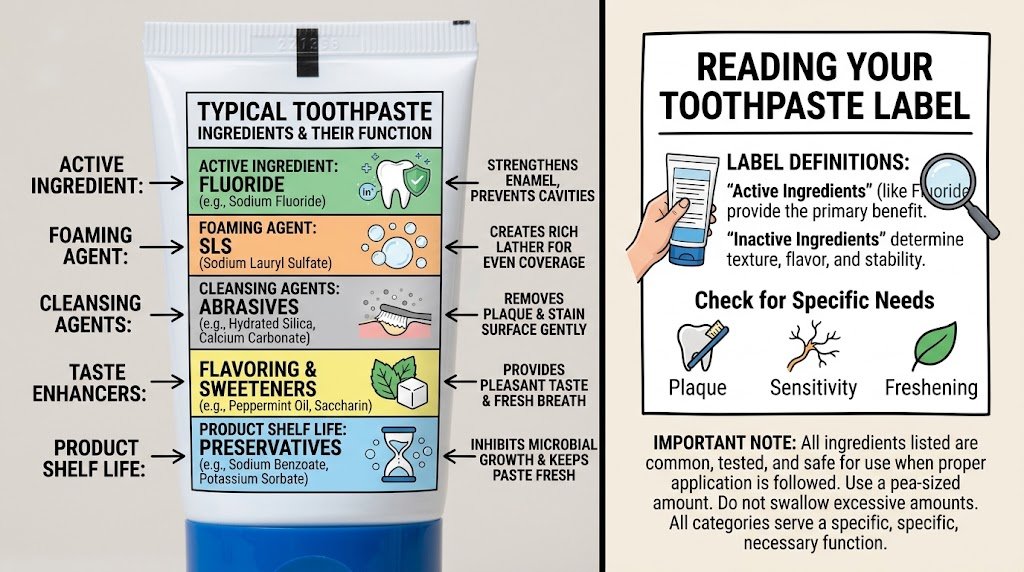
Toothpaste contains more than ingredients that clean your teeth. Depending on the formula, it may include detergents, flavoring agents, preservatives, abrasives, sweeteners, and active ingredients. Some people can develop irritation or an allergic reaction to particular ingredients.
The important point is that mouth irritation does not automatically mean your toothpaste is unsafe. It may be related to one specific ingredient, and a formula that bothers one person may be completely comfortable for another.
This guide explains what toothpaste-related irritation can feel like, which ingredients are worth checking, what to do if you suspect your toothpaste, and how to choose another formula without ignoring your actual oral-health needs.
Can Toothpaste Really Cause Mouth Irritation?
Yes. Toothpaste can cause irritation or an allergic reaction in some people.
Because toothpaste is used directly inside the mouth, the oral tissues are exposed to its ingredients every time you brush. If you are sensitive to a particular ingredient, repeated exposure may contribute to symptoms such as burning, soreness, redness, swelling, or peeling.
The reaction can affect different areas, including:
- Tongue
- Gums
- Inside of the cheeks
- Lips
- Other tissues inside the mouth
Toothpaste-related reactions are not the only possible explanation for these symptoms, though. Mouth irritation can also result from infections, oral conditions, medications, foods, or other personal-care products.
That is why the useful question is not simply “Is toothpaste bad for my mouth?”
It is:
“Could something in my particular toothpaste be contributing to my symptoms?”
That distinction helps you investigate the problem without unnecessarily avoiding ingredients that may still be useful for your oral health.
What Does Toothpaste-Related Mouth Irritation Feel Like?
Toothpaste irritation can look and feel different from person to person.
Possible symptoms include:
- Burning or stinging
- Sore mouth
- Redness
- Swelling
- Irritated gums
- Burning or uncomfortable tongue
- Peeling or shedding tissue
- White or peeling areas inside the mouth
- Lip irritation
- Mouth soreness
- Mouth ulcers in some situations
You may notice symptoms immediately after brushing, or you may notice a recurring pattern over time.
For example, someone might find that their mouth feels normal until they switch to a new toothpaste. After several uses, their tongue or inner cheeks may begin to feel irritated. Another person may notice burning every time they use a strongly flavored formula.
These symptoms can be useful clues, but they cannot identify the exact ingredient responsible.
Burning does not automatically mean SLS is the cause. Peeling does not automatically mean you have an allergy. And mouth ulcers do not automatically mean your toothpaste is responsible.
If the symptoms persist or keep returning, professional evaluation is important.
Is It Irritation or an Allergic Reaction?
This is one of the most important distinctions to understand.
Irritant reaction
An irritant reaction occurs when an ingredient directly bothers sensitive tissue.
It does not necessarily involve an immune-system allergy.
A person may therefore experience burning, soreness, or peeling from a particular product while another person can use the same product without problems.
Allergic reaction
An allergic reaction involves the immune system responding to a substance.
Allergic reactions can sometimes affect areas around the lips as well as tissues inside the mouth.
Why are the two easy to confuse?
Because the symptoms can overlap.
Burning, redness, swelling, soreness, and peeling can occur with different types of reactions.
So if your mouth burns after brushing, it would be premature to conclude:
“I must be allergic to SLS.”
The actual trigger could be a flavoring ingredient, detergent, preservative, another component of the formula, or something unrelated to toothpaste.
If you experience recurring symptoms, a dentist, physician, dermatologist, allergist, or other appropriate healthcare professional can help determine whether a contact reaction is likely.
Which Toothpaste Ingredients Can Cause Irritation?
Toothpaste contains several categories of ingredients, and more than one type can potentially contribute to irritation or allergic reactions in susceptible people.
Flavoring Agents and Essential Oils
Flavoring is one of the first things worth investigating when toothpaste causes burning or irritation.
Common toothpaste flavors include mint, but formulas can also contain cinnamon and other flavoring compounds.
This is particularly relevant if you assume that a natural toothpaste must be gentler.
Natural ingredients can still cause reactions.
For example, a toothpaste may use peppermint, spearmint, cinnamon, or another plant-derived flavoring. If you are sensitive to one of those ingredients, its natural origin does not necessarily make it comfortable for you.
Sodium Lauryl Sulfate (SLS)
Sodium lauryl sulfate, usually called SLS, is a detergent or surfactant used in many toothpaste formulas.
One reason it is used is to help toothpaste spread and foam during brushing.
SLS has received particular attention in discussions about oral irritation. Research has reported possible associations between SLS-containing toothpaste and oral mucosal irritation or peeling in some circumstances, although the evidence does not justify saying that SLS universally harms everyone.
That distinction matters.
You do not need to assume that every person should avoid SLS. But if you repeatedly experience irritation and notice that an SLS-free formula feels more comfortable, SLS may be one ingredient worth considering.
Cinnamon and Cinnamal
Cinnamon flavoring can also be relevant when investigating oral irritation.
Cinnamal, also known as cinnamic aldehyde, is a flavoring and fragrance compound that has been associated with contact reactions.
If a cinnamon-flavored toothpaste consistently causes burning, redness, or discomfort, comparing its ingredient list with a toothpaste you tolerate can provide a useful clue.
The goal is not to label cinnamon as unsafe. It is to recognize that individual sensitivity can make a normally useful flavoring a poor choice for a particular person.
Cocamidopropyl Betaine
Cocamidopropyl betaine is a surfactant used in some personal-care products, including certain toothpaste formulas.
The ADA lists it among ingredients that have been reported as possible irritants or allergens.
If you suspect this ingredient, compare the complete ingredient list of the toothpaste that causes symptoms with products you have previously tolerated.
A single ingredient appearing in both formulas does not prove that it is the cause, but ingredient comparison can help you and your healthcare professional investigate patterns.
Propylene Glycol and PEGs
Some toothpaste formulas contain propylene glycol or polyethylene glycol (PEG) compounds.
These ingredients have different functions depending on the formulation, but they are also among ingredients the ADA identifies as possible contact irritants or allergens.
Again, the presence of an ingredient does not mean that you need to avoid it automatically.
The more useful question is:
Does this ingredient appear to be connected with your own symptoms?
That requires looking at your individual pattern rather than relying on a universal “good ingredient/bad ingredient” list.
Pyrophosphates
Pyrophosphates can be used in tartar-control toothpaste.
They are another example of why the complete formula matters when investigating irritation. Certain tartar-control formulations can cause irritation in susceptible individuals.
If your symptoms started after changing to a tartar-control toothpaste, compare the new formula with your previous product and consider discussing the difference with a dental professional.
Why SLS-Free Toothpaste May Help Some People
If you repeatedly experience oral irritation, an SLS-free toothpaste may be worth considering.
SLS is primarily used as a detergent or surfactant rather than as the ingredient providing cavity protection.
Research has investigated whether SLS-containing toothpaste can contribute to oral mucosal irritation and peeling. Some studies and reviews have reported such effects, but the evidence is not a reason to claim that SLS is harmful to every toothpaste user.
An SLS-free formula may therefore be a reasonable option if:
- You frequently experience irritation while brushing.
- You are investigating whether SLS contributes to your symptoms.
- You prefer a lower-foaming toothpaste.
- A dental professional has suggested trying an SLS-free formula.
- You want to simplify your toothpaste while identifying a possible trigger.
But there is an important limitation:
SLS-free does not automatically mean irritation-free.
A toothpaste without SLS can still contain flavorings, essential oils, preservatives, or other ingredients that do not suit you.
So if you switch to SLS-free toothpaste and the irritation continues, do not assume that the product category has failed. Another ingredient may be responsible.
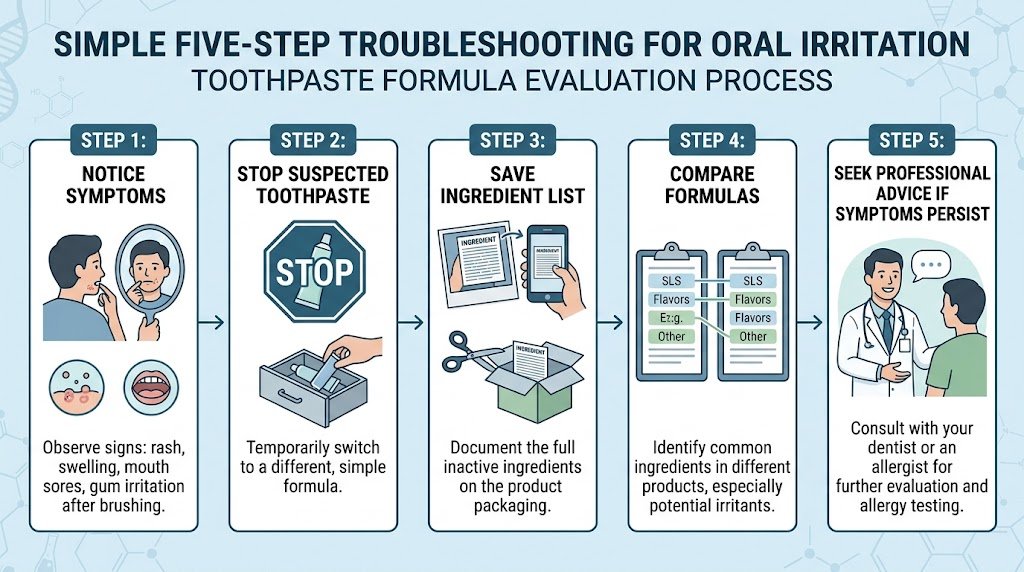
What Should You Do If You Think Your Toothpaste Is Causing Irritation?
If you suspect your toothpaste, taking a structured approach is more useful than randomly eliminating ingredients.
1. Stop using the suspected toothpaste
If a particular product appears to be causing the problem, stop using it rather than repeatedly exposing your mouth to the same formula.
2. Keep the ingredient list
Take a photo of the ingredient list or keep the tube.
This makes it easier to compare the product with another toothpaste later.
Pay particular attention to differences in:
- Flavoring
- Essential oils
- SLS
- Other surfactants
- Preservatives
- Pyrophosphates
- Other ingredients that are not present in toothpaste you tolerate
3. Think about when the symptoms started
Ask yourself:
- Did the problem begin after changing toothpaste?
- Does burning occur shortly after brushing?
- Does the irritation improve when you stop using that formula?
- Does the problem return when you use it again?
- Did you change your mouthwash at the same time?
- Did you start using a whitening product or another oral-care product?
The timing can provide useful information, although it does not establish a diagnosis by itself.
4. Avoid changing every oral-care product at once
If you replace your toothpaste, mouthwash, whitening product, lip balm, and other oral-care products simultaneously, it becomes difficult to know which change made a difference.
When practical, simplify your routine and change one major variable at a time.
5. Speak with a professional if symptoms persist
Toothpaste may be responsible, but it is not the only possible cause of mouth irritation.
Persistent or recurring symptoms can have other explanations, including oral conditions, infections, medications, foods, or reactions to other products.
A dentist or appropriate healthcare professional can help determine whether further evaluation is needed.
How to Choose a Gentler Toothpaste
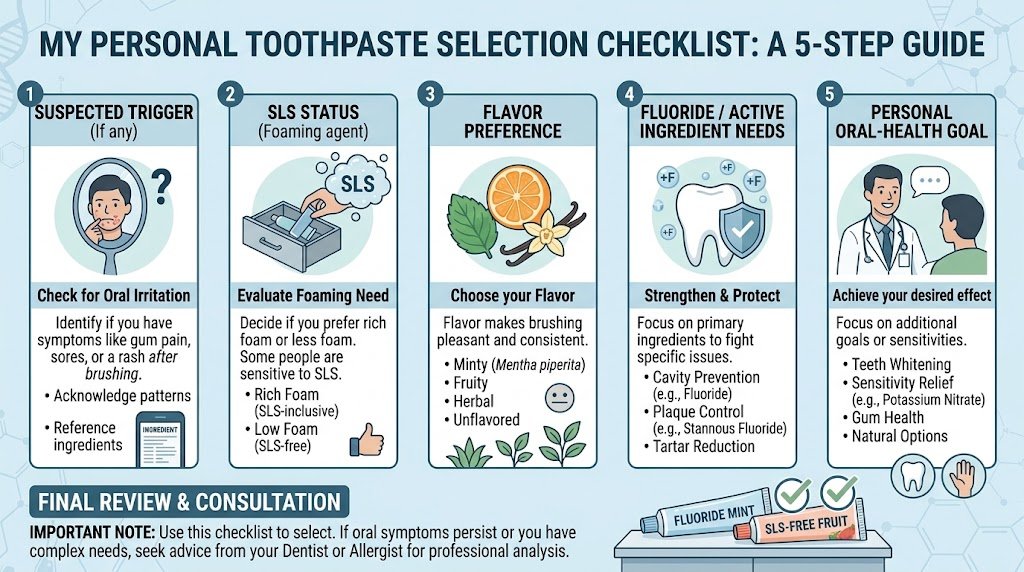
Once you have decided to change toothpaste, do not choose based on one marketing claim alone.
Instead, work through the following criteria.
1. Consider your fluoride needs
If cavity prevention is important, do not automatically choose the toothpaste with the shortest ingredient list.
If you are considering a fluoride-free toothpaste because of irritation, make sure you understand what you are giving up and whether that choice fits your individual dental needs.
2. Consider an SLS-free formula
If SLS is one of the ingredients you are investigating, choosing an SLS-free toothpaste gives you a straightforward way to remove that particular variable from your routine.
This does not prove that SLS was responsible. It simply gives you a reasonable product option to consider.
3. Look at the flavor
If your mouth burns after using strongly flavored toothpaste, consider a milder formula.
Pay attention to ingredients such as:
- Peppermint
- Spearmint
- Menthol
- Cinnamon
- Other flavoring compounds
If you already know that a particular flavoring causes problems for you, avoiding that ingredient is more useful than simply choosing a toothpaste labeled “natural.”
4. Read the complete ingredient list
Front-label claims can be useful, but they do not tell you everything.
Words such as:
- Natural
- Clean
- Gentle
- Non-toxic
- Sensitive
do not identify your personal trigger.
Read the complete ingredient list instead.
5. Match the formula to your oral-health needs
A toothpaste should not be chosen solely around irritation.
You may also need to consider:
- Cavity prevention
- Tooth sensitivity
- Gum health
- Enamel protection
- Whitening
- Braces
- Dry mouth
The goal is to find a toothpaste that you tolerate while still addressing your oral-health needs.
Should You Switch to Natural or Non-Toxic Toothpaste?
Not necessarily.
If your mouth is irritated, it is understandable to look for a toothpaste marketed as natural or non-toxic. But those labels alone cannot tell you whether a formula will be comfortable for your mouth.
A natural toothpaste can still contain essential oils and flavoring compounds that cause reactions in susceptible individuals.
For example, peppermint, spearmint, and cinnamon-derived flavorings may be relevant when investigating contact reactions.
So rather than asking only:
“Is this toothpaste natural?”
ask:
“Which ingredients are actually in this toothpaste, and does the formula fit my oral-health needs and personal sensitivities?”
That is a much more useful way to evaluate toothpaste.
A simpler formula can be helpful when you are trying to identify a trigger, but fewer ingredients do not automatically mean better oral health.
When Should You See a Dentist or Doctor?
Mild irritation after using a particular toothpaste may improve after you stop using the suspected product, but persistent or recurring symptoms deserve more attention.
Consider seeing a dentist or healthcare professional if your symptoms:
- Keep returning
- Do not improve after changing products
- Cause significant pain
- Include persistent sores or ulcers
- Cause substantial swelling
- Make eating or drinking difficult
- Continue despite removing the suspected toothpaste
A professional can consider causes other than toothpaste and determine whether further investigation is appropriate.
Seek emergency help for severe allergic symptoms
Mouth irritation is different from a potentially serious allergic reaction.
Do not wait for severe symptoms to resolve on their own.
How to Shop for Toothpaste When Your Mouth Is Sensitive
Once you know what to look for, shopping becomes much easier.
Look for:
- An ingredient list you can understand and compare
- A formula without any known personal trigger
- SLS-free labeling if you are investigating SLS
- A flavor you tolerate
- An active ingredient appropriate for your oral-health needs
- Fluoride when appropriate for your cavity-prevention needs
- A reputable manufacturer
- A formula that does not introduce unnecessary ingredients you are specifically trying to avoid
Do not assume:
- Natural means irritation-free
- SLS-free means every other ingredient is gentle
- Fluoride-free automatically means safer
- More foam means better cleaning
- Stronger flavor means better cleaning
- Fewer ingredients automatically means better toothpaste
The right product depends on the combination of tolerance, ingredients, oral-health needs, and personal preference.
Compare relevant toothpaste options on Amazon
If you have already decided that you want an SLS-free, mild-flavor, or otherwise simpler toothpaste, Amazon can be useful for comparing available formulas.
Before buying, check:
- The complete ingredient list
- Fluoride status
- Active ingredients
- Flavoring ingredients
- SLS status
- Intended oral-health use
- Current price and package size
[ Amazon affiliate CTA — Compare SLS-free and sensitive-mouth toothpaste options on Amazon ]
The goal is not to find a toothpaste with the most impressive marketing claims. It is to find a formula that matches the reason you are changing toothpaste in the first place.
Frequently Asked Questions
Can toothpaste cause mouth irritation?
Yes. Some people can develop irritation or allergic reactions to particular toothpaste ingredients. Flavoring agents, essential oils, SLS, and several other ingredients have been reported as possible irritants or allergens. However, mouth irritation has many possible causes, so toothpaste should not automatically be blamed.
Why does toothpaste burn my mouth?
Burning can have several possible causes. Flavoring ingredients, essential oils, SLS, and other components may irritate or trigger a reaction in susceptible people. Burning alone cannot identify the exact ingredient responsible.
Is SLS bad for your mouth?
SLS is not universally harmful to everyone. It is a detergent used in some toothpaste formulas, and research has investigated possible associations with oral mucosal irritation and peeling. If you experience recurring irritation, an SLS-free toothpaste may be worth considering, but SLS status should not be the only factor in choosing toothpaste.
Can toothpaste cause mouth ulcers?
Toothpaste may contribute to irritation in some people, and SLS-free formulas have been investigated in relation to recurrent aphthous ulcers. However, mouth ulcers have many possible causes. If ulcers are persistent or recurring, discuss them with a dental or healthcare professional.
What ingredients should I avoid if toothpaste irritates my mouth?
There is no universal ingredient list that everyone with mouth irritation needs to avoid. Instead, compare the toothpaste associated with your symptoms against formulas you tolerate. Flavorings, essential oils, SLS, cocamidopropyl betaine, propylene glycol, PEGs, parabens, and pyrophosphates are among ingredients reported as possible irritants or allergens.
Should I switch to SLS-free toothpaste?
An SLS-free formula may be worth trying if you repeatedly experience irritation and want to investigate whether SLS contributes to the problem. However, SLS-free toothpaste can still contain other ingredients that cause irritation, so look at the complete formula.
Can natural toothpaste cause mouth irritation?
Yes. Natural ingredients can still cause irritation or allergic reactions. Essential oils and flavoring ingredients are examples of natural or naturally derived ingredients that may not be tolerated by everyone.
How long does toothpaste irritation take to go away?
The time can vary depending on the cause and severity of the reaction. Avoiding the suspected product may allow symptoms to improve, but persistent or worsening symptoms should be evaluated by a dentist or healthcare professional rather than assumed to be toothpaste-related.
Final Takeaway
Yes, toothpaste can cause mouth irritation in some people.
The most useful response is not to assume that an entire toothpaste formula is harmful. Instead, look for a relationship between your symptoms and the ingredients in the product you are using.
Flavorings and essential oils deserve particular attention, while SLS may also be relevant for some people experiencing oral irritation or peeling. Other toothpaste ingredients can contribute as well.
If you suspect your toothpaste:
- Stop using the suspected formula.
- Keep its ingredient list.
- Compare it with a toothpaste you tolerate.
- Consider whether SLS, flavoring, or another ingredient is worth investigating.
- Seek professional advice if symptoms persist or return.
When choosing another toothpaste, prioritize personal tolerance, ingredient transparency, and your actual oral-health needs.
A toothpaste does not have to be marketed as “natural” or “non-toxic” to be the right choice for you. What matters most is understanding the formula, avoiding known personal triggers, and maintaining the ingredients that support your oral-health goals.
Affiliate Disclosure: This article may contain affiliate links. If you purchase through a qualifying link, we may earn a commission at no additional cost to you. Product suggestions should be based on ingredient information, intended use, and relevance to the reader’s needs—not unsupported claims or guaranteed results.
