If you have looked at a toothpaste ingredient list and noticed names such as FD&C Blue No. 1, FD&C Yellow No. 5, or Red No. 40, you may wonder whether those colors are safe to put in your mouth every day.
The more useful question is therefore not simply whether a toothpaste dye is “artificial” or “chemical.” It is what the ingredient is, why it is being used, whether it is permitted for that use, and whether you personally have a reason to avoid it.
This guide explains why toothpaste contains color, what common color additives mean, how to read the ingredient list, when dye-free toothpaste may make sense, and what you should consider before buying one.
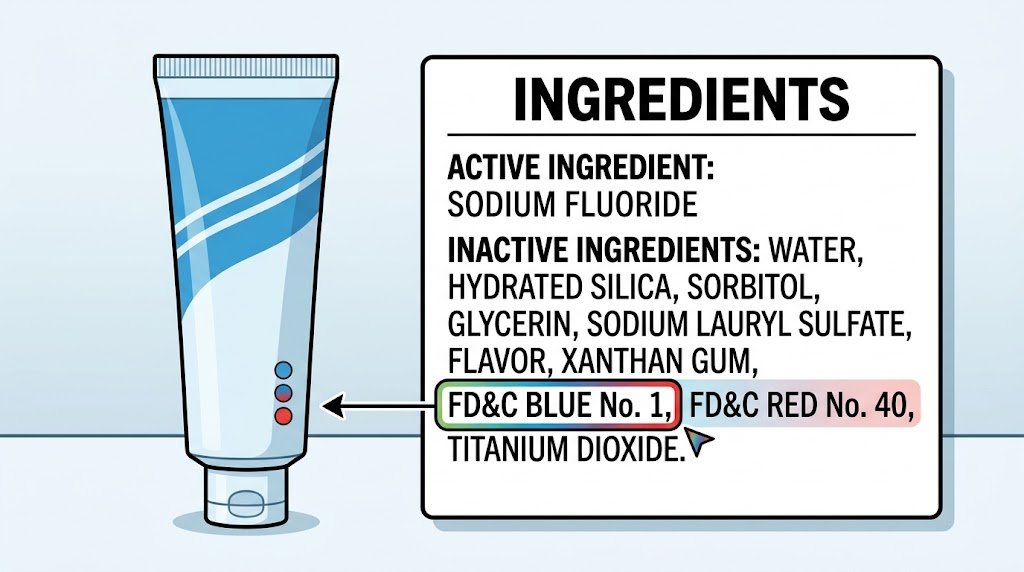
Quick Answer: Are Toothpaste Dyes Safe?
Generally, toothpaste color additives that are permitted for use in the United States are regulated by the FDA according to their intended use. Some color additives are subject to a certification process, while others are exempt from batch certification but still have to comply with applicable requirements.
That does not mean every person will tolerate every ingredient in exactly the same way.
The FDA notes that allergic-type reactions to color additives can occur, although such reactions are rare. The American Dental Association also notes that toothpaste can contain several ingredients capable of causing irritation or allergic reactions in susceptible people, including some flavoring agents, essential oils, menthol, SLS, and other ingredients.
So there are two different questions:
- Are permitted toothpaste dyes automatically dangerous? No.
- Can you choose toothpaste without added dyes? Yes.
If you prefer a simpler ingredient list, have experienced a reaction to a particular toothpaste, or simply do not want added color, a dye-free toothpaste can be a reasonable choice.
The important point is that dye-free does not automatically mean better, just as a colored toothpaste does not automatically mean unsafe.
Why Is Color Added to Toothpaste?
Toothpaste contains ingredients that perform different jobs. Some help clean the teeth, some help maintain the consistency of the paste, some affect taste, and others provide active oral-health benefits.
Color is generally used for appearance and formulation purposes, rather than because your teeth need the color itself.
Color is mainly a cosmetic feature
A toothpaste can be white, blue, green, red, striped, or another color depending on how it is formulated.
The appearance may make the product more visually appealing or help distinguish one formulation from another. But the color itself is not what cleans plaque from your teeth or provides fluoride’s cavity-prevention benefit.
This is useful when evaluating ingredients because “not necessary for cleaning” and “unsafe” are not the same thing.
An ingredient can have a cosmetic purpose without being harmful.
Toothpaste does not need to be colorful to work
If your goal is to simplify your toothpaste, you may decide that added color is something you would rather skip.
That is a personal ingredient preference.
It is different from saying that every color additive is toxic or that everyone should avoid colored toothpaste.
A better approach is to look at the whole formulation and decide which ingredients provide benefits that matter to you.
What Types of Dyes Can Be Found in Toothpaste?
The term “dye” can make all color additives sound like the same type of ingredient, but color additives are a broader category.
The FDA describes color additives as substances that can impart color to products. Some are subject to certification, while others are exempt from certification because of their particular characteristics or sources.
Certified color additives
Some synthetic color additives are subject to FDA batch certification.
You may recognize names such as:
- FD&C Blue No. 1
- FD&C Yellow No. 5
- FD&C Red No. 40
These names identify particular certified color additives.
The certification process is separate from simply seeing a color name on a package. For colors that require certification, batches must meet the applicable FDA requirements before they can be used.
Certification-exempt color additives
Other permitted color additives do not require the same batch-certification process.
The FDA gives examples of color additives derived from sources such as plants, minerals, and other natural materials. Examples include substances such as annatto extract, dehydrated beets, beta-carotene, and grape skin extract.
This creates an important distinction for shoppers:
Natural does not automatically mean safer, and synthetic does not automatically mean dangerous.
The source of a color is only one part of the picture.
What matters is the specific ingredient, how it is used, applicable safety requirements, and whether it causes a problem for the individual using the product.
Artificial vs. Natural Toothpaste Colors
“Artificial” and “natural” are popular words on toothpaste packaging, but they can oversimplify the safety question.
A naturally derived color can still be an ingredient that someone chooses to avoid. Conversely, the fact that a color is synthetic does not by itself establish that the toothpaste is unsafe when the ingredient is permitted for its intended use.
If your goal is to buy a toothpaste with fewer cosmetic ingredients, you can simply choose a product that does not use added color.
You do not need to prove that every other color is harmful before making that choice.
A better way to evaluate color
Instead of asking:
“Is this color natural?”
Ask:
- What is the actual ingredient?
- Why is it included?
- Is it permitted for this use?
- Do I have a known sensitivity or reason to avoid it?
- Does avoiding it matter more to me than other toothpaste characteristics?
This approach helps prevent both extremes: assuming all artificial ingredients are dangerous or assuming every regulated ingredient is automatically the right choice for every person.
How Does the FDA Regulate Toothpaste Color Additives?
The FDA regulates color additives used in products sold in the United States.
One important detail is that approval is connected to specific intended uses and conditions. A color additive being permitted for one use does not mean it is automatically permitted for every possible use.
The FDA considers safety information when determining whether a color additive can be used for a particular purpose. Regulations can specify the permitted use, specifications, and other conditions.
This is why the phrase “FDA approved” should not be interpreted as a blanket statement that an ingredient can be used anywhere in any amount.
What does “FD&C” mean?
You may see a name such as FD&C Blue No. 1 on a toothpaste label.
FD&C is part of the naming system used for certain certified color additives. The color number identifies the specific color.
Seeing a scientific-sounding name does not tell you by itself whether an ingredient is harmful.
Likewise, seeing the word “natural” does not prove that an ingredient is better.
For a more useful assessment, read the entire ingredient list and consider the product’s intended purpose.
Can Toothpaste Dyes Cause Irritation or Allergies?
This is one of the most important areas where general safety and individual sensitivity can differ.
The FDA states that allergic-type reactions to color additives can occur but are rare. Certain color additives have been associated with reactions in susceptible individuals.
However, if your mouth becomes irritated after using toothpaste, do not automatically assume the dye is responsible.
Toothpaste contains many ingredients, and several of them can potentially cause irritation or allergic reactions.
The ADA identifies ingredients reported as allergens or irritants in toothpaste, including:
- Essential oils
- Fragrance
- Menthol
- Citric acid
- SLS
- Propylene glycol
- PEGs
- Cocamidopropyl betaine
- Parabens
- Pyrophosphates
This matters because someone who experiences burning, soreness, redness, peeling, or another recurring reaction may need to consider the entire formulation, not just its color.
If symptoms continue or are significant, a dentist or healthcare professional can help determine what may be causing the problem rather than relying on trial and error alone.
Should You Avoid Colored Toothpaste?
Not necessarily.
There is a major difference between saying:
“This ingredient is unsafe.”
and saying:
“I would rather not use this ingredient.”
If you tolerate a toothpaste and it contains a permitted color additive, there is no reason to assume that the color alone makes the product unsafe.
At the same time, you are free to choose a dye-free toothpaste.
You might prefer one because you want:
- A simpler ingredient list
- Fewer cosmetic ingredients
- A particular natural or minimalist formulation
- To avoid an ingredient you personally do not tolerate
- More control over what goes into your toothpaste
When choosing dye-free makes sense
A dye-free toothpaste can make sense when avoiding added color is one of your personal priorities.
It can also make shopping easier if you are trying to simplify the number of ingredients you need to evaluate.
But there is one important warning:
Do not let “dye-free” become your only selection criterion.
For example, if cavity prevention is your main goal, fluoride status may be much more important than whether the toothpaste is blue or white.
The ADA states that fluoride-containing toothpaste is the standard for cavity-prevention claims among ADA-Accepted toothpastes.
So the better question is:
“Does this toothpaste meet my oral-health needs while also fitting my ingredient preferences?”
That is more useful than simply asking whether it contains color.
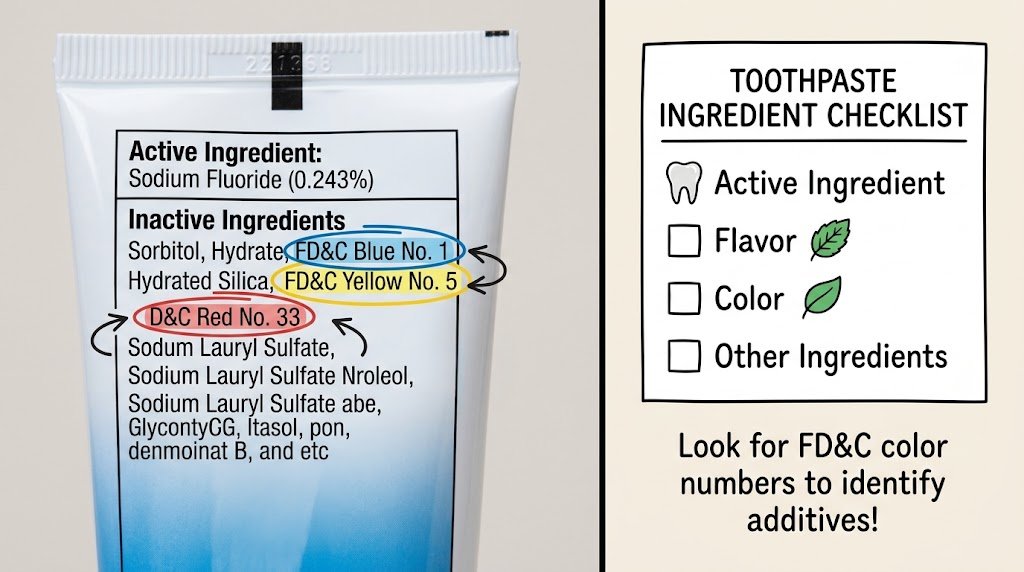
How to Find Dyes on a Toothpaste Ingredient Label
If you want to avoid added dyes, the ingredient list is your best starting point.
Look for declared color additives such as:
- FD&C Blue No. 1
- FD&C Yellow No. 5
- FD&C Red No. 40
- Blue 1 Lake
- Other named color additives
The exact terminology can vary depending on the color and applicable labeling requirements.
Use this simple label-checking process
Step 1: Read the complete ingredient list.
Do not rely only on front-of-package claims such as “natural,” “clean,” or “pure.”
Step 2: Look for color names or numbers.
Specific color designations can help you identify whether added color is present.
Step 3: Check for a dye-free claim if that is important to you.
A clearly labeled dye-free product can make initial shopping easier.
Step 4: Check the rest of the formula.
Dye-free does not mean ingredient-free.
The toothpaste can still contain flavoring agents, sweeteners, detergents, abrasives, preservatives, or other ingredients that matter to you.
Step 5: Consider the active ingredient.
Think about why you are buying the toothpaste in the first place.
If cavity prevention is your goal, for example, do not sacrifice that priority simply to avoid a cosmetic ingredient.
What Matters More Than Toothpaste Color?
If you are comparing two toothpaste products, color should usually be only one small part of your decision.
1. Your oral-health goal
Start with the reason you need the toothpaste.
Are you primarily looking for:
- Cavity protection?
- Sensitive-teeth care?
- Whitening?
- Gum care?
- A general daily toothpaste?
The right formula depends on the job you want the toothpaste to perform.
2. Active ingredients
Active ingredients deserve attention because they are included for specific oral-health purposes.
For example, fluoride is important when cavity prevention is a priority.
A toothpaste should not become your preferred choice simply because its ingredient list looks “clean” if it does not meet your actual oral-health needs.
3. Your personal tolerance
If a particular toothpaste causes recurring irritation, consider the complete ingredient list.
Color could be relevant, but it is only one possibility.
4. Ingredient transparency
A manufacturer should provide enough information for you to understand what is in the product.
A short, understandable ingredient list can make comparison easier, but the number of ingredients alone does not determine whether a toothpaste is appropriate.
5. Independent evaluation
The ADA Seal of Acceptance can be another useful consideration.
The ADA explains that products carrying the Seal have undergone voluntary evaluation against requirements related to their safety and effectiveness for the applicable claims.
The Seal does not mean that every toothpaste without it is unsafe. It simply provides another source of product information when comparing eligible products.
How to Choose a Dye-Free Toothpaste
If you have decided that you prefer toothpaste without added dyes, you can keep the selection process simple.
1. Start with the ingredient list
Look for declared color additives.
Do not judge the product only by the color of the paste or the front label.
2. Decide whether you want fluoride
If cavity prevention is important to you, evaluate fluoride before making dye-free status the deciding factor.
3. Consider your personal needs
A toothpaste for sensitive teeth may have different priorities from a whitening toothpaste or a children’s toothpaste.
Choose based on what you actually need.
4. Look at the whole formulation
If you have experienced irritation, do not stop your investigation at color.
Look at flavoring, essential oils, SLS, and other ingredients as well.
5. Prefer clear labeling
Transparent ingredient information makes it easier to compare products without relying entirely on marketing claims.
6. Consider independent evaluation when available
An ADA Seal can provide additional information about a qualifying product’s evaluated claims.
The goal is not to find the toothpaste with the fewest ingredients.
The goal is to find a toothpaste that fits your oral-health needs while respecting the ingredients you personally want to avoid.
What to Look for When Shopping for Dye-Free Toothpaste
Once you move from research to shopping, compare products using practical criteria rather than packaging.
| What to Check | Why It Matters |
| Dye-free formulation | Useful if you prefer to avoid added colors |
| Active ingredient | Helps determine whether the toothpaste fits your oral-health goal |
| Fluoride status | Important when cavity prevention is a priority |
| Complete ingredient list | Helps you evaluate the whole formulation |
| Personal tolerance | Important if a toothpaste has caused irritation before |
| Intended use | Helps match the toothpaste to your specific need |
| Ingredient transparency | Makes comparison easier |
| ADA Seal, when applicable | Provides an additional independently evaluated signal |
| Price | Helps you compare overall value |
At this stage, Amazon can be useful for comparing several toothpaste options, but do not choose based only on ratings, packaging, or the phrase “natural.”
Compare the actual ingredients and product purpose.
If you want to shop for dye-free toothpaste, use the criteria above first and then compare current product options.
Are Natural Toothpaste Colors Safer?
Not automatically.
This is especially important if you are shopping for “natural” or “non-toxic” toothpaste.
Some color additives come from natural sources, but natural origin alone does not establish that an ingredient is safer for every person.
Likewise, a synthetic color is not automatically dangerous simply because it was manufactured rather than extracted from a plant.
A better approach is to separate three questions:
Where did the color come from?
Is it permitted for the intended use?
Do you personally have a reason to avoid it?
This gives you a much more realistic way to evaluate toothpaste ingredients.
If your personal goal is simply to minimize added cosmetic ingredients, choosing a dye-free formula is perfectly reasonable.
But you do not need to label every other color as “toxic” to justify your preference.
What About Children’s Toothpaste?
Children deserve special consideration because younger children may swallow toothpaste during brushing.
When choosing toothpaste for a child, the primary concern should be selecting a product appropriate for the child’s age and oral-health needs, while following dental guidance about fluoride and brushing.
Parents who want to avoid dyes can certainly look for a dye-free children’s toothpaste.
But dye status should not be the only consideration.
Also consider:
- Age recommendations
- Fluoride status
- Amount of toothpaste used
- Whether the child can spit effectively
- The child’s dental needs
- Any known ingredient sensitivities
If a child develops recurring irritation or another reaction after using toothpaste, discuss the issue with a pediatric dentist or healthcare professional rather than assuming that the color is responsible.
Frequently Asked Questions
Are toothpaste dyes toxic?
Permitted color additives are regulated for their intended uses, so it is not accurate to describe all toothpaste dyes as toxic simply because they are synthetic. The FDA evaluates color additives and establishes requirements for approved uses. Individual reactions are still possible.
Is dye-free toothpaste better?
Not automatically. Dye-free toothpaste may be preferable if you want a simpler formulation or personally want to avoid added colors. However, the toothpaste should still meet your oral-health needs.
Can toothpaste dyes cause mouth irritation?
They can potentially contribute to reactions in susceptible individuals, but toothpaste contains many other ingredients that can also cause irritation or allergic reactions. If irritation keeps occurring, consider the complete formulation.
Are natural toothpaste colors safer than artificial colors?
Not automatically. Natural and synthetic describe characteristics such as the source or production of an ingredient, not a guarantee of safety for every person.
How can I tell if toothpaste contains artificial colors?
Check the complete ingredient list for declared color additives. Names may include FD&C color designations, color numbers, or other specific color names.
Does toothpaste need dye?
No. Color is generally related to the product’s appearance rather than the primary cleaning or cavity-prevention function of toothpaste.
Should I avoid Red 40, Yellow 5, or Blue 1 in toothpaste?
You do not need to assume that everyone must avoid these colors. If you personally prefer dye-free products or have a known sensitivity, you can choose a toothpaste without those color additives.
Is ADA-Seal toothpaste safer?
The ADA Seal indicates that a product has undergone the ADA’s voluntary evaluation process and met applicable requirements for its evaluated claims. It should be viewed as an additional source of information, not as proof that every toothpaste without the Seal is unsafe.
Final Takeaway: Are Toothpaste Dyes Safe?
So, are toothpaste dyes safe?
For most consumers, the presence of a permitted color additive does not by itself mean that a toothpaste is unsafe. Color additives are regulated by the FDA for their intended uses, and reactions can occur in susceptible people but are uncommon.
The more useful approach is to evaluate the whole toothpaste, not just its color.
Look at:
- The active ingredients
- Your cavity-prevention needs
- Your personal sensitivity
- The complete ingredient list
- Flavoring and other ingredients
- Ingredient transparency
- The toothpaste’s intended purpose
- Independent evaluation such as the ADA Seal, when applicable
If you prefer to avoid added dyes, choosing a dye-free toothpaste is a reasonable personal choice.
Just remember that dye-free does not automatically mean healthier, safer, or more effective. The best choice is the toothpaste that meets your oral-health needs while fitting your personal ingredient preferences.
Affiliate Disclosure: If you purchase a product through a qualifying affiliate link on this page, we may earn a commission at no additional cost to you. Product recommendations are provided to help you compare options and should be evaluated against the current product label and your individual needs.
