If you accidentally swallow a small amount of toothpaste while brushing, it usually does not mean you are in serious danger. The situation is different when someone swallows a large amount, a child gets into a tube of toothpaste, or the product is a prescription-strength fluoride toothpaste.
Toothpaste is not meant to be swallowed, and fluoride-containing toothpaste can cause stomach upset when enough is ingested. Large fluoride exposures can be more serious, so the amount swallowed, the product involved, the person’s age, and any symptoms all matter.
If a significant or uncertain amount was swallowed, don’t try to guess the risk from a general internet chart. In the United States, Poison Control can assess the exposure based on the person’s age, the product, the amount, and symptoms.
This guide explains what happens after swallowing toothpaste, what to do immediately, when to contact Poison Control, what parents should know about children, and how to reduce the chance of repeated swallowing.
What Happens If You Swallow a Small Amount of Toothpaste?
Swallowing a small amount of toothpaste accidentally is fairly common, particularly among children who are still learning to brush and spit.
For most accidental exposures involving a small amount of over-the-counter fluoride toothpaste, serious toxicity is unlikely. However, toothpaste can irritate the digestive system, and some people may develop temporary stomach symptoms. Poison Control notes that swallowing toothpaste can cause an upset stomach, while larger fluoride exposures can potentially cause more serious effects.
The important distinction is how much was swallowed and what product was involved.
For example, accidentally swallowing a little toothpaste foam during brushing is very different from swallowing a large quantity directly from the tube.
If only a small amount was accidentally swallowed and the person feels well, there is generally no reason to assume that a serious poisoning has occurred. However, if you are unsure how much was swallowed, the person is a young child, or the toothpaste was a prescription-strength product, getting individualized advice is the safer approach.
What Happens If You Swallow a Large Amount of Toothpaste?
A larger ingestion deserves more attention because it can result in substantially greater exposure to the ingredients in toothpaste, including fluoride when the product contains it.
Fluoride is useful when toothpaste is used as directed because it helps prevent tooth decay. It is not intended to be consumed as a food or drink. A sufficiently large fluoride ingestion can cause gastrointestinal symptoms and, in serious cases, toxic effects.
There is no single amount of toothpaste that can safely be labeled “too much” for everyone. The significance of an ingestion depends on factors such as:
- The person’s age and size
- The type of toothpaste
- Whether it contains fluoride
- The fluoride concentration
- Approximately how much was swallowed
- Whether the toothpaste was a regular or prescription-strength product
- Whether symptoms have developed
This is why a generic teaspoon-based safety rule can be misleading.
If someone swallowed a substantial or unknown amount, particularly a child, contact Poison Control rather than trying to calculate the risk yourself.
Why Does Fluoride Matter If You Swallow Toothpaste?
Fluoride is one of the main reasons toothpaste helps protect against cavities.
When used during brushing, fluoride interacts with the tooth surface and helps strengthen enamel and reduce the risk of tooth decay. The ADA recommends fluoride toothpaste for regular brushing because of this cavity-prevention benefit.
The problem is not that fluoride is inherently unsafe. The issue is unnecessary ingestion of excessive amounts.
This distinction is particularly important for children because young children may not yet have good control over swallowing and spitting.
Fluoride Helps Teeth When Used Correctly
Fluoride toothpaste is designed primarily for use in the mouth during brushing.
For children, the ADA recommends a rice-grain-sized smear from the eruption of the first tooth through age 3, followed by no more than a pea-sized amount from ages 3 to 6. Children should be supervised so they learn to spit rather than swallow the toothpaste.
Using the correct amount allows the toothpaste to perform its intended job without unnecessarily increasing the amount a child could swallow.
Too Much Fluoride Ingestion Is Different
The body can be exposed to fluoride from several sources, including toothpaste, drinking water, mouth rinses, and other dental products.
An occasional small accidental swallow is different from repeatedly swallowing excessive amounts or consuming a large quantity at once.
For that reason, parents should not respond to one accidental swallow by automatically eliminating fluoride toothpaste. Instead, the focus should be on appropriate toothpaste amounts, supervision, and professional advice when an ingestion is concerning.
Dental Fluorosis Is Different From Acute Toxicity
Dental fluorosis is a change in the appearance of developing teeth that can occur when a child consumes too much fluoride while those teeth are forming. The CDC explains that fluorosis affects young children and is usually mild and cosmetic in the United States.
That is different from an acute ingestion event.
In simple terms:
Repeated excessive fluoride intake during tooth development → possible dental fluorosis
while
A sufficiently large ingestion at one time → possible acute fluoride toxicity
These should not be treated as the same problem.
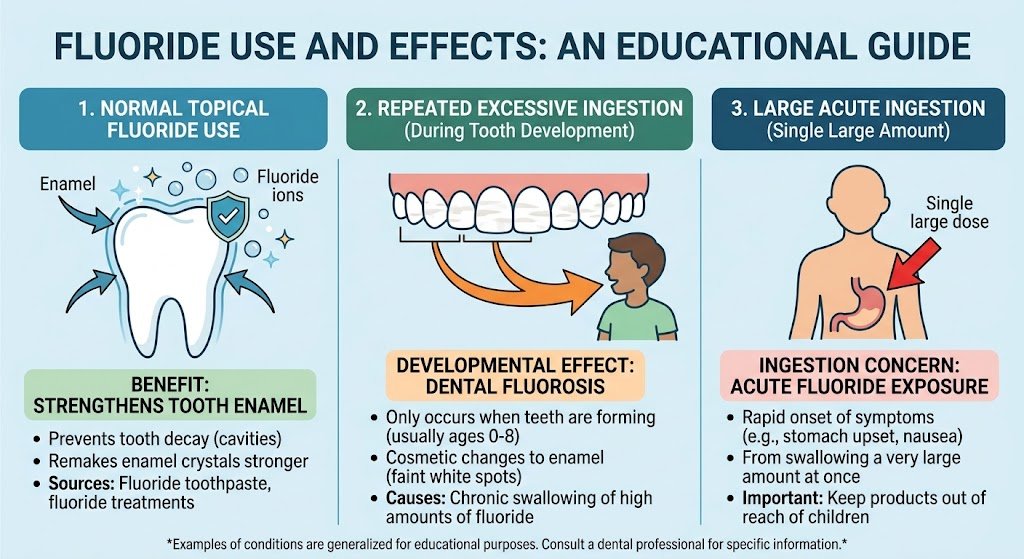
[ IMAGE SUGGESTION — A simple educational diagram distinguishing normal topical fluoride use, repeated excessive fluoride ingestion during tooth development, and a large acute ingestion. Clearly label dental fluorosis as a developmental effect and acute fluoride exposure as an ingestion concern. Avoid alarming imagery. ]
What Should You Do If You Swallow Toothpaste?
If toothpaste was accidentally swallowed, start by assessing what actually happened rather than assuming the worst.
1. Stop and Check the Product
Look at the toothpaste tube or packaging.
Identify:
- Product name
- Whether it contains fluoride
- Active ingredients
- Fluoride concentration if listed
- Whether it is regular or prescription-strength toothpaste
Having the actual product available can make it much easier for Poison Control to assess the exposure.
2. Estimate How Much Was Swallowed
You do not need a perfect measurement.
Try to determine whether it was:
- A small amount during normal brushing
- More than the normal brushing amount
- A noticeable amount from the tube
- An unknown amount
If a child was found with toothpaste around their mouth or holding an open tube, don’t assume you know how much they swallowed.
3. Do Not Make the Person Vomit
Do not induce vomiting after swallowing toothpaste.
Poison Control specifically advises against inducing vomiting after swallowed poison exposures.
Trying to force vomiting can create additional problems and does not replace professional exposure assessment.
4. Get Poison Control Guidance When Needed
In the United States, Poison Control provides individualized advice based on the substance, amount, age, and symptoms. You can use its online service or call 1-800-222-1222. The service is free and confidential.
If you are dealing with an ingestion right now and are uncertain about the amount or product, contacting Poison Control is more useful than relying on a general article.
What Symptoms Can Happen After Swallowing Toothpaste?
A small accidental ingestion may cause no symptoms at all.
When symptoms do occur, toothpaste ingestion can cause gastrointestinal irritation. Poison Control lists symptoms such as:
- Nausea
- Vomiting
- Diarrhea
- Stomach discomfort
These symptoms can result from fluoride and other toothpaste ingredients irritating the digestive tract.
Symptoms and severity depend on the product and amount swallowed.
Do not wait for symptoms before seeking help if you know that a potentially significant amount was swallowed. Poison Control can help determine whether monitoring at home is appropriate or whether further medical evaluation is needed.
If someone develops severe symptoms or becomes difficult to wake, has a seizure, collapses, or has trouble breathing, call 911 immediately. Poison Control identifies these as emergency warning signs for poisoning situations.
When Should You Call Poison Control or Get Emergency Help?
Knowing where to get help can be more important than trying to determine the exact risk yourself.
Contact Poison Control
Consider contacting Poison Control when:
- The amount swallowed is unknown.
- A child swallowed more than the normal brushing amount.
- Someone swallowed a large amount from the tube.
- Prescription-strength toothpaste was swallowed.
- You are unsure whether the toothpaste contains fluoride.
- Symptoms develop after the ingestion.
- You simply are not sure whether the exposure needs medical attention.
Poison Control can use the person’s age, the exact product, estimated amount, and symptoms to provide situation-specific advice.
Seek Emergency Medical Help
Call 911 immediately if the person:
- Collapses
- Has a seizure
- Has trouble breathing
- Cannot be awakened
These are emergency signs that require immediate medical attention rather than waiting for an online response.
Have the Product Information Ready
If you contact Poison Control, keep the toothpaste tube nearby.
Useful information includes:
| Information | Why it matters |
| Product name | Identifies the exact formulation |
| Fluoride status | Helps determine fluoride exposure |
| Fluoride concentration | Helps assess the product |
| Approximate amount swallowed | Helps estimate exposure |
| Person’s age | Important for exposure assessment |
| Weight, if known | May help with individualized assessment |
| Time of ingestion | Helps determine next steps |
| Current symptoms | Helps assess urgency |
You do not need to delay contacting Poison Control while trying to collect every detail. Give them whatever information you know.
What If a Child Swallows Toothpaste?
Children are the group most likely to swallow toothpaste accidentally because they are still developing the ability to spit reliably.
The CDC advises parents to supervise young children and teach them to spit out toothpaste rather than swallow it.
The most important thing is to distinguish between normal accidental swallowing during brushing and a child actually eating toothpaste from the tube.
A little toothpaste swallowed during brushing is not the same exposure as an unknown quantity consumed directly from a tube.
If you find a child with toothpaste around their mouth, don’t panic. Remove the toothpaste, identify the product, estimate what may have been swallowed, and contact Poison Control if you are concerned or the amount is uncertain.
For a potentially significant ingestion, don’t wait for symptoms before asking for professional advice.
How Much Toothpaste Should a Child Use?
One of the easiest ways to reduce unnecessary fluoride ingestion is to use the appropriate amount in the first place.
| Child’s age | General amount of fluoride toothpaste |
| First tooth through age 3 | No more than a grain-of-rice-sized smear |
| Ages 3–6 | No more than a pea-sized amount |
The ADA and CDC recommend these small amounts and advise supervision so children learn to spit rather than swallow toothpaste.
[ IMAGE SUGGESTION — A clean comparison graphic showing a rice-grain-sized toothpaste smear and a pea-sized amount on two child-sized toothbrushes, with the corresponding age ranges clearly labeled. Use realistic proportions and no brand names. ]
The amount matters because a large stripe of toothpaste can contain much more fluoride than a child needs for normal brushing.
Parents should also avoid allowing young children to squeeze toothpaste directly from the tube. Dispensing the toothpaste themselves makes it easier to control the amount.
Should You Switch to Fluoride-Free Toothpaste?
Not automatically.
If a child accidentally swallows some fluoride toothpaste, the answer is not necessarily to remove fluoride from the child’s brushing routine.
Fluoride has an important role in preventing tooth decay, and the ADA recommends fluoride toothpaste for children in appropriate amounts.
The better question is:
Why did the child swallow the toothpaste, and how much was swallowed?
If the issue is that the child is using too much toothpaste, reduce the amount.
If the child cannot reliably spit, supervise brushing.
If the child repeatedly eats toothpaste from the tube, store it out of reach.
If there was a potentially significant ingestion, contact Poison Control.
If a child has unusual dental needs or a history of frequent cavities, discuss toothpaste selection with their dentist rather than making the decision based only on fear of fluoride.
How to Prevent Your Child From Swallowing Toothpaste
Prevention is usually easier than dealing with repeated accidental ingestion.
Use the Correct Amount
For young children, less toothpaste is needed than many parents assume.
Follow the age-based recommendations rather than covering the entire toothbrush head.
Supervise Brushing
Young children often need an adult to help them brush effectively.
The ADA recommends that caregivers supervise children’s brushing and teach them to spit rather than swallow toothpaste.
Keep the Tube Out of Reach
Toothpaste may taste sweet or appealing to children, and Poison Control recommends keeping it out of children’s sight and reach.
Treat toothpaste as a dental-care product rather than something children should be able to access like food.
Teach Spitting
Children need time to develop the coordination needed to brush, spit, and avoid swallowing.
Give simple instructions and supervise until the child can consistently manage the routine.
Avoid Making Toothpaste a Treat
Some children may enjoy toothpaste flavors and may intentionally swallow it.
A child should understand that toothpaste is for brushing teeth, not eating.
Choosing Toothpaste and a Toothbrush for Children
Once the immediate safety question is resolved, parents may want to make the brushing routine easier.
This is where product selection becomes relevant.
What to Look For in Children’s Toothpaste
For everyday use, consider:
- Age-appropriate labeling
- Fluoride when recommended for the child
- Clear active-ingredient information
- A flavor the child can tolerate
- Instructions that are easy for caregivers to follow
- Packaging that makes it easy for an adult to dispense the correct amount
The goal is not to find the toothpaste with the longest ingredient list or the most marketing claims.
The goal is to choose a product that fits the child’s age and dental needs and can be used correctly every day.
What to Look For in a Children’s Toothbrush
A child-sized toothbrush with soft bristles and a small head can make brushing easier.
The ADA recommends child-sized toothbrushes with soft bristles and a head small enough to maneuver around the child’s mouth.
Useful features include:
- Small brush head
- Soft bristles
- Comfortable handle
- Age-appropriate design
- Easy control for parents who assist with brushing
At this stage, an Amazon affiliate link can be useful because the reader has moved from “Is my child safe?” to “How can I make the brushing routine work better?”
That distinction keeps the commercial recommendation relevant instead of turning a safety article into an advertisement.
Common Mistakes Parents Make
Using too much toothpaste
A toothbrush does not need to be covered with toothpaste.
Young children should use the recommended small amount based on age.
Assuming fluoride-free automatically means safer
Fluoride-free does not automatically solve every toothpaste concern. Fluoride provides a recognized cavity-prevention benefit when used appropriately.
Leaving toothpaste where children can access it
A child who can squeeze an entire tube may swallow far more than they would during normal brushing.
Keep toothpaste out of reach and sight.
Trying to make a child vomit
Do not induce vomiting after an ingestion. Poison Control specifically advises against it.
Guessing whether an ingestion is dangerous
A generic article cannot assess an individual exposure as accurately as a poison specialist with the actual product and person’s details.
When the amount is substantial, uncertain, or involves a prescription-strength product, contact Poison Control.
Ignoring repeated swallowing
One accidental swallow and a child who regularly consumes toothpaste are different situations.
Repeated swallowing should prompt parents to improve supervision and toothpaste dispensing and discuss concerns with the child’s dentist when appropriate.
Frequently Asked Questions
What happens if you accidentally swallow a little toothpaste?
A small accidental amount of over-the-counter toothpaste is unlikely to cause serious toxicity, although it can cause temporary stomach upset. Risk depends on the product and amount swallowed.
What should I do if my child swallows toothpaste?
Remove any remaining toothpaste, identify the product, estimate how much may have been swallowed, and monitor the child. If the amount is uncertain or potentially significant, contact Poison Control for individualized guidance. Do not induce vomiting.
Is fluoride toothpaste dangerous if swallowed?
Fluoride toothpaste is intended to be used during brushing, not swallowed. Small accidental ingestions of regular over-the-counter fluoride toothpaste are unlikely to be toxic, but larger fluoride exposures can cause more serious effects.
Can swallowing toothpaste cause fluoride poisoning?
A sufficiently large ingestion of fluoride-containing toothpaste can cause fluoride toxicity. However, not every accidental swallow represents poisoning. The amount, product, age, and symptoms all matter, so Poison Control is the appropriate resource for individualized exposure assessment.
Should I make someone vomit after swallowing toothpaste?
No. Do not induce vomiting after a swallowed poison exposure. Poison Control specifically advises against making someone vomit.
What happens if a toddler eats toothpaste?
The risk depends on how much was consumed and what type of toothpaste was involved. A small accidental amount of regular over-the-counter toothpaste is unlikely to cause serious toxicity, but eating toothpaste directly from a tube can represent a larger exposure. Contact Poison Control if the amount is uncertain or concerning.
Should children use fluoride-free toothpaste if they swallow toothpaste?
Not necessarily. Fluoride toothpaste provides cavity-prevention benefits, and the ADA recommends using appropriate amounts for children. If swallowing is a recurring problem, address the amount and supervision first and discuss individual concerns with the child’s dentist.
How much toothpaste should a child use?
The ADA recommends no more than a grain-of-rice-sized smear from the first tooth through age 3, followed by no more than a pea-sized amount from ages 3 to 6. Children should be supervised so they learn to spit rather than swallow.
When should I call Poison Control after swallowing toothpaste?
Contact Poison Control when the amount swallowed is unknown or potentially significant, when a child has consumed toothpaste directly from the tube, when prescription-strength toothpaste was swallowed, or when symptoms develop. Poison Control can assess the exposure using the exact product, amount, age, and symptoms.
Bottom Line
So, what happens if you swallow toothpaste?
If you accidentally swallow a small amount during normal brushing, serious toxicity is unlikely, particularly with regular over-the-counter toothpaste. You may have no symptoms or temporary stomach upset.
The situation deserves more attention when someone swallows a large or unknown amount, a child consumes toothpaste directly from the tube, or a prescription-strength fluoride toothpaste is involved.
The safest approach is simple:
Small accidental amount → don’t panic.
Unknown or potentially significant amount → contact Poison Control.
Seizure, collapse, trouble breathing, or inability to wake → call 911 immediately.
For children, prevention comes down to using the appropriate amount of toothpaste, supervising brushing, teaching them to spit, and keeping the tube out of reach.
If you are choosing toothpaste for a child after addressing a swallowing concern, focus on age suitability, appropriate fluoride use, and a brushing routine the child can follow consistently.
