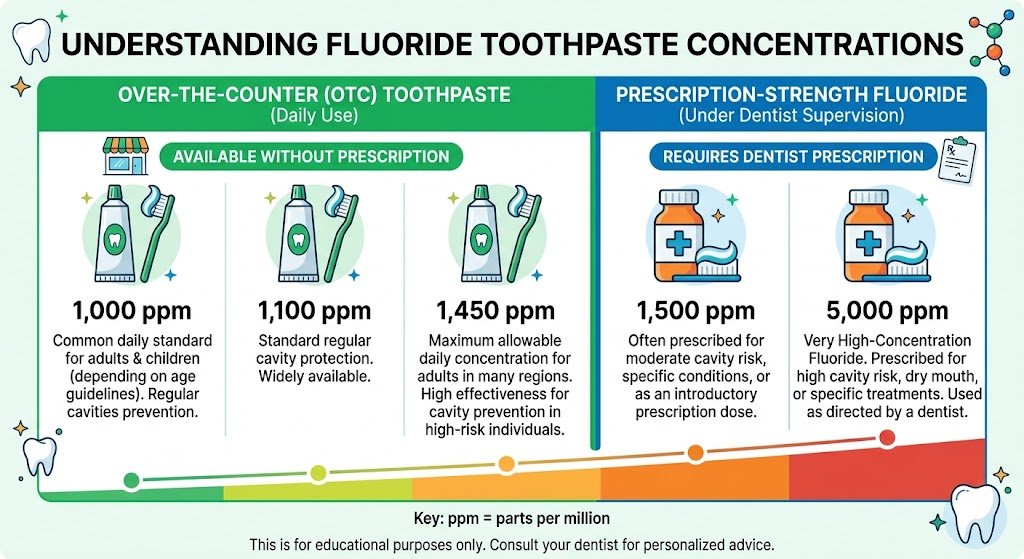
Choosing a fluoride toothpaste can be confusing when the package lists numbers such as 1,000 ppm, 1,100 ppm, 1,450 ppm, 1,500 ppm, or even 5,000 ppm.
Those numbers refer to the concentration of fluoride in the toothpaste. For most over-the-counter fluoride toothpastes sold in the U.S., the concentration generally falls between 1,000 and 1,500 parts per million (ppm). Prescription-strength fluoride toothpaste can contain 5,000 ppm.
But a higher number does not automatically mean a toothpaste is the right choice for everyone.
In this guide, you’ll learn what fluoride toothpaste concentration means, how ppm works, what the common fluoride levels mean, how adult and children’s needs differ, what 5,000 ppm toothpaste is used for, and how to read a toothpaste label before buying.
What Does Fluoride Toothpaste Concentration Mean?
Fluoride toothpaste concentration describes how much fluoride is present in the toothpaste formulation. The concentration is commonly expressed as parts per million, or ppm.
For example, when a toothpaste label says 1,450 ppm fluoride, the number tells you the concentration of fluoride in that product. It is not a score that rates the toothpaste’s overall quality.
This distinction is important.
A toothpaste with a higher ppm number is not automatically better in every situation. Fluoride concentration is only one part of choosing a toothpaste. Your age, cavity risk, dental history, other ingredients, and specific oral-health needs can also matter.
PPM vs. Fluoride Ingredient
The toothpaste may also list the specific fluoride compound used as its active ingredient.
Common fluoride ingredients in U.S. toothpastes include:
- Sodium fluoride
- Stannous fluoride
- Sodium monofluorophosphate
So when reading a toothpaste label, think about two separate pieces of information:
Which fluoride ingredient is used?
And
What fluoride concentration does the product provide?
Both can be useful when comparing products.
How Much Fluoride Is in Regular Toothpaste?
In the United States, over-the-counter fluoride toothpastes generally contain 1,000 to 1,500 ppm fluoride, according to the American Dental Association. Prescription-strength fluoride toothpastes can contain 5,000 ppm.
That means numbers in this general range are not unusual:
- 1,000 ppm
- 1,100 ppm
- 1,450 ppm
- 1,500 ppm
However, these numbers should not be treated as a simple ranking where the largest number automatically wins.
1,000 ppm Fluoride Toothpaste
A toothpaste containing 1,000 ppm fluoride falls within the typical U.S. over-the-counter range.
For a reader comparing products, the important point is that 1,000 ppm is a genuine fluoride-containing toothpaste concentration rather than a fluoride-free formulation.
The appropriate product still depends on the person using it and their dental needs.
1,100 ppm Fluoride Toothpaste
1,100 ppm is another concentration that can appear on fluoride toothpaste labels.
When comparing a 1,100 ppm product with another fluoride toothpaste, don’t judge the products by the number alone. Look at the active fluoride ingredient, intended user, product formulation, and any specific dental need the toothpaste is designed to address.
1,450 ppm Fluoride Toothpaste
1,450 ppm is a commonly encountered concentration in fluoride toothpaste.
It sits toward the upper end of the typical U.S. over-the-counter range. For shoppers, this is one reason it is useful to understand ppm rather than simply looking for the word “fluoride.”
1,500 ppm Fluoride Toothpaste
1,500 ppm is at the upper end of the general 1,000–1,500 ppm range described by the ADA for U.S. OTC fluoride toothpastes.
That does not mean everyone should automatically choose 1,500 ppm.
The right concentration should be considered in the context of the individual, especially for children and people with specific dental concerns.
Is Higher Fluoride Concentration Better?
Not necessarily.
It’s easy to assume that if fluoride helps protect teeth, then more fluoride must provide better protection. But toothpaste selection is not that simple.
For most consumers shopping for regular OTC toothpaste, the relevant comparison is generally within the 1,000–1,500 ppm range. A 5,000 ppm product is different because it is prescription-strength and intended for specific clinical situations.
The concentration may become more important when someone has a higher risk of developing tooth decay. A dental professional can consider factors such as previous cavities, exposed roots, dry mouth, oral hygiene, diet, medications, and other individual circumstances when deciding whether additional or higher-strength fluoride is appropriate.
So the better question isn’t:
“What’s the highest fluoride concentration I can buy?”
A better question is:
“What fluoride concentration is appropriate for my age and dental needs?”
That distinction helps prevent unnecessary self-treatment with high-strength fluoride products.
1000 vs 1100 vs 1450 vs 1500 ppm: What’s the Difference?
Here’s a simple way to understand the numbers:
| Fluoride concentration | General category | What it means |
| 1,000 ppm | OTC fluoride toothpaste | Within the typical U.S. OTC range |
| 1,100 ppm | OTC fluoride toothpaste | Another common fluoride concentration |
| 1,450 ppm | OTC fluoride toothpaste | Toward the upper end of the typical OTC range |
| 1,500 ppm | OTC fluoride toothpaste | Upper end of the typical U.S. OTC range |
| 5,000 ppm | Prescription-strength | A substantially higher concentration used under professional guidance |
The table is useful for understanding the numbers, but it should not be interpreted as a “best to worst” ranking.
A 1,500 ppm toothpaste isn’t automatically the right choice for every adult, and a 1,000 ppm product isn’t automatically inadequate.
Product selection should also consider the active fluoride ingredient, the person’s dental risk, age, formulation, and any specific needs.
For general shoppers, this is where product comparison becomes useful. Instead of looking only at the largest ppm number, compare the entire formulation and intended use.
What Fluoride Toothpaste Concentration Is Best for Adults?
For many adults, a regular OTC fluoride toothpaste is the starting point. The ADA describes U.S. OTC fluoride toothpastes as generally containing 1,000–1,500 ppm fluoride, and recommends brushing twice daily with fluoride toothpaste for most people.
Fluoride remains useful beyond childhood. NIDCR explains that fluoride helps prevent tooth decay across the lifespan and that both children and adults benefit from it.
However, adults don’t all have the same cavity risk.
Someone who rarely develops cavities may have different needs from someone who:
- Frequently develops new cavities
- Has exposed tooth roots
- Has dry mouth
- Takes medications that reduce saliva
- Has difficulty maintaining oral hygiene
- Has been told by a dentist that they are at high risk for decay
For someone at higher risk, a dentist may recommend additional fluoride or a prescription-strength product.
If you are simply shopping for everyday OTC toothpaste, you generally don’t need to assume that the highest available concentration is automatically appropriate.
What Fluoride Concentration Is Best for Children?
Children require more careful consideration because they may swallow toothpaste while brushing.
The issue is not only the fluoride concentration. The amount of toothpaste used and whether the child swallows it also matter.
CDC guidance recommends using only a small amount of fluoride toothpaste for young children. For children younger than 3, the amount should be no more than a smear about the size of a grain of rice. For children ages 3 to 6, no more than a pea-sized amount should be used, with supervision to encourage spitting rather than swallowing.
For children younger than 2, CDC and NIDCR advise consulting a doctor or dentist about fluoride toothpaste use.
This is also why parents should not treat fluoride concentration as a simple “higher is better” decision.
For children, consider:
- The child’s age
- The amount of toothpaste used
- Whether the child can spit reliably
- The child’s cavity risk
- Guidance from their dentist or healthcare professional
Excessive fluoride ingestion while teeth are developing can contribute to dental fluorosis, which is why appropriate toothpaste amounts and supervision are important.
What Is 5000 ppm Fluoride Toothpaste?
5,000 ppm fluoride toothpaste is prescription-strength toothpaste.
It is substantially more concentrated than the typical 1,000–1,500 ppm OTC range. The ADA identifies prescription-strength fluoride toothpaste as containing 5,000 ppm fluoride as sodium fluoride.
That doesn’t mean 5,000 ppm is simply a “better” version of regular toothpaste.
High-fluoride toothpaste may be considered for people with particular dental needs, including those at increased risk of tooth decay. The decision should come from a dental professional who understands the individual’s risk factors.
This distinction matters when shopping online.
If you see a toothpaste advertised with a much higher fluoride concentration than ordinary OTC products, don’t assume the higher number makes it the ideal everyday toothpaste. Check whether it is prescription-strength and whether it is appropriate for your situation.
If you believe you need high-fluoride toothpaste because of frequent cavities or another dental concern, discuss that need with your dentist rather than choosing a prescription-strength product simply because its ppm number is higher.
Does the Type of Fluoride Ingredient Matter?
Yes. Fluoride concentration is important, but the type of fluoride compound is another part of the formulation.
Sodium Fluoride
Sodium fluoride is a commonly used fluoride active ingredient in toothpaste.
It is also the fluoride compound used in the 5,000 ppm prescription-strength toothpaste described by the ADA.
Stannous Fluoride
Stannous fluoride is another active fluoride ingredient used in U.S. toothpastes.
Some formulations use stannous fluoride because the ingredient can serve fluoride-related anticaries functions while also being used in formulations targeting other oral-health concerns.
When comparing a stannous fluoride toothpaste with a sodium fluoride toothpaste, don’t assume the compound name alone tells you which product is better. Consider the complete formulation and the reason you’re buying the toothpaste.
Sodium Monofluorophosphate
Sodium monofluorophosphate is another fluoride compound used as an anticaries ingredient in toothpaste.
The ADA identifies sodium fluoride, stannous fluoride, and sodium monofluorophosphate among fluoride compounds used in toothpastes.
This means that when you’re comparing toothpaste labels, you may see different ingredient names even though both products are fluoride toothpastes.
How to Read Fluoride Concentration on a Toothpaste Label
Once you understand ppm, choosing between products becomes much easier.
Use this simple process.
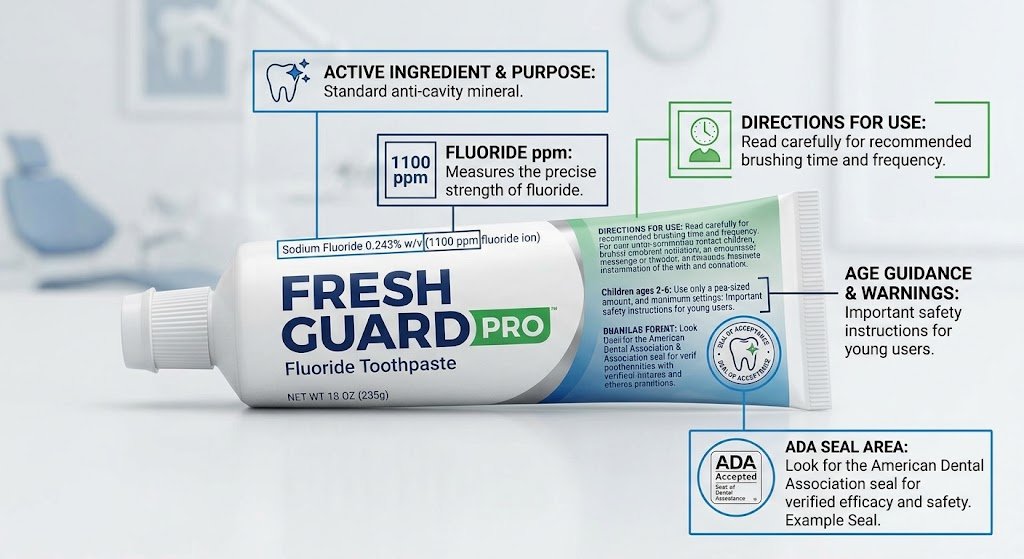
Step 1: Find the Active Ingredient
Look for the section that identifies the active ingredient.
You may see:
- Sodium fluoride
- Stannous fluoride
- Sodium monofluorophosphate
This tells you which fluoride compound the product uses.
Step 2: Check the Fluoride Concentration
Look for the fluoride concentration expressed in ppm.
For example, you may see a number such as 1,000, 1,100, 1,450, or 1,500 ppm.
Don’t assume the biggest number is automatically the best option.
Step 3: Determine Whether It Is OTC or Prescription-Strength
A regular OTC toothpaste and a 5,000 ppm prescription toothpaste should not be treated as interchangeable products.
If the product has an unusually high fluoride concentration, check the labeling and follow professional guidance.
Step 4: Consider Who Will Use It
An adult choosing everyday toothpaste has different considerations from a parent buying toothpaste for a young child.
For children, the amount of toothpaste and supervision are especially important.
Step 5: Consider Your Dental Needs
Think beyond the fluoride number.
Do you mainly want:
- Everyday cavity protection?
- Help with sensitive teeth?
- Enamel-focused care?
- An SLS-free formulation?
- A toothpaste for a child?
- A product recommended by your dentist for higher cavity risk?
The answer can change which formulation makes sense.
Step 6: Look for Trustworthy Quality Signals
The ADA Seal of Acceptance can be one useful signal when comparing eligible dental products. The ADA explains that accepted toothpastes must meet requirements related to safety and efficacy, and anticaries toothpastes must contain fluoride.
Once you know how to read these details, you can compare products based on your actual needs instead of choosing solely by the largest number.
Fluoride Concentration vs Fluoride-Free Toothpaste
The most obvious difference is simple: fluoride toothpaste contains fluoride as an active anticaries ingredient, while fluoride-free toothpaste does not provide fluoride from the toothpaste.
Fluoride has a well-established role in preventing tooth decay. It can help strengthen enamel and support the repair of early mineral loss. NIDCR explains that early tooth decay can sometimes be stopped or reversed before a cavity forms, with saliva and fluoride helping restore lost minerals.
That does not mean every person’s toothpaste decision can be reduced to “fluoride good, fluoride-free bad.”
People may choose different formulations for different reasons. But if cavity prevention is a major goal, it’s important to understand what you give up when choosing a fluoride-free toothpaste.
For readers who are specifically comparing fluoride and fluoride-free products, the decision should be based on their oral-health goals and, when necessary, guidance from a dental professional.
What Else Should You Consider Besides Fluoride Concentration?
Fluoride concentration is important, but it is not the entire toothpaste-selection process.
Active Fluoride Ingredient
Compare whether the toothpaste contains sodium fluoride, stannous fluoride, or sodium monofluorophosphate.
Your Dental Need
A general-purpose toothpaste may be appropriate for everyday cavity prevention, while someone with sensitivity or a higher cavity risk may want a more specific formulation.
SLS and Other Ingredients
If you’re specifically looking for a cleaner or more minimalist formulation, you may also want to check whether the toothpaste contains sodium lauryl sulfate (SLS) and other ingredients that matter to you.
Abrasivity
A toothpaste can contain an appropriate amount of fluoride and still not be the right product for every person. If enamel preservation is important to you, the overall formulation and abrasivity deserve consideration.
Product Purpose
A whitening toothpaste, sensitive-teeth toothpaste, children’s toothpaste, and general cavity-protection toothpaste may have different formulations.
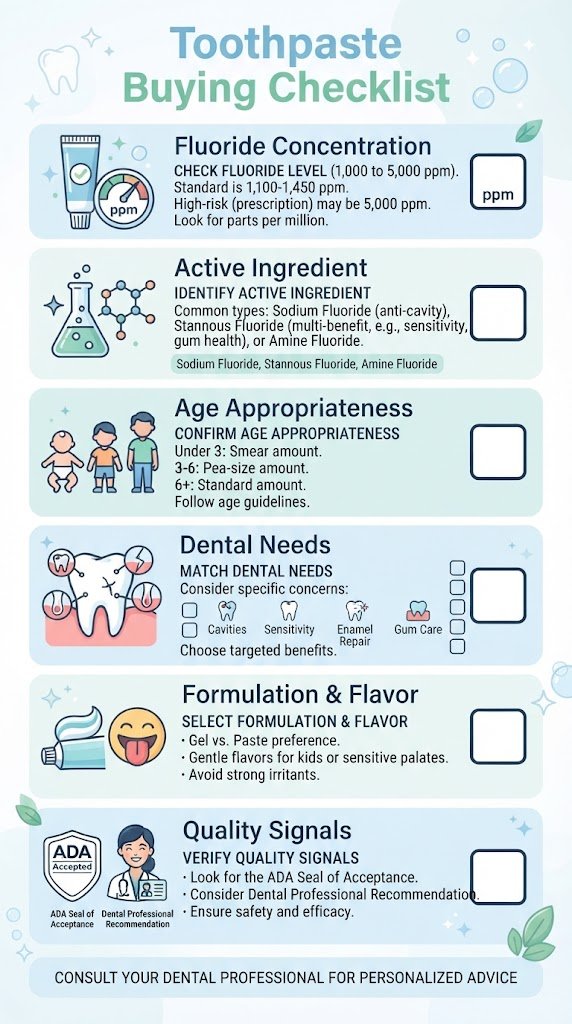
The best buying decision is therefore not:
“Which toothpaste has the highest ppm?”
It is:
“Which fluoride toothpaste has an appropriate concentration and formulation for my needs?”
Frequently Asked Questions
What does ppm mean in fluoride toothpaste?
PPM means parts per million and is used to describe the concentration of fluoride in toothpaste. For U.S. over-the-counter fluoride toothpastes, the ADA generally describes concentrations from 1,000 to 1,500 ppm. Prescription-strength toothpaste can contain 5,000 ppm.
Is 1000 ppm fluoride enough?
1,000 ppm is within the typical U.S. OTC fluoride toothpaste range. Whether a particular concentration is appropriate depends on factors such as age, dental history, and cavity risk. A higher number should not automatically be assumed to be necessary.
Is 1500 ppm fluoride toothpaste better than 1000 ppm?
Not automatically. Both fall within the general U.S. OTC range described by the ADA. The appropriate choice depends on the individual and the complete toothpaste formulation rather than concentration alone.
What is 5000 ppm fluoride toothpaste?
5,000 ppm fluoride toothpaste is prescription-strength and is substantially more concentrated than typical OTC fluoride toothpaste. It may be recommended for people with particular dental needs or higher cavity risk. It should be used according to professional guidance.
What fluoride concentration is best for adults?
For many adults, a standard OTC fluoride toothpaste in the typical 1,000–1,500 ppm range is appropriate for everyday use. People with higher cavity risk may have different needs and should discuss those needs with a dentist.
What fluoride concentration is safe for children?
Children require special attention to both fluoride exposure and the amount of toothpaste used. CDC recommends no more than a rice-grain-sized smear for children younger than 3 and no more than a pea-sized amount for ages 3–6, with supervision. For children younger than 2, consult a doctor or dentist about fluoride toothpaste use.
How do I know how much fluoride is in my toothpaste?
Check the toothpaste label for its active ingredient and fluoride concentration. The concentration may be expressed in ppm. Also check the product directions and intended age group.
Does higher fluoride mean better cavity protection?
Higher fluoride concentration can have a role in certain higher-risk situations, but it does not mean that the highest concentration is appropriate for everyone. Standard OTC toothpaste and prescription-strength toothpaste serve different purposes.
Bottom Line: How Much Fluoride Should Your Toothpaste Have?
For most people shopping for regular fluoride toothpaste in the U.S., the useful starting point is understanding the 1,000–1,500 ppm OTC range rather than searching for the highest possible number. The ADA identifies this as the general concentration range for OTC fluoride toothpastes, while 5,000 ppm products are prescription-strength.
The right choice depends on more than ppm.
Consider:
- Your age
- Your cavity risk
- The active fluoride ingredient
- Your specific dental needs
- The toothpaste formulation
- Whether the product is OTC or prescription-strength
- Relevant quality signals such as the ADA Seal
For children, the amount of toothpaste and supervision are especially important. For people with frequent cavities or other high-risk conditions, a dentist can determine whether a higher-strength fluoride product is appropriate.
If you’re ready to compare everyday fluoride toothpaste options, start by looking at the concentration, active ingredient, formulation, and intended use rather than choosing a product solely because it has the largest fluoride number.
