Tooth enamel is constantly going through a cycle of mineral loss and mineral replacement. Acid from plaque can pull minerals out of enamel, while saliva and fluoride help put minerals back and make the tooth surface more resistant to future acid attacks.
That process is called remineralization. Fluoride does not simply “grow new enamel,” but it can support remineralization and help prevent early tooth decay from progressing.
In this guide, you’ll learn how enamel loses minerals, how fluoride supports remineralization, what happens during the process, and what to look for in a fluoride toothpaste if your goal is better enamel and cavity protection.
What Is Enamel Remineralization?
Enamel remineralization is the process in which minerals are deposited back into tooth enamel after some of those minerals have been lost.
Enamel is the hard outer layer of a tooth. Much of its mineral structure is made from calcium and phosphate arranged in crystals related to hydroxyapatite. When acids repeatedly attack the tooth surface, some of these minerals can dissolve and leave the enamel weakened.
Your mouth has natural defenses against this process. Saliva contains minerals that can help replenish the tooth surface, while fluoride can help the remineralized enamel become more resistant to acid.
This creates a constant balance:
Demineralization → minerals leave enamel
Remineralization → minerals return to enamel
The balance does not always stay the same. Frequent acid exposure can shift it toward mineral loss, while saliva, fluoride and good oral hygiene can help shift it back toward protection.
What Is Demineralization?
Demineralization happens when acids cause minerals to leave the enamel.
It can occur naturally after eating because bacteria in dental plaque can use carbohydrates and produce acids. When the environment around the tooth becomes acidic enough, minerals in enamel become more likely to dissolve.
This does not mean every acid exposure immediately creates a cavity. Teeth can recover from many short periods of mineral loss because saliva and fluoride help support remineralization.
The problem develops when mineral loss repeatedly outweighs mineral replacement.
Why Does Tooth Enamel Lose Minerals?
Enamel is strong, but it is not immune to acid.
Acid From Plaque Bacteria
Dental plaque contains bacteria that can use sugars and other fermentable carbohydrates from food and drinks. Their metabolism can produce acids that lower the pH around the tooth.
When the environment becomes acidic, minerals can begin leaving the enamel.
This is one reason frequent exposure to fermentable carbohydrates can increase the conditions that contribute to tooth decay.
Demineralization
During an acid attack, calcium and phosphate can leave the enamel’s mineral structure.
If the acid exposure is limited and the mouth returns to a healthier environment, saliva can help restore some of those minerals. Fluoride can also help the tooth surface resist further mineral loss and support remineralization.
NIDCR describes tooth decay as a balance between factors that cause mineral loss and protective factors such as saliva and fluoride.
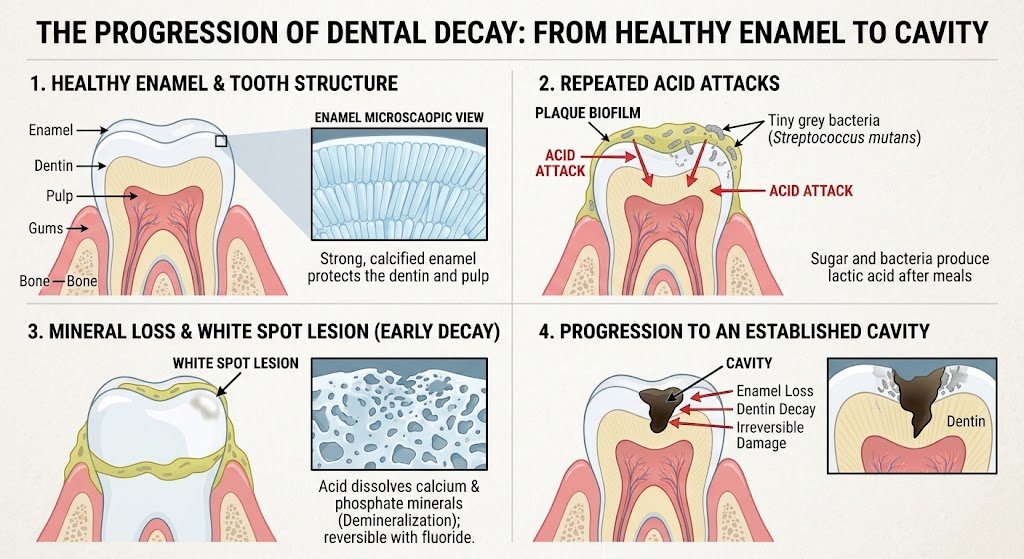
What Early Enamel Damage Looks Like
Early mineral loss does not necessarily look like a hole in the tooth.
One possible sign of early decay is a white spot lesion, where the enamel has lost minerals beneath its surface while the outer surface may still be intact.
This stage is important because early tooth decay can sometimes be stopped or reversed before it develops into an actual cavity.
Once enough mineral structure is lost to create a physical hole, however, fluoride cannot simply replace the missing tooth structure.
How Does Fluoride Help Remineralize Enamel?
Fluoride’s role is more specific than simply saying that it “strengthens teeth.”
It helps influence the balance between mineral loss and mineral replacement at the tooth surface.
Fluoride Helps Reduce Mineral Loss
When fluoride is present around the teeth, it can make the enamel surface less susceptible to dissolution during acid attacks.
This matters because tooth decay is not caused by one single acid exposure. It develops when repeated episodes of mineral loss are not adequately balanced by periods of mineral replacement.
By helping reduce mineral loss, fluoride can shift that balance in a protective direction.
Fluoride Helps Replace Lost Minerals
Fluoride also supports remineralization when minerals are available in the mouth.
Saliva naturally provides calcium and phosphate. When fluoride is present, it can help these minerals become incorporated into weakened enamel and contribute to a mineral structure that is more resistant to acid.
This is why remineralization should not be thought of as fluoride working alone.
A simpler model is:
Saliva provides minerals + fluoride helps the tooth use them effectively → stronger, more acid-resistant enamel
The American Dental Association explains that topical fluoride can encourage remineralization and help produce a tooth structure that is more resistant to acid.
Fluoride Helps Create a More Acid-Resistant Surface
One of the important benefits of fluoride is that the mineral structure formed during remineralization can be more resistant to future acid attacks.
That does not make teeth completely resistant to acids. Instead, fluoride helps improve the tooth’s ability to withstand the acidic conditions associated with tooth decay.
This is especially important because your teeth are exposed to changing conditions throughout the day.
Fluoride Works With Saliva
Saliva is an important part of the remineralization process.
It helps:
- wash food and acids away
- buffer acids
- provide calcium and phosphate
- support the natural repair process
Fluoride adds another layer of protection by remaining available around the tooth and influencing the mineral balance.
The CDC explains that fluoride can replace minerals lost from teeth, make enamel harder to dissolve, and may also affect bacterial acid production and attachment.
So the process is not simply:
Fluoride → stronger teeth
It is closer to:
Acid exposure → mineral loss → saliva + minerals + fluoride → remineralization → greater resistance to future acid attacks
What Happens During Fluoride Remineralization?
Fluoride and enamel remineralization can be easier to understand when the process is broken down into steps.
Step 1: Acid Attacks the Enamel
Plaque bacteria produce acids after using fermentable carbohydrates.
Those acids can begin dissolving minerals from enamel.
Step 2: Minerals Are Lost
Calcium and phosphate can leave the enamel’s mineral structure.
If this happens repeatedly, the tooth can become progressively weaker.
Step 3: Saliva Supplies Minerals
As the mouth returns toward a less acidic environment, saliva provides calcium and phosphate that can participate in remineralization.
Step 4: Fluoride Becomes Available
Fluoride from toothpaste, drinking water or other topical sources can be present in saliva and around the tooth surface.
Step 5: Minerals Are Deposited Back
Fluoride helps support the incorporation of minerals into areas of weakened enamel.
Step 6: The Repaired Surface Becomes More Resistant
The resulting mineral structure can be more resistant to future acid attacks than the original demineralized surface.
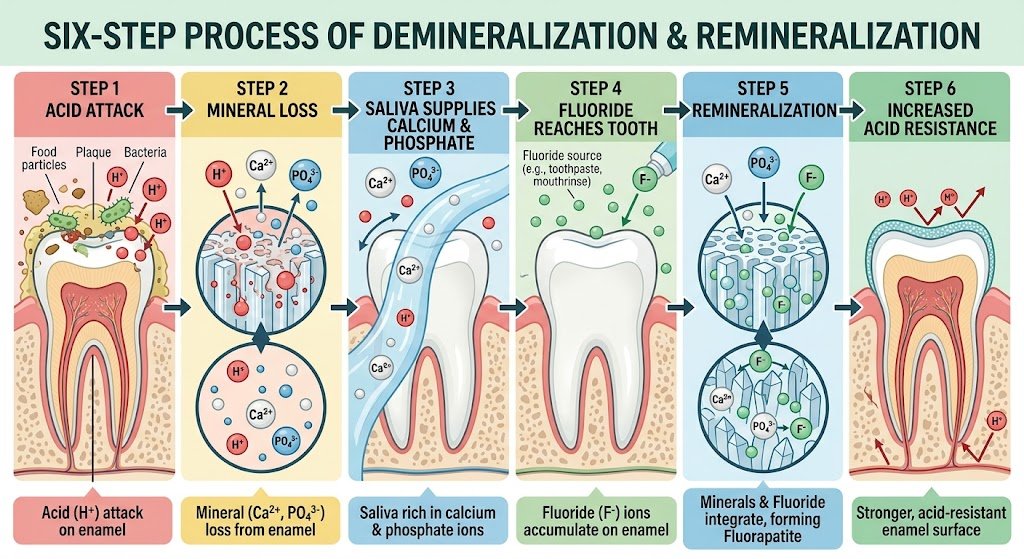
This is why fluoride is particularly useful as part of regular oral care. The goal is not to wait until a cavity appears. The goal is to repeatedly support the tooth during the normal cycle of mineral loss and replacement.
Can Fluoride Reverse Early Enamel Damage?
In some cases, early tooth decay can be stopped or reversed before an actual cavity forms.
This distinction is important.
Early decay involves mineral loss while the tooth structure may still be largely intact. At this stage, saliva and fluoride can support remineralization and help prevent the process from progressing.
An established cavity is different.
When enough enamel or tooth structure has been lost to create a physical hole, fluoride cannot simply rebuild the missing structure. A dentist may need to restore the damaged tooth.
NIDCR specifically distinguishes early decay that can be stopped or reversed from an established cavity that may require a filling or other restorative treatment.
So when you hear that fluoride can “repair enamel,” the more accurate interpretation is:
Fluoride can support the remineralization of weakened enamel and help prevent early mineral loss from progressing.
It does not mean that fluoride can regrow a completely missing section of enamel.
Does Fluoride Actually Rebuild Enamel?
Not in the same way that your body grows new tissue.
The word remineralization can sometimes create confusion because it sounds like complete rebuilding.
Instead, think of it as restoring minerals to a weakened tooth surface.
A simplified example:
Imagine enamel has lost some of its mineral content because of repeated acid attacks. The tooth has not necessarily developed a cavity yet. Saliva supplies minerals, and fluoride helps support their incorporation into the enamel.
The result is not brand-new biological enamel growing over the tooth.
It is a mineral-repair process that can make the affected surface stronger and more resistant to acid.
That distinction is important when evaluating toothpaste claims. A product should not be described as literally “regrowing lost enamel” unless there is strong evidence supporting that specific claim.
How Does Fluoride Toothpaste Support Enamel Remineralization?
Fluoride toothpaste provides a convenient way to bring fluoride into direct contact with your teeth during brushing.
The benefit comes from more than simply having fluoride somewhere in the toothpaste tube. What matters is getting an appropriate amount of fluoride onto the teeth and using the toothpaste consistently.
Fluoride Reaches the Tooth Surface
During brushing, fluoride-containing toothpaste spreads across the teeth.
Some fluoride becomes available in the mouth and can interact with the tooth surface and saliva.
This provides topical exposure at the place where demineralization and remineralization occur.
Regular Use Matters
The mouth goes through many cycles of eating, acid exposure and recovery.
Regular brushing with fluoride toothpaste helps maintain repeated opportunities for fluoride exposure rather than relying on a single occasional application.
For this reason, fluoride toothpaste is a central part of cavity-prevention guidance.
Common Fluoride Ingredients
Common fluoride compounds used in toothpaste include:
- Sodium fluoride
- Stannous fluoride
- Sodium monofluorophosphate
The specific formulation can vary between products.
For US over-the-counter fluoride toothpastes, the ADA notes that concentrations are generally in the 1,000–1,500 ppm range. The appropriate product depends on factors such as age, dental risk and individual circumstances.
The important point is that choosing a toothpaste should not be based only on whether the label says “fluoride.” The active ingredient, concentration, formulation and your own dental needs all matter.
Does Fluoride Work for Adults?
Yes. Fluoride is not only relevant to children’s teeth.
Adults can experience enamel mineral loss and tooth decay throughout life. Teeth remain exposed to acids, plaque bacteria and other factors that can contribute to demineralization.
Topical fluoride can help protect erupted teeth by reducing mineral loss and supporting remineralization.
Adults may have additional reasons to pay attention to fluoride, including:
- previous cavities
- gum recession
- exposed root surfaces
- dry mouth
- dietary acid exposure
- difficulty maintaining oral hygiene
The appropriate oral-care routine depends on individual risk. Someone with frequent cavities or significant dry mouth may need advice that goes beyond choosing an ordinary toothpaste.
NIDCR recognizes fluoride as an important tool for preventing tooth decay in both children and adults.
Fluoride vs Fluoride-Free Toothpaste for Enamel
If your main concern is enamel protection and cavity prevention, the difference between fluoride and fluoride-free toothpaste is important.
| Factor | Fluoride Toothpaste | Fluoride-Free Toothpaste |
| Contains fluoride | Yes | No |
| Supports fluoride-based remineralization | Yes | No |
| Cavity-prevention role | Well established | Depends on the alternative formulation |
| Useful for enamel protection | Yes | May offer other benefits, depending on ingredients |
| Main consideration | Fluoride ingredient and concentration | What active ingredients replace fluoride |
This does not mean every person must choose the same toothpaste.
Some people specifically prefer fluoride-free formulations for personal reasons. However, the choice should be made with an understanding of what is being gained and what is being given up.
If your primary goal is evidence-based fluoride exposure for cavity prevention, a fluoride toothpaste provides a mechanism that fluoride-free toothpaste does not.
For someone specifically comparing remineralization ingredients, hydroxyapatite may also come up. That is a separate comparison because it works through a different ingredient approach.
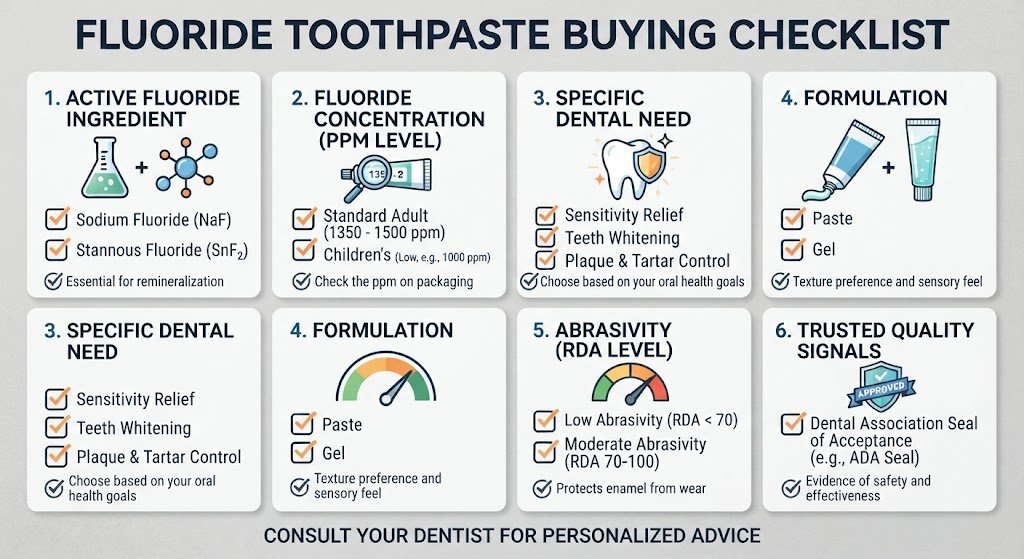
What to Look for in a Fluoride Toothpaste for Enamel Protection
Once you understand how fluoride supports remineralization, choosing a toothpaste becomes much easier.
You don’t necessarily need the toothpaste with the longest ingredient list or the most marketing claims. Instead, focus on features that relate directly to your oral-health needs.
Check the Active Fluoride Ingredient
Look at the active ingredients section of the package.
Common fluoride ingredients include:
- sodium fluoride
- stannous fluoride
- sodium monofluorophosphate
Different fluoride compounds can have different properties and may be combined with other ingredients for additional oral-health benefits.
Check the Fluoride Concentration
Look for the fluoride concentration listed on the packaging.
For standard US OTC fluoride toothpaste, the concentration is generally within the range discussed by the ADA. Don’t assume that a higher number automatically makes a toothpaste better for everyone.
Children, people with particular dental risks, and people who have been prescribed high-fluoride products may have different recommendations.
Consider Your Dental Needs
Your best choice depends on what you are trying to accomplish.
For example:
Concerned mainly about cavities?
Prioritize an appropriate fluoride toothpaste and consistent brushing.
Concerned about sensitivity?
Look for a fluoride toothpaste designed for sensitive teeth and consider the additional active ingredients.
Concerned about enamel?
Pay attention to fluoride, formulation and how abrasive the toothpaste is.
Looking for a fluoride toothpaste without SLS?
You can compare formulations while still maintaining fluoride exposure.
Consider Abrasivity and Formulation
A toothpaste is more than its fluoride ingredient.
Other characteristics can matter depending on your needs, including:
- abrasivity
- flavoring ingredients
- detergents
- sensitivity ingredients
- whitening ingredients
- humectants
- preservatives
Someone concerned about enamel may want to avoid assuming that a strongly marketed whitening toothpaste is automatically the best option for everyday enamel care.
Look for Trusted Quality Signals
When comparing products, look for transparent labeling and clear information about the active ingredients.
The ADA Seal of Acceptance can also be a useful quality signal when available because products carrying the seal have met the ADA’s applicable evaluation requirements.
Where to Start if You Want to Compare Products
Once you’ve identified the features that matter to you, you can compare fluoride toothpaste options rather than choosing based only on branding or marketing language.
This is the point where product recommendations become useful because you already know what you’re looking for and why.
Can Fluoride Fix an Existing Cavity?
An important limitation is that fluoride is not a substitute for restorative dental treatment.
If a tooth has an established cavity with a physical hole, fluoride cannot simply fill the missing structure.
Fluoride is most useful earlier in the process, when mineral loss has occurred but the tooth has not developed irreversible structural damage.
That is why prevention and early intervention matter.
If you have persistent tooth pain, a visible hole, swelling, significant sensitivity or another concerning dental symptom, a dentist can determine whether there is an established cavity or another problem requiring treatment.
Frequently Asked Questions
Does fluoride really remineralize enamel?
Yes. Fluoride supports the remineralization process by helping minerals become incorporated into weakened enamel and by making the resulting tooth structure more resistant to acid. It does not mean that fluoride grows completely new enamel.
How does fluoride help remineralization?
Fluoride works alongside saliva and minerals such as calcium and phosphate. After acids cause some mineral loss, fluoride can help the tooth surface regain minerals and become more resistant to future acid attacks.
Can fluoride repair weakened enamel?
Fluoride can support the remineralization of enamel that has experienced early mineral loss. However, this is different from completely rebuilding enamel that has physically disappeared. Early decay and an established cavity should not be treated as the same thing.
Can fluoride reverse early tooth decay?
Early tooth decay can sometimes be stopped or reversed when mineral loss has not progressed to an established cavity. Fluoride, saliva and good oral hygiene can all contribute to this process.
Can fluoride fix a cavity?
No. Fluoride can help prevent and control early tooth decay, but an established cavity involves permanent loss of tooth structure. A dentist may need to restore the damaged area.
Does saliva help remineralize teeth?
Yes. Saliva is an important part of natural remineralization because it provides minerals such as calcium and phosphate and helps neutralize acids. Fluoride works alongside these natural protective processes.
Does fluoride work for adults?
Yes. Adults can benefit from topical fluoride because erupted teeth remain vulnerable to mineral loss and decay. Fluoride toothpaste is an important part of routine cavity prevention for many adults.
What fluoride toothpaste is best for enamel?
There is no single toothpaste that is best for every person. Start by looking for an appropriate fluoride active ingredient and concentration, then consider your dental needs, formulation and other features. People with specific dental problems should follow advice from their dentist.
Is fluoride better than fluoride-free toothpaste for cavity protection?
Fluoride has an established role in cavity prevention and supports remineralization. Fluoride-free toothpaste may be chosen for other reasons, but it does not provide the same fluoride exposure. The right choice depends on your goals and dental needs.
Bottom Line
Fluoride and enamel remineralization are closely connected because fluoride helps the teeth recover from the mineral loss caused by acid attacks.
The process is not simply about “making enamel grow back.” Instead, fluoride works with saliva and minerals such as calcium and phosphate to support remineralization, reduce mineral loss and create a tooth surface that is more resistant to future acid attacks.
The biggest benefit comes before a cavity becomes established. Early mineral loss can sometimes be stopped or reversed, while a formed cavity may require professional dental treatment.
If you’re choosing a toothpaste specifically for enamel and cavity protection, start with the fundamentals: check the active fluoride ingredient, concentration, formulation and your individual dental needs.
