If you notice ingredients such as sodium saccharin or sucralose on a toothpaste label, it is reasonable to wonder why a sweetener is there in the first place—and whether it is something you should avoid.
In most toothpaste formulations, sweeteners are used mainly to improve taste rather than to provide the main oral-health benefit. The important question is therefore not simply whether an ingredient sounds “artificial,” but what the ingredient does, how the toothpaste is intended to be used, and whether the overall formulation meets your oral-health needs. The American Dental Association notes that non-caloric sweeteners are common in toothpaste, while sugar and other cavity-causing ingredients are not permitted in ADA-Accepted toothpastes. ADA
This guide explains why sweeteners are added to toothpaste, which ones you may see on labels, what safety considerations actually matter, and how to choose a toothpaste if you prefer to avoid artificial sweeteners.
Why Does Toothpaste Contain Artificial Sweeteners?
Toothpaste is not supposed to taste like the ingredients that make up its formula.
Some ingredients can have bitter, chemical, salty, or otherwise unpleasant tastes. A small amount of a sweetening ingredient can make the finished toothpaste more pleasant to use without turning it into a sugary product.
The American Dental Association lists non-caloric sweeteners as common toothpaste ingredients. It also distinguishes them from sugar and other cariogenic ingredients, which are not permitted in ADA-Accepted toothpaste. ADA
So, when you see a sweetener on a toothpaste label, its primary role is generally related to taste and formulation, not cavity protection.
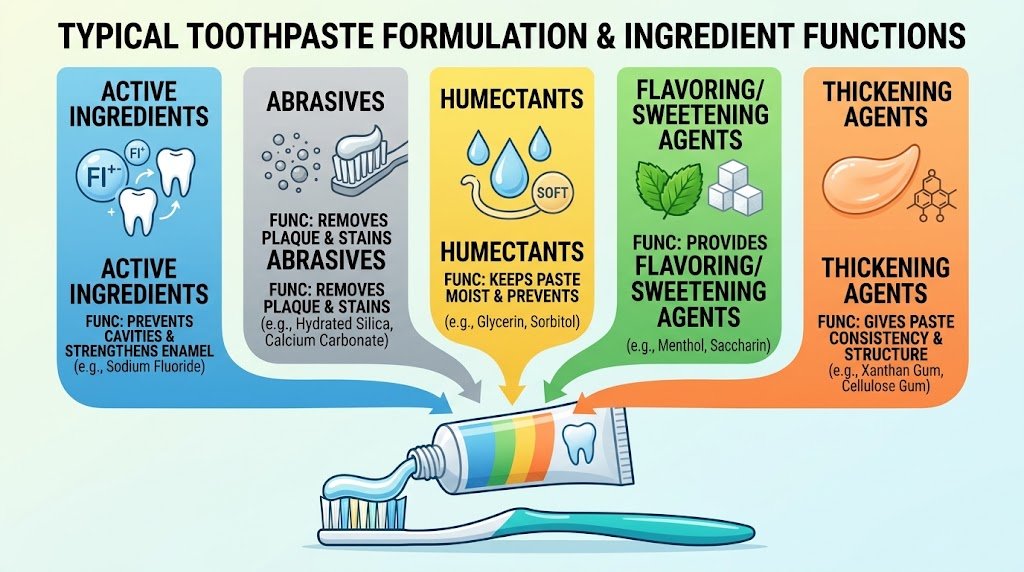
That distinction matters because toothpaste contains different types of ingredients for different jobs:
- Active ingredients may help prevent cavities or address other oral-health concerns.
- Abrasives help clean teeth and remove surface deposits.
- Humectants help keep toothpaste from drying out.
- Flavoring and sweetening ingredients help make brushing more pleasant.
- Thickening agents help maintain the desired texture.
For example, the ADA identifies fluoride compounds such as sodium fluoride, sodium monofluorophosphate, and stannous fluoride as anticaries active ingredients in toothpaste. ADA
In other words, a sweetener should not be confused with the ingredient responsible for a toothpaste’s cavity-protection claim.
Which Artificial Sweeteners Are Found in Toothpaste?
The exact sweetener depends on the formulation. You should always check the current ingredient list of the specific product rather than assuming every toothpaste contains the same ingredients.
Sodium Saccharin
Sodium saccharin is one sweetening ingredient that appears in some toothpaste formulations.
For example, the ADA’s current listing for Colgate Cavity Protection Gel & Toothpaste identifies sodium saccharin as an inactive ingredient, while sodium monofluorophosphate is the active ingredient. The same listing describes the product as having the ADA Seal of Acceptance for helping prevent tooth decay when used as directed. ADA
This is a useful example of why ingredient labels need context.
Seeing sodium saccharin on a toothpaste label does not mean that sodium saccharin is the ingredient providing cavity protection. In that formulation, it is listed separately from the active anticaries ingredient.
Saccharin is also an FDA-regulated high-intensity sweetener for food use, with FDA describing it as an approved sweetener under specified conditions of use. U.S. Food and Drug Administration
Sucralose
Sucralose is another high-intensity sweetener you may encounter in oral-care products.
FDA has approved sucralose for specified uses in food and reports that its safety review included more than 110 studies examining potential toxic effects and other health effects. U.S. Food and Drug Administration
Sucralose can also appear in toothpaste. For example, the ADA’s listing for ClōSYS Sensitive Fluoride Toothpaste identifies sucralose as an inactive ingredient and sodium fluoride as the active ingredient. ADA
The practical lesson is simple:
Don’t evaluate a toothpaste solely because one ingredient sounds artificial. Look at what the ingredient does and evaluate the entire formulation.
Are Artificial Sweeteners in Toothpaste Safe?
For a typical consumer, the answer should be considered ingredient by ingredient rather than as a blanket “all artificial sweeteners are safe” or “all artificial sweeteners are harmful” statement.
Saccharin and sucralose, for example, have undergone FDA safety evaluation for their permitted uses. FDA states that approved sweeteners must meet applicable safety requirements for their intended conditions of use. U.S. Food and Drug Administration
However, there is an important limitation when applying food-sweetener information to toothpaste:
A food-use approval should not automatically be interpreted as proof that every possible toothpaste formulation is safe or effective.
Toothpaste is an oral-care product with its own formulation, intended use, active ingredients, and labeling requirements.
That is why product-specific evidence matters.
The ADA’s toothpaste guidance explains that toothpastes contain both active and inactive ingredients. It also notes that products carrying the ADA Seal undergo scientific evaluation against requirements for safety and efficacy for their specific claims. ADA
For consumers, the more useful question is therefore:
Does this particular toothpaste meet my oral-health needs, and is there a specific reason for me to avoid one of its ingredients?
If you have experienced persistent mouth irritation, swelling, sores, or an allergy-like reaction after using a toothpaste, don’t assume the sweetener is automatically responsible. The ADA notes that several toothpaste ingredients can cause irritation or allergic reactions in susceptible people, including some flavoring agents and other formulation ingredients. ADA
In that situation, identifying the complete ingredient list and discussing the reaction with a dental or medical professional is more useful than simply labeling all artificial sweeteners as unsafe.
Can Artificial Sweeteners Cause Cavities?
Generally, you should distinguish sweet taste from cavity-causing sugar.
An artificial sweetener can make toothpaste taste sweet without functioning like ordinary dietary sugar.
The ADA specifically states that non-caloric sweeteners are common in toothpaste and that sugar or other cariogenic ingredients are not permitted in ADA-Accepted toothpastes. ADA
But that does not mean the sweetener itself is what protects your teeth.
For cavity prevention, the active ingredient and the overall toothpaste formulation matter much more. In the United States, fluoride-containing toothpaste is the standard evidence-based option for cavity prevention. The ADA identifies sodium fluoride, sodium monofluorophosphate, and stannous fluoride as anticaries active ingredients, while NIDCR explains that fluoride helps prevent tooth decay and supports the repair of early mineral loss in enamel. ADA
So, if your main concern is cavities, don’t choose toothpaste solely because it is sweetener-free. First consider whether the toothpaste provides the active ingredient appropriate for your dental needs.
Artificial vs. Natural Sweeteners in Toothpaste
The words artificial and natural can make toothpaste ingredients sound much simpler than they actually are.
A natural sweetener is not automatically safer simply because it comes from a natural source. Likewise, an artificial sweetener is not automatically dangerous because it is manufactured.
For toothpaste, a more useful comparison is:
| Question | Artificial sweetener | Natural-derived sweetener |
| Main purpose | Usually taste | Usually taste |
| Does “natural” prove safety? | No | No |
| Does the ingredient need evaluation? | Yes | Yes |
| Does it provide the main cavity protection? | Usually no | Usually no |
| Should you read the full label? | Yes | Yes |
For example, xylitol is commonly discussed in oral-care products, but it should not simply be treated as a universal replacement for every artificial sweetener or as proof that a toothpaste is automatically better.
The same principle applies to the word natural on toothpaste packaging.
A product can have a natural-looking marketing message while still containing ingredients you personally prefer to avoid. Conversely, a conventional toothpaste may contain an artificial sweetener but still provide a useful active ingredient and meet recognized safety and efficacy requirements.
The better approach is to evaluate the whole formulation, not one marketing label.
Should You Avoid Artificial Sweeteners in Toothpaste?
For most people, there is no need to treat the word artificial as an automatic warning sign.
But there are legitimate reasons someone might prefer to avoid artificial sweeteners.
You may choose to keep using the toothpaste if:
- You tolerate it well.
- It meets your oral-health needs.
- You are comfortable with its ingredient list.
- It has an appropriate active ingredient for your needs.
- You have no specific reason to avoid the sweetener.
You may prefer another toothpaste if:
- You personally want a simpler ingredient list.
- You are deliberately avoiding particular sweeteners.
- You prefer a formulation that clearly identifies all ingredients.
- You have found that a particular product causes unpleasant symptoms.
The key is not to sacrifice an important oral-health benefit simply to remove one ingredient that you don’t necessarily need to avoid.
For example, if you are choosing toothpaste primarily for cavity prevention, the presence or absence of a sweetener should not distract you from considering fluoride and the product’s actual cavity-protection claims. The ADA and NIDCR both identify fluoride toothpaste as an important tool for preventing tooth decay. ADA
If you have persistent mouth irritation, ulcers, swelling, or suspected allergy, it is better to identify the possible trigger with professional guidance rather than assuming the sweetener is responsible. Toothpaste reactions can involve several different ingredients. ADA
How to Find Toothpaste Without Artificial Sweeteners
If you simply prefer to avoid artificial sweeteners, finding a suitable toothpaste is mostly a matter of reading the ingredient list carefully.
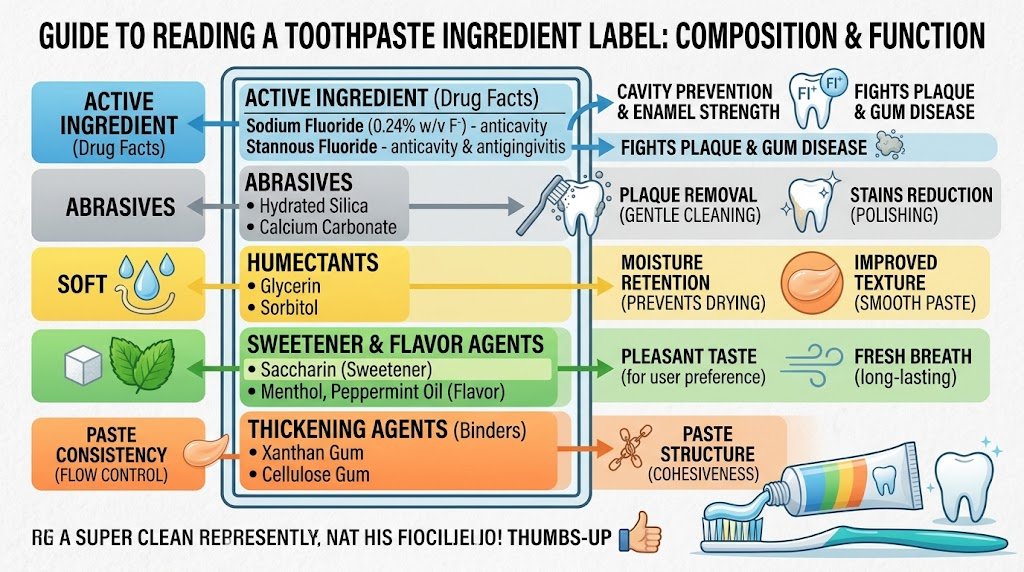
1. Read the complete ingredient list
Don’t rely only on front-label phrases such as:
- natural
- clean
- simple
- non-toxic
- plant-based
These terms don’t tell you everything in the formulation.
2. Look for sweetening ingredients
Ingredient names vary between products. Sodium saccharin and sucralose are two examples that may appear in toothpaste formulations, but you should check the actual label of the product you’re considering.
3. Check the active ingredient separately
This is one of the most important steps.
Don’t reject a toothpaste simply because you see a sweetener before checking what the toothpaste is designed to do.
If cavity prevention is your priority, check whether it contains an appropriate anticaries active ingredient. In the U.S., common fluoride actives include sodium fluoride, sodium monofluorophosphate, and stannous fluoride. ADA
4. Match the toothpaste to your dental need
Your decision may depend more on whether you need help with:
- cavities
- sensitivity
- gum health
- enamel concerns
- whitening
- dry mouth
than on whether the toothpaste contains a particular sweetener.
5. Consider your personal preferences
If two otherwise suitable products meet your needs and one doesn’t contain an ingredient you prefer to avoid, choosing the simpler option can be a reasonable personal preference.
6. Verify current product information
Formulas can change.
Before buying an Amazon-listed toothpaste, check the current manufacturer’s ingredient list and product labeling rather than relying only on an old review, retailer description, or search snippet.
What to Look for When Choosing a Toothpaste
Once you move from ingredient research to actual product selection, use a broader decision framework.
1. Start with your dental goal
Ask:
What am I trying to improve or maintain?
Cavity prevention, sensitivity, enamel concerns, whitening, and other goals can require different considerations.
2. Check the active ingredient
The sweetener tells you mainly about taste. The active ingredient tells you much more about the toothpaste’s intended oral-health function.
For cavity protection, fluoride is particularly important. NIDCR states that fluoride prevents tooth decay and recommends brushing with fluoride toothpaste twice daily as part of oral-health care. nidcr.nih.gov
3. Read the entire ingredient list
If avoiding artificial sweeteners is important to you, check the actual ingredients instead of assuming that “natural” or “clean” means sweetener-free.
4. Consider ingredient transparency
A product should make it reasonably easy for you to understand what you’re buying.
5. Consider taste and daily usability
A toothpaste that you dislike using is not a practical choice if it discourages consistent brushing.
6. Consider professional advice when needed
If you have a specific dental condition or repeated reaction to toothpaste, a dentist can help you choose an appropriate formulation.
Recommended Toothpaste Options
Because this article is primarily about artificial sweetener safety, the product section should not become a random list of “best” toothpastes.
A better approach is to choose products according to the reader’s actual preference.
Option 1: A fluoride toothpaste with a transparent ingredient list
This is appropriate for readers whose main priority is cavity prevention but who also want to understand what else is in their toothpaste.
Look for:
- a clearly identified fluoride active
- a complete ingredient list
- clear directions
- appropriate age labeling
- evidence or certification supporting the product’s stated claims
Option 2: A fluoride-free toothpaste for readers who specifically want one
Some consumers intentionally choose fluoride-free products.
However, this should be presented as a preference-based category, not as a claim that fluoride toothpaste is unsafe. Fluoride has an established role in cavity prevention. nidcr.nih.gov
Option 3: A hydroxyapatite toothpaste
Readers who want a fluoride-free alternative may also be interested in hydroxyapatite formulations.
The important point is to evaluate the specific product rather than assuming every hydroxyapatite toothpaste has identical ingredients, evidence, or formulation quality.
Option 4: A toothpaste without artificial sweeteners
If avoiding artificial sweeteners is your primary preference, compare current ingredient lists and confirm that the product actually meets that requirement.
Don’t rely solely on phrases such as “clean” or “natural.”
Affiliate CTA opportunity:
If you have identified products that meet the criteria above, this is the most appropriate point to show a small comparison table with the current ingredient information and an “Check current price on Amazon” CTA.
The product information should be rechecked before publication because formulations, availability, and listings can change.
Frequently Asked Questions
Is sodium saccharin safe in toothpaste?
Sodium saccharin is used as a sweetening ingredient in some toothpaste formulations. For example, the ADA lists sodium saccharin as an inactive ingredient in Colgate Cavity Protection Gel & Toothpaste. FDA also recognizes saccharin as an approved high-intensity sweetener for specified food uses. ADA
The important point is to evaluate the ingredient within the specific toothpaste formulation and intended use rather than assuming that its presence automatically makes the product unsafe.
Does toothpaste sweetener cause cavities?
A sweet taste does not mean that toothpaste contains ordinary sugar. The ADA states that non-caloric sweeteners are common in toothpaste and that sugar or other cariogenic ingredients are not permitted in ADA-Accepted toothpaste. ADA
For cavity prevention, pay attention to the toothpaste’s active ingredient and overall formulation, particularly fluoride when appropriate.
Is natural sweetener better than artificial sweetener in toothpaste?
Not automatically. “Natural” describes the source or processing of an ingredient; it does not by itself prove that an ingredient is safer or more effective. Compare the specific ingredients, their purpose, available evidence, and your own needs.
Should I avoid artificial sweeteners in toothpaste?
You can choose to avoid them if that is your personal preference, but their presence alone does not mean the toothpaste is unsafe. If you have a suspected reaction, consider the entire ingredient list because several toothpaste ingredients can potentially cause irritation or allergy in susceptible people. ADA
How can I tell if toothpaste contains artificial sweeteners?
Read the current ingredient list rather than relying on the front of the package. Look for the names of sweetening ingredients, such as sodium saccharin or sucralose, when they are used. Product formulas can change, so check the current label before purchasing.
What is more important than the sweetener when choosing toothpaste?
Your oral-health need and the toothpaste’s active ingredient are usually more important considerations. For cavity prevention, fluoride has strong support from dental-health authorities. You should also consider the full ingredient list, age suitability, your tolerance of the product, and any advice from your dentist. ADA
Conclusion
Artificial sweeteners in toothpaste are mainly used to improve taste, and ingredients such as sodium saccharin and sucralose can appear as inactive ingredients in toothpaste formulations. Their presence does not automatically mean that the toothpaste is harmful.
The better way to evaluate a toothpaste is to look at the whole formulation: what the active ingredient does, what other ingredients are included, whether the product fits your dental needs, and whether you personally have a reason to avoid a particular ingredient.
If you prefer to avoid artificial sweeteners, you can compare ingredient lists and choose a formulation that fits your preferences. Just don’t let one ingredient distract you from more important questions such as cavity protection, active ingredients, ingredient transparency, and your specific oral-health needs.
