Fluoride helps prevent cavities by protecting tooth enamel from acid-related mineral loss, supporting remineralization, and making the tooth surface more resistant to future acid attacks. It can also reduce the ability of cavity-causing bacteria to produce acid.
The process is easier to understand when you look at how a cavity develops in the first place. Your teeth are constantly going through cycles of losing and gaining minerals. Fluoride helps shift that balance toward protection.
In this guide, we’ll explain how cavities form, where fluoride acts in that process, how fluoride toothpaste works, whether fluoride can reverse early tooth decay, and what to look for when choosing a fluoride toothpaste.
First, How Does a Cavity Form?
Before understanding how fluoride prevents cavities, it helps to understand what causes one.
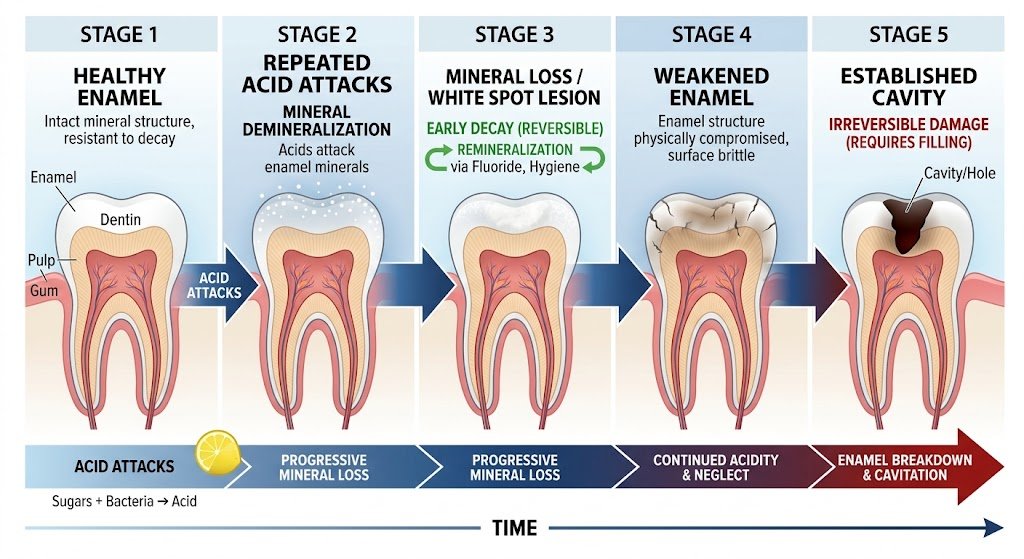
A cavity doesn’t usually appear overnight. It develops when repeated acid attacks cause more mineral loss from a tooth than the tooth can naturally replace.
Bacteria Turn Sugars and Starches Into Acid
Your mouth contains many types of bacteria. Some can contribute to tooth decay.
When these bacteria encounter carbohydrates such as sugars and starches from food and drinks, they can produce acids. Those acids come into contact with the tooth surface and begin to dissolve minerals from enamel.
The National Institute of Dental and Craniofacial Research (NIDCR) describes tooth decay as a process in which bacteria use sugars to produce acids that attack enamel.
This means the basic cavity process looks like this:
Food carbohydrates → bacterial activity → acid → enamel mineral loss
The more frequently teeth are exposed to acid, the more opportunities there are for mineral loss.
Acid Causes Demineralization
Enamel is the hard outer layer of a tooth. It contains a mineral structure largely based on calcium and phosphate.
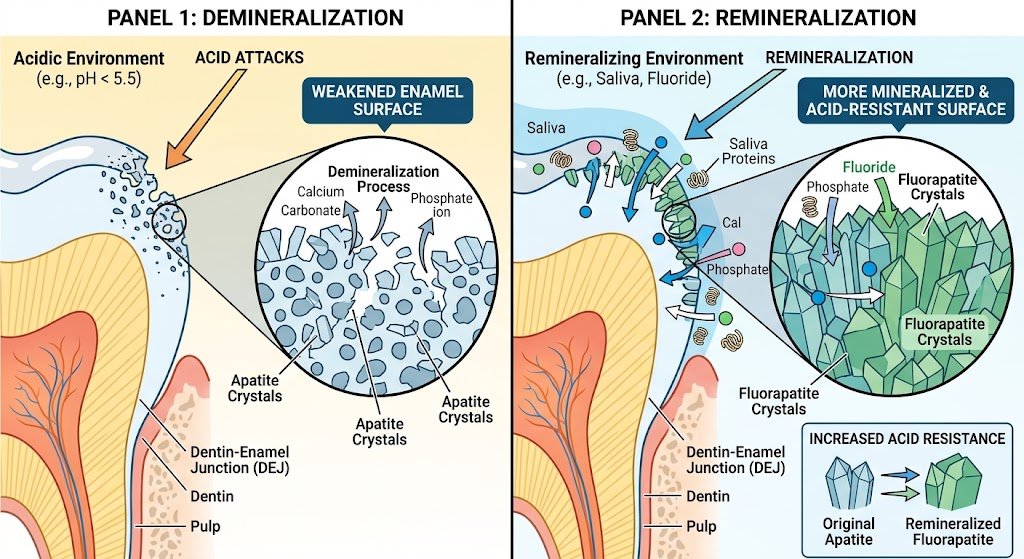
When acids repeatedly attack enamel, they can dissolve some of these minerals. This process is called demineralization.
Demineralization isn’t automatically the same thing as a cavity.
Your teeth can lose small amounts of minerals and then regain them through minerals present in saliva. This natural cycle happens repeatedly throughout the day.
The problem occurs when mineral loss consistently outweighs mineral replacement.
A useful way to picture it is as a balance:
Demineralization ← acid attacks
Remineralization → saliva + fluoride + available minerals
When the balance remains unfavorable for long enough, enamel becomes weaker.
Repeated Mineral Loss Can Become a Cavity
One of the earliest visible signs of mineral loss can be a white spot on the enamel.
At this stage, the tooth may not have a physical hole yet. Early decay can potentially be stopped or reversed because the enamel still has the ability to regain minerals.
But if acid attacks continue and mineral loss exceeds repair, the enamel can eventually break down and form a cavity.
Once an actual hole has formed, fluoride toothpaste cannot simply fill that missing tooth structure. A dentist may need to restore the tooth with a filling or another appropriate treatment.
How Does Fluoride Prevent Cavities?
So, how does fluoride prevent cavities?
It works mainly by changing the balance between mineral loss and mineral repair.
Fluoride has several related effects:
- It helps reduce mineral loss from enamel.
- It supports remineralization of early weakened areas.
- It helps make the tooth surface more resistant to acid.
- It can reduce the ability of cavity-causing bacteria to produce acid.
The CDC explains that fluoride replaces minerals lost during acid attacks, can make the outer enamel harder to dissolve, and may reduce acid production and bacterial attachment.
1. Fluoride Helps Reduce Mineral Loss
When acid begins attacking enamel, fluoride present in the mouth can help reduce the amount of mineral that is lost.
This is particularly important because your teeth experience many small acid challenges throughout the day.
Fluoride doesn’t create an invisible shield that prevents every acid molecule from touching your teeth. Instead, it changes the tooth surface and the mineral environment in ways that make enamel less vulnerable to acid dissolution.
The CDC notes that fluoride can replace minerals lost from the tooth and make the outer enamel layer harder to dissolve.
2. Fluoride Supports Remineralization
Your saliva naturally contains minerals such as calcium and phosphate.
When early mineral loss occurs, these minerals can become available for rebuilding weakened areas of enamel. Fluoride helps this repair process occur more effectively.
This is called remineralization.
The ADA explains that fluoride encourages remineralization and can help reverse the early decay process while creating a tooth surface that is more resistant to future decay.
3. Fluoride Makes Enamel More Resistant to Acid
Fluoride can become incorporated into the mineral structure at the tooth surface.
The resulting mineral environment is more resistant to acid attack than the original mineral structure.
This doesn’t mean that fluoride makes enamel impossible to damage. Rather, it makes the tooth surface better able to withstand the acidic conditions that contribute to tooth decay.
4. Fluoride Can Affect Bacterial Acid Production
Fluoride’s role isn’t limited to the tooth itself.
It can also affect the activity of bacteria involved in the decay process.
The CDC states that fluoride may reduce the amount of acid produced by cavity-causing bacteria and make it harder for those bacteria to stick to teeth.
So fluoride works through a combination of effects rather than one single mechanism.
A simplified model is:
Less mineral loss + better remineralization + greater acid resistance + reduced bacterial acid activity = lower cavity risk
How Does Fluoride Help Remineralize Teeth?
Remineralization is one of the most important concepts for understanding fluoride.
It also causes some confusion because “remineralization” can sound like fluoride grows completely new enamel.
That’s not what it means.
What Remineralization Means
Demineralized enamel has lost some of its mineral content.
Saliva naturally contains minerals that can move back toward the tooth surface. Fluoride helps support the process in which minerals are returned to weakened enamel.
Think of enamel as going through a continuous repair cycle:
Acid removes minerals → saliva supplies minerals → fluoride helps the repair process → enamel becomes more resistant
The ADA describes fluoride as helping remineralize the calcium-hydroxyapatite structure of enamel and forming a more acid-resistant mineral structure.
How Fluoride Helps
Fluoride is especially useful at the tooth surface where demineralization and remineralization are happening.
When fluoride is available in saliva and dental plaque, it can be taken up by areas of demineralized enamel. Calcium and phosphate can then participate in rebuilding the mineral structure.
This is why maintaining fluoride in the mouth matters.
The CDC notes that cavity prevention depends on consistent, low levels of fluoride in saliva and on tooth surfaces.
Can Fluoride Reverse a Cavity
This depends on what you mean by “cavity.”
If you’re talking about early tooth decay before a physical hole has formed, fluoride can help stop or reverse the mineral-loss process.
NIDCR explains that early tooth decay can be stopped or reversed because enamel can repair itself using minerals from saliva and fluoride from toothpaste or professional fluoride treatment.
But once decay has progressed enough to create an actual hole in the tooth, fluoride cannot rebuild the missing structure.
That distinction is important:
| Stage | What is happening? | Can fluoride help? |
| Healthy enamel | Normal tooth surface | Helps maintain protection |
| Early mineral loss | Enamel has lost minerals but no cavity is present | Can help stop or reverse early decay |
| Advanced decay | Enamel is increasingly weakened | Fluoride may still provide preventive benefits, but professional evaluation is important |
| Established cavity | A physical hole has formed | Fluoride cannot fill the hole; restorative treatment may be needed |
So when you hear that fluoride can “reverse cavities,” the more accurate interpretation is that it can help reverse or arrest early tooth decay before cavitation, rather than rebuilding a fully formed hole.
Does Fluoride Kill the Bacteria That Cause Cavities?
Not exactly.
It would be misleading to describe fluoride as a simple antibacterial agent that kills all cavity-causing bacteria.
Cavity development involves a relationship between bacteria, dietary carbohydrates, acid production, saliva, tooth mineral, and other factors.
Fluoride can influence bacterial activity, including reducing acid production, but one of its most important effects is directly protecting the tooth surface.
The CDC notes that fluoride may reduce acid production by cavity-causing bacteria and make it more difficult for those bacteria to stick to teeth.
This distinction matters because you don’t need fluoride to sterilize your mouth for it to help prevent cavities.
Its main value comes from helping teeth withstand and recover from the acid-related mineral loss that drives tooth decay.
How Does Fluoride Toothpaste Prevent Cavities?
Fluoride toothpaste provides one of the most practical ways to deliver fluoride directly to your teeth.
When you brush, fluoride from the toothpaste comes into contact with:
- Enamel
- Dental plaque
- Saliva
- Areas of early mineral loss
Some fluoride remains available in the mouth after brushing, creating a topical source of fluoride for the teeth.
The ADA describes fluoride toothpaste as the most commonly used form of self-applied fluoride and notes that fluoride from toothpaste is taken up by dental plaque and demineralized enamel while also increasing fluoride levels in saliva.
This is why brushing isn’t only about physically removing food and plaque.
With fluoride toothpaste, brushing also delivers an active ingredient that supports cavity prevention.
Why Regular Use Matters
Fluoride protection is not a one-time treatment.
Your teeth continue to encounter acids throughout the day, so ongoing fluoride availability is useful.
The CDC emphasizes the importance of maintaining consistent, low levels of fluoride in the mouth and on tooth surfaces.
For most people, this makes regular fluoride toothpaste an important part of daily cavity-prevention care.
The ADA notes that U.S. over-the-counter fluoride toothpastes generally contain 1,000–1,500 ppm fluoride and commonly use sodium fluoride, stannous fluoride, or sodium monofluorophosphate as the active fluoride ingredient.
Does Fluoride Work for Adults?
Yes.
Fluoride isn’t only useful while children’s permanent teeth are developing.
Topical fluoride can benefit erupted teeth, meaning teeth that are already present in the mouth.
The ADA explains that topical fluoride strengthens teeth already present in the mouth and makes them more resistant to decay.
Adults can therefore benefit from fluoride toothpaste as part of routine cavity prevention.
This is particularly relevant because cavity risk doesn’t disappear with age. NIDCR notes that people can develop tooth decay throughout life, including older adults whose receding gums may expose root surfaces.
Your individual needs can still vary. Someone with frequent cavities, dry mouth, exposed roots, or other risk factors may need a more specific preventive plan from a dentist.
Fluoride vs Fluoride-Free Toothpaste for Cavity Prevention
If your main goal is cavity prevention, fluoride has an important advantage: it has an established role in preventing and controlling dental caries.
Fluoride-free toothpaste can still clean teeth and may contain other ingredients that people choose for particular reasons. But removing fluoride also removes the specific fluoride-based cavity-protection mechanism described above.
That doesn’t mean every fluoride-free toothpaste is automatically a poor product.
It means you should understand what you’re giving up and what the alternative formulation is intended to accomplish.
| Factor | Fluoride Toothpaste | Fluoride-Free Toothpaste |
| Contains fluoride | Yes | No |
| Direct fluoride exposure during brushing | Yes | No |
| Established role in cavity prevention | Yes | Depends on the overall approach |
| Supports fluoride-assisted remineralization | Yes | No |
| May suit people specifically avoiding fluoride | No | Yes |
| Best choice for cavity-focused care | Commonly recommended | May require individual consideration |
The important point is that “natural,” “clean,” or “fluoride-free” doesn’t automatically tell you whether a toothpaste is appropriate for your cavity risk.
A better approach is to look at the active ingredients and your actual oral-health needs.
What to Look for in a Fluoride Toothpaste
Once you understand how fluoride prevents cavities, the next question becomes practical:
How do you choose a fluoride toothpaste?
You don’t necessarily need the most complicated formula. Start with the features that matter most for your oral-health needs.
Check the Active Fluoride Ingredient
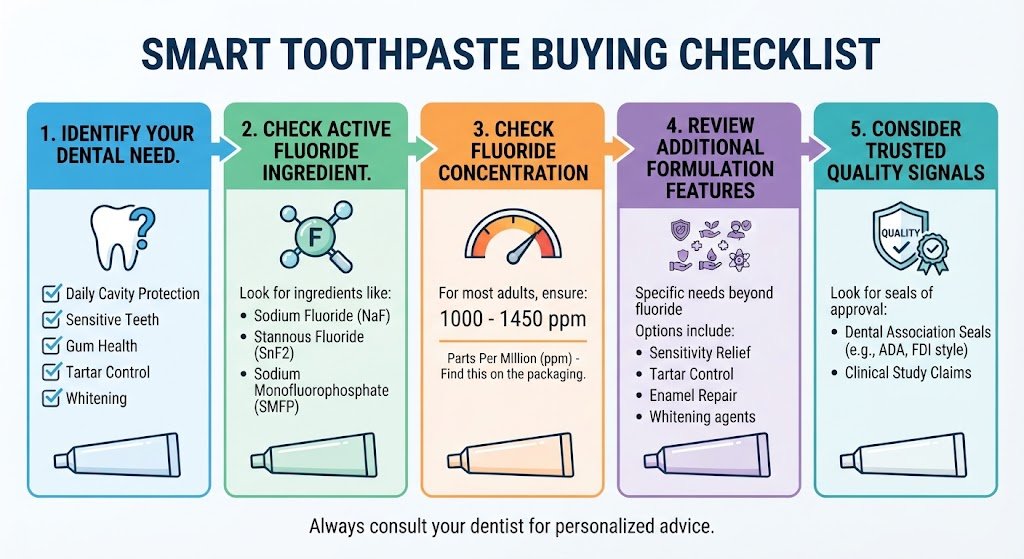
Look at the Active Ingredients section of the toothpaste label.
Common fluoride ingredients include:
- Sodium fluoride
- Stannous fluoride
- Sodium monofluorophosphate
The ADA identifies these fluoride compounds as anticaries ingredients used in toothpaste.
The presence of one of these ingredients tells you that fluoride is being used as an active cavity-prevention ingredient.
Check the Fluoride Concentration
Fluoride concentration is usually expressed in parts per million (ppm).
Many U.S. over-the-counter fluoride toothpastes contain between 1,000 and 1,500 ppm fluoride.
Don’t assume that a higher concentration automatically makes a toothpaste better for everyone.
Age, cavity risk, product instructions, and professional recommendations all matter.
Prescription-strength fluoride products also exist for people who need additional fluoride based on their individual risk, but these should be used according to professional guidance.
Consider Your Dental Needs
Fluoride is the cavity-prevention foundation, but your toothpaste can have other features that address additional concerns.
For example, you may want a toothpaste formulated for:
- Tooth sensitivity
- Enamel protection
- Gum health
- Whitening
- Bad breath
- Dry mouth
This is where product selection becomes more individual.
Someone who frequently develops cavities may prioritize cavity protection first. Someone who also has sensitivity may want a fluoride toothpaste that includes an ingredient intended for sensitivity.
Consider Other Ingredients
After checking the active fluoride ingredient, you can evaluate the rest of the formulation.
Depending on your preferences, you may want to consider:
- SLS or SLS-free formulations
- Abrasiveness
- Flavoring ingredients
- Sweeteners
- Whitening ingredients
- Other active ingredients
For example, if you specifically want to avoid SLS, you can look for an SLS-free fluoride toothpaste rather than assuming that avoiding SLS means you must also avoid fluoride.
The ADA also notes that toothpastes can contain active ingredients aimed at concerns such as sensitivity, tartar, gingivitis, enamel erosion, whitening, and bad breath in addition to fluoride.
Consider Trusted Quality Signals
Ingredient transparency is important, but you can also look for recognized quality signals.
For products carrying the ADA Seal of Acceptance, the ADA evaluates products against applicable requirements for safety and effectiveness.
The ADA also states that a toothpaste must contain fluoride to receive ADA acceptance for an anticaries claim.
Can Fluoride Prevent Every Cavity?
No.
Fluoride is an important part of cavity prevention, but it doesn’t make teeth immune to decay.
Cavities develop through multiple interacting factors, including bacterial activity, dietary carbohydrates, oral hygiene, saliva, tooth anatomy, and individual risk.
Even someone who uses fluoride toothpaste can develop cavities.
For example, frequent exposure to sugary or starchy foods and drinks can provide repeated opportunities for bacteria to produce acid. Poor plaque control can also increase the amount of acid-producing bacteria around the teeth.
Fluoride helps the teeth handle these challenges, but it works as part of a broader oral-health routine.
That’s why cavity prevention usually involves more than toothpaste alone:
- Brush regularly with fluoride toothpaste.
- Clean between your teeth.
- Limit frequent sugary or starchy exposures.
- Follow appropriate dental-care recommendations.
- Have regular dental examinations.
- Use additional fluoride treatments when recommended for your individual risk.
NIDCR recommends brushing twice daily with fluoride toothpaste and maintaining good oral hygiene as part of preventing tooth decay.
Frequently Asked Questions
How exactly does fluoride prevent cavities?
Fluoride helps prevent cavities by reducing mineral loss from enamel, supporting remineralization, making the tooth surface more resistant to acid, and influencing the acid-producing activity of cavity-causing bacteria. These effects help shift the balance away from repeated mineral loss and toward tooth protection.
Can fluoride reverse early tooth decay?
Yes, early tooth decay can potentially be stopped or reversed when mineral loss has occurred but a physical cavity has not yet formed. Saliva supplies minerals, while fluoride helps support remineralization and makes the repaired enamel more resistant to acid.
Can fluoride repair a cavity?
Fluoride cannot fill a physical hole in a tooth. It can help prevent or reverse early mineral loss before cavitation, but once an actual cavity has formed, the damaged tooth structure generally needs professional dental treatment.
Does fluoride kill cavity-causing bacteria?
Fluoride should not be thought of simply as a substance that kills all cavity-causing bacteria. It can interfere with bacterial activity and reduce acid production, while also protecting the tooth surface directly.
Does fluoride work for adults?
Yes. Topical fluoride benefits teeth that have already erupted, so adults can benefit from fluoride toothpaste as part of routine cavity prevention. The ADA recognizes topical fluoride as helping strengthen erupted teeth and make them more resistant to decay.
Is fluoride toothpaste better for cavities than fluoride-free toothpaste?
For cavity prevention, fluoride toothpaste has an established evidence-based role. Fluoride-free toothpaste may still clean teeth and may be chosen for specific preferences or formulations, but it does not provide the fluoride-based cavity-protection mechanism described in this article. Individual needs can vary.
How often should I use fluoride toothpaste?
For most people, brushing twice daily with fluoride toothpaste is part of routine cavity-prevention care. NIDCR recommends brushing twice daily with fluoride toothpaste. Children need age-appropriate amounts and supervision to reduce unnecessary swallowing of toothpaste.
Bottom Line: How Fluoride Stops the Cavity Process
So, how does fluoride prevent cavities?
The simplest explanation is:
Bacteria use sugars and starches → acids attack enamel → minerals are lost → fluoride helps reduce mineral loss and supports remineralization → enamel becomes more resistant to acid → cavity risk is reduced.
Fluoride doesn’t make teeth invincible, and it can’t fill an established cavity. Its major value is helping teeth withstand the repeated acid attacks that drive tooth decay and supporting the repair of early mineral loss.
For most people, fluoride toothpaste is one of the simplest ways to get regular topical fluoride exposure.
If you’re ready to choose a product, focus first on the active fluoride ingredient, fluoride concentration, your dental needs, and the overall formulation rather than relying only on marketing claims.
