Introduction
If you have ever checked the ingredient list on a toothpaste tube, you may have noticed hydrated silica listed among the ingredients. The name can sound more complicated than it actually is, which often leads to a simple question: Is hydrated silica safe for your teeth, or should you avoid toothpaste that contains it?
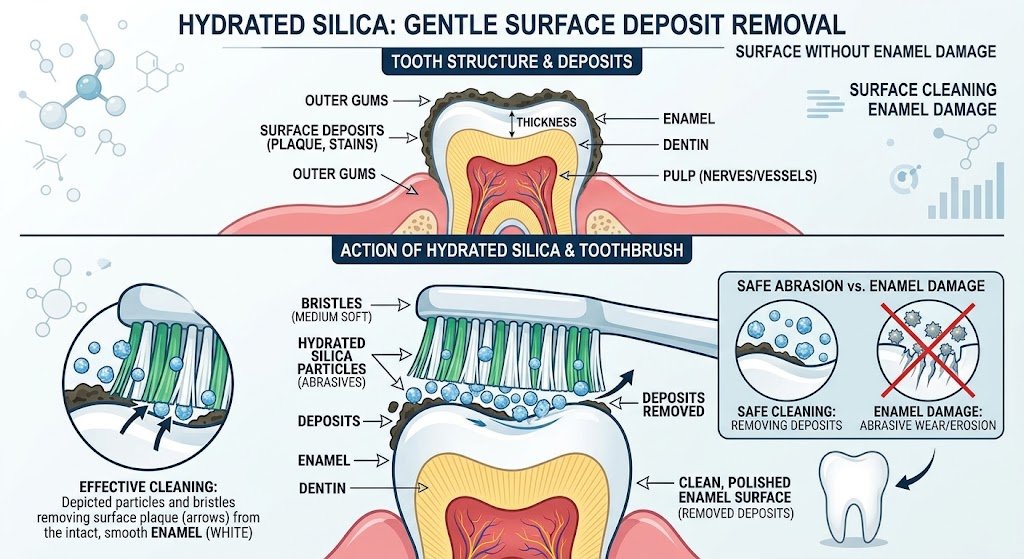
Hydrated silica is commonly used in toothpaste as an abrasive ingredient. Its main job is to help the toothpaste mechanically clean the tooth surface and remove some surface deposits and stains during brushing. The American Dental Association lists hydrated silica among the abrasive materials used in toothpaste.
However, the presence of hydrated silica does not, by itself, tell you whether a toothpaste is good or bad for your teeth. Different toothpaste formulas can have different abrasive characteristics, and your brushing habits and dental condition also matter.
In this guide, you’ll learn what hydrated silica actually does, how it relates to whitening and enamel, what RDA means, how it compares with calcium carbonate and hydroxyapatite, and what to look for when choosing toothpaste.
What Is Hydrated Silica in Toothpaste?
Hydrated silica is a form of silicon dioxide (silica) used in many personal-care products, including toothpaste. In toothpaste, its most important role is usually as an abrasive.
An abrasive is a material that helps with mechanical cleaning. When you brush your teeth, the toothbrush provides physical movement while the toothpaste provides ingredients that interact with the tooth surface. Hydrated silica can help remove deposits and external stains as part of that process.
The word “abrasive” can sound alarming, but abrasion is not automatically the same thing as harmful damage. Toothpaste needs some ability to clean mechanically. The important question is how abrasive the finished toothpaste is and how it is used, rather than whether the ingredient name appears on the label.
The ADA identifies hydrated silica and other silica-based materials among toothpaste abrasives used to help clean teeth and remove surface stains.
Is Hydrated Silica the Same as Silicone?
No.
Although the names sound similar, silica and silicone are different materials.
Silica refers to silicon dioxide, while silicones are a broader class of synthetic polymers containing silicon and oxygen along with other elements. Seeing “hydrated silica” on a toothpaste label does not mean that the toothpaste contains silicone.
For toothpaste, the more useful question is not whether the ingredient sounds familiar or unfamiliar. It is what function the ingredient performs in the complete formula.
Why Is Hydrated Silica Added to Toothpaste?
Toothpaste manufacturers can use hydrated silica as part of the product’s abrasive system.
Its role can include helping with:
- Mechanical cleaning
- Removal of surface deposits
- Removal of some external stains
- Tooth polishing as part of the overall formulation
The exact cleaning and abrasive performance depends on the formulation rather than the ingredient name alone.
What Does Hydrated Silica Do in Toothpaste?
The simplest answer is:
Hydrated silica mainly helps toothpaste clean the tooth surface through controlled mechanical action.
When you brush, several things happen at the same time. The toothbrush moves across the teeth, saliva and toothpaste spread around the mouth, and toothpaste ingredients interact with deposits on the tooth surface.
Hydrated silica can contribute to the mechanical part of this cleaning process.
1. It Helps With Mechanical Cleaning
Your toothbrush does not work alone.
The abrasive system in toothpaste can help physically interact with deposits on the tooth surface. This is one reason abrasives are common in toothpaste formulations.
However, abrasive cleaning should not be confused with scraping the tooth aggressively.
A toothpaste is formulated to balance cleaning performance with acceptable use. The characteristics of the abrasive material, the rest of the formulation, and the way a person brushes all influence the result.
2. It Can Help Remove Surface Stains
Hydrated silica can contribute to the removal of external or surface stains.
These may come from things such as:
- Coffee
- Tea
- Tobacco
- Certain foods
- Other substances that discolor the outer tooth surface
Removing these deposits can make teeth appear cleaner or brighter.
But there is an important distinction:
Removing a surface stain is not the same as bleaching the natural color of the tooth.
This difference becomes especially important when evaluating whitening toothpaste.
3. It Is Not the Same as an Anticaries Active
Hydrated silica is mainly associated with the abrasive function of toothpaste.
It should not be confused with ingredients used specifically for cavity prevention.
For example, fluoride compounds can serve as anticaries active ingredients in fluoride toothpaste. Hydrated silica and fluoride therefore have different primary jobs.
This is why looking at one ingredient is not enough when evaluating toothpaste.
How Does Hydrated Silica Clean Your Teeth?
To understand hydrated silica, it helps to think of toothpaste as a system rather than a single ingredient.
Your toothbrush creates mechanical movement. The toothpaste spreads across the teeth and contains ingredients that contribute different functions. Abrasives such as hydrated silica can help physically interact with surface deposits while brushing.
The goal is controlled cleaning—not aggressive removal of the tooth itself.
A Simple Example
Imagine a stain sitting on the outer surface of a tooth.
When you brush:
- The toothbrush moves across the tooth.
- Toothpaste spreads over the surface.
- Abrasive particles interact with deposits on the surface.
- Some external material can be removed.
- The tooth surface appears cleaner.
This is one reason abrasive ingredients are useful in toothpaste.
But the process does not mean that the toothpaste is intentionally removing healthy enamel.
The performance of the complete formula matters.
Why More Abrasion Is Not Automatically Better
It might seem logical that a more abrasive toothpaste should clean better.
That conclusion is too simple.
Abrasivity is only one part of toothpaste performance. A toothpaste should provide useful cleaning while remaining appropriate for regular use.
Research comparing different dentifrices has found meaningful variation in both abrasivity and cleaning performance among products. This is important because it shows why you should not assume that every toothpaste containing hydrated silica behaves identically.
The amount and characteristics of abrasive material, the rest of the formula, and brushing conditions can all influence performance.
Your Toothbrush Matters Too
Toothpaste is only one part of brushing.
Your brushing pressure, brushing technique, toothbrush type, frequency of brushing, and individual dental condition can also affect mechanical wear.
For example, someone who brushes very aggressively may create substantially more mechanical stress than someone who brushes gently with appropriate pressure.
That is why evaluating hydrated silica in isolation can give an incomplete picture.
Does Hydrated Silica Whiten Teeth?
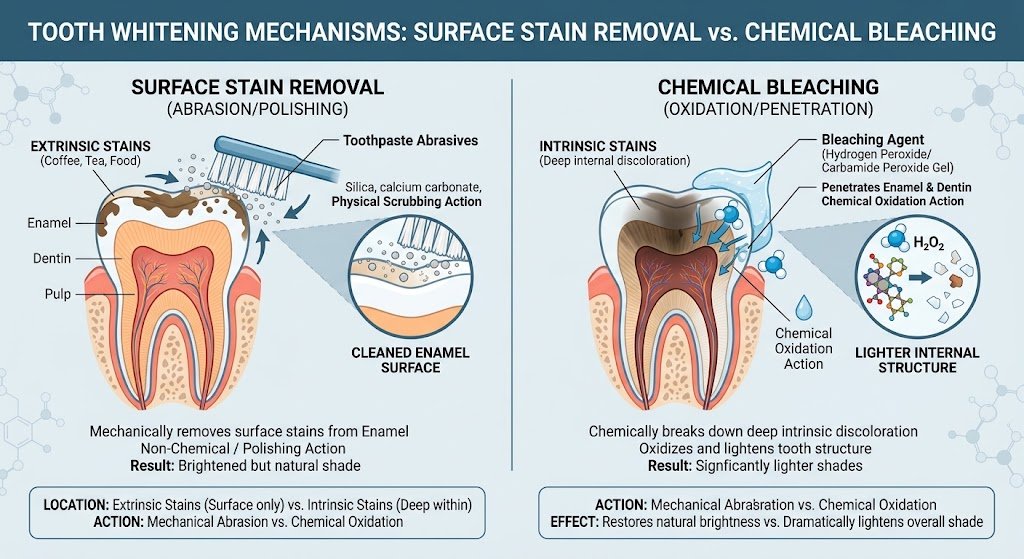
Hydrated silica can help remove some surface stains, but that is not the same as chemically bleaching teeth.
This distinction is one of the most important things to understand about whitening toothpaste.
Surface Stain Removal
External stains sit on or near the outer surface of the tooth.
A toothpaste containing an abrasive such as hydrated silica can help remove some of these deposits through mechanical cleaning.
As the surface stain is reduced, the teeth may look cleaner and brighter.
Bleaching Is Different
Bleaching works differently.
Chemical whitening treatments can change the appearance of tooth discoloration through chemical processes rather than simply removing surface deposits.
So when a toothpaste is described as “whitening,” you should ask:
Is it primarily helping remove surface stains, or is it using a chemical bleaching ingredient?
These are not necessarily the same thing.
Does More Abrasion Mean More Whitening?
Not necessarily.
Increasing abrasion is not a simple shortcut to better whitening.
A toothpaste needs to balance cleaning and stain removal with appropriate use characteristics. More aggressive mechanical action is not automatically better for someone’s teeth.
This is especially relevant for people who already have:
- Tooth sensitivity
- Gum recession
- Exposed dentin
- Enamel erosion
- Existing tooth wear
If whitening is your main goal, evaluate the whole toothpaste formulation and the type of whitening it is designed to provide rather than choosing solely because “hydrated silica” appears on the label.
Is Hydrated Silica Safe for Teeth?
For most readers, the better question is not simply whether hydrated silica is “safe” or “unsafe.”
A more useful question is:
Is the particular toothpaste formulation appropriate for your teeth and how you use it?
Hydrated silica is a commonly used abrasive in toothpaste. The ADA recognizes silica-based abrasives as ingredients used for cleaning and stain removal.
However, an ingredient list alone does not tell you the complete abrasive behavior of a toothpaste.
Different formulas can use different types and amounts of abrasive materials, and products can perform differently.
The Complete Formula Matters
When evaluating a toothpaste, consider more than hydrated silica.
Look at:
- The complete ingredient list
- The toothpaste’s intended purpose
- Its abrasive characteristics when available
- Active ingredients
- Whether it is designed for sensitivity
- Whether it is intended for whitening
- Your own dental condition
- How you brush
This approach is more useful than labeling a single ingredient as automatically good or bad.
What About Enamel?
Enamel is the hard outer layer of the tooth, but “hard” does not mean it is impossible to wear.
Tooth wear can involve several different processes, including abrasion and erosion. Existing acid erosion, aggressive brushing, exposed tooth surfaces, and other factors can change how a person’s teeth respond to mechanical brushing.
Research on tooth wear indicates that abrasion and erosion can interact, which is one reason individual circumstances matter when discussing toothpaste abrasivity.
This does not mean that toothpaste containing hydrated silica automatically damages enamel.
It means that people with existing dental wear or other concerns may need to pay closer attention to their toothpaste and brushing habits.
Brushing Pressure Matters
A common mistake is assuming that harder brushing produces cleaner teeth.
It does not necessarily work that way.
Aggressive brushing can increase mechanical stress on the teeth and gums. If you already have sensitivity, recession, or visible tooth wear, your brushing technique deserves attention alongside your toothpaste choice.
If you’re specifically looking for toothpaste for sensitivity, you can explore our guide to [ best toothpaste for sensitive teeth — Destination: /best-toothpaste-for-sensitive-teeth/ ].
Can Hydrated Silica Damage Enamel?
The short answer is:
The presence of hydrated silica in a toothpaste does not, by itself, prove that the toothpaste will damage enamel.
To understand the issue properly, you need to consider abrasivity, exposure conditions, and individual dental factors.
Abrasion vs. Erosion
These terms are related but different.
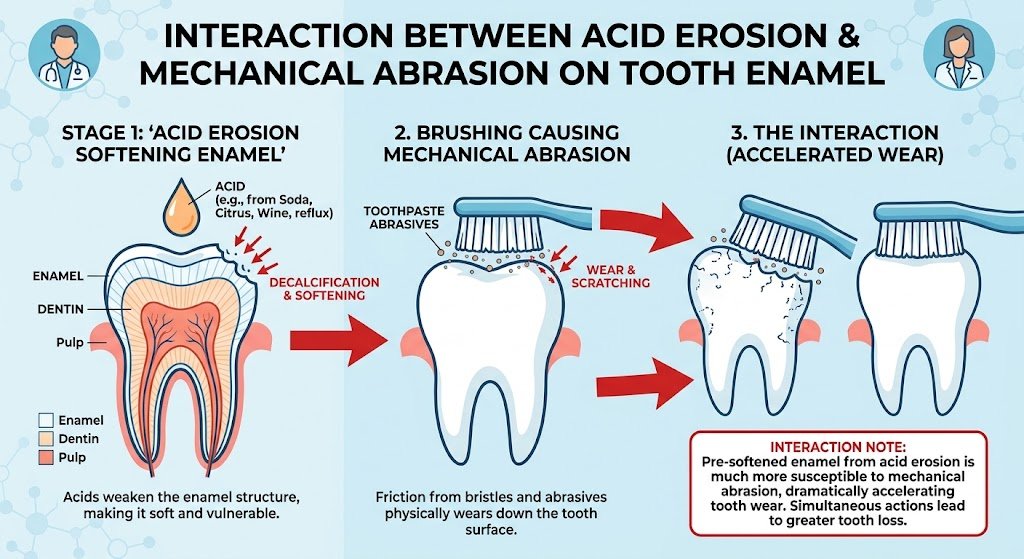
Abrasion refers to mechanical wear caused by physical contact.
Erosion refers to chemical loss of dental hard tissue caused by acids.
They can occur together.
For example, acid exposure may soften the tooth surface, after which mechanical brushing can have a different effect than it would on an unaffected surface.
This is why someone with frequent acid exposure or existing erosion may need different advice from someone without those concerns.
Factors That Can Matter
The effect of brushing on tooth surfaces can depend on:
- Toothpaste abrasivity
- Abrasive characteristics
- Brushing pressure
- Brushing technique
- Toothbrush characteristics
- Frequency of brushing
- Acid exposure
- Existing enamel condition
- Exposed dentin
- Gum recession
This is a much more accurate way to think about toothpaste abrasivity than simply asking whether an ingredient is “harsh.”
Should Everyone Avoid Silica?
No.
There is no general reason for everyone to avoid hydrated silica simply because it is an abrasive.
If you have healthy teeth and use toothpaste appropriately, the presence of a recognized abrasive ingredient does not automatically make the product unsuitable.
If you have persistent sensitivity, significant enamel wear, recession, or another dental condition, however, choosing toothpaste may require more individual consideration.
What Is RDA in Toothpaste?
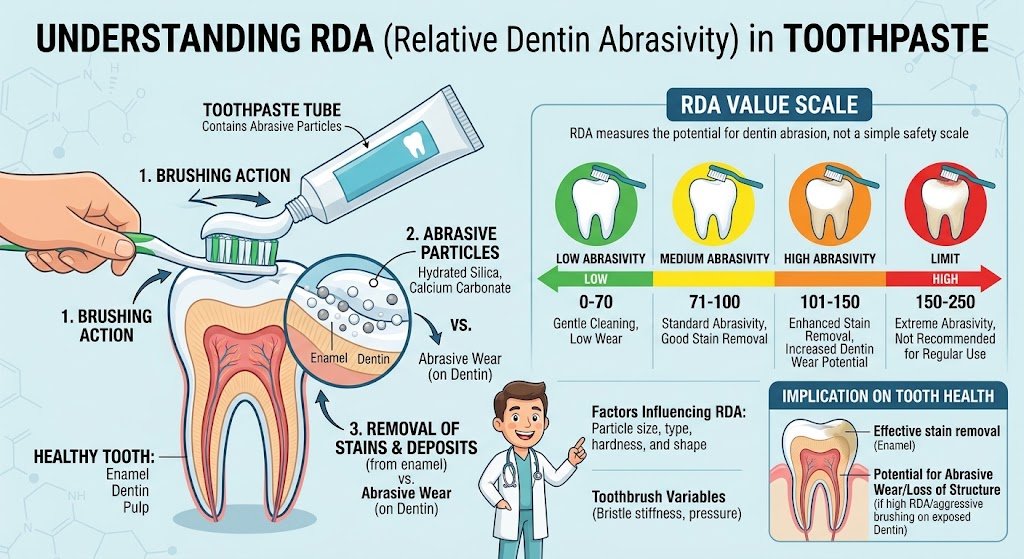
RDA stands for Relative Dentin Abrasivity.
It is a measurement used to describe the abrasive potential of toothpaste against dentin under standardized testing conditions.
RDA can be useful because it gives researchers and dental professionals a way to compare the abrasivity of dentifrice formulations.
But there is an important warning:
RDA should not be treated as a simple “safe” versus “dangerous” score.
A toothpaste’s real-world effect depends on more than one laboratory measurement.
Why RDA Matters
If you’re researching hydrated silica because you’re worried about enamel or sensitivity, RDA can help you understand the broader issue of toothpaste abrasivity.
It moves the discussion away from:
“Does this toothpaste contain silica?”
and toward:
“How abrasive is the finished toothpaste?”
That is a much more useful question.
The ADA provides information about toothpaste abrasivity and notes that RDA values should not be interpreted as a simple quantitative ranking of safety
RDA Does Not Tell the Whole Story
Even an RDA number does not capture every real-world variable.
Your:
- Brushing technique
- Brushing pressure
- Toothbrush
- Brushing frequency
- Diet
- Acid exposure
- Existing dental condition
can all influence the practical situation.
So if you see an RDA value associated with a toothpaste, use it as one piece of information, not as the only factor in your purchasing decision.
[ ARTICLE CONTINUES — NEXT PART STARTS WITH: H2: Hydrated Silica and Sensitive Teeth ]
Continuing exactly from the approved outline and previous section, without repeating anything.
Hydrated Silica and Sensitive Teeth
If you have sensitive teeth, seeing “hydrated silica” on a toothpaste label may make you wonder whether the abrasive could make sensitivity worse. The answer is not simply yes or no.
Tooth sensitivity is often related to exposed dentin or areas where the protective enamel or gum tissue has changed. When those areas are exposed, everyday triggers such as cold drinks, hot foods, sweet foods, or even brushing can cause discomfort.
That means the important question is not only whether a toothpaste contains hydrated silica. You also need to consider the abrasivity of the complete toothpaste formula, how you brush, and whether the toothpaste is designed for sensitive teeth.
A toothpaste containing hydrated silica can still be appropriate for some people with sensitive teeth. However, if you already experience sensitivity, it may be sensible to look for a formula specifically designed for sensitive teeth rather than choosing a product based on the presence or absence of one abrasive ingredient.
Why abrasivity matters more when teeth are sensitive
Brushing is meant to clean the teeth, but mechanical cleaning involves some level of contact between the toothbrush, toothpaste, and tooth surface.
If someone regularly brushes with excessive pressure or uses a toothpaste with relatively high abrasive potential, the overall mechanical wear may become more important—especially when dentin is exposed or teeth have already been affected by erosion or other forms of wear.
This does not mean that all abrasive toothpaste should be avoided.
Instead, people with sensitivity should pay attention to:
- The toothpaste’s overall abrasivity
- Whether it is marketed for sensitive teeth
- Brushing pressure
- Toothbrush bristle firmness
- Frequency and technique of brushing
- Existing enamel or dentin exposure
- Acidic food and drink exposure
- Gum recession
If sensitivity is persistent, severe, or getting worse, a dental professional can help identify the underlying cause rather than simply changing toothpaste.
Hydrated Silica vs. Calcium Carbonate
Hydrated silica and calcium carbonate are both used as abrasive ingredients in toothpaste, but they are not identical materials and should not automatically be treated as interchangeable.
Both can contribute to mechanical cleaning by helping the toothbrush remove deposits from the tooth surface. What matters in practice is how each abrasive is formulated within the complete toothpaste.
Hydrated silica
Hydrated silica is a form of silica used in toothpaste primarily for its abrasive and cleaning properties. Different silica materials can be engineered with different characteristics, which means one toothpaste containing hydrated silica may not behave exactly like another.
This is an important reason not to judge abrasivity simply by looking for the word “silica” on an ingredient label.
Calcium carbonate
Calcium carbonate is another commonly used abrasive material. It can help with mechanical cleaning and is found in various toothpaste formulations.
Its presence also does not automatically tell you whether a finished toothpaste is gentle, highly abrasive, suitable for sensitive teeth, or ideal for whitening.
Which one is better?
There is no universal answer that hydrated silica is better than calcium carbonate—or that calcium carbonate is automatically gentler.
A more useful comparison considers the finished toothpaste, including:
- Abrasive system
- Particle characteristics
- Concentration
- Other ingredients
- Intended use
- Overall abrasivity
- How the toothpaste is used
So, if you are comparing two toothpaste products, do not choose solely because one says “silica” and the other says “calcium carbonate.”
The finished formula matters more than the name of one abrasive.
Hydrated Silica vs. Baking Soda
Baking soda is another ingredient commonly associated with tooth cleaning. Its chemical name is sodium bicarbonate, and it is different from hydrated silica.
The two ingredients can contribute to cleaning in different ways.
Hydrated silica
Hydrated silica primarily functions as an abrasive. It helps the toothbrush mechanically remove surface deposits and stains.
Baking soda
Baking soda can also contribute to mechanical cleaning, while its chemical properties make it different from silica. Toothpaste formulations containing sodium bicarbonate may use it as part of their cleaning system.
This is why comparing “silica toothpaste” with “baking soda toothpaste” based on ingredient reputation alone can be misleading.
Which is better for whitening?
Neither ingredient should automatically be described as a bleaching agent.
If a toothpaste appears to whiten teeth, one important question is whether it is primarily helping remove extrinsic surface stains or whether it contains ingredients intended for a chemical whitening process.
Toothpaste can improve the appearance of stained teeth through cleaning and stain removal, but that is not the same process as professional or peroxide-based bleaching.
What should you compare instead?
When choosing between toothpaste formulas, consider:
- What type of whitening result you want
- Whether your concern is surface staining or deeper tooth color
- Your sensitivity level
- The toothpaste’s overall abrasivity
- Whether it contains fluoride or another cavity-protection active
- Whether the complete formula fits your everyday needs
The ingredient name alone does not answer all of these questions.
Hydrated Silica vs. Hydroxyapatite
Hydroxyapatite has become increasingly interesting to people looking for alternatives or additions to traditional toothpaste ingredients.
But hydrated silica and hydroxyapatite serve different primary roles.
Hydrated silica is mainly used as an abrasive for mechanical cleaning.
Hydroxyapatite is a calcium-phosphate mineral related to the mineral component of teeth and bones. In toothpaste, it is used in formulations designed around tooth-surface and remineralization-related benefits.
These ingredients therefore should not be viewed as direct substitutes.
A toothpaste can contain an abrasive for cleaning and a separate active ingredient for a different purpose. In other words, asking whether hydrated silica is “better” than hydroxyapatite is often comparing two ingredients that perform different jobs.
Why this distinction matters
Suppose you are looking for toothpaste because you want:
- Better removal of surface stains
- Cavity protection
- Support for sensitive teeth
- A fluoride-free option
- Hydroxyapatite as the primary active ingredient
- A balanced everyday formula
Those goals require different evaluation criteria.
For example, if your priority is hydroxyapatite, you should evaluate the toothpaste based on its hydroxyapatite formulation rather than expecting hydrated silica to perform the same function.
Likewise, if your priority is cleaning and surface-stain removal, the abrasive system deserves attention.
Can a toothpaste contain both?
Yes. Toothpaste is a formulation rather than a single-ingredient product.
A product may contain an abrasive such as hydrated silica while also containing an active ingredient such as fluoride or a hydroxyapatite-based ingredient.
That is why reading the complete ingredient and active-ingredient information is more useful than labeling a toothpaste as simply “silica toothpaste” or “hydroxyapatite toothpaste.”
Hydrated Silica and Fluoride: Are They the Same Thing?
No. Hydrated silica and fluoride perform different jobs in toothpaste.
This is one of the most important distinctions to understand when reading a toothpaste label.
Hydrated silica is primarily an abrasive ingredient.
Fluoride is an anticaries active ingredient used to help prevent cavities.
They are therefore not alternatives in the same sense.
A toothpaste may contain hydrated silica to help clean the tooth surface and fluoride to provide cavity-protection benefits.
The two ingredients can exist in the same formulation because they serve different functions.
Why this matters when choosing toothpaste
Someone might see a toothpaste containing silica and assume that it is the ingredient responsible for cavity protection. That would be incorrect.
Likewise, someone looking for fluoride toothpaste should not assume that a toothpaste containing hydrated silica provides the same benefit simply because both ingredients appear on the label.
For people specifically looking for fluoride toothpaste, the relevant information is the toothpaste’s fluoride active ingredient and concentration, along with the product’s labeling and intended use.
The ADA also explains that abrasives such as hydrated silica help clean teeth and remove surface stains, while anticaries ingredients such as fluoride serve a different purpose.
Does Hydrated Silica Prevent Cavities?
Hydrated silica itself should not be confused with a cavity-prevention active.
Its main role in toothpaste is mechanical cleaning. It can help remove deposits and surface stains when used with brushing, but cleaning the tooth surface is not the same thing as providing an anticaries active.
Cavities develop through a complex process involving tooth structure, oral bacteria, dietary factors, and acid production. Toothpaste designed for cavity prevention commonly relies on an anticaries active ingredient such as fluoride.
This creates an important distinction:
Cleaning and cavity prevention are related, but they are not the same function.
A toothpaste may clean effectively while also containing an active ingredient intended to help prevent cavities.
Why fluoride status matters
If cavity prevention is one of your main goals, do not choose toothpaste simply because it contains hydrated silica.
Instead, check the product’s active ingredients and determine whether it is formulated for your cavity-protection needs.
For many U.S. consumers, this means paying attention to whether the toothpaste contains fluoride and what the product label says about its anticaries use.
The FDA’s OTC anticaries framework provides requirements for products marketed with anticaries claims and recognizes fluoride active ingredients for this purpose.
This is also why an ingredient-focused toothpaste review should separate:
- Abrasive ingredients
- Anticaries active ingredients
- Sensitivity-related ingredients
- Whitening-related ingredients
- Flavoring and other supporting ingredients
Looking at these categories separately gives you a much clearer picture of what the toothpaste is actually designed to do.
Is Hydrated Silica Natural?
The word “natural” can become confusing when discussing toothpaste ingredients.
Hydrated silica is a form of silica, or silicon dioxide, used in toothpaste as a functional ingredient. However, whether a particular toothpaste should be described as “natural” is a broader question than whether one ingredient occurs naturally.
A material can have a naturally occurring counterpart while still being purified, processed, manufactured, or formulated for a specific commercial use.
Therefore, it is not useful to decide that a toothpaste is natural—or not natural—based only on the presence of hydrated silica.
Natural does not automatically mean better
This is particularly important for toothpaste because consumers may use “natural” as a shortcut for “safe” or “healthy.”
Those are not necessarily the same thing.
A better evaluation asks:
- What does the ingredient do?
- Why is it included?
- Is the complete formulation appropriate for your needs?
- Does the toothpaste contain a cavity-protection active?
- Is its abrasivity appropriate for you?
- Are there ingredients you personally need to avoid?
- Is the product intended for your specific dental concern?
This approach is more useful than assigning a product a simple natural-versus-chemical label.
What about “natural silica”?
If a toothpaste markets itself around natural ingredients, check the manufacturer’s full ingredient information and product claims rather than assuming that every ingredient has the same origin or processing history.
For ingredient-conscious shoppers, transparency is generally more useful than a broad “natural” label.
Who Should Pay More Attention to Toothpaste Abrasivity?
Most people can use toothpaste without needing to calculate its abrasivity themselves. However, some people may have more reason to pay attention to how abrasive a toothpaste is.
This is especially relevant when there are existing concerns about tooth wear, sensitivity, exposed dentin, gum recession, or frequent acidic exposure.
People with sensitive teeth
If brushing regularly causes discomfort, choosing a toothpaste specifically formulated for sensitive teeth may be more useful than simply searching for a toothpaste without silica.
People with exposed dentin
Exposed dentin can be more vulnerable to sensitivity and mechanical wear than protected tooth surfaces. If you have exposed areas, your dentist can help determine the most appropriate cleaning approach.
People with gum recession
When gums recede, parts of the tooth that were previously covered may become exposed. These areas may respond differently to brushing and toothpaste.
People with significant acid exposure
Acidic foods, beverages, and certain oral conditions can contribute to dental erosion. When tooth surfaces have been softened by acids, mechanical abrasion can become more relevant.
This is why abrasion and erosion should not always be considered completely separate issues.
People who brush aggressively
Brushing harder does not necessarily mean cleaning better.
Excessive pressure can increase mechanical stress on the tooth and gum surfaces. A suitable toothpaste cannot completely compensate for poor brushing technique.
A soft-bristled toothbrush, appropriate technique, and controlled pressure may be just as important as the toothpaste ingredient list.
People using whitening toothpaste frequently
Whitening toothpastes often focus heavily on removing surface stains. If you use these products regularly, it is reasonable to consider how the complete formula balances stain removal with everyday tooth-surface care.
The goal should not be maximum abrasivity.
The goal should be effective cleaning that fits your individual needs.
How to Choose a Toothpaste With Hydrated Silica
If you find hydrated silica on a toothpaste ingredient list, there is no need to automatically reject the product.
Instead, use a broader evaluation process.
1. Start with your main dental goal
Ask what you actually want the toothpaste to accomplish.
For example:
- Everyday cavity prevention
- Sensitive teeth
- Surface-stain removal
- Whitening
- Fluoride-free care
- Hydroxyapatite-based care
- Ingredient-conscious shopping
- Gum-related concerns
Your main goal should determine which toothpaste features matter most.
2. Check the active ingredient
If cavity prevention is important to you, check whether the toothpaste contains an appropriate anticaries active, such as fluoride.
Do not treat hydrated silica as a substitute for an anticaries active.
3. Look at the complete formula
Do not make your decision from one ingredient alone.
Consider the full ingredient list, active ingredients, intended purpose, and claims made on the packaging.
A toothpaste with hydrated silica can have a very different overall profile from another toothpaste that also contains hydrated silica.
4. Consider abrasivity if it is relevant to you
If you have sensitivity, exposed dentin, gum recession, tooth wear, or other concerns, abrasivity deserves more attention.
If the manufacturer provides useful information about abrasivity, use it alongside the rest of the product information.
Remember that the presence of hydrated silica does not give you a complete RDA value by itself.
5. Do not confuse whitening with bleaching
If you want whiter-looking teeth, determine whether you mainly need removal of surface stains or actual bleaching.
A toothpaste can help clean away some external discoloration without changing the natural internal color of the tooth in the same way a bleaching treatment can.
6. Consider your brushing habits
Even a carefully formulated toothpaste is only one part of the equation.
Think about:
- How hard you brush
- How long you brush
- What type of toothbrush you use
- How often you brush
- Whether you regularly consume acidic drinks
- Whether brushing causes sensitivity
7. Choose based on the whole product
The best toothpaste is not necessarily the one with the fewest ingredients.
Nor is it automatically the one with the most “natural” ingredients.
A better choice is a toothpaste whose complete formulation matches your dental needs and personal preferences.
Should You Avoid Hydrated Silica in Toothpaste?
For most people, there is no general reason to assume that hydrated silica must be avoided simply because it is an abrasive.
Hydrated silica has a legitimate functional role in toothpaste: it helps with mechanical cleaning and surface-stain removal.
The more useful question is whether the specific toothpaste formula and its level of abrasivity are appropriate for you.
You may not need to avoid it if:
- You have no particular sensitivity concerns
- The toothpaste meets your cavity-prevention needs
- You like its cleaning performance
- You use reasonable brushing pressure
- The product fits your dental goals
- You have no professional recommendation to avoid it
You may want to investigate further if:
- Your teeth are unusually sensitive
- You have exposed dentin
- You have significant gum recession
- You have noticeable tooth wear
- You frequently use highly acidic foods or drinks
- A dentist has advised you to use a low-abrasion toothpaste
- A particular toothpaste seems to increase discomfort
The important distinction is between avoiding an ingredient out of fear and selecting a formulation based on your actual needs.
If you have a specific dental condition, your dentist’s recommendation should take priority over a general ingredient guide.
Common Myths About Hydrated Silica
Myth 1: “Hydrated silica is basically glass, so it must damage teeth.”
This is an oversimplification.
Hydrated silica is a form of silica used in toothpaste as a controlled abrasive material. Its presence does not automatically mean that the finished toothpaste will damage enamel.
The relevant issue is the behavior of the complete formulation and how it is used.
Myth 2: “Any toothpaste containing silica is highly abrasive.”
Not necessarily.
Different toothpaste formulations can have different abrasive characteristics. The word “silica” on an ingredient list does not provide a complete measurement of the product’s abrasivity.
Myth 3: “More abrasive toothpaste means whiter teeth.”
Not automatically.
Abrasives can help remove surface stains, but increasing abrasion is not the same as chemical bleaching.
A toothpaste that aggressively removes deposits is not automatically the best whitening product for every person.
Myth 4: “Hydrated silica prevents cavities.”
Hydrated silica is mainly used as an abrasive for cleaning.
It should not be confused with an anticaries active such as fluoride.
Myth 5: “Hydrated silica and silicone are the same.”
They are not.
Silica refers to silicon dioxide. Silicone refers to a different class of synthetic silicon-containing polymers.
Similar names can make the two sound related in everyday conversation, but they are different materials.
Myth 6: “If a toothpaste is natural, it cannot be abrasive.”
Natural and abrasive describe different characteristics.
A natural-origin ingredient can still have a mechanical cleaning function. What matters is how the complete toothpaste performs and whether it suits your needs.
Myth 7: “If you have sensitive teeth, you must avoid all abrasives.”
Not necessarily.
People with sensitivity may need to pay closer attention to toothpaste selection and brushing technique, but toothpaste is inherently a cleaning product and many formulations contain some type of abrasive system.
The better approach is to choose an appropriate formulation and address the cause of sensitivity when necessary.
Simple Hydrated Silica Toothpaste Buying Checklist
Before buying a toothpaste that contains hydrated silica, use this quick checklist.
Your dental needs
- Do I mainly need cavity protection?
- Do I have sensitive teeth?
- Am I mainly concerned about surface stains?
- Do I want a whitening toothpaste?
- Am I specifically looking for fluoride-free toothpaste?
- Do I want hydroxyapatite?
- Has a dentist recommended a specific type of toothpaste?
The toothpaste formula
- What is the main active ingredient?
- Does the product provide the cavity-protection approach I want?
- Does the full ingredient list fit my preferences?
- Is the product intended for sensitivity, whitening, or everyday use?
- Is useful information available about its abrasivity?
Your brushing habits
- Do I brush with excessive pressure?
- Am I using a suitable toothbrush?
- Do I experience pain while brushing?
- Do I have gum recession or exposed areas?
- Do I regularly consume acidic drinks or foods?
If several of these questions raise concerns, choosing toothpaste based only on whether it contains hydrated silica is probably too narrow.
FAQ
Is hydrated silica safe in toothpaste?
Hydrated silica is widely used in toothpaste as an abrasive ingredient that helps with mechanical cleaning and surface-stain removal. Its presence alone does not determine whether a toothpaste is suitable for every person. The complete formulation, abrasivity, brushing habits, and individual dental condition all matter.
Does hydrated silica whiten teeth?
It can help remove some external or surface stains, which may make teeth look cleaner or whiter. However, surface-stain removal is different from chemical tooth bleaching.
Does hydrated silica damage enamel?
Not simply because it is present in toothpaste. Enamel wear depends on multiple factors, including the abrasivity of the complete formulation, brushing pressure, frequency, acid exposure, and the condition of the tooth surface.
Is hydrated silica the same as silica?
Hydrated silica is a form of silica used in toothpaste. “Silica” is a broad term referring to silicon dioxide materials, while the specific characteristics of a toothpaste’s silica abrasive can vary by formulation.
Is hydrated silica the same as silicone?
No. Hydrated silica is related to silicon dioxide, while silicone refers to a different class of synthetic silicon-containing polymers.
Is hydrated silica a fluoride?
No. Hydrated silica and fluoride have different functions. Hydrated silica is primarily an abrasive, while fluoride is used as an anticaries active in appropriate toothpaste formulations.
Can hydrated silica prevent cavities?
Hydrated silica itself should not be treated as a cavity-prevention active. It helps with mechanical cleaning, while anticaries ingredients such as fluoride are used for cavity-prevention purposes.
Is hydrated silica natural?
The term “natural” depends on how a product and its ingredients are sourced, processed, and defined by the manufacturer. The presence of hydrated silica alone does not establish whether an entire toothpaste should be considered natural.
Should I avoid hydrated silica if I have sensitive teeth?
Not automatically. If you have sensitive teeth, it is more useful to consider the toothpaste’s complete formulation, abrasivity, and intended use. A toothpaste specifically formulated for sensitive teeth may be a better starting point.
Which is better: hydrated silica or hydroxyapatite?
They are mainly used for different purposes. Hydrated silica is primarily an abrasive for mechanical cleaning, while hydroxyapatite is used in toothpaste formulations focused on tooth-mineral-related benefits. The better choice depends on your specific goal.
Does hydrated silica remove tartar?
Toothpaste can help with daily cleaning and removal of some deposits, but hardened tartar or calculus generally cannot simply be brushed away once it has formed. Professional dental cleaning may be needed.
Is silica in toothpaste bad for you?
The presence of silica in toothpaste does not automatically make the product harmful. Evaluate the complete formula, intended use, abrasivity, and your individual dental needs rather than judging the product from one ingredient.
Conclusion
Hydrated silica is one of the functional ingredients that helps toothpaste clean teeth.
Its primary role is mechanical: it works with brushing to help remove surface deposits and external stains. That can contribute to a cleaner-looking smile, but it should not be confused with chemical bleaching or with an anticaries ingredient such as fluoride.
The biggest takeaway is simple:
Seeing hydrated silica on a toothpaste label does not automatically mean the toothpaste is harmful, highly abrasive, or unsuitable for you.
At the same time, the ingredient should not be evaluated in isolation.
If you have sensitive teeth, exposed dentin, gum recession, tooth wear, or other concerns, pay closer attention to the complete formulation, abrasivity, and your brushing technique. If cavity protection is your priority, separately evaluate the toothpaste’s anticaries active.
For ingredient-conscious shoppers, the best approach is not to create a blacklist based on one ingredient. Instead, look at the entire product and ask whether it provides the cleaning, cavity protection, sensitivity support, whitening approach, and ingredient profile you actually need.
