If you have sensitive teeth, you may have seen arginine listed as an active ingredient in toothpaste and wondered what it actually does. Arginine is an amino acid that has been studied in oral-care products, particularly for helping manage dentin hypersensitivity.
Unlike ingredients that mainly focus on cleaning or polishing teeth, arginine-containing toothpaste is designed to address one of the mechanisms associated with tooth sensitivity. Some formulations use arginine together with calcium-containing compounds to help create conditions that reduce sensitivity at exposed areas of dentin.
But does arginine toothpaste actually work? Is it better than potassium nitrate or fluoride? Is it safe for everyday use? And what should you look for when choosing a product?
This guide explains what arginine does in toothpaste, how it may help sensitive teeth, how it compares with other desensitizing ingredients, and what to consider before buying an arginine toothpaste.
What Is Arginine in Toothpaste?
Arginine is an amino acid that can be included in toothpaste formulations as a desensitizing ingredient. In oral care, its role is different from ingredients such as fluoride that are primarily associated with cavity prevention and supporting tooth mineral.
Arginine has received particular attention in products designed for people with dentin hypersensitivity, a condition in which exposed dentin can make teeth respond painfully to things such as cold drinks, hot foods, sweet foods, air, or touch.
The exact behavior of arginine depends on the complete toothpaste formulation. Many commercial formulations combine arginine with calcium-containing ingredients and other components intended to support a desensitizing effect.
This means you should not judge a toothpaste solely by seeing the word “arginine” on the label. The complete formula, active ingredients, fluoride status, intended use, and directions all matter.
Is Arginine a Cleaning Ingredient?
Not primarily.
Toothpaste contains several types of ingredients that perform different jobs. Abrasives help remove surface deposits, fluoride can provide anticaries benefits, flavoring improves taste, and other ingredients affect texture, foaming, preservation, or moisture.
Arginine is mainly relevant here because of its potential role in sensitivity management.
That distinction is important because an arginine toothpaste should not automatically be described as a toothpaste that “repairs everything” that causes sensitive teeth.
Why Is Arginine Used in Toothpaste?
The main reason arginine is included in certain toothpastes is to help manage tooth sensitivity, particularly sensitivity associated with exposed dentin.
When enamel or gum tissue no longer adequately protects the underlying dentin, external stimuli can affect the dentinal tubules. These microscopic channels extend through dentin toward the tooth’s inner tissues.
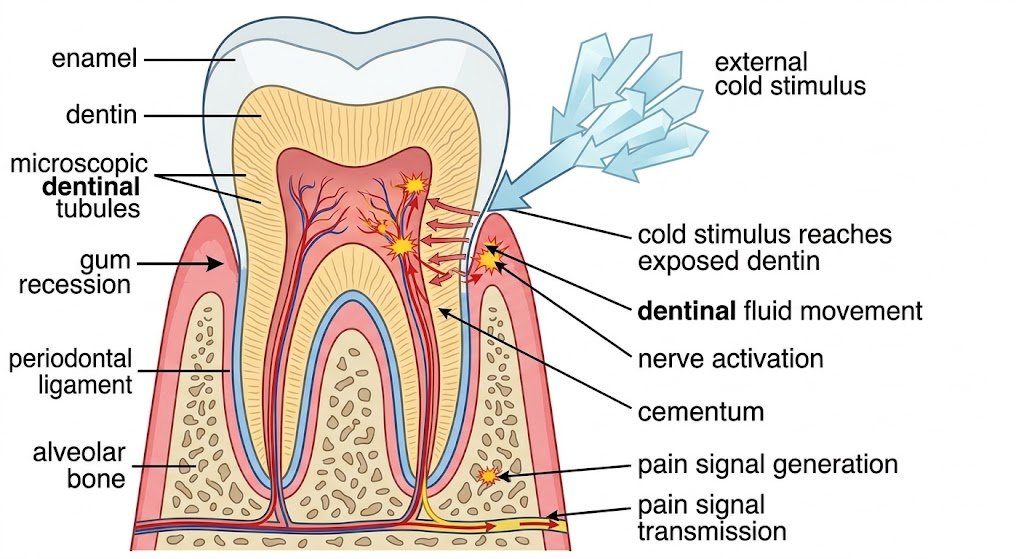
A desensitizing toothpaste may work by reducing the way those exposed areas respond to stimuli.
Arginine-containing formulations have been studied because arginine can participate in a process that may encourage the formation of mineral-containing material at exposed dentin surfaces and within or around dentinal tubules.
The practical goal is straightforward:
Less exposure or movement at sensitive dentin areas → less stimulation → potentially less sensitivity.
However, the response depends on the cause of sensitivity and the particular formulation.
Common Situations That Can Cause Tooth Sensitivity
Sensitive teeth can have many possible causes, including:
- Gum recession that exposes the tooth root
- Enamel wear
- Acid erosion
- Aggressive tooth brushing
- Tooth grinding or clenching
- Recent dental procedures
- Cavities
- Cracked or damaged teeth
- Gum disease
- Other dental problems
A sensitivity toothpaste may help with the symptom, but it does not necessarily correct the underlying cause.
For example, if one tooth suddenly becomes painful because of a cavity or crack, repeatedly changing toothpaste may delay the dental evaluation you actually need.
What Is Tooth Sensitivity?
Tooth sensitivity is commonly experienced as a short, sharp pain triggered by something such as cold, heat, sweetness, acidity, brushing, or touch.
A common dental term for this type of sensitivity is dentin hypersensitivity.
The important part is the relationship between the trigger and the pain. A person may drink cold water and experience a sudden sharp sensation from an exposed area of dentin.
But not every toothache is dentin hypersensitivity.
Pain that occurs without an obvious trigger, lasts for a long time after the stimulus disappears, becomes increasingly severe, or affects only one tooth can have a different cause.
What Is Dentin?
Dentin is the tooth structure underneath enamel and cementum.
It is not as hard or as highly mineralized as enamel, and it contains microscopic channels called dentinal tubules.
When protective tooth structure or gum tissue is lost, dentin can become exposed.
That exposure can make external stimuli more likely to produce sensitivity.
What Are Dentinal Tubules?
Dentinal tubules are tiny channels within dentin.
They are important when discussing sensitivity because changes involving fluid movement within these tubules are part of the hydrodynamic theory of dentin hypersensitivity.
The theory provides one explanation for why exposed dentin can respond strongly to temperature, touch, air, or other external stimuli.
Understanding this mechanism also helps explain why some sensitivity toothpastes focus on tubule occlusion rather than only attempting to reduce nerve responsiveness.
How Does Arginine Work in Toothpaste?
Arginine-containing sensitivity toothpaste is commonly associated with an occlusion-based approach.
In simple terms, the goal is to help create a mineral-rich layer or deposit that can reduce the exposure or permeability of sensitive dentin.
A simplified pathway looks like this:
Exposed dentin → open or exposed dentinal tubules → external stimulus → sensitivity
A desensitizing formulation aims to change that pathway:
Exposed dentin → mineral-containing deposits / reduced tubule permeability → less stimulus reaching sensitive structures → potentially less sensitivity
Arginine itself should not be described as simply “blocking the nerves.” That explanation is more appropriate for some other desensitizing mechanisms.
Instead, arginine-containing formulations have been investigated for their ability to promote conditions that can help occlude dentinal tubules and reduce dentin permeability.
The exact mechanism depends on the formulation and the way its ingredients interact.
Why Calcium Matters in Some Arginine Formulations
Some arginine-based sensitivity toothpaste formulations also contain calcium-related ingredients.
This is important because the desensitizing concept is not simply “arginine touches the tooth and stops pain.”
The formulation can be designed to encourage mineral deposition around exposed dentin.
That is one reason the whole formula matters when comparing products.
Two toothpastes may both contain arginine but differ in:
- Other active ingredients
- Calcium-containing ingredients
- Fluoride status
- Abrasive system
- Flavoring
- Surfactants
- Intended use
- Concentration and formulation
- Directions for use
Therefore, the presence of arginine alone does not tell you everything about how a particular product will perform.
Arginine and the Hydrodynamic Theory of Tooth Sensitivity
The hydrodynamic theory is one of the major explanations used to understand dentin hypersensitivity.
When dentinal tubules are exposed, external stimuli may cause changes in fluid movement within these microscopic channels. Those changes can stimulate sensory structures associated with the tooth.
This provides a useful framework for understanding why tubule-occluding ingredients are used in sensitivity toothpaste.
If a formulation can reduce the accessibility or permeability of dentinal tubules, it may reduce the amount of stimulus reaching the sensitive structures.
Arginine-containing formulations are therefore different from ingredients that primarily aim to alter nerve excitability.
Arginine vs. Nerve-Desensitizing Ingredients
There are different approaches to managing dentin hypersensitivity.
| Approach | Basic idea |
| Arginine-based formulation | May promote mineral deposition and dentinal tubule occlusion |
| Potassium-based formulation | Aims to reduce sensory nerve excitability |
| Stannous fluoride formulation | Can provide fluoride benefits while also contributing to sensitivity management and tubule-related effects depending on formulation |
| Calcium/phosphate-based approach | May support mineral deposition and/or tubule occlusion depending on the ingredients |
These categories should not be treated as perfectly interchangeable.
The formulation, evidence, concentration, brushing routine, and cause of sensitivity all influence the result.
Does Arginine Toothpaste Repair Sensitive Teeth?
Not in the sense of rebuilding a damaged tooth.
Arginine toothpaste may help reduce sensitivity, but that does not mean it can regenerate lost enamel, make receded gums grow back, repair a cracked tooth, or fill a cavity.
This distinction is especially important when shopping for sensitivity toothpaste.
For example:
- Gum recession: toothpaste may help reduce sensitivity, but it does not regrow the missing gum tissue.
- Enamel erosion: toothpaste may help with oral-care management, but it cannot simply replace significant enamel that has already been lost.
- Cavity: a sensitivity toothpaste does not substitute for treatment of the decay.
- Cracked tooth: sensitivity relief does not repair the crack.
- Post-treatment sensitivity: some temporary sensitivity can occur after certain dental procedures, but persistent or severe symptoms should be discussed with a dentist.
A product can be useful for symptom management without fixing the underlying dental condition.
What Does the Research Say About Arginine Toothpaste?
Research has investigated arginine-containing toothpaste and other arginine-based oral-care formulations for dentin hypersensitivity.
Clinical research has reported reductions in sensitivity with some arginine-containing formulations, but results should be interpreted carefully because studies can differ in important ways.
Factors include:
- The exact formulation tested
- The amount of active ingredients
- How sensitivity was measured
- How long the product was used
- The comparison toothpaste
- The characteristics of the participants
- Whether the study was randomized or blinded
- Whether the outcome was statistically significant, clinically meaningful, or both
This is why it is better to say that arginine-containing toothpaste has evidence supporting its use in sensitivity management rather than claiming that every arginine toothpaste will work equally well for every person.
What Does “Clinically Proven” Actually Mean?
You may see phrases such as “clinically proven” on toothpaste packaging.
That phrase should not be interpreted as meaning:
“This product will definitely eliminate your sensitivity.”
Clinical evidence normally refers to results observed under particular study conditions.
A product can perform well in a clinical study while an individual consumer experiences a different result.
When evaluating a product, consider the actual claim, the formulation tested, the duration of use, and whether the research is relevant to the product you are considering.
How Long Does Arginine Toothpaste Take to Work?
There is no single timeframe that applies to everyone.
Some sensitivity products are evaluated in clinical studies over repeated use rather than after one brushing. Your response can also depend on why your teeth are sensitive and how severe the sensitivity is.
For practical use, the most important approach is to:
- Follow the product’s directions.
- Use the toothpaste consistently.
- Avoid aggressive brushing.
- Use an appropriate soft-bristled toothbrush.
- Pay attention to whether sensitivity is improving, staying the same, or getting worse.
- Seek professional evaluation if the symptoms do not behave like ordinary sensitivity.
Do not assume that stronger or more frequent brushing will make a desensitizing toothpaste work faster. Excessive brushing pressure can itself contribute to enamel wear or gum recession.
Is Arginine Safe in Toothpaste?
Arginine has been used in oral-care formulations, including products designed for sensitivity management.
However, evaluating toothpaste safety requires looking at the complete product, not just one ingredient.
When choosing an arginine toothpaste, consider:
- The intended age group
- The complete ingredient list
- Other active ingredients
- Fluoride status
- Product directions
- Known personal sensitivities or allergies
- Whether the product is intended for daily use
- Any dental advice you have already received
A product being marketed for sensitive teeth does not mean it is automatically the right choice for every person.
When Should You See a Dentist Instead of Just Changing Toothpaste?
Consider professional dental evaluation if sensitivity is:
- Severe
- Getting worse
- Occurring without an obvious trigger
- Focused on one particular tooth
- Lingering for an unusual amount of time after the trigger
- Associated with swelling
- Associated with significant gum problems
- Associated with a visible crack or damaged filling
- Accompanied by symptoms that suggest a cavity or infection
A toothpaste can be part of an oral-care routine, but it should not be used to mask symptoms that may require diagnosis or treatment.
Arginine vs. Potassium Nitrate
Arginine and potassium nitrate are two different approaches to managing dentin hypersensitivity. Both are used in toothpaste designed for sensitive teeth, but they do not work in exactly the same way.
Arginine-based formulations generally focus on the tooth surface and exposed dentin. Depending on the formulation, arginine can work with calcium-containing ingredients to encourage mineral-rich deposits that help reduce dentin permeability and limit exposure through dentinal tubules.
Potassium nitrate takes a different approach. It is commonly described as a nerve-desensitizing ingredient because potassium ions can reduce the ability of sensory nerves to respond to repeated stimulation.
This means the two ingredients should not simply be compared as though one is universally “stronger.”
| Feature | Arginine | Potassium Nitrate |
| Main sensitivity approach | Surface/tubule occlusion | Nerve desensitization |
| Main target | Exposed dentin and dentinal tubules | Sensory nerve response |
| Often used for | Dentin hypersensitivity | Dentin hypersensitivity |
| Works by rebuilding enamel? | No | No |
| Can be combined with fluoride? | Yes, depending on formulation | Yes, depending on formulation |
| Is one automatically better? | No | No |
The best choice depends on the cause of sensitivity, the complete toothpaste formula, how consistently it is used, and how the individual responds.
For a person with sensitivity caused by exposed root surfaces, for example, a toothpaste designed around tubule occlusion may be particularly relevant. Another person may respond well to a potassium nitrate formulation.
The important point is to compare the complete formulation, rather than choosing a toothpaste simply because one ingredient sounds more advanced.
Can You Use Arginine and Potassium Nitrate Together?
There is no general reason to assume that sensitivity toothpaste must contain only one desensitizing approach. However, consumers should follow the product’s directions rather than combining multiple specialized toothpastes without a reason.
If sensitivity is persistent despite appropriate use, the next step should usually be identifying the underlying cause rather than continuously adding more desensitizing products.
Arginine vs. Fluoride
Arginine and fluoride have different primary roles in toothpaste.
Fluoride is primarily used for cavity prevention and supporting the mineral balance of teeth. Arginine-containing formulations, on the other hand, are commonly developed with dentin hypersensitivity in mind.
That means these ingredients are not necessarily competitors.
A toothpaste can contain an arginine-based sensitivity system and fluoride at the same time. In that situation, the product may be designed to provide both cavity protection and sensitivity management.
This distinction is important because someone with sensitive teeth may still need effective cavity protection.
What Does Fluoride Do?
Fluoride helps teeth resist acid-related mineral loss and supports remineralization. Regular use of fluoride toothpaste is one of the established ways to reduce the risk of dental caries.
The exact fluoride concentration and recommended use can vary by product, age, and individual dental needs.
Is Arginine a Replacement for Fluoride?
Not automatically.
Arginine should not be viewed as a universal replacement for fluoride because they address different oral-care goals.
If cavity prevention is an important concern, check whether the toothpaste contains fluoride and whether it is appropriate for your age and dental risk.
If you are considering fluoride-free toothpaste, the decision should be based on your individual needs rather than assuming that every non-fluoride ingredient provides the same cavity-prevention benefit as fluoride.
Arginine vs. Hydroxyapatite
Arginine and hydroxyapatite are also different types of toothpaste ingredients.
Arginine is commonly associated with dentin sensitivity management, particularly through formulations intended to reduce dentin permeability.
Hydroxyapatite is a calcium-phosphate mineral closely related to the mineral found naturally in teeth and bones. Toothpaste containing hydroxyapatite is generally formulated around mineral-related oral-care benefits.
Because their intended functions can overlap in some areas but are not identical, the comparison should focus on what the person actually needs.
| Question | Arginine | Hydroxyapatite |
| Main area of interest | Tooth sensitivity | Mineral-related tooth care |
| Common formulation goal | Reduce dentin sensitivity | Support mineral-related tooth-surface care |
| Naturally present in teeth? | No | Yes |
| Is it fluoride? | No | No |
| Can a formula contain both? | Potentially, depending on product | Potentially, depending on product |
Hydroxyapatite should also not be described as a magic ingredient that “rebuilds” an entire damaged tooth. Toothpaste has limitations, and a cavity, fracture, severe erosion, or other structural problem may require professional treatment.
Which Is Better for Sensitive Teeth?
There is no universal answer.
If sensitivity is your main concern, compare products based on their actual desensitizing ingredients, formulation, evidence, directions, and your dental needs.
If you are also interested in fluoride-free oral care or mineral-based toothpaste, hydroxyapatite may be another category worth evaluating.
The goal should be to choose the formulation that matches your needs—not simply the ingredient with the most attention online.
Arginine vs. Stannous Fluoride
Stannous fluoride is another ingredient commonly associated with sensitivity toothpaste.
Unlike arginine, stannous fluoride provides fluoride for cavity protection while also being used in formulations designed to address sensitivity and other oral-health concerns.
This creates an important difference:
- Arginine: primarily associated with a sensitivity-focused approach.
- Stannous fluoride: combines fluoride-related cavity protection with additional oral-care benefits, depending on the formulation.
- Potassium nitrate: primarily focuses on reducing nerve sensitivity.
- Hydroxyapatite: provides a mineral-based approach to tooth-surface care.
The actual performance of a toothpaste depends on more than the ingredient name. Concentration, formulation chemistry, other active ingredients, abrasives, and how the product is used can all matter.
For someone who wants both sensitivity management and fluoride-based cavity protection, a stannous fluoride toothpaste may be worth considering. For someone specifically comparing different desensitizing systems, an arginine formulation may also be relevant.
Can Arginine Toothpaste Help Sensitive Teeth?
It can be a reasonable option for people experiencing dentin hypersensitivity, particularly when sensitivity occurs after a recognizable trigger such as cold drinks, hot foods, sweet foods, acidic foods, brushing, or touching an exposed area.
However, toothpaste cannot diagnose why a tooth is sensitive.
Sensitivity can occur because of:
- Gum recession
- Exposed tooth roots
- Enamel wear
- Acid erosion
- Aggressive brushing
- Tooth grinding
- Recent dental procedures
- Cavities
- Cracked teeth
- Damaged fillings
- Gum disease
If the problem is caused by a cavity or cracked tooth, simply switching to sensitivity toothpaste may reduce discomfort temporarily without fixing the underlying problem.
What Kind of Sensitivity May Respond?
A short, sharp response to a specific stimulus is more consistent with typical dentin hypersensitivity than pain that appears spontaneously or continues after the stimulus is removed.
For example:
Cold water → brief sharp sensation → disappears quickly
This pattern can be consistent with sensitivity.
By contrast:
Tooth hurts without a trigger → pain lingers → worsening pain or swelling
That pattern deserves dental evaluation rather than relying only on sensitivity toothpaste.
How to Choose an Arginine Toothpaste
Choosing an arginine toothpaste should involve more than searching the ingredient list for the word “arginine.”
Use this simple checklist.
1. Start With the Reason for Sensitivity
First ask why your teeth may be sensitive.
If you have recently had whitening treatment, sensitivity may have a different context than sensitivity caused by gum recession or enamel erosion.
If only one tooth is suddenly sensitive, especially if the pain is severe or persistent, consider getting it checked.
2. Check the Active Ingredients
Look for the active ingredients listed on the packaging.
Arginine may be part of a broader desensitizing system. The other active ingredients can affect what the toothpaste is designed to do.
Do not judge the entire product based on one ingredient.
3. Check the Fluoride Status
If cavity prevention is a priority, check whether the toothpaste contains fluoride.
For adults who want fluoride toothpaste, the label should clearly identify the relevant fluoride ingredient and concentration where required.
If you intentionally want a fluoride-free toothpaste, understand what that choice means for your cavity-prevention strategy.
4. Look at the Complete Ingredient List
The complete formula matters.
Depending on your preferences and needs, you may want to review:
- Abrasives
- Surfactants
- Flavoring agents
- Sweeteners
- Preservatives
- Fluoride compounds
- Calcium or phosphate ingredients
- Other desensitizing ingredients
Someone looking for a “non-toxic” toothpaste should also avoid treating that phrase as a regulated scientific category. Instead, identify which ingredients you personally want to avoid and why.
5. Consider Abrasivity
Abrasive toothpaste can help remove surface deposits, but aggressive brushing and excessive abrasion can contribute to tooth wear in some circumstances.
People with exposed dentin, enamel erosion, or gum recession may want to pay particular attention to brushing technique and product abrasivity.
A sensitivity toothpaste cannot compensate for consistently brushing too hard.
6. Follow the Directions
Use the toothpaste according to the manufacturer’s directions.
Using more toothpaste does not necessarily mean faster results.
Consistency is generally more useful than repeatedly switching between products every few days.
What to Look for on an Arginine Toothpaste Label
A toothpaste label can tell you more than the marketing claims on the front of the package.
Before buying, check:
Active ingredient:
Identify what the toothpaste is actually designed to do.
Fluoride status:
Determine whether it contains fluoride if cavity protection is important to you.
Complete ingredient list:
Look beyond the highlighted ingredient.
Directions:
Check how often the manufacturer recommends using it and whether there are age-specific instructions.
Intended use:
Some products are designed specifically for sensitivity, while others target multiple oral-health concerns.
Manufacturer information:
A transparent manufacturer should provide enough information for consumers to understand what the product contains and how it should be used.
Don’t Choose Based Only on “Natural” or “Clean”
Marketing terms such as “natural,” “clean,” “non-toxic,” or “chemical-free” do not automatically tell you whether a toothpaste will work well for sensitive teeth.
Everything in a toothpaste is made of chemicals in the scientific sense. The more useful question is:
What ingredients are present, in what formulation, for what purpose, and is there evidence supporting the intended use?
This approach makes it easier to compare products objectively.
Common Mistakes When Choosing Sensitivity Toothpaste
Mistake 1: Focusing on One Ingredient
Seeing “arginine” on a package does not tell you everything about the toothpaste.
Two products can contain the same highlighted ingredient but have different formulas and different intended uses.
Mistake 2: Assuming All Tooth Sensitivity Is the Same
Sensitivity caused by exposed dentin is not the same as pain from a cavity, cracked tooth, infection, or damaged filling.
A toothpaste can help manage symptoms without treating the underlying dental condition.
Mistake 3: Changing Products Too Quickly
Switching products every few days makes it difficult to determine whether a toothpaste is actually helping.
Follow the product’s directions and give the approach a reasonable opportunity to work unless symptoms require earlier professional evaluation.
Mistake 4: Brushing Too Hard
More pressure does not mean cleaner teeth.
A gentle technique and appropriate toothbrush can be important, particularly when gum recession or enamel wear contributes to sensitivity.
Mistake 5: Ignoring Persistent Pain
If sensitivity keeps getting worse, occurs without an obvious trigger, lasts after the trigger disappears, or affects one specific tooth, don’t keep changing toothpaste indefinitely.
A dental examination may be more useful.
Mistake 6: Treating “Non-Toxic” as a Complete Buying Criterion
A toothpaste can fit someone’s ingredient preferences while still not being the best match for their dental needs.
Consider both:
Ingredient preferences + oral-health requirements
rather than only one side.
Who Should Consider Arginine Toothpaste?
Arginine toothpaste may be worth considering if you:
- Experience brief sensitivity from cold or hot foods
- Have exposed dentin or tooth roots
- Experience sensitivity when brushing
- Want a toothpaste specifically formulated for dentin hypersensitivity
- Are comparing different sensitivity ingredients
- Want to understand alternatives to potassium nitrate-based products
It may be particularly useful as part of a broader sensitivity-management routine that also includes gentle brushing, appropriate oral hygiene, and professional care when needed.
The goal is not simply to find a toothpaste containing arginine. The goal is to determine whether an arginine-based formulation matches the reason your teeth are sensitive.
Who Should Be More Careful?
Some symptoms should not be treated as ordinary tooth sensitivity.
Consider professional dental evaluation if you experience:
- Severe tooth pain
- Pain that occurs without a trigger
- Pain that continues for a long time after eating or drinking
- Swelling around the tooth or gum
- Fever or other signs of infection
- A visibly cracked or damaged tooth
- A loose or damaged filling
- Significant bleeding or gum problems
- Sensitivity affecting one tooth unexpectedly
- Symptoms that continue despite appropriate oral care
Children also require age-appropriate toothpaste choices and supervision according to dental guidance.
Pregnant people, older adults, and people with complex dental conditions may also benefit from individualized advice from a dentist or other qualified dental professional.
A Simple Decision Framework
If you are trying to decide whether arginine toothpaste is right for you, use this five-step process.
Step 1: Identify the Pattern
Ask:
What triggers the pain?
Cold? Heat? Sweet foods? Brushing? Touch? Nothing obvious?
The pattern provides useful information.
Step 2: Think About the Possible Cause
Consider whether you have:
- Gum recession
- Recent whitening
- Enamel wear
- Acid exposure
- Aggressive brushing
- Recent dental treatment
- A known cavity or damaged tooth
Step 3: Choose the Appropriate Toothpaste Category
If the main issue appears to be dentin hypersensitivity, compare sensitivity-focused toothpastes.
Arginine, potassium nitrate, stannous fluoride, and other approaches may appear in different products.
Step 4: Compare the Complete Formula
Check:
- Active ingredients
- Fluoride status
- Ingredient list
- Intended use
- Abrasivity considerations
- Directions
- Age suitability
Step 5: Reassess
If sensitivity improves, continue using the product as directed.
If symptoms do not improve, become worse, or show unusual characteristics, consider dental evaluation instead of simply buying another toothpaste.
Frequently Asked Questions About Arginine in Toothpaste
What does arginine do in toothpaste?
Arginine is commonly used in toothpaste formulations designed to manage dentin hypersensitivity. Depending on the formulation, it can contribute to a mineral-rich occlusive layer that reduces dentin permeability and helps limit sensitivity.
Is arginine safe in toothpaste?
Arginine is used in oral-care formulations, including products designed for sensitive teeth. However, safety should always be considered in the context of the complete product, intended age group, directions, and individual circumstances.
Is arginine better than potassium nitrate?
Neither should automatically be considered better for everyone. They use different approaches to sensitivity management. Arginine-based formulations generally focus on dentin/tubule occlusion, while potassium nitrate is associated with reducing sensory nerve excitability.
Is arginine better than fluoride?
They have different primary roles. Fluoride is mainly associated with cavity prevention and mineral protection, while arginine is commonly used for sensitivity management. A toothpaste can contain both.
How long does arginine toothpaste take to work?
There is no single timeframe that applies to everyone. Research protocols vary, and individual response depends on the severity and cause of sensitivity, the formulation, and consistent use.
Can children use arginine toothpaste?
Do not assume that an adult arginine toothpaste is appropriate for children. Follow the product’s age guidance and dental recommendations for children.
Does arginine repair enamel?
Arginine toothpaste should not be described as repairing or rebuilding damaged enamel in the same way that a dental treatment repairs structural damage. Its primary relevance in toothpaste is sensitivity management.
Can arginine and fluoride be used together?
Yes, some toothpaste formulations contain both. Their functions are different, so the combination can provide sensitivity-focused benefits alongside fluoride-based cavity protection, depending on the product.
Is arginine toothpaste good for gum recession?
It may help manage sensitivity associated with exposed root surfaces, but it does not reverse gum recession. If recession is significant or worsening, the underlying gum condition should be evaluated.
Is arginine toothpaste good for cavities?
Arginine should not be treated as a substitute for established cavity-prevention ingredients. If you are at elevated risk of cavities, discuss appropriate fluoride use and your overall dental-care routine with a dental professional.
Final Takeaway
Arginine in toothpaste is mainly relevant to tooth sensitivity, particularly dentin hypersensitivity.
Its importance comes from its role in formulations designed to reduce the effects of exposed dentin and dentinal tubules. This makes arginine different from ingredients such as fluoride, which is primarily associated with cavity prevention, or potassium nitrate, which uses a different approach to sensitivity.
The most useful way to evaluate an arginine toothpaste is not to ask whether arginine is simply “good” or “bad.” Instead, ask:
What is causing my sensitivity?
What does the complete toothpaste formula contain?
Does it provide the oral-health benefits I need?
Does the product have appropriate directions and evidence for its intended use?
And most importantly:
Could my sensitivity be a sign of a dental problem that toothpaste alone cannot treat?
For ordinary stimulus-triggered sensitivity, an appropriate sensitivity toothpaste may be a useful part of daily oral care. But persistent, severe, spontaneous, or unusual pain deserves professional evaluation.
