If cold water, ice cream, hot drinks, sweet foods, or even brushing your teeth causes a sudden sharp pain, you may be dealing with tooth sensitivity. One ingredient you will often find in toothpaste made for sensitive teeth is potassium nitrate.
But what does potassium nitrate actually do?
Potassium nitrate is mainly used as a desensitizing ingredient. It is intended to help reduce the pain associated with dentin hypersensitivity. It has a different role from fluoride, which is primarily used in toothpaste for cavity prevention.
Understanding that difference can help you choose a toothpaste based on your actual dental needs instead of simply choosing a product because its packaging says “for sensitive teeth.”
In this guide, we will explain what potassium nitrate is, how it is thought to work, what the research says, how it compares with other sensitivity ingredients, how to choose a potassium nitrate toothpaste, and when sensitivity may require professional dental care.
What Is Potassium Nitrate in Toothpaste?
Potassium nitrate is a chemical compound used as an active ingredient in many toothpastes formulated for sensitive teeth.
Its main purpose is desensitization. In other words, it is included to help reduce the uncomfortable or painful response that can occur when exposed dentin reacts to cold, heat, touch, sweet foods, or other triggers.
It is important to understand that potassium nitrate is not the same thing as the cleaning ingredients found in ordinary toothpaste.
A toothpaste is usually a complete mixture of several types of ingredients, and each one can have a different job.
For example, a toothpaste may contain:
- Potassium nitrate for sensitivity
- Fluoride for cavity prevention
- Abrasives to help clean the tooth surface and remove some surface stains
- Humectants to help maintain moisture and texture
- Flavoring agents for taste
- Surfactants to help distribute the toothpaste and create foam
- Other ingredients that support the formula
This means you should not judge a toothpaste only by whether it contains potassium nitrate.
Two products can contain the same sensitivity ingredient but still have different formulas, different additional active ingredients, and different intended uses.
Why is potassium nitrate associated with sensitive teeth?
The key reason is its relationship with the nerves involved in tooth sensitivity.
When dentin becomes exposed, external stimuli can reach structures connected with the dental pulp through microscopic pathways called dentinal tubules. These stimuli can contribute to the sharp pain commonly associated with dentin hypersensitivity.
Potassium-containing toothpaste is designed to help reduce the ability of the sensory nerves to respond strongly to these stimuli.
The important point is that potassium nitrate is generally considered a desensitizing ingredient, not a treatment that repairs every possible cause of tooth pain.
Why Is Potassium Nitrate Used in Toothpaste?
The main reason potassium nitrate is used in toothpaste is to help manage dentin hypersensitivity.
Dentin hypersensitivity is commonly experienced as a short, sharp pain when the teeth are exposed to certain triggers.
Common triggers include:
- Cold water
- Ice cream
- Hot drinks
- Sweet foods
- Acidic foods or drinks
- Cold air
- Tooth brushing
- Touch
For someone with sensitive teeth, these everyday activities can become uncomfortable enough to affect eating, drinking, and normal oral hygiene.
A sensitivity toothpaste containing potassium nitrate is intended to make these sensations less painful.
However, there is an important distinction:
Reducing sensitivity is not the same as treating the reason the tooth became sensitive.
For example, if sensitivity is caused by gum recession, enamel wear, erosion, a cavity, a cracked tooth, or another dental problem, potassium nitrate may not address the underlying condition.
That is why a good sensitivity-toothpaste strategy starts with understanding the problem rather than immediately choosing a product.
What Is Tooth Sensitivity?
Tooth sensitivity is a common dental complaint characterized by a brief, sharp pain in response to particular stimuli.
When the sensitivity is specifically associated with exposed dentin and meets appropriate diagnostic criteria, it is commonly referred to as dentin hypersensitivity.
The pain may happen when you:
- Drink something cold
- Eat something hot
- Consume sweets
- Eat acidic foods
- Brush your teeth
- Touch a sensitive area
- Breathe in cold air
The sensation is usually different from a constant toothache.
A short, sharp response that happens only when a particular stimulus is applied can be consistent with dentin hypersensitivity. But this pattern alone does not prove the diagnosis.
Other dental conditions can produce sensitivity or pain too.
What is dentin?
Dentin is the layer of tooth structure located beneath the enamel and around the dental pulp.
Unlike the outer enamel surface, dentin contains microscopic tubules.
When protective tooth structure is lost or the root surface becomes exposed, these tubules can become more accessible to external stimuli.
This is one reason exposed dentin is closely associated with sensitivity.
What are dentinal tubules?
Dentinal tubules are tiny channels within dentin.
They extend through the dentin toward the pulp.
When dentin is exposed, changes associated with external stimuli can affect the fluid within these tubules. This can contribute to stimulation of nerves located deeper within the tooth.
One widely discussed explanation for this process is the hydrodynamic theory.
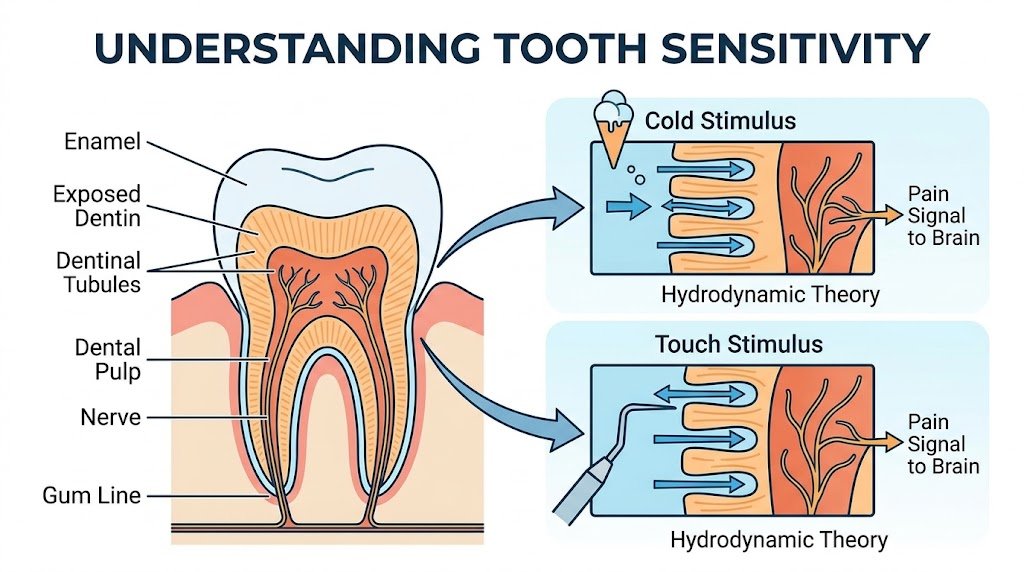
The hydrodynamic theory helps explain why cold water or touch can produce a sudden sharp sensation in an exposed-dentin area.
However, tooth sensitivity is not always caused by the same problem, which is why persistent or unusual pain should not automatically be treated as ordinary sensitivity.
What Causes Sensitive Teeth?
There are several possible reasons why a person may experience sensitive teeth.
Gum recession
When the gum tissue moves away from part of the tooth, the root surface may become exposed.
Root surfaces do not have the same enamel covering found on the crown of the tooth.
As a result, exposed root dentin can be more vulnerable to sensitivity.
Enamel wear
Enamel protects the underlying structures of the tooth.
Over time, excessive mechanical wear or exposure to acids can contribute to loss of tooth structure.
When protective enamel becomes thinner or is lost in an area, sensitivity may become more noticeable.
Aggressive brushing
Brushing harder does not necessarily mean cleaning better.
Excessive brushing pressure, especially when combined with an abrasive toothpaste or an unsuitable brushing technique, can contribute to wear of tooth structure or gum tissue.
People with sensitivity should pay attention not only to their toothpaste but also to their brushing technique.
Acid exposure
Frequent exposure to acidic foods and drinks can contribute to dental erosion.
Examples may include:
- Soft drinks
- Citrus beverages
- Energy drinks
- Sports drinks
- Other acidic foods and drinks
The effect depends on the overall diet, frequency of exposure, oral environment, and individual factors.
Dental procedures
Some people experience temporary sensitivity following certain dental treatments.
In these cases, the sensitivity may improve over time, depending on the procedure and the individual’s dental condition.
Cavities or damaged teeth
A cavity, cracked tooth, worn restoration, or other structural problem can also produce sensitivity.
This is particularly important because a person may assume that any sensitivity can be solved with a sensitivity toothpaste.
That is not always the case.
Gum disease or other oral-health problems
Changes in gum health can contribute to exposed root surfaces and sensitivity.
If sensitivity occurs alongside bleeding gums, swelling, persistent pain, or other symptoms, professional evaluation may be more appropriate than simply changing toothpaste.
How Does Potassium Nitrate Work?
Potassium nitrate is generally associated with a nerve-desensitizing approach to managing dentin hypersensitivity.
The basic idea is that potassium ions may influence the excitability of the nerves involved in transmitting sensitivity signals.
When dentin is exposed, stimuli can interact with structures within the dentinal tubules and ultimately affect sensory nerves.
Potassium-containing formulations are intended to reduce the ability of these nerves to respond strongly to the stimulus.
The simplified process
A simplified way to understand the proposed mechanism is:
Exposed dentin
↓
External stimulus such as cold or touch
↓
Changes within dentinal tubules
↓
Stimulation of sensory nerve structures
↓
Sharp sensitivity
Potassium-based desensitization aims to reduce the nerve response further along this pathway.
This is different from an ingredient whose main action is to physically block or occlude dentinal tubules.
Does potassium nitrate “block” the nerves?
It is better not to describe potassium nitrate as literally blocking the nerves.
A more accurate explanation is that potassium ions are thought to reduce nerve excitability.
The proposed mechanism has been discussed in dental research for many years, although researchers have also noted limitations and uncertainty around exactly how potassium-containing products produce their clinical effects.
This distinction is important because it prevents the article from turning a scientific explanation into an exaggerated marketing claim.
Potassium Nitrate and the Hydrodynamic Theory
The hydrodynamic theory provides one useful framework for understanding dentin hypersensitivity.
When dentin is exposed, external stimuli can cause fluid movement within dentinal tubules.
That movement can contribute to stimulation of sensory structures near the dental pulp.
Potassium nitrate takes a different approach from ingredients designed primarily to reduce the movement of fluid through those tubules.
Instead, potassium ions are associated with reducing the excitability of the nerves involved in the pain response.
This means there are different possible strategies for managing sensitivity:
| Approach | Basic idea |
| Potassium-based desensitization | Reduce nerve excitability |
| Tubule occlusion | Reduce exposure or movement through dentinal tubules |
| Fluoride-based approach | May support tooth mineral and can contribute to sensitivity management in some formulations while also providing anticaries benefits |
| Mineral-based ingredients | May support mineral deposition or tubule-related effects depending on the ingredient |
The important takeaway is that not every sensitivity toothpaste works in exactly the same way.
Does Potassium Nitrate Repair Sensitive Teeth?
No—not in the sense of repairing damaged tooth structure.
Potassium nitrate is primarily used to reduce the sensation of sensitivity.
It should not be described as repairing:
- A cavity
- A cracked tooth
- Significant enamel loss
- Gum recession
- An infected tooth
- A damaged filling
- Other structural dental problems
This distinction can help prevent unrealistic expectations.
If your tooth is sensitive because its root is exposed, potassium nitrate may help reduce the sensation. But it does not necessarily cause the gum tissue to grow back over the exposed root.
Likewise, if a cavity is causing pain, sensitivity toothpaste may not solve the cavity.
The appropriate response depends on the cause.
What Does the Research Say About Potassium Nitrate Toothpaste?
Research on potassium-containing toothpaste has examined its ability to reduce dentin hypersensitivity using different study designs and sensitivity measurements.
Some clinical studies have reported reductions in sensitivity after regular use of potassium nitrate toothpaste.
Systematic reviews and meta-analyses have also evaluated potassium-containing desensitizing toothpastes, but the evidence should be interpreted carefully because studies can differ in:
- Formulation
- Potassium concentration
- Study duration
- Number of participants
- Type of sensitivity
- Method used to measure pain
- Comparison toothpaste
- Follow-up period
This makes it difficult to reduce the entire evidence base to a simple statement such as “potassium nitrate definitely works for everyone.”
A more useful conclusion is that potassium-containing toothpastes have evidence supporting their use for dentin hypersensitivity, but individual results can vary and the quality of evidence is not identical across every study.
Why study design matters
Suppose one study reports that people using a potassium nitrate toothpaste experienced less sensitivity.
That is useful information.
But researchers also need to consider:
- What was the comparison group?
- How was sensitivity measured?
- How long did participants use the toothpaste?
- Was the study randomized?
- Were participants blinded?
- Was the product formulation representative of products currently available?
- Were the results statistically and clinically meaningful?
These questions help separate promising evidence from overly broad marketing claims.
How Long Does Potassium Nitrate Toothpaste Take to Work?
One common mistake is expecting a sensitivity toothpaste to completely solve the problem after one or two uses.
Clinical research on potassium nitrate toothpastes has often evaluated sensitivity over multiple weeks of regular use rather than judging the product after a single brushing.
The exact time required can vary depending on:
- The cause of sensitivity
- Severity of sensitivity
- Product formulation
- Frequency of use
- Individual response
- Whether the sensitivity is actually caused by dentin hypersensitivity
This means it is more reasonable to follow the product directions consistently than to expect an immediate permanent change.
If sensitivity is not improving, becomes worse, or starts occurring without an obvious trigger, the next step should be evaluating the cause.
Is Potassium Nitrate Safe in Toothpaste?
Potassium nitrate has a long history of use in toothpaste formulated for sensitive teeth.
However, it is still important to evaluate the complete product formulation, rather than assuming that the presence of one ingredient tells you everything about the product.
When choosing a potassium nitrate toothpaste, look at:
- Active ingredients
- Potassium nitrate concentration
- Fluoride status
- Abrasive ingredients
- Flavoring ingredients
- Surfactants
- Sweeteners
- Preservatives
- Intended age group
- Usage instructions
A product can be appropriate for one person but less suitable for another because their oral-health needs differ.
The word “safe” should therefore not be used as a shortcut for “right for everyone.”
When should you talk to a dentist?
Consider professional evaluation if your sensitivity:
- Is severe
- Keeps getting worse
- Happens without an obvious trigger
- Is concentrated in one tooth
- Continues after the trigger is removed
- Occurs with swelling
- Occurs with significant gum problems
- Is accompanied by a suspected cavity or cracked tooth
These symptoms may indicate something other than routine dentin hypersensitivity.
[ ARTICLE CONTINUES — NEXT PART STARTS WITH: H2: Potassium Nitrate vs. Fluoride ]
Bilkul, Part 2 yahin se continue kar raha hoon — previous content repeat nahi karunga.
Potassium Nitrate vs. Fluoride: What’s the Difference?
Potassium nitrate and fluoride can both appear in toothpaste, but they do different jobs.
Potassium nitrate is primarily included to help manage tooth sensitivity, while fluoride is primarily used to help prevent dental caries (cavities) and strengthen the tooth against acid-related mineral loss.
This means you should not automatically think of potassium nitrate as an alternative to fluoride.
In fact, some sensitivity toothpastes contain both potassium nitrate and fluoride, allowing one formula to address sensitivity while also providing fluoride’s anticaries benefits.
| Feature | Potassium Nitrate | Fluoride |
| Main purpose | Sensitivity management | Cavity prevention |
| Main target | Sensory response associated with dentin hypersensitivity | Tooth mineral and caries risk |
| Common use | Sensitive-teeth toothpaste | Everyday anticavity toothpaste |
| Replaces the other? | Not necessarily | Not necessarily |
| Can appear together? | Yes | Yes |
| Main buying question | Do I need sensitivity support? | Do I need fluoride for cavity protection? |
The right choice therefore depends on why you are choosing the toothpaste.
If your main problem is sensitivity, potassium nitrate may be useful.
If your main concern is cavity prevention, fluoride status becomes an important consideration.
If you have both concerns, a toothpaste containing both may be worth considering.
Why this distinction matters
Marketing language can make toothpaste ingredients sound interchangeable when they are not.
For example, a toothpaste may advertise itself as “for sensitive teeth,” but that does not tell you whether it contains fluoride.
Similarly, choosing a fluoride-free toothpaste simply because it contains potassium nitrate does not automatically mean it provides the same cavity-prevention benefits as a fluoride toothpaste.
The better approach is to identify your primary dental need first and then evaluate the formula.
Potassium Nitrate vs. Stannous Fluoride for Sensitive Teeth
Stannous fluoride is another ingredient commonly associated with sensitivity-focused toothpaste.
Unlike potassium nitrate, stannous fluoride combines fluoride’s anticaries role with additional properties that can be useful in oral-care formulations.
The two ingredients therefore differ in both mechanism and overall role.
Potassium nitrate
Potassium nitrate is primarily used as a desensitizing ingredient.
It is often selected by people whose main concern is sensitivity and who want a familiar sensitivity-focused formulation.
Stannous fluoride
Stannous fluoride provides fluoride for cavity prevention and may also help with sensitivity.
It is therefore particularly relevant when someone wants a toothpaste that addresses more than one oral-health concern.
However, product formulation matters.
A toothpaste is not defined by one ingredient alone. The concentration, combination of ingredients, abrasivity, flavoring system, and intended use can all affect the overall product experience.
Which one should you choose?
There is no universal answer.
A simple way to think about it is:
- Main concern = sensitivity: potassium nitrate may be an ingredient worth considering.
- Sensitivity + cavity prevention: a fluoride toothpaste that also provides sensitivity support may make sense.
- High cavity risk: discuss your toothpaste choice with a dental professional rather than choosing based only on sensitivity marketing.
- Persistent or unusual pain: identify the cause before relying on a desensitizing toothpaste.
Potassium Nitrate vs. Hydroxyapatite for Sensitive Teeth
Hydroxyapatite is a calcium-phosphate mineral related to the mineral naturally found in teeth and bones.
It has become increasingly visible in toothpaste, especially in products marketed as fluoride-free or focused on enamel and mineral care.
Potassium nitrate and hydroxyapatite should not be treated as competing ingredients with identical purposes.
Potassium nitrate is mainly associated with sensitivity management through a nerve-related mechanism.
Hydroxyapatite is generally discussed in relation to mineral deposition, enamel support, remineralization, and other oral-care applications.
Some formulations may contain a sensitivity-focused ingredient alongside mineral-based ingredients.
This is why looking at the whole formula is more useful than deciding that one ingredient is automatically better.
What about nano-hydroxyapatite?
Nano-hydroxyapatite is a form of hydroxyapatite produced at the nanoscale.
Its particle size gives it different physical characteristics from larger hydroxyapatite particles, and it has been studied for applications involving enamel, dentin, remineralization, and sensitivity.
However, the presence of nano-hydroxyapatite does not automatically mean that a toothpaste is better for sensitivity than a potassium nitrate formulation.
The important question is still:
What problem is the formula designed to address, and what evidence supports its intended use?
Can Potassium Nitrate Help With Enamel Loss?
Potassium nitrate itself should not be described as an enamel-repair ingredient.
Its primary role is sensitivity management.
If enamel has been weakened or lost, the appropriate strategy depends on why the damage occurred and how extensive it is.
Potential contributors to enamel wear can include:
- Acid exposure
- Dietary habits
- Mechanical wear
- Grinding or clenching
- Certain oral-health conditions
- Other individual factors
A toothpaste may contain additional ingredients intended to support enamel or mineral care, but that does not mean potassium nitrate itself repairs enamel.
This distinction is especially important for readers comparing a sensitivity toothpaste with products marketed for remineralization.
Can Potassium Nitrate Help With Cavities?
Potassium nitrate is not the primary anticavity ingredient in toothpaste.
If cavity prevention is an important concern, pay attention to whether the toothpaste contains an appropriate fluoride ingredient and whether the product is intended for anticaries use.
A sensitivity toothpaste can potentially contain both potassium nitrate and fluoride.
That combination may be useful for someone who wants sensitivity support without giving up fluoride-based cavity protection.
But if a toothpaste contains potassium nitrate and is fluoride-free, you should not assume that the potassium nitrate itself provides equivalent cavity-prevention protection.
This is one of the most important distinctions when shopping for sensitivity toothpaste.
Sensitivity and cavities can occur together
A person can have sensitive teeth and also be at risk for cavities.
These are not mutually exclusive conditions.
That means choosing toothpaste should not be based on sensitivity alone.
Consider the bigger picture:
Sensitivity → What is causing it?
Cavity risk → What level of anticaries protection do I need?
Enamel condition → What type of mineral support is appropriate?
Formula → Which ingredients address those needs?
Can Potassium Nitrate Help With Gum Recession?
Potassium nitrate may help reduce sensitivity associated with exposed root surfaces, but it does not reverse gum recession.
This is an important difference.
When gums recede, the underlying root surface may become exposed. Because the root does not have the same enamel protection as the crown, sensitivity can occur.
A potassium nitrate toothpaste may help manage the resulting discomfort.
But it does not cause receded gum tissue to grow back.
If you notice:
- Increasing gum recession
- Exposed roots
- Bleeding gums
- Persistent sensitivity
- Changes in gum shape
it is worth discussing the issue with a dental professional.
A sensitivity toothpaste can be part of symptom management, but it should not replace evaluation of the underlying gum condition.
How to Choose a Potassium Nitrate Toothpaste
Once you understand what potassium nitrate does, the next question is practical:
Which potassium nitrate toothpaste should you actually buy?
The answer should depend on your oral-health needs rather than the front of the package.
Here are the most useful factors to evaluate.
1. Check the active ingredients
Start by looking at the Drug Facts panel or other regulated product information where applicable.
Confirm whether potassium nitrate is actually listed as an active ingredient.
Do not assume that a product marketed for sensitive teeth contains potassium nitrate.
Different sensitivity toothpastes may use different active ingredients.
2. Check the fluoride status
This is especially important if you are choosing toothpaste for everyday use.
Ask yourself:
Do I want fluoride in this toothpaste?
If yes, look for an appropriate fluoride active ingredient and verify the product’s intended use.
If you specifically want fluoride-free toothpaste, confirm that rather than assuming it from the marketing language.
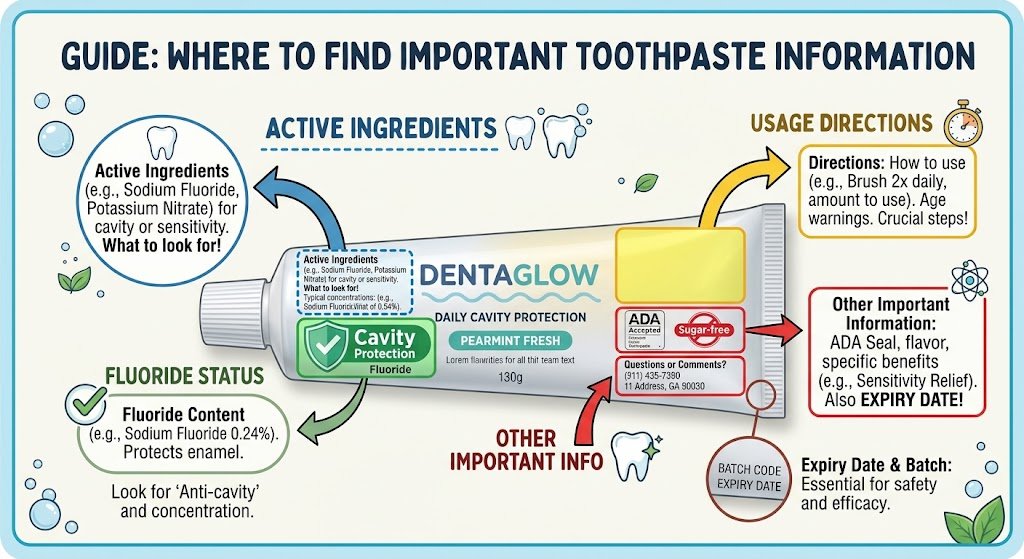
3. Look at the complete ingredient list
Potassium nitrate is only one part of the formulation.
Look at the rest of the ingredient list for factors that matter to you, such as:
- Flavoring
- Foaming ingredients
- Abrasives
- Sweeteners
- Preservatives
- Other active ingredients
People with a history of irritation or sensitivity to particular ingredients should pay especially close attention to the complete formula.
4. Consider abrasivity
Someone with sensitive teeth may want to think carefully about how aggressively their toothpaste cleans.
Abrasive ingredients help remove deposits and surface stains, but the overall abrasivity of a toothpaste can matter when someone already has concerns about enamel wear, dentin exposure, or gum recession.
Do not assume that “more whitening” automatically means “better cleaning.”
If sensitivity is your primary concern, the overall formulation and your brushing technique both matter.
5. Consider your actual trigger
Ask when your teeth hurt.
For example:
- Cold drinks?
- Hot drinks?
- Sweet foods?
- Brushing?
- Touch?
- Cold air?
Knowing the trigger can help you determine whether your symptoms resemble ordinary dentin hypersensitivity or whether they deserve further evaluation.
6. Consider how many dental problems you are trying to address
A person who only wants sensitivity relief may prioritize a different formula from someone who wants:
- Sensitivity support
- Cavity protection
- Enamel care
- Gum-health support
A multi-purpose toothpaste may be more convenient if it appropriately addresses several needs.
But more ingredients do not automatically make a product better.
The goal is fit, not maximum ingredient count.
What Should You Look for on a Potassium Nitrate Toothpaste Label?
Before buying, use this quick checklist.
| What to check | Why it matters |
| Potassium nitrate listed as an active ingredient | Confirms the product actually uses it for sensitivity |
| Fluoride status | Helps determine whether it fits your cavity-prevention preference |
| Complete ingredient list | Helps identify other ingredients you may want or avoid |
| Directions for use | Shows how the manufacturer intends the product to be used |
| Age guidance | Important when buying for children |
| Sensitivity positioning | Helps confirm the product’s intended purpose |
| Manufacturer information | Useful for transparency |
| Package size | Helps compare value |
| Other active ingredients | May indicate additional oral-care purposes |
| Warnings | Important for proper use |
Don’t judge the toothpaste by one ingredient
A common shopping mistake is:
“This contains potassium nitrate, so it must be the right toothpaste for me.”
That conclusion is too simple.
A better process is:
Need → active ingredient → complete formula → usage directions → suitability → value
This approach helps you choose based on the problem you are actually trying to solve.
Potassium Nitrate Toothpaste Buying Guide
If you are ready to compare products, organize your choices around the use case rather than simply looking for the cheapest tube.
For everyday sensitivity
Look for a toothpaste specifically formulated for sensitive teeth and check whether potassium nitrate is one of its active ingredients.
Also consider whether you want fluoride included.
For sensitivity plus cavity protection
A toothpaste containing potassium nitrate and an appropriate fluoride active ingredient may be worth considering.
This type of formula can make sense for people who want one toothpaste to address both sensitivity and routine cavity prevention.
For someone avoiding fluoride
If you intentionally want a fluoride-free toothpaste, check the label carefully.
Do not assume that fluoride-free products provide the same anticaries protection as fluoride toothpaste.
You may want to compare other active ingredients and the evidence supporting their intended benefits.
For people with multiple oral-health concerns
If you have sensitivity alongside cavities, enamel concerns, gum recession, or persistent pain, selecting toothpaste becomes more complicated.
Instead of choosing solely from marketing claims, consider discussing the situation with a dental professional.
A toothpaste can help manage a symptom while the underlying dental problem still needs treatment.
Common Mistakes When Using Potassium Nitrate Toothpaste
Even a suitable toothpaste may not provide the expected benefit if it is used incorrectly or if the underlying problem is misunderstood.
Mistake 1: Expecting instant results
Sensitivity toothpaste is generally intended for consistent use rather than one-time treatment.
Give the product reasonable time according to its directions and the evidence behind its intended use.
Mistake 2: Assuming sensitivity always means sensitive teeth
Pain from a cavity, cracked tooth, gum problem, or other dental condition can sometimes be mistaken for ordinary sensitivity.
If the symptoms are unusual, persistent, or getting worse, seek professional evaluation.
Mistake 3: Brushing harder because your teeth are sensitive
More pressure is not a better solution.
Use an appropriate brushing technique and avoid aggressive scrubbing.
Mistake 4: Ignoring the rest of the formula
Potassium nitrate may be the reason you noticed the product, but it is not the whole toothpaste.
Check the active ingredients and complete ingredient list.
Mistake 5: Giving up fluoride without understanding the trade-off
Some people specifically prefer fluoride-free products.
That is a personal product preference, but it should not be confused with the claim that potassium nitrate replaces fluoride for cavity prevention.
These ingredients have different roles.
Mistake 6: Treating the symptom indefinitely
If sensitivity continues despite consistent use, do not simply keep changing toothpaste forever.
The underlying cause may need to be identified.
[ ARTICLE CONTINUES — NEXT PART STARTS WITH: H2: Who Should Consider Potassium Nitrate Toothpaste? ]
Bilkul. Ab exactly previous boundary se continue kar raha hoon — repeat nahi karunga.
Who Should Consider Potassium Nitrate Toothpaste?
Potassium nitrate toothpaste may be worth considering if your main problem is short, sharp sensitivity triggered by things such as cold drinks, hot foods, sweets, brushing, or touch.
It can be especially relevant when sensitivity is associated with exposed dentin or exposed root surfaces.
However, choosing a sensitivity toothpaste should be based on the pattern of your symptoms rather than the product label alone.
People with cold sensitivity
Cold drinks and cold foods are common triggers for dentin hypersensitivity.
If your discomfort is brief and happens mainly when something cold touches the teeth, a sensitivity toothpaste may be a reasonable option to try.
People with sensitivity from brushing
Some people notice a sharp sensation while brushing particular teeth.
This can happen when dentin or root surfaces are exposed.
In this situation, toothpaste is only one part of the solution. Gentle brushing technique and appropriate oral-health care also matter.
People with exposed tooth roots
Gum recession can expose root surfaces and make certain teeth more sensitive.
Potassium nitrate may help manage the resulting sensitivity, but it does not repair the gum recession itself.
People who experience sensitivity after dental treatment
Temporary sensitivity can sometimes occur after certain dental procedures.
Whether potassium nitrate toothpaste is appropriate depends on the procedure, severity, and duration of the symptoms.
If sensitivity persists longer than expected or becomes severe, contact your dentist rather than assuming that toothpaste alone will solve it.
Who Should Be More Careful With Sensitivity Toothpaste?
Most people can use commercially available toothpaste according to its directions, but sensitivity should not automatically be treated as a minor problem.
Certain symptom patterns deserve more attention.
When pain occurs without a trigger
Typical dentin sensitivity is usually associated with a specific stimulus.
If a tooth hurts spontaneously, especially when you are not eating, drinking, brushing, or touching it, the cause may be different.
When pain lingers
A brief response to cold is different from pain that continues long after the cold stimulus is removed.
Lingering pain can indicate a problem that needs professional assessment.
When only one tooth is affected
If one specific tooth suddenly becomes very sensitive while the surrounding teeth feel normal, consider getting it checked.
Possible causes can include decay, a crack, a damaged restoration, or another localized problem.
When there is swelling
Swelling around a tooth or gum should not be managed only with sensitivity toothpaste.
Seek dental care promptly.
When sensitivity is getting worse
If sensitivity continues to increase despite normal oral care, changing to another toothpaste may not address the underlying problem.
Can Children Use Potassium Nitrate Toothpaste?
Children should use toothpaste according to age-appropriate product instructions and dental guidance.
Do not assume that an adult sensitivity toothpaste is automatically suitable for a child simply because it contains an ingredient commonly used in sensitivity products.
Children also have different cavity risks, toothpaste-use habits, and swallowing considerations.
When selecting toothpaste for a child, check:
- The recommended age range
- Active ingredients
- Fluoride concentration
- Directions for use
- Amount of toothpaste recommended
- Whether the child can reliably spit it out
- Advice from the child’s dentist
For young children, dental guidance is more important than choosing a toothpaste based on a single ingredient.
Can You Use Potassium Nitrate and Fluoride Together?
Yes, toothpaste can be formulated with both potassium nitrate and fluoride.
This combination makes sense because the ingredients have different primary purposes.
Potassium nitrate is used for sensitivity management, while fluoride is primarily associated with cavity prevention and maintaining tooth mineral in the presence of acid challenges.
Therefore, the presence of potassium nitrate does not mean fluoride has to be excluded.
For many people, the more useful question is not:
“Potassium nitrate or fluoride?”
It is:
“What does my mouth need, and does this complete formula provide it?”
This is especially important when comparing fluoride and fluoride-free products.
Can Potassium Nitrate Stop Tooth Sensitivity Permanently?
Not necessarily.
Potassium nitrate toothpaste is intended to help manage sensitivity, but the long-term outcome depends on the reason the tooth is sensitive.
For example, if sensitivity is associated with:
- Gum recession
- Enamel wear
- Acid erosion
- Exposed dentin
- Brushing habits
then reducing the trigger and managing the underlying cause can be just as important as using a sensitivity toothpaste.
If sensitivity comes from a cavity or cracked tooth, treating the underlying dental problem is more important than simply masking the symptom.
So it is better to think of potassium nitrate as a sensitivity-management tool, not a permanent cure for every cause of tooth pain.
How to Use Potassium Nitrate Toothpaste Effectively
The exact instructions depend on the product, so follow the manufacturer’s directions.
In general, consistency matters more than occasionally using a sensitivity toothpaste when pain appears.
Use it consistently
Sensitivity products are commonly designed for regular use.
Stopping and starting repeatedly makes it harder to determine whether the product is actually helping.
Brush gently
Use a soft-bristled toothbrush and avoid aggressive pressure.
Hard brushing can contribute to gum recession and tooth-surface wear, which may make sensitivity worse.
Give the product enough time
Do not judge the product after only one brushing unless the product specifically provides different instructions.
Clinical studies of sensitivity toothpastes commonly evaluate outcomes over repeated use rather than a single application.
Do not use more than directed
More toothpaste does not necessarily produce better results.
Follow the product’s directions for amount and frequency.
Continue appropriate dental care
A sensitivity toothpaste should not replace regular brushing, interdental cleaning, dental examinations, or treatment of an identified dental problem.
Potassium Nitrate Toothpaste and Non-Toxic Toothpaste
If you are looking for a non-toxic toothpaste, potassium nitrate adds another layer to the buying decision.
The term “non-toxic” is not, by itself, a precise scientific description of a complete toothpaste formula.
Instead of judging a product only by whether it says “natural,” “clean,” or “non-toxic,” examine the actual ingredients and the product’s intended use.
Consider:
- What are the active ingredients?
- Does it contain fluoride?
- What abrasive system does it use?
- What flavoring ingredients are present?
- Does it contain surfactants you prefer to avoid?
- Does the manufacturer clearly disclose the ingredients?
- Is the product appropriate for your age and oral-health needs?
A potassium nitrate toothpaste can fit into a broader ingredient-conscious oral-care routine, but potassium nitrate itself should not be treated as proof that the entire formula is “non-toxic.”
A Simple Decision Framework for Choosing Potassium Nitrate Toothpaste
If you are confused by the number of sensitivity toothpastes available, use this simple process.
Step 1: Identify the sensitivity pattern
Ask:
What triggers the pain?
Cold? Heat? Sweet foods? Brushing? Touch?
A predictable, short-lived response is more consistent with ordinary dentin sensitivity than unexplained or persistent pain.
Step 2: Think about the possible cause
Consider whether you have:
- Gum recession
- Enamel wear
- Recent dental work
- Aggressive brushing habits
- Frequent acidic foods or drinks
- A known cavity
- A cracked tooth
You do not need to diagnose yourself. The purpose is simply to recognize when toothpaste may not be the whole answer.
Step 3: Decide what protection you need
Do you mainly need sensitivity support?
Or do you also want:
- Cavity protection
- Fluoride
- Enamel support
- A fluoride-free formula
- Ingredient preferences such as SLS-free or fragrance-free
This determines which formulations are worth comparing.
Step 4: Compare the active ingredients
Look beyond the product name.
Check whether the toothpaste contains potassium nitrate and whether it also contains another active ingredient that matters to you.
Step 5: Check the complete formula
Review the inactive ingredients, flavoring, abrasives, and other formulation details.
This is particularly important if you have previously experienced irritation from toothpaste.
Step 6: Use it consistently
Follow the product instructions and give the toothpaste enough time to evaluate whether your sensitivity improves.
Step 7: Reassess your symptoms
If sensitivity improves, continue appropriate oral care.
If it does not improve, becomes worse, occurs without a trigger, or is accompanied by other symptoms, consider professional dental evaluation.
Potassium Nitrate Toothpaste: Pros and Cons
Before buying, it helps to understand both sides.
| Potential benefit | Important limitation |
| Specifically used for sensitivity management | Does not repair every cause of tooth sensitivity |
| Available in many sensitivity formulations | Products differ in their complete formulation |
| Can be combined with fluoride | Potassium nitrate does not replace fluoride’s primary anticaries role |
| May help reduce sensitivity with regular use | Results can vary between individuals |
| Familiar ingredient in sensitivity toothpaste | Persistent pain still needs evaluation |
| Can fit into an everyday oral-care routine | Choosing only by the ingredient can overlook other needs |
The key takeaway is simple:
Potassium nitrate can be useful, but the right toothpaste depends on the complete formula and the reason your teeth are sensitive.
Frequently Asked Questions About Potassium Nitrate in Toothpaste
What does potassium nitrate do in toothpaste?
Potassium nitrate is mainly used as a desensitizing ingredient. It is intended to help reduce the nerve response associated with dentin hypersensitivity.
Is potassium nitrate safe in toothpaste?
Potassium nitrate has been used in sensitivity toothpaste formulations for many years. However, suitability depends on the complete product, intended user, and proper use. Follow the product’s directions and seek dental advice for persistent or unusual pain.
Is potassium nitrate better than fluoride?
They have different primary roles, so it is not accurate to say that one is simply “better.”
Potassium nitrate is mainly associated with sensitivity management, while fluoride is primarily used for cavity prevention and tooth mineral protection.
Some products contain both.
How long does potassium nitrate toothpaste take to work?
Results vary by product and person. Clinical studies commonly assess sensitivity improvement after repeated use over a period of time rather than after a single brushing.
Follow the manufacturer’s directions consistently.
Can potassium nitrate repair enamel?
No. Potassium nitrate is primarily a sensitivity-management ingredient. It should not be described as an ingredient that directly rebuilds lost enamel.
Can potassium nitrate treat cavities?
No. Potassium nitrate is not the primary ingredient responsible for cavity prevention. If cavity prevention is a priority, evaluate the toothpaste’s fluoride status and other anticaries properties.
Can potassium nitrate toothpaste help exposed roots?
It may help reduce sensitivity associated with exposed root surfaces, but it does not reverse gum recession or restore the lost gum tissue.
Can you use potassium nitrate and fluoride together?
Yes. Toothpaste can contain both ingredients because they serve different primary purposes.
Is potassium nitrate the same as potassium fluoride?
No.
The names may sound similar because both contain potassium, but they are different compounds with different roles in toothpaste.
Can children use potassium nitrate toothpaste?
Children should use toothpaste according to age-specific product instructions and dental guidance. Do not assume an adult sensitivity toothpaste is appropriate for a child.
Can potassium nitrate permanently cure sensitive teeth?
Not necessarily. It may help manage sensitivity, but the long-term outcome depends on the underlying cause.
If the cause is a cavity, crack, gum problem, or another dental condition, that condition may require separate treatment.
What should I do if potassium nitrate toothpaste does not help?
If your sensitivity does not improve after consistent use, or if pain becomes stronger, spontaneous, prolonged, or localized to one tooth, contact a dentist to determine the cause.
Final Takeaway: Is Potassium Nitrate Worth Considering?
Potassium nitrate is an established ingredient used in toothpaste designed for sensitive teeth.
Its primary purpose is not to whiten teeth, rebuild enamel, or prevent cavities. Instead, it is used to help manage the uncomfortable nerve response associated with dentin hypersensitivity.
That distinction makes it easier to choose toothpaste intelligently.
If cold drinks, hot foods, sweets, brushing, or touch cause brief sharp sensitivity, a potassium nitrate toothpaste may be worth considering.
But do not stop at the ingredient name.
Look at the complete formula, check whether it contains fluoride if cavity protection is important to you, consider the product’s other ingredients, and use it according to its directions.
Most importantly, do not assume every toothache is ordinary sensitivity.
If pain is persistent, spontaneous, severe, localized to one tooth, associated with swelling, or otherwise unusual, the better next step is a dental evaluation.
For shoppers comparing sensitivity toothpastes, the best product is not necessarily the one with the longest ingredient list or the strongest marketing claim.
It is the one whose ingredients, intended use, and overall formulation match your actual oral-health needs.
