If you have seen hydroxyapatite in toothpaste and wondered what it actually does, you are not alone. The ingredient is increasingly discussed as a mineral-based option for people interested in enamel care, remineralization, sensitivity, or fluoride-free toothpaste.
Hydroxyapatite is a calcium-phosphate mineral closely related to the mineral component of teeth. In toothpaste, it is used in formulations designed to interact with the tooth surface and support oral health. Research on hydroxyapatite-containing oral-care products has expanded, including clinical studies evaluating their potential for reducing caries risk and supporting remineralization. (PubMed)
But there is an important distinction between understanding what hydroxyapatite does and deciding whether hydroxyapatite toothpaste is right for you.
This guide explains what hydroxyapatite is, how it works, what the evidence says about cavities and enamel, how it compares with fluoride, what nano-hydroxyapatite means, and what to look for when choosing a product.
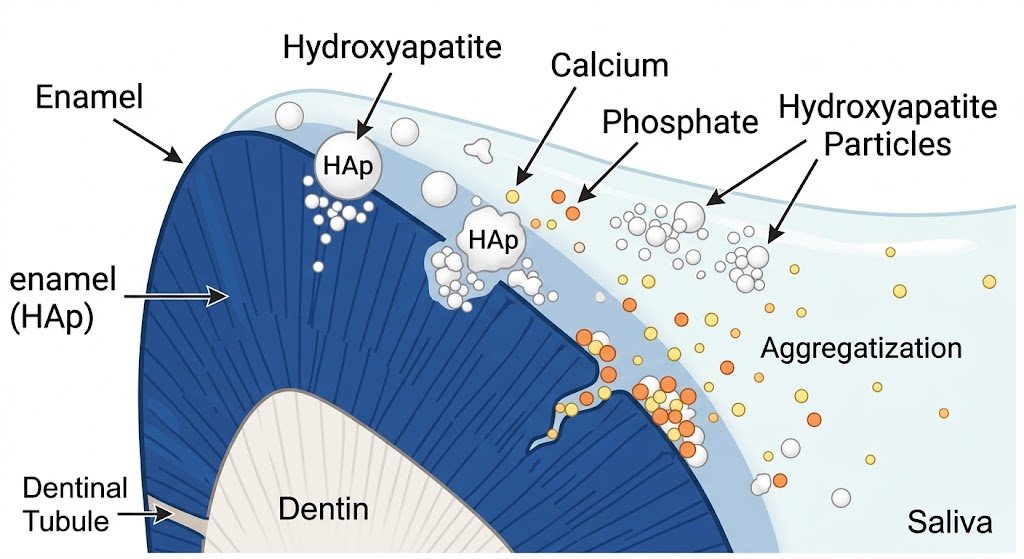
What Is Hydroxyapatite in Toothpaste?
Hydroxyapatite is a calcium-phosphate mineral. It is closely related to the inorganic mineral component that gives teeth their hardness and structure.
When used in toothpaste, hydroxyapatite is included as an active or functional ingredient intended to interact with the tooth surface. This is different from ingredients such as flavoring agents, thickeners, or humectants, which mainly help create the toothpaste’s texture, taste, or stability.
The basic idea behind hydroxyapatite toothpaste is relatively straightforward:
Hydroxyapatite → tooth surface → mineral interaction → support for enamel and early mineral loss
That does not mean the toothpaste simply creates a new layer of tooth enamel every time you brush. The biology is more nuanced.
Teeth constantly experience cycles of demineralization and remineralization. Acids produced by oral bacteria can contribute to mineral loss from enamel, while saliva and minerals in the mouth help support repair of early mineral changes.
Hydroxyapatite toothpaste is designed around this mineral environment.
Research published in recent systematic reviews has found growing clinical evidence that hydroxyapatite-containing oral-care products can reduce caries risk, although the evidence base varies by formulation, study design, and comparison product. (PubMed)
This is one reason hydroxyapatite has become an important ingredient for people looking beyond traditional fluoride toothpaste.
However, hydroxyapatite is not simply another name for fluoride.
Fluoride and hydroxyapatite are different materials and should be evaluated separately. Fluoride has a long-established role in cavity prevention, and the American Dental Association continues to recognize fluoride toothpaste as the standard category for toothpaste carrying an ADA cavity-protection claim. (ADA)
So when you see hydroxyapatite on a toothpaste label, the useful question is not simply:
“Is this good or bad?”
A better question is:
“What does this formulation contain, what is it designed to do, and does it fit my dental needs?”
How Does Hydroxyapatite Work in Toothpaste?
To understand why hydroxyapatite is used in toothpaste, it helps to understand what happens to tooth enamel throughout the day.
Hydroxyapatite and Enamel
Enamel is the hard outer layer of a tooth. Its mineral structure is largely based on calcium phosphate crystals related to hydroxyapatite.
Everyday eating and drinking can create conditions in which acids temporarily lower the pH around teeth. These acids can contribute to mineral loss from the tooth surface.
At the same time, saliva provides calcium, phosphate, and other components that help the mouth move toward remineralization.
This creates an ongoing balance:
Demineralization ↔ Remineralization
If mineral loss repeatedly outweighs repair, the risk of developing dental caries increases.
Hydroxyapatite toothpaste is intended to participate in this mineral-focused environment by providing hydroxyapatite to the oral cavity.
Research on hydroxyapatite-containing toothpaste has investigated outcomes such as mineral changes, initial caries lesions, and caries-related risk factors. A 2024 systematic review and meta-analysis found an expanded body of clinical evidence supporting hydroxyapatite-containing oral-care products for caries prevention, while also noting the need to interpret the available evidence within the individual studies and formulations. (PubMed)
Hydroxyapatite and Remineralization
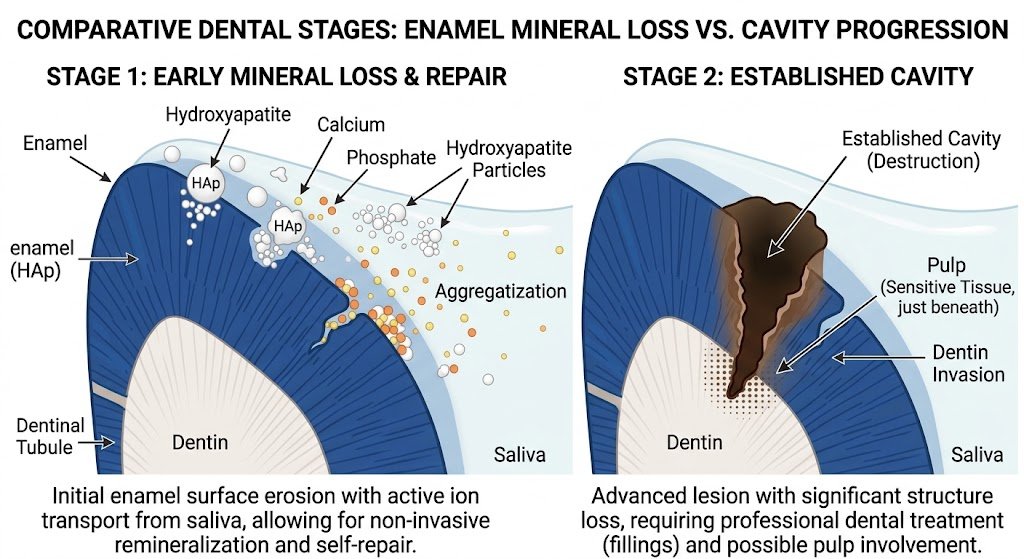
Remineralization means the return or deposition of minerals into areas of tooth structure that have experienced early mineral loss.
This is different from repairing a large cavity.
For example, an early enamel lesion may involve mineral changes without the tooth having a large structural hole. Supporting remineralization in this early stage is fundamentally different from repairing a cavity that has already created substantial structural damage.
This distinction is important because some marketing language can make “remineralization” sound like a toothpaste can rebuild any damaged tooth.
It cannot.
If a tooth has an established cavity, fracture, major erosion, or another significant structural problem, toothpaste should not be viewed as a replacement for professional dental treatment.
The American Dental Association similarly explains that once a cavity has formed, professional dental care may be necessary; toothpaste should not be presented as a way to simply fill an established cavity. (ADA News)
What Hydroxyapatite Cannot Do
Hydroxyapatite toothpaste should not be described as a universal solution for every dental problem.
It cannot replace:
- Regular brushing
- Cleaning between teeth
- A balanced oral-health routine
- Professional dental examinations
- Treatment of established cavities
- Treatment of broken or cracked teeth
- Professional management of serious gum disease
It also does not mean that every hydroxyapatite toothpaste has the same formulation or produces identical results.
The concentration, particle characteristics, other active ingredients, abrasives, and overall formulation can all matter.
That is why choosing a hydroxyapatite toothpaste requires looking beyond the ingredient name.
What Are the Potential Benefits of Hydroxyapatite Toothpaste?
The potential benefits of hydroxyapatite toothpaste center mainly around tooth mineral support and caries prevention.
However, the strength of evidence is not identical for every claimed benefit, so it is useful to separate what the ingredient is intended to do from what a particular product may claim.
1. Supporting Enamel Mineralization
Because hydroxyapatite is closely related to tooth mineral, its use in toothpaste is intended to support interactions with the tooth surface.
This makes enamel care one of the central reasons hydroxyapatite appears in oral-care products.
However, “supporting enamel” should not be interpreted as making damaged enamel permanently regenerate.
The realistic concept is support for mineral balance and early mineral changes—not unlimited rebuilding of damaged teeth.
2. Supporting Remineralization
Hydroxyapatite has been studied for its ability to support remineralization of early enamel lesions.
A 2025 systematic review and meta-analysis examining fluoride-free hydroxyapatite toothpaste in younger populations found no significant difference in several caries-progression outcomes compared with conventional fluoride toothpaste, while some measures of lesion size and fluorescence favored hydroxyapatite in the included studies. The authors described hydroxyapatite toothpaste as a promising alternative, but the evidence should still be interpreted in the context of the limited number of eligible studies. (PubMed)
This is useful information for consumers because it shows why hydroxyapatite is being studied seriously without requiring the conclusion that it is automatically superior to fluoride.
3. Potential Cavity Protection
Hydroxyapatite is also being studied as an anticaries ingredient.
An updated 2024 systematic review and meta-analysis identified clinical and in-situ evidence supporting the caries-prevention potential of hydroxyapatite-containing oral-care products, including fluoride-free formulations. (PubMed)
At the same time, consumers should recognize an important difference between:
“There is clinical evidence supporting hydroxyapatite’s potential for caries prevention”
and:
“Every hydroxyapatite toothpaste is proven to prevent cavities equally well.”
The second statement does not follow from the first.
Different products can contain different concentrations, particle sizes, combinations of active ingredients, and overall formulations.
4. Potential Support for Tooth Sensitivity
Hydroxyapatite has also been investigated in relation to dentin and sensitivity.
The basic idea is that mineral deposition may help reduce pathways through which external stimuli reach sensitive tooth structures.
However, sensitivity has many possible causes.
For example, it may be related to:
- Gum recession
- Exposed dentin
- Enamel wear
- Acid erosion
- Cracked teeth
- Tooth decay
- Recent dental treatment
Therefore, someone with persistent sensitivity should not assume that switching to hydroxyapatite toothpaste will address the underlying cause.
If sensitivity is severe, localized, or getting worse, professional evaluation is more important than simply changing toothpaste.
5. An Option for Fluoride-Free Oral Care
One of the strongest commercial reasons consumers look at hydroxyapatite toothpaste is the availability of fluoride-free formulas.
Some people specifically want fluoride-free oral-care products because of personal preferences or concerns about fluoride exposure.
Hydroxyapatite provides a different approach that is being studied for cavity prevention and remineralization. Recent clinical evidence has increased interest in this category. (PubMed)
But fluoride-free does not automatically mean better for every person.
Someone with a high risk of dental caries may need a different approach, and the American Dental Association continues to recommend fluoride toothpaste for cavity prevention. (ADA)
This is where individual dental risk becomes more important than marketing language.
Hydroxyapatite vs. Fluoride Toothpaste
This is probably the most important comparison for someone researching hydroxyapatite in toothpaste.
The two should not be treated as identical ingredients.
Hydroxyapatite and fluoride are different approaches to oral mineral protection.
Fluoride has extensive evidence and an established role in preventing dental caries. The ADA states that fluoride toothpaste helps prevent tooth decay and supports remineralization of early enamel lesions. (ADA)
Hydroxyapatite, meanwhile, has a growing clinical evidence base, including systematic reviews evaluating its potential as an anticaries ingredient. (PubMed)
What Is the Difference?
| Feature | Hydroxyapatite | Fluoride |
| What is it? | Calcium-phosphate mineral | Fluoride-containing active ingredient |
| Naturally related to tooth mineral? | Yes | Fluoride interacts with tooth mineral |
| Used in toothpaste? | Yes | Yes |
| Studied for remineralization? | Yes | Yes |
| Studied for cavity prevention? | Yes | Extensive evidence |
| Available in fluoride-free formulas? | Yes | No |
| ADA cavity-protection toothpaste category | Not the standard fluoride category | Established fluoride category |
| Best choice for everyone? | No | No single product is ideal for everyone |
The table is intentionally not a “winner” chart.
The correct choice depends on the individual’s oral-health risk, preferences, and the specific toothpaste formulation.
Which One Is Better for Cavities?
There is no responsible one-word answer that applies to every person.
Fluoride has a much longer-established role in caries prevention, and the ADA recommends fluoride toothpaste for cavity protection. (ADA)
At the same time, recent systematic reviews suggest that hydroxyapatite-containing products can have meaningful anticaries effects and may be a promising alternative in some circumstances. (PubMed)
A 2024 randomized clinical trial comparing hydroxyapatite-containing and fluoride-containing toothpastes found evidence that hydroxyapatite formulations affected several caries-related variables, but the authors described the evidence as robust but still inconclusive regarding efficacy compared with traditional fluoridated toothpaste. (PubMed)
That distinction matters.
If you have a history of frequent cavities, your dentist may recommend fluoride based on your individual risk.
If you are a healthy adult specifically looking for a fluoride-free toothpaste, hydroxyapatite may be a category worth investigating.
Can Hydroxyapatite Replace Fluoride?
For some consumers, hydroxyapatite is being considered as a fluoride-free alternative.
But it should not be presented as though fluoride and hydroxyapatite have exactly the same evidence base.
The current evidence supports serious consideration of hydroxyapatite, but fluoride remains the established standard for cavity-prevention toothpaste in the U.S. ADA system. (ADA)
This means your decision should depend on your risk profile and reason for choosing hydroxyapatite.
For someone with low cavity risk who strongly prefers fluoride-free oral care, the decision may look different from someone who repeatedly develops cavities.
Who Might Prefer Hydroxyapatite?
Hydroxyapatite toothpaste may be particularly interesting to people who:
- Want a fluoride-free toothpaste
- Are interested in mineral-based oral care
- Want to explore remineralization-focused formulations
- Are comparing alternatives to conventional fluoride toothpaste
- Prefer ingredient-conscious oral-care products
That does not mean these users should ignore their dental risk.
The best toothpaste is not determined by whether an ingredient sounds natural, modern, or scientifically advanced. It is determined by whether the complete product and routine make sense for the person’s actual oral-health needs.
Hydroxyapatite vs. Nano-Hydroxyapatite
The term nano-hydroxyapatite can make the toothpaste category more confusing.
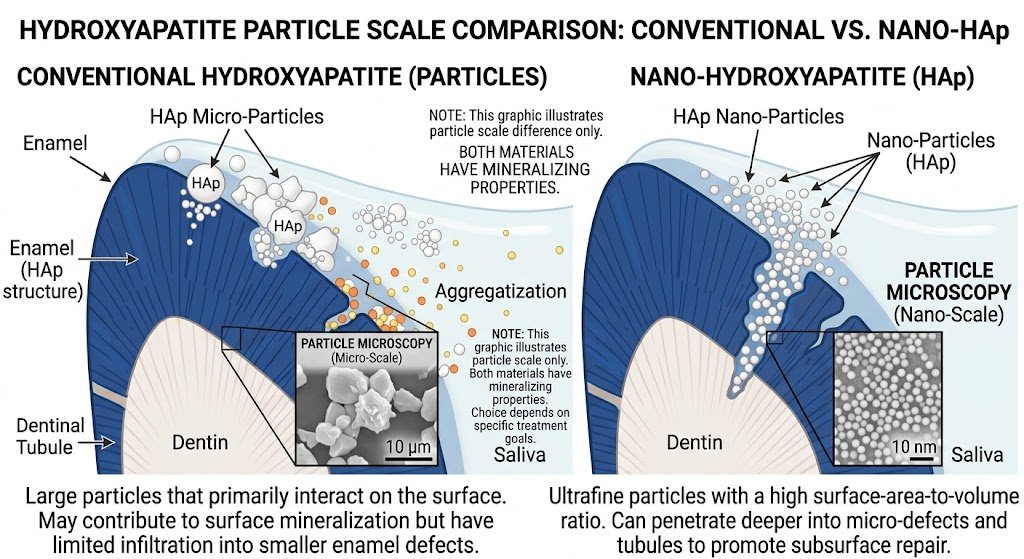
Nano-hydroxyapatite, often abbreviated nHA, refers to hydroxyapatite particles engineered at the nanoscale.
In other words:
Hydroxyapatite is the broader material category.
Nano-hydroxyapatite refers to a form with nanoscale particle dimensions.
The reason particle size matters is that it can affect how a material behaves and interacts with surfaces.
Nano-hydroxyapatite has been investigated specifically for oral-care applications, including remineralization and caries prevention. A systematic review and meta-analysis has evaluated clinical and in-situ research on nano-hydroxyapatite for reducing or remineralizing initial caries lesions. (PubMed)
However, the word “nano” should not automatically be interpreted as “better.”
It describes a physical characteristic of the material, not a universal quality rating.
When comparing products, look at:
- Type of hydroxyapatite
- Particle characteristics
- Concentration
- Complete formula
- Evidence supporting the specific product or formulation
- Intended oral-health benefit
A toothpaste containing nano-hydroxyapatite is not automatically superior to every toothpaste containing another form of hydroxyapatite.
[ ARTICLE CONTINUES — NEXT PART STARTS WITH: H2: “Is Hydroxyapatite Toothpaste Safe?” ]
Part 1 complete. The next part will continue directly with “Is Hydroxyapatite Toothpaste Safe?” and then cover who should consider it, how to choose a product, common buying mistakes, FAQs, conclusion, and the complete implementation package.
Continuing directly from the previous section—no repetition.
Is Hydroxyapatite Toothpaste Safe?
For most people, hydroxyapatite toothpaste is generally considered a well-tolerated oral-care option, and hydroxyapatite has been studied in toothpaste formulations for remineralization and caries-related outcomes.
However, “safe” does not mean that every hydroxyapatite product is identical or appropriate for every person.
The complete formulation matters.
When evaluating a toothpaste, consider:
- The type of hydroxyapatite used
- The concentration or amount of the active ingredient
- Other active ingredients
- Abrasives
- Flavoring agents
- Surfactants
- Sweeteners
- Preservatives
- Intended age group
- Directions for use
A toothpaste can contain a desirable active ingredient while also containing other ingredients that a particular user may prefer to avoid.
Is Nano-Hydroxyapatite Safe?
Nano-hydroxyapatite has received particular attention because its particle size is different from conventional hydroxyapatite.
Research has investigated nano-hydroxyapatite toothpaste in oral-care applications, including enamel remineralization and caries prevention. Systematic reviews have reported promising results, but the evidence should be interpreted according to the specific formulation, study population, exposure, and outcome being evaluated.
For consumers, this means that the word “nano” should not automatically be treated as either a safety warning or a quality guarantee.
A better approach is to examine the evidence and the product’s intended use.
If you have a specific concern about nano-material exposure, pregnancy, a child using the product, or another individual health circumstance, discuss the product with a dentist or other qualified healthcare professional.
Can You Swallow Hydroxyapatite Toothpaste?
Toothpaste is generally intended to be brushed onto the teeth and then expectorated rather than deliberately swallowed.
This is particularly important for children because younger children may have difficulty controlling swallowing while brushing.
For children, follow the toothpaste manufacturer’s age directions and your child’s dental professional’s guidance.
The important point is that choosing a fluoride-free toothpaste does not make intentional swallowing a good habit.
Can Hydroxyapatite Cause Side Effects?
A person can potentially react to ingredients in any toothpaste.
If irritation develops after changing products, the cause may not necessarily be hydroxyapatite itself. Other ingredients—including flavors, essential oils, surfactants, preservatives, or other additives—can also contribute to irritation or sensitivity in susceptible people.
Possible signs that a product is not agreeing with you may include:
- Burning or irritation
- Unusual soreness
- Swelling
- Persistent mouth discomfort
- Rash around the lips
- Worsening sensitivity
If symptoms are significant or persistent, stop using the product and seek professional advice rather than assuming the active ingredient is responsible.
Who May Benefit From Hydroxyapatite Toothpaste?
Hydroxyapatite toothpaste is not a universal solution, but there are several situations where consumers may reasonably want to consider it.
People Looking for Fluoride-Free Toothpaste
This is one of the clearest reasons consumers search for hydroxyapatite toothpaste.
If someone wants a fluoride-free formulation but still wants an active ingredient specifically associated with enamel and caries-related research, hydroxyapatite is a logical category to investigate.
However, a fluoride-free preference should be weighed against individual cavity risk.
If you regularly develop cavities, changing from fluoride toothpaste to a fluoride-free product is a decision worth discussing with your dentist.
People Interested in Mineral-Based Oral Care
Some consumers prefer oral-care products that use ingredients closely related to naturally occurring tooth minerals.
Hydroxyapatite fits this preference because it is a calcium-phosphate mineral closely associated with the mineral structure of teeth.
But “mineral-based” should not be confused with “automatically better.”
A product still needs to perform its intended function, fit your oral-health needs, and have a formulation you are comfortable using consistently.
People Comparing Alternatives to Conventional Fluoride Toothpaste
If you are researching different approaches to oral care, hydroxyapatite can be one category to compare with:
- Sodium fluoride toothpaste
- Stannous fluoride toothpaste
- Fluoride-free toothpaste
- Other remineralization-focused formulations
The goal should not be to identify one ingredient that wins in every situation.
Instead, ask:
What is my main oral-health concern?
Then evaluate the formulation against that need.
People Focused on Enamel Care
Someone concerned about early enamel mineral loss may be interested in a toothpaste containing hydroxyapatite.
However, enamel concerns can have very different causes.
For example, acid erosion, mechanical wear, bruxism, dry mouth, frequent acidic drinks, and dental caries are not interchangeable problems.
If you notice visible enamel changes, persistent sensitivity, or tooth damage, identifying the cause is more important than simply switching toothpaste.
Who Should Be More Careful When Choosing?
Some people should put more emphasis on professional dental guidance than on toothpaste marketing.
People With Frequent Cavities
If you develop cavities repeatedly, your toothpaste choice should be based on your overall caries risk rather than simply your ingredient preferences.
Your dentist may consider factors such as:
- Previous cavities
- Oral hygiene
- Diet
- Saliva flow
- Medication use
- Gum health
- Existing restorations
- Exposed root surfaces
- Other risk factors
Fluoride has an established role in cavity prevention, so replacing fluoride toothpaste with a fluoride-free hydroxyapatite product may not be appropriate for every high-risk patient.
People With Significant Tooth Sensitivity
Hydroxyapatite may be relevant to sensitivity-focused oral care, but sensitivity can have many causes.
If one tooth is suddenly sensitive, pain persists after eating or drinking, or sensitivity is accompanied by swelling or other symptoms, a toothpaste change should not be your only response.
People With Existing Dental Problems
Toothpaste is a preventive and maintenance product.
It should not be expected to treat:
- A large cavity
- A broken tooth
- A dental abscess
- Severe gum disease
- A significant crack
- Persistent unexplained dental pain
Those problems require professional assessment.
Parents Choosing Toothpaste for Children
Children require special consideration because toothpaste use involves both oral-health benefits and the possibility of swallowing.
Do not assume that an adult toothpaste is automatically appropriate for a young child simply because it contains hydroxyapatite.
Check the product’s age guidance and discuss the choice with a pediatric dentist or the child’s dental professional when appropriate.
How to Choose a Hydroxyapatite Toothpaste
Once you understand the ingredient, the next question becomes practical:
How do you choose one product from the many hydroxyapatite toothpastes available?
Instead of choosing based only on packaging or the phrase “natural,” use a simple evaluation framework.
1. Check the Type of Hydroxyapatite
Look at the ingredient list and product description to determine what type of hydroxyapatite is used.
You may encounter terms such as:
- Hydroxyapatite
- Nano-hydroxyapatite
- Nanohydroxyapatite
- Calcium hydroxyapatite
Do not assume that different names necessarily mean completely different oral-health outcomes.
If the manufacturer makes a specific claim about particle size, concentration, or clinical performance, look for supporting documentation rather than relying only on marketing copy.
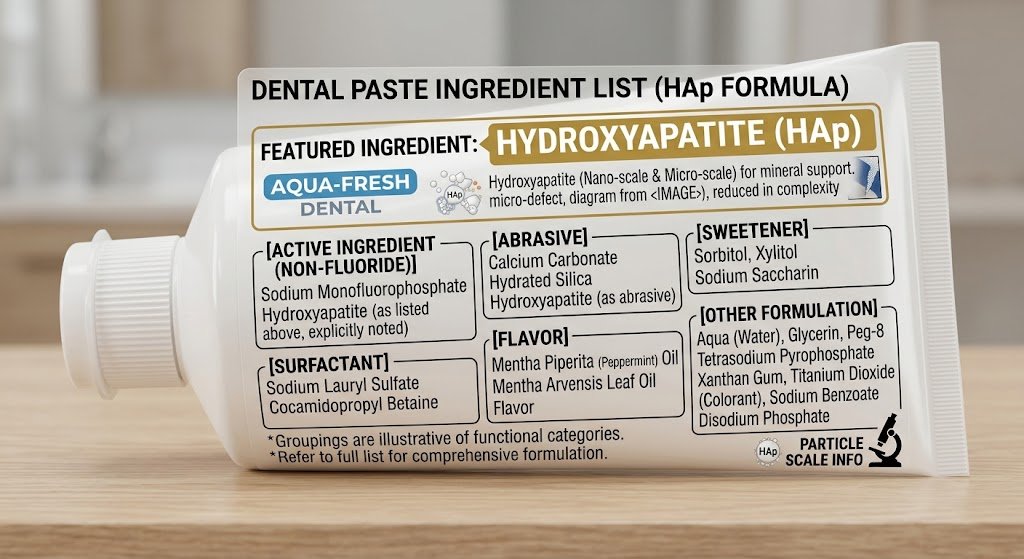
2. Look at the Complete Formula
Hydroxyapatite is important, but it is not the entire toothpaste.
Check the rest of the ingredient list.
Depending on your preferences and dental needs, you may want to examine:
- Abrasive system
- Surfactants
- Flavoring agents
- Sweeteners
- Preservatives
- Essential oils
- Other active ingredients
This is especially important if you have previously experienced irritation from toothpaste.
3. Identify Your Main Oral-Health Goal
Do not buy a hydroxyapatite toothpaste simply because the ingredient is trending.
Start with your actual goal.
| Your main goal | What to evaluate |
| Fluoride-free oral care | Hydroxyapatite formulation and overall cavity-prevention evidence |
| Enamel support | Remineralization-focused claims and supporting evidence |
| Sensitivity | Ingredients and evidence relevant to sensitivity |
| Cavity prevention | Overall anticaries strategy and your personal cavity risk |
| Gum care | Look for a formulation specifically designed for gum-related needs |
| Ingredient-conscious shopping | Full ingredient list and transparency |
| Children’s use | Age guidance and professional dental advice |
This prevents a common mistake: choosing a product because of one ingredient while ignoring the reason you actually need toothpaste.
4. Consider Fluoride Status
This is one of the most important buying decisions.
Some hydroxyapatite toothpastes are fluoride-free.
Others may combine hydroxyapatite with fluoride or other active ingredients.
Therefore, “hydroxyapatite toothpaste” does not automatically mean “fluoride-free toothpaste.”
Read the label carefully.
If fluoride-free is essential to you, verify that the actual product formulation—not just the marketing title—matches your preference.
If you specifically want fluoride because of your cavity risk, look for a toothpaste that provides fluoride at an appropriate concentration and fits your dentist’s recommendations.
5. Look for Evidence, Not Just Marketing Claims
A manufacturer may describe a toothpaste using phrases such as:
- Remineralizes enamel
- Strengthens teeth
- Protects against cavities
- Supports sensitive teeth
- Mineralizes teeth
Those phrases are not equally meaningful unless you understand what evidence supports them.
For a product you are seriously considering, look for:
- Published research
- Transparent ingredient information
- Clearly identified active ingredients
- Specific rather than vague claims
- Appropriate directions and warnings
- Reliable manufacturer information
If a claim sounds dramatically stronger than the available evidence, be cautious.
6. Choose a Formula You Will Actually Use
Theoretically excellent toothpaste is not useful if you dislike brushing with it.
Taste, texture, foaming, and mouthfeel can affect whether you use a toothpaste consistently.
For that reason, product selection is partly about practical fit.
A toothpaste should be:
- Comfortable to brush with
- Appropriate for your needs
- Reasonable for your budget
- Easy to purchase consistently
- Suitable for your age and circumstances
Consistency matters because oral care is not a one-time treatment.
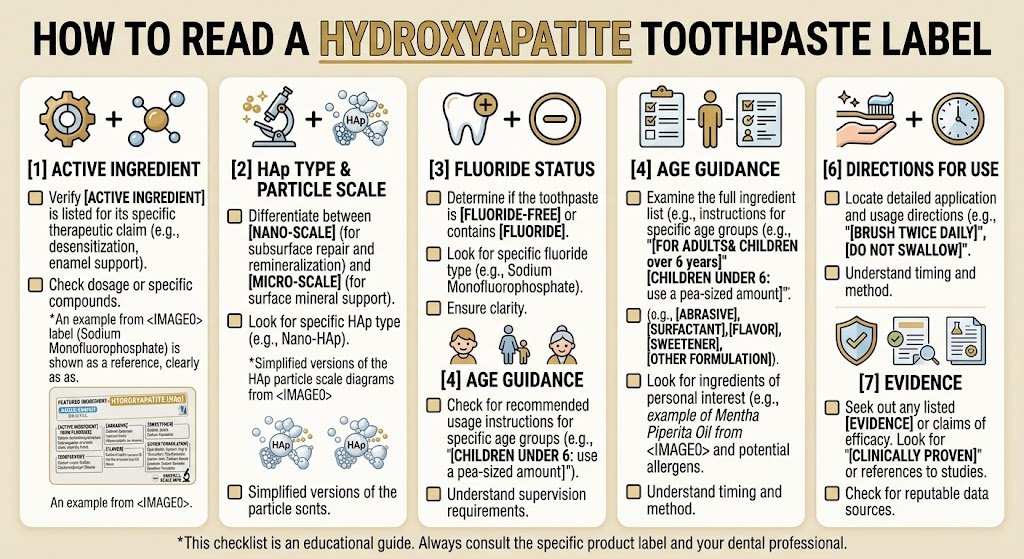
What Should You Look for on a Hydroxyapatite Toothpaste Label?
A quick label check can help you avoid buying based purely on front-of-package marketing.
Label Checklist
Before purchasing, check:
1. Active ingredients
What does the product actually identify as its active ingredient?
2. Hydroxyapatite type
Does the label specify hydroxyapatite, nano-hydroxyapatite, or another form?
3. Fluoride status
Is fluoride present or absent?
4. Intended benefit
Is the product designed primarily around cavity prevention, sensitivity, enamel care, or general oral hygiene?
5. Age guidance
Is it intended for adults, children, or a specific age group?
6. Complete ingredient list
Review the full formula instead of focusing on one ingredient.
7. Directions
How often should it be used, and are there specific warnings?
8. Manufacturer transparency
Can you identify who makes the product and find meaningful information about the formulation?
9. Evidence
Does the product make clinical claims that are supported by accessible evidence?
10. Your own dental needs
Does the product make sense for your actual oral-health situation?
Common Mistakes When Buying Hydroxyapatite Toothpaste
The growing popularity of hydroxyapatite has also created several easy mistakes for shoppers.
Mistake 1: Assuming “Natural” Means Better
Hydroxyapatite may appeal to consumers who prefer mineral-based ingredients, but naturalness alone does not determine effectiveness or safety.
Evaluate the actual formulation.
Mistake 2: Assuming Fluoride-Free Is Automatically Safer
“Fluoride-free” describes what a product does not contain.
It does not automatically establish that the product is safer or more effective for every individual.
Your cavity risk matters.
Mistake 3: Assuming Nano Means Better
Nano-hydroxyapatite has specific particle characteristics, but the word “nano” is not a quality score.
Look at evidence and formulation instead.
Mistake 4: Comparing Products Only by the Hydroxyapatite Name
Two products can both contain hydroxyapatite while differing substantially in their complete formulations.
Look beyond the headline ingredient.
Mistake 5: Expecting Toothpaste to Repair Major Damage
Remineralization support is not the same thing as rebuilding a tooth with an established cavity or major structural damage.
If you have pain, a visible hole, a broken tooth, or another significant dental issue, seek professional care.
Mistake 6: Ignoring Your Cavity Risk
This may be the most important mistake.
A toothpaste choice should reflect your actual risk rather than only your ingredient preferences.
Someone with a strong preference for fluoride-free products may reasonably explore hydroxyapatite.
Someone with recurrent cavities may need a different conversation with their dentist.
Mistake 7: Buying From Packaging Alone
A clean-looking tube, “natural” design, or scientific-sounding terminology does not prove that a toothpaste is the right choice.
Read the label.
Check the claims.
Look for evidence.
Then decide.
When Should You Consider Buying a Hydroxyapatite Toothpaste?
Hydroxyapatite toothpaste becomes a reasonable product category to investigate when your needs line up with what the ingredient and formulation are intended to provide.
It may make sense to compare products if you:
- Want a fluoride-free toothpaste
- Are interested in mineral-based oral care
- Want to explore enamel-focused formulations
- Are researching alternatives to traditional fluoride toothpaste
- Want to compare hydroxyapatite and fluoride before purchasing
- Prefer products with transparent ingredient lists
Before buying, identify the specific reason you want hydroxyapatite.
That reason should determine what you compare.
For example:
If your priority is fluoride-free oral care:
Focus on the hydroxyapatite formulation, complete ingredients, and evidence for cavity prevention.
If your priority is sensitivity:
Look for evidence and ingredients relevant to sensitivity rather than choosing based on hydroxyapatite alone.
If your priority is cavity prevention:
Consider your personal cavity risk and discuss fluoride versus fluoride-free options with your dentist if you are unsure.
If your priority is enamel care:
Look for a formulation designed around remineralization and avoid assuming that “enamel strengthening” means damaged enamel can simply be rebuilt.
This approach makes product selection much more rational.
Hydroxyapatite Toothpaste: What Matters Most?
If you remember only a few points from this guide, remember these:
- Hydroxyapatite is a calcium-phosphate mineral closely related to the mineral component of teeth.
- It is used in toothpaste because researchers are interested in its ability to interact with tooth mineral and support remineralization and caries prevention.
- Hydroxyapatite and fluoride are not the same ingredient.
- Fluoride remains the established standard for cavity-prevention toothpaste in the U.S.
- Hydroxyapatite has a growing evidence base and may be particularly relevant for people looking for fluoride-free oral care.
- Nano-hydroxyapatite is a specific form characterized by nanoscale particles; “nano” does not automatically mean better or worse.
- The complete toothpaste formulation matters—not just the headline ingredient.
- Your personal cavity risk should influence your toothpaste choice.
- Toothpaste can support prevention and maintenance but cannot replace treatment for an established dental problem.
- A good buying decision starts with your oral-health goal, then evaluates the product against that goal.
Frequently Asked Questions About Hydroxyapatite in Toothpaste
Is hydroxyapatite good for your teeth?
Hydroxyapatite is used in toothpaste because it is closely related to the mineral component of teeth and has been studied for remineralization and caries prevention. Research is promising, but the effectiveness of an individual toothpaste depends on its complete formulation and the user’s oral-health needs.
Is hydroxyapatite better than fluoride?
Not universally. Fluoride has a much longer-established evidence base for cavity prevention and remains the standard recommended active ingredient in U.S. fluoride toothpaste. Hydroxyapatite has growing evidence and may be an option for some people, particularly those seeking fluoride-free oral care.
Does hydroxyapatite toothpaste prevent cavities?
Research suggests that hydroxyapatite-containing toothpaste can have anticaries effects, and systematic reviews have reported promising evidence. However, results can vary by formulation and study, so it is not accurate to assume that every hydroxyapatite toothpaste provides identical cavity protection.
Does hydroxyapatite rebuild enamel?
Hydroxyapatite toothpaste may support remineralization of early mineral loss, but it should not be described as rebuilding severely damaged enamel or repairing an established cavity. Significant tooth damage requires professional dental evaluation.
What is nano-hydroxyapatite?
Nano-hydroxyapatite is a form of hydroxyapatite with nanoscale particle dimensions. It has been studied for oral-care applications including remineralization and caries prevention. The term “nano” describes particle size and does not automatically mean that one toothpaste is superior to another.
Is nano-hydroxyapatite safe in toothpaste?
Nano-hydroxyapatite has been studied in toothpaste and oral-care research, but safety and performance should be considered in relation to the specific formulation, intended use, and available evidence. If you have a specific concern about nano-materials or a particular medical circumstance, ask a qualified dental or healthcare professional.
Can children use hydroxyapatite toothpaste?
Some hydroxyapatite toothpastes are formulated for children, while others are intended for adults. Always check the product’s age guidance and follow advice from the child’s dental professional. Children should also be supervised appropriately during brushing to reduce swallowing.
Can I use hydroxyapatite toothpaste if I have sensitive teeth?
Potentially, depending on the cause of your sensitivity and the formulation. Hydroxyapatite has been studied in relation to dentin and sensitivity, but persistent or severe sensitivity can indicate an underlying dental problem that needs professional evaluation.
Does hydroxyapatite toothpaste contain fluoride?
Not necessarily. Some hydroxyapatite toothpastes are fluoride-free, while formulations can differ. Always read the actual ingredient and active-ingredient information rather than assuming that the presence of hydroxyapatite tells you whether fluoride is included.
Should I switch from fluoride toothpaste to hydroxyapatite?
That depends on why you want to switch and your cavity risk. If you have frequent cavities or other elevated caries risk, discuss the decision with your dentist before replacing fluoride toothpaste. If your primary reason is a preference for fluoride-free oral care, hydroxyapatite is one category worth researching.
How do I choose the best hydroxyapatite toothpaste?
Start with your main oral-health goal. Then compare the type of hydroxyapatite, complete ingredient list, fluoride status, intended age group, evidence supporting the product’s claims, directions, and suitability for your dental needs. Do not choose solely on packaging or the phrase “natural.”
Conclusion
Hydroxyapatite in toothpaste is more than a marketing trend. It is a mineral-based ingredient that has been studied for its interaction with tooth mineral, remineralization, and caries prevention.
The growing research makes hydroxyapatite particularly interesting for consumers who want to explore alternatives to conventional fluoride toothpaste. At the same time, it would be misleading to present hydroxyapatite as a universal replacement for fluoride or as a solution to every dental problem.
The most useful way to evaluate it is to look at the complete formulation and your individual needs.
If you want fluoride-free oral care, hydroxyapatite may be worth considering. If you have frequent cavities, significant sensitivity, or existing dental problems, your personal dental risk should carry more weight than ingredient trends.
Before purchasing, check the hydroxyapatite type, complete ingredient list, fluoride status, intended use, evidence behind the claims, and product directions.
And remember: the best toothpaste is not necessarily the one with the most impressive ingredient list. It is the one that fits your oral-health needs and that you can use correctly and consistently.
If you are ready to compare products, use the criteria above rather than choosing simply because a package says “hydroxyapatite.”
