Stannous fluoride is a fluoride compound commonly used in toothpaste to help prevent cavities. Some toothpaste formulas containing stannous fluoride are also designed to address other oral-care concerns, including tooth sensitivity, plaque, and gingivitis.
But what exactly is stannous fluoride, and is it different from the fluoride found in other toothpastes?
The answer matters if you are comparing toothpaste ingredients or trying to choose a formula for a specific dental need. This guide explains what stannous fluoride does, how it works, its potential benefits and limitations, how it compares with other fluoride compounds, and what to look for when choosing a toothpaste.
What Is Stannous Fluoride?
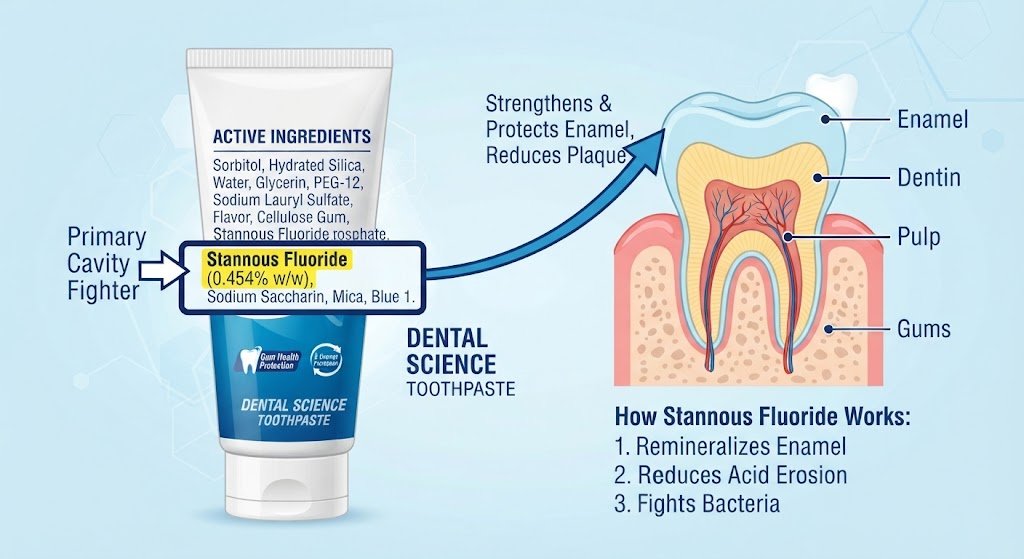
Stannous fluoride is a chemical compound made from tin and fluoride. Its chemical formula is SnF₂.
In toothpaste, stannous fluoride is used as an active ingredient that provides fluoride to the teeth. Fluoride helps protect teeth against acid-related mineral loss and supports the natural remineralization process that can repair early stages of mineral loss.
Stannous fluoride is one of several fluoride compounds used in toothpaste. Other common examples include:
- Sodium fluoride
- Sodium monofluorophosphate
- Stannous fluoride
The important distinction is that these are different chemical compounds, even though they are used to provide fluoride for dental care.
For a toothpaste shopper, you do not need to understand the chemistry in detail. The practical takeaway is:
Stannous fluoride is a specific fluoride compound used in toothpaste to provide cavity protection and, depending on the formula, other oral-care benefits.
The exact benefits depend on the formulation and the claims supported for that particular product. Therefore, seeing “stannous fluoride” on a toothpaste label does not mean every product containing it will perform exactly the same way.
Is Stannous Fluoride the Same as Fluoride?
No. Stannous fluoride is a type of fluoride compound, not simply another word for fluoride.
The word “fluoride” is often used broadly when discussing dental products. In toothpaste, fluoride refers to the fluoride component that helps protect teeth, while stannous fluoride is one chemical compound that delivers that fluoride.
A simple example makes the relationship easier to understand:
Fluoride = the active dental component
Stannous fluoride = one compound used to provide fluoride
This is similar to how toothpaste can contain different forms of fluoride while still being described as a fluoride toothpaste.
For example:
| Fluoride compound | Used in toothpaste? | Main dental role |
| Stannous fluoride | Yes | Fluoride-based cavity protection; some formulas offer additional benefits |
| Sodium fluoride | Yes | Fluoride-based cavity protection |
| Sodium monofluorophosphate | Yes | Fluoride-based cavity protection |
The American Dental Association recognizes fluoride compounds such as stannous fluoride, sodium fluoride, and sodium monofluorophosphate as active ingredients used in toothpaste for cavity prevention.
This distinction becomes important when comparing products. A toothpaste labeled “fluoride toothpaste” does not necessarily contain stannous fluoride.
If you specifically want stannous fluoride, check the Active Ingredient section of the package instead of relying only on the front-label wording.
Why Is Stannous Fluoride Used in Toothpaste?
The primary reason stannous fluoride is used in toothpaste is cavity prevention.
To understand why, it helps to look at what happens inside the mouth.
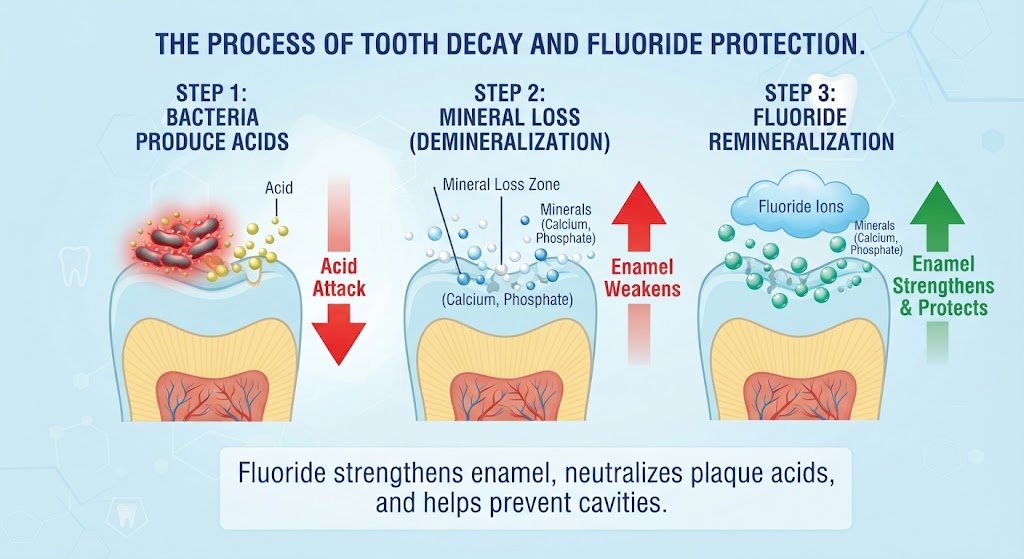
Dental plaque contains bacteria. When these bacteria interact with fermentable carbohydrates from food and drinks, they can produce acids. Repeated acid exposure can remove minerals from tooth enamel.
This process is called demineralization.
Your mouth also has a natural repair process. Saliva supplies minerals and helps create conditions that support remineralization.
Fluoride supports this process and helps make tooth surfaces more resistant to acid attacks.
So the basic cycle looks like this:
Plaque bacteria + carbohydrates → acids → mineral loss
Then:
Fluoride exposure → stronger resistance to acid damage + support for remineralization
This is why fluoride toothpaste is widely used as part of everyday cavity-prevention routines.
Stannous fluoride can also be included in formulations designed around additional oral-health concerns. Depending on the specific formulation, these may include sensitivity, plaque, or gingivitis.
However, it is important not to treat every stannous fluoride toothpaste as identical.
The fluoride compound is only one part of a toothpaste. Other ingredients can affect how the product is designed to work and what claims it can reasonably make.
How Does Stannous Fluoride Work?
Stannous fluoride works by making fluoride available around the teeth during and after brushing.
When you brush with fluoride toothpaste, fluoride comes into contact with the tooth surfaces and oral environment. It can become available in plaque and saliva and interact with tooth mineral.
This helps teeth become more resistant to acid-related mineral loss and supports remineralization of early mineral changes.
A useful way to think about it is that fluoride does not simply create a permanent protective coating over your teeth.
Instead, regular fluoride exposure helps your teeth respond better to the everyday acid challenges that can contribute to tooth decay.
The process in simple terms
1. Acid attacks the tooth
Plaque bacteria can produce acids that lower the pH around the teeth and contribute to mineral loss.
2. Fluoride becomes available
Brushing with fluoride toothpaste increases fluoride exposure in the mouth.
3. Early mineral loss can be supported
Fluoride can help support remineralization when mineral loss is still at an early stage.
4. Tooth mineral becomes more resistant
Fluoride can make the tooth surface more resistant to future acid attacks.
This does not mean stannous fluoride makes teeth impossible to damage.
Frequent sugar exposure, poor plaque control, dry mouth, acidic foods and drinks, and other risk factors can still contribute to dental problems.
That is why toothpaste works best as part of a complete oral-care routine rather than as a standalone solution.
Does Stannous Fluoride Prevent Cavities?
Yes. Stannous fluoride is used as an anticaries ingredient in toothpaste.
Its fluoride component helps protect teeth against the processes that contribute to tooth decay.
The FDA recognizes stannous fluoride as an active ingredient for anticaries dentifrice products.
However, preventing cavities involves more than choosing a particular fluoride compound.
Your overall cavity risk can also be influenced by:
- How frequently you consume sugary foods and drinks
- Plaque buildup
- Brushing habits
- Cleaning between your teeth
- Saliva production
- Dry mouth
- Previous history of cavities
- Diet
- Access to regular dental care
This means a person should not think:
“I use stannous fluoride, so I cannot get cavities.”
A more accurate way to think about it is:
Stannous fluoride toothpaste can provide fluoride-based cavity protection as part of a complete oral-care routine.
If cavities are your main concern, look at the fluoride ingredient, concentration, brushing routine, diet, and your personal cavity risk together.
Stannous Fluoride and Enamel
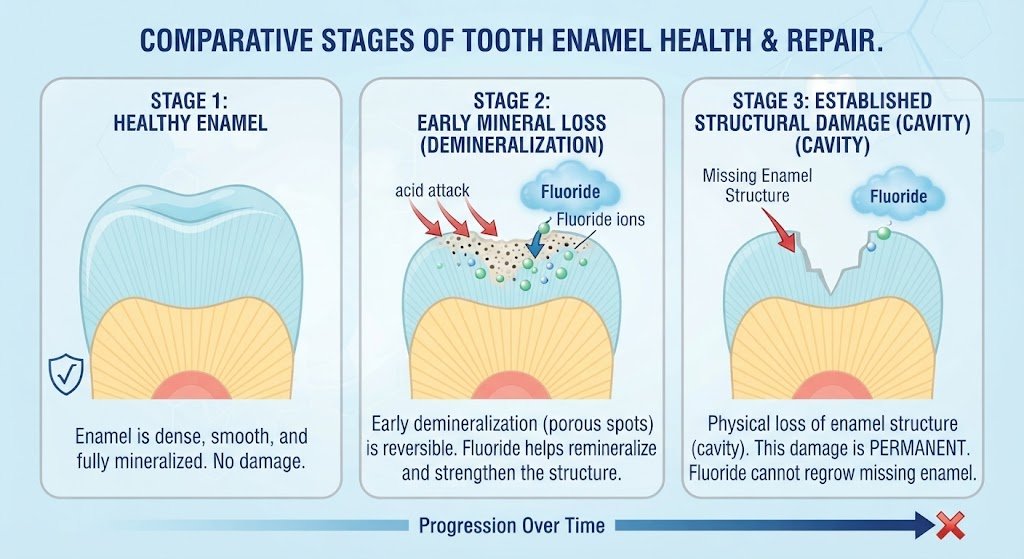
Enamel is the hard outer layer of a tooth. Although it is highly mineralized, it can still lose minerals when exposed to acids.
Fluoride helps enamel become more resistant to acid-related damage and supports remineralization of early mineral loss.
This makes stannous fluoride relevant for people who want a toothpaste that provides fluoride-based enamel protection.
But there is an important limitation:
Stannous fluoride cannot regrow enamel that has already been physically lost.
For example, if enamel has been significantly worn away because of erosion or another dental problem, toothpaste cannot simply replace the missing tooth structure.
Fluoride is more accurately understood as part of the process that helps protect existing tooth mineral and support early remineralization.
If you have significant enamel wear, visible damage, or ongoing sensitivity, the underlying cause should be evaluated rather than relying only on toothpaste.
Does Stannous Fluoride Help Sensitive Teeth?
This is one area where stannous fluoride can be especially relevant.
Some stannous fluoride toothpaste formulations are designed to help reduce dentin hypersensitivity, commonly known as tooth sensitivity.
Sensitivity can happen when dentin becomes exposed or when the tooth responds strongly to stimuli such as:
- Cold drinks
- Hot foods
- Sweet foods
- Touch
- Brushing
Stannous fluoride-containing formulas may help by interacting with exposed dentin and reducing pathways through which stimuli can reach the nerves inside the tooth.
However, not every toothpaste containing stannous fluoride should automatically be treated as a dedicated sensitivity toothpaste.
The exact formulation matters.
If sensitivity is your main reason for changing toothpaste, look for a product specifically formulated and labeled for sensitive teeth rather than choosing a product based only on the presence of stannous fluoride.
There is also an important medical consideration.
Sensitivity is a symptom, not always a diagnosis.
It can be related to:
- Gum recession
- Enamel wear
- Exposed dentin
- Tooth decay
- Cracks
- Recent dental treatment
- Other dental conditions
If sensitivity is severe, persistent, getting worse, or concentrated around one particular tooth, a dentist should evaluate the cause.
Does Stannous Fluoride Help With Plaque and Gingivitis?
Some stannous fluoride toothpaste formulas are designed to provide benefits beyond cavity protection, including support for plaque control and gingivitis.
This is one reason stannous fluoride can be attractive to people who want one toothpaste to address multiple oral-care concerns.
But there is an important distinction between the ingredient and the finished product.
A toothpaste containing stannous fluoride does not automatically mean that every possible gum-health claim applies to that product.
The formulation, concentration, additional ingredients, product directions, and evidence supporting its specific claims all matter.
Gingivitis can cause symptoms such as red, swollen, or bleeding gums. Toothpaste can be part of an oral-care routine, but persistent gum problems should not be treated as something that toothpaste alone must solve.
If your gums regularly bleed or remain swollen, talk to a dental professional to determine the cause.
Stannous Fluoride Concentration: What Should You Look For?
When comparing toothpaste, the concentration of the active ingredient is important.
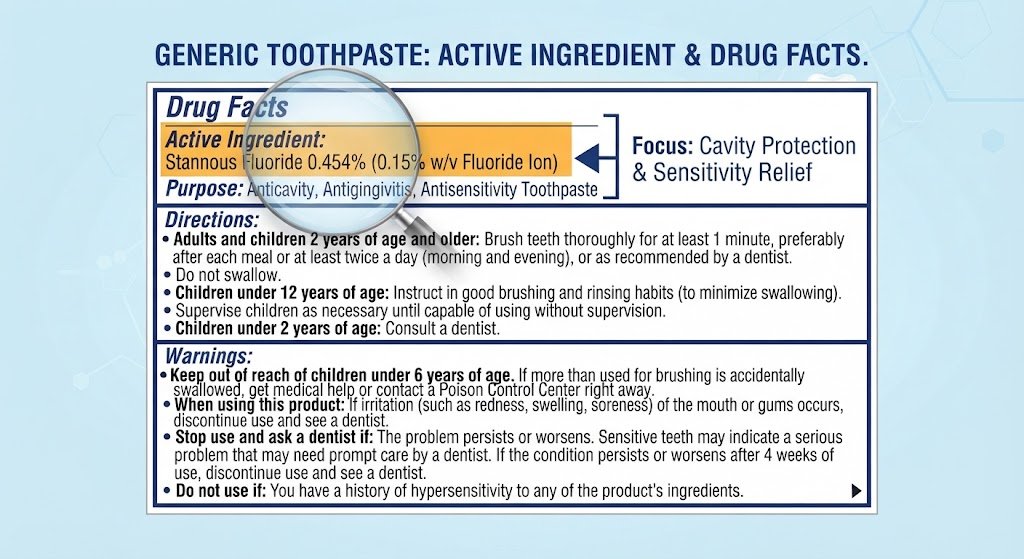
For stannous fluoride, you may see the ingredient expressed as a percentage on the product’s Drug Facts label.
The FDA’s OTC anticaries requirements specify permitted stannous fluoride concentrations for certain dentifrice formulations. The exact regulatory requirements depend on the product formulation and available fluoride ion concentration.
For consumers, the important point is that the percentage of stannous fluoride is not necessarily the same thing as the amount of available fluoride ion.
You generally do not need to perform the chemistry yourself.
Instead, check:
- The active ingredient
- The stated concentration
- The product’s intended use
- The directions
- The complete ingredient list
- Any age-related warnings or instructions
If a toothpaste makes several dental claims, also look at what those claims are based on rather than assuming that a higher concentration automatically means a better product.
What about ppm?
Fluoride toothpaste may also display fluoride information in parts per million (ppm).
When comparing different fluoride compounds, be careful not to compare the percentage of one compound directly with the percentage of another compound as if the numbers represented exactly the same thing.
For everyday shopping, the safest approach is to follow the product’s Drug Facts label and directions.
Is Stannous Fluoride Safe?
Yes. Stannous fluoride is an established fluoride ingredient used in toothpaste for cavity protection when used as directed. It has been used in oral-care products for many years and is recognized as an anticaries active ingredient.
As with any fluoride toothpaste, safety depends on using the product according to its label. The main concern is usually not the presence of stannous fluoride itself, but how much toothpaste is used, whether it is swallowed, the user’s age, and the individual’s dental needs.
For most adults, the practical approach is simple:
- Use the amount recommended on the toothpaste label.
- Brush as directed, generally twice daily.
- Spit after brushing rather than intentionally swallowing the toothpaste.
- Keep toothpaste out of the reach of young children.
- Follow age-specific directions for children.
What About Fluoride Exposure?
Fluoride is useful for preventing tooth decay, but more is not necessarily better. Toothpaste is intended to deliver fluoride to the teeth during brushing, not to be consumed.
This is especially important for young children because they may swallow toothpaste while learning to brush. Parents should follow the product’s age and usage instructions and ask a dentist if they are unsure which fluoride toothpaste is appropriate.
Can You Use Stannous Fluoride Every Day?
For products intended for routine use, stannous fluoride toothpaste can generally be used as directed on the label. The exact instructions can vary between products because formulas differ.
If you have a specific dental condition, unusual sensitivity, extensive enamel wear, or another concern, a dentist can help determine whether a particular toothpaste is appropriate.
Can Stannous Fluoride Cause Staining?
Some stannous fluoride toothpaste formulas may be associated with surface staining in certain users. This is one reason some people notice a difference when switching between fluoride toothpaste formulas.
The staining is generally discussed as an extrinsic, or surface-level, discoloration, rather than the fluoride permanently changing the natural color of the tooth.
However, not every stannous fluoride toothpaste behaves exactly the same way. Modern formulations may be designed to improve the stability and cosmetic performance of the ingredient.
Should You Avoid Stannous Fluoride Because of Staining?
Not necessarily.
If a stannous fluoride toothpaste provides benefits that match your dental needs—such as cavity protection, sensitivity care, or gum-focused care—the possibility of surface staining is only one factor to consider.
A better approach is to look at the complete formula and the product’s intended benefits rather than judging the ingredient by itself.
If you already have noticeable discoloration, ask your dentist whether it is surface stain, tartar, enamel discoloration, or another issue before assuming that toothpaste is responsible.
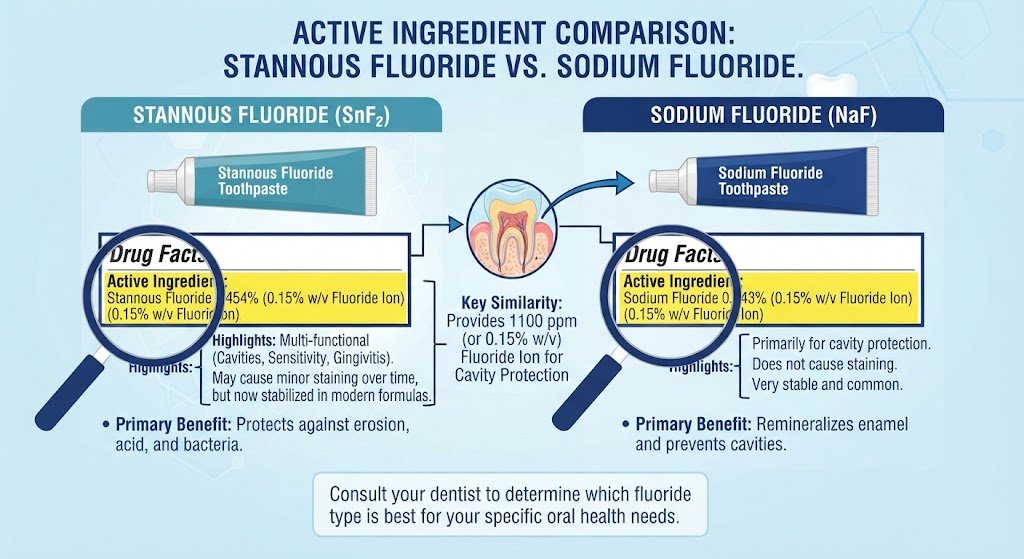
Stannous Fluoride vs. Sodium Fluoride
Stannous fluoride and sodium fluoride are both fluoride compounds used in toothpaste to provide anticaries protection.
The main difference is the chemical compound carrying the fluoride.
| Feature | Stannous Fluoride | Sodium Fluoride |
| Chemical formula | SnF₂ | NaF |
| Contains fluoride | Yes | Yes |
| Cavity protection | Yes | Yes |
| Common toothpaste use | Yes | Yes |
| May be used in sensitivity-focused formulas | Yes, depending on formula | Depends on formulation |
| May be used in gum-focused formulas | Yes, depending on formula | Depends on formulation |
| Complete formula matters | Yes | Yes |
The important point is that you should not choose between them based only on the word “fluoride.”
A toothpaste’s active ingredient, concentration, supporting ingredients, directions, and intended purpose all matter.
Which One Is Better?
There is no universal answer.
If your main goal is basic cavity protection, both can be appropriate fluoride sources when formulated and used correctly.
If you are specifically looking for additional benefits such as sensitivity or gum care, look at the specific product formulation and evidence for its claims, rather than assuming that every toothpaste containing one fluoride compound provides the same benefits.
Stannous Fluoride vs. Sodium Monofluorophosphate
Sodium monofluorophosphate, often abbreviated as MFP, is another fluoride compound used in toothpaste.
Like stannous fluoride and sodium fluoride, its purpose is to provide fluoride for cavity protection. However, the chemistry and formulation are different.
| Feature | Stannous Fluoride | Sodium Monofluorophosphate |
| Contains fluoride | Yes | Yes |
| Used for cavity protection | Yes | Yes |
| Chemical compound | Tin + fluoride | Sodium monofluorophosphate |
| Commonly found in toothpaste | Yes | Yes |
| Other potential benefits | Depend on formula | Depend on formula |
| Label evaluation needed | Yes | Yes |
For a shopper, the key question is not simply “Which fluoride compound sounds better?”
Instead, ask:
- What is the active ingredient?
- What fluoride concentration does the product provide?
- What dental problem is the product designed to address?
- What other active or inactive ingredients are included?
- Are the product’s claims supported by appropriate evidence?
- Does the toothpaste fit your age and dental needs?
This approach gives you a more useful comparison than focusing on the ingredient name alone.
Stannous Fluoride vs. Fluoride-Free Toothpaste
This is a more important distinction because these products take different approaches to cavity prevention.
Stannous fluoride toothpaste contains fluoride. Fluoride-free toothpaste does not provide fluoride as an active anticaries ingredient.
Fluoride has a long-established role in preventing dental caries. For people who are at risk of cavities, removing fluoride from toothpaste can therefore be an important decision rather than simply a preference about ingredients.
Why Do Some People Choose Fluoride-Free Toothpaste?
People may look for fluoride-free toothpaste because of:
- Personal ingredient preferences
- Interest in alternative oral-care ingredients
- Concerns about swallowing fluoride
- Preference for certain natural or minimalist formulas
- Specific recommendations from a dental professional
However, a toothpaste being labeled natural, clean, non-toxic, or fluoride-free does not automatically mean it provides the same cavity-prevention benefits as fluoride toothpaste.
If cavity prevention is a major concern, consider discussing your toothpaste choice with a dentist before switching away from fluoride.
What About Hydroxyapatite?
Hydroxyapatite is another ingredient you may see in toothpaste marketed for enamel or remineralization support.
It is different from fluoride and should not simply be treated as another name for fluoride.
If you are deciding between a fluoride toothpaste containing stannous fluoride and a fluoride-free hydroxyapatite toothpaste, compare the evidence, active ingredients, concentration, intended use, and your personal cavity risk.
Stannous Fluoride vs. Hydroxyapatite
Stannous fluoride and hydroxyapatite represent two different approaches to toothpaste formulation.
Stannous fluoride provides fluoride, which is used for cavity prevention. Hydroxyapatite is a calcium-phosphate mineral that resembles a major mineral component of natural tooth structure.
The two ingredients should not be considered interchangeable simply because both may appear in toothpaste marketed around enamel care.
| Feature | Stannous Fluoride | Hydroxyapatite |
| Provides fluoride | Yes | No |
| Used in cavity-prevention toothpaste | Yes | Some products are marketed for this purpose |
| Mineral-based ingredient | No | Yes |
| Supports enamel-related care | Yes, through fluoride action | Formulated for enamel-related benefits |
| Sensitivity products available | Yes | Yes |
| Formula matters | Yes | Yes |
If you are choosing a toothpaste for a specific dental concern, focus on the evidence behind the active ingredient and the needs of your mouth, not simply whether an ingredient sounds more natural.
For people who prefer fluoride-free products, hydroxyapatite may be an ingredient worth researching. For people who specifically want fluoride-based cavity protection, stannous fluoride remains one option to consider.
Who May Benefit From Stannous Fluoride Toothpaste?
Stannous fluoride toothpaste may be worth considering if you want a fluoride toothpaste and your dental priorities include one or more of the following:
1. Cavity Protection
This is the most basic reason to consider any fluoride toothpaste.
If you frequently develop cavities or have been told that you have an elevated cavity risk, fluoride toothpaste can be an important part of your daily oral-care routine.
2. Sensitive Teeth
Some stannous fluoride formulas are specifically designed for sensitivity.
If cold drinks, hot foods, sweets, or brushing cause short, sharp discomfort, a sensitivity-focused formula may be useful.
However, persistent or severe sensitivity should not automatically be treated by changing toothpaste. It can sometimes be related to decay, gum recession, enamel wear, a cracked tooth, or another dental problem.
3. Plaque and Gum-Care Concerns
Some stannous fluoride formulations are designed with plaque and gingivitis-related benefits in mind.
This may make them attractive to people who want more than basic cavity protection from their toothpaste.
Still, toothpaste is not a substitute for professional treatment when gum problems are persistent.
4. People Comparing Different Fluoride Options
If you are deciding between stannous fluoride, sodium fluoride, and sodium monofluorophosphate, understanding the differences can help you read toothpaste labels more confidently.
The goal is not to find a universally superior fluoride compound. The goal is to choose a well-formulated toothpaste that matches your dental needs.
Who Should Be More Careful When Choosing Stannous Fluoride Toothpaste?
Stannous fluoride toothpaste is suitable for many people, but the right product can depend on age, dental history, sensitivity, cavity risk, and the specific formula.
You may want professional guidance if:
- You have frequent or severe cavities.
- Your teeth are persistently sensitive.
- Your gums bleed regularly or are swollen.
- You have significant enamel erosion or tooth wear.
- You have a cracked, painful, or damaged tooth.
- You are choosing toothpaste for a young child.
- You have been advised to use a specific fluoride concentration.
- You are experiencing an unusual reaction after using a toothpaste.
A toothpaste can support daily oral hygiene, but it cannot diagnose or treat every dental problem.
Children and Stannous Fluoride Toothpaste
Children need extra attention because toothpaste can be swallowed while they are learning to brush.
Parents should choose a product appropriate for the child’s age and follow the label directions. The amount of toothpaste and supervision during brushing matter more than simply choosing a product because it contains stannous fluoride.
If you are unsure which toothpaste is appropriate for a child, ask a dentist or pediatric dental professional.
Pregnancy and Stannous Fluoride Toothpaste
Pregnancy can change oral-care needs, but choosing toothpaste should still be based on established oral-health guidance and the product label.
If you have unusual gum bleeding, severe sensitivity, or other dental symptoms during pregnancy, professional dental advice is more useful than simply switching between toothpaste ingredients.
How to Choose a Stannous Fluoride Toothpaste
If you have decided that stannous fluoride fits your needs, don’t choose a toothpaste based only on the front of the package.
Instead, work through this simple checklist.
1. Check the Active Ingredient
First, find the Drug Facts or active-ingredient section.
Look specifically for:
Stannous fluoride
The label should also show the concentration and the purpose of the active ingredient.
This is more reliable than assuming a toothpaste contains stannous fluoride because the packaging says “fluoride protection.”
2. Check the Fluoride Concentration
Look at the percentage listed next to stannous fluoride.
Do not compare the percentage of stannous fluoride directly with the percentage of another fluoride compound and assume the larger number means a stronger toothpaste.
Different compounds contain different amounts of fluoride by weight.
For a consumer, the better approach is to compare products according to their active ingredient, stated fluoride concentration, intended use, and regulatory labeling.
3. Match the Toothpaste to Your Dental Need
Think about why you are buying the toothpaste.
| Your priority | What to look for |
| Cavities | Fluoride toothpaste with an appropriate anticaries indication |
| Sensitivity | A stannous fluoride formula specifically marketed for sensitivity |
| Gum care | A formula with appropriate plaque/gingivitis-related claims |
| Enamel protection | Fluoride plus a formula appropriate for your enamel needs |
| Ingredient-conscious shopping | Read the complete ingredient list rather than relying on “clean” claims |
| General daily care | A fluoride toothpaste appropriate for routine use |
The same stannous fluoride ingredient can appear in products with very different supporting formulas.
4. Read the Complete Ingredient List
The active ingredient tells you what provides the main therapeutic benefit, but the rest of the formula can affect your experience.
Look at ingredients related to:
- Flavor
- Abrasivity
- Foaming
- Humectants
- Sweeteners
- Preservatives
- Texture
- Sensitivity or gum-care claims
If you avoid a particular ingredient, check the actual ingredient list rather than relying on marketing language such as “clean,” “natural,” or “non-toxic.”
5. Consider Your Sensitivity to Flavor and Foaming Ingredients
Two toothpaste products can contain the same fluoride compound but feel completely different during brushing.
Flavoring agents and foaming ingredients can affect whether you enjoy using a product consistently.
If a toothpaste repeatedly causes burning, irritation, mouth discomfort, or another reaction, stop assuming that stronger cleaning means better cleaning. Consider discussing the reaction with a dental professional.
6. Look for Appropriate Dental Claims
Don’t treat every claim on a toothpaste package as equally important.
For example, a product may focus on:
- Cavity protection
- Sensitivity
- Whitening
- Enamel
- Plaque
- Gingivitis
- Tartar
- Fresh breath
Choose the benefit that actually matches your needs.
If cavity prevention is your main concern, a long list of cosmetic claims should not distract you from the active anticaries ingredient.
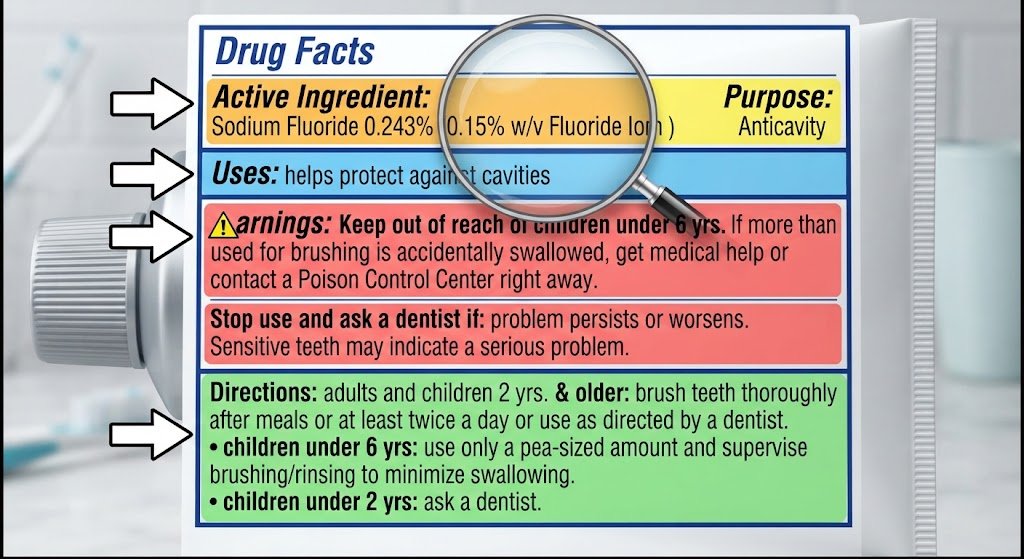
What to Look for on a Stannous Fluoride Toothpaste Label
A quick label check can prevent a lot of confusion.
Active Ingredient
Look for stannous fluoride in the active ingredient section.
Concentration
Check the stated concentration and compare products using the same type of information.
Uses
Review what the toothpaste is intended to help with. This can tell you whether the formula is primarily focused on cavities, sensitivity, or another oral-care need.
Warnings
Read the warnings, especially when purchasing toothpaste for children.
Directions
Follow the brushing frequency, amount, and other instructions provided on the label.
Other Ingredients
Review the complete ingredient list if you have ingredient preferences or known sensitivities.
Product Acceptance or Professional Recognition
Some toothpaste products may carry dental organization acceptance or other evidence-based signals. For U.S. consumers, the ADA Seal of Acceptance can be one useful factor when evaluating eligible oral-care products.
The seal should not be your only consideration, but it can provide additional information when comparing products.
Common Mistakes When Buying Stannous Fluoride Toothpaste
Choosing toothpaste can become confusing when packaging contains words such as “natural,” “advanced,” “professional,” “clean,” and “whitening.”
Here are some common mistakes to avoid.
Mistake 1: Thinking All Fluoride Toothpaste Is the Same
Fluoride toothpaste is not one single formula.
Stannous fluoride, sodium fluoride, and sodium monofluorophosphate are different compounds, and the supporting ingredients can also vary.
Mistake 2: Choosing Based Only on the Front Label
The front of the tube is designed to communicate benefits quickly.
The active ingredients and Drug Facts section provide more useful information when you want to compare products.
Mistake 3: Assuming a Higher Percentage Automatically Means Better
Fluoride compounds should not be compared by percentage alone.
The type of compound, available fluoride, formulation, intended use, and labeling all matter.
Mistake 4: Ignoring Your Main Dental Problem
A toothpaste marketed for whitening may not be the most appropriate choice if your biggest concern is sensitivity.
Likewise, someone focused on cavity prevention should not choose a toothpaste simply because its packaging looks more natural.
Start with your dental need and then evaluate the formula.
Mistake 5: Assuming Stannous Fluoride Guarantees Gum Treatment
Stannous fluoride can be included in formulas designed for plaque and gingivitis-related care, but the ingredient alone does not mean every stannous fluoride toothpaste treats gum disease.
If your gums regularly bleed, swell, or hurt, seek professional evaluation.
Mistake 6: Avoiding a Product Because of the Word “Fluoride”
Fluoride has an established role in cavity prevention.
If you are considering fluoride-free toothpaste because of ingredient preferences, understand what you are giving up in terms of fluoride-based cavity protection before making the switch.
Mistake 7: Buying Without Checking the Formula
Two products can both contain stannous fluoride while having different flavors, supporting ingredients, claims, and user experiences.
The complete formula matters.
How Does Stannous Fluoride Fit Into a Non-Toxic Toothpaste Routine?
For shoppers interested in “non-toxic” or cleaner personal-care products, stannous fluoride can create an important distinction.
A toothpaste does not become unsafe simply because its active ingredient has a chemical name.
At the same time, “non-toxic” is not a standardized scientific guarantee that every product using the term has the same ingredients or safety profile.
A better evaluation method is to look at:
- The active ingredient.
- Fluoride concentration.
- The complete ingredient list.
- The product’s intended purpose.
- Age suitability.
- Directions and warnings.
- Evidence supporting important claims.
- Your own dental needs.
This keeps the focus on the actual formula rather than marketing labels.
For an ingredient-conscious shopper, the goal should be to find a balance between effective cavity protection and a formula that fits your personal ingredient preferences.
When Should You Choose Stannous Fluoride Over Another Fluoride?
There isn’t one fluoride compound that is automatically the right choice for everyone.
Stannous fluoride may make sense when you want fluoride-based cavity protection and are also interested in a formulation designed around concerns such as sensitivity, plaque, or gum health.
Sodium fluoride may be perfectly reasonable when the product meets your cavity-prevention needs.
Sodium monofluorophosphate is another established fluoride option found in toothpaste.
The best choice depends on the product formulation and your dental priorities, not simply the ingredient name.
If you want a deeper comparison, see:
Stannous Fluoride FAQs
Is stannous fluoride good for teeth?
Yes. Stannous fluoride is used in toothpaste as a fluoride source for cavity protection. Some formulations are also designed to address concerns such as sensitivity, plaque, or gingivitis.
Is stannous fluoride better than regular fluoride?
Stannous fluoride is itself a type of fluoride compound. Comparing it with “regular fluoride” is therefore misleading. A more useful comparison is stannous fluoride versus another fluoride compound, such as sodium fluoride.
Is stannous fluoride safe in toothpaste?
It is an established toothpaste ingredient when used according to product directions. As with other fluoride toothpastes, avoid intentionally swallowing toothpaste and follow age-specific instructions.
Does stannous fluoride whiten teeth?
Stannous fluoride itself should not be treated as a general whitening ingredient. Some products containing stannous fluoride may also contain ingredients intended to remove surface stains or provide whitening benefits.
Check the complete formula and the product’s actual whitening claims.
Does stannous fluoride help sensitivity?
Some stannous fluoride toothpaste formulations are designed to help with dentin sensitivity. The benefit depends on the specific formulation rather than simply the presence of stannous fluoride.
Can stannous fluoride cause tooth staining?
Some users may experience surface staining with certain stannous fluoride formulations. Modern formulas can differ, so the possibility of staining should be considered alongside the toothpaste’s overall benefits and formula.
Is stannous fluoride better than sodium fluoride for cavities?
Both are fluoride compounds used for cavity protection. There is no need to assume that stannous fluoride is universally better simply because it is a different fluoride compound.
Is stannous fluoride the same as sodium fluoride?
No. Both contain fluoride, but they are different chemical compounds. Stannous fluoride contains tin and fluoride, while sodium fluoride contains sodium and fluoride.
Is stannous fluoride better than fluoride-free toothpaste?
If your priority is fluoride-based cavity protection, stannous fluoride toothpaste provides an advantage that a fluoride-free toothpaste does not: it supplies fluoride as an active anticaries ingredient.
However, individual toothpaste choices can depend on dental needs and professional recommendations.
Can you use stannous fluoride toothpaste every day?
Products intended for daily oral care can generally be used according to their label directions. Always follow the specific product instructions.
Should children use stannous fluoride toothpaste?
The appropriate toothpaste for a child depends on age and individual dental needs. Parents should follow the product’s age directions and supervise brushing when necessary.
Does stannous fluoride damage enamel?
Stannous fluoride is used in toothpaste to help protect teeth against cavities. It should not be confused with abrasive wear, which depends on the overall toothpaste formulation and brushing behavior.
If you have significant enamel erosion or tooth wear, speak with a dentist about your specific situation.
Can stannous fluoride treat gum disease?
A stannous fluoride toothpaste may be formulated to help with plaque and gingivitis-related concerns, but toothpaste should not be considered a replacement for professional diagnosis and treatment of established gum disease.
Final Takeaway: Is Stannous Fluoride a Good Toothpaste Ingredient?
Stannous fluoride is a well-established fluoride compound used in toothpaste for cavity protection.
Its main role is supplying fluoride to the teeth during brushing, helping support the teeth against the effects of acid and tooth decay.
What makes the ingredient especially interesting is that some formulations are designed to provide additional benefits, including sensitivity and plaque or gingivitis-related care.
But the ingredient name alone does not tell you whether a particular toothpaste is the right choice.
When comparing products, look at:
- Stannous fluoride as the active ingredient
- Fluoride concentration
- The toothpaste’s intended benefits
- The complete ingredient list
- Age suitability
- Directions and warnings
- Evidence behind specific claims
- Your personal dental needs
If your goal is to find a toothpaste that balances cavity protection with other oral-care priorities and your ingredient preferences, stannous fluoride products are worth considering.
