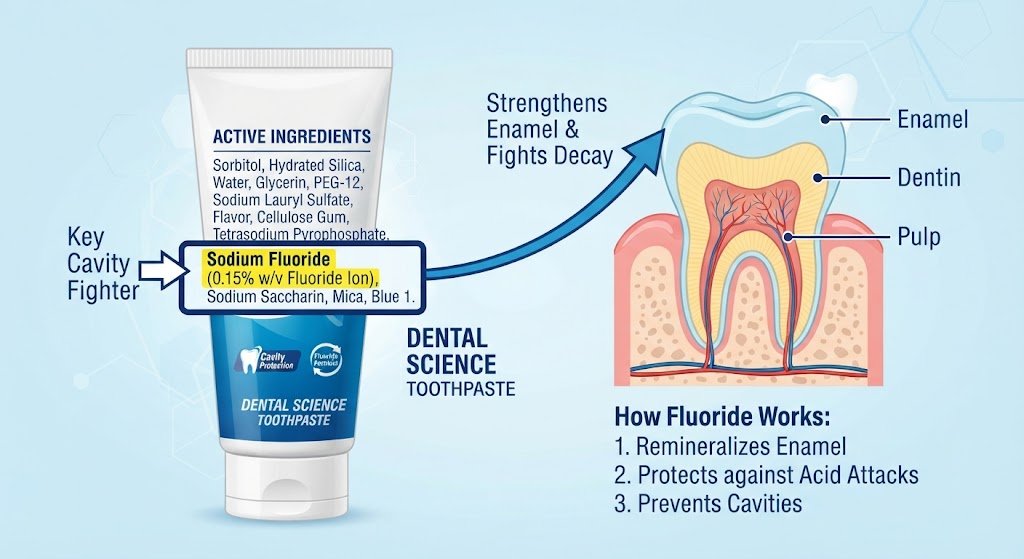
If you have looked at the back of a toothpaste tube, you may have noticed sodium fluoride listed under the active ingredients.
But what is sodium fluoride, why is it used in toothpaste, and should you be concerned about seeing it on a label?
Sodium fluoride is one of the fluoride compounds used in toothpaste to help prevent tooth decay. It provides fluoride that can help teeth resist acid-related mineral loss and support remineralization during the early stages of tooth decay.
The important point is that sodium fluoride is only one part of a toothpaste formula. Its concentration, the other ingredients in the product, your age, cavity risk, sensitivity, and overall dental needs can all affect whether a particular toothpaste is a good fit.
This guide explains what sodium fluoride is, how it works, how it compares with other fluoride ingredients, how to read it on a toothpaste label, and what to consider before choosing a product.
What Is Sodium Fluoride?
Sodium fluoride is a chemical compound containing sodium and fluoride.
In toothpaste, its important role is to provide fluoride for the teeth.
When you brush with toothpaste containing sodium fluoride, fluoride becomes available in your mouth and around the tooth surface. This fluoride can interact with enamel and support the natural processes that help protect teeth from decay.
The National Institute of Dental and Craniofacial Research explains that fluoride can strengthen enamel and help reverse early tooth decay by helping replace minerals that have been lost.
So when you see sodium fluoride on a toothpaste label, think of it as the specific fluoride compound being used to deliver fluoride during brushing.
Sodium fluoride is not the only compound that can provide fluoride in toothpaste. Other commonly used fluoride compounds include:
- Stannous fluoride
- Sodium monofluorophosphate
These compounds have different chemical structures, but their inclusion in toothpaste is related to providing fluoride for oral-health benefits.
Is Sodium Fluoride the Same as Fluoride?
Not exactly.
The terms are closely related, but they do not mean the same thing.
Fluoride refers to the fluoride ion and, in everyday dental discussions, is commonly used to describe the mineral used to help prevent tooth decay.
Sodium fluoride is one specific compound that contains fluoride.
A simple way to understand the relationship is:
Sodium fluoride is one way toothpaste provides fluoride to your teeth.
This distinction becomes useful when you compare toothpaste labels.
A toothpaste may say that it is a fluoride toothpaste, while its active ingredient may specifically be sodium fluoride, stannous fluoride, or sodium monofluorophosphate.
The American Dental Association recognizes these fluoride compounds as anticaries ingredients used in toothpaste.
You therefore should not assume that every fluoride toothpaste contains sodium fluoride.
Why Is Sodium Fluoride Used in Toothpaste?
The main reason sodium fluoride is used in toothpaste is cavity prevention.
To understand why, it helps to look at what happens to your teeth throughout the day.
Bacteria in dental plaque can use sugars and starches from foods and drinks to produce acids. Those acids can remove minerals from the enamel surface.
This mineral loss is called demineralization.
Your mouth also has a natural repair process called remineralization, in which minerals from saliva can return to the tooth surface.
Fluoride supports this process and can help make teeth more resistant to acid attacks.
That is why fluoride toothpaste is used as part of everyday cavity-prevention routines.
The National Institute of Dental and Craniofacial Research explains that fluoride can help prevent tooth decay and can help stop or reverse early tooth decay before a cavity develops.
For a broader explanation of this process, see to how toothpaste prevents cavities.
How Does Sodium Fluoride Work?
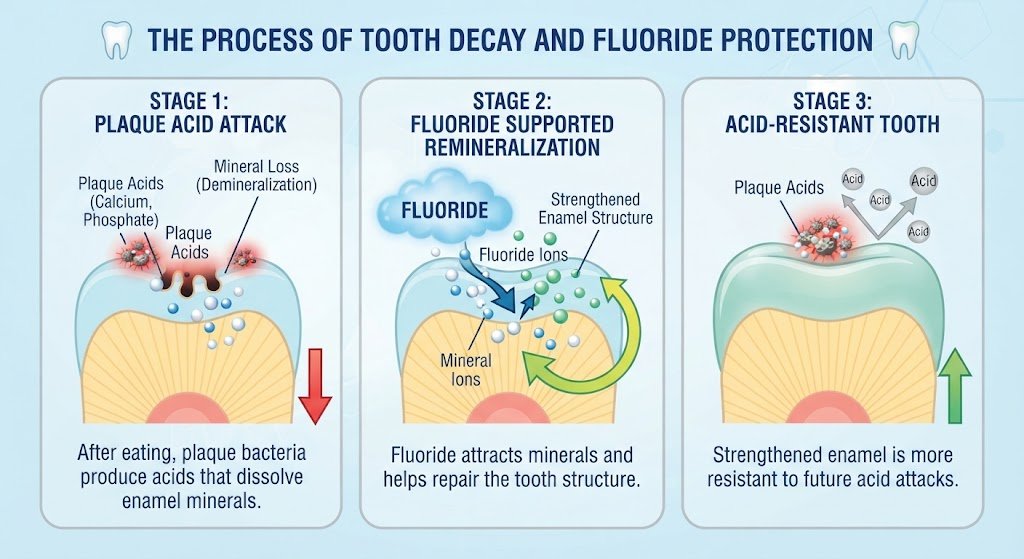
The easiest way to understand sodium fluoride is to look at the balance between mineral loss and mineral repair.
1. Acid causes mineral loss
After you eat or drink, bacteria in plaque can produce acids.
These acids can cause minerals to leave the enamel.
This is the demineralization stage.
2. Fluoride becomes available during brushing
When you brush with sodium fluoride toothpaste, fluoride is introduced into the mouth.
Some fluoride remains available around the teeth and in saliva after brushing.
3. Remineralization is supported
Your saliva naturally contains minerals that can return to the tooth surface.
Fluoride helps support this remineralization process, particularly when mineral loss is still in its early stages.
4. The tooth becomes more resistant
Fluoride can help make the tooth surface more resistant to future acid attacks.
This does not make teeth impossible to damage. Your diet, plaque levels, saliva, oral hygiene, and other factors still influence your risk of tooth decay.
The benefit comes from repeated exposure to fluoride as part of a regular oral-care routine.
Does Sodium Fluoride Prevent Cavities?
Yes. Sodium fluoride toothpaste can help prevent cavities because it provides fluoride.
Fluoride has an established role in preventing dental caries, which is the scientific term for tooth decay.
The American Dental Association describes fluoride as an anticaries ingredient and explains that fluoride can strengthen teeth and support remineralization.
The important distinction is that sodium fluoride does not work like a protective coating that permanently seals the tooth.
Its benefit comes from supporting the tooth’s natural defenses against the repeated acid attacks that contribute to decay.
Cavity prevention also depends on other factors, including:
- How consistently you brush
- Whether you clean between your teeth
- How frequently your teeth are exposed to sugars and starches
- Your saliva flow
- Your existing dental health
- Your individual cavity risk
- Regular professional dental care
So choosing a sodium fluoride toothpaste is one part of cavity prevention, not the entire strategy.
Sodium Fluoride and Enamel
Enamel is the hard outer layer of your teeth.
It protects the softer structures underneath, but it is still exposed to acids every day.
When acids repeatedly remove minerals from enamel, the surface can gradually become weaker.
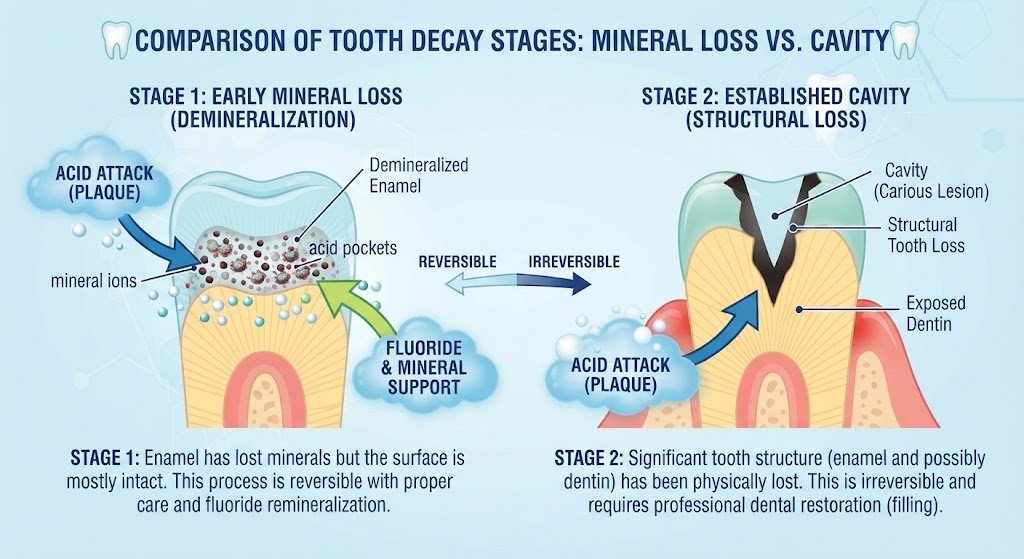
Fluoride can help during this process by supporting remineralization and helping the tooth surface become more resistant to acid-related damage.
This is particularly relevant when mineral loss is still in an early stage.
However, there is an important limitation:
Sodium fluoride cannot simply grow back enamel that has already been physically lost.
If enamel has been significantly worn away or a cavity has already created a hole in the tooth, toothpaste cannot rebuild the missing tooth structure.
That is why early prevention matters.
How Much Sodium Fluoride Is in Toothpaste?
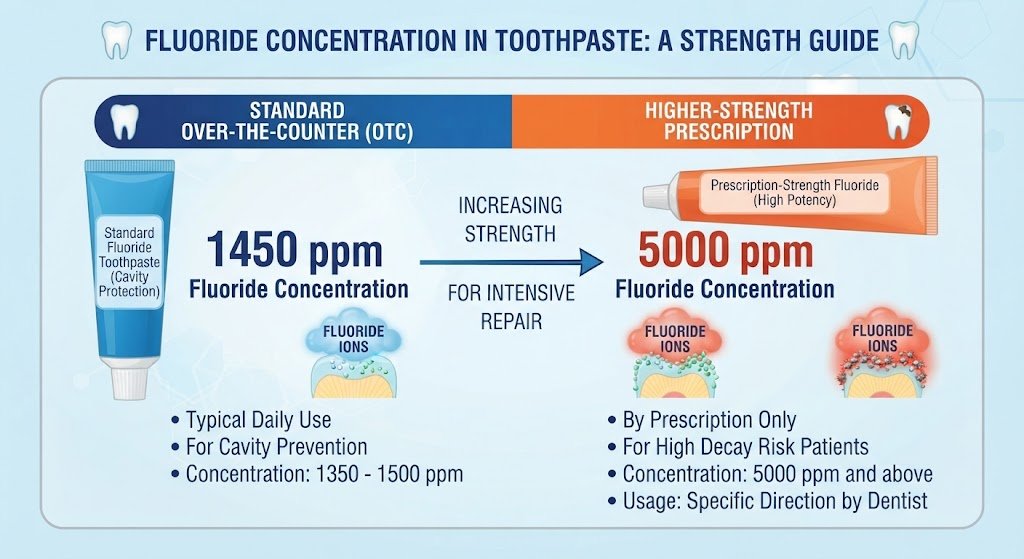
Toothpaste labels can make fluoride concentration confusing because fluoride is commonly discussed using parts per million, or ppm.
The ppm number describes the concentration of fluoride in the toothpaste.
The important thing is not to assume that the toothpaste with the highest fluoride concentration is automatically the best choice for everyone.
The appropriate product depends on factors such as:
- Age
- Cavity risk
- Product directions
- Dental history
- Professional recommendations
If a dentist recommends a prescription-strength fluoride toothpaste, follow those specific instructions rather than trying to choose a high-strength product yourself.
How Do You Find Sodium Fluoride on a Toothpaste Label?
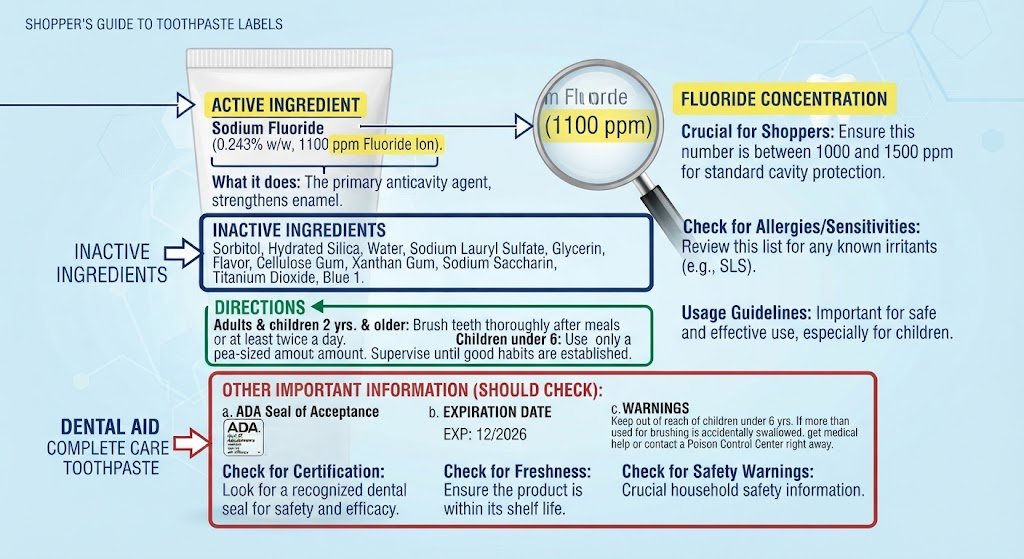
The easiest place to start is the Drug Facts or active-ingredient section of the package.
You may see wording similar to:
Active ingredient: Sodium Fluoride
The package may also provide the percentage of sodium fluoride and the amount of fluoride expressed in ppm.
This distinction is important because the amount of the sodium fluoride compound and the amount of fluoride supplied by that compound are not exactly the same measurement.
When comparing two toothpaste products, look at more than the ingredient name.
Check:
- The active ingredient
- The fluoride concentration
- The intended oral-health benefit
- The complete ingredient list
- The directions for use
A product can contain sodium fluoride and still be formulated very differently from another sodium fluoride toothpaste.
Is Sodium Fluoride Safe?
For most people, fluoride toothpaste can be used safely when used according to its directions.
The main issue is not simply whether sodium fluoride is present. The amount used and whether toothpaste is swallowed also matter.
Toothpaste is designed to be brushed onto the teeth and then spit out.
It is not intended to be consumed.
This is especially important for young children because they may swallow toothpaste while learning to brush.
So the more useful question is not:
“Is sodium fluoride safe or unsafe?”
A better question is:
“Is this fluoride toothpaste being used correctly for the person’s age and dental needs?”
That distinction helps avoid both unnecessary fear and careless use.
What Happens If You Swallow Sodium Fluoride Toothpaste?
Accidentally swallowing a small amount of toothpaste is different from regularly consuming large amounts.
Young children are particularly likely to swallow toothpaste because they are still learning how to brush and spit.
Repeated excessive fluoride ingestion while permanent teeth are developing can increase the risk of dental fluorosis.
Dental fluorosis can cause visible changes in developing teeth, such as white lines or spots.
This is one reason parents should supervise young children while they brush.
The goal is not to eliminate fluoride toothpaste unnecessarily. The goal is to use an age-appropriate amount and teach children to spit it out.
If a large amount of toothpaste is swallowed, especially by a child, seek appropriate medical guidance rather than assuming the amount is harmless.
Sodium Fluoride for Children
Children can use fluoride toothpaste, but the amount should be appropriate for their age.
The CDC recommends:
- Children younger than 3: use no more than a rice-grain-sized amount of fluoride toothpaste.
- Children ages 3–6: use no more than a pea-sized amount.
- Parents or caregivers should supervise brushing and encourage children to spit rather than swallow the toothpaste.
The important point is simple:
Using more toothpaste does not mean getting proportionally more protection.
The amount matters because young children may swallow toothpaste instead of spitting it out.
Sodium Fluoride vs. Stannous Fluoride
Both sodium fluoride and stannous fluoride are fluoride compounds used in toothpaste to help prevent cavities. The important difference is that they are not the same ingredient, and the complete toothpaste formula can affect what additional benefits a product offers.
Sodium fluoride primarily provides fluoride for cavity protection. Stannous fluoride also provides fluoride, while some formulations are designed to provide additional benefits related to sensitivity, gingivitis, plaque, or gum health.
That does not mean one is automatically better for everyone.
When comparing them, look beyond the fluoride compound itself. Consider the toothpaste’s fluoride concentration, other active ingredients, sensitivity needs, flavoring, abrasivity, and whether the product fits your dental routine.
Quick comparison
| Feature | Sodium Fluoride | Stannous Fluoride |
| Provides fluoride | Yes | Yes |
| Main role | Cavity protection | Cavity protection plus possible additional benefits depending on formula |
| Helps strengthen enamel | Yes, through fluoride | Yes, through fluoride |
| Used in toothpaste | Common | Common |
| May be formulated for sensitivity | Depends on formula | Some formulations target sensitivity |
| Best choice for everyone | No | No |
The key point is simple: the fluoride compound is only one part of a toothpaste formula. If you have a specific concern such as sensitive teeth or gum problems, look at the entire active-ingredient profile rather than choosing based on the word “fluoride” alone.
Sodium Fluoride vs. Sodium Monofluorophosphate
Sodium monofluorophosphate is another fluoride compound used in toothpaste.
Like sodium fluoride, its purpose is to provide fluoride that supports cavity prevention. The two ingredients deliver fluoride in different chemical forms, but consumers generally do not need to choose between them based only on the ingredient name.
Instead, check the toothpaste’s fluoride concentration, directions, other active ingredients, and whether the product meets your dental needs.
For everyday shopping, the more useful question is often:
Does this toothpaste provide an appropriate amount of fluoride for my needs, and is the overall formula right for me?
A toothpaste containing sodium fluoride can be a good option, but a toothpaste containing sodium monofluorophosphate can also provide fluoride protection when used as directed.
Sodium Fluoride vs. Fluoride-Free Toothpaste
The biggest difference here is straightforward: sodium fluoride toothpaste contains a fluoride compound, while fluoride-free toothpaste does not provide fluoride as its active cavity-protection ingredient.
Fluoride has a well-established role in preventing tooth decay, so people at higher risk of cavities may have different needs from someone specifically seeking a fluoride-free product.
Some people choose fluoride-free toothpaste because of personal preferences, ingredient concerns, or because they want an alternative ingredient such as hydroxyapatite.
However, “fluoride-free” should not automatically be interpreted as “safer” or “better.” The right choice depends on your individual dental risk and why you are considering a fluoride-free formula.
When might sodium fluoride make more sense?
A sodium fluoride toothpaste may be worth considering if your main goal is conventional fluoride-based cavity protection and you want a toothpaste with a clearly listed fluoride active ingredient.
When might someone consider fluoride-free toothpaste?
Someone may prefer a fluoride-free formula because of personal preference or because they are specifically looking for an alternative active ingredient.
If you have frequent cavities, enamel problems, dry mouth, or other factors that increase your risk of tooth decay, it is worth discussing your toothpaste choice with a dentist rather than removing fluoride from your routine based only on general online advice.
Sodium Fluoride vs. Hydroxyapatite
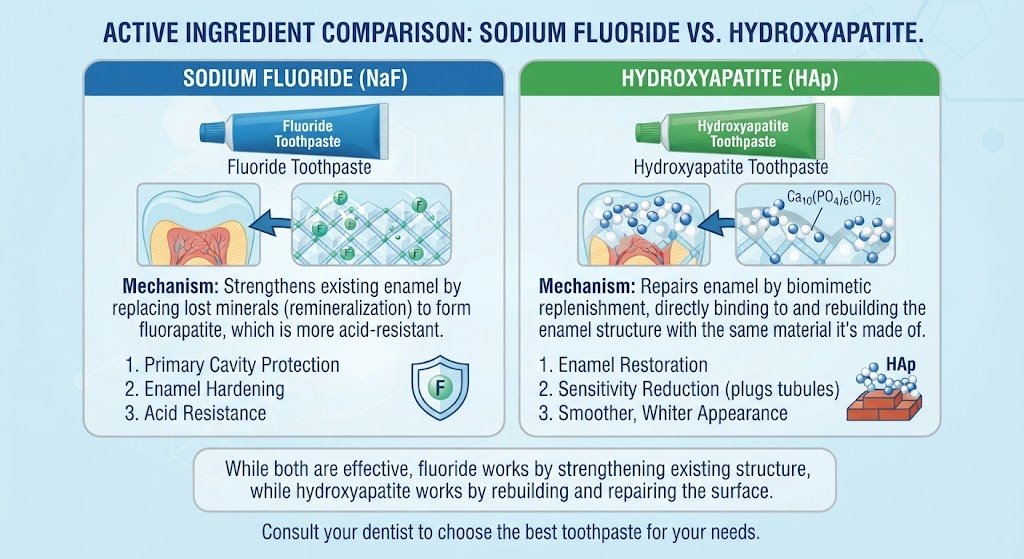
Hydroxyapatite and sodium fluoride are different approaches to toothpaste formulation.
Sodium fluoride provides fluoride, which supports the natural processes that help teeth resist acid damage and recover from early mineral loss.
Hydroxyapatite is a calcium-phosphate mineral related to the mineral structure of teeth. Some toothpaste formulas use hydroxyapatite as an alternative active ingredient for supporting tooth mineral.
This comparison is more complicated than simply asking which ingredient is “better.”
Research on hydroxyapatite toothpaste continues to develop, while fluoride has a long history of use in cavity prevention. If your primary goal is established fluoride-based cavity protection, sodium fluoride toothpaste remains a straightforward option.
If you are interested in hydroxyapatite because you want a fluoride-free toothpaste, compare the complete formula and understand what the product is designed to do.
A simple way to think about the difference
- Sodium fluoride: supplies fluoride for cavity protection.
- Hydroxyapatite: supplies a mineral-based ingredient used in some toothpastes to support tooth mineral.
- Both: should be evaluated as part of the complete toothpaste formula.
- Neither: should be selected solely because of marketing language such as “natural,” “clean,” or “non-toxic.”
For readers building a non-toxic toothpaste routine, this distinction is especially important. “Non-toxic” is not a substitute for evaluating the active ingredient and the evidence behind its intended dental benefit.
Does Sodium Fluoride Help Sensitive Teeth?
Sodium fluoride’s primary role is cavity protection, not direct treatment of every cause of tooth sensitivity.
Tooth sensitivity can occur for different reasons, including exposed dentin, gum recession, enamel wear, tooth damage, or other dental problems. A toothpaste can contain sodium fluoride while also including other ingredients specifically intended to help with sensitivity.
This means you should not assume that every sodium fluoride toothpaste will provide the same sensitivity benefits.
If sensitivity is your main concern, look for a toothpaste specifically formulated for sensitive teeth and check its active ingredients and intended use.
Persistent or severe sensitivity should also be evaluated by a dentist because toothpaste alone may not address the underlying cause.
Does Sodium Fluoride Whiten Teeth?
Sodium fluoride is not primarily a whitening ingredient.
Its main dental role is cavity protection. A toothpaste containing sodium fluoride may also be marketed as a whitening toothpaste, but any whitening effect generally comes from other parts of the formula, such as ingredients designed to remove or reduce surface stains.
This distinction matters when shopping.
If you want both cavity protection and stain removal, you can look for a toothpaste that contains sodium fluoride and is also formulated for whitening.
However, whitening claims should not be confused with changing the natural color of the tooth. Many whitening toothpastes primarily target surface stains rather than providing the same type of color change associated with professional whitening treatments.
What should you check?
Look for:
- Sodium fluoride listed as the active ingredient
- A fluoride concentration appropriate for your needs
- A whitening claim supported by the product’s actual formulation
- An abrasivity level that fits your dental needs
- Additional ingredients that may address sensitivity if you experience it
Whitening does not need to come at the expense of cavity protection. The goal is to find a formula that addresses both needs appropriately.
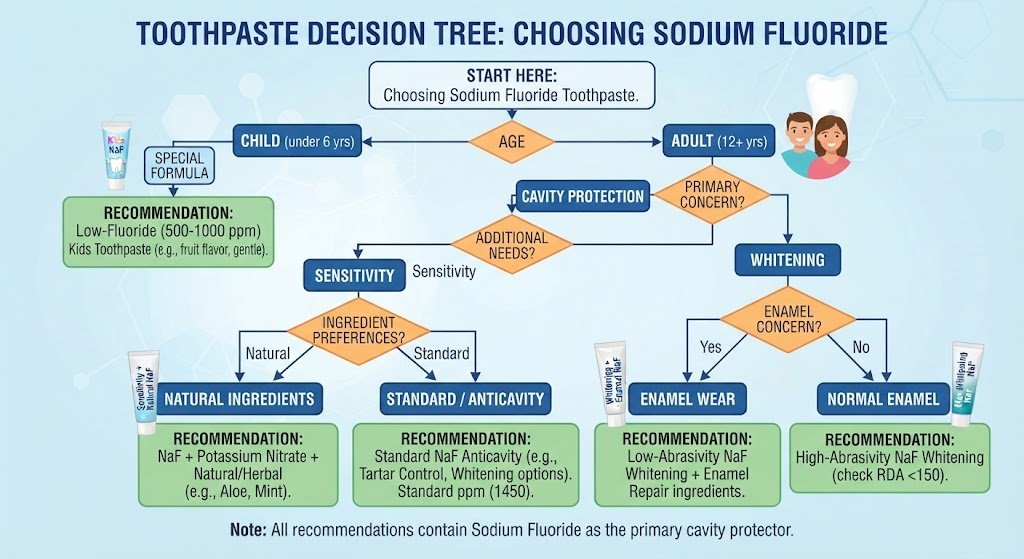
How to Choose a Sodium Fluoride Toothpaste
Choosing a sodium fluoride toothpaste is easier when you stop looking at the front of the package first.
Marketing terms such as “clean,” “natural,” “fresh,” or “whitening” can be useful for understanding the product’s positioning, but they do not tell you everything about its dental function.
Start with the Drug Facts label and active ingredients.
1. Check for sodium fluoride
Look for wording such as:
Active ingredient: Sodium Fluoride
This confirms that sodium fluoride is the fluoride compound used in that formula.
2. Check the fluoride concentration
Look for the fluoride concentration, commonly expressed in ppm.
For U.S. over-the-counter fluoride toothpastes, concentrations commonly fall around the 1,000–1,500 ppm range. Prescription-strength products may contain higher concentrations and should be used according to professional directions.
Do not assume that choosing the highest number available is automatically the best choice.
3. Match the toothpaste to your main dental need
Your priorities might include:
- Cavity prevention
- Sensitive teeth
- Enamel protection
- Whitening
- Gum health
- Bad breath
- A simpler ingredient list
If cavity prevention is your main concern, make that the first filter. Then consider additional features.
4. Read the complete ingredient list
Sodium fluoride tells you about the active fluoride ingredient, but it does not tell you everything about the toothpaste.
Check the rest of the formula for ingredients that matter to you, such as:
- Abrasives
- Humectants
- Flavoring ingredients
- Surfactants
- Sweeteners
- Preservatives
- Additional active ingredients
This is particularly useful if you are trying to avoid specific ingredients rather than simply looking for a toothpaste labeled “non-toxic.”
5. Consider sensitivity and abrasivity
If your teeth are sensitive, do not choose a whitening toothpaste solely because you want brighter teeth.
A highly abrasive formula may not be the best fit for someone already dealing with enamel wear or sensitivity.
Look for a product that addresses your main goal without creating a new problem.
6. Consider age and swallowing risk
Children need age-appropriate amounts of fluoride toothpaste and should be supervised during brushing.
Adults shopping for a family should avoid assuming that one toothpaste or one amount is appropriate for every person in the household.
7. Look for credible product information
If a toothpaste makes strong claims about cavity protection, enamel, sensitivity, or other dental benefits, look for clear active-ingredient information and reliable supporting information.
Third-party seals or professional acceptance programs can provide additional information, but they should not replace reading the actual product label.
Common Mistakes When Choosing Sodium Fluoride Toothpaste
Even when someone specifically wants sodium fluoride toothpaste, several common mistakes can make the decision harder.
Mistake 1: Thinking sodium fluoride is the same as the entire toothpaste
Sodium fluoride is one ingredient.
The rest of the formula can affect taste, texture, sensitivity, abrasivity, and other characteristics.
Mistake 2: Choosing based only on “natural” or “clean”
A marketing label does not tell you whether a toothpaste is appropriate for your cavity risk.
Instead, evaluate the active ingredient, concentration, complete formula, and your dental needs.
Mistake 3: Assuming more fluoride is always better
Fluoride concentration matters, but more is not automatically better for every person.
Use the amount and strength appropriate for your age and dental needs, and follow the product directions.
Mistake 4: Ignoring the reason you need toothpaste
Someone primarily concerned about cavities may need to prioritize cavity protection.
Someone with sensitivity may need a formula specifically designed for sensitivity.
Someone interested in whitening may want stain removal while still maintaining fluoride protection.
The best choice starts with the problem you are trying to solve.
Mistake 5: Treating fluoride-free as automatically superior
Fluoride-free toothpaste can be a personal choice, but removing fluoride also means giving up fluoride as the active cavity-protection ingredient.
If you have a high risk of tooth decay, discuss the decision with your dentist.
Mistake 6: Ignoring the label
The front of the package is designed to communicate benefits quickly. The active-ingredient section provides more useful information for understanding what the toothpaste actually contains.
Make label reading part of your buying process.
When Should You Talk to a Dentist?
Sodium fluoride toothpaste can be a useful part of everyday oral care, but toothpaste cannot diagnose or treat every dental problem.
Talk to a dentist if you have:
- Frequent or recurring cavities
- Severe or persistent tooth sensitivity
- Tooth pain that does not go away
- Bleeding or swollen gums
- Visible holes, cracks, or damage to a tooth
- Significant enamel wear
- Dry mouth that is increasing your cavity risk
- Questions about prescription-strength fluoride toothpaste
- Concerns about fluoride use for a young child
- A reason to consider switching from fluoride to a fluoride-free toothpaste
A dentist can consider your cavity risk, oral health, age, medications, diet, saliva production, and previous dental history when recommending a toothpaste or fluoride treatment.
If a large amount of toothpaste has been swallowed, especially by a child, seek appropriate medical guidance rather than relying only on general toothpaste-use advice.
Frequently Asked Questions About Sodium Fluoride
Is sodium fluoride safe in toothpaste?
For most people, sodium fluoride toothpaste can be used safely when used according to the product directions. The important issue is using an appropriate amount and avoiding unnecessary swallowing.
Children need additional supervision because they are more likely to swallow toothpaste.
Is sodium fluoride a natural ingredient?
Sodium fluoride is a chemical compound that contains sodium and fluoride. The word “natural” does not by itself determine whether an ingredient is appropriate or inappropriate for toothpaste.
For toothpaste, a more useful approach is to consider what the ingredient does, how much is present, how the product is intended to be used, and the available evidence for its dental purpose.
Is sodium fluoride better than fluoride-free toothpaste?
They serve different purposes.
Sodium fluoride toothpaste provides fluoride for cavity protection. Fluoride-free toothpaste does not provide fluoride as its active cavity-protection ingredient.
If you are at higher risk for cavities, speak with a dentist before deciding to remove fluoride from your routine.
Is sodium fluoride the same as sodium monofluorophosphate?
No. They are different fluoride compounds used in toothpaste.
Both can provide fluoride for cavity protection, but they are chemically different ingredients.
Is sodium fluoride the same as stannous fluoride?
No. Both are fluoride compounds, but they have different chemical compositions and can be used in different toothpaste formulations.
Some stannous fluoride formulas are designed to provide benefits beyond cavity protection, such as sensitivity or gum-related benefits.
Does sodium fluoride rebuild enamel?
Sodium fluoride does not regrow enamel that has been physically lost.
However, fluoride can support remineralization of teeth and help make tooth mineral more resistant to acid-related damage. This is especially relevant during the early stages of mineral loss.
If you already have significant enamel erosion or a damaged tooth, toothpaste cannot simply replace the missing structure.
How much sodium fluoride should toothpaste contain?
Look at the fluoride concentration listed on the product rather than trying to calculate the amount of sodium fluoride compound yourself.
U.S. over-the-counter fluoride toothpastes commonly contain about 1,000–1,500 ppm fluoride. Some higher-strength products are available by prescription or professional recommendation.
The appropriate concentration depends on factors such as age and cavity risk.
Can children use sodium fluoride toothpaste?
Yes, children can use fluoride toothpaste, but the amount should be age appropriate and they should be supervised.
For young children, only a small amount is needed. Children younger than 3 generally use no more than a rice-grain-sized amount, while children ages 3–6 generally use no more than a pea-sized amount.
The goal is to provide the benefit of fluoride while reducing unnecessary swallowing.
Can you swallow sodium fluoride toothpaste?
Toothpaste should be brushed onto the teeth and then spit out rather than swallowed.
Accidentally swallowing a small amount is different from intentionally or repeatedly swallowing toothpaste. Repeated excessive fluoride ingestion during tooth development can contribute to dental fluorosis.
If a significant amount is swallowed, especially by a child, seek medical guidance.
Does sodium fluoride whiten teeth?
Not by itself.
Sodium fluoride’s primary role is cavity protection. A sodium fluoride toothpaste may also contain ingredients intended to remove surface stains, but those whitening effects come from the overall formula rather than sodium fluoride being a dedicated whitening ingredient.
Does sodium fluoride help sensitive teeth?
Sodium fluoride provides fluoride for cavity protection, but sensitivity relief depends on the overall toothpaste formula and the cause of sensitivity.
If sensitivity is your main concern, look for a toothpaste specifically formulated for sensitive teeth and consider discussing persistent sensitivity with a dentist.
Is sodium fluoride good for cavities?
Yes. Sodium fluoride is used in toothpaste to provide fluoride that helps prevent tooth decay.
However, cavity prevention is not controlled by toothpaste alone. Brushing regularly, cleaning between teeth, limiting frequent exposure to cavity-causing sugars and starches, and maintaining regular dental care also matter.
Can sodium fluoride cause fluorosis?
Excessive fluoride ingestion during the period when permanent teeth are developing can contribute to dental fluorosis.
Dental fluorosis can appear as changes in the appearance of tooth enamel, such as white lines or spots.
This is one reason children should use only an age-appropriate amount of fluoride toothpaste and be supervised while brushing.
How do I know if my toothpaste contains sodium fluoride?
Check the Drug Facts or Active Ingredient section of the package.
If sodium fluoride is the active fluoride compound, it may be listed as:
Active ingredient: Sodium Fluoride
Do not rely only on the front of the package. The active-ingredient section is the better place to identify the fluoride compound.
Final Takeaway: Is Sodium Fluoride a Good Choice?
Sodium fluoride is one of the established fluoride compounds used in toothpaste for cavity prevention.
Its role is relatively simple: it provides fluoride that helps teeth resist acid-related mineral loss and supports the remineralization process.
But choosing toothpaste should not stop at the words “sodium fluoride.”
A better decision considers:
- The fluoride concentration — check the ppm listed on the product.
- Your dental needs — cavity risk, sensitivity, enamel concerns, whitening, or gum health.
- Your age and usage habits — especially for children who may swallow toothpaste.
- The complete formula — sodium fluoride is only one ingredient.
- Your personal preferences — such as avoiding certain ingredients or choosing a particular toothpaste format.
- Professional advice when needed — especially for frequent cavities, persistent sensitivity, or special dental conditions.
If your primary goal is fluoride-based cavity protection, a sodium fluoride toothpaste can be a practical option. If you are comparing sodium fluoride with stannous fluoride, hydroxyapatite, or fluoride-free toothpaste, focus on the actual dental benefit you need rather than assuming that one ingredient is universally better.