If you have ever wondered why fluoride is in toothpaste, what it actually does, or whether you should choose a fluoride or fluoride-free formula, the answer starts with one important fact: fluoride is an active ingredient used primarily to help prevent tooth decay.
Fluoride does more than simply make toothpaste part of your brushing routine. It interacts with the tooth surface and helps during the ongoing process of mineral loss and repair that occurs in your mouth. That makes it particularly important for people who want to reduce their risk of cavities.
But there is more to understand before choosing a toothpaste. The type of fluoride, its concentration, how it is used, your age, your cavity risk, and your other oral-health needs can all matter.
This guide explains fluoride in toothpaste, how it works, how safe use differs for adults and children, and what to look for when comparing products.
What Is Fluoride?
Fluoride is a naturally occurring mineral that can be found in the environment, including water, soil, and rocks. It is also used in dental care because of its ability to help protect teeth against decay.
When fluoride is included in toothpaste, it is considered an active ingredient. That means it has a specific purpose related to oral health rather than simply affecting the taste, texture, or appearance of the toothpaste.
The main reason fluoride is used in toothpaste is cavity prevention.
Your teeth are exposed to acids throughout the day. These acids can cause minerals to leave the enamel surface. Fluoride can help make teeth more resistant to this process and support the repair of early mineral loss.
It is also useful to understand that fluoride in toothpaste is not the same thing as saying that every ingredient in a toothpaste performs the same function.
A toothpaste may contain:
- An active ingredient such as fluoride
- Cleaning ingredients
- Moisturizers
- Flavoring ingredients
- Ingredients that control texture
- Ingredients that help preserve the formulation
- Other active ingredients for specific oral-health concerns
So when you are evaluating fluoride toothpaste, the active ingredient deserves particular attention.
Why Is Fluoride in Toothpaste?
The simplest answer is:
Fluoride is in toothpaste because it helps prevent cavities.
To understand why, it helps to look at what happens to your teeth during a normal day.
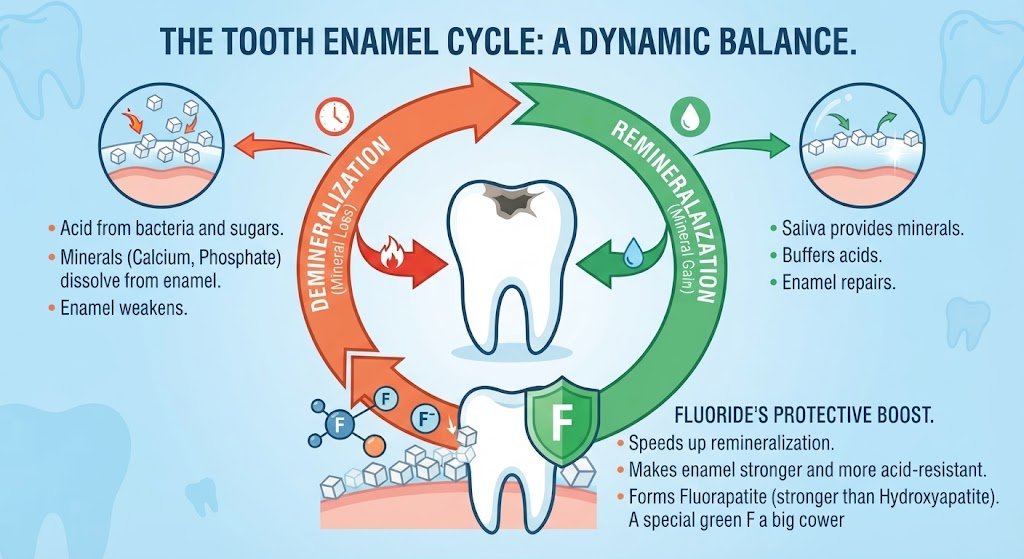
Bacteria in dental plaque can use sugars and starches from foods and drinks. As they do this, they produce acids. These acids can remove minerals from tooth enamel.
This process is called demineralization.
Fortunately, your teeth are not simply losing minerals all day. Saliva naturally helps return minerals to the tooth surface. This process is called remineralization.
Fluoride can support this protective cycle.
According to the National Institute of Dental and Craniofacial Research, fluoride can help prevent tooth decay and can help reverse early tooth decay by supporting the remineralization process. [ add a link ]
The American Dental Association also identifies fluoride toothpaste as an important tool for preventing tooth decay. [ add a link ]
This gives fluoride toothpaste a very specific role:
It helps your teeth handle repeated acid exposure and reduces the chance that early mineral loss will progress into a cavity.
How Does Fluoride Work?
Fluoride’s role becomes easier to understand when you separate demineralization from remineralization.
Demineralization: When Teeth Lose Minerals
Enamel is the hard outer layer of your teeth.
Although enamel is strong, it can be affected by acids. When bacteria in plaque produce acids after consuming fermentable carbohydrates, those acids can cause minerals to leave the enamel.
If this happens repeatedly and the tooth does not recover sufficiently, the enamel can become weakened.
Early mineral loss may appear as a white spot on the tooth.
At this stage, the process is different from having a fully formed cavity.
That distinction is important because early mineral loss may be managed differently from advanced tooth decay.
Remineralization: When Teeth Regain Minerals
Your mouth has natural mechanisms that help protect your teeth.
Saliva contains minerals and helps neutralize acids. Between acid exposures, minerals can return to the tooth surface.
This is remineralization.
Fluoride supports this process and can help the tooth surface become more resistant to future acid attacks.
So fluoride is not simply sitting on your teeth as a permanent coating.
Its value comes from being part of the ongoing oral environment.
A Simple Way to Think About It
The process can be simplified like this:
Food and plaque bacteria → acid exposure → mineral loss → saliva and fluoride help protect and restore the tooth surface → repeated protection helps reduce cavity risk.
This is one of the main reasons regular brushing with fluoride toothpaste is recommended for cavity prevention.
Does Fluoride Really Prevent Cavities?
Yes.
Fluoride has a well-established role in reducing the risk of dental caries, commonly called cavities or tooth decay.
The important point is that fluoride works as part of regular oral care rather than as a one-time treatment.
Every time you brush with fluoride toothpaste, you are using the toothpaste to deliver fluoride to the tooth surfaces.
The American Dental Association recognizes fluoride toothpaste as an effective tool for helping prevent tooth decay. [ add a link ]
The National Institute of Dental and Craniofacial Research similarly explains that fluoride can help prevent cavities and support early decay repair. [ add a link ]
However, fluoride does not eliminate every cause of cavities.
Your overall cavity risk can also be influenced by:
- How often you consume sugary foods and drinks
- Plaque buildup
- Brushing habits
- Cleaning between your teeth
- Saliva
- Previous dental problems
- Individual cavity risk
- Access to professional dental care
That is why the most accurate way to think about fluoride is:
Fluoride toothpaste is an important cavity-prevention tool, not a complete replacement for good oral hygiene.
How Much Fluoride Is in Toothpaste?
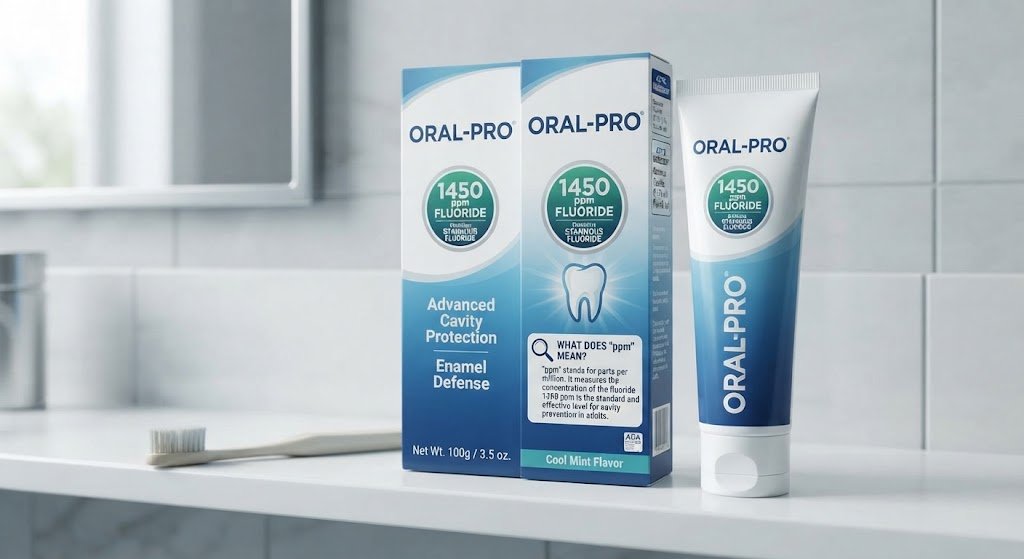
If you have ever looked at a toothpaste package and seen a number such as 1,000 ppm, 1,100 ppm, 1,450 ppm, or 1,500 ppm, you may have wondered what those numbers mean.
The number refers to the concentration of fluoride in the toothpaste.
PPM means parts per million.
For U.S. over-the-counter fluoride toothpastes, the American Dental Association says fluoride concentrations generally range from 1,000 to 1,500 ppm. Higher-concentration prescription fluoride toothpaste, such as 5,000 ppm formulations, is also available for particular situations. [ add a link ]
That does not mean that everyone should simply choose the toothpaste with the highest number.
Prescription-strength fluoride toothpaste is a different category and may be recommended based on an individual’s dental needs.
For everyday toothpaste, the better questions are:
- What fluoride compound does it use?
- What concentration does it contain?
- What is the toothpaste designed to do?
- Is it appropriate for my age?
- Does it address my particular oral-health needs?
Understanding the label is more useful than assuming more fluoride automatically means better toothpaste.
What Types of Fluoride Are Used in Toothpaste?
Not every fluoride toothpaste contains the exact same fluoride compound.
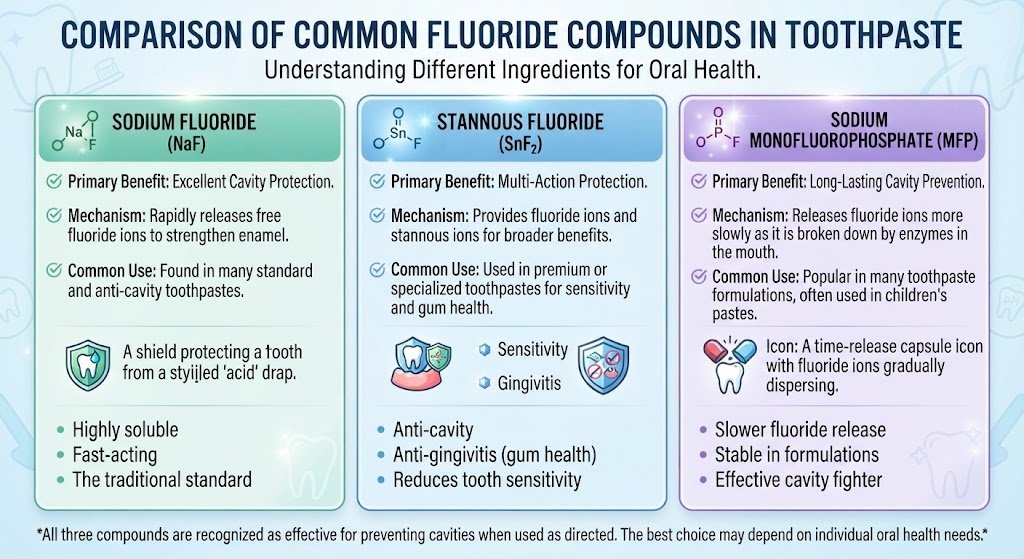
In the United States, common fluoride compounds used in toothpaste include:
- Sodium fluoride
- Stannous fluoride
- Sodium monofluorophosphate
The American Dental Association identifies these fluoride compounds in its information about toothpaste ingredients and anticaries products. [ add a link ]
These names can make toothpaste labels seem more complicated than they really are.
The important point is that they are different chemical forms used to deliver fluoride in toothpaste formulations.
Sodium Fluoride
Sodium fluoride is a common fluoride compound used in toothpaste.
When you see sodium fluoride listed as the active ingredient, its primary oral-health purpose is cavity protection.
It can be found in many everyday fluoride toothpastes.
Stannous Fluoride
Stannous fluoride is another fluoride compound used in toothpaste.
It provides fluoride for cavity protection and is also used in formulations designed around additional oral-health concerns.
Depending on the complete formulation, a stannous fluoride toothpaste may be marketed for concerns such as sensitivity or gum health.
The important distinction is that the fluoride compound is only one part of the product.
Two toothpastes can both contain fluoride but have different additional ingredients and different intended uses.
Sodium Monofluorophosphate
Sodium monofluorophosphate is another fluoride compound used in toothpaste.
Like the other fluoride compounds, its inclusion allows the toothpaste to provide fluoride for cavity protection.
When comparing these compounds, avoid reducing the decision to:
“Which chemical name sounds safest?”
Instead, look at the complete formulation, intended benefit, evidence, and your own oral-health needs.
Is Fluoride Safe in Toothpaste?
For most consumers, the more useful question is not simply whether fluoride is “safe” or “unsafe.”
The important issue is appropriate use.
Fluoride toothpaste is designed to be used during brushing and then spit out. The concern is greater when toothpaste is repeatedly swallowed, particularly by young children.
This is why toothpaste amounts and brushing habits matter.
The Centers for Disease Control and Prevention recommends using fluoride toothpaste as part of regular oral care and provides specific guidance about how much toothpaste young children should use. [ add a link ]
For adults and older children who can reliably spit out toothpaste, normal brushing according to the product directions is different from intentionally ingesting toothpaste.
This distinction is often lost in online discussions about fluoride.
What About Fluoride Exposure?
Fluoride exposure can come from more than one source, including:
- Toothpaste
- Drinking water
- Foods and beverages
- Other dental products
- Professionally applied fluoride
- Prescription fluoride products
Your total exposure therefore depends on your individual circumstances.
If you have questions about fluoride because of your drinking water, medical situation, dental history, or use of prescription fluoride products, your dentist or healthcare professional can provide advice specific to you.
What Happens If You Swallow Fluoride Toothpaste?
The main concern with toothpaste swallowing is especially relevant to young children.
Children may not yet have complete control over spitting and may swallow some toothpaste while brushing.
That is why caregivers should supervise young children and use only the recommended amount.
Repeated excessive ingestion of fluoride during the period when permanent teeth are developing can increase the risk of dental fluorosis.
Dental fluorosis is a developmental condition that can affect the appearance of teeth.
It is one reason parents should not give young children a large amount of toothpaste simply because they are learning to brush.
The goal is to get the benefits of fluoride while using it appropriately.
Fluoride Toothpaste for Children
Children need special consideration when it comes to fluoride toothpaste.
The CDC recommends:
- Under age 3: no more than a rice-grain amount of fluoride toothpaste
- Ages 3–6: no more than a pea-sized amount
- Children younger than 2: discuss fluoride toothpaste use with a dentist or doctor
[ add a link ]
These recommendations are about both fluoride exposure and effective brushing habits.
Young children may need help applying the correct amount of toothpaste and brushing thoroughly.
Parents should also encourage children to spit rather than swallow toothpaste.
The goal is not to avoid fluoride simply because a child is young.
Instead, the goal is age-appropriate fluoride use.
Can Fluoride Repair Enamel?
This is where wording matters.
Fluoride can support remineralization and early tooth-decay repair, but it cannot simply rebuild a tooth after a cavity has created a hole in the tooth.
Early mineral loss and an established cavity are different stages.
Early Mineral Loss
When minerals begin leaving enamel, the process may still be reversible or stoppable.
Fluoride can support remineralization and help strengthen the tooth surface.
Established Cavity
Once tooth decay progresses far enough to create a cavity, toothpaste cannot fill the missing tooth structure.
A dentist may need to remove the damaged portion and restore the tooth.
NIDCR explains that early tooth decay can sometimes be stopped or reversed, while a cavity represents more advanced damage requiring dental treatment. [ add a link ]
This distinction is important because it prevents an exaggerated understanding of what fluoride can do.
Fluoride helps prevent and manage early stages of decay; it is not a substitute for a dental filling or other treatment when a cavity has already formed.
[ ARTICLE CONTINUES — NEXT PART STARTS WITH: H2: “Fluoride vs Fluoride-Free Toothpaste” ]
Continuing exactly from the previous section:
Fluoride vs Fluoride-Free Toothpaste
The biggest difference between fluoride and fluoride-free toothpaste is the active ingredient used to help protect against tooth decay.
Fluoride toothpaste contains a fluoride compound that helps teeth resist acid-related mineral loss and supports remineralization during the early stages of tooth decay. This is why fluoride has remained a standard ingredient in cavity-prevention toothpaste.
Fluoride-free toothpaste does not contain fluoride as its cavity-protective active ingredient. Some formulas use ingredients such as hydroxyapatite instead, while others may focus on cleaning, flavor, sensitivity, or other oral-care goals.
For people who are at higher risk of cavities, removing fluoride from toothpaste is not necessarily an advantage. The choice should consider your cavity risk, dental history, age, and the ingredients used in the alternative formula.
Which one is better?
There is no single answer for everyone.
If your main priority is proven cavity prevention, fluoride toothpaste has strong support from dental organizations and decades of research.
If you prefer a fluoride-free formula, it is important to look beyond the words “natural,” “clean,” or “non-toxic.” Check what active ingredient the toothpaste uses and what it is designed to do.
The important question is not simply:
“Is this toothpaste fluoride-free?”
A better question is:
“Does this toothpaste provide the oral-health benefits I actually need?”
That distinction becomes especially important when choosing toothpaste for someone who frequently develops cavities.
Is Fluoride-Free Toothpaste Better for a Non-Toxic Lifestyle?
Not automatically.
The term non-toxic is not a scientific measure of how effective a toothpaste is at preventing cavities. A toothpaste can have a simple ingredient list and still be less suitable for someone who needs strong cavity protection.
Likewise, the presence of fluoride alone does not tell you whether the entire toothpaste formula is a good fit for you.
When evaluating a toothpaste, consider the complete formula:
- Active ingredients
- Fluoride concentration, if present
- Abrasives
- Surfactants
- Flavoring ingredients
- Sweeteners
- Preservatives
- Ingredients that may irritate your mouth
- Your specific dental needs
For a broader look at ingredients, see [ add a link ] to toothpaste ingredients to avoid and [ add a link ] to the toothpaste ingredient safety guide.
Our [ add a link ] to how we evaluate toothpaste can also explain how ingredients and product claims should be assessed together.
Don’t confuse “natural” with “better”
Natural toothpaste can be a good choice for some people, but “natural” does not automatically mean more effective for cavity prevention.
The same applies to terms such as:
- Clean
- Chemical-free
- Non-toxic
- Plant-based
- Organic
These labels describe marketing or formulation characteristics, not necessarily the level of cavity protection.
A better approach is to identify your primary oral-health need first and then evaluate whether the toothpaste formula addresses it.
Fluoride vs Hydroxyapatite Toothpaste
Fluoride and hydroxyapatite are different ingredients that can both be used in toothpaste designed to support tooth health.
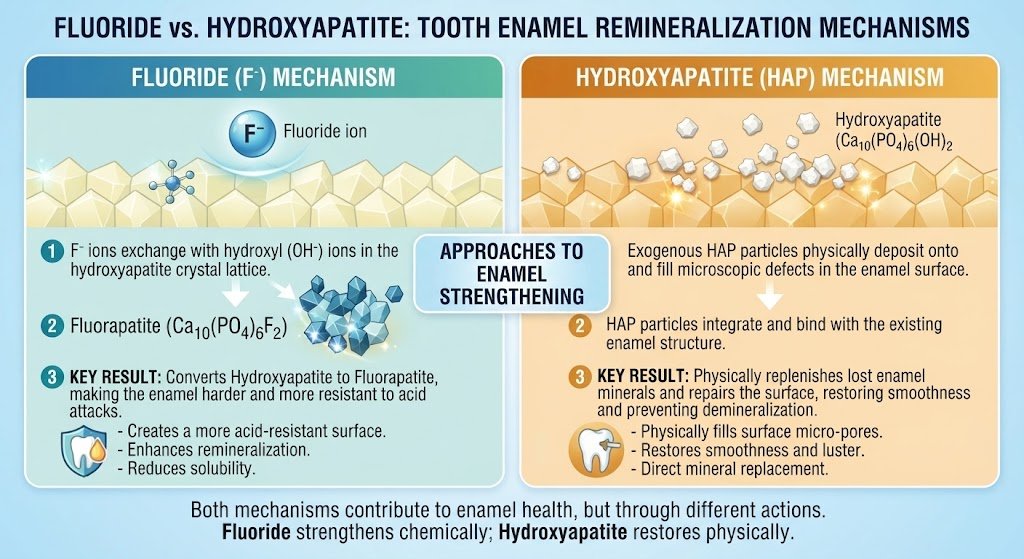
Fluoride works by interacting with the tooth surface and helping teeth become more resistant to acid-related mineral loss. It also supports remineralization.
Hydroxyapatite is a calcium-phosphate mineral closely related to the mineral naturally found in teeth and bones. Toothpaste containing hydroxyapatite is designed to interact with the tooth surface and support mineral repair.
The two approaches are not identical, so they should not simply be treated as interchangeable ingredients.
| Feature | Fluoride Toothpaste | Hydroxyapatite Toothpaste |
| Main purpose | Cavity prevention | Mineral support and tooth-surface protection |
| Main mechanism | Supports resistance to acid and remineralization | Supplies a tooth-like calcium-phosphate mineral |
| Fluoride-free | No | Usually yes |
| Long history of use | Yes | More recent in comparison |
| Best choice depends on | Cavity risk and individual needs | Formula, dental needs, and personal preference |
Research on hydroxyapatite continues to develop, while fluoride remains one of the most established ingredients for preventing dental caries.
If you are deciding between the two, see [ add a link ] to fluoride vs hydroxyapatite toothpaste.
You can also learn more about the ingredient itself in [ add a link ] hydroxyapatite in toothpaste.
What Is Stannous Fluoride and Why Is It Used?
Stannous fluoride is one of the fluoride compounds used in toothpaste.
Its primary fluoride-related role is helping protect against tooth decay. Depending on the specific formulation, stannous fluoride may also be included to support other oral-health benefits, such as helping with sensitivity or plaque and gingival concerns.
However, the benefits of a toothpaste do not come from the fluoride compound alone. The complete formulation matters.
Some people may notice differences in taste or mouth feel with certain stannous fluoride products. Formulation technology has also improved over time, so one product should not automatically be treated as representative of every toothpaste containing stannous fluoride.
If you are comparing fluoride compounds, look at the complete product rather than choosing solely based on the name of the active ingredient.
What Is Sodium Fluoride and Why Is It Common?
Sodium fluoride is another common fluoride compound used in toothpaste.
When used in an appropriate concentration, it provides fluoride to the tooth surface during brushing. This helps support the prevention of tooth decay.
Sodium fluoride is found in many conventional fluoride toothpastes and is familiar to consumers because of its long history of use in dental products.
The presence of sodium fluoride does not mean a toothpaste is automatically better or worse than a toothpaste containing another fluoride compound.
Instead, consider:
- The fluoride concentration
- The rest of the formula
- Your dental needs
- How well you tolerate the toothpaste
- Whether the product fits your brushing routine
For many people, consistency in brushing matters more than choosing between two familiar fluoride compounds.
Fluoride Toothpaste for Sensitive Teeth
Fluoride toothpaste can help protect teeth from cavities, but fluoride is not necessarily the ingredient responsible for relieving tooth sensitivity.
Sensitivity can happen when areas of the tooth become exposed to temperature, touch, or other triggers.
Some toothpastes designed for sensitive teeth contain additional ingredients, such as potassium nitrate, that target sensitivity.
If sensitivity is your main concern, don’t choose toothpaste based only on its fluoride content.
Instead, look for a formula that provides cavity protection while also addressing sensitivity.
See [ add a link ] to best toothpaste for sensitive teeth for a more focused guide.
If your sensitivity is persistent, severe, or associated with pain, it is worth discussing the cause with a dentist rather than simply switching toothpaste.
Fluoride Toothpaste for Enamel Protection
Enamel is the hard outer layer of your teeth, but it can still lose minerals when exposed to acids.
Fluoride helps make the tooth surface more resistant to acid attacks and supports remineralization when mineral loss is still in its early stages.
This makes fluoride particularly relevant to enamel protection.
However, fluoride cannot rebuild enamel that has already been physically lost. Once enamel has been significantly worn away, changing toothpaste cannot simply grow it back.
For enamel-related concerns, toothpaste selection should therefore be combined with habits that reduce acid exposure and excessive abrasion.
Learn more in [ add a link ] to how toothpaste protects enamel and [ add a link ] to best toothpaste for enamel.
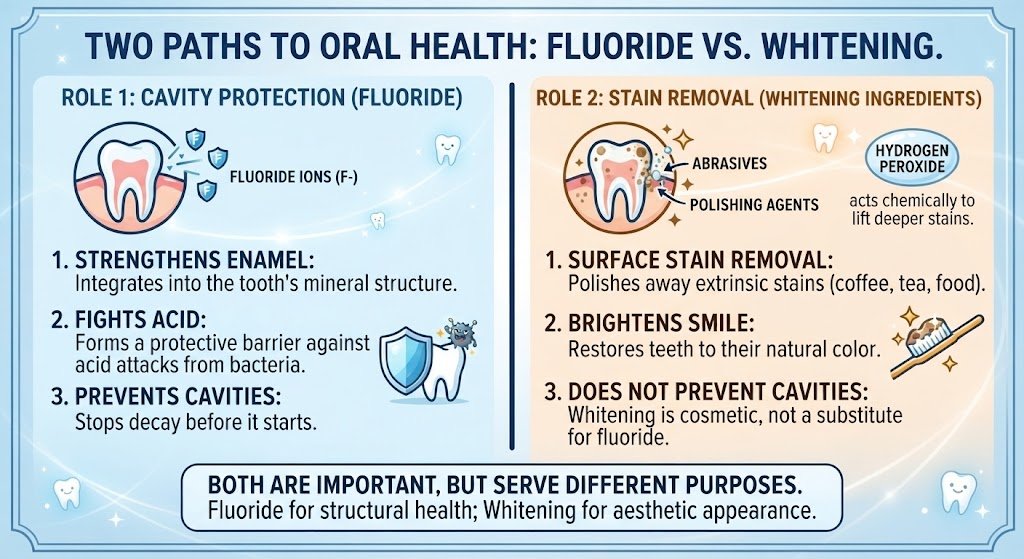
Does Fluoride Whiten Teeth?
Fluoride itself is not a bleaching ingredient.
Its main role in toothpaste is protecting against tooth decay and supporting tooth mineral health.
A whitening toothpaste may still contain fluoride, but the whitening effect usually comes from other parts of the formula, such as ingredients designed to remove surface stains.
This distinction matters because a toothpaste can provide cavity protection and whitening at the same time, but those benefits come from different parts of the formulation.
If whitening is your main goal, consider factors such as:
- Surface-stain removal
- Abrasiveness
- Whitening ingredients
- Tooth sensitivity
- Fluoride protection
See [ add a link ] to best whitening toothpaste for a deeper look at whitening formulas.
How to Choose a Fluoride Toothpaste
Choosing a fluoride toothpaste does not need to be complicated.
Start with the oral-health problem you are trying to solve. Then look at the active ingredient and the rest of the formula.
1. Check the active ingredient
Look for a recognized fluoride compound on the ingredient or Drug Facts information.
Common examples include:
- Sodium fluoride
- Stannous fluoride
- Sodium monofluorophosphate
The exact ingredient is less important than understanding what it is doing and whether the complete formula fits your needs.
2. Check the fluoride concentration
Fluoride concentration is usually listed in parts per million, or ppm.
For everyday over-the-counter toothpaste in the United States, many fluoride toothpastes contain around 1,000–1,500 ppm fluoride.
Do not assume that a higher number is automatically better for everyone. Higher-fluoride products can be intended for specific situations and may require professional guidance.
3. Match the toothpaste to your dental needs
Think about your biggest concern.
For example:
Frequent cavities: prioritize established cavity protection.
Sensitive teeth: look for a fluoride toothpaste formulated specifically for sensitivity.
Enamel concerns: consider fluoride protection alongside low-abrasion and acid-conscious habits.
Whitening: look for a formula that addresses surface stains without creating unnecessary sensitivity.
Gum concerns: consider the ingredients and formulation designed for plaque and gingival health.
4. Consider abrasivity
Abrasives help remove plaque and surface stains, but stronger cleaning is not always better.
If you have enamel wear, sensitivity, or frequent use of whitening toothpaste, abrasivity becomes an important factor.
See [ add a link ] to best low-abrasive toothpaste for more information.
5. Read the complete ingredient list
Do not stop after seeing the word “fluoride.”
Look at the complete formula to understand:
- What provides fluoride
- What cleans the teeth
- What creates texture
- What provides flavor
- What creates foam
- What ingredients may cause irritation for you
For a step-by-step method, see [ add a link ] to how to read toothpaste ingredients.
6. Consider whether you tolerate the formula
A toothpaste can be effective but still be a poor personal fit if it causes irritation, unpleasant taste, dryness, or other problems.
The best toothpaste is one that provides the protection you need and that you can comfortably use consistently.
7. Look for trustworthy product information
When comparing products, prioritize clear ingredient information and transparent product labeling.
For products sold in the United States, relevant dental organization seals or professional recommendations can provide another useful signal, but they should not replace reading the actual product information.
Common Mistakes When Choosing Fluoride Toothpaste
Many toothpaste decisions are based on marketing rather than oral-health needs.
Here are some common mistakes to avoid.
Choosing based only on “natural” or “clean”
These terms do not tell you whether the toothpaste provides adequate cavity protection.
Look at the active ingredient and complete formula instead.
Assuming the most expensive toothpaste is the best
Price does not automatically determine effectiveness.
A less expensive toothpaste can contain an established fluoride ingredient and provide the protection you need.
Choosing only by fluoride type
Sodium fluoride and stannous fluoride are not the only things that matter.
The complete formulation, concentration, intended benefit, and your own dental needs should all be considered.
Using a highly abrasive toothpaste every day
A toothpaste that removes stains aggressively may not be the best choice for someone with sensitivity or enamel-wear concerns.
Ignoring age
Children need age-appropriate toothpaste amounts and supervision to reduce unnecessary swallowing.
Changing toothpaste constantly
If your current toothpaste works well for your needs and you tolerate it comfortably, there may be no reason to switch simply because a new marketing claim appears.
Consistency is an important part of an effective oral-care routine.
Can You Use Fluoride Toothpaste Every Day?
Yes. Fluoride toothpaste is designed for regular use when used according to its directions.
The American Dental Association recommends brushing teeth twice daily with fluoride toothpaste. [ add a link ]
The important part is using the appropriate amount, brushing properly, and spitting out the toothpaste rather than intentionally swallowing it.
For children, the amount of toothpaste should be adjusted for age.
If you have a specific dental condition, unusually high cavity risk, or have been prescribed a high-fluoride toothpaste, follow your dentist’s instructions.
Should You Rinse After Brushing?
What you do immediately after brushing can affect how long toothpaste ingredients remain in contact with your teeth.
If you immediately rinse your mouth with a large amount of water, you may remove some of the remaining toothpaste.
For this reason, many dental professionals recommend spitting after brushing rather than thoroughly rinsing with water.
However, individual instructions can differ, especially for children or people with specific dental needs.
See [ add a link ] to should you rinse after brushing for a detailed explanation.
Who Should Talk to a Dentist About Fluoride?
Most people can use regular fluoride toothpaste as directed, but some situations deserve professional advice.
Consider speaking with a dentist if you:
- Develop cavities frequently
- Have a history of significant enamel damage
- Experience persistent tooth sensitivity
- Have dry mouth
- Have difficulty controlling plaque
- Are concerned about excessive fluoride exposure
- Have a child who frequently swallows toothpaste
- Have been told you need prescription-strength fluoride
- Notice white or brown changes on developing or erupted teeth
- Are unsure whether fluoride or fluoride-free toothpaste is appropriate for you
A dentist can evaluate your actual cavity risk and recommend a fluoride concentration or formulation that fits your situation.
Frequently Asked Questions About Fluoride in Toothpaste
Is fluoride in toothpaste safe?
For most people, fluoride toothpaste is considered safe when used as directed. The main concern is excessive ingestion, particularly in young children. Use the recommended amount and avoid intentionally swallowing toothpaste.
What does fluoride do in toothpaste?
Fluoride helps prevent tooth decay by making teeth more resistant to acid-related mineral loss and supporting remineralization during early stages of decay.
How much fluoride should toothpaste have?
Many standard over-the-counter fluoride toothpastes in the United States contain approximately 1,000–1,500 ppm fluoride. The appropriate concentration can depend on age, cavity risk, and professional recommendations.
Is fluoride-free toothpaste effective?
A fluoride-free toothpaste may still clean teeth and may contain other ingredients intended to support oral health. However, fluoride has strong evidence for cavity prevention, so fluoride-free toothpaste should not automatically be considered an equivalent replacement for everyone.
Which type of fluoride is best?
There is no universal answer. Sodium fluoride, stannous fluoride, and sodium monofluorophosphate are all used in toothpaste. The best choice depends on the complete formulation and your oral-health needs.
Does fluoride whiten teeth?
No. Fluoride’s primary role is cavity prevention and mineral support. Whitening effects generally come from other ingredients designed to remove or reduce surface stains.
Can fluoride repair enamel?
Fluoride can support remineralization and help strengthen areas experiencing early mineral loss. It cannot rebuild enamel that has already been physically lost or repair an established cavity.
Can children use fluoride toothpaste?
Yes, children can use fluoride toothpaste in age-appropriate amounts. Young children should be supervised because swallowing excessive toothpaste can increase the risk of dental fluorosis while teeth are developing. [ add a link ]
Is stannous fluoride better than sodium fluoride?
Not necessarily. Both provide fluoride for cavity protection, while some formulations containing stannous fluoride may offer additional oral-health benefits. The complete formulation and individual needs matter.
Final Takeaway
Fluoride is one of the most important active ingredients used in toothpaste because of its established role in preventing tooth decay.
It works by helping teeth withstand acid attacks and supporting remineralization when mineral loss is still in its early stages. That makes fluoride relevant not only to cavity prevention but also to maintaining stronger tooth surfaces.
Choosing toothpaste, however, should not come down to one ingredient alone.
Consider your:
- Cavity risk
- Age
- Tooth sensitivity
- Enamel condition
- Whitening goals
- Gum health
- Ingredient preferences
- Ability to use the toothpaste consistently
For someone who wants established cavity protection, fluoride toothpaste remains an important option. For someone considering fluoride-free toothpaste, the decision should be based on the complete formula and individual oral-health needs rather than marketing terms alone.
If you are comparing specific products, start with [ add a link ] to best fluoride toothpaste and then use our [ add a link ] to best non-toxic toothpaste guide to compare formulas based on ingredients, dental needs, and overall product quality.
[ AMAZON AFFILIATE CTA — Compare recommended fluoride toothpaste options based on fluoride type, concentration, dental needs, ingredients, and overall formula. ]
Affiliate Disclosure: Some links on this page may be affiliate links. If you purchase through these links, we may earn a commission at no additional cost to you. Our recommendations should be based on product information, ingredient analysis, and reader usefulness rather than commission alone.
