Dental plaque is a sticky film of bacteria that forms on your teeth and along the gumline. It develops naturally, but when plaque is not removed regularly, it can contribute to tooth decay, gum inflammation, and eventually tartar buildup.
The good news is that plaque can be managed with consistent oral hygiene. This guide explains what dental plaque is, how it forms, why it matters, how it differs from tartar and tooth decay, and what you can do to control it every day.
What Is Dental Plaque?
Dental plaque is a sticky bacterial film that develops on the surfaces of your teeth. Your mouth naturally contains bacteria, and some of these bacteria can become part of the plaque that collects on teeth.
Plaque is not simply leftover food. It is a living bacterial biofilm that can remain attached to tooth surfaces, particularly around the gumline, between teeth, and in other areas that are difficult to clean.
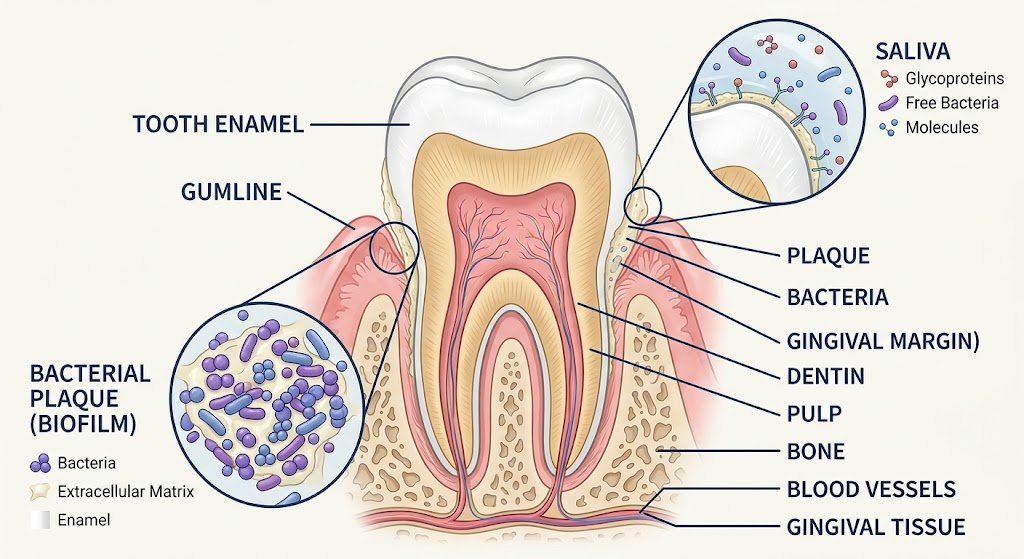
Because plaque can be difficult to see, you may have buildup without realizing it. This is one reason regular brushing and cleaning between the teeth are important.
When plaque remains on the teeth, bacteria can interact with sugars and starches from foods and drinks. This can produce acids that contribute to enamel mineral loss and tooth decay. Plaque around the gums can also contribute to inflammation and gum disease
The important point is that plaque is a normal buildup that needs regular removal. The goal is not to permanently prevent every trace of plaque from forming, but to avoid allowing it to remain undisturbed for long periods.
How Does Dental Plaque Form?
Dental plaque develops through an ongoing interaction between your mouth, oral bacteria, saliva, and what you eat and drink.
A simplified version looks like this:
Oral bacteria + tooth surface + food exposure → bacterial biofilm → plaque buildup
If plaque is not adequately disrupted through daily cleaning, it can become more problematic.
Oral Bacteria and the Mouth
Your mouth contains many types of microorganisms. Some bacteria can attach to tooth surfaces and become part of a biofilm.
Once bacteria and other components accumulate on a tooth surface, the resulting plaque can become increasingly organized and persistent.
This is why simply rinsing your mouth with water is not the same as physically cleaning plaque from your teeth. Plaque adheres to surfaces and needs to be disrupted through brushing and interdental cleaning.
Food, Sugars, and Starches
Food does not simply turn directly into plaque. Instead, foods containing carbohydrates such as sugars and starches can interact with bacteria already present in dental plaque.
Certain bacteria use these carbohydrates and produce acids. Those acids can lower the environment around the tooth and contribute to mineral loss from enamel.
Repeated exposure can matter because the mouth is constantly moving between periods of mineral loss and recovery.
This connects dental plaque with another important oral-health process: enamel demineralization.
Plaque Builds Up on Tooth Surfaces
Plaque can accumulate in places that are easy to miss, including:
- Along the gumline
- Between teeth
- Around orthodontic appliances
- In grooves and other difficult-to-clean areas
- On the surfaces of teeth that are not brushed thoroughly
The location matters because a toothbrush cannot reach every surface equally well.
For example, brushing the front and back surfaces of your teeth may leave plaque between closely spaced teeth. That is why interdental cleaning is an important part of plaque control rather than an optional replacement for brushing.
What Happens If Plaque Is Not Removed?
Unremoved plaque can contribute to two major oral-health problems.
First, plaque can contribute to tooth decay. Bacteria within plaque can produce acids that attack tooth enamel. Repeated acid exposure can result in mineral loss and, if the process progresses, a cavity.
Second, plaque can irritate the gums. The body’s response to bacteria around the gumline can cause inflammation, which is associated with gingivitis and gum disease.
Plaque can also eventually harden into tartar, also called calculus. Unlike soft plaque, hardened tartar cannot simply be brushed away at home.
Why Is Dental Plaque a Problem?
Dental plaque becomes a concern when it remains on the teeth and is not regularly disrupted.
The main problems associated with plaque buildup include tooth decay, gum inflammation, gingivitis, and tartar formation.
Tooth Decay
Plaque contains bacteria that can produce acids after exposure to sugars and other fermentable carbohydrates. These acids can contribute to the loss of minerals from enamel.
Over time, repeated mineral loss can weaken the tooth and contribute to tooth decay.
However, plaque itself is not a cavity. It is one part of the process that can contribute to cavity formation.
This distinction is useful because seeing plaque on your teeth does not automatically mean you have a cavity.
Gum Inflammation
Plaque around the gumline can irritate the gums. This may lead to signs such as redness, swelling, or bleeding.
Early gum inflammation is commonly called gingivitis.
Tartar Formation
Plaque that remains on the teeth can harden when minerals in saliva become incorporated into the buildup.
The hardened material is called tartar or calculus.
This creates an important difference:
Plaque can be disrupted through daily oral hygiene. Tartar is hardened buildup that generally requires professional removal.
Trying to scrape tartar off your teeth with household objects is not a safe substitute for professional dental cleaning.
Plaque vs. Tartar: What Is the Difference?
Plaque and tartar are related, but they are not the same thing.
| Feature | Dental Plaque | Tartar |
| What it is | Sticky bacterial biofilm | Hardened mineralized buildup |
| How it develops | Forms continuously on tooth surfaces | Can form when plaque hardens |
| Texture | Soft or sticky | Hard and firmly attached |
| Can daily cleaning help? | Yes | Cannot be fully removed by normal brushing |
| Professional cleaning | Not normally required simply for plaque | Often required for removal |
| Main concern | Can contribute to decay and gum inflammation | Can contribute to ongoing gum problems |
This difference is especially important when someone says, “I have plaque that will not come off.”
If the buildup is hard and firmly attached, it may be tartar rather than ordinary plaque. A toothbrush is designed to clean plaque, not remove hardened calculus.
NIDCR explains that plaque can harden into tartar, and tartar cannot be removed with normal brushing and flossing. [ add a link ]
Plaque vs. Tooth Decay
Dental plaque and tooth decay are connected, but they describe different things.
Plaque is a bacterial biofilm.
Tooth decay is a disease process involving damage to the tooth caused by factors including acids produced by bacteria.
A simplified pathway is:
Plaque bacteria → sugars/starches → acids → mineral loss → tooth decay
Early mineral loss does not necessarily mean a fully formed cavity already exists. At an early stage, the balance between mineral loss and mineral recovery can still matter.
That is why plaque control is part of preventing dental caries rather than simply a cosmetic concern.
NIDCR describes tooth decay as beginning when bacteria in plaque use sugars to make acids that attack the tooth. [ add a link ]
A formed cavity is different from early mineral loss. Once structural damage has created a cavity, toothpaste cannot simply rebuild the missing tooth structure. Professional dental treatment may be required depending on the extent of the damage.
Plaque vs. Gingivitis
Plaque and gingivitis are also not interchangeable terms.
Plaque is the bacterial buildup.
Gingivitis is inflammation of the gums.
Plaque along the gumline can trigger an inflammatory response. If plaque is not effectively controlled, the gums may become red, swollen, or bleed during brushing or cleaning between the teeth.
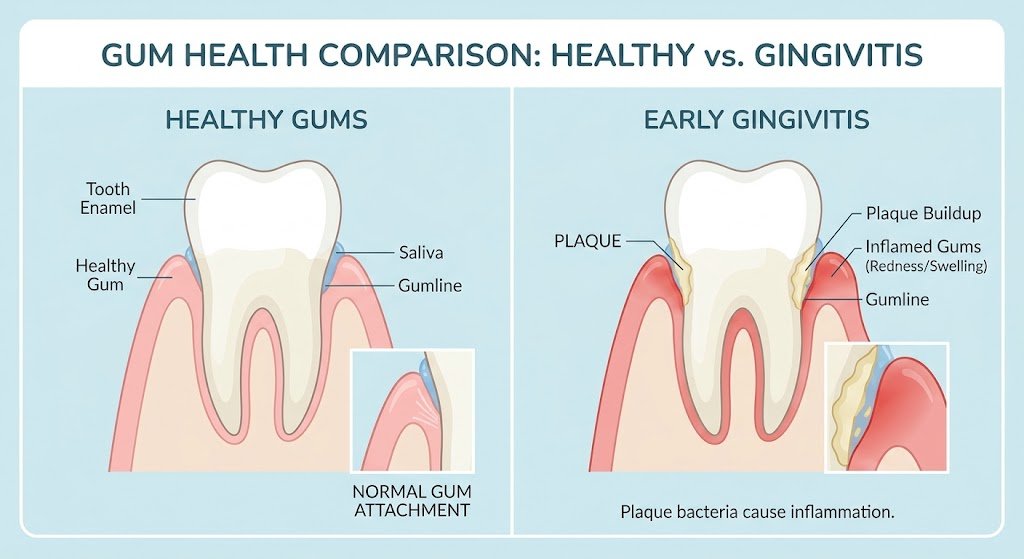
Understanding this relationship makes daily cleaning easier to understand:
Plaque control → less bacterial buildup → healthier gumline
It also explains why brushing only the visible surfaces of your teeth is not enough. The gumline and areas between teeth deserve attention too.
What Does Dental Plaque Look Like?
Dental plaque can be difficult to see because it may appear as a thin, nearly colorless or pale film on the teeth.
You may notice a slippery or fuzzy feeling on your teeth, particularly after going without brushing for some time. However, appearance alone is not always a reliable way to identify every area of plaque.
Plaque can collect:
- Along the gumline
- Between teeth
- Behind the lower front teeth
- Around braces or other dental appliances
- In grooves and areas that are difficult to reach
One useful way to identify missed plaque is a plaque-disclosing product. These products can temporarily make plaque easier to see, allowing you to identify areas that your normal brushing routine may be missing.
This can be especially useful as a learning tool because it changes plaque control from guessing to visual feedback.
The purpose is not to make your teeth look perfectly plaque-free at every moment. Instead, it can help you understand where your cleaning technique needs improvement.
[ add a link ]
[ARTICLE CONTINUES — NEXT PART STARTS WITH: H2: “How to Remove Dental Plaque”]
Part 2 of 3
How to Remove Dental Plaque
Dental plaque is best controlled through consistent physical removal. The basic approach is simple: brush your teeth regularly, clean between your teeth, and use products that make those tasks easier to perform well and consistently.
No single product replaces the entire routine. A toothbrush cleans many tooth surfaces, while floss or another interdental cleaner helps reach areas that toothbrush bristles cannot clean effectively.
Brush Twice a Day
Brushing is one of the main ways to disrupt plaque before it can remain undisturbed on your teeth.
For most adults, a practical routine is to brush twice a day with fluoride toothpaste and clean all accessible tooth surfaces, including areas near the gumline. NIDCR recommends brushing twice daily with fluoride toothpaste as part of good oral hygiene. [ add a link ]
The goal is not to brush harder. Aggressive pressure can irritate the gums and may contribute to wear when brushing is too forceful.
Instead:
- Use a soft-bristled toothbrush.
- Position the bristles so they reach the gumline.
- Brush the outer, inner, and chewing surfaces.
- Use gentle, controlled movements.
- Spend enough time cleaning all areas rather than rushing through the routine.
A consistent technique is more useful than simply buying a more expensive toothbrush.
For readers whose main concern is cavity prevention as well as plaque control, fluoride toothpaste is particularly relevant.
Clean Between Your Teeth
Brushing cannot effectively reach every surface between closely spaced teeth. This is where interdental cleaning becomes important.
Dental floss is one option, but it is not the only one. Depending on your teeth, preferences, and dental situation, you may use:
- Traditional dental floss
- Floss picks
- Interdental brushes
- Water flossers
The important principle is to clean the areas that a toothbrush cannot adequately reach.
The ADA recognizes floss and other interdental cleaners as tools for removing plaque from between teeth and other difficult-to-reach areas. [ add a link ]
Which option should you choose?
There is no need to choose a product simply because it is marketed as the most advanced option.
Instead, ask:
Can I use it comfortably?
Can it reach the areas I need to clean?
Will I use it consistently?
A simple flossing method that you actually use is more useful than a product that stays in a bathroom drawer.
If you have larger spaces between your teeth, orthodontic appliances, or difficulty handling conventional floss, an interdental brush or water flosser may be worth considering.
Consider an Electric Toothbrush
An electric toothbrush can be a useful option for people who want powered brushing or have difficulty maintaining a consistent manual brushing technique.
However, electric does not automatically mean better for every person or every situation.
When evaluating one for plaque control, focus on practical features such as:
- Comfortable brush head
- Easy-to-use controls
- Suitable brushing modes
- A design that makes it easy to reach different tooth surfaces
- Replacement brush-head availability
- Battery or charging convenience
- Features that encourage consistent brushing
Some powered toothbrushes also provide feedback features that can help users develop more consistent brushing habits.
The important question is not:
“Is this the most expensive electric toothbrush?”
It is:
“Will this help me clean my teeth properly and consistently?”
That distinction keeps the purchasing decision focused on the reader’s actual problem.
Consider a Water Flosser or Interdental Brush
For some people, cleaning between teeth with traditional floss can be difficult or uncomfortable.
A water flosser uses a stream of water to clean around and between teeth. An interdental brush uses a small brush designed to fit into spaces between teeth.
These products may be particularly worth considering when the design of the mouth or dental appliances makes conventional flossing difficult.
For example, someone with braces may have additional areas around brackets and wires that require attention. Someone with wider spaces between teeth may find an appropriately sized interdental brush easier to use.
The key is to select the tool based on the space you need to clean rather than assuming one product is universally superior.
Can You Prevent Dental Plaque?
You cannot permanently stop plaque from forming. Your mouth naturally contains bacteria, and plaque can develop again after it is removed.
The goal is therefore regular plaque control, not a one-time attempt to eliminate it forever.
A practical prevention routine includes:
1. Brush twice daily
Use fluoride toothpaste and clean the teeth systematically rather than focusing only on the front surfaces.
2. Clean between your teeth
Choose floss, an interdental brush, water flosser, or another appropriate method that you can use consistently.
3. Pay attention to the gumline
Plaque commonly collects near the gums, so this area should not be overlooked during brushing.
4. Reduce frequent sugar exposure
Bacteria in plaque can use sugars to produce acids that contribute to tooth decay. Reducing frequent exposure to sugary foods and drinks can therefore support cavity prevention.
5. Maintain regular dental care
Professional dental visits allow a dentist or dental professional to identify problems that may not be obvious at home and remove hardened deposits when necessary.
6. Replace worn cleaning tools
A toothbrush with significantly worn bristles may not perform as intended. Follow the replacement guidance for the specific product you use.
The CDC recommends brushing twice daily with fluoride toothpaste, cleaning between teeth daily, and maintaining regular dental care as part of oral-health prevention. [ add a link ]
What Products Help With Plaque Control?
Once you understand how plaque forms and why regular removal matters, product selection becomes much easier.
The right product depends on which part of your oral-care routine needs help.
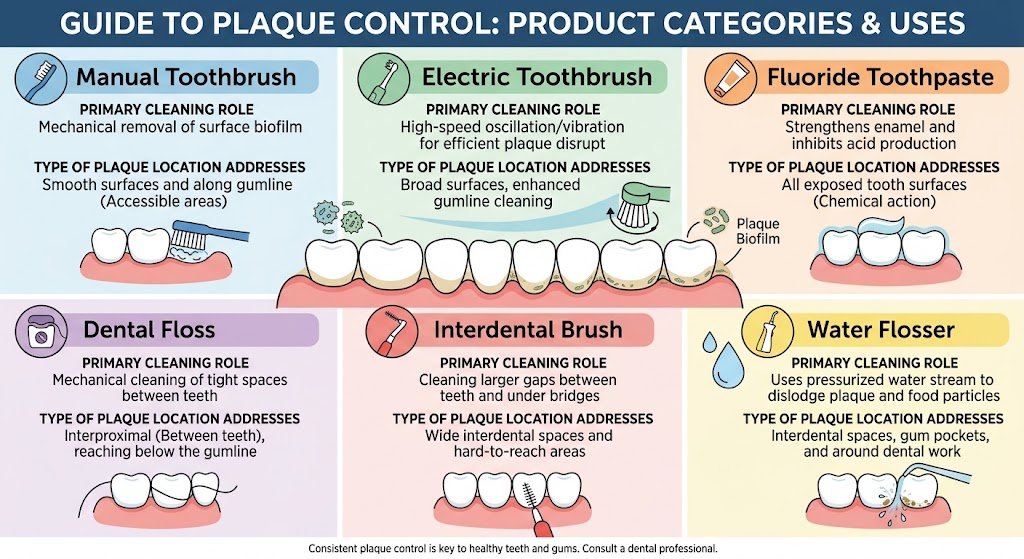
| Product | Main purpose | When it may make sense |
| Manual toothbrush | Physical plaque removal | Simple everyday brushing |
| Electric toothbrush | Powered brushing | Users who prefer powered cleaning or helpful brushing features |
| Fluoride toothpaste | Brushing plus cavity protection | Most adults who need routine cavity protection |
| Dental floss | Cleaning between teeth | Tight interdental spaces and conventional floss users |
| Interdental brush | Cleaning between teeth | Suitable larger spaces or specific dental situations |
| Water flosser | Water-based interdental cleaning | Users who prefer this method or have difficult-to-clean areas |
| Plaque-disclosing tablets | Shows areas of remaining plaque | Users who want visual feedback on brushing |
The purpose of this table is not to suggest that you need every product.
You generally need a basic routine that covers the surfaces of your teeth and the areas between them. Additional products should solve a specific problem.
How to Choose a Plaque-Control Product
Before purchasing an oral-care product, consider these questions:
Does it solve a specific problem?
If your main problem is brushing consistency, a powered toothbrush may be worth considering.
If your main problem is cleaning between teeth, an interdental product may be more relevant.
If your concern is identifying areas you repeatedly miss, a plaque-disclosing product may provide useful feedback.
Is it comfortable?
A product that irritates your mouth or feels difficult to use is unlikely to become part of a sustainable routine.
Is it easy to maintain?
For powered products, consider replacement brush heads, charging, cleaning, and other ongoing requirements.
For interdental products, consider whether replacement supplies are easy to obtain.
Does it fit your dental needs?
People with braces, implants, bridges, larger interdental spaces, sensitive gums, or other dental considerations may have different cleaning needs.
If you’re unsure which tool is appropriate for your specific dental situation, ask your dentist or dental hygienist.
How to Choose a Toothpaste for Plaque Control
Toothpaste is only one part of plaque control, but it can serve an important role in your daily brushing routine.
When choosing toothpaste, look beyond marketing terms such as “deep clean,” “natural,” “clean,” or “detox.”
Instead, check the active ingredients and intended purpose.
For adults primarily concerned with cavity prevention, fluoride is an important consideration. The ADA notes that fluoride toothpastes accepted for cavity protection contain fluoride and that fluoride helps prevent tooth decay and supports remineralization of early enamel damage. [ add a link ]
Other factors may matter depending on your situation:
- Tooth sensitivity
- Gum concerns
- Enamel protection
- Ingredient preferences
- Abrasivity
- Flavor and comfort
- Whether the product has an ADA Seal where applicable
If gum health is your primary concern, you can explore a more targeted guide rather than trying to make this plaque article cover every toothpaste type.
Likewise, readers specifically looking for fluoride options can move to the dedicated buying guide:
The important principle is that toothpaste should support your oral-health goal, not replace the physical removal of plaque.
What Should You Look for in a Plaque-Control Toothbrush?
If you are shopping for a toothbrush specifically to improve plaque control, focus on usability rather than marketing claims.
Soft bristles
A toothbrush should be comfortable against the teeth and gums. More aggressive bristles are not automatically better at cleaning.
Appropriate head size
The brush head should allow you to reach the different surfaces of your teeth without making brushing awkward.
Comfortable handle
A comfortable grip can make it easier to maintain consistent brushing technique.
Powered features
With electric toothbrushes, features such as timers or other feedback systems may be useful if they help you develop a more consistent routine.
Replacement availability
A toothbrush is not a one-time purchase if its head or bristles need regular replacement. Consider whether replacement heads or brushes are readily available and reasonably convenient to obtain.
Your specific dental situation
Someone with braces, dental restorations, sensitive areas, or other oral-health considerations may benefit from a different brush design than someone with no special needs.
[ARTICLE CONTINUES — NEXT PART STARTS WITH: H2: “When Should You See a Dentist?”]
Part 3 of 3
When Should You See a Dentist?
Daily plaque control is important, but home care cannot replace a professional dental evaluation when you have symptoms or hardened buildup.
Consider making a dental appointment if you notice:
- Gums that regularly bleed when brushing or cleaning between your teeth
- Red, swollen, or tender gums
- Persistent bad breath
- Tooth pain or ongoing sensitivity
- Visible hard deposits that do not come off with normal brushing
- Loose or shifting teeth
- A suspected cavity
- Changes in your gums or teeth that do not improve with better oral hygiene
These symptoms do not necessarily tell you exactly what condition you have. For example, bleeding gums can have different causes, while tooth sensitivity can be associated with several dental problems.
A dentist can examine your teeth and gums and determine whether the problem is plaque buildup, tartar, tooth decay, gum disease, or something else.
If you notice hard buildup on your teeth, do not try to scrape it away with sharp household objects. Tartar is firmly attached and may require professional cleaning.
Professional care is particularly important when symptoms persist despite improving your daily cleaning routine.
A Simple Daily Plaque-Control Routine
You do not need a complicated collection of products to manage dental plaque. A consistent routine is usually more useful than constantly changing products.
Morning
1. Brush your teeth with fluoride toothpaste.
Clean the outer, inner, and chewing surfaces of your teeth and pay attention to the gumline.
2. Take your time.
Instead of brushing only the most visible areas, follow a consistent pattern so you do not repeatedly miss the same surfaces.
During the Day
Your daily habits also influence your oral environment.
Try to avoid repeatedly exposing your teeth to sugary foods and drinks throughout the day. Bacteria in plaque can use sugars to produce acids that contribute to tooth decay.
Drinking water can also be a simple way to support normal oral hygiene between meals.
The goal is not to make your diet perfect. It is to develop habits that reduce unnecessary repeated exposure and make your overall oral-care routine easier to maintain.
Evening
The evening routine is an important opportunity to clean areas that are easy to miss.
1. Clean between your teeth.
Use floss, an interdental brush, or another method appropriate for you.
2. Brush your teeth.
Use fluoride toothpaste and clean all tooth surfaces.
3. Pay attention to problem areas.
If plaque repeatedly accumulates behind certain teeth or around the gumline, spend more time improving your technique in those areas.
Optional: Use Plaque-Disclosing Products
Plaque-disclosing tablets can provide visual feedback by making remaining plaque easier to identify.
They can be useful if you are trying to improve your brushing technique because you can see where plaque remains instead of relying only on how clean your teeth feel.
This can turn the process into a simple feedback loop:
Brush → disclose plaque → identify missed areas → improve technique → repeat
The purpose is not to create anxiety about having any plaque. Plaque naturally forms again. The useful goal is learning to remove it effectively and consistently.
Frequently Asked Questions
What is dental plaque?
Dental plaque is a sticky bacterial biofilm that forms on tooth surfaces and around the gumline. It develops naturally in the mouth but needs to be regularly disrupted and removed through daily oral hygiene. If plaque remains on teeth, it can contribute to tooth decay, gum inflammation, and eventually tartar formation.
Is dental plaque harmful?
Plaque can become harmful when it remains on the teeth and is not regularly removed. Bacteria in plaque can produce acids that contribute to tooth decay, while plaque around the gumline can contribute to inflammation and gingivitis.
Plaque itself is not the same as a cavity or gum disease, but it can play an important role in the processes that lead to these problems.
What is the difference between plaque and tartar?
Plaque is a soft, sticky bacterial biofilm that forms on teeth. Tartar, also called calculus, is hardened plaque that has become mineralized.
Daily brushing and interdental cleaning can help control plaque. Hardened tartar generally cannot be removed effectively with normal home brushing and requires professional dental cleaning.
Can brushing remove dental plaque?
Yes. Brushing is one of the main ways to physically disrupt and remove plaque from tooth surfaces.
However, brushing does not effectively clean every area between teeth. That is why cleaning between the teeth with floss, interdental brushes, or another suitable method is also important.
A good plaque-control routine therefore involves more than simply brushing the front surfaces of your teeth.
Does flossing remove plaque?
Yes. Floss and other interdental cleaners can help remove plaque from between teeth and areas that toothbrush bristles cannot effectively reach.
The best interdental-cleaning method depends on your individual mouth and what you can use comfortably and consistently.
If traditional floss is difficult to handle, you may find another interdental method easier to maintain.
Can dental plaque cause cavities?
Plaque can contribute to the process that causes cavities.
Bacteria within plaque can use sugars and other carbohydrates and produce acids. These acids can contribute to mineral loss from tooth enamel. Repeated mineral loss can eventually contribute to tooth decay.
This is why controlling plaque and maintaining fluoride exposure are important parts of cavity prevention.
Can dental plaque cause gingivitis?
Plaque around the gumline can contribute to gum inflammation, which is associated with gingivitis.
Signs can include red, swollen, or bleeding gums. Improving daily plaque control can help support healthier gums, but persistent symptoms should be evaluated by a dental professional.
How often should you remove plaque?
Plaque should be controlled as part of your regular daily oral-hygiene routine rather than through occasional intensive cleaning.
For most adults, this means brushing twice daily with fluoride toothpaste and cleaning between the teeth regularly.
The important point is consistency. Waiting until a large amount of buildup is noticeable makes the routine more difficult than removing plaque regularly.
What is the best toothbrush for plaque?
There is no single toothbrush that is automatically the best choice for everyone.
A good toothbrush should allow you to clean your teeth comfortably and thoroughly. Some people prefer a manual toothbrush, while others may find an electric toothbrush easier to use consistently.
When comparing products, consider the brush head, bristle design, comfort, ease of use, replacement needs, and features that may help you maintain a consistent routine.
The most useful toothbrush is ultimately one that fits your needs and that you will use properly every day.
Conclusion
Dental plaque is a sticky bacterial biofilm that forms naturally on teeth, but leaving it undisturbed can contribute to tooth decay, gum inflammation, and tartar formation.
The most useful way to think about plaque control is as a daily process:
Brush your teeth → clean between your teeth → pay attention to the gumline → maintain healthy habits → get professional care when needed.
You do not need every oral-care product available. Start with the basics and add a product when it solves a specific problem.
A manual or electric toothbrush can help with tooth-surface cleaning. Fluoride toothpaste can support cavity prevention. Floss, interdental brushes, or water flossers can help clean between teeth. Plaque-disclosing products can provide visual feedback when you want to improve your technique.
If you are choosing products for plaque control, focus on function, comfort, intended use, and your own dental needs rather than simply choosing the most expensive or heavily marketed option.
