When your baby’s first tooth appears, brushing becomes part of the daily routine. But choosing toothpaste can feel confusing. Parents often wonder whether a baby needs fluoride toothpaste, how much to use, whether swallowing toothpaste is a concern, and which ingredients are worth paying attention to.
The good news is that you do not need a complicated oral-care routine. The important things are starting at the right time, using the appropriate amount, helping your baby brush, and choosing a toothpaste that fits your child’s needs.
This guide explains when babies should start using toothpaste, how much to use, how fluoride fits into the decision, what to look for on the ingredient label, and how to choose toothpaste without being distracted by confusing marketing claims.
When Should Babies Start Using Toothpaste?
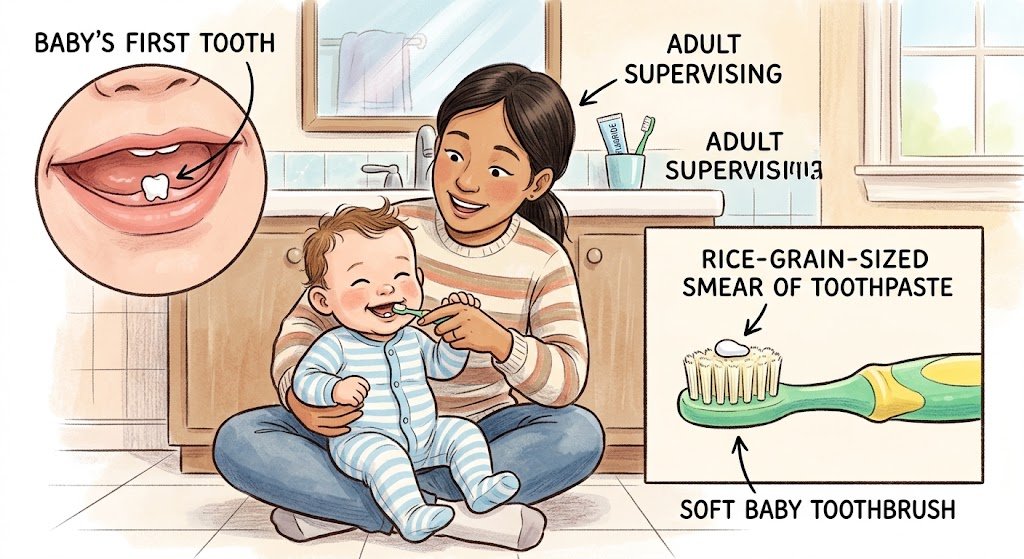
You can start brushing your baby’s teeth when the first tooth appears. You do not need to wait until several teeth have come in.
A baby’s primary teeth still need daily care because they can develop cavities. Starting a brushing routine early also helps your child become familiar with the process.
The first stage does not need to be complicated:
- Use a small, soft-bristled toothbrush designed for a young child.
- Apply the appropriate amount of toothpaste.
- Gently brush the tooth and surrounding areas.
- Let the adult caregiver control the brushing.
- Make brushing part of the morning and bedtime routine.
The caregiver should do most or all of the brushing at this age because babies do not yet have the coordination needed to clean their teeth effectively.
The important point is that the first tooth is the starting point for an oral-care routine, not the point at which a child is old enough to manage brushing independently.
Start With a Small, Soft Toothbrush
A baby’s toothbrush should have a small head that fits comfortably in the mouth and soft bristles.
The goal is gentle, effective cleaning rather than scrubbing.
A large toothbrush can be difficult for a caregiver to maneuver around a baby’s small mouth, while firm bristles are unnecessary for routine cleaning.
A simple baby toothbrush is often enough. You do not need a complicated brush with numerous features if a basic design allows you to clean your baby’s teeth comfortably and consistently.
Make Brushing a Caregiver-Led Routine
At this age, brushing is primarily the parent’s or caregiver’s job.
Your baby may want to hold the toothbrush, chew on it, or move it around. That is normal, but letting your baby play with a toothbrush is not the same as effectively brushing the teeth.
One practical approach is to let your baby hold or explore a toothbrush while the caregiver uses another toothbrush to perform the actual cleaning.
This can make the routine feel less like a struggle while still ensuring the teeth are cleaned.
Should Babies Use Fluoride Toothpaste?
This is one of the most important questions parents have when choosing toothpaste for babies.
Fluoride helps protect teeth against cavities, but parents may also worry because babies may not yet be able to spit toothpaste out reliably.
That is why both the type of toothpaste and the amount used matter.
The American Dental Association recommends using a fluoride toothpaste when the first tooth appears, with a smear about the size of a grain of rice for children younger than 3. [ add a link ]
At the same time, parents may encounter different advice online. The CDC advises parents of children younger than 2 to discuss fluoride toothpaste with a doctor or dentist. [ add a link ]
These recommendations are not a reason to become confused or avoid professional guidance. Instead, they highlight why fluoride decisions for very young children should consider the child’s age, cavity risk, fluoride exposure, and individual circumstances.
Why Is Fluoride Used?
Fluoride helps teeth resist the effects of acids involved in tooth decay and supports the tooth’s ability to maintain and regain minerals.
For children at risk of cavities, fluoride toothpaste can therefore be an important part of preventive oral care.
But more fluoride is not better.
For a baby, the amount of toothpaste placed on the toothbrush is intentionally very small. Parents should not cover the toothbrush with toothpaste or allow a baby to dispense toothpaste independently.
What About Fluoride Safety?
The main concern for parents is often swallowing.
Babies and young children may swallow toothpaste rather than reliably spitting it out. Using only a small amount and supervising brushing helps limit unnecessary toothpaste ingestion.
Fluoride exposure also needs to be considered in the context of the child’s overall fluoride sources and age.
If you are unsure whether fluoride toothpaste is appropriate for your baby, especially if your child has particular dental or medical circumstances, ask a dentist, pediatric dentist, or healthcare professional.
The goal is not to label fluoride toothpaste as automatically safe or unsafe.
The better question is:
What type and amount of fluoride toothpaste are appropriate for this particular child?
How Much Toothpaste Should a Baby Use?
For babies and young children, the amount of toothpaste is extremely small.
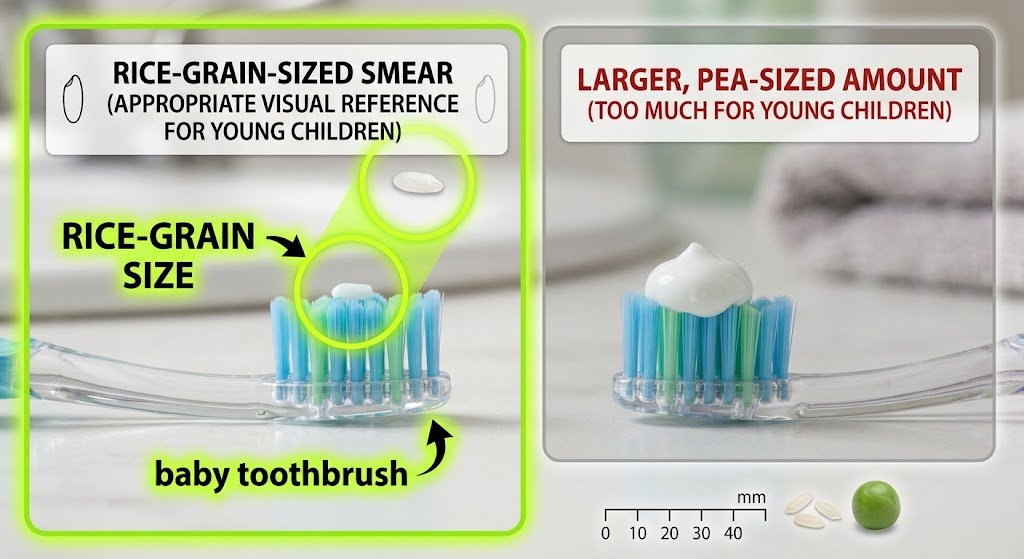
The commonly recommended amount for children under 3 is a smear about the size of a grain of rice when using fluoride toothpaste.
This is much less than the amount an adult might normally place on a toothbrush.
The small quantity is practical because young children may swallow some toothpaste instead of spitting it out.
What Does a Rice-Grain Amount Look Like?
Think of a tiny smear rather than a long strip of toothpaste.
You do not need to cover the bristles.
The caregiver should dispense the toothpaste so the amount can be controlled.
Should You Use More if Your Baby Has Several Teeth?
Not simply because more teeth have appeared.
The amount of toothpaste is based on the child’s age and current guidance, not on covering every tooth with a large quantity of toothpaste.
As children grow, the recommended amount changes. That is one reason parents should avoid assuming that the amount used for an older child or adult should also be used for a baby.
Who Should Put the Toothpaste on the Brush?
The caregiver should control the toothpaste.
A baby should not be given the tube to squeeze independently.
This makes it easier to use the intended amount and keeps toothpaste use under adult supervision.
How to Brush a Baby’s Teeth
Choosing the right toothpaste is only one part of the process.
Even an appropriate toothpaste cannot replace physical brushing.
The toothbrush removes plaque from the tooth surfaces while the toothpaste provides ingredients that can support oral health.
Use a Small, Soft Toothbrush
Choose a toothbrush designed for babies or very young children.
Look for:
- A small brush head
- Soft bristles
- A comfortable handle
- A design that allows the caregiver to reach the teeth easily
A toothbrush does not need to be expensive to be useful.
The most important feature is whether it allows you to clean the baby’s teeth gently and consistently.
Brush Twice a Day
Make brushing part of a predictable routine, such as:
Morning → brush
Night → brush
Bedtime brushing is particularly important as part of the daily routine because it gives you a consistent opportunity to clean the teeth before the child goes to sleep.
Try to make the routine calm and predictable rather than turning each brushing session into a negotiation.
Let an Adult Do the Brushing
Babies cannot reliably clean their own teeth.
Even when a child becomes interested in holding the toothbrush, the caregiver should remain responsible for effective brushing.
As children become older, they can gradually participate more in brushing, but independence develops over time.
Keep the Routine Simple
You do not need a large collection of oral-care products for a baby.
A basic routine can include:
- A small, soft toothbrush
- An appropriate amount of toothpaste
- Adult-assisted brushing twice daily
- Regular dental care
If your baby resists brushing, consistency is often more useful than constantly changing toothpaste or buying new products.
Try keeping the routine at the same time each day, using a calm voice, and allowing your child to become familiar with the toothbrush.
Add a clear age-based safety summaryRemove repeated brushing guidance
Part 2 of 3
What Should You Look for in Baby Toothpaste?
Once you understand when to start brushing and how much toothpaste to use, choosing a product becomes much easier.
Instead of choosing toothpaste simply because the package says “baby,” look at the characteristics that actually matter.
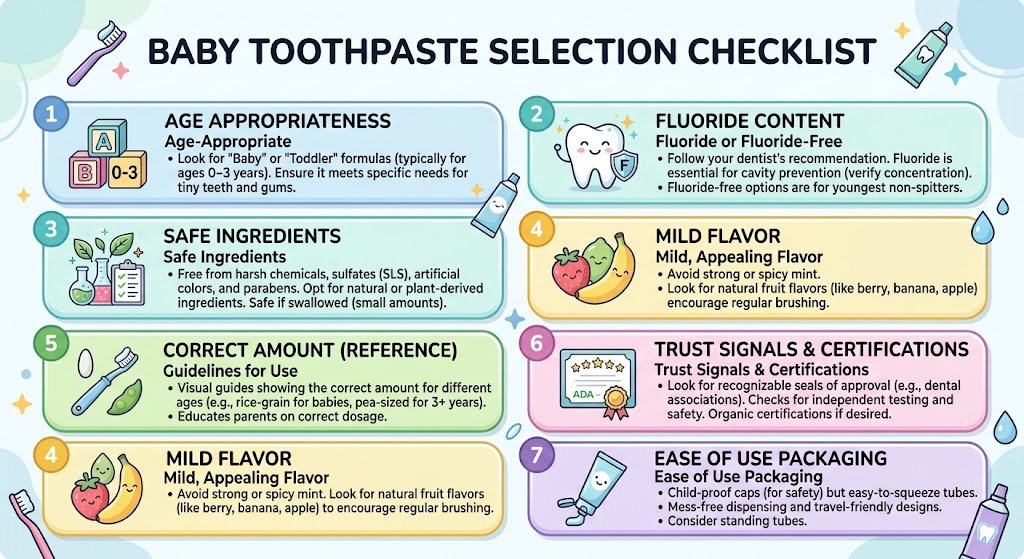
A useful checklist includes:
- Fluoride status
- Age suitability
- Ingredient transparency
- Flavor
- Texture
- Ease of dispensing
- Trust signals
- Your child’s individual dental needs
The goal is not to find a toothpaste with the longest ingredient list or the most “natural” claims. It is to find a product that fits your child’s oral-care needs and that you can use correctly and consistently.
Check the Fluoride Status
First determine whether the toothpaste contains fluoride.
This matters because fluoride plays an important role in cavity prevention, while some products marketed specifically to parents are fluoride-free.
Do not assume that “fluoride-free” automatically means safer or better.
Likewise, do not assume that every child should use exactly the same toothpaste without considering professional guidance.
For babies and very young children, the combination of fluoride status + toothpaste amount + supervision + individual cavity risk is more useful than looking at any one factor by itself.
Consider Age Suitability
Check the product label and manufacturer’s directions for the intended age range.
A toothpaste designed for older children may have characteristics that are not ideal for a baby, such as a different flavor, texture, packaging, or usage instructions.
Age labeling should not replace professional advice, but it is an important first filter when comparing products.
Look for Ingredient Transparency
Parents who are interested in non-toxic or clean oral-care products often want to know exactly what is in the toothpaste.
That is a reasonable goal.
Look for a clearly listed ingredient panel rather than relying only on phrases such as:
- Natural
- Clean
- Non-toxic
- Gentle
- Safe
- Chemical-free
These terms can mean different things depending on the company and do not, by themselves, tell you whether a toothpaste is appropriate for your baby.
Consider Flavor and Texture
Flavor may seem like a minor detail, but it can affect whether your baby accepts brushing.
A strong mint flavor may be unpleasant for a very young child. Some products use milder flavors designed for younger children.
The right choice is the one your child tolerates while still meeting the other criteria that matter.
Do not choose a toothpaste solely because the packaging looks child-friendly.
Think About Ease of Use
Small details can make a daily routine easier.
Consider:
- Whether the tube is easy for a caregiver to control
- Whether a tiny amount can be dispensed easily
- Whether the cap is easy to close
- Whether the packaging is practical for daily use
- Whether the product is easy to replace
For a baby, the parent is the actual product user in many practical ways.
A toothpaste that is theoretically appealing but difficult to dispense accurately may not be the best fit for your routine.
Fluoride vs Fluoride-Free Toothpaste for Babies
The fluoride question deserves a direct comparison because parents often see very different opinions when shopping for baby toothpaste.
The important distinction is that fluoride-free does not automatically mean safer, and fluoride toothpaste does not mean that a child should use a large amount.
| Factor | Fluoride Toothpaste | Fluoride-Free Toothpaste |
| Fluoride exposure | Provides fluoride during brushing | Does not provide fluoride |
| Cavity-prevention role | Fluoride is used to help prevent cavities | Does not provide fluoride’s cavity-prevention benefit |
| Amount | A very small amount is used for young children | Appropriate product directions should still be followed |
| Main parent concern | Using the appropriate amount and supervising brushing | Whether the child is receiving enough cavity-prevention support |
| Decision factors | Age, cavity risk, fluoride exposure, professional guidance | Reason for choosing fluoride-free, cavity risk, professional guidance |
| Best for everyone? | Not a universal one-size-fits-all decision | Not a universal one-size-fits-all decision |
The key is to avoid turning this into a simple “fluoride versus chemicals” debate.
Fluoride is an evidence-based cavity-prevention ingredient, but young children require age-appropriate use.
If a parent is considering fluoride-free toothpaste because of concerns about swallowing or other circumstances, that decision is worth discussing with a dentist or pediatric dentist.
On the other hand, a parent should not assume that removing fluoride automatically creates a superior toothpaste.
The right choice should be based on the child’s oral-health needs rather than the strongest marketing claim on the package.
Which Ingredients Matter in Baby Toothpaste?
Ingredient lists can look complicated, but parents do not need to understand every chemical name before choosing toothpaste.
Start with the ingredients that have a clear relationship to the product’s purpose.
Fluoride
Fluoride is the most important active ingredient to consider when cavity prevention is the goal.
Different fluoride compounds can appear on toothpaste labels, so parents should focus first on whether the product contains fluoride and then consider the specific formulation and professional guidance.
Flavoring
Flavor is primarily a practical consideration for babies.
A flavor that your child accepts may make brushing easier, while a strong or unpleasant flavor may create resistance.
Parents should not assume that a particular flavor is inherently dangerous simply because it is unfamiliar. Instead, consider the complete formulation and whether your child tolerates the product.
SLS
Sodium lauryl sulfate, commonly called SLS, is a foaming ingredient found in some toothpaste formulas.
Some parents prefer SLS-free products because they want a simpler formulation or because their child appears sensitive to certain toothpaste ingredients.
However, avoiding SLS should not automatically become the main criterion for choosing baby toothpaste.
Sweeteners
Toothpaste may contain sweetening ingredients to make the flavor more acceptable.
The important distinction is between making toothpaste taste pleasant and adding cavity-promoting sugars.
Parents should check the ingredient list rather than assuming that every sweet-tasting toothpaste contains ordinary sugar.
Essential Oils
Some toothpaste formulas use essential oils or plant-derived flavoring ingredients.
“Natural” does not automatically mean that an ingredient is appropriate for every child.
If your baby experiences irritation or another unusual reaction after using a product, stop using it and discuss the issue with an appropriate healthcare professional.
Dyes and Other Additives
Some parents prefer to minimize unnecessary coloring or additives.
That preference is reasonable, but the presence of a particular ingredient should not automatically be interpreted as proof that a product is harmful.
The better approach is to evaluate the entire formulation, the purpose of each ingredient, the child’s needs, and the reliability of the product’s labeling.
What Ingredients Should Parents Avoid in Baby Toothpaste?
There is no universal list of ingredients that every baby must avoid.
Instead, parents should focus on avoiding unnecessary risk, inappropriate formulations, and products that do not match the child’s needs.
A few practical principles can help.
Avoid Added Sugar
A toothpaste used for cleaning teeth should not need ordinary added sugar as a reason for its sweetness.
Parents should check the ingredient label and distinguish between sweeteners used for flavor and ingredients that contribute to tooth decay.
Be Careful With “Natural” Marketing
Natural ingredients can sound reassuring, but natural does not automatically mean safer for a baby.
Plant extracts, essential oils, and other naturally derived ingredients can still be unsuitable for an individual child or cause irritation.
Avoid Overcomplicating the Ingredient List
A long ingredient list is not automatically bad, just as a short ingredient list is not automatically better.
Instead, ask:
Does each major ingredient have a clear purpose, and is the product appropriate for my baby’s age and needs?
How to Choose the Best Toothpaste for Your Baby
There is no single toothpaste that is automatically the right choice for every baby.
Instead of starting with a brand name, start with a decision checklist.
Step 1: Consider Your Baby’s Age
Age affects toothpaste amount, brushing ability, and the type of guidance that applies.
Choose a product intended for your child’s stage and follow the appropriate usage instructions.
Step 2: Decide How You Will Handle Fluoride
Look at whether the toothpaste contains fluoride and consider current professional guidance.
If you are uncertain, especially with a very young child, discuss the choice with a dentist or pediatric dentist.
Step 3: Check the Ingredient Label
Look beyond the front of the package.
Check the complete ingredient list and consider whether the formulation matches your priorities.
Step 4: Choose a Baby-Friendly Flavor
If your child strongly dislikes the taste, even an otherwise suitable toothpaste may become difficult to use consistently.
A mild, acceptable flavor can therefore have practical value.
Step 5: Consider Ease of Dispensing
You should be able to place a very small amount on the toothbrush without difficulty.
This is particularly important for babies because the intended amount is tiny.
Step 6: Look for Trust Signals
Professional guidance and credible certification can be more meaningful than attractive packaging or vague “clean” claims.
For example, the ADA Seal can be useful when evaluating qualifying oral-care products because it indicates that the product has gone through the ADA’s evaluation process for the claims covered by the Seal.
Do not assume that the absence of an ADA Seal automatically makes another product unsafe. It is one trust signal, not the only criterion.
Step 7: Consider Your Budget
You do not need the most expensive toothpaste to build a good brushing routine.
If two products meet your important criteria, price, availability, flavor, and ease of use can help determine which one fits your household better.
What Baby Oral-Care Products Do You Actually Need?
A baby does not need a bathroom full of oral-care products.
The basic setup is straightforward:
1. A small, soft-bristled toothbrush
This is the main physical cleaning tool.
2. Appropriate toothpaste
Use the amount recommended for your child’s age and current guidance.
3. A consistent caregiver-led routine
This is more important than owning multiple specialized products.
4. Regular dental care
A dentist can evaluate your baby’s developing teeth and help answer questions about fluoride and cavity risk.
A finger toothbrush can be useful for some parents during the earliest stages, but it should not be treated as a requirement for every baby.
When comparing products on Amazon, focus on the characteristics that actually solve your problem rather than buying a large bundle simply because it contains more items.
[ARTICLE CONTINUES — NEXT PART STARTS WITH: H2: “When Should a Baby First See a Dentist?”]
Add a clear fluoride-use takeawayClarify the baby toothpaste amount
Part 3 — Final Part
When Should a Baby First See a Dentist?
A baby’s first dental visit should not wait until there is a visible problem.
The American Dental Association and pediatric dental organizations recommend establishing dental care early in childhood. A common recommendation is to have the first dental visit by the first birthday or within a certain period after the first tooth appears.
[ add external link — Anchor Text: “American Dental Association guidance on a child’s first dental visit” — Destination: “ADA — First Dental Visit” ]
An early visit gives the dentist an opportunity to check the developing teeth, discuss brushing, review fluoride exposure, and help parents understand their child’s cavity risk.
It also gives parents a chance to ask practical questions such as:
- Should my baby use fluoride toothpaste?
- How much toothpaste should I use?
- Is my baby’s brushing technique adequate?
- Does my baby have signs of early tooth decay?
- Are there dietary or feeding habits that could affect the teeth?
- Does my baby need additional fluoride protection?
You do not need to wait for your child to have a full set of teeth before starting dental care.
If you notice white or brown spots, visible damage, unusual sensitivity, swelling, bleeding, or another concerning change, contact a dental professional rather than trying to manage the problem with a different toothpaste alone.
Common Baby Toothpaste Mistakes
Even when parents understand the basic recommendations, a few mistakes are common.
Waiting Until More Teeth Appear
The first tooth is the signal to begin the brushing routine.
Waiting until several teeth have appeared means those early teeth are not receiving the same daily care.
Using Too Much Toothpaste
More toothpaste does not mean better cleaning.
For children under 3, the commonly recommended amount of fluoride toothpaste is a rice-grain-sized smear.
The caregiver should control the amount rather than allowing the baby to squeeze toothpaste onto the brush.
Letting the Baby Do All the Brushing
A baby can participate by holding the toothbrush or practicing brushing.
But participation is different from effective cleaning.
The caregiver should perform the actual brushing and make sure the teeth are cleaned properly.
Choosing Based Only on “Natural” Claims
Natural, organic, clean, and non-toxic are not interchangeable with “effective for preventing cavities.”
A better approach is to evaluate the complete product:
age suitability → fluoride status → ingredients → amount → brushing routine → professional guidance.
Assuming Fluoride-Free Automatically Means Better
Fluoride-free toothpaste may appeal to parents who are concerned about swallowing fluoride, but removing fluoride does not automatically make a toothpaste the best choice.
Fluoride has an established role in cavity prevention.
The decision should consider the child’s age, cavity risk, fluoride exposure, and dental guidance.
Focusing on Ingredients While Ignoring Brushing
A carefully selected toothpaste cannot replace regular brushing.
The most useful toothpaste is one that is appropriate for the child and actually becomes part of a consistent twice-daily routine.
Using Adult Toothpaste Without Checking the Formula
Adult toothpaste may have a flavor, formulation, or usage directions that are not appropriate for a baby.
Always check the product information and choose a formula suitable for the child’s age and circumstances.
Turning Brushing Into a Struggle
Babies may resist brushing, especially when the routine is new.
Forcing a long or complicated routine can make future brushing harder.
Keep it simple, calm, and consistent.
FAQs About Toothpaste for Babies
When should a baby start using toothpaste?
Start brushing when the baby’s first tooth appears.
Use a small, soft toothbrush and an age-appropriate amount of toothpaste. For children under 3, current U.S. guidance commonly recommends a rice-grain-sized smear of fluoride toothpaste.
Should babies use fluoride toothpaste?
Fluoride toothpaste can help prevent cavities, but young children need the correct amount and adult supervision because they may swallow toothpaste.
For children under 2, the CDC advises parents to discuss fluoride toothpaste use with a doctor or dentist.
[ add external link — Anchor Text: “CDC guidance on children’s oral health and fluoride” — Destination: “CDC — Children’s Oral Health” ]
If you are unsure which type is appropriate for your baby, ask your dentist or pediatric dentist.
How much toothpaste should I put on a baby’s toothbrush?
For a child under 3, use a rice-grain-sized smear of fluoride toothpaste.
The amount should be tiny rather than covering the toothbrush bristles.
What does a rice-grain-sized smear mean?
It means a very small amount of toothpaste placed across a small area of the toothbrush.
It should look like a tiny smear rather than a pea-sized blob.
For visual guidance, always compare the amount with the current recommendations from your child’s dentist or trusted dental-health authority.
What if my baby swallows toothpaste?
Young children often cannot reliably spit toothpaste out.
That is one reason the amount used is kept very small and brushing should be supervised by an adult.
If your baby repeatedly swallows toothpaste or you are concerned about fluoride exposure, discuss the situation with a dentist or healthcare professional.
Is fluoride-free toothpaste safer for babies?
Not necessarily.
Fluoride-free toothpaste eliminates fluoride exposure from toothpaste, but it also does not provide fluoride’s cavity-prevention benefit.
Safety and effectiveness should be considered together.
The best choice depends on the child’s age, dental-health needs, fluoride exposure, and professional guidance.
Is SLS-free toothpaste better for babies?
Not automatically.
Some parents prefer SLS-free formulas, particularly when they want to avoid certain foaming ingredients or have concerns about irritation.
However, SLS-free status alone does not determine whether a toothpaste is effective or appropriate for a baby.
Are natural ingredients better for baby toothpaste?
Not automatically.
An ingredient being natural does not by itself prove that it is safer, more effective, or more appropriate for a baby.
Look at the complete formulation and the purpose of the product.
Can babies use toothpaste with flavoring?
Yes, flavored toothpaste can be used when the formulation is appropriate for the child’s age.
Flavor preference is mainly a practical consideration. A mild flavor that your baby accepts may make brushing easier.
Does a baby need a special toothbrush?
A small toothbrush with soft bristles is generally the practical choice for babies.
The brush should have a head that fits comfortably in the baby’s mouth and should be easy for the caregiver to control.
How often should I brush my baby’s teeth?
A consistent twice-daily brushing routine is generally recommended.
The important part is to make brushing a regular caregiver-led habit rather than something done only when convenient.
Should I rinse my baby’s mouth after brushing?
Babies cannot reliably follow complicated rinsing instructions.
Because young children may swallow toothpaste, the priority is using the correct small amount and supervising brushing.
For specific instructions about rinsing and toothpaste use, follow your dentist’s advice and current guidance for your child’s age.
[ add a link — Anchor Text: “whether you should rinse after brushing” — Destination: “O56 — Should You Rinse After Brushing?” ]
When should a baby first see a dentist?
A baby’s first dental visit is generally recommended around the time of the first birthday or after the first tooth appears, depending on the guidance being followed.
Early dental visits help establish preventive care and give parents an opportunity to discuss fluoride, brushing, diet, and cavity risk.
Conclusion
Choosing toothpaste for a baby does not have to be complicated.
The most important step is to begin brushing when the first tooth appears and make brushing part of the baby’s daily routine.
For very young children, the amount of toothpaste matters just as much as the product itself. A rice-grain-sized smear of fluoride toothpaste is the commonly recommended amount for children under 3, while an adult should control the toothpaste and perform the actual brushing.
When choosing a product, look beyond words such as “natural,” “clean,” or “non-toxic.” Check the fluoride status, age suitability, ingredient list, flavor, texture, and overall usability.
Most importantly, do not let toothpaste selection distract from the bigger picture. Consistent brushing, appropriate fluoride use, caregiver supervision, and early dental care all work together to support healthy baby teeth.
